The refugees
In 1937 Japan went to war with China, and the fighting reached Shanghai. The foreign-run International Settlement and French Concession stayed outside Japanese control for the time being, and they filled with refugees.[1] That same year the first Jewish refugees from Germany and Austria began to arrive. Shanghai was one of the few places in the world that would not turn them away. No one issued visas, and anyone who landed was admitted. Most other countries, including the United States, held to strict quotas.[2] The Encyclopaedia Judaica records that from 1933 Victor Sassoon “worked strenuously to help refugees fleeing from Nazism.”[3]
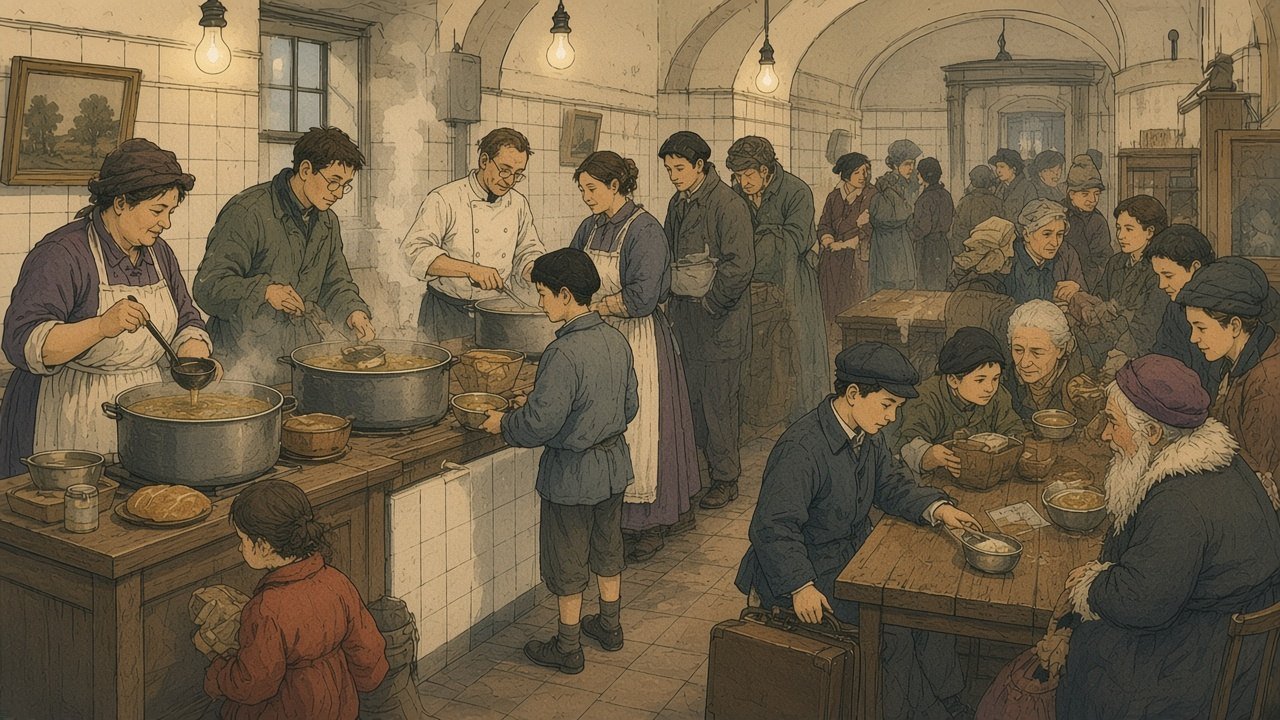
What he did is described in detail in Jonathan Kaufman’s The Last Kings of Shanghai, adapted for the Forward. Soon a thousand refugees a month were arriving. Victor and a small group of long-established Jewish businessmen organised housing, food and medical care. He turned the first floor of one of his skyscrapers into a reception centre, where each new arrival was given blankets, sheets, a tin dish, a cup and a spoon. He put a kitchen in the basement that served 1,800 meals a day, and he set up a vocational centre to train 200 men as mechanics, joiners and carpenters.[2] Most of the refugees settled in a poor district where rents were cheap. They called it “Little Vienna” and opened cafés, a German-language newspaper, orchestras and theatres.[2] The Kadoories, the old rivals, worked with the Sassoons in supporting the refugees. Kaufman tells how Elly Kadoorie appealed to Victor’s pride and to his heritage. “Victor, there is a war going on,” Elly said. “You are a Sassoon. You are the leader.” Elly wrote out a cheque for $50,000, and Victor answered, “Whatever Elly gave, I’ll give.”[4] The two families also pressed Chinese intellectuals and politicians to help, and encouraged Madame Sun Yat-sen to lead a delegation to the German consulate in Shanghai to protest against anti-Jewish policies. Sylvia Chancellor, a long-time British resident who had once criticised Victor as a playboy who ignored the city’s poverty, changed her mind. “God will forgive him all his sins,” she said, “because of the charity he gives.”[4] The Hadassah Magazine review of Kaufman’s book gives their number as 18,000.[5]
Victor also played a political game with the Japanese. Tokyo had sent Captain Koreshige Inuzuka, a naval officer who had translated the Protocols of the Elders of Zion, to deal with Shanghai’s Jews. Inuzuka believed that Victor was the linchpin of Jewish power in China.[2] Kaufman describes how Victor set out to charm him, “even to con him.” He hinted at investment in Japanese-occupied Manchuria and entertained Japanese officers in the Cathay’s bars, while his manager reported on what they said when drunk. Inuzuka told Tokyo that Sassoon was “willing to cooperate”. Japan’s policy then directed that Jewish refugees “are to be treated fairly and in the same manner as other foreign nationals.”[2] At the same time, on a visit to the United States in 1938, Victor privately urged friends on Wall Street and officials at the State Department to impose an economic embargo on Japan. He also went to Brazil in an unsuccessful attempt to buy land for Jewish resettlement. He was, he wrote to a friend, “walking a tightrope.”[2]
Inuzuka’s view of the Jews was itself a warning. They were, he wrote, like fugu, the Japanese puffer fish that is a delicacy when prepared correctly and lethal when it is not.[2]
Leaving Shanghai
The tightrope gave way in 1941. Inuzuka concluded that Victor had “obviously elected to disregard the sympathy and the generosity hitherto accorded Jewish refugees by Japanese authorities.” Warned that he might be arrested, Victor sailed for Bombay.[2] The Forward’s account puts his departure in the autumn of 1941, weeks before Pearl Harbor, while Scroll.in says it was in the spring.[1][2] In December, with the attack on Pearl Harbor, the foreign settlements became Japanese targets.[1]
The refugees stayed and survived. In 1942 an SS officer, Josef Meisinger, came to Shanghai and proposed that the refugees be rounded up, loaded on to old ships in front of the Cathay and sunk at sea. The Japanese refused. They still regarded the refugees as useful hostages. Instead they confined most of them to a ghetto in the crowded district where they already lived.[2] The work of feeding and clothing the refugees passed to others, notably Laura Margolis, an American social worker sent by the Joint Distribution Committee, who dealt with Inuzuka directly.[2] When American troops reached the city in 1945 they found 18,000 Jewish refugees there, “bedraggled, crammed into small apartments, defiant — and alive.”[2] Among them were W. Michael Blumenthal, later US Treasury Secretary, the Hollywood executive Mike Medavoy and the lawyer Laurence Tribe.[2][6] After the war the Americans arrested Inuzuka and meant to try him as a war criminal. Jewish refugees came forward to testify that he had protected them from harder men in the Japanese military and from the Nazis, and he went home to Tokyo. Kaufman records that decades later a visiting professor found, hanging in his hallway, a photograph from the late 1930s of Inuzuka and his fellow officers laughing together at Victor Sassoon’s Cathay Hotel.[2]
The end in China
Victor returned to Shanghai after the war, but only for a short time. Accounts differ on how he left. Scroll.in says he sold his holdings to Chinese businesses under the Nationalist government and moved to the Bahamas, and that the Cathay was bought by a Chinese company in 1947.[1] The Encyclopaedia Judaica dates his move to the Bahamas to 1948.[3] Sotheby’s records that in 1950 the firm sold its Chinese interests and moved to Nassau.[7] The Forward says he was “driven out” in 1949, when the communists entered the city and seized his hotel, factories and apartment buildings.[2] These versions are not necessarily contradictory. They describe a run of sales, losses and confiscations between the end of the war and the early years of the People’s Republic. The Los Angeles Review of Books notes that Gu Zhun, the economist and party official responsible, imposed crushing taxes on the Sassoons and Kadoories and then confiscated their property.[4]
The Cathay itself became the Peace Hotel. Scroll.in reports that it was allowed to operate for three years after 1949, then served as offices for the municipal construction department until 1965, when it was partly restored as a hotel.[1] The New York Times dates its change of name to the mid-1950s.[8] When Kaufman, then a twenty-three-year-old foreign correspondent, walked into its lobby in 1979, Shanghai was still a city of Mao suits and black bicycles. Inside he found chandeliers, a poster advertising a nightly jazz band and an elderly bellhop in a white jacket who greeted him in French.[9] Today it is the Fairmont Peace Hotel, and Victor’s portrait hangs again in the suite that bears his name.[1][4]
The Kadoories made the opposite choice. They moved to Hong Kong, kept their faith in China, and decades later were welcomed back to invest on the mainland. Patel and Kaufman both draw the contrast.[10][4] “I gave up India and China gave me up,” Victor remarked after his property was seized.[4] By the Los Angeles Review of Books’ account, he vowed never to set foot in Shanghai again, like the defeated king in a Song dynasty poem who would not cross the river home.[4]
Nassau and the Derby
He spent his last years in Nassau, building up new trading, banking and property interests in the Bahamas.[3] His greatest public success came on the racecourse. Between 1935 and 1960 his horses won fourteen classic races, by the count of one racing record.[11] He won the Derby four times: with Pinza in 1953, Crepello in 1957, Hard Ridden in 1958 and St Paddy in 1960. Lester Piggott rode Crepello and St Paddy.[3][11] Earlier, in 1937, his filly Exhibitionnist had won the 1,000 Guineas and the Oaks. His most important partnership was with the trainer Noel Murless, who saddled four of the fourteen classic winners.[11] No other Sassoon came so close to the English sporting establishment, and he did it as an ageing Shanghai tycoon living in the Caribbean.
Late in life, despite a large difference in age, he married his American nurse, Evelyn Barnes.[12] He died in Nassau in 1961, aged seventy-nine.[1][12] He had no children. With him ended the line of Sassoons who ran the family’s Asian trade in person.[3][1]
References
OpenClose
- Ajay Kamalakaran, “How the Sassoon family built a business empire in Shanghai from Bombay,” Scroll.in *
- Jonathan Kaufman, “In Shanghai, a refuge for Jews fleeing Nazi Europe,” The Forward, 2020, adapted from The Last Kings of Shanghai *
- “Sassoon,” Encyclopaedia Judaica, 2nd ed. (Detroit: Macmillan Reference, 2007), reprinted at Encyclopedia.com *
- Qiu Xiaolong, “History Has Many Cunning Passages: On Jonathan Kaufman’s The Last Kings of Shanghai,” Los Angeles Review of Books *
- Stewart Kampel, “The Last Kings of Shanghai: Two Rival Families,” Hadassah Magazine, 17 November 2020 *
- “The Last Kings of Shanghai examines the little-known history of two extraordinary dynasties,” The Boston Globe, 2 June 2020 *
- Sotheby’s, “The Sassoons in the Far East” *
- Taras Grescoe, “The Man Who Changed the Face of Shanghai,” The New York Times, 2 October 2014 *
- “‘The Last Kings Of Shanghai’ Delves Into Role Of Competing Jewish Business Empires,” Here & Now, WBUR, 11 June 2020, with an excerpt from Jonathan Kaufman’s book *
- Dinyar Patel, “The Rise and Fall of the Sassoons,” The India Forum, 6 October 2022 *
- ClassicWinners, “Sir Victor Sassoon: classic record” *
- “Setting history straight: discovering the truth about a WW1 aviator, businessman and playboy,” TheGenealogist, 2023 *
The family tree, timeline, places, glossary and select bibliography for the whole history are on the Sassoon index page.