David Solomon Sassoon’s library
Not every Sassoon of the fourth generation left the family’s Jewish world behind. Farha’s son, David Solomon Sassoon, was born in 1880 and followed his mother into scholarship rather than into the business.[1][2] The Encyclopaedia Judaica calls him “an outstanding Hebraist and bibliophile.”[1] He built up a collection of more than a thousand Hebrew and Samaritan manuscripts.[1] Among them was the Farhi Bible, written in fourteenth-century Provence.[1] His sister Rachel, later Lady Ezra, helped him from India to track down manuscripts in the East.[2] In 1932 he published its catalogue, Ohel Dawid, in two volumes. The title, “the Tent of David”, is the same as the name of his great-grandfather’s synagogue in Pune.[1]
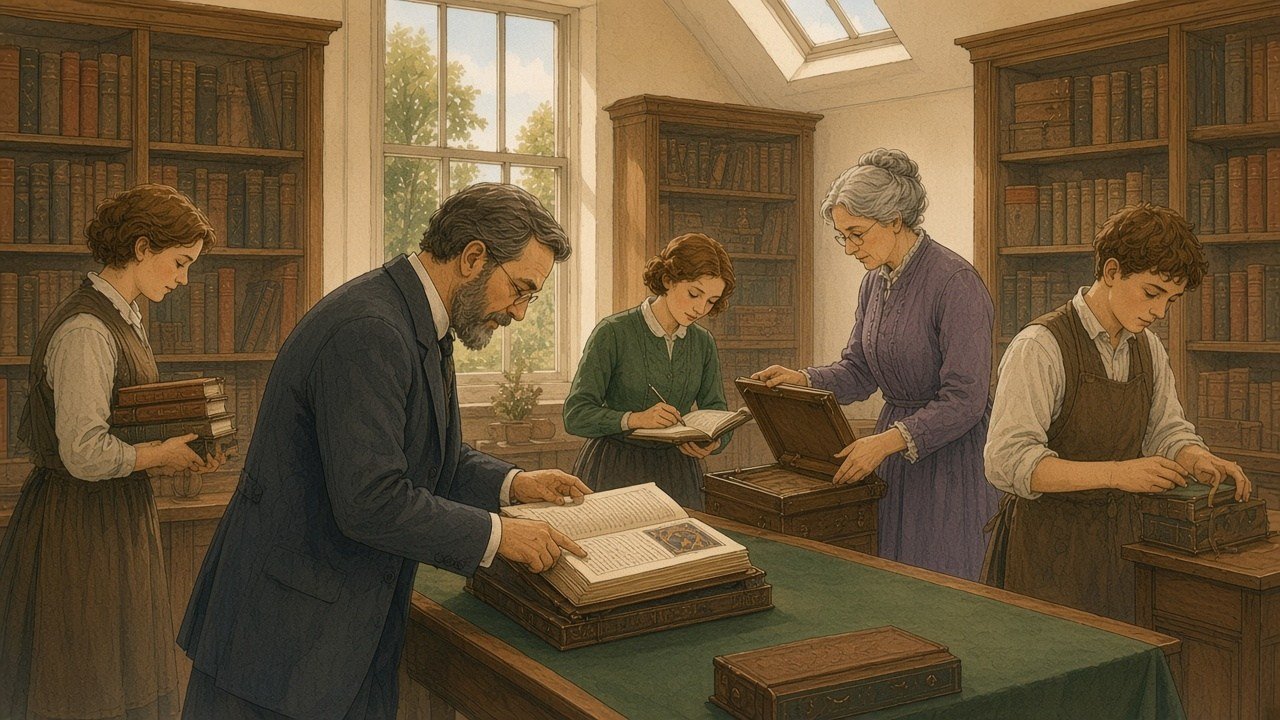
His own scholarship included the first edition of the poems of Samuel ha-Nagid, the eleventh-century Jewish vizier of Granada, from a manuscript in his collection (1934), and a History of the Jews of Baghdad, published after his death in 1949.[1] He died in 1942.[1] His son, Solomon David Sassoon (1915–1985), was ordained as a rabbi in 1936. He enlarged the collection to some 1,350 items and published editions from it, including a facsimile of Maimonides’ commentary on the Mishnah, which was claimed to be in the author’s own hand. In 1970 he settled in Jerusalem.[1] Its most famous manuscript, the Hebrew Bible known as the Codex Sassoon, which Sotheby’s called the earliest most complete Hebrew Bible, sold in New York in May 2023 for $38.1 million, a record for a historical manuscript at auction. The buyer, American Friends of ANU, gave it to ANU – Museum of the Jewish People in Tel Aviv.[3]
Percival David and Chinese art
The E. D. Sassoon side produced a collector of a different kind. Sir Percival David (1892–1964) was the son of Sir Sassoon Jacob David, a grandson of Elias. His family were, in one reviewer’s phrase, international bankers.[1][4] He learned Chinese to a high level and collected in Europe, Japan, Hong Kong and China. The British Museum says he built “the finest private collection of Chinese ceramics.”[5] The Encyclopaedia Judaica calls him “probably the foremost collector of Chinese art of his time.”[1]
In 1950 he gave his collection of almost 1,700 pieces to the University of London. It was displayed for decades in Gordon Square, Bloomsbury, as the Percival David Foundation of Chinese Art.[1][4] A review of its new display noted that he had collected after the fall of the Qing dynasty, when objects from the Forbidden City were coming on to the market. It added that “many of his acquisitions” are generally thought to have come from the imperial household, though he recorded little about provenance.[4] After a funding crisis closed the Bloomsbury museum in 2007, the collection went on loan to the British Museum. Since 2009 it has been shown there in its own bilingual gallery, Room 95.[5][4] In November 2024 the foundation’s trustees announced that they were giving it to the museum outright. The museum describes the gift, valued at around £1 billion, as “the highest value object donation in UK museum history.”[5]
How the firms ended
The trading houses themselves did not survive. Joseph Sassoon writes that after Philip’s death in 1939 and the disruption of the Second World War, what was left of David Sassoon & Co. “was managed by outsiders — who were eventually declared unfit by the Bank of England in the 1980s.”[6] Patel adds that the firm withdrew from India and passed out of family hands, and that it “limped along until it was unceremoniously liquidated sometime in the 1980s.”[7]
E. D. Sassoon & Co. lasted longer and fell further. As Victor soured on India’s political direction, the firm began selling off its mills and other Indian assets in a tearing hurry, often at depressed prices. In China the Communists nationalised its properties after 1949.[7] Joseph Sassoon records that in 1978 Charterhouse Japhet acquired E. D. Sassoon Bank and Trust, and that with it “the Sassoon name … slipped from the annals of international trade and finance.”[6] He quotes an observer who compared the shape of the dynasty to a diamond: “starting at a point, widening out rapidly, and tapering disastrously towards the bottom.”[6]
Several explanations for the decline recur. The English branch put social acceptance before commerce. Joseph Sassoon writes that its focus on status “came at the cost of fostering innovation and seeking new market opportunities,” and that it was too slow to leave the opium trade.[6] The family’s commercial strength had rested on Baghdadi networks, and once those faded, Patel argues, “the firm lost much of its energy and raison d’être.”[7] Victor’s bet on Shanghai over India turned out to be wrong.[7][8] The Kadoories, who made the opposite choice, are still in business.[7][9]
What remains
The Sassoon name is still written all over the map of the family’s journey. In Mumbai there are the David Sassoon Library at Kala Ghoda, the Sassoon Dock fish market at Colaba, and the synagogues of Magen David and Keneseth Eliyahoo. The district of Kala Ghoda is named after the statue Albert gave.[7][10][11][12] In Pune there are Ohel David, with David Sassoon’s tomb in its courtyard, and the Sassoon hospital.[1][10] In Hong Kong Ohel Leah is still in use, and in Shanghai Sassoon House is now the Fairmont Peace Hotel, its green pyramid roof still visible on the Bund.[8][13] In England the family left the Sassoon mausoleum in Brighton, Port Lympne and Trent Park. A Gainsborough went to the National Gallery in Philip’s memory, and Percival David’s ceramics are now in the British Museum.[14][15][16][17][5] The Places section below lists these sites. The buildings have outlived the communities they were built for. The account published for Keneseth Eliyahoo’s anniversary noted that very few Baghdadis remain in Bombay and Pune, and that services continue with congregations made up of Baghdadis, Bene Israel and foreign visitors in the city on business.[18] Many of the Sassoon Torah scrolls, it adds, were sent to the new settlements of Israel after 1948.[18] The trust that bears Jacob’s name still runs all three synagogues, and in Pune the tomb of David Sassoon now has a place on the state’s Jewish heritage circuit.[10]
The family and its historians
For most of the twentieth century the family’s story was told by Cecil Roth’s The Sassoon Dynasty (1941) and Stanley Jackson’s The Sassoons (1968). The Guardian’s archive still holds Jackson’s 1965 correspondence with the Observer about Rachel Beer.[19] Joseph Sassoon’s The Global Merchants (2022) changed the picture, because he could read the Baghdadi Judaeo-Arabic of the family’s business letters.[7] Jonathan Kaufman’s The Last Kings of Shanghai (2020) put Victor and the Kadoories at the centre of modern Chinese history.[20][21] Damian Collins, then the MP for Hythe, wrote Philip’s biography, Charmed Life (2016), and Peter Stansky wrote about Philip and Sybil.[22][23]
Exhibitions have followed the books. The Jewish Museum in New York’s The Sassoons (2023) brought together more than 120 works collected by four generations of the family.[15] It also drew criticism for having “missed an opportunity to look more critically at the family’s opium trade, and to delve into the lives of its women.”[24] Geordie Greig, reviewing Stansky, observed wryly that the most famous Sassoon today is a hairdresser called Vidal.[23] The family that once gave its name to docks, hospitals and a bank now lives on mostly in buildings and collections. The record behind them includes opium as well as philanthropy, and refugees saved in Shanghai as well as fortunes made there. Telling the whole of it is the task its historians have taken on in the past decade, and the one this page has tried to share.
Readers who want to follow the Baghdadi network further can turn to the Kadoorie page, and the rest of the series is on the Merchants hub.
References
OpenClose
- “Sassoon,” Encyclopaedia Judaica, 2nd ed. (Detroit: Macmillan Reference, 2007), reprinted at Encyclopedia.com *
- Jewish Women’s Archive, “Flora Sassoon,” Shalvi/Hyman Encyclopedia of Jewish Women *
- Sotheby’s, “Museums and Collectors in Asia Make Major Acquisitions at The New York Sales,” May 2023 auction results *
- “Sir Percival David Collection of Chinese Art, British Museum, London,” Museums Journal (Museums Association), 13 November 2009 *
- British Museum, “British Museum to receive £1bn collection gift from The Sir Percival David Foundation,” press release, 13 November 2024 *
- Joseph Sassoon, “How to lose an empire,” The Critic, April 2024 *
- Dinyar Patel, “The Rise and Fall of the Sassoons,” The India Forum, 6 October 2022 *
- Ajay Kamalakaran, “How the Sassoon family built a business empire in Shanghai from Bombay,” Scroll.in *
- Stewart Kampel, “The Last Kings of Shanghai: Two Rival Families,” Hadassah Magazine, 17 November 2020 *
- “Ohel David Synagogue and David Sassoon Tomb join Maharashtra’s Jewish Heritage Tourism Circuit,” Hindustan Times, December 2024 *
- Kala Ghoda Association, “Restoration Projects: David Sassoon Library” *
- Jinit Parmar, “Sassoon Dock: Mumbai’s Oldest Fishing Harbour Faces A Storm,” Outlook India, 19 September 2025 *
- Ohel Leah Synagogue, “Our History” *
- E. I. C., “Sassoon, Sir Albert Abdullah David (1818–1896),” Dictionary of National Biography, vol. 50 (London: Smith, Elder, 1897), pp. 312–313 *
- The Jewish Museum, New York, “The Sassoons” (exhibition, 2023) *
- Trent Park House, “About” *
- Kent Historic Environment Record, “Port Lympne,” Registered Park or Garden (Historic England register description) *
- “The Kenesseth Eliyahu Synagogue,” Midrash Ben Ish Hai, “Jews of India” pages *
- The Guardian Foundation, “Rachel Beer, editor of the Observer 1891–1901,” The Guardian, 2 March 2018 *
- Jonathan Kaufman, “In Shanghai, a refuge for Jews fleeing Nazi Europe,” The Forward, 2020, adapted from The Last Kings of Shanghai *
- Qiu Xiaolong, “History Has Many Cunning Passages: On Jonathan Kaufman’s The Last Kings of Shanghai,” Los Angeles Review of Books *
- Richard Davenport-Hines, “Charmed Life by Damian Collins review – the phenomenal world of Philip Sassoon,” The Guardian, 31 December 2016 *
- Geordie Greig, review of Peter Stansky, Sassoon: The Worlds of Philip and Sybil, Literary Review *
- Rebecca Schiffman, “The Jewish Museum’s Sanitized History of an Opium Dynasty,” Hyperallergic, 5 July 2023 *
The family tree, timeline, places, glossary and select bibliography for the whole history are on the Sassoon index page.