Haig’s dining car
Philip Albert Gustave David Sassoon was born on 4 December 1888, in the Paris house of his mother’s family, the Rothschilds, on the Avenue de Marigny.[1][2] He was educated at Eton and Christ Church, Oxford, where he read modern history.[3] Even at Eton, Richard Davenport-Hines notes in his review of Damian Collins’s biography, he gave other boys ruby shirt studs and diamond cufflinks. “Thereafter,” Davenport-Hines writes, “he spent his wealth in ceaseless coddling of the English governing classes.”[1] His father died in 1912, and at twenty-three Philip inherited the baronetcy, a fortune and his father’s seat at Hythe. He was the youngest member of the House, and he held the seat for the rest of his life. In the 1920s his opponents did not even bother to contest it.[1] He was nicknamed “the baby of the House.”[3]
The First World War made his career. He had joined the Royal East Kent Yeomanry while still at Oxford, and by 1915 he was a staff officer at British headquarters in France.[3] In 1915 Field Marshal Sir Douglas Haig, commander-in-chief on the Western Front, chose him as his private secretary.[1] Good understanding between British and French commanders was essential, and with his family and political connections he was in his element.[3] Haig joked that in taking him on he had attached a first-class dining car to his train.[1] The post put Philip at the centre of the war’s high command, and it put him against his cousin. As Chapter 12 describes, the Encyclopaedia Judaica records that Philip, “privately horrified by the war,” publicly denounced Siegfried’s protest.[4] Davenport-Hines describes relations between the two cousins as “mutually mistrustful.”[1]
Hythe and the air
After the war Philip became a political secretary to David Lloyd George.[1] In 1924 the new prime minister, Stanley Baldwin, made him Under-Secretary of State for Air, and he held the post from 1924 to 1929 and again from 1931 to 1937.[4][3] Aviation was his passion. He bought his own aeroplane in 1919, Davenport-Hines writes, “and used it in the way that poorer people ran their motor cars.” As minister he promoted civil air travel and the chain of routes and airfields that ran from Britain through the Middle East to India.[1] He also commanded No. 601 Squadron.[3] His book The Third Route (1929) described a 17,000-mile tour of Britain’s overseas air stations. Davenport-Hines calls it “as eloquent as anything written by his cousin Siegfried.”[4][1]
Max Beerbohm drew him as a newly elected member, looking demure and exotic among the beefy Tories on the Commons benches.[1] Geordie Greig, reviewing Peter Stansky’s double biography of Philip and Sybil, describes him as “a political fixer, society host and sybarite” whose life was devoted to “collecting, entertaining and placing himself near people of power and influence.” Prime ministers, artists and kings, Greig writes, “lapped up his hospitality.”[5] He was an able politician. He had a faultless memory for facts and figures and spoke without notes. In the words of one Labour MP he had “the air of having wafted into parliament on a magic carpet.”[1] In 1937 Neville Chamberlain made him First Commissioner of Works, a post just below cabinet rank responsible for the royal palaces, parks and ancient monuments.[4][1] His political judgement was less sure elsewhere. He idolised the Prince of Wales, and in the abdication crisis of 1936 he backed the “King’s party” and was drawn into Churchill’s failed attempts to keep Edward VIII on the throne.[1] Davenport-Hines writes that “unlike Churchill, he wanted international peace at any cost, and convinced himself that Hitler’s promises were dependable.”[1] Joseph Sassoon adds that it was rumoured Philip wanted to remove the Hebrew inscription from the family coat of arms, above its Latin motto Candide et Constanter. He also notes that under Philip’s nominal chairmanship David Sassoon & Co. went into decline.[6]
Park Lane, Port Lympne and Trent Park
Philip’s houses were his real work. He inherited 25 Park Lane, where his weekly political lunches were nicknamed “cabinet lunches” because ministers came straight from Downing Street. Neville Chamberlain compared him to the Count of Monte Cristo.[1] In Kent, on a high site above Romney Marsh, he built Port Lympne. Sir Herbert Baker built the house between 1911 and 1913, and from about 1918 the architect Philip Tilden made large additions, among them a Moorish courtyard with a fountain. Rooms were painted for Philip by Rex Whistler, whose Tent Room of about 1933 survives, and by José María Sert.[7][8] Writers disagree about its style. The heritage register describes Baker’s house as built in his “Cape Dutch manner”, while Davenport-Hines found it “Italianate and Moorish”, with gardens “like a Hollywood version of Tuscany.”[1][7] Joseph Sassoon lists among Philip’s guests there the Curzons, Winston Churchill, Noël Coward, Virginia Woolf and Charlie Chaplin.[6] Others who came included Lloyd George and T. E. Lawrence.[8] After Philip’s death Port Lympne passed to his cousin Hannah Gubbay, but the RAF commandeered it in 1942. After the war it changed hands and then lay empty for many years, until John Aspinall bought it in 1973 as a centre and park for wild animals.[7]
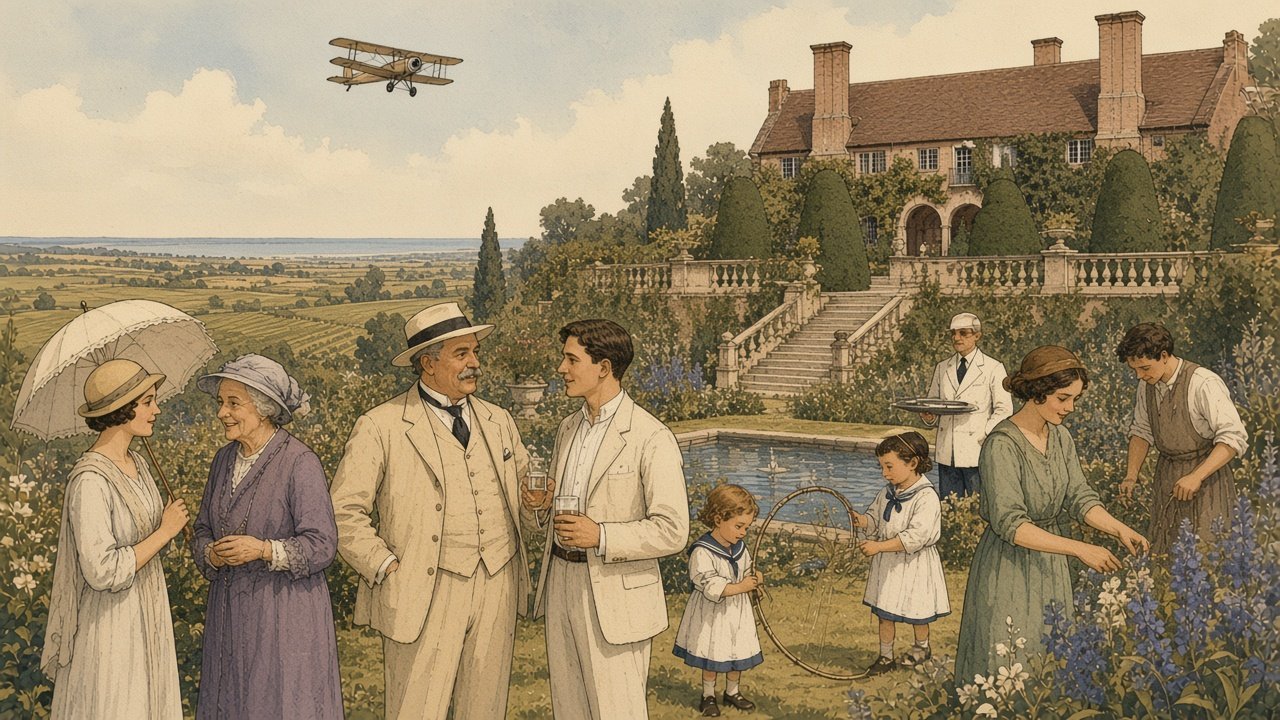
His third house was Trent Park, near Cockfosters on the northern edge of London. Davenport-Hines writes that Philip transformed it “from a mauve and black bricked Victorian mansion into a masterpiece of rose-red brick,” with a golf course and an airstrip. On weekend visits footmen in red cummerbunds waited on politicians, royalty, sportsmen and writers.[1] After Philip’s death the house had a second, secret history. At the outbreak of the Second World War it was requisitioned by the War Office, and from 1942 captured senior German officers were held there in deliberate comfort. In the basement German-speaking refugees, most of them Jewish, recorded their conversations through hidden microphones.[9] Fifty-nine German generals were held at Trent Park.[10] After the war it became a training college and then part of Middlesex University.[9]
The collector and June 1939
Philip was a serious art collector.[3] He was a trustee of the National Gallery, the Wallace Collection and the Tate.[4] Sotheby’s records that he chaired the National Gallery’s trustees from 1933 to 1935.[11] Davenport-Hines judges that he “bought rare objects with discrimination, displaying them with flair.”[1] Works from his collection, among them Zoffany’s The Family of Sir William Young, were shown in the Jewish Museum’s 2023 exhibition.[12]
He died in Westminster on 3 June 1939, aged fifty, of complications after influenza.[2] His physicians had ordered rest, but in Davenport-Hines’s phrase he “hurtled about in unnecessary gaieties until his body was beyond recovery.”[1] His friend James Hawtrey, of the squadron Philip had commanded, flew over Trent Park and scattered his ashes.[3] He had never married. Davenport-Hines describes his sexuality as “central to his character and activities”. He was attracted to young men, but there is never any hint of an affair in the many memories of him.[1]
Sybil at Houghton
Sybil Sassoon was born on 30 January 1894.[2] In 1913 she married George Cholmondeley, Earl of Rocksavage, later the 5th Marquess of Cholmondeley.[11][13] She was painted by John Singer Sargent and William Orpen, and Sargent’s 1922 portrait of her as Countess of Rocksavage is in the Houghton Hall collection.[12][13] In 1919 she and her husband took up residence at Houghton Hall in Norfolk, Sir Robert Walpole’s Palladian house, which had been let to tenants for more than thirty years. Over the following decades they restored both the state and the private rooms.[13] She helped to found the Women’s Royal Naval Service in the First World War, and in the Second she served as Chief Staff Officer to its Director.[11][13] The Encyclopaedia Judaica calls her “a celebrated hostess.”[4]
She lived until 26 December 1989. Gainsborough’s Portrait of the Artist with His Wife and Daughter went to the National Gallery under the acceptance-in-lieu scheme, at her wish and in memory of Philip.[12] Philip and Sybil were Albert’s grandchildren and David’s great-grandchildren. With them the English line of the old house had moved completely from Baghdad and Bombay into the English country house, Parliament and the national collections. Patel suggests that they had “turned their backs on their heritage as well as their business.”[14] Joseph Sassoon’s judgement is that by the fourth generation, “the links with their Baghdadi Jewish heritage were broken.”[6]
References
OpenClose
- Richard Davenport-Hines, “Charmed Life by Damian Collins review – the phenomenal world of Philip Sassoon,” The Guardian, 31 December 2016 *
- Imperial War Museums, Lives of the First World War, “Philip Albert Gustave David Sassoon” *
- Fred Glueckstein, “Great Contemporaries: Philip Sassoon – A Friend at the End of an Era,” Hillsdale College Churchill Project, 1 August 2020 *
- “Sassoon,” Encyclopaedia Judaica, 2nd ed. (Detroit: Macmillan Reference, 2007), reprinted at Encyclopedia.com *
- Geordie Greig, review of Peter Stansky, Sassoon: The Worlds of Philip and Sybil, Literary Review *
- Joseph Sassoon, “How to lose an empire,” The Critic, April 2024 *
- Kent Historic Environment Record, “Port Lympne,” Registered Park or Garden (Historic England register description) *
- The Aspinall Foundation, “Celebrating 50 Years of Port Lympne Hotel & Reserve,” 19 February 2026 *
- Trent Park House, “About” *
- Trent Park House, “The Secret Listeners” *
- Sotheby’s, “The Sassoons in England” *
- The Jewish Museum, New York, “The Sassoons” (exhibition, 2023) *
- Houghton Hall, “History” *
- Dinyar Patel, “The Rise and Fall of the Sassoons,” The India Forum, 6 October 2022 *
The family tree, timeline, places, glossary and select bibliography for the whole history are on the Sassoon index page.