Weirleigh and a disinherited son
Of all the Sassoons, the one most widely remembered in Britain grew up outside the family. Alfred Ezra Sassoon, the second son of S. D. Sassoon and Rachel Beer’s younger brother, married Theresa Thornycroft. She was an Anglo-Catholic from a well-known family of sculptors, and for the marriage the Sassoons disinherited him.[1][2] The National Army Museum puts it simply: Siegfried’s father was “the disinherited son of a line of wealthy Baghdadi Jewish bankers.”[2] Alfred was the first of S. D.’s children to marry out of the faith, and Rachel was the second.[3]
Siegfried Loraine Sassoon was born on 8 September 1886 at Weirleigh, the family house near Matfield in Kent. He was the middle of three brothers, between Michael, born in 1884, and Hamo, born in 1887.[1][2] Despite his name he had no German heritage.[2] His parents separated when he was small, and he saw little of his father, who died of consumption in 1895.[1] The boys were brought up by their mother, an Anglo-Catholic from a family of sculptors, in the Thornycroft world of Kent rather than the Sephardi households of Brighton and Belgrave Square.[1][4] Joseph Sassoon goes further. He writes that Siegfried “had no idea about his Baghdadi origin or his family’s religion until his father died”, when the boy was in fact eight years old.[5] He had little sympathy for the world of money his grandfather’s generation had made. Joseph Sassoon notes that Siegfried “loathed those engaged in business”, and quotes a line from one of his poems: “I accuse the rich of what they’ve always done before.”[5] He did, however, inherit part of the family fortune by an indirect route. When his aunt Rachel died in 1927, her estate went to her nephews and nieces, and he was said to have lived comfortably on his share.[3]
He was a delicate child who read and wrote poetry for hours. He went to the New Beacon School in Kent and then to Marlborough College. In 1905 he went up to Clare College, Cambridge, to read law, but he spent his time hunting, playing golf and writing verse, and he left without a degree.[1][2] For the next eight years he lived as a country gentleman at Weirleigh. He hunted, flirted with a career as a sportsman and printed slim volumes of verse privately. Edmund Gosse, Edward Marsh and Robert Ross encouraged him.[1][6]
Mad Jack
He joined up at the very beginning. He was serving as a trooper in the Sussex Yeomanry in August 1914, but a riding accident sent him to officer training instead. In May 1915 he was commissioned into the Royal Welch Fusiliers.[1][2] The accident kept him out of the Gallipoli campaign, where his brother Hamo was killed. He heard the news in November 1915 while drilling at Litherland.[1][2] He reached France that month and there met Robert Graves, a fellow officer and poet.[2] He was far from the only member of the family in uniform. Joseph Sassoon counts at least fourteen grandsons and great-grandsons of David Sassoon who held commissions in the British Army.[5]
At first he was a transport officer. In March 1916 he got the front-line post he wanted, and his men soon called him “Mad Jack” for his reckless courage.[1][2] In May 1916 he won the Military Cross for bringing in a wounded lance-corporal under heavy fire. According to the National Army Museum he was even recommended for the Victoria Cross after taking a German trench single-handed.[2] He was wounded on the Somme that summer. The death of his friend David Thomas in March 1916 had already shaken him, and while he recovered he met the pacifists around Bertrand Russell and Lady Ottoline Morrell.[1][2] Back in France in the spring of 1917, he was wounded again on 14 April near Arras. The National Army Museum, drawing on his notebooks, says that he exposed himself to German snipers deliberately. The night before he had written: “Fully expecting to get killed on Monday morning.”[2]
The declaration of July 1917
On leave in London in June 1917, he met H. W. Massingham, the editor of The Nation, who introduced him to John Middleton Murry and Bertrand Russell. They believed that a public statement by a decorated officer could change the debate about the war.[2] He worked on it for two weeks and finished it on 15 June. Its opening lines are among the most famous sentences written by any British soldier of the war:
I am making this statement as an act of wilful defiance of military authority because I believe that the war is being deliberately prolonged by those who have the power to end it. I am a soldier, convinced that I am acting on behalf of soldiers.[7]
He went on: “I am not protesting against the conduct of the war, but against the political errors and insincerities for which the fighting men are being sacrificed.”[7] When the adjutant of his battalion telegraphed him on 4 July, Sassoon replied with a copy of the declaration and a letter saying that he would not return. He was “fully aware of what I am letting myself in for” and expected a court martial.[2]
The army refused to give him one. Putting a decorated hero on trial would have caused exactly the scandal he wanted, so instead he was summoned before a medical board. In frustration he threw the ribbon of his Military Cross into the Mersey.[2] The declaration was published in the Bradford Pioneer on 27 July, read in the House of Commons on 30 July and printed in The Times on 31 July 1917, the day the Battle of Passchendaele began.[2][7] By then Robert Graves had persuaded the authorities that his friend was suffering from shell shock and unfit to face a court martial. Graves also warned Sassoon that if he kept refusing he would end up locked away.[2][7]
His cousin took the other side. Philip Sassoon was then on Haig’s staff, and the Encyclopaedia Judaica records that, though “privately horrified by the war, he publicly denounced the pacifistic sentiments of his relative.”[8] The two grandsons of the Bombay firm thus stood on opposite sides of the most famous protest of the war: one in the commander-in-chief’s train, the other on his way to a military hospital.
Craiglockhart and after
Sassoon was sent to Craiglockhart War Hospital near Edinburgh to be treated for neurasthenia. There he formed a deep friendship with the psychiatrist W. H. R. Rivers and met the poet Wilfred Owen. He also worked on the hospital’s magazine, The Hydra.[1][7] Rivers later became a central figure in Pat Barker’s trilogy of novels about shell-shocked officers, whose third volume, The Ghost Road, won the Booker Prize in 1995.[9] Rivers eventually helped to persuade Sassoon to return to the front.[4] In 1918 he served in Palestine and then again in France, until 13 June, when a sentry of his own company mistook him for a German as he came back from a patrol and shot him in the head. That wound ended his war.[1]
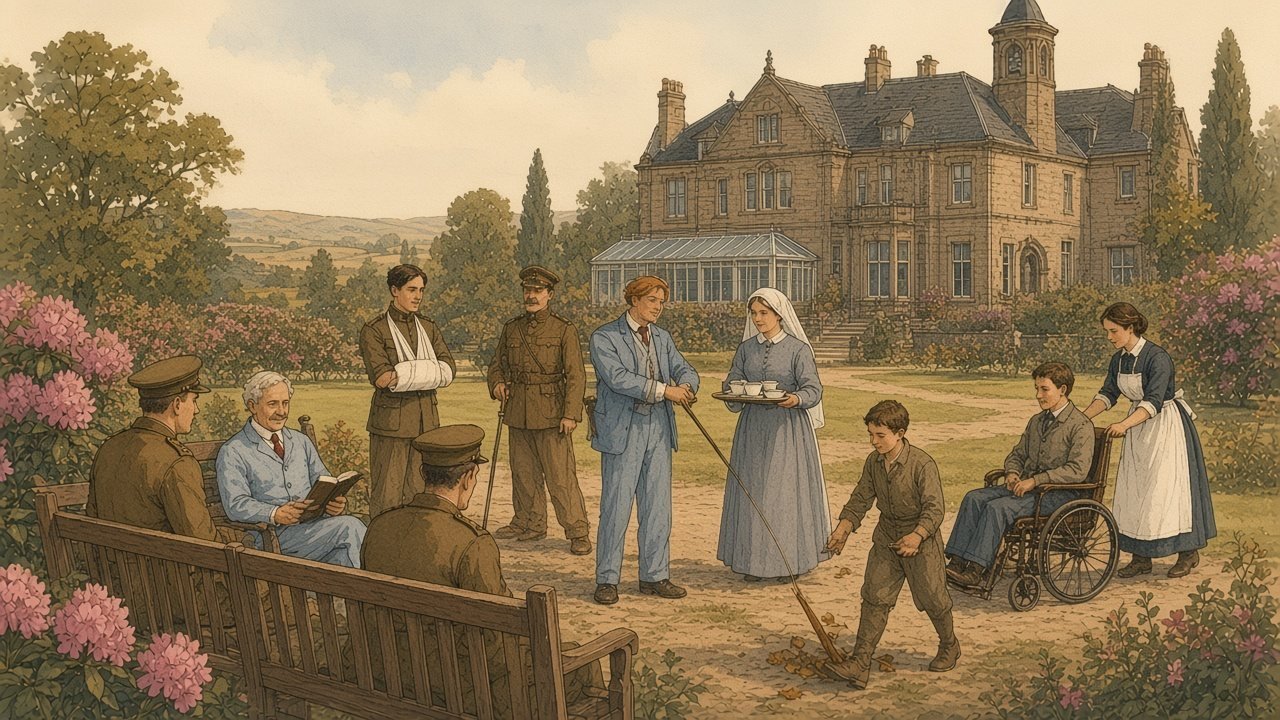
The war poems made him famous. The Old Huntsman came out in 1917, Counter-Attack and Other Poems in 1918 and Picture-Show in 1919.[1] The Poetry Foundation notes that he wrote “of the horror and brutality of trench warfare” and satirised generals, politicians and churchmen.[6] After the war he became literary editor of the Daily Herald and was active in Labour politics. He wrote the fictionalised Sherston trilogy, beginning with Memoirs of a Fox-Hunting Man (1928) and Memoirs of an Infantry Officer (1930), and a series of more direct memoirs.[1][6] In 1933 he married Hester Gatty and bought Heytesbury House in Wiltshire. Their son George was born in 1936.[1]
Honours came late. He was appointed CBE in 1951, made an honorary fellow of his old Cambridge college, Clare, in 1953, and given an honorary degree by Oxford in 1965.[1] In 1957 he became a Roman Catholic.[6][4] That year he was also awarded the Queen’s Medal for Poetry.[6] He died on 1 September 1967 and is buried at Mells in Somerset. In 1985 his name was among sixteen war poets commemorated on a stone in Poets’ Corner in Westminster Abbey.[1][10] He thus has a place in the national memory that no other Sassoon has: not Albert with his baronetcy, not Philip in the government, not Victor with his Shanghai towers. It belongs to the son of the man the family cut off.
References
OpenClose
- Alisa Miller and Stuart Lee, “Siegfried Sassoon,” First World War Poetry Digital Archive, University of Oxford *
- National Army Museum, “Captain Siegfried Sassoon” *
- Jewish Women’s Archive, “Rachel Sassoon Beer,” Shalvi/Hyman Encyclopedia of Jewish Women *
- Cambridge University Library, ArchiveSearch, “Sassoon, Siegfried Loraine, 1886–1967 (poet and author)” *
- Joseph Sassoon, “How to lose an empire,” The Critic, April 2024 *
- Poetry Foundation, “Siegfried Sassoon” *
- Siegfried Sassoon, “Finished with the War: A Soldier’s Declaration” (July 1917), public-domain text *
- “Sassoon,” Encyclopaedia Judaica, 2nd ed. (Detroit: Macmillan Reference, 2007), reprinted at Encyclopedia.com *
- The Booker Prizes, “The Ghost Road” by Pat Barker, winner of the Booker Prize 1995 *
- Westminster Abbey, “Poets of the First World War” *
The family tree, timeline, places, glossary and select bibliography for the whole history are on the Sassoon index page.