Gulf goods and Indian cotton
The firm that David Sassoon set up in Bombay in 1832 began, like most of the city’s merchant houses, as a general trading and banking business. The Jewish Encyclopedia calls it “the house of David Sassoon & Co.” and describes David as an “Indian merchant and banker.”[1] Its first strength was the route he knew best. The Dictionary of National Biography says that the firm “notably developed the trade between Mesopotamia and Persia and western India,” the old commerce of the Gulf, in which Indian textiles went one way and the goods of Basra, Baghdad and the Persian ports came the other.[2] David’s languages and his standing among Baghdadi Jews let him work through correspondents in those ports whom other Bombay houses could not reach so easily.
The second strength was cotton. Bombay was becoming the great cotton port of western India. Raw cotton from Gujarat and the Deccan was shipped to China and to Britain, and cotton yarn and piece goods came back from Lancashire. Joseph Sassoon, writing about the firm’s later decades, says that it traded in a wide range of goods, including tea, silk and pearls. Until the end of the nineteenth century, however, cotton and opium dominated the business of both Sassoon firms.[3] The opium side of the business, which grew through the 1840s and 1850s into the family’s chief source of profit, is the subject of later chapters. For the first decade in Bombay the house was building up capital, connections and reputation. The Guardian’s reviewer of Joseph Sassoon’s book describes the family settling down “to rebuild their lives, using their tried and tested methods of exemplary ethics and ferocious hard work.”[4]
David himself gave two reasons for his success. The Jewish Encyclopedia, drawing on accounts published in his lifetime and soon after, reports that he attributed it “to the employment of his sons as his agents and to his strict observance of the law of tithe.”[1] The first of these is described below. The second, the religious duty to give away a tenth of one’s income, explains something about the family’s philanthropy. In David’s understanding, giving was not something added on top of commerce. It was part of the same obligation.
A subject of the Crown
For a refugee from Ottoman Baghdad, legal status mattered as much as profit. Joseph Sassoon records that David Sassoon was granted British citizenship in 1853, and that he signed his oath of allegiance to the Empire and the East India Company in Hebrew.[3] The gesture sums up his position. He was loyal to the power that sheltered him, but he remained fully himself: a Baghdadi Jew who wrote his own language in his own script. Joseph Sassoon’s interpretation is that, as a man who had lost everything in Baghdad, David chose deliberately to identify with the strongest empire of the day.[3]
The choice was tested in 1857, when much of northern and central India rose against Company rule. Bombay was largely spared the fighting, but the city’s merchants were expected to declare where they stood. The Jewish Encyclopedia lists, among David’s public subscriptions, the fund “for the widows and orphans of those killed during the Indian Mutiny of 1857.”[1] The same entry lists contributions to the Sailors’ Homes of Bombay and Hong Kong and to famine relief. It also mentions the Lancashire relief fund, raised in the early 1860s for the mill workers thrown out of work when the American Civil War cut off Britain’s supply of cotton.[1] The list is telling. The Sassoon house was by then a business of the whole empire, with interests in Indian famines, Chinese ports and English mill towns.
The house was also becoming conspicuous. The Guardian’s review of The Global Merchants quotes the Illustrated London News describing the head of the family as “Mr David Sassoon, the well-known wealthy Jew Merchant of Bombay and China.” The reviewer reads that phrase, with some justice, as a sneer.[4] Joseph Sassoon’s argument is that the early Sassoons were careful not to draw unwanted attention to themselves. They balanced a fortune that was one of the wonders of the age with a philanthropy that built hospitals, libraries and schools “for the whole community.”[4]
A Judaeo-Arabic press
David Sassoon’s Bombay was also a centre of Baghdadi Jewish culture. The Encyclopaedia Judaica records that he was instrumental in publishing a Judaeo-Arabic newspaper, Doresh Tov le-Ammo (“Seeking the good of his people”), which appeared from 1855 to 1866. It also says that he supported scholars and scholarly publications.[5] For the scattered Baghdadi diaspora of the Gulf, India and the Far East, such a paper was a link between communities who shared a language that hardly any outsider could read. The newspaper ran over the same years as the firm’s great expansion eastward, and it served the same network of clerks, agents and families that ran the firm’s branches.
The Jewish Encyclopedia adds that David’s benefactions made his name “familiar to all the Jews of Turkey, China, Japan, Persia, and India.”[1] Letters asking for help came to him from all over the Jewish East, and later generations of the family kept up the habit of answering them. The Jewish Women’s Archive, writing of his son Solomon’s widow Flora Sassoon, notes that she answered appeals by hand on the day they arrived, “which had been the custom of her ancestor, David Sassoon.”[6]
The cotton boom and the share mania
The firm’s last great test in David’s lifetime came with the American Civil War. When the war interrupted the export of cotton from the American South after 1861, Lancashire mills turned to India. The demand for Indian cotton kept rising as the war went on, and between 1861 and 1865 it brought vast wealth into Bombay.[7] The Civil War cotton boom is one of the episodes in Joseph Sassoon’s history of the family.[8] The windfall set off a speculative boom in Bombay: new companies were floated, land reclamation schemes were launched and shares changed hands at extravagant prices. When the war ended in 1865 and American cotton returned to the market, the bubble burst, in what the Jewish Encyclopedia calls “the crisis of the share mania.”[1]
The Sassoons came through it intact. The Jewish Encyclopedia credits Elias, the second son, who had returned from China to run the Bombay business, with conducting “his father’s business in Bombay with great skill and energy.” It says he “avoided becoming involved in the crisis of the share mania.”[1] By then David was dead, and the question of who would lead the family was about to divide it. The firm he left was one of the richest in India, with branches stretching from the Gulf to Japan, and it was staffed above all by his own sons.
The use he made of his sons
In the Bombay of the 1850s, a city of great merchant dynasties, the Sassoon method was a byword. Tristram Hunt quotes the verdict of the Parsi magnate Sir Jamsetjee Jejeebhoy, the richest Indian merchant of his day: “The chief cause of David Sassoon’s success was the use he made of his sons.”[9] Patel calls it a quip, to the effect that David’s key asset was his progeny.[10] Either way, it was a precise description of how the firm worked.
David Sassoon had eight sons, by the reckoning of every later account.[5][10] The eldest, Abdullah, later Sir Albert, was born in Baghdad in 1818, and the second, Elias, a year or two later. The rest followed over the next three decades. Sassoon David, known in the family as S. D., was born in 1832. Then came Reuben in 1835 and Abraham Shalom, later known as Arthur, in 1840. The twins Solomon and Aaron were born in 1841 and Frederick, or Faraj Hayyim, in 1853.[5][11] There were daughters too, but in the firm’s correspondence it is the sons who appear, moved from post to post like officers in an army.
The pattern was the same for each. A son was educated at home in Hebrew and Jewish law, and often in English as well. He was then sent out young to serve an apprenticeship in a distant branch, usually in China, before being recalled to Bombay or sent on to London. Sotheby’s summary of the family’s far-eastern history lists Elias, S. D., Albert, Reuben and Arthur, “and particularly Solomon and Frederick,” as having done stints of varying length in the East. Between them they extended the firm’s reach to Rangoon, Singapore, Yokohama, Nagasaki and Kobe.[12] S. D. was first sent to Baghdad to be “initiated into Biblical and Talmudic lore” and then to Shanghai to run the firm’s China business, before being dispatched to London in 1858.[1] Albert’s first assignment was a return to Baghdad. From there he moved to Shanghai and then, in 1862, back to Bombay to help his ageing father.[11] Arthur was sent to England in 1855 to study under Dr Hermann Adler, the future Chief Rabbi, before returning to India and travelling to China.[11]
Hunt notes the “overbearing dedication” with which David trained his children and sent them out to Calcutta, Shanghai and London.[9] The arrangement was a solution to the basic problem of nineteenth-century long-distance trade, which was trust. A merchant in Bombay who shipped cotton or opium to an agent in Shanghai had to rely on that agent’s honesty and judgement for months at a time, before a letter could pass in each direction. A son, bound to the father by duty, religion and inheritance, was the most reliable agent there could be.
Letters in Hebrew script
The firm’s other safeguard was its language. The Sassoons’ business correspondence was written in the Baghdadi Jewish dialect of Arabic, set down in Hebrew letters. Frances Cairncross explains that this was done “to ensure privacy.”[13] A letter intercepted by a rival, or read by a curious clerk in a British agency house, would have meant nothing to almost anyone outside the Baghdadi Jewish world. Patel, reviewing Joseph Sassoon’s book in The India Forum, calls this correspondence “indecipherable to outsiders.”[10]
That privacy is why the letters were neglected for so long. Patel describes the correspondence as scattered between the family’s branches in India, China and Britain, yet “somehow” meticulously preserved and deposited in the National Library of Israel.[10] Joseph Sassoon is one of the few historians able to read it. According to Hunt, his research yields four main strands to the family’s rise, beginning with a corporate structure that used the family as “the bedrock for trust.”[9]
The same letters show how the firm kept itself informed. The Sassoons were early adopters of the telegraph. Joseph Sassoon describes them as “among the pioneers in developing investments and trades that were globally oriented rather than local.”[10] They followed the silk harvest in France, the price of rice in Shanghai and the market for Javanese sugar in India. The Guardian’s reviewer, summarising his argument, describes the Sassoons as having built “the first truly global business,” able to grasp how a change in one market would move prices in another thousands of miles away.[4]
Clerks, cousins and the Baghdadi network
Sons alone could not staff a business on the scale the Sassoons were building. Beneath the family partners was a large staff of clerks, agents and assistants, and they too were drawn mainly from the Baghdadi Jewish world. Patel writes that the Sassoons built their global business through Baghdadi Jewish networks, “recruiting community members, whom they knew and trusted, and dispatching them to faraway posts.”[10] A clerk from Baghdad or Basra who came to Bombay to work for the Sassoons might be sent on to Calcutta, Hong Kong or Shanghai. He took with him his language and his religious practice, and he brought family members after him. In this way the firm created the Baghdadi Jewish communities of the Far East almost as a by-product of its business.
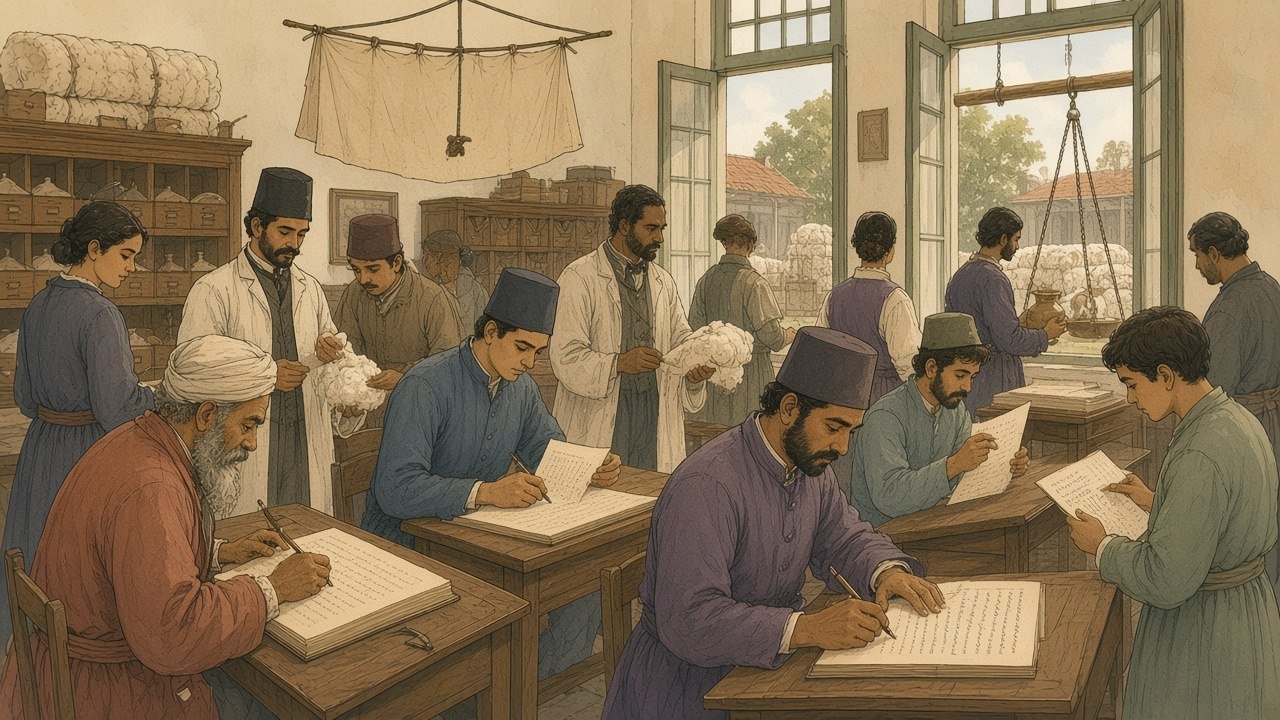
The firm accepted the obligations that came with this arrangement. The Encyclopaedia Judaica records that Elias, following his father’s policy, provided his numerous Jewish employees with schools and synagogues “even in the company’s remotest outposts.”[5] The Hong Kong Jewish community, according to the history kept by its synagogue, was formally established in the 1850s in premises leased by the Sassoon family.[14] In the Far East, as Elias’s policy implies, the Sassoon office often came before the synagogue, and Jewish communal life grew up around the firm’s staff.
By the 1860s the firm’s local branches, each overseen by one of David’s sons, were known as the “House of Bombay,” the “House of Shanghai” and so on, and its reach was proverbial. One competitor described it in words the Times of Israel quotes from Joseph Sassoon’s book: “Silver and gold, silks, gums and spices, opium and cotton, wool and wheat — whatever moves over sea or land feels the hand or bears the mark of Sassoon & Co.”[15]
The phrase lists opium alongside silk and spices, as one commodity among many. For the Sassoons, and for most of the merchants of Bombay, that is how it was seen. But it was not one commodity among many. By the time the competitor wrote those words, opium had become the foundation of the family’s fortune, and its history needs a chapter of its own.
References
OpenClose
- Joseph Jacobs, Goodman Lipkind and J. Hyams, “Sassoon,” Jewish Encyclopedia, vol. 11 (New York: Funk and Wagnalls, 1906), pp. 66–68 *
- E. I. C., “Sassoon, Sir Albert Abdullah David (1818–1896),” Dictionary of National Biography, vol. 50 (London: Smith, Elder, 1897), pp. 312–313 *
- Joseph Sassoon, “How to lose an empire,” The Critic, April 2024 *
- Kathryn Hughes, “The Global Merchants by Joseph Sassoon review – the rise and fall of a dynasty,” The Guardian, 25 February 2022 *
- “Sassoon,” Encyclopaedia Judaica, 2nd ed. (Detroit: Macmillan Reference, 2007), reprinted at Encyclopedia.com *
- Jewish Women’s Archive, “Flora Sassoon,” Shalvi/Hyman Encyclopedia of Jewish Women *
- S. M. Edwardes (comp.), The Gazetteer of Bombay City and Island, vol. 1 (Bombay: Times Press, 1909) *
- Adam Rathe, “The Rise and Fall of a Great Dynasty,” review of Joseph Sassoon, The Sassoons, The New York Times, 20 October 2022 *
- Tristram Hunt, review of Joseph Sassoon, The Global Merchants, Times Literary Supplement *
- Dinyar Patel, “The Rise and Fall of the Sassoons,” The India Forum, 6 October 2022 *
- Sotheby’s, “The Sassoons in England” *
- Sotheby’s, “The Sassoons in the Far East” *
- Frances Cairncross, “Buddenbrooks of Bombay,” review of The Global Merchants, Literary Review *
- Ohel Leah Synagogue, “Our History” *
- “The rise and fall of the opium-fueled Sassoon dynasty, the ‘Rothschilds of the East’,” The Times of Israel *
The family tree, timeline, places, glossary and select bibliography for the whole history are on the Sassoon index page.