Tea, silver and the poppy
The trade that made the Sassoons rich was older than their firm, and it was built by others. Its origins lay in a problem of the British East India Company. From the eighteenth century Britain bought tea, silk and porcelain from China in great quantities, but China wanted little that Britain made. Europeans therefore had to pay for Chinese goods in gold or silver.[1] British merchants were allowed to trade only at Canton.[2]
Opium solved the problem for the British. By 1773 the British had become the leading suppliers of the Chinese market, and the East India Company established a monopoly on opium cultivation in Bengal.[1] A second source was Malwa, in the princely states of central India, where the opium never belonged to the Indian government.[1][3] The Company did not carry the drug to China itself, because the Qing government had banned its import. Instead it farmed the trade out to “country traders”, private merchants licensed to take goods from India to China. They sold the opium to smugglers on the Chinese coast and handed the gold and silver they received to the Company, which used it to buy goods in China for sale in England. The scale of the trade grew steeply. Imports into China rose to about 10,000 chests a year between 1820 and 1830 and to some 40,000 a year by 1838. A chest averaged about 140 pounds, or 63.5 kilograms.[1]
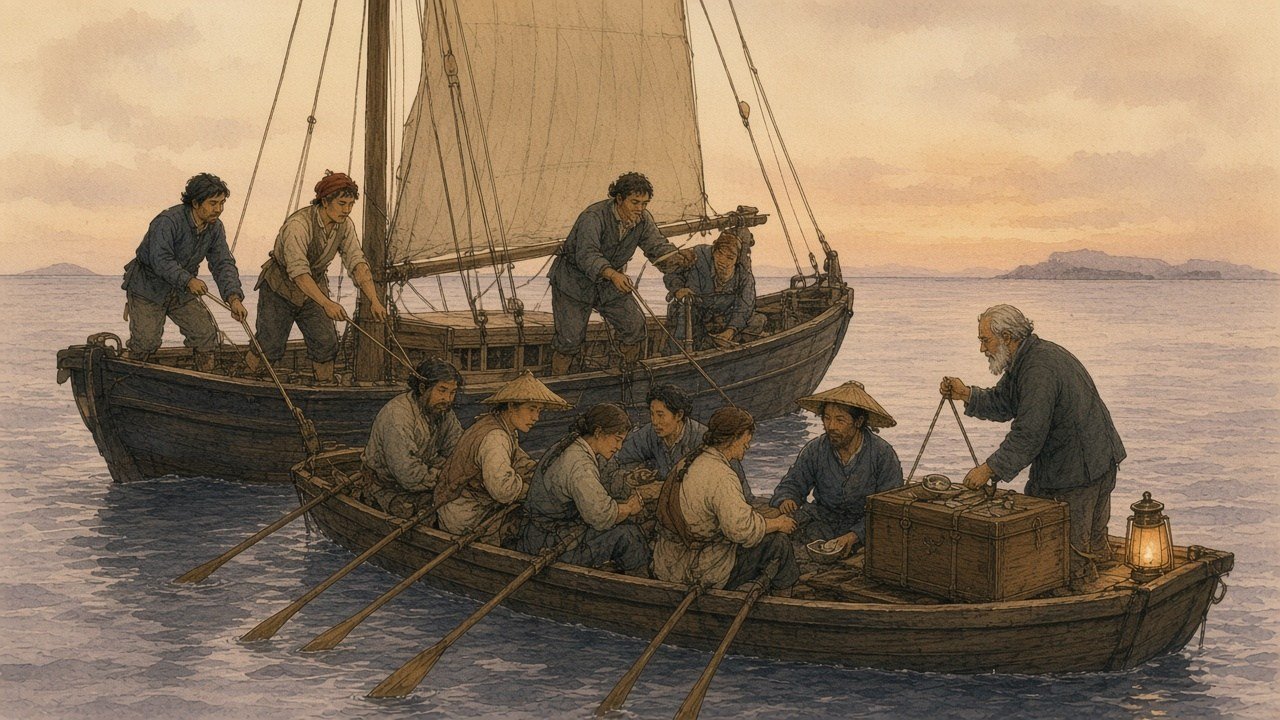
Malwa opium mattered most to Bombay. It was grown largely in princely states outside direct British rule and shipped through Bombay to China. In Bombay it was handled by Parsi, Gujarati and Baghdadi merchants rather than by the great Calcutta agency houses. Dinyar Patel describes the Sassoons establishing “a firm hold on the movement of prized Malwa opium through Bombay and onwards to the Chinese market.”[4] Most accounts of Bombay’s involvement in the opium trade, Patel notes, end in the 1850s, when Indian merchants began moving their capital into textile mills.[4] For the Sassoons, as later chapters show, the 1850s were only the beginning.
Canton, Lin Zexu and the first war
The Qing government regarded opium as a poison and its trade as a crime. Late in 1838 the Daoguang Emperor appointed Lin Zexu imperial commissioner with extraordinary powers, and Lin went to Canton, the hub of the trade. He forced foreign merchants to surrender their stocks of opium for destruction.[5] In the spring of 1839 more than 20,000 chests, some 1,400 tons of the drug, were confiscated and destroyed.[6]
Early in 1840 the British government decided to send an expeditionary force, and the war that followed ended in British victory. The Treaty of Nanking, signed on 29 August 1842, required China to pay a large indemnity and ceded Hong Kong Island to Britain. It increased the ports where the British could trade and reside from one, Canton, to five, among them Shanghai.[6] British merchants could now trade there with whomever they pleased, under a “fair and reasonable” tariff.[2] The treaty did not legalise opium. It did not need to. With the new ports open, the trade continued.[6]
These were the circumstances in which David Sassoon turned his attention east. Sotheby’s account of the family is direct about the connection. With the signing of the Treaty of Nanking, which ended the First Opium War and opened five Chinese ports, “David Sassoon recognized an opportunity to expand his commercial activities into the Far East.”[7] In 1844 he sent his second son, Elias, to Canton.[7] The Times of Israel, summarising Joseph Sassoon’s account, describes him as dispatching the “energetic and tenacious” 24-year-old Elias to scout the market and find new customers.[8]
Legalisation in 1858
The second Anglo-Chinese war, often called the Second Opium War, began in October 1856 with the seizure by Chinese officials of the Arrow, a lorcha flying the British flag. British and French forces captured Canton in late 1857 and then moved north towards Tianjin. The treaties of Tientsin, signed in June 1858, opened several new ports, gave foreign envoys residence in Beijing and allowed foreign travel and Christian missionaries in the interior. In further negotiations at Shanghai later that year the importation of opium was legalised.[6] The treaties were ratified only after further fighting, which ended in October 1860 with the capture of Beijing and the burning of the emperor’s summer palace.[6]
From 1858, then, the trade on which the Sassoons were building their fortune was lawful under treaties that China had been forced to sign. That legal fact is central to how the family and its defenders saw their business, and it does not settle the moral question. Opium was legal in Britain and India too. As Joseph Sassoon has pointed out, it was freely available in pharmacies as a painkiller, and its price was quoted in the financial press.[8] In China, however, it was consumed above all as a smoked narcotic on a mass scale, and the Qing government had fought two wars to keep it out. The scale is hard to measure. According to the United Nations drug agency’s later account, the estimates put before the International Opium Commission in 1909 ranged from 13.5 million opium smokers in China to 25 million users. The commission finally recorded a figure of 21.5 million users, about 5.4 per cent of the population.[9] Those figures came at the very end of the trade. The same agency’s tables, drawn from the commission’s reports, show India as by far the world’s largest exporter of raw opium in 1906–07, at about 4,200 metric tons. Hong Kong, where both Sassoon firms had houses, came second.[9]
The British debate about the trade was conducted mostly in terms of Indian revenue. In 1893 a Royal Commission on Opium was appointed to consider whether poppy growing and the sale of opium in India should be prohibited except for medical purposes. Its report of 1895 concluded, in the summary of the United Nations drug agency, that prohibition except for medical purposes was neither necessary nor wanted by Indians. It also found that India’s finances could not bear the loss of the opium revenue, and that Indian consumption did not cause “extensive moral or physical degradation.”[9] The commission concerned itself with India. The export trade to China, which was the source of the Sassoons’ wealth, lay outside its main questions, and it would be ended by another route, as Chapter 4 describes.
The machinery as Whitehall described it
The fullest official description of how the trade worked came near its end. In the House of Commons on 30 May 1906, John Morley, the Secretary of State for India, set out the system for a new Parliament. In Bengal the poppy was grown under licences that officers of the government’s Opium Department issued to individual cultivators or to the headmen of groups of cultivators. The raw opium was delivered to the district opium officers and sent to two government factories, where, in Morley’s words, it was manufactured “with great skill and attention” into “this horrible drug.” It then went down to Calcutta to be sold at monthly auctions. Each year the government announced how many chests would go to market, and the price was settled by bidding. Once sold, the opium could be shipped wherever the private buyer liked. Most of it went to China, though Morley put the share sent elsewhere at 16,000 chests out of 48,000.[3]
Malwa opium, the Bombay trade in which the Sassoons had made their position, worked differently, and Morley was careful to say so. Malwa opium, he told the House, “at no stage belonged to the Indian Government.” It was grown in the princely states of central India, where wealthy opium merchants made advances to the growers. Because those states lay far from the sea, the drug had to cross British territory to reach the coast, and on the way it paid what Morley called “a very large and … a growing transit duty.”[3] The arrangement explains much about the firm’s opportunity. In Malwa there was no government auction to win. A Bombay house made its profit by financing, buying and carrying the drug from the interior to the China coast, and by bearing the commercial risk at every stage. That was work for merchants with capital, credit and trusted correspondents at both ends of the route, which is what the Sassoons had.
The same debate showed why the government of India was reluctant to give the revenue up. Sir Henry Cotton, closing the discussion, put the sum India received from China at £3,000,000 a year. Morley warned the House against placing on the people of India burdens that, if they had been represented in Parliament, they would not have accepted.[3]
References
OpenClose
- “Opium trade,” Encyclopaedia Britannica *
- “Treaty of Nanjing,” Encyclopaedia Britannica *
- “The Opium Traffic,” House of Commons debate, 30 May 1906, Hansard, 4th series, vol. 158 *
- Dinyar Patel, “The Rise and Fall of the Sassoons,” The India Forum, 6 October 2022 *
- Charles W. Hayford, “Lin Zexu,” Encyclopaedia Britannica *
- Kenneth Pletcher, “Opium Wars,” Encyclopaedia Britannica *
- Sotheby’s, “The Sassoons in the Far East” *
- “The rise and fall of the opium-fueled Sassoon dynasty, the ‘Rothschilds of the East’,” The Times of Israel *
- United Nations Office on Drugs and Crime, “A Century of International Drug Control,” in World Drug Report 2008 (Vienna: UNODC, 2008) *
The family tree, timeline, places, glossary and select bibliography for the whole history are on the Sassoon index page.