A family of the nasi
The Sassoons liked to say that their story began in medieval Spain. According to the account the family gave the Victorian compilers of the Dictionary of National Biography, their ancestors had lived in Toledo between the twelfth and fifteenth centuries under the name Ibn Shoshan. They had held the leadership of that city’s Jewish community and were known for wealth and learning. Persecution in the fifteenth century, the story went on, drove them eastward, and the chief branch settled in Baghdad, then under Turkish rule, early in the sixteenth century.[1] The Jewish Encyclopedia, written a few years later, was more guarded and described the Sassoons as a family “claiming to trace its descent from the Ibn Shoshans of Spain.”[2] No document has been published that carries the line unbroken from Toledo to Baghdad. The tradition matters less as genealogy than as self-portrait. It shows a family that thought of itself, long before it reached India or England, as an aristocracy of the diaspora.
What is certain is that by the late eighteenth century the Sassoons stood at the head of Baghdadi Jewry. The Encyclopaedia Judaica names Sheikh Sassoon ben Ṣāliḥ (1750–1830) as the founder of the family’s fortunes. For almost forty years he was president, or nasi, of the Jewish community of Baghdad, and he was also chief treasurer to the Ottoman pashas who governed the province.[3] Tristram Hunt, reviewing Joseph Sassoon’s history of the family, gives 1781 as the year Sheikh Sassoon was appointed chief treasurer and thus lay head of the community.[4] The Jewish Encyclopedia records that he was known by the old title “Nasi of the Captivity.” The Dictionary of National Biography says that the title carried large powers, recognised by the Turkish government, over the Jewish communities of Turkey in Asia. It also says that he held the post of state treasurer to the governor of the pashalic.[2][1]
The Jews of Baghdad were among the oldest communities of the diaspora. They traced their presence in Mesopotamia to the Babylonian exile, and their academies had once been the centres of Jewish learning for the whole Jewish world. In Ottoman Baghdad, Jewish bankers and merchants were indispensable to the provincial treasury. That made them powerful, and it also made them vulnerable. A treasurer to the pasha had access to the governor’s finances and the governor’s ear, but he served at the governor’s pleasure. When governors changed or fell out with their financiers, the treasurer’s family could lose everything. Jewish bankers in Baghdad were involved in the affairs of the governing circles, and in 1811 the banker Ezekiel Gabbai supported the removal of a governor who had rebelled against the sultan.[5]
Daud Pasha’s city
David Sassoon was born into this world in October 1792.[2] He grew up in a household where Hebrew was the language of prayer and study and Judaeo-Arabic was the language of daily life and business. He also learned the Arabic, Persian and Turkish of the Ottoman administration. The Jewish Encyclopedia says he had a fair knowledge of Hebrew, Arabic, Persian, Turkish and Hindustani, “but not of English.”[2] According to the same source he worked in a banking house in Baghdad until 1822.[2] He married twice. His first wife, Hannah, daughter of Abdullah Joseph of Baghdad, bore his eldest son, Abdullah, on 25 July 1818. After her death in 1826 he married Farha, the daughter of Furraj Hyeem of Baghdad, in 1828, and she bore him several more sons and daughters.[1] Abdullah would one day be Sir Albert Sassoon, baronet. In the 1820s, however, the family’s position was being undermined by the politics of the province.
Baghdad in these years was governed by Daud Pasha, the last of the Mamluk governors. He ruled from 1817 to 1831, had himself tried to rebel against the sultan, and oppressed the Jews of Baghdad, so that many of the wealthier families fled to Persia, India and other countries.[5] The Encyclopaedia Judaica speaks simply of “the oppression and tyranny of Pasha Daud.”[3] Joseph Sassoon describes the method more exactly. The governor made money by arresting members of the wealthiest families and demanding a ransom for their release.[6]
Ransom and flight
Among those detained, Joseph Sassoon writes, was David himself, the son of the pasha’s treasurer. His father paid the ransom, and David fled.[6] The sources do not agree on the dates. The Encyclopaedia Judaica says David escaped in 1828 to Bushire on the Persian Gulf, where his father joined him and died.[3] Joseph Sassoon, in his 2024 essay, puts the flight to Bushire in 1830 and the move to Bombay in the following year.[6] The Jewish Encyclopedia says David left Baghdad “after the plague” for Basra and went on from there to Bushire.[2] Hunt’s summary of Joseph Sassoon’s book has the family fleeing first to Basra and then to Bushire, with David deciding in 1830 that the best hope of rebuilding the family fortune lay across the Arabian Sea.[4] The Guardian’s reviewer of the same book gives 1828 for the forced departure.[7] The likeliest reading is a staged flight: Baghdad to Basra, then Bushire in the late 1820s, with the decision for Bombay taken around 1830. Whether David reached Bombay in 1830, 1831 or 1832 is discussed below.
What the flight meant is clearer than its chronology. David Sassoon left Baghdad having lost the wealth and status his family had built over generations. Joseph Sassoon, who grew up in Baghdad himself, calls him “a refugee in a new land.” He also argues that this experience shaped the family’s later loyalties: he chose to identify with the British Empire, then the strongest power in the world.[6] The Guardian’s reviewer puts the same argument another way. For Joseph Sassoon, the family’s experience as “serial immigrants” explains both their success and their decline. Their years as treasurers to the pashas had given them the Arabic, Turkish, Hebrew and Persian needed to trade throughout the Ottoman world. Their expulsion taught them to read the political landscape and to stay close to whatever power could protect them.[7]
How the story is known
For most of the twentieth century the standard accounts of the family were Cecil Roth’s The Sassoon Dynasty, published in 1941, and Stanley Jackson’s The Sassoons, published in 1968.[3] The historian Dinyar Patel has called the newest chronicler “uniquely qualified”, for a reason that has to do with the family’s own papers.[8] The family’s own business correspondence was written in the Baghdadi Jewish dialect of Arabic in Hebrew script, partly so that outsiders could not read it. It survived in scattered bundles and was eventually deposited at the National Library of Israel as the David Sassoon Archives.[8][4] Joseph Sassoon is a professor of history and political economy at Georgetown University and a distant relation of the family. He is fluent, as he says, in Arabic, Hebrew and the Baghdadi-Jewish dialect, and he read those letters for The Global Merchants, published in 2022.[7][9] Much of what follows about the family’s commercial methods, its quarrels and its attitude to opium comes from that work. It reaches us through Joseph Sassoon’s own essay of 2024 and through the long reviews of the book by historians and critics in Britain and India.
The other great body of evidence is in stone. The synagogues, schools, hospitals and docks the family paid for are recorded in the encyclopaedias of 1906 and later, in the records of the trusts that still maintain them and in the heritage registers of Mumbai, Pune and Hong Kong. These buildings are a kind of public archive of the Sassoons, and they are still in use.
A British agency on the Gulf
Bushire, the modern Bushehr, was the main Persian port on the Gulf in the early nineteenth century, a town of merchants, caravans and shipping that faced across the water to Basra and the Arabian coast. For a Baghdadi Jew in flight it had one great advantage. The Dictionary of National Biography, written in the 1890s from the family’s own account, says David Sassoon moved there because “an English agency had been established” in the town. The East India Company kept a Resident at Bushire, and the presence of British officials and British shipping offered a measure of protection that the pashas of Baghdad had not.[1]
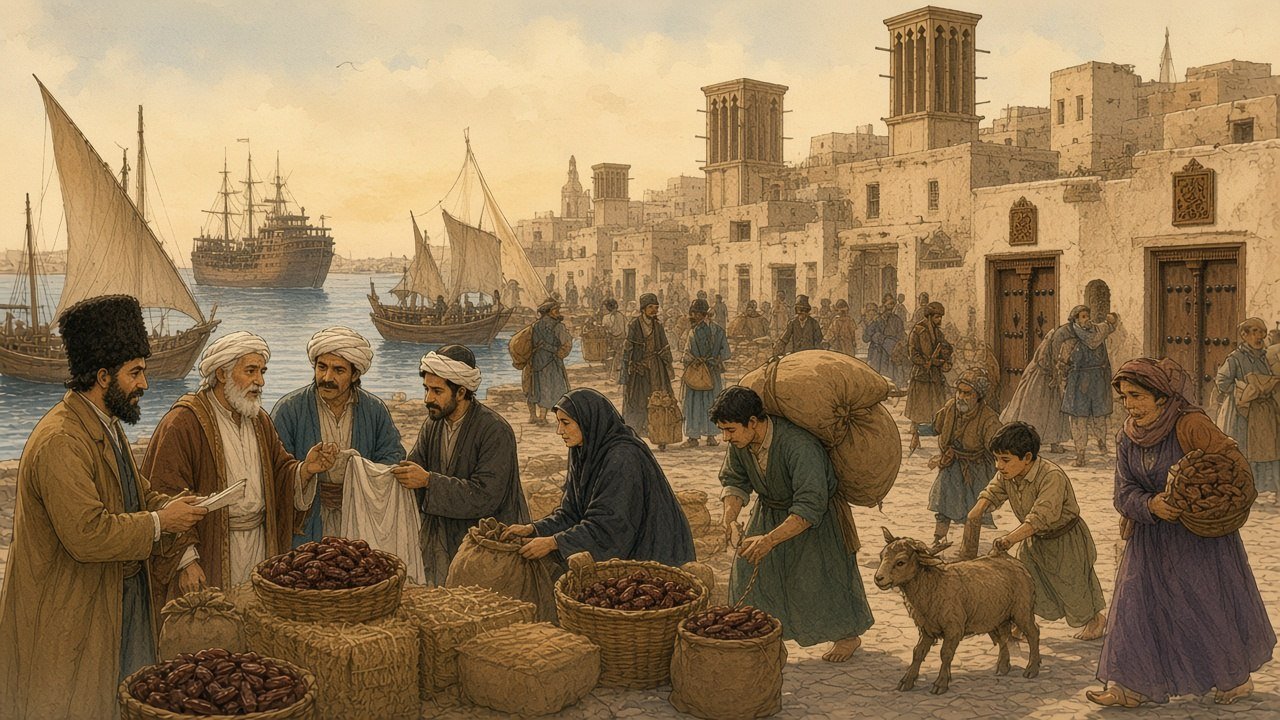
It may not have been the first time British power had entered the family’s calculations. Dinyar Patel, summarising the research of Joseph Sassoon, notes that a British political agent in Baghdad “might have played an outsized role” in the family’s history, by helping Sheikh Sassoon begin to think of refuge in British India.[8] The old patriarch never made the journey. He died at Bushire, and the Encyclopaedia Judaica places his death there in 1830, after he had joined his son in exile.[3][8] For David Sassoon, the death of his father removed the last tie that might have drawn him back to Baghdad. Tristram Hunt, reviewing Joseph Sassoon’s book, says that with “no pathway back to Baghdad,” David decided in 1830 that the best hope of rebuilding the family fortune lay across the Arabian Sea, “in fast-expanding Bombay.”[4]
Little is known in detail of David’s years on the Gulf, and the encyclopaedias do not agree on the order of events. The Jewish Encyclopedia says that in 1832 “an important commercial engagement” caused him to visit Bombay, and that he then moved there with his family.[2] The Dictionary of National Biography says simply that in 1832 he left Persia to settle in Bombay.[1] The Encyclopaedia Judaica has him moving to Bombay “with his large family” in 1832.[3] Joseph Sassoon’s own short account says that after fleeing to Bushire in 1830 David took his family with him to Bombay “the following year,” which gives 1831.[6] Patel’s review, in its opening lines, speaks of “Jewish refugees from Baghdad who arrived in colonial Bombay in 1830.”[8] Two explanations would reconcile these dates. David may have scouted the city and begun trading before he moved his household, or 1832 may be the year his firm was formally established rather than the year he arrived. The year 1832, which the family itself used for the founding of David Sassoon & Co., is followed here for the firm, while the arrival is placed between 1830 and 1832.
A city of migrants
The Bombay that David Sassoon entered was a city made by migrants. It was the seat of the presidency government of the East India Company in western India, and its fortified core, the Fort, sat on the southern end of a chain of islands that land reclamation was slowly joining into one. Its commercial life was dominated by Parsi shipbuilders and merchants, by Gujarati Hindu, Jain and Muslim traders and by British agency houses. Its population was drawn from all along the western coast. Frances Cairncross, reviewing Joseph Sassoon’s book, calls it “a boom town thanks to its cotton and opium markets.”[9]
Jews were already part of this world. The Bene Israel, a Marathi-speaking Jewish community, had laid the foundation of a permanent Jewish settlement in the second half of the eighteenth century, moving gradually from their villages in the Konkan to Bombay, and they built their first synagogue there in 1796. Jewish merchants from Syria and Mesopotamia followed, joined by “Arabian Jews” from Surat. One of them, Solomon Jacob, is documented in the Bombay records from 1795 to 1833.[10] Unlike the Bene Israel, the Arabic-speaking Jews did not adopt Marathi. They kept their Judeo-Arabic language and literature and regarded Baghdad as their spiritual centre.[10]
The timing of David’s arrival was favourable for another reason. The East India Company’s commercial monopoly had been broken in 1813, and from 1834 the Company was merely a managing agency for the British government of India.[11] Hunt puts it in one phrase: the Sassoons established themselves as a great trading house “as the monopoly power of the East India Company receded.”[4]
Learning a new city
David Sassoon was nearly forty when he reached Bombay. He did not speak English and never properly learned it. Joseph Sassoon records that although he spoke Arabic, Hebrew, Persian and Turkish and learned Hindustani, “he never bothered with English.”[6] Patel adds that English “proved difficult for him to master.”[8] What he did have was a set of languages that let him deal directly with the Arab, Persian and Baghdadi Jewish merchants who traded between the Gulf and western India, and with the Indian brokers of the Bombay cotton market. He soon added Hindustani to them, and Patel describes him making contacts in the city’s cotton exchange.[8]
The portrait of David’s early Bombay years that emerges from Joseph Sassoon’s research is of a man who moved easily across communities. Patel writes that he “rubbed shoulders with Parsi magnates, French-Syrian Jewish business partners, Iranian merchants, and British officials.” One of his closest friends was the Scottish missionary John Wilson, with whom he studied and debated the Hebrew Bible in a mixture of Arabic and Hindustani.[8] Wilson was a scholar of Indian languages and a founder of the college in Bombay that later bore his name. The friendship of an Orthodox Baghdadi merchant and a Presbyterian missionary is a small sign of the city’s cosmopolitanism, and of David’s own curiosity.
The first Sassoons of Bombay
The household that came with David, or followed him, was already large. Abdullah, the eldest son, was a teenager at the time of the move. Elias, the second son, was born in 1819 or 1820 according to different authorities.[2][3] The children of the second marriage were still small, and more were born in Bombay. Sassoon David Sassoon, the third son, named after the grandfather who had died at Bushire, was born there in 1832.[2][12] Solomon and his twin Aaron followed in 1841, and Frederick, the youngest, in 1853.[12] In all, David Sassoon had eight sons, and the Encyclopaedia Judaica makes the philanthropy of “David Sassoon and his eight sons” one of the central facts of Bombay’s nineteenth-century history.[3]
These first years in Bombay laid down the pattern for everything that followed. A refugee family, stripped of its old wealth, rebuilt itself through a single household firm. That firm drew its staff from a widening circle of Baghdadi Jews who followed the Sassoons to India, and it sought the protection of the British authorities whose rule made the city safe for them. Within a generation the firm would have branches on three continents. Within two it would be one of the great commercial houses of Asia.
References
OpenClose
- E. I. C., “Sassoon, Sir Albert Abdullah David (1818–1896),” Dictionary of National Biography, vol. 50 (London: Smith, Elder, 1897), pp. 312–313 *
- Joseph Jacobs, Goodman Lipkind and J. Hyams, “Sassoon,” Jewish Encyclopedia, vol. 11 (New York: Funk and Wagnalls, 1906), pp. 66–68 *
- “Sassoon,” Encyclopaedia Judaica, 2nd ed. (Detroit: Macmillan Reference, 2007), reprinted at Encyclopedia.com *
- Tristram Hunt, review of Joseph Sassoon, The Global Merchants, Times Literary Supplement *
- “Baghdad,” Jewish Virtual Library *
- Joseph Sassoon, “How to lose an empire,” The Critic, April 2024 *
- Kathryn Hughes, “The Global Merchants by Joseph Sassoon review – the rise and fall of a dynasty,” The Guardian, 25 February 2022 *
- Dinyar Patel, “The Rise and Fall of the Sassoons,” The India Forum, 6 October 2022 *
- Frances Cairncross, “Buddenbrooks of Bombay,” review of The Global Merchants, Literary Review *
- “Mumbai,” Jewish Virtual Library *
- “East India Company,” Encyclopaedia Britannica *
- Sotheby’s, “The Sassoons in England” *
The family tree, timeline, places, glossary and select bibliography for the whole history are on the Sassoon index page.