Engineering
Geothermal Hazards and Deep Tunnelling on the Sichuan–Tibet Railway
Contents ▾
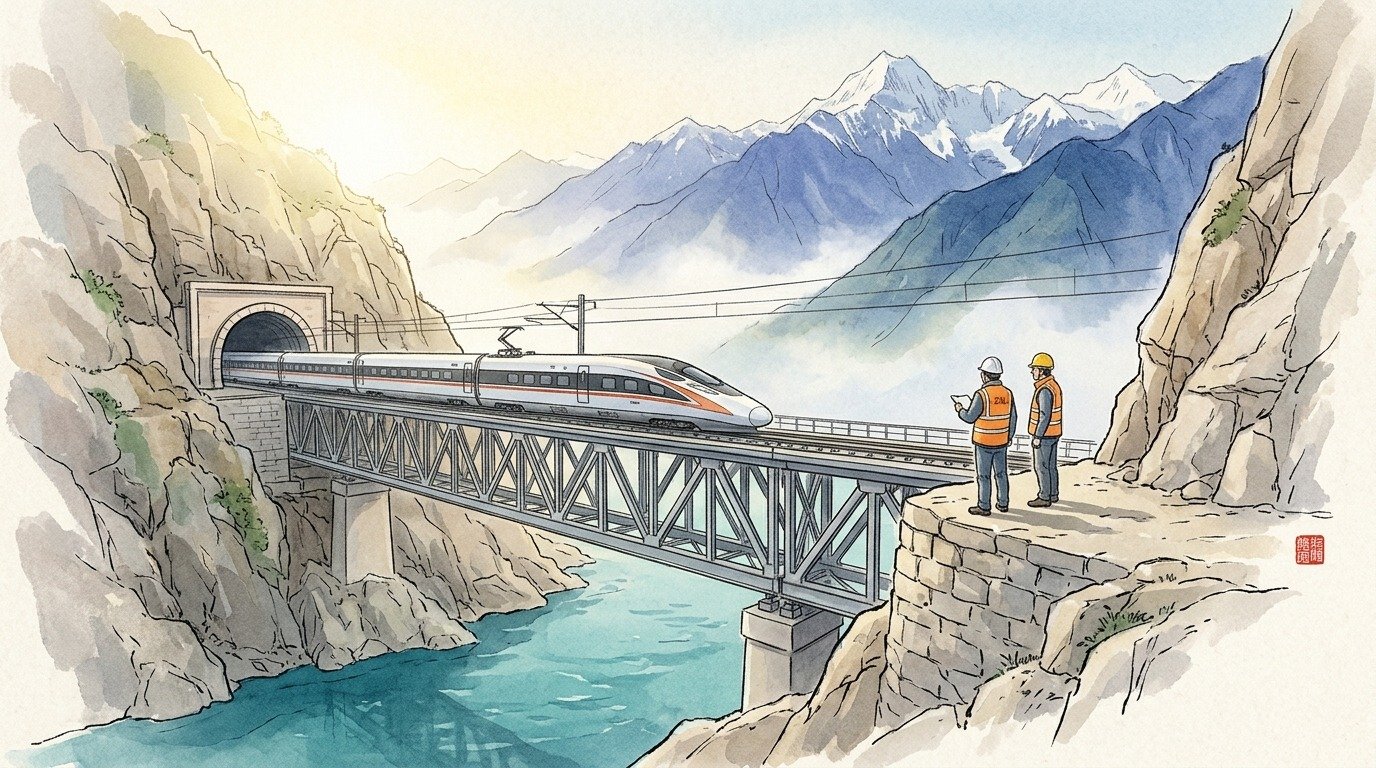
Driving an electrified dual-track railway through the active collision zone between the Indian and Eurasian tectonic plates requires civil engineers to confront the most extreme thermodynamic and geomechanical conditions ever encountered in terrestrial construction. From high-stress strainbursts in brittle granites to superheated hydrothermal inflows exceeding 85 degrees Celsius, the Ya’an-to-Nyingchi alignment of the Sichuan–Tibet corridor represents a foundational transformation in alpine tunneling technology.
1. The Geotectonic corridor, Traversing the Hengduan suture
The Sichuan–Tibet Railway (川藏铁路), spanning approximately 1,543 kilometres from Chengdu in the Sichuan Basin to Lhasa on the southern Tibetan Plateau, is divided into three distinct construction eras: the Chengdu–Ya’an section (operational December 2018), the Lhasa–Nyingchi section (operational June 2021), and the formidable 1,011-kilometre Ya’an–Nyingchi central trunk. While the outer segments traversed peripheral river valleys, the central trunk cuts transversely across the strike of the eastern Tibetan Plateau and the Hengduan Mountains (横断山脉), negotiating seven major river canyons—including the Dadu, Yalong, Jinsha, Lancang, and Nu—and eight formidable mountain ranges whose passes exceed 4,500 metres above sea level.
Between Ya’an (elevation 580 metres) and the high plateau interior at Nyingchi (elevation 3,000 metres), the rail line is subjected to a vertical undulating profile colloquially termed an “engineering roller-coaster,” accumulating over 14,000 metres of aggregate climb and descent. To maintain operational design gradients within the maximum 30-per-mille threshold for high-altitude electric locomotives (such as the custom-modified CR400AF-Z and FXN3C units), engineers had no alternative but to place more than 90 percent of the alignment within underground bores and viaduct structures. Tunnels alone account for approximately 840 kilometres of the Ya’an–Nyingchi section, with over twenty individual bores exceeding 15 kilometres in length, including the 37.9-kilometre Sejila Mountain Tunnel (色季拉山隧道) and the 39.8-kilometre Dadu River Tunnel complex.
Geologically, the railway intersects the active collision boundary between the northward-drifting Indian Plate and the relatively rigid Eurasian continent. This convergent margin drives tectonic crustal thickening at rates between 15 and 20 millimetres per year, generating severe regional strain accumulation. The alignment slices across several deeply active regional shear zones: the Longmenshan fault zone (source of the catastrophic 2008 Wenchuan earthquake), the Xianshuihe strike-slip fault system, the Batang fault zone, and the Yarlung Tsangpo suture zone. Within these metamorphic and magmatic complexes, sedimentary accretionary wedges, Precambrian crystalline basements, and late-Cenozoic granitic intrusions are locked under profound tectonic confinement.
2. In-situ stress fields and high-stress rockburst dynamics
As subterranean headings delve beneath mountain massifs with rock covers (overburdens) exceeding 1,500 to 2,200 metres, gravitational lithostatic pressure couples with powerful lateral tectonic squeezing to produce in-situ geostress fields of unprecedented magnitude. In-situ hydraulic fracturing stress measurements along the Kangding and Sejila sectors reveal maximum horizontal principal stresses (σH) surpassing 50 to 70 megapascals (MPa). The ratio of maximum horizontal stress to vertical gravitational stress regularly spans 1.5 to 2.4, indicating intense tectonic horizontal compression orthogonal to the tunnel axes.
Under such stress concentrations, excavating a conventional horseshoe or circular tunnel bore redistributes the tangential circumferential stress (σθ) around the boundary of the excavation opening. In hard, brittle rocks—such as fine-grained granite, migmatitic gneiss, and silicified dolomites—where the ratio of maximum tangential stress to uniaxial compressive strength (UCS) exceeds 0.7, the elastic strain energy stored within the rock mass reaches explosive instability. The immediate result is violent rockbursting (岩爆): the instantaneous, explosive detachment and projectile expulsion of fractured rock slabs from the tunnel perimeter, often accompanied by shockwaves, seismic rumblings, and sudden perimeter convergence.
To mitigate the catastrophic hazard to tunneling crews and drill-and-blast equipment, China Railway Construction Corporation (CRCC) and China Railway Group (CREC) established a multi-tiered defense paradigm. Real-time acoustic emission (AE) arrays and 24-channel high-frequency microseismic monitoring networks are installed behind the advancing excavation face. By triangulating the micro-fracturing hypocentres and tracking temporal spikes in cumulative event rate and radiated seismic energy, engineers identify stress accumulation zones up to 48 hours before macroscopic rockburst failure occurs.
Where severe rockburst susceptibility is detected, active stress relief is achieved through face destressing: systematic deep-hole advance destress blasting drilled 5 to 10 metres ahead of the working face, coupled with high-pressure water jet pre-splitting to create artificial energy-dissipating fracture curtains. For structural support, rigid steel sets are replaced by yielding, high-toughness, energy-absorbing rock bolts (yielding D-bolts and constantly resisting large-deformation anchors) that permit controlled circumferential strain of up to 15 to 20 percent without rupture, dissipating hundreds of kilojoules of kinetic energy before conventional shotcrete linings are sprayed.
3. Hydrothermal geothermal hazards, the boiling Caverns of the high Plateau
Compounding the geomechanical hazards of high stress is the omnipresence of extreme geothermal energy. The eastern margin of the Tibetan Plateau hosts one of the world’s most active high-temperature hydrothermal belts, sustained by shallow crustal magmatic heat sources and mantle upwelling along active deep-seated regional faults. Tunnel bores driven through the Zheduoshan and Nyingchi blocks penetrate deep into geothermal reservoirs where virgin rock temperatures (VRT) escalate rapidly beyond normal geothermal gradients, exceeding 50°C, 65°C, and in severe hydrothermal fault conduits reaching as high as 89°C.
In conventional underground excavation, ambient air temperatures above 28°C impair cognitive function, while sustained temperatures above 36°C under high relative humidity (>80%) rapidly induce severe heatstroke, multi-organ failure, and collapse. In the Kangding No. 2 Tunnel and the Sangzhuling Tunnel (on the adjacent Lhasa–Nyingchi line), rock wall temperatures reached 89.9°C, and ambient tunnel air temperatures hovered at 56°C, effectively transforming the tunnel face into an underground industrial steam bath. In these zones, groundwaters emerge as boiling pressurized geysers from fracture zones, dissolving mineral sulphates, toxic hydrogen sulphide (H2S), and high-salinity brines.
Operating heavy machinery in such environments presents severe mechanical and chemical bottlenecks. Internal combustion diesel engines suffer acute power de-rating of up to 40 percent due to both high ambient temperatures and the thin, oxygen-depleted atmosphere at 3,500 metres elevation. Hydraulic fluids and engine lubricants break down rapidly, electrical insulation softens and deteriorates, and cooling radiators overheat within minutes of operation.
4. Thermodynamic countermeasures, from artificial ice Ingestion to specialized chemistry
To overcome thermal thresholds that would otherwise render excavation physically impossible, Chinese railway engineers devised complex mechanical and thermodynamic mitigation systems operating at industrial scales. At the Sangzhuling and Zheduoshan tunnel portals, industrial refrigeration complexes were erected capable of producing over 100 to 200 tonnes of flake and block ice per day. Insulated dump trucks transport this solid ice directly to the tunnel headings, where large modular ice hoppers and high-velocity axial fans blow air across the melting blocks, establishing local convective cool-zones that lower ambient face temperatures from 52°C to an acceptable 28°C during drilling and mucking cycles.
For long-distance ventilation across bores advancing several kilometres from the nearest portal or vertical shaft, conventional forced-air ventilation is insufficient due to thermodynamic heat conduction from the bare rock walls. The air heats up significantly before it ever reaches the face. Engineers introduced closed-loop cold-water heat exchange circuits: chilling plants situated at surface portals pump glycol-chilled water through insulated high-pressure pipeline loops to modular finned coil air handlers suspended from the tunnel crown immediately behind the work zones.
Material chemistry had to be fundamentally re-engineered for high-temperature geothermal conditions. Standard Portland cement mortars and shotcretes undergo accelerated hydration when sprayed onto rock surfaces exceeding 50°C; water flashes into steam, cement paste flashes into premature set within minutes, micro-cracking propagates, and long-term 28-day compressive and shear strength declines by up to 50 percent. Material scientists at Southwest Jiaotong University developed specialised high-temperature shotcrete formulations incorporating high-volume ground granulated blast-furnace slag (GGBS), nano-silica, polycarboxylate superplasticizers, and temperature-retarded set-modifying admixtures. This bespoke mix prevents thermal flash-setting, maintains rheological workability during pumping, and ensures compressive strength development exceeds 35 MPa under 60°C substrate conditions.
5. Active fault crossing and Aseismic articulation
Beyond rockbursts and boiling waters, the Sichuan–Tibet alignment must physically cross 16 active Quaternary fault zones that accommodate ongoing inter-plate slip. If an earthquake occurs or if steady-state tectonic creep shifts the rock mass by tens of centimetres, a conventional continuous reinforced concrete tunnel tube would suffer catastrophic shear rupture, collapsing the clearance envelope and severing the railway line.
To solve the fault-crossing dilemma, the railway’s structural engineers introduced an articulated, oversized, segmented cross-section design known as the “expandable, ductile lining system.” In sections intersecting active fault planes, the excavation diameter is enlarged by 1.2 to 2.0 metres beyond standard railway kinematic clearance envelopes. The lining is cast not as a monolithic tube, but as a series of short, independent articulated rings ranging from 6 to 12 metres in longitudinal length. Each ring is separated by wide seismic deformation joints fitted with multi-layered high-grade ethylene propylene diene monomer (EPDM) synthetic rubber gaskets, ductile steel waterstops, and shear-slip dowels.
When the underlying tectonic fault displaces during a seismic rupture, the tunnel behaves not as a brittle glass rod, but like a flexible vertebral column: adjacent segments rotate, shear, and displace along the articulation joints without shearing the primary concrete shell. Even under permanent horizontal fault offsets of up to 1.0 metre, the interior enlarged clearance ensures that the spatial envelope required for high-speed train clearance remains completely unobstructed, allowing track slabs to be realigned without necessitating major structural re-mining.
6. Technological legacy and high-altitude tunneling standards
The technical innovations refined on the Sichuan–Tibet Railway have crystallized into China’s comprehensive National Alpine Tunnel Engineering Standard, establishing empirical design criteria for geothermal cooling, deep-bore microseismic early warning, and ductile seismic articulation that are now referenced globally across international infrastructure initiatives. By transforming deep geological hazards into measurable thermodynamic and geomechanical systems, engineers have successfully established a transport conduit across the highest tectonic plateau on Earth, rewriting the limits of underground civil construction.
Share this article
References
- Lu, C., & Cai, C. (2019). Challenges and countermeasures for construction safety during the Sichuan–Tibet Railway project. Engineering, 5(5), 833–838. doi:10.1016/j.eng.2019.06.007
- He, C., Wang, B., & Meng, X. (2021). Key technical problems and countermeasures for extra-long and ultra-deep tunnels on the Sichuan–Tibet Railway. Tunnelling and Underground Space Technology, 114, 103989. doi:10.1016/j.tust.2021.103989
- Feng, X. T., Xiao, Y. X., & Feng, G. L. (2018). Rockburst mechanism and quantitative early warning in deep tunnels. Rock Mechanics and Rock Engineering, 51(8), 2489–2512. doi:10.1007/s00603-018-1481-8
- Zhang, W., Qu, X., & Peng, J. (2022). High-geothermal environment characteristics and cooling technology in extra-long tunnels of southwest China. Modern Tunnelling Technology, 59(2), 12–25.
- Chen, Z., & Guo, X. (2020). Seismic design principles and flexible joint technologies for tunnels crossing active faults in the Hengduan Mountains. China Railway Science, 41(4), 68–78.
Related reading
The Hyperscalers
A small number of firms now build computing at a scale once reserved for states — data centres measured in gigawatts, processors designed in house and made by others, and supply chains spanning three continents. This long read traces how the hyperscalers arose, how they build, who else is building, and what may limit them.
Ian Buck and the Making of GPU Computing
The graphics processing unit was designed to do one thing very quickly: turn descriptions of three-dimensional scenes into coloured pixels on a screen. For most of its history that was all anyone…
The Twenty-Tesla Magnet: High-Field Fusion
The Twenty-Tesla Magnet - High-Field Fusion On September 5, 2021, inside a fortified testing bunker at the Massachusetts Institute of Technology's Plasma Science and Fusion Center in Cambridge, an engineering team held…