Science
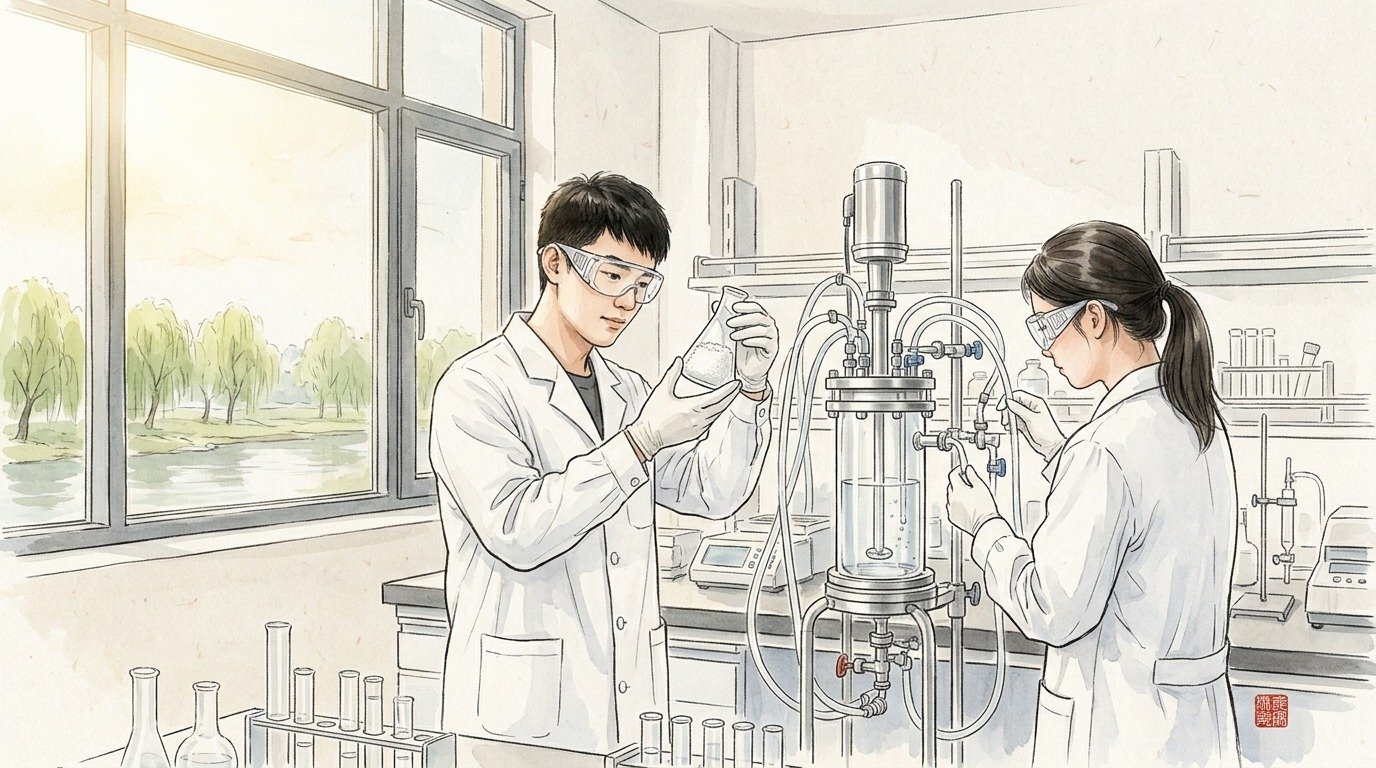
De Novo Starch Synthesis from Carbon Dioxide at the Tianjin Institute
Contents ▾
1. Introduction, bypassing three billion years of photosynthetic evolution
For more than three billion years, the primary energetic foundation of terrestrial life has been oxygenic photosynthesis. From single-celled cyanobacteria in ancient Archean oceans to the sprawling maize and rice belts of the modern world, plants and autotrophic microbes capture photons of sunlight to fix atmospheric carbon dioxide ($text{CO}_2$) and water into energetic carbohydrates. Among these carbohydrates, starch—a complex polymer of glucose units linked by glycosidic bonds in linear chains (amylose) and branched arborisations (amylopectin)—is the pre-eminent caloric staple of humanity, supplying more than fifty percent of all human dietary energy and serving as a critical raw material for paper, textiles, bioplastics, and industrial fermentation.
Yet from an energetic and thermodynamic engineering perspective, biological photosynthesis is remarkably clumsy and inefficient. Evolved through unguided natural selection to ensure organism survival rather than high agricultural throughput, the natural photosynthetic machinery suffers from severe biological bottlenecks. Central among them is the enzyme ribulose-1,5-bisphosphate carboxylase-oxygenase (RuBisCO), the catalytic engine of the Calvin-Benson-Bassham cycle. RuBisCO is notoriously slow, catalysing only three to ten carboxylation reactions per second, and is plagued by a competitive oxygenase reaction (photorespiration) in which it mistakenly binds molecular oxygen ($text{O}_2$), dissipating up to a third of the plant’s absorbed solar energy as metabolic heat.
Compounded by stomatal conductance limits, light-saturation effects, and water evaporation, the net theoretical solar-to-biomass energy conversion efficiency of major C3 and C4 cereal crops (such as rice, wheat, and maize) rarely exceeds one to two percent under real-world field conditions. Consequently, producing starch through traditional agriculture requires immense ecological footprints: billions of hectares of arable land, trillions of cubic metres of fresh irrigation water, and millions of tonnes of synthetic nitrogen and phosphorus fertilisers that pollute global river basins.
In September 2021, an interdisciplinary team of synthetic biologists and chemical engineers at the Tianjin Institute of Industrial Biotechnology (TIB) of the Chinese Academy of Sciences (CAS) announced a biological breakthrough that shattered this ancient paradigm. Publishing in Science, the researchers unveiled the Artificial Starch Anabolic Pathway (ASAP): a cell-free, chemoenzymatic system that synthesises pure, polymeric starch directly from carbon dioxide and green hydrogen, bypassing biological photosynthesis entirely and achieving an enzymatic synthesis rate 8.5 times faster than starch synthesis in maize.
2. The 11-Step engine, de novo chemoenzymatic architecture
In natural plants, converting carbon dioxide into starch requires approximately sixty interconnected metabolic steps regulated through intricate cellular feedback loops. Designing an artificial pathway in a test tube required abandoning the biological architecture of the plant cell and re-engineering carbon condensation from first principles. Directed by Academician Ma Yanhe and Associate Professor Cai Tao, the Tianjin team designed the Artificial Starch Anabolic Pathway (ASAP) as a hybrid chemoenzymatic cascade structured into four distinct functional modules:
1. Module 1: Chemical Hydrogenation ($C_1$ Fixation): Rather than relying on sluggish biological enzymes to fix gaseous $text{CO}_2$, the process initiates with high-efficiency inorganic chemical catalysis. Carbon dioxide gas and hydrogen gas—generated by solar or wind water electrolysis—are fed into a catalytic reactor loaded with a commercial copper-zinc-aluminium oxide catalyst ($text{Cu}/text{ZnO}/text{Al}_2text{O}_3$). At elevated temperature and pressure, the catalyst hydrogenates $text{CO}_2$ into methanol ($text{CH}_3text{OH}$) with an efficiency exceeding eighty-five percent, condensing dilute atmospheric gas into a liquid one-carbon ($C_1$) intermediate.
2. Module 2: Formaldehyde Condensation to Triose ($C_1 to C_3$): In the second step, an alcohol oxidase (AOX) converts methanol into formaldehyde ($text{HCHO}$). The crucial synthetic hurdle was condensing three single-carbon formaldehyde molecules into a three-carbon ($C_3$) sugar without producing toxic side-products. The researchers deployed an engineered enzyme known as formolase (FLS), optimized through computational protein design. Formolase condensed formaldehyde molecules into dihydroxyacetone (DHA).
3. Module 3: Phosphorylation and Hexose Synthesis ($C_3 to C_6$): The three-carbon DHA is phosphorylated by a triokinase (TK) to generate dihydroxyacetone phosphate (DHAP), which is converted into fructose-1,6-bisphosphate (FBP) by fructose-bisphosphate aldolase (FBA). A sequence of engineered phosphatases and isomerases converts FBP into glucose-6-phosphate (G6P), which is then activated by an ADP-glucose pyrophosphorylase to yield adenosine diphosphate glucose (ADP-glucose)—the universal metabolic monomer for starch chain elongation.
4. Module 4: Enzymatic Polymerisation ($C_6 to C_n$): Finally, bacterial starch synthases and branching enzymes polymerise the ADP-glucose monomers into long, continuous alpha-1,4-glycosidic chains (amylose) or introduce alpha-1,6-glycosidic branching points (amylopectin), causing pure, high-molecular-weight starch granules to precipitate out of the clear reaction liquid.
In total, the ASAP pathway condensed the sixty-step biological Calvin cycle down to just eleven core enzymatic reactions. By mining enzymes from thirty-one different biological species—spanning bacteria, yeast, plants, and animals—and redesigning their catalytic pockets through directed evolution, the Tianjin team created an artificial metabolic engine that had never existed in nature.
3. Solving the kinetic bottlenecks, ATP regeneration and spatial separation
Designing an eleven-step cell-free pathway on a computer screen is straightforward; making it function in a single reaction vessel is an extraordinary chemical engineering challenge. When the Tianjin researchers initially mixed all eleven enzymes together in an aqueous solution, they encountered severe thermodynamic and kinetic gridlock. Two primary bottlenecks threatened the viability of the system: product feedback inhibition and cofactor depletion.
First, formaldehyde is a notoriously reactive, cytotoxic compound that rapidly cross-links protein amine groups, inactivating surrounding enzymes. If the local concentration of formaldehyde rose above a few millimoles, the downstream enzymes were destroyed. To solve this, the researchers performed rational directed evolution on the formolase enzyme, introducing targeted mutations into its catalytic active site to enhance its substrate affinity ($K_m$) and catalytic efficiency ($k_{text{cat}}/K_m$) by more than tenfold, ensuring that formaldehyde was converted into DHA as fast as it was produced.
Second, converting triose sugars into polymeric starch requires a continuous, stoichiometric supply of chemical energy in the form of adenosine triphosphate (ATP) and reducing equivalents (NADH). In living cells, ATP is continuously regenerated across mitochondrial and thylakoid membranes by ATP synthase. In an open cell-free beaker, ATP is consumed within minutes, halting the reaction. To overcome this, the Tianjin team engineered a closed-loop ATP regeneration module utilising polyphosphate kinase and cheap inorganic polyphosphate, alongside a formate dehydrogenase regeneration cascade that recycled NADH with a turnover number exceeding one thousand.
Finally, to eliminate thermodynamic competition between intermediate enzymes, the team implemented a two-stage spatial-temporal reaction strategy (designated ASAP 2.0 and ASAP 3.0). In the first stage, chemical hydrogenation and $C_1 to C_3$ condensation proceeded at fifty degrees Celsius in an alkaline environment; the reaction product was then shifted into a second-stage bioreactor maintained at thirty degrees Celsius where hexose activation and starch polymerisation proceeded without enzymatic cross-talk. Through these optimizations, the synthetic starch accumulation rate reached 1.3 grams per litre per hour.
The catalytic linchpin that made the entire pathway possible was the directed evolution of formolase. Naturally occurring aldolases have evolved to bind phosphorylated sugars; they exhibit virtually no natural affinity for simple, uncharged formaldehyde molecules. The Tianjin team took a synthetic formolase enzyme originally conceptualised by computational biologists and subjected it to multiple rounds of semi-rational mutagenesis and high-throughput microfluidic screening. By mutating critical amino acid residues surrounding the thiamine pyrophosphate (TPP) cofactor binding pocket—specifically introducing hydrophobic and aromatic residues to stabilise the thiazolium carbanion intermediate—the researchers created an engineered variant designated FLS-M3. This mutant exhibited an enzymatic catalytic efficiency (kcat/Km) for formaldehyde condensation that was forty-fold higher than the wild-type enzyme, effectively eliminating formaldehyde toxicity before the reactive intermediate could diffuse and damage surrounding cascade enzymes.
4. Verification, identical morphology, amylose ratios, and X-ray spectra
To verify that the white precipitated powder was authentic starch rather than non-specific glycogen or dextrin, the CAS team subjected the synthetic product to rigorous structural characterisation:
1. Iodine Staining Spectrometry: Amylose forms helical complexes with molecular iodine, shifting the absorption spectrum to a deep, characteristic royal blue (absorption peak around 620 nanometres), while branched amylopectin stains reddish-purple (peak around 530 nanometres). The synthetic starch exhibited optical absorption curves identical to high-grade commercial corn starch.
2. High-Performance Liquid Chromatography (HPLC) and NMR: Nuclear magnetic resonance ($^1text{H}$ and $^{13}text{C}$ NMR) confirmed that the synthetic polymer consisted strictly of alpha-D-glucopyranosyl units linked by alpha-1,4 and alpha-1,6 glycosidic bonds, with zero unnatural stereochemical defects. By modulating the ratio of branching enzyme to starch synthase, the chemists demonstrated that they could dial the amylose-to-amylopectin ratio from twenty percent (mimicking standard corn starch) to over seventy percent (mimicking high-amylose specialty starches used in industrial packaging).
3. Scanning Electron Microscopy (SEM) and X-Ray Diffraction (XRD): Scanning electron microscopy revealed discrete, spherical microscopic granules ranging from five to twenty micrometres in diameter, displaying the classic concentric growth rings and Maltese-cross birefringence under polarized light typical of biological starch granules. X-ray powder diffraction patterns exhibited the classic A-type and B-type crystalline polymorphs, confirming that the cell-free enzyme cascade had assembled macroscopic starch granules indistinguishable from cereal grains grown in a farm field.
5. Transformative implications, farmland liberation and planetary exploration
The industrial and ecological ramifications of cell-free starch synthesis are staggering. Under traditional agriculture, producing one kilogram of starch requires hundreds of litres of irrigation water, chemical pesticides, and months of agricultural land occupation vulnerable to floods, droughts, and heatwaves. Under the ASAP paradigm, starch production is transformed from seasonal agriculture into an enclosed, continuous chemical engineering process.
According to calculations published by TIB CAS, if the overall chemoenzymatic conversion efficiency can be scaled to commercial viability, a standard one-cubic-metre industrial bioreactor could theoretically produce the annual starch yield of approximately five mu (one-third of a hectare) of conventional maize farmland. Scaling this technology to factory scale could potentially liberate over ninety percent of arable land currently devoted to cereal crops, enabling vast reforestation, biodiversity recovery, and total insulation of human food supplies from the shocks of global climate change.
Beyond terrestrial agriculture, cell-free starch synthesis provides the foundational biochemical technology required for deep-space planetary colonisation. On Mars, the atmosphere consists of ninety-five percent carbon dioxide, while subsurface permafrost provides abundant water for electrolytic hydrogen generation. Hauling tonnes of food across interplanetary space or attempting to cultivate fragile cereal crops in radiation-shielded Martian greenhouses is energetically prohibitive. A compact, cell-free chemoenzymatic reactor running on solar power could continuously generate dietary carbohydrates and industrial bioplastics directly from the local Martian atmosphere, solving the caloric arithmetic of long-duration interplanetary exploration.
Thermodynamic efficiency calculations underscore why cell-free chemoenzymatic synthesis represents an evolutionary inflection point. In traditional agricultural cultivation, the theoretical solar-to-biomass energy efficiency is constrained by the absorption spectrum of chlorophyll (which captures only photosynthetically active radiation between 400 and 700 nanometres, roughly 43 percent of solar irradiance), photochemical quantum yields, RuBisCO oxygenation losses, and dark respiration maintenance costs, resulting in a net real-world solar-to-starch conversion efficiency of roughly 0.5 to 1.0 percent in commercial corn.
Under the ASAP pathway, solar energy capture is uncoupled from biology. Commercial photovoltaic panels convert solar photons into electricity with an efficiency exceeding twenty-two percent. Modern proton-exchange membrane (PEM) water electrolysers convert that electricity into green hydrogen with eighty percent efficiency. When coupled with the chemoenzymatic condensation reactor, the total system achieves a theoretical solar-to-starch energy conversion efficiency exceeding seven to eight percent—nearly ten times higher than the photosynthetic efficiency of maize. In thermodynamic terms, the scientists at Tianjin did not merely replicate biology; they surpassed it by an order of magnitude.
6. Conclusion, from proof of concept to industrial reality
Despite its historic significance, cell-free starch synthesis currently remains at the advanced laboratory and pilot demonstration stage. Significant technical hurdles must be conquered before synthetic starch competes economically with bulk agricultural corn (which trades at a few hundred dollars per tonne). Central among these challenges is the cost of enzyme production: enzymes degrade over hours or days, requiring immobilization on magnetic nanoparticles or graphene oxide supports to allow multi-cycle reuse. Furthermore, the overall energy efficiency from solar electricity to final carbohydrate must be pushed from its current experimental baseline toward twenty percent.
To accelerate commercialization, the Chinese government established the National Technology Innovation Center for Synthetic Biology in Tianjin, investing billions of Yuan to scale up multi-tonne bioreactor cascades and engineer ultra-stable thermophilic enzymes. Alongside China’s concurrent breakthroughs in artificial protein synthesis, microbial single-cell protein production from industrial exhaust gases, and genetic engineering, the synthesis of starch from $text{CO}_2$ marks the transition of synthetic biology from an analytical science into a transformative manufacturing force.
By liberating the caloric foundation of human civilization from the biological constraints of the leaf, the seed, and the soil, the scientists of Tianjin demonstrated that humanity’s relationship with nature is entering a new epoch. In a world challenged by environmental degradation, population pressure, and planetary boundaries, the ability to weave air and sunlight directly into food stands as one of the supreme technological triumphs of the 21st century.
Sources
Share this article
References
- Science — Cell-free chemoenzymatic starch synthesis from carbon dioxide (September 2021). The landmark paper by Cai Tao, Ma Yanhe, and the TIB CAS research group detailing the 11-step ASAP pathway.
- Nature News — Chinese scientists synthesize starch from carbon dioxide (September 2021). Global scientific reporting on the kinetics and agricultural implications of the cell-free enzyme cascade.
- Science Bulletin — Artificial photosynthesis of starch: Beyond natural biology (2021). Comprehensive biochemical review comparing ASAP against the natural Calvin-Benson-Bassham cycle.
- Trends in Biotechnology — Chemoenzymatic Carbon Fixation: Advances and Prospects (2022). Technical evaluation of directed evolution on formolase and ATP cofactor regeneration cascades.
- Science China Life Sciences — The dawn of artificial starch synthesis from CO2 (2022). In-depth structural and physicochemical characterization of synthetic amylose and amylopectin granules.
- PNAS — Synthetic biology routes for biochemical carbon capture (2020). Theoretical foundations of non-natural carbon fixation pathways bypassing RuBisCO inefficiencies.
- Nature Catalysis — Chemoenzymatic cascades for solar chemical manufacturing (2022). Industrial chemical engineering analysis of scaling heterogeneous methanol catalysts with enzymatic reactors.
- Molecular Plant — Synthetic biology reshaping the future of food production (2021). Agricultural economics assessment of land and water conservation potentials of de novo carbohydrate synthesis.
Related reading

Terafab and the Orbital Foundry
In March 2026 Tesla and SpaceX unveiled Terafab, an ambition to build logic, memory, and advanced packaging in Texas at a scale of one terawatt of compute hardware a year. Behind the Kardashev-scale rhetoric lies a far more revealing story of Intel 14A physics, stacked Texas tax filings, radiator thermodynamics in vacuum, and the hard arithmetic of moving artificial intelligence off the grid.
Against the Grain
The lives and work of thirteen Jewish women scientists, from Gerty Cori and Lise Meitner to Ada Yonath and Shafi Goldwasser. Each of them did foundational work in physics, chemistry, biology, medicine, mathematics, astronomy or computing while facing barriers of sex and antisemitism.

The House of Wisdom in Baghdad and the Sages of the Middle East
In the summer of 762 the second Abbasid ruler, Abu Jafar al-Mansur, chose a site on the west bank of the Tigris, close to the point where that river runs nearest to…