Science
The 1965 Total Synthesis of Crystalline Bovine Insulin in Shanghai
Contents ▾
1. Introduction, Friedrich Wöhler’s heirs and the threshold of life
In 1828, German chemist Friedrich Wöhler synthesised urea from ammonium cyanate, demolishing the ancient vitalist doctrine that organic chemical compounds could only be generated through the mysterious “vital force” (vis vitalis) of living organisms. Yet for more than a century following Wöhler’s discovery, a far higher and more formidable vitalist boundary persisted: the protein. While chemists mastered the total synthesis of carbohydrates, lipids, dyes, and vitamins, proteins—the complex macromolecular engines of cellular life, enzymatic catalysis, and metabolic regulation—remained an impenetrable biological black box.
In 1955, British biochemist Frederick Sanger at the University of Cambridge accomplished an epochal milestone by determining the complete primary amino acid sequence of bovine insulin, proving that proteins are not amorphous colloids, but defined linear polymers composed of specific amino acids arranged in precise sequence. For this achievement, Sanger was awarded the 1958 Nobel Prize in Chemistry. Sanger revealed that bovine insulin consists of fifty-one amino acids organised into two polypeptide chains: an A-chain containing twenty-one residues, and a B-chain containing thirty residues, stitched together in three-dimensional space by two interchain disulfide bonds (between cysteine residues A7–B7 and A20–B19) and an internal intrachain disulfide ring within the A-chain (between A6 and A11).
Determining the sequence was one thing; synthesising it from scratch was considered an impossibility. Leading international biochemists, including Sanger himself and American peptide pioneer Vincent du Vigneaud (who had synthesised the tiny nine-amino-acid peptide hormone oxytocin in 1953), believed that chemically synthesising a functional, fifty-one-residue protein with three specific disulfide bonds was decades beyond human capability. In nature, four cysteine residues can theoretically pair into three disulfide bonds in twelve distinct topological combinations; six cysteines can form seventy-five combinations. Without the cellular machinery of ribosomes, endoplasmic reticulum, and enzyme chaperones, random oxidation in a beaker was assumed to produce an inactive, scrambled tangle of misfolded peptide polymers.
Yet in the summer of 1958, an impoverished nation struggling through the political and economic turbulence of the Great Leap Forward decided to attempt what the global biochemical establishment deemed impossible. In laboratories in Shanghai and Beijing, Chinese scientists launched a coordinated national campaign to achieve the world’s first total chemical synthesis of crystalline bovine insulin.
2. The coalition of 1958, Marshalling Shanghai’s chemical elite
The proposal to synthesise insulin originated in July 1958 at the Shanghai Institute of Biochemistry of the Chinese Academy of Sciences (CAS). In the feverish atmosphere of the Great Leap Forward, when national institutions were urged to surpass Western scientific benchmarks, Director Wang Yinglai (王应睐) convened an extraordinary seminar of young, foreign-trained biochemists. The team included Zou Chenglu (邹承鲁), who had earned his doctorate at Cambridge under the renowned enzymologist David Keilin; Shen Zhaowen; Niu Jingyi; and Cao Tianqin. Together, they established the research objective under the classified designation Project 601 (or simply “Item 601”).
Recognising that the undertaking required organic chemical synthesis capabilities far beyond the scope of a single biochemistry institute, Wang Yinglai forged a grand inter-institutional alliance. He partnered with the Shanghai Institute of Organic Chemistry (CAS), directed by Wang You (汪猷), and the Department of Chemistry at Peking University in Beijing, led by Professor Xing Qiyi (邢其毅). Over two hundred researchers, technicians, and university students were mobilised into a coordinated scientific division of labour.
The strategy was divided into three interdependent tactical phases: 1. Recombination: Cleave natural bovine insulin into separate A and B chains, and discover an in vitro chemical mechanism to re-oxidise and re-combine them back into biologically active insulin. 2. B-Chain Synthesis: Synthesise the thirty-residue B-chain peptide purely from individual laboratory amino acids. 3. A-Chain Synthesis: Synthesise the twenty-one-residue A-chain peptide purely from laboratory amino acids, followed by final synthetic combination.
3. The recombination breakthrough, proving spontaneous folding
The entire project hinged on whether isolated A and B chains could spontaneously find each other and form the correct disulfide bridges in a test tube. If isolated chains could not reassemble in vitro, then chemically synthesising them would be an exercise in futility. In 1959, Zou Chenglu and his research team at the Shanghai Institute of Biochemistry tackled this question.
Zou treated pure natural bovine insulin with sodium in liquid ammonia or with excess sodium sulfite and mercaptoethanol, cleaving all three disulfide bonds and separating the protein into stable, reduced A and B chains. He then dialysed away the reducing agents, exposing the mixture of separate chains to air in a mildly alkaline aqueous solution (pH 10.6) at zero degrees Celsius. To the astonishment of the scientific community, the re-oxidised solution regained measurable biological activity, initially at five to ten percent, and subsequently optimised to fifty to sixty percent of the original native insulin potency.
This was a biological discovery of the first magnitude. Zou Chenglu had experimentally demonstrated that the primary linear amino acid sequence of a protein carries within itself all the necessary stereochemical and thermodynamic information required to fold into its native, three-dimensional functional conformation. In the West, American biochemist Christian Anfinsen was independently conducting similar renaturation experiments on ribonuclease A, for which he was awarded the 1972 Nobel Prize in Chemistry. Zou’s recombination of insulin—a far more complex two-chain protein with multiple interchain bonds—anticipated and corroborated Anfinsen’s thermodynamic hypothesis, providing the theoretical green light for total chemical synthesis.
4. Classical solution Chemistry, The agony of protecting groups
In the early 1960s, automated solid-phase peptide synthesis (invented by Bruce Merrifield in 1963) did not exist in China. Every single peptide coupling reaction had to be conducted via classical solution-phase peptide synthesis. In solution synthesis, linking two amino acids requires chemically “protecting” reactive functional side groups (such as amino, carboxyl, thiol, and hydroxyl groups) with bespoke organic protecting groups—such as carbobenzoxy (Z), tert-butyloxycarbonyl (Boc), and benzyl ester groups—to ensure that only the desired alpha-amino and alpha-carboxyl groups form a peptide bond.
After each single coupling reaction, the protecting groups had to be selectively cleaved without destroying the nascent peptide backbone, and the intermediate peptide had to be painstakingly isolated, crystallized, and purified. As the peptide chains grew longer, intermediate fragments became increasingly hydrophobic and insoluble, precipitating out of solution as unmanageable gels. Chinese chemists had to synthesize hundreds of kilograms of chemical reagents, solvents, and amino acids from basic raw materials, purifying them through fractional distillation columns and recrystallisation.
The thirty-residue B-chain was conquered first by Niu Jingyi’s team at the Shanghai Institute of Biochemistry in late 1964. By assembling smaller protected peptide blocks (fragments 1–8, 9–16, 17–20, and 21–30) using dicyclohexylcarbodiimide (DCC) and azide coupling methods, they constructed the complete synthetic B-chain. When combined with natural A-chain, the synthetic B-chain successfully yielded active insulin with crystalline morphology.
The twenty-one-residue A-chain proved far more treacherous. Containing four cysteine residues, including the tight intrachain A6–A11 disulfide loop, the A-chain suffered from severe aggregation and solubility collapse. In a heroic joint effort between Wang You’s Shanghai Institute of Organic Chemistry and Xing Qiyi’s Peking University team, chemists synthesised twelve individual sub-fragments, coupling them into a complete twenty-one-residue protected A-chain by the spring of 1965.
5. 17 september 1965, the first synthetic crystals of life
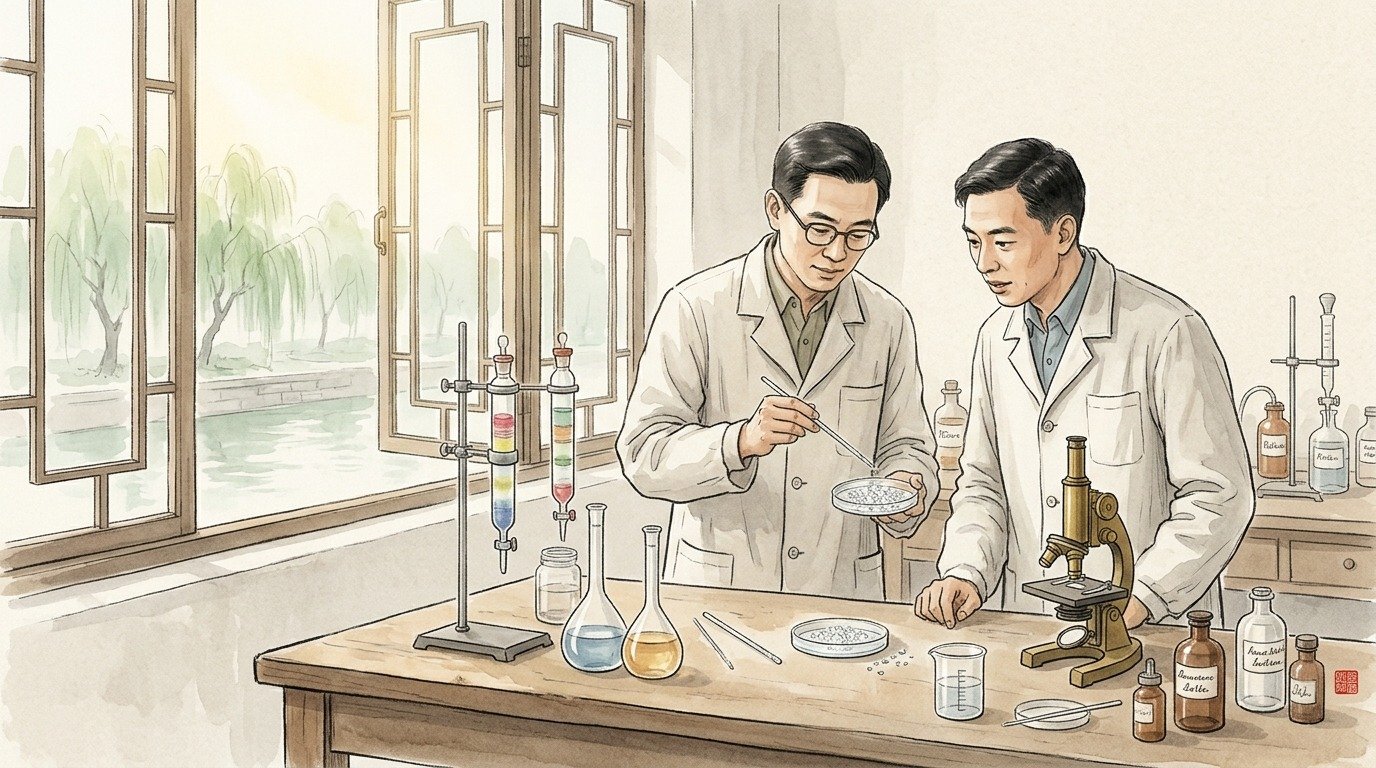
On the morning of 17 September 1965, the culmination of seven years of scientific struggle took place in a temperature-controlled laboratory at the Shanghai Institute of Biochemistry. Biochemist Du Yucang and his colleagues took the completely synthetic A-chain, synthesized purely from laboratory chemicals by Wang You and Xing Qiyi, and combined it with the completely synthetic B-chain synthesized by Niu Jingyi.
The chains were dissolved in liquid ammonia, treated with sodium to remove all benzyl protecting groups, converted to stable S-sulfonated forms, and mixed in stoichiometric ratios. Under strict pH control, the mixture was reduced with mercaptoethanol and exposed to atmospheric oxygen at zero degrees Celsius to allow spontaneous oxidative folding. After extensive purification through Sephadex column chromatography, zinc acetate was added to the solution.
Under the optical microscope, clean, rhombohedral zinc-insulin crystals began to precipitate from the clear liquid. The crystals exhibited identical morphological symmetry to natural bovine insulin. When injected into fasted white mice, the synthetic product induced classic hypoglycaemic insulin shock and convulsions at doses identical to natural insulin, an effect immediately reversed upon glucose injection. The product was verified through paper chromatography, paper electrophoresis, and enzymatic fingerprinting. The People’s Republic of China had achieved the first total chemical synthesis of a biologically active protein in human history.
6. International Shockwaves and the 1979 Nobel deliberations
In November 1965, the achievement was published as a brief preliminary communication in Chinese Science Bulletin, followed in April 1966 by a comprehensive twenty-page paper in the English-language journal Scientia Sinica under a collective twenty-one-author byline headed by Wang Yinglai. Western and Soviet scientific establishments reacted with stunned disbelief. Teams in the United States led by Panayotis Katsoyannis at the University of Pittsburgh and in West Germany led by Helmut Zahn at the RWTH Aachen University had been racing toward insulin synthesis for years, but both had produced only crude, non-crystallised reaction mixtures with fractional biological activity. China had delivered pure, crystalline, biologically active protein.
Prominent international scientists traveled to Shanghai to inspect the evidence. When Soviet Nobel laureate Nikolai Semenov and British crystallographer John Desmond Bernal visited the Shanghai Institute of Biochemistry, they examined the mouse convulsion assays and crystalline diffraction patterns, verifying the authenticity of the breakthrough. In 1972, Nobel laureate Christian Anfinsen visited China, declaring that the Chinese synthesis was a watershed moment in chemical history.
In 1979, following China’s diplomatic opening to the West, the Nobel Committee for Chemistry formally solicited nominations for the synthesis of insulin. However, the Nobel statutes strictly prohibit dividing a single prize among more than three individuals. The Chinese leadership convened an extraordinary internal evaluation to select a single representative from among Wang Yinglai, Zou Chenglu, Wang You, Niu Jingyi, and Xing Qiyi. In keeping with the collective socialist ethos of the era, the consensus was fraught; while Niu Jingyi was ultimately selected as the sole candidate, the nomination arrived late, and the Nobel Committee chose not to award the prize for insulin synthesis, awarding the 1984 prize instead to Bruce Merrifield for automated solid-phase synthesis.
7. Conclusion, the enduring foundation of Chinese molecular biology
The total synthesis of bovine insulin in 1965 stands as one of the most remarkable anomalies in modern scientific history: a world-first breakthrough in frontier molecular biology achieved by a developing nation isolated by Cold War embargoes and convulsed by domestic political turmoil. It proved that Chinese scientists could organise and execute complex multidisciplinary research campaigns capable of defeating the wealthiest scientific establishments in the West.
More importantly, Project 601 established the institutional and intellectual nursery from which modern Chinese biotechnology emerged. The young researchers who mastered peptide chemistry and protein folding in Shanghai in the 1960s—Zou Chenglu, Wang Yinglai, Wang You, and their students—became the founding leaders of the Chinese Academy of Sciences in the post-Mao reform era, establishing the National Center for Gene Research, the Shanghai Institutes for Biological Sciences, and the structural biology programs that dominate contemporary molecular biophysics. From the test tubes of 1965 to today’s cutting-edge cryo-electron microscopy and synthetic biology labs, the spirit of insulin synthesis confirmed that the fundamental architecture of life is written in a chemical language that human intellect can decipher, disassemble, and recreate.
Sources
8. Timeline
In 1828, German chemist Friedrich Wöhler synthesised urea from ammonium cyanate, demolishing the ancient vitalist doctrine that organic chemical compounds could only be generated through the mysterious “vital force” ( vis vitalis ) of living organisms.
Leading international biochemists, including Sanger himself and American peptide pioneer Vincent du Vigneaud (who had synthesised the tiny nine-amino-acid peptide hormone oxytocin in 1953), believed that chemically synthesising a functional, fifty-one-residue protein with three specific disulfide bonds was decades beyond human capability.
In 1955, British biochemist Frederick Sanger at the University of Cambridge accomplished an epochal milestone by determining the complete primary amino acid sequence of bovine insulin , proving that proteins are not amorphous colloids, but defined linear polymers composed of specific amino acids arranged in precise sequence.
In 1959, Zou Chenglu and his research team at the Shanghai Institute of Biochemistry tackled this question.
[8] PNAS — Thermodynamic Aspects of Protein Folding and Disulfide Bond Formation (1961).
In the early 1960s, automated solid-phase peptide synthesis (invented by Bruce Merrifield in 1963) did not exist in China.
The thirty-residue B-chain was conquered first by Niu Jingyi’s team at the Shanghai Institute of Biochemistry in late 1964.
The total synthesis of bovine insulin in 1965 stands as one of the most remarkable anomalies in modern scientific history: a world-first breakthrough in frontier molecular biology achieved by a developing nation isolated by Cold War embargoes and convulsed by domestic political turmoil.
In 1972, Nobel laureate Christian Anfinsen visited China, declaring that the Chinese synthesis was a watershed moment in chemical history.
In 1979, following China’s diplomatic opening to the West, the Nobel Committee for Chemistry formally solicited nominations for the synthesis of insulin.
[3] Trends in Biochemical Sciences — The Total Synthesis of Insulin: A Personal Account (2005).
[7] History and Technology — The Politics of Making Insulin in Mao’s China (2006).
Share this article
References
- Scientia Sinica — Total Synthesis of Crystalline Bovine Insulin (April 1966). The definitive landmark paper by Wang Yinglai and the twenty-one-author coalition detailing the complete chemical synthesis and crystallization.
- Nature — How China synthesized insulin in 1965 (September 2020). Historical retrospective on Project 601, political context during the Great Leap Forward, and international scientific impact.
- Trends in Biochemical Sciences — The Total Synthesis of Insulin: A Personal Account (2005). Zou Chenglu’s firsthand historical account of the oxidative recombination experiments and thermodynamic folding.
- Molecular Cell — Protein Folding and the Lessons of Insulin Synthesis (2005). Biophysical analysis of Zou Chenglu’s recombination experiments anticipating Anfinsen’s thermodynamic hypothesis.
- Science China Life Sciences — The 50th Anniversary of the Total Synthesis of Crystalline Bovine Insulin (2015). Memorial volume detailing the organic synthesis of A and B chains at Shanghai and Peking University.
- Nobel Lecture in Chemistry — The Chemistry of Insulin by Frederick Sanger (December 1958). Detailing the primary amino acid sequence determinations of A and B chains.
- History and Technology — The Politics of Making Insulin in Mao’s China (2006). Historical analysis of the collective socialist organization of science and the 1979 Nobel Prize deliberations.
- PNAS — Thermodynamic Aspects of Protein Folding and Disulfide Bond Formation (1961). Christian Anfinsen’s foundational papers verifying spontaneous tertiary structure folding.
Related reading

Terafab and the Orbital Foundry
In March 2026 Tesla and SpaceX unveiled Terafab, an ambition to build logic, memory, and advanced packaging in Texas at a scale of one terawatt of compute hardware a year. Behind the Kardashev-scale rhetoric lies a far more revealing story of Intel 14A physics, stacked Texas tax filings, radiator thermodynamics in vacuum, and the hard arithmetic of moving artificial intelligence off the grid.
Against the Grain
The lives and work of thirteen Jewish women scientists, from Gerty Cori and Lise Meitner to Ada Yonath and Shafi Goldwasser. Each of them did foundational work in physics, chemistry, biology, medicine, mathematics, astronomy or computing while facing barriers of sex and antisemitism.

The House of Wisdom in Baghdad and the Sages of the Middle East
In the summer of 762 the second Abbasid ruler, Abu Jafar al-Mansur, chose a site on the west bank of the Tigris, close to the point where that river runs nearest to…