History
Wu Zetian, Emperor of the Zhou
Contents ▾
1. At a glance
Empress Wu Zetian ruled the Chinese empire as emperor in her own right for just over fifteen years, from 690 to 705, in what is conventionally called the Zhou dynasty interregnum. She was the only woman in Chinese history to take the imperial title, not as regent, not as empress dowager, but as Huangdi, the Son of Heaven. By the time she was overthrown in a palace coup in 705, she had destroyed most of the surviving Tang imperial line, restructured the civil service around a network of Buddhist loyalists, and presided over a regime that was both more authoritarian and more ideologically coherent than the Tang dynasty had been for two generations. Her reign changed the political grammar of later Chinese history, even though her own dynasty did not survive her.
2. Early life
Wu Zhao, who would later take the name Wu Zetian, was born in 624, around the same year as the founding of the Tang dynasty itself. Her father, Wu Shiyue, was a minor official in the early Tang government, descended from a family of the kind that the Tang court liked to recruit into its service. The Wu family was not from the great aristocratic houses of the early Tang, but they were educated, and Wu Zhao grew up in a household where the classics and the arts were cultivated. Her mother is sometimes described in later sources as a woman of unusual intelligence, and it is possible that the emphasis on learning in the household came from her.
In the early 630s, when Wu Zhao was still a young girl, her father died and the family moved to a more modest position. The young Wu Zhao was, by many accounts, a striking person: tall, full-faced, with the kind of presence that several of the early Tang chronicles remember. She was, by some accounts, also unusually well read. The later histories record that she was admitted to the imperial palace in the early 640s as a low-ranked palace attendant. The Tang harem of the time was a complex institution with many ranks and many routes to promotion, and Wu Zhao entered it at the bottom.
From the early 640s to the early 650s, Wu Zhao was in the palace as one of the lower-ranked attendants of Emperor Taizong. The harem attendants of a deceased emperor were, by convention, expected to withdraw from public life and live out their days in a convent or in retirement. The convention was usually enforced, but it was not absolute. When Taizong died in 649 and was succeeded by his son Li Zhi, the future Emperor Gaozong, the young Wu Zhao was one of several lower-ranked women who were assigned to the new empress’s household. In 651, she was sent to the new palace of Gaozong as one of his concubines, with a rank that placed her well below the established empress and the senior consorts.
3. Rise to power
Wu Zhao’s rise to power is one of the most closely studied political ascents in Chinese history. The main sources are the official Tang histories, completed in the early eighth century, and the unofficial court chronicles that survive in fragments. The accounts agree on the broad lines but disagree on the motives and the details.
By the early 650s, Wu Zhao had attracted the attention of Emperor Gaozong. The reasons for the attraction are variously explained. Some accounts emphasise her looks, others her intelligence, others her ability to manage the court’s complex etiquette. What is clear is that she bore her first son, Li Hong, in 652, and that by 654 she had been promoted to the rank of zhaoyi, one of the nine senior concubines. The empress at that time was Empress Wang, the daughter of a senior official, who had borne no children. Empress Wang was, by the early Tang accounts, childless and in formal ways. Wu Zhao’s promotion was a direct challenge to her position.
The turning point came in 656, when Wu Zhao bore a second child. The empress Wang had by then become estranged from Gaozong, and the senior consort, Consort Xiao, had also lost favour. In 656, Wu Zhao was promoted further, and in 660, in the aftermath of a succession of palace controversies, the empress Wang was deposed and Wu Zhao was made empress in her stead. The next decade saw the consolidation of Wu Zhao’s position. She worked actively with the chancellors of the time, including the senior minister Li Yifu, and she had a network of supporters among the officials who owed their advancement to her.
In 660, Emperor Gaozong began to suffer from a chronic illness that progressively weakened his eyesight and his capacity to handle the day-to-day business of government. Wu Zhao, as empress, increasingly took over the writing of the imperial responses and the management of court business. By the late 660s, she was, in practice, the chief executive of the imperial government. The convention of the time was that an empress might act in this capacity when the emperor was incapacitated, and the regency was not, in itself, controversial. What was controversial was the direction in which Wu Zhao used her regency.
4. The Empress Dowager years, 683 to 690
The first stage of the post-Gaozong succession was the most dangerous. By the Chinese imperial tradition, the late emperor’s eldest surviving son should have mounted the throne immediately on the death of his father. Gaozong’s eldest son Li Hong had predeceased him in 675, and the next eldest, Li Xián, had been created crown prince in 680 only to be deposed in 681 in favour of his younger half-brother Li Xi. Li Xi, who took the throne name Emperor Zhongzong, was the son of Empress Wu and was twenty-eight when his father died in 683. Li Zhongzong had been on the throne less than two months when Wu Zhao declared him unfit, deposed him, and exiled him to Luoyang on the grounds that he had attempted to hand over imperial powers to his father-in-law, Wei Shifu. The Wei family was put to death, Li Zhongzong’s wife (Wu Zhao’s daughter) was deposed, and a younger son of Empress Wu, Li Dan, was elevated to the throne as Emperor Ruizong.
The deposed Li Zhongzong did not in fact intend to do anything so bold. The accusation was almost certainly a pretext. What had really happened was that the consort Wei Shifu had said something to a court official that suggested the young emperor’s intention to share power with his father-in-law. The remark was reported to Wu Zhao through the inner palace intelligence network she had spent the previous fifteen years constructing. Wu Zhao responded with the ruthless efficiency she had by then perfected: the remark became an act of treason, the act became a deposition, and the deposition became the elevation of her younger son. Li Dan, the new Ruizong, was a mild man of Buddhist sympathies who had no ambition to govern. Once on the throne, he was given the nominal dignity of emperor and Wu Zhao took the practical direction of the dynasty under the title Empress Dowager and chief regent.
The Empress Dowager years are striking in retrospect not just for their ruthlessness but for the way they were carefully framed. Wu Zhao did not at first claim to rule in her own name. She ruled through her sons, first the ill Zhongzong and then the nominal Ruizong. She sat behind the imperial throne at audiences and presided over the imperial examinations in 685, 686, 690, and 691, issuing the literary questions and ranking the candidates in person. The formal edicts went out in the emperor’s name. The petitions that came back to the throne were addressed to her. The ministers who served her were not technically her officials but the emperor’s officials. The whole arrangement was a careful staged performance of imperial regency that lasted for seven years and gave the dynasty time to grow accustomed to her exercise of power before the moment when she would openly take the throne.
This period was also the high-water mark of her political violence. The Wu Zhao regime used the period to settle the long-running feud with the senior Tang aristocracy. The members of the seven great families of the early Tang – the Li, Lu, Xiao, Cui, Zheng, Wang, and Dou houses – had, by the late seventh century, an entrenched hold on the senior offices of the dynasty, and Wu Zhao felt, with some justice, that the regent-emperor’s government would always be in their hands unless she built a counter-elite. She recruited openly from the lower aristocracy, the frontier military officer class, and the Buddhist establishment. The counter-elite served her loyally because it had no other source of patronage. In 685, she instituted the “court visitors’ barn” (tongtian), a small, secretive office whose staff were encouraged to denounce fellow officials and ordinary citizens for any unorthodoxy. The system produced a stream of accusations, and the accusations produced a stream of convictions. The most famous political disaster of the Empress Dowager years was the literary inquisition of 689 to 690, which destroyed the careers of some of the senior Tang officials and their families. The historical record of the period, even in the standard Tang histories, is suspicious: the historians’ sources were largely Chinese-bureaucratic survivors, and the surviving confessions may or may not fully represent the actual allegations.
5. Buddhist legitimation
The political use of Buddhism by Wu Zhao is one of the most striking features of her reign, and it has been the subject of intense scholarly study for more than a century. The central text is the Great Cloud Sutra, a Buddhist scripture that was circulating in Chinese by the late 600s. The Great Cloud Sutra describes a female incarnation of the Buddha, identified by name in the Chinese translation as Maitreya, who is reincarnated as a female ruler. The Chinese translation of the sutra includes a prophecy that this female ruler will establish a new dynasty and rule as a Buddhist monarch.
The Great Cloud Sutra was, until the twentieth century, generally assumed to be a translation of an originally Indian text. Modern scholarship has shown that the sutra is most likely a Chinese composition, produced in the late Northern and early Sui dynasties and translated into a form of literary Chinese that imitated the style of older translations. The text is not a single composition but a compilation, and the prophecies about a female ruler are added to a translation of an older Indian Buddhist text. The Chinese additions appear to have been written with the explicit purpose of providing a Buddhist legitimation for a Chinese female ruler.
Whether Wu Zhao herself ordered the production of the Great Cloud Sutra is a question that cannot be answered definitively. The traditional account, in the Old Tang History and the New Tang History, is that the text was produced by a Buddhist monk named Xue Huaiyi, who had been a lover of Wu Zhao in the early years of her regency. Xue Huaiyi was a politically active monk who had connections at court and who was willing to work with Wu Zhao on a project of Buddhist legitimation. The traditional account also says that the sutra was distributed to the monasteries of the capital and the provinces in 690, just before Wu Zhao’s formal assumption of the imperial title.
Whatever the precise authorship of the Great Cloud Sutra, the text was the cornerstone of a much larger Buddhist project. Wu Zhao’s government promoted the building of Buddhist monasteries, the translation of new Buddhist texts, and the inclusion of Buddhist monks in the imperial ritual. The most striking of the new Buddhist buildings was the Ming Qiu Public Foundation, a large monastic complex in Luoyang that became, in the early years of the Zhou dynasty, a centre of political power. The Ming Qiu Foundation was, in effect, the ideological centre of the new Zhou government, and it was the place where the most important political rituals of the Zhou interregnum were performed.
6. The Zhou dynasty
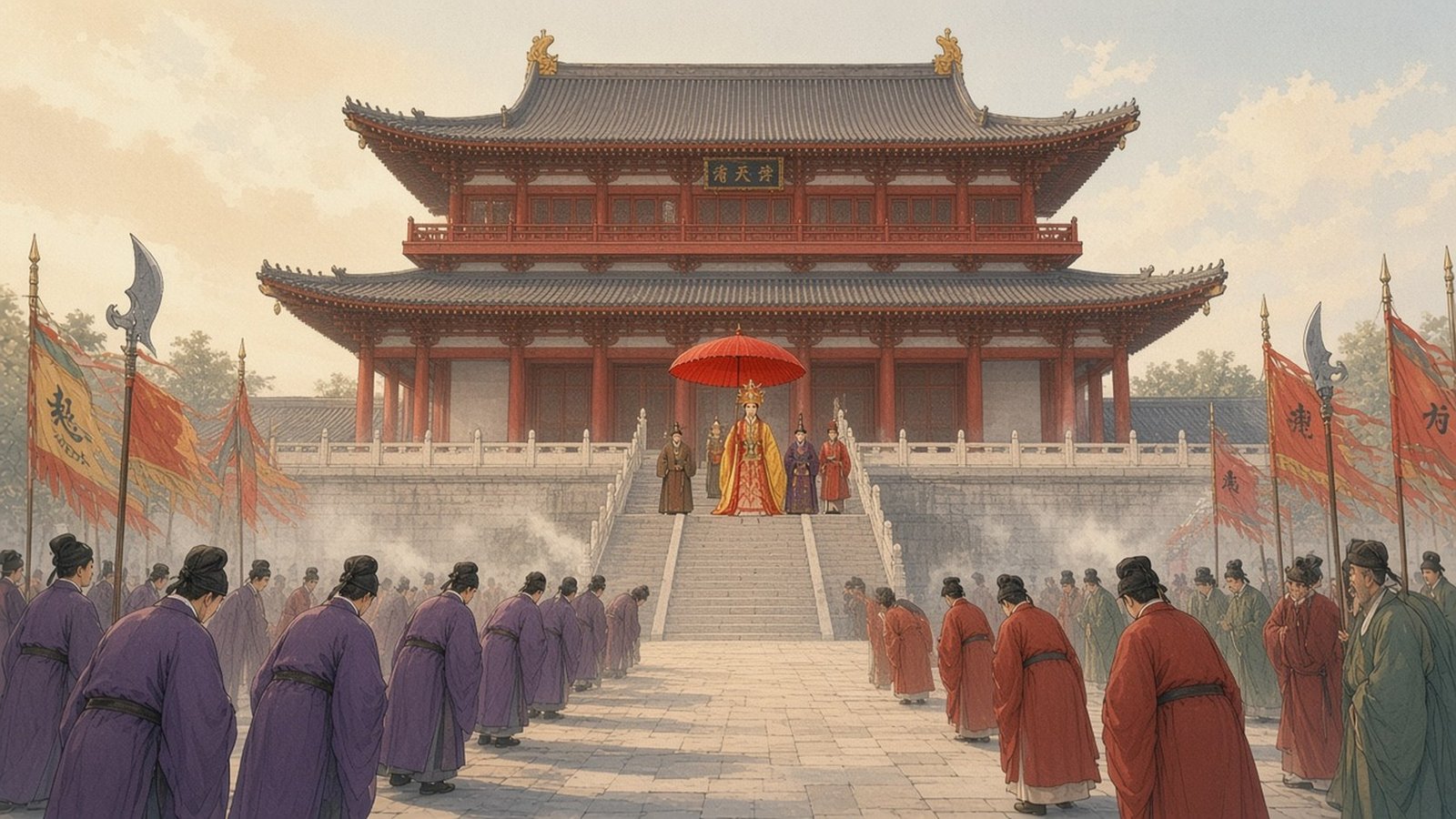
In 690, Wu Zhao took the imperial title and proclaimed the establishment of a new dynasty, the Zhou, which would rule in place of the Tang. The act was, in formal terms, a coup. The Tang ruling house, descended from the Li family that had founded the dynasty in 618, was pushed aside, and a new ruling house, the Wu, was proclaimed. The change of dynasty was justified, in the public rhetoric of the time, by the prophecy of the Great Cloud Sutra. The new dynasty was, in effect, a Buddhist monarchy, and its ideological basis was the prophecy that a female ruler would establish a new era in the last days of the present age.
The actual government of the Zhou interregnum was a complex of personal, ideological, and bureaucratic elements. Wu Zhao was, by the late 680s, an experienced political operator with a network of supporters among the officials of the Tang government and a network of allies among the Buddhist clergy. The new Zhou government was built on this network. The chancellors of the new dynasty were chosen partly for their administrative ability and partly for their loyalty to Wu Zhao personally. The most senior ministers of the Zhou period were the chancellor Wei Juyuan, the chancellor Li Jingye, the chancellor Yao Yuanzhi, and the chancellor Li Zhimian.
The early years of the Zhou interregnum saw a number of striking innovations. The civil service examinations were reformed, with the addition of a new section on the works of the Buddha. The new examinations were designed to test the loyalty of the candidates to the new dynasty, and they were used to bring into the government a new generation of officials who had been educated in the new Buddhist schools. The examination system was also used to limit the influence of the great aristocratic families, who had dominated the Tang government in the seventh century. The new officials were drawn from less established families, and they owed their advancement to the Zhou government.
The Zhou interregnum also saw a striking expansion of the Buddhist monastic establishment. New monasteries were built in the capital and the provinces. New Buddhist texts were translated. The monastic population grew. The state provided substantial support for the Buddhist monastic system, and the monks in turn provided ideological support for the Zhou government. The relationship between the state and the Buddhist church was, in the early Zhou, closer than it had been at any previous point in Chinese history.
7. The reign, year by year
The reign of Wu as emperor lasted from 690 to 705. The Zizhi tongjian divides the period into several phases. The first phase, 690 to 692, was the consolidation of the Zhou. The loyalist opposition was suppressed. The Tang princes were either killed or exiled. The chancellors of the early reign were Wu’s close associates: Li Zhi, the chief of the secretariat, and the censor Lai Junchen, who directed a system of secret accusations. The censorship and the system of secret police were the most repressive instruments of the early Zhou.
The second phase, 692 to 700, was a period of relative stability. Lai Junchen was dismissed in 694 and later killed. The chancellors of the period included Zhou Xing, the architect of the secret police, and Di Renjie, who would later become famous as the model of Tang judicial wisdom. The bureaucracy continued to function. The examination system continued to recruit officials. The provincial governors continued to govern. The state maintained the fubing militia system and the provincial commands.
The third phase, 700 to 705, saw the succession question come to a head. Wu’s sons, the former Tang princes, had been demoted but not all killed. Her nephews, the sons of her brother Wu Chengsi and Wu Yuanshuang, became powerful figures in the court. The choice between a son and a nephew as heir was not merely personal. A son would restore the Tang. A nephew would continue the Zhou. Wu alternated between promoting her sons and her nephews, without committing to either, for most of the period.
In 705, Wu fell ill. A palace coup, led by the chancellor Zhang Jianzhi and the imperial guard general Cui Xuanwei, with the cooperation of Li Dan’s brother Li Xian (the son of Wu’s deposed husband Li Xian, not the same person), entered the palace. Wu was forced to abdicate in favour of Li Xian, who became Emperor Zhongzong for the second time. The Zhou was abolished. The Tang was restored. Wu was given the title of empress regent in retirement. She died later that year.
8. Repression and terror
The Zhou interregnum was also a period of intense political repression. The new dynasty had been established by a coup, and the surviving members of the Tang imperial house were a constant threat. Wu Zhao’s response was systematic. In 691, soon after the establishment of the new dynasty, a major plot by the Tang princes was uncovered and crushed. Several of the surviving sons of Gaozong were executed or forced to commit suicide. The survivors were placed under house arrest. The descendants of Li Yuan, the founder of the Tang dynasty, were similarly repressed. The imperial cult of the Tang house, which had been maintained at the ancestral temple in Chang’an, was abolished.
The Zhou government also used the security apparatus of the state against potential opponents. The most notorious of the security officials was the secret police chief Lai Junchen, who served as the head of the imperial secretariat in the early years of the Zhou. Lai Junchen was a former monk who had been recruited into the imperial service by Wu Zhao. He built an extensive network of informants and informers, and he presided over a series of political purges that eliminated many of the senior officials of the Tang government. The purges were, in effect, a reign of terror that lasted from 691 to 697. Several hundred officials of the Tang court were executed or forced to commit suicide.
The political purges of the early Zhou were, in their day, the most extensive in the history of the dynasty. They were also controversial. Some of the most senior officials of the Tang court had been Wu Zhao’s allies for decades, and their execution shocked the political establishment. The purges were also, in effect, a response to the resistance of the Tang aristocracy, who had not yet accepted the legitimacy of the new Zhou dynasty. The purges were, in this sense, part of the process of establishing the new dynasty.
By the late 690s, the political situation had stabilised. The Tang princes had been eliminated. The great aristocratic families had been brought under control. The new Zhou government had a corps of officials who owed their advancement to it. The political repression continued, but it was less systematic than it had been in the early years of the dynasty. Lai Junchen was eventually overthrown and executed, in part because he had become a liability for the government.
9. The Luoyang inscription and the question of authority
One of the most striking artefacts of the Zhou interregnum is the Luoyang inscription, a stone inscription at the Longmen Buddhist caves near Luoyang that bears the imperial title of Wu Zhao in a form that uses a character that was newly invented for her reign. The character combines the radical for the sun with the radical for the moon and the radical for void, and it is intended to be read as a feminine equivalent of the emperor character. The use of the new character is one of the most striking visual statements of the new Zhou regime.
The Luoyang inscription is also one of the most important pieces of evidence for the political use of Buddhism by the Zhou government. The inscription is dated to the 6th year of the Zhenzheng era of the Zhou dynasty, which corresponds to 692. It includes the imperial title of Wu Zhao in the new character, and it includes a long Buddhist eulogy of the dynasty. The inscription is one of the most striking examples of the political use of the Buddhist cave temples of the Longmen.
The new character was not, however, used in the imperial title of Wu Zhao in the official records of the Zhou government. The official records used the standard emperor character, and the new character was reserved for the use of the imperial family. The contrast between the new character and the standard character is a striking visual expression of the ideology of the Zhou dynasty.
10. The court and the literati
The court of Wu as emperor was a substantial institution. The chancellors included some of the most able officials of the Tang: Li Zhi, Yao Yuanzhi, Di Renjie, and Zhang Jianzhi. The censors and the provincial governors continued to be drawn from the established families of the Tang aristocracy. The examination system continued to produce officials. The literati of the period – the poets, the essayists, the historians – were subject to the same political pressures as in other reigns, but the use of literary talent as a test of political loyalty was more pronounced.
The most striking case of literary loyalty was the poet Song Zhiwen, who served Wu loyally and was rewarded with high office. The most striking case of literary resistance was the poet Chen Zi’ang, who was exiled for his criticisms of the Zhou. The most famous case of ambiguous loyalty was the poet Luo Binwang, who was involved in a plot against Wu and was exiled but later pardoned. The literary culture of the Zhou was a culture of accommodation, resistance, and survival.
The historiography of Wu is dominated by the two Tang histories. The Jiu Tang shu, compiled under Later Jin in 945, includes Wu’s reign as a section of the Gaozong biography, treating it as a regency rather than as an independent reign. The Xin Tang shu, compiled under Song in 1060, separates Wu’s reign into a distinct basic annal, treating it as a legitimate reign but with strong moral critique. The difference in treatment is significant. The Tang historians treated Wu’s reign as an interruption of the Tang. The Song historians treated it as a historical episode.
The Zizhi tongjian, compiled by Sima Guang in 1084, treats Wu’s reign as a continuous part of the Tang history but with extensive commentary on the political mechanics of her rule. Sima’s commentary is critical but contains crucial detail. The Zizhi tongjian remains the most comprehensive narrative source for the period.
11. The political economy of the Zhou
The Zhou restoration was, in economic terms, a continuation of the Tang political economy rather than a rupture. The equal-field system, which allocated land to households on the basis of the labour force, continued to function in most regions. The tax registers, which recorded households and their obligations to the state, were not reorganised. The salt and iron monopolies, which had been a feature of the Tang fiscal system since the seventh century, continued under Wu. The silk tribute system, which brought silk from the provinces to the capital, continued. The granary system, which stored grain against famine and military emergencies, continued.
The principal fiscal innovation of Wu’s reign was the tightening of provincial tax collection. The provincial governors, who had accumulated substantial power under Gaozong, were brought back under central control through a series of transfers and demotions in the 690s. The censors were given enhanced powers to investigate provincial administration. The provincial officials were rotated more frequently than under Gaozong. The result was a more centralised fiscal system, but not a structurally different one.
The military establishment of the Zhou was the same as the Tang military establishment. The fubing militia system, which registered soldiers as household members and rotated them between garrison duty and farming, continued to function. The jimi prefectures, which governed the border regions under the dual authority of the Tang administration and the local tribal leaders, continued to exist. The military commands of the frontier, particularly the Anxi and Anbei commands in the Tarim Basin and the Mongolian steppe, continued to operate. The Tang military system had been built under Taizong and Gaozong, and Wu did not alter it.
The most distinctive military development of Wu’s reign was the use of the imperial guard as a political instrument. The imperial guard, which had been a hereditary force under the Tang, was reorganised under Wu to include larger numbers of palace attendants and recruited soldiers loyal to the court. The result was a more reliable palace force but also a more expensive one. The cost of the expanded imperial guard was a significant fiscal burden in the later years of the Zhou.
The trade policy of the Zhou was, in many respects, a continuation of Tang trade policy. The Silk Road trade with Central Asia continued. The maritime trade with Southeast Asia and the Indian Ocean continued. The tributary system, which managed China’s relations with neighbouring states, continued to function. The principal new development was the increased use of Buddhist institutions as channels of foreign relations, particularly with Korea, Japan, and Tibet. The Buddhist missions of the Zhou period were larger than the missions of the Tang period, and they played a more visible role in foreign policy.
The economic effects of Wu’s reign were, in the aggregate, modest. The Tang economy was already large and complex. The political changes of the Zhou did not substantially alter the underlying structure. The fiscal burden of the expanded imperial guard, the increased reliance on Buddhist institutions, and the larger ceremonial apparatus of the Zhou did create fiscal pressure. The pressure was relieved in part by increased tax collection in the provinces and in part by drawing on the reserves of the imperial household. The economic strains of the Zhou were, however, contained within the existing fiscal system.
12. The literary politics of the Zhou
The literary politics of Wu’s reign were inseparable from the political politics. The poets and essayists of the period were required to navigate the political expectations of the Zhou, and the literary production of the period reflects the accommodations and resistances that the regime produced. The official histories of the period, the Jiu Tang shu and the Xin Tang shu, include biographical sections on the literary figures of the Tang and Zhou that document the patterns of accommodation and resistance.
The most prominent literary figure of the Zhou period was the poet Song Zhiwen, who served Wu loyally and was rewarded with the position of yushi dafu (grand master of remonstrance). Song Zhiwen had been a friend of Chen Zi’ang in the early reign of Gaozong and had been involved in the literary circles of the Tang court. His accommodation of the Zhou was politically effective but personally costly. He died in exile in 690 or shortly thereafter, having fallen from favour late in the Zhou.
The most prominent literary critic of the Zhou was the poet Chen Zi’ang, who was exiled to the south for his criticisms. Chen Zi’ang’s poetry was a poetry of political engagement, drawing on the classical tradition of the shi jing and the chu ci. His exile and his death in 702 were the most prominent literary martyrdom of the Zhou period. The treatment of Chen Zi’ang was a warning to other literary figures of the cost of resistance.
The literary production of the Zhou period was substantial. The poets of the period produced collections that have survived and that are studied as a distinct literary phase of the Tang. The major literary genres – the shi, the fu, the pianwen – continued to be practiced. The themes of the poetry were, however, modified by the political expectations of the Zhou. The Buddhist themes that Wu promoted were taken up by some poets. The Confucian themes that the conservative literati preferred were taken up by others. The literary culture of the Zhou was a culture of accommodation, resistance, and survival.
13. End of the reign
The last decade of Wu Zhao’s reign was marked by a slow recovery of Tang loyalism, a series of palace intrigues, and the decline of the political capacity of the empress herself. By the late 690s, Wu Zhao was in her mid-seventies, and her capacity for the day-to-day business of government had begun to decline. The secret police apparatus, which had been the cornerstone of her power, had been weakened by the overthrow of Lai Junchen. The great aristocratic families, which had been repressed, were beginning to recover their political position. The Buddhist monastic establishment, which had been the ideological support of the Zhou government, was beginning to be seen as a burden on the state.
The turning point came in 705, when Wu Zhao was overthrown in a palace coup led by the chancellor Zhang Jianzhi and a group of senior officials. The coup was timed to coincide with the illness of Wu Zhao, and it was justified by a petition from a group of officials who claimed that the empress had been misled by her younger favourites. The coup succeeded, and Wu Zhao was placed under house arrest in the palace. The Tang dynasty was restored, with Li Xian, the son of Wu Zhao and the former Crown Prince, taking the throne as Emperor Zhongzong.
Wu Zhao died later in 705, a few months after the coup. She was buried with imperial honours, but the new Tang government was careful to limit the cult of her memory. The Ming Qiu Foundation was abolished. The Buddhist monks were removed from the political establishment. The Tang imperial cult was restored. The archives of the Zhou government were, for the most part, destroyed. The historiography of the Zhou dynasty was rewritten to emphasise the legitimacy of the Tang restoration.
14. Historiographical erasure
The historiography of the Zhou interregnum is one of the most striking examples of political erasure in Chinese history. The official histories of the Tang dynasty were rewritten to treat the Zhou interregnum as a brief interruption of the legitimate Tang dynasty, and the achievements of Wu Zhao were either attributed to her predecessors or attributed to her successors. The new historiography was careful to present Wu Zhao as a usurper who had illegitimately seized the throne.
The most important of the official histories is the Old Tang History, completed in 945, and the New Tang History, completed in 1060. Both histories include sections on the Zhou dynasty, but they treat it as a brief interregnum and they minimise the significance of Wu Zhao’s reign. The biographies of the senior officials of the Zhou dynasty are included in the official histories, but they are presented as Tang loyalists who served under the legitimate dynasty.
The erasure of the Zhou dynasty was not, however, complete. The Buddhist monastic records of the time preserve some of the institutional history of the Zhou dynasty. The epigraphic record, including the inscriptions at the Longmen Buddhist caves and the inscriptions at the great stupa temples of Luoyang, preserves a great deal of evidence for the political use of Buddhism by the Zhou dynasty. The travel records of the Japanese monks who visited China in the eighth century also preserve evidence for the political situation of the Zhou interregnum.
The modern historiography of Wu Zhao has been built on this evidence. The most important modern studies are the biographies of Wu Zhao by Gu Jiegang and the chapters on the Zhou dynasty in the Cambridge History of China. The modern historiography has been particularly interested in the political use of Buddhism by Wu Zhao, and in the extent to which the Zhou dynasty was a genuine interruption of the Tang dynasty or a continuation of the Tang in a new institutional form.
15. Why it matters
The reign of Wu Zhao matters because it changed the political grammar of later Chinese history. The establishment of a new dynasty by a woman was, in itself, a striking innovation, and it established a precedent that later dynasties had to take into account. The use of Buddhism as a political ideology was, in itself, a striking innovation, and it established a precedent that later dynasties had to take into account. The combination of the two innovations made the Zhou interregnum a distinctive moment in the history of Chinese political culture.
The Zhou interregnum also matters because it was a test of the political system of the Tang dynasty. The Tang political system had been built on the assumption that the dynasty would be ruled by the Li family, and the establishment of a new dynasty by a member of a different family tested the system in a way that no previous challenge had done. The fact that the system survived the challenge, even though the dynasty that had built the system was overthrown, is a sign of how robust the Tang political system had become.
The reign of Wu Zhao also matters because it shows what was possible for a woman in the late traditional Chinese political system. The system was, in principle, a patriarchal system that excluded women from formal political authority. The fact that a woman could rise to the imperial title and rule as emperor in her own right shows that the system was more flexible than the formal ideology of the system suggested. The system was flexible enough to allow a woman to take the imperial title, but it was not flexible enough to allow a woman to establish a lasting dynasty. The most that any woman could do was to rule for a generation and then to be overthrown.
The legacy of Wu Zhao also extends to the cultural sphere. The poetry of the Zhou period is one of the high points of Tang poetry. The visual arts of the Zhou period, including the Buddhist sculpture of the Longmen caves, are some of the most striking of the period. The official culture of the Zhou period was, in many ways, a continuation of the Tang, but it was also distinctive. The poetry of the Zhou period is more confident than the poetry of the late Tang, and the visual arts of the Zhou period are more elaborate than the visual arts of the late Tang.
16. The Zhou restoration question
One of the most interesting questions about the Zhou interregnum is whether it should be understood as a genuine interruption of the Tang dynasty or as a continuation of the Tang in a new institutional form. The two readings have been advanced in different ways by different historians. The traditional Chinese reading, embodied in the official Tang histories, is that the Zhou interregnum was a brief interruption of the legitimate Tang dynasty. The modern reading, embodied in the works of Gu Jiegang and his successors, is that the Zhou interregnum was a continuation of the Tang in a new institutional form, and that the change of dynasty was, in effect, a change of the imperial house rather than a change of the political system.
The arguments for the latter reading are strong. The Zhou government was staffed largely by officials who had served the Tang government. The Zhou administrative system was largely a continuation of the Tang administrative system. The Zhou tax system was largely a continuation of the Tang tax system. The Zhou military system was largely a continuation of the Tang military system. The Zhou foreign policy was largely a continuation of the Tang foreign policy. The most significant changes were the political use of Buddhism, the change of the imperial house, and the partial purges of the great aristocratic families.
The arguments for the former reading are also strong. The change of dynasty was, in formal terms, a major event. The establishment of a new imperial house was a major event. The abolition of the Tang imperial cult was a major event. The political use of Buddhism was a major event. The purges of the great aristocratic families were a major event. The Zhou interregnum was, in this sense, a distinctive moment in the history of the Tang dynasty, and it should be treated as a separate period.
The modern reading tends to combine the two positions, treating the Zhou interregnum as a distinctive period in the history of the Tang dynasty that introduced some significant innovations but did not constitute a complete break with the Tang. The Zhou interregnum is, in this reading, a transitional moment between the early Tang and the late Tang, with some features of both and some features of neither.
17. The two capitals
The Zhou interregnum was administered from two capitals, the eastern capital Luoyang and the western capital Chang’an, with the formal capital moving between them. The new Zhou dynasty placed special emphasis on Luoyang as the ideological centre, and the Ming Qiu Foundation, the Buddhist monastic complex that was the institutional centre of the Zhou government, was located there. The Tang court had, since the founding of the dynasty, maintained its main capital at Chang’an, and the move of the administrative centre to Luoyang was a striking symbolic statement.
The shift of the administrative centre to Luoyang was also a practical matter. The Tang dynasty had used Chang’an as the location of the imperial palace since its founding in 618, and the palace had become overcrowded and difficult to maintain. Luoyang had been a secondary capital under the Sui dynasty and under the early Tang, and it had the necessary infrastructure to support an imperial government. The Zhou government rebuilt the Luoyang palace and expanded the city. The Ming Qiu Foundation was located on the eastern side of the city, near the imperial palace.
The two-capital system had implications for the political culture of the Zhou dynasty. The shift of the administrative centre to Luoyang was a way for the new dynasty to mark its distance from the Tang imperial establishment at Chang’an. It was also a way for the Zhou government to draw on the institutional infrastructure of Luoyang, which had been maintained under the Sui and the early Tang. The shift of the administrative centre was, in effect, a way of signalling that the Zhou government was a new dynasty with a new political vision.
18. The culture of the Zhou court
The culture of the Zhou court was, in many ways, a continuation of the high Tang culture of the early eighth century. The court maintained the imperial academy, supported the imperial library, and patronised the major poets of the day. The poets of the Zhou period, including Shangguan Wan’er, Song Zhiwen, and Li Jiao, were among the most distinguished of the early eighth century, and they produced some of the most striking poetry of the Tang.
The Zhou court also supported a substantial programme of monumental building. The new palace at Luoyang was one of the largest building projects of the period. The Longmen Buddhist caves were expanded, with new statues and new inscriptions. The Wei River stele, an important stone inscription at the mausoleum of the Tang founder Li Yuan, was restored and re-erected. The official histories of the period describe an extensive programme of road building, bridge building, and public works.
The visual arts of the Zhou period are some of the most striking of the Tang dynasty. The Buddhist sculpture of the Longmen caves, including the great Vairocana Buddha commissioned by Emperor Gaozong and completed under Wu Zhao, is one of the high points of Tang sculpture. The Buddhist sculpture of the Zhou period is distinguished by its monumentality, its formal sophistication, and its elaborate iconographic programmes. The Zhou period also saw a striking expansion of Buddhist painting, with new commissions for monasteries and for the imperial palace.
19. Afterlife in literature
The Zhou interregnum left a substantial mark on the literary imagination of later Chinese culture. The historical novels of the Ming and Qing dynasties often included Wu Zhao as a character, often as a villain, and the most famous of these treatments is in the novel Stories to Awaken the World by Feng Menglong and the related dramas of the Yuan and Ming periods. The literary Wu Zhao is usually presented as an ambitious and ruthless woman who uses her sexuality and her political cunning to seize the throne.
The most famous of the literary treatments of Wu Zhao is the play The Palace of Eternal Life by Hong Sheng, written in the late seventeenth century. The play combines the historical story of Wu Zhao with the romantic story of the Tang emperor Xuanzong and his concubine Yang Guifei, and it presents Wu Zhao as one of the most striking villains of Chinese literary history. The play is still performed in the Chinese opera tradition, and it remains one of the most influential literary treatments of the Zhou interregnum.
The literary treatment of Wu Zhao has been criticised in recent decades for its tendency to present Wu Zhao as a sexually transgressive woman. The modern historical scholarship has worked to recover a more nuanced view of Wu Zhao, and the modern Chinese popular culture has begun to present Wu Zhao in a more balanced way. The most striking of these achievements is the recent film The Empress of China and the related television series, which present Wu Zhao as a serious political figure rather than a stereotypical villain.
20. After the court, the cult
The Empress Wu’s name has also become a reference point in contemporary discussions of women and political power in East Asia. The historiographical rehabilitation of her reign has been part of a wider reassessment of women rulers in Chinese history, and her reign is now regularly cited in textbooks and lectures as one of the few examples in world history of an unrivalled female sovereign who presided over a major state for a substantial period. Her policies on the examination system, her command of the imperial bureaucracy, her management of the frontier, and her patronage of Buddhism have all been studied with the assumption that the Empress Wu was a major historical actor rather than a curiosity. The Empress Wu’s name is now regularly invoked in the public discourse of the People’s Republic of China and Taiwan as a representative example of a historical Chinese ruler who rose by talent to the highest position in the state, and her bronze portrait is part of the standard visual iconography of the Tang dynasty in Chinese museums and historical atlases.
One of the most distinctive features of the Empress Wu’s afterlife is the cult that grew up around her posthumous memory. The Empress Wu was never formally deified during the Tang dynasty itself, in part because the dynasty that replaced hers made a point of erasing as much of her memory as it could, and in part because deification of living or recently deceased rulers had not been a practice of the Tang dynasty. By the Song dynasty, however, a popular cult of the Empress Wu had begun to develop, principally centred on the city of Luoyang, and some of the surviving stelae and inscriptions of the period refer to her as a tutelary spirit of the eastern capital. The cult is visible in the Song-era travel account of the southwestern provinces by Fan Chengda, who records that the Empress Wu had shrines in several prefectures of Sichuan. By the Ming dynasty, the cult appears to have been substantially absorbed into the general religious landscape of the eastern empire.
The Empress Wu’s image in the popular religious tradition was, and to some extent still is, more ambiguous than her reputation in the official historical tradition. The Empress Wu was credited in folk legends with the ability to discern the true intentions of a courtier from a single look, and several Temples of Destiny in central China retained her memory as a goddess of discernment. The Empress Wu was also credited with the founding of a number of institutions whose existence was traced back to her legendary initiative, ranging from the imperial examination reform to the rescue of a legendary Tang-era princess from a military siege. The Empress Wu’s image in the Chinese-language literary tradition of the Ming and Qing dynasties was substantially one of a wise and just ruler, much at variance with the hostile picture in the official Tang histories, and the difference reflects the long-term popular tendency in Chinese culture to remember strong rulers with admiration regardless of formal Confucian historiography.
The Empress Wu’s legacy in the modern Chinese diaspora has been more mixed. The Empress was a deeply controversial figure in modern Chinese nationalist historiography, which held the Tang dynasty in high regard as a model of a strong and cosmopolitan state. The Empress Wu’s role as the founder of the Zhou, a short-lived interruption of the Tang line, was consistently downplayed in the PRC-era histories of the Tang dynasty published in the 1960s and 1970s, and it was only in the late 1970s and 1980s, with the partial opening of historical inquiry, that the Empress Wu’s reign received the more favourable re-evaluation that we now treat as standard. The 1990s television dramatisation of her life, based on the mid-1990s best-selling historical novel by Su Jingsong, brought her back to a wide popular audience, and the 2010s and 2020s television adaptations have continued to keep her in the popular imagination as both a political figure and a romantic heroine.
21. Modern reassessment
The modern reassessment of Wu Zhao has been one of the most striking developments in the historiography of the Tang dynasty. The traditional Chinese historiography had treated Wu Zhao as a usurper, and the early modern Western historiography had treated her as a curiosity. The recent scholarship has worked to recover the political achievements of her government, and has begun to treat her as a serious political figure rather than a curiosity or a villain.
The modern reassessment has been particularly interested in the political use of Buddhism by Wu Zhao, and in the extent to which the Zhou dynasty was a genuine interruption of the Tang dynasty. The modern scholarship has also been interested in the gender politics of the Zhou dynasty, and in the extent to which the Zhou government represented a distinctive response to the gender norms of the Tang dynasty.
The modern reassessment has not, however, been uncritical. The political purges of the early Zhou are still seen as a serious violation of the political norms of the Tang dynasty, and the destruction of the Tang imperial house is still seen as a serious violation of the family ideology of the Tang dynasty. The modern view of the Chinese state has been more sympathetic to the political achievements of Wu Zhao, but it has not been uncritical of the methods she used.
22. What survives of Wu
The most striking physical survivals of Wu’s reign are the inscriptions. The Longxing Temple inscription at Longmen, the stele at the Dayun Temple, the giant statue of the Buddha Vairocana at Longmen carved during her reign, the inscriptions at the Qianling Tomb where she is buried with Gaozong – all of these survive. The most impressive is the Vairocana at Longmen, a seventeen-metre statue commissioned in 672 and completed in 675, which was rededicated under Wu’s reign and bears an inscription naming her as the patron.
The most striking documentary survivals are the Buddhist texts. The Dayun jing and the prophecies of the female Maitreya were preserved in the Buddhist canon. The catalogues of Buddhist translations compiled during the reign list the texts produced by the Tang translation bureau. The translation bureau of Wu’s reign was the largest of the Tang, and its work became part of the later Buddhist canon.
The most striking architectural survival is the imperial palace at Luoyang. Wu made Luoyang the effective capital during her reign. The palace complex at Luoyang was built in the Zhou style and was the principal residence of the emperor. The palace is gone, but the site is marked, and the foundations have been excavated. The excavation has produced ceramics, architectural elements, and inscriptions that document the imperial architecture of the Zhou.
The most striking institutional survival is the examination system. Wu expanded the examination quotas, added palace examinations in which she herself participated, and recruited officials from a wider range of backgrounds than previous Tang emperors. The pattern of recruitment established under her was continued by her successors and became the model for the high Tang of Xuanzong. The bureaucratic culture of the Tang of the eighth century was, in part, a bureaucratic culture that Wu had shaped.
The most striking personal survival is the historiography. The image of Wu as villain, as victim, as feminist icon, as political realist, has been constructed and reconstructed over the centuries. The image in the Xin Tang shu, the image in the Zizhi tongjian, the image in the modern historiography of Tang China – all are different. The historical Wu is a figure who can be approached but not retrieved. The sources are dense, the historians are divided, and the political theology of the Zhou is irreducible to a single moral verdict.
23. The legacy in practice
The restored Tang government of Zhongzong and Ruizong in 705 and 710 carried out a determined programme of erasure. The temples built in the Empress’s name were demolished or rededicated. The Buddhist canonical project was wound down. The scholarly families who had served the Empress Wu were dispersed. The Empress’s sons, daughters, and grandsons were put to death or driven into remote exile. By 711, when Emperor Ruizong was preparing to retreat from the throne in favour of his son Li Longji (the future Xuanzong), the official attitude to the Empress Wu’s reign was substantially one of condemnation. The Old Book of Tang presented her as a clear deviation from the natural order, and the major Zen Buddhist authors of the mid-Tang treated her political story as one of the cautionary tales of a violent and unstable age. The Chinese literary tradition generally continued to remember the Empress Wu as a talented but dangerous ruler, whose sexual appetites, religious excesses, and political vindictiveness marked her as an exception to the proper conduct of an imperial sovereign.
What survived the counter-reaction was the institutional architecture that the Empress had built. The imperial examination system, reformed under her, was maintained. The frontier command structure, tightened under her, was kept in place. The Tang state continued to patronise Buddhism on the same scale as it had during the Empress’s reign, and the great Longmen monument of Vairocana remained a major pilgrimage destination for centuries. The Empress’s poetry, a substantial body of court odes, dirges, and petitions written in a deliberately archaistic Tang formal style, survived in the standard Tang poetry anthologies. The first of the two emperors to rebuild relations with the Empress’s political project, Xuanzong, was the great patron of Tang Buddhism, and his reign saw a notable expansion of Buddhist temple foundations in the capital and at the southern sites of Mount Lu and Mount Tiantai. In the longer view, the Empress Wu is now increasingly read by Chinese historians as a major rather than a marginal ruler, whose institutional innovations had lasting effect on the Tang state and whose religious politics set the template for the later Tang and Five Dynasties relationship between throne and temple.
The historiography of the Empress Wu has been a slow and uneven business. The Old Book of Tang of 945 and the New Book of Tang of 1060 set the basic framework: a talented, devious, and sexually rapacious woman who came to power through illegitimate means and held the throne by terror. The Qing dynasty historian Zhao Yi and the late Qing and Republican historians Ji Jianyun and Chen Yinke produced more nuanced treatments, and the historical debate of the twentieth century has been substantially about whether the Empress Wu was a strong ruler whose actions were dominated by necessity, or a ruthless usurper whose successes were due to her ruthlessness rather than to her judgement. Modern Chinese scholarship of the post-1950 period has been ambivalent. The political campaigns against “bourgeois historical revisionism” of the late 1950s included direct attacks on the Empress Wu’s reputation, but the subsequent historical writing of the last four decades has been more favourable. The English-language history of the Empress Wu has been dominated by the works of C.P. Fitzgerald, E. H. Schafer, J. W. de Bary, Twitchett, and Denis Twitchett’s collaborative Cambridge History volume on the Sui and Tang periods, all of which present her as a substantial and complicated ruler. The current scholarly consensus is that the Empress Wu was one of the most competent rulers of the Tang dynasty, whose founding of the Zhou was not the aberration of the traditional picture but a major constitutional innovation that prolonged the dynasty’s high age by several decades.
The Empress Wu’s death was unremarkable in its time. She died in the Luoyang palace in December 705, three days after the death of her oldest surviving daughter. The restored Tang government buried her at the imperial tomb of Emperor Gaozong, with the title Empress Dowager and Wuhou. The posthumous name Wuhou, sometimes translated “Empress Wu” but more properly “Empress Dowager and Emperor Emeritus,” captured the duality of her status, simultaneously empress-consort of Gaozong and emperor-in-her-own-right of the Zhou. The story of Wu Zhao’s tomb, with its stelae inscribed only with the character “void” and its burial in the dynastic tomb complex, is a legend of historiographical erasure rather than a historical fact. The tomb is recorded by Tang and Song sources, and it still stands at the foot of the Qianling mountains near Xi’an. The memory of the only woman to sit on the throne as emperor in the dynastic age survived her graves in an unusually quiet form. She was one of the longest-reigning rulers of the Tang dynasty and one of the longest-lived of the Tang imperial women. The question of whether she was a great ruler or a dangerous one is one of the perennial puzzles of Chinese historiography, and the modern Chinese memory of her is plural. The Empress Wu is now a major cultural figure in the Chinese-speaking world, with novels, plays, films, and television dramatisations producing a more complex and sympathetic picture than the late-Tang-tinged historical tradition had been able to support. The Empress lived as a minor concubine and died as the founder of a dynasty. She is remembered in a way that no other woman in Chinese imperial history has been.
Share this article
References
- Jiu Tang shu (Old Book of Tang), compiled under Liu Xu, 945; Zhonghua shuju punctuated edition, 1975.
- Xin Tang shu (New Book of Tang), Ouyang Xiu and Song Qi, 1060; Zhonghua shuju punctuated edition, 1975.
- Zizhi tongjian (Comprehensive Mirror for Aid in Government), Sima Guang, 1084, chapters 199–208; Zhonghua shuju punctuated edition, 1956.
- Denis Twitchett, ed., The Cambridge History of China, Volume 3: Sui and T’ang China, 589–906, Part 1 (Cambridge: Cambridge University Press, 1979).
- Antonino Forte, Political Propaganda and Ideology in China at the End of the Seventh Century (Naples: Istituto Universitario Orientale, 1976).
- R. W. L. Guisso, Wu Tse-t’ien and the Politics of Legitimation in T’ang China (Bellingham: Western Washington University, 1978).
- N. Harry Rothschild, Wu Zhao: China’s Only Woman Emperor (New York: Pearson Longman, 2008).
- Jacques Gernet, Buddhism in Chinese Society: An Economic History from the Fifth to the Tenth Centuries, trans. Franciscus Verellen (New York: Columbia University Press, 1995).
Related reading

Minsk and the Book of Books
For four centuries Minsk was one of the great Jewish cities of Lithuania and the Russian Empire: a city of yeshivot and study houses, of Aryeh Leib Gunzberg and the Gadol of Minsk, of maskilim, Hebrew teachers and Zionists. This long read follows how its Jews studied the Hebrew Bible, from the first customs farmers to the ghetto, the Soviet silence and the small community of today.
Counting the Communities
How the religious make-up of Lebanon, Syria, Israel and the Palestinian territories changed between 1860 and 2026, through emigration, famine, mandates, war, flight and immigration, told through the censuses, registers and estimates that each state has used, avoided or contested.

Simon Schama and the Art of History
For more than half a century Simon Schama has bet that scholarship and storytelling are not rivals. This long read follows his work from the Dutch Republic, the French Revolution and Rembrandt to his lifelong engagement with Jewish history: Two Rothschilds, The Story of the Jews and his writing on antisemitism, weighed against what critics and admirers have said.