History
Counting the Communities
How the religious make-up of Lebanon, Syria, Israel and the Palestinian territories changed between 1860 and 2026, through emigration, famine, mandates, war, flight and immigration, told through the censuses, registers and estimates that each state has used, avoided or contested.
Contents ▾
LEVANT · 1860–2026 · LONG READ
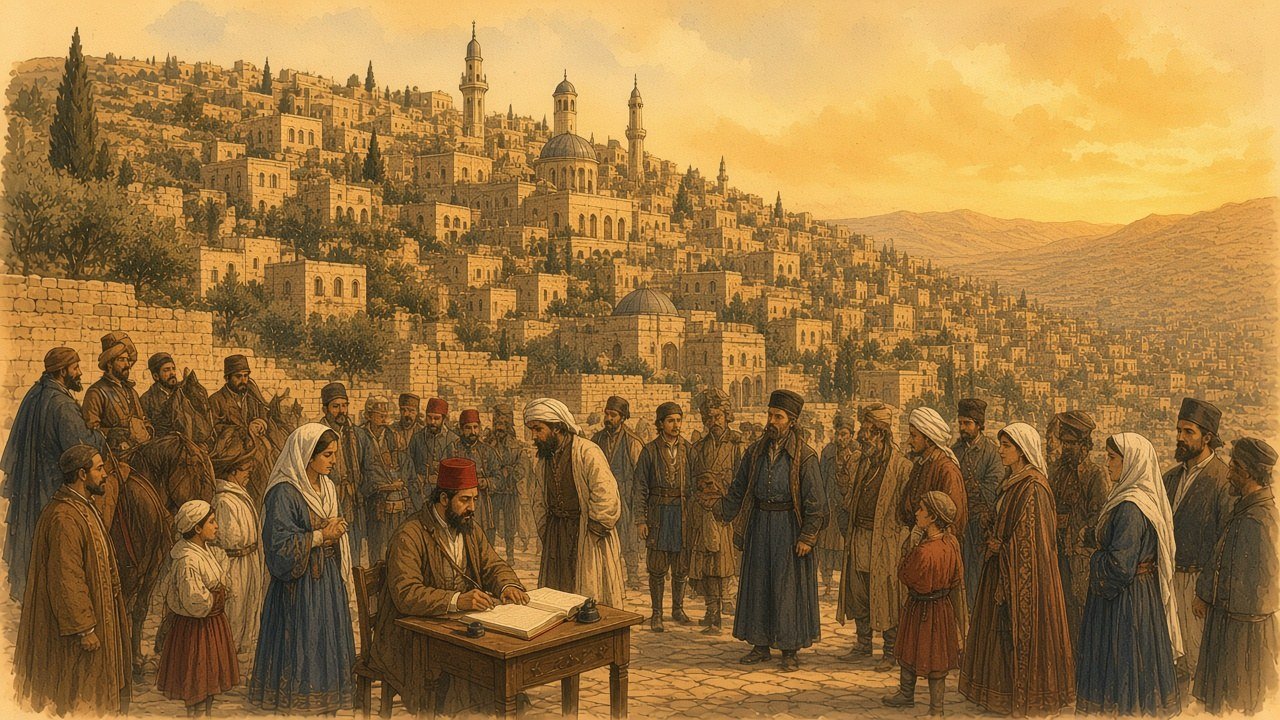
In 1860 the lands that are now Lebanon, Syria, Israel and the Palestinian territories were provinces of one empire, and the people who lived in them were counted, when they were counted at all, as members of religious communities: Muslims, Christians of a dozen churches, Jews, Druze. A century and a half later the same region is divided among four political units, and religious community remains the most argued-over statistic in all of them. Lebanon has not dared to hold a census since 1932. Syria has published no census figures on religion since the count of 1960. Israel publishes its population by “population group” every year, and the Palestinian Central Bureau of Statistics counts a people most of whom live outside the territory it covers. Between 1860 and 2026 the proportions of these communities changed profoundly, and in some places beyond recognition.[1][2]
This essay follows those changes. It begins with the Ottoman baseline and the limits of Ottoman counting, then traces the forces that remade the map: the long peace of the Mutasarrifate of Mount Lebanon, the great emigration to the Americas, the famine and the refugee flows of the First World War, the mandates and their censuses, the Lebanese census of 1932 and the confessional bargain built on it, Jewish immigration to Palestine and the war of 1948, the departure of the Jews of the Arab lands, the demographic history of Israel, the West Bank and Gaza, the Ba‘athist and Assad eras in Syria, the war of 2011 and its aftermath, and the slow, uncounted shift in Lebanon’s balance. It closes with five cities, a comparative ledger of the main communities across the four states, and an attempt to say what changed and why. The war of 1860 itself, and the settlement that followed it, is the subject of an earlier long read on this site; Lebanon’s political history since then is told in The Unfinished Republic. This piece is about numbers, and about why the numbers are so hard to trust.
| 1860 | 1881–93 | 1922 / 1931 | 1932 | 1948 |
|---|---|---|---|---|
| War on Mount Lebanon | Ottoman general census | Palestine Mandate censuses | Last Lebanese census | War and Nakba; Israel founded |
| 1960 | 1967 | 1975–90 | 2011–24 | 8 DEC 2024 |
|---|---|---|---|---|
| Last Syrian religious count | West Bank and Gaza occupied | Lebanese civil war | Syrian war | Fall of Assad |
1. The Short Answer
The religious map of the Levant in 1860 was one of overlapping minorities inside a Sunni Muslim majority. Across the Ottoman provinces that would later become Syria, Lebanon and Palestine, Sunni Muslims were the largest group by a wide margin. Christians of the Greek Orthodox, Greek Catholic (Melkite), Maronite, Armenian, Syriac and Latin churches formed a substantial minority, unevenly spread: dominant on Mount Lebanon, numerous in Damascus, Aleppo and the towns of the coast, thin in much of the countryside. Alawites held the coastal mountains behind Latakia; Druze held the Shuf, Wadi al-Taym, Mount Hermon and, increasingly, the Hawran; Ismailis lived around Salamiyya and the Syrian hill country; Twelver Shi‘a held Jabal ‘Amil in the south of what is now Lebanon and the northern Beqaa. Jews lived mainly in the cities: Damascus, Aleppo, Beirut, Sidon, and the four holy towns of Palestine, Jerusalem, Hebron, Safed and Tiberias. No census of the period counted all of them reliably, but reconstructions from Ottoman registers put Palestine’s population in the early 1880s at roughly 87 per cent Muslim, 10 per cent Christian and 3 per cent Jewish, and Mount Lebanon’s at around four-fifths Christian.[3][4]
By 2026 that map had been redrawn almost everywhere. Israel, a state that did not exist until 1948, is about three-quarters Jewish; its Arab citizens, Muslim, Christian and Druze, are about a fifth of the population. In the West Bank and Gaza, Palestinian Christians, once around a tenth of the Arab population of Palestine, are now about one per cent of the Palestinian population counted there. In Lebanon, Christians, who were roughly half of the residents counted in 1932, are now about a third of registered voters, while the Shi‘a, a minority within a minority under the Ottomans, are roughly level with the Sunnis as the largest communities. In Syria, Christians have fallen from about one in seven of the population counted in 1943 to perhaps two or three in a hundred after the war that began in 2011, while the country’s Jews, almost thirty thousand at the same census, number fewer than ten. The Alawites, once a marginal rural community, ruled Syria for half a century through the Assad family and then, after December 2024, became the targets of the worst sectarian violence of the transition.[5][6][7][8][9][10][11]
The causes of those changes can be grouped under five headings, and the rest of this essay is an attempt to give each its due. The first is differential natural increase: communities entered and left the demographic transition at different times, so that for long periods Christians had lower mortality than Muslims, and then lower fertility. The second is emigration, which drew Christians out of the region from the 1880s onwards in far greater proportion than Muslims, and which later drew Shi‘a, Sunnis and Druze as well. The third is immigration, above all the arrival of Jews in Palestine from the 1880s, but also of Armenians, Syriacs and Assyrians fleeing the collapse of Ottoman Anatolia, of Circassians and Chechens settled by the Ottomans, of Palestinians after 1948, of Iraqis after 2003, and of Syrians after 2011. The fourth is war and forced displacement, from the famine of 1915–18 to the Nakba of 1948, the Lebanese civil war of 1975–90 and the Syrian war of 2011–24. The fifth is the work of borders and categories: where frontiers were drawn, who was counted, and what the counters chose to call people. A Lebanese Shi‘i, a Syrian Alawite or an Israeli “Other” is partly a product of the state that does the counting.[2][12][13]
A word on the evidence. Almost every number in this essay is an estimate, and many of them are contested for political reasons. Censuses were taken by states with interests in the result: Ottoman officials counting taxpayers and conscripts, French and British mandate administrators counting communities whose relative weight would decide the shape of new institutions, Israeli and Palestinian statistical offices counting rival populations in the same land, Lebanese ministries keeping electoral rolls that include the emigrant and the dead. Where figures are given, they are attributed to their source, and where sources disagree, the disagreement is reported. The tables are comparisons of estimates, not a single consistent series, and they should be read that way.
2. Counting Souls in Millets and Registers
The Ottoman Empire did not think of its subjects as a population in the modern sense. It thought of them as taxpayers, soldiers and members of religious communities. Muslims, as the community of the ruling faith, were not a millet in the formal sense; non-Muslims were organised, for many legal and fiscal purposes, through their religious hierarchies. By the nineteenth century the recognised non-Muslim communities, the ملل (milal, singular millet), included the Greek Orthodox under the Patriarch of Constantinople, the Armenians under their patriarch, and the Jews under the chief rabbi. In the course of the century new millets were recognised as Catholic and Protestant churches won separate status: the Armenian Catholics in 1831, the Protestants in 1850, the Greek Catholics in the 1840s, and others in turn. Each community kept its own registers of births, marriages and deaths, and each had reasons to keep its numbers high or low according to the purpose of the count.[14][15]
For the Levant this had two consequences that still shape the statistics. The first is that religious affiliation was the primary category of almost every count. Ottoman registers recorded a person as Muslim, Greek Orthodox, Maronite or Jewish long before they recorded language, let alone ethnicity. Kurds, Turkmen and Circassians disappear into the Muslim column; Arabic-speaking Christians are divided by church rather than joined by language. The second is that the categories were not neutral. To be recognised as a separate community brought legal autonomy, courts, schools and sometimes political representation; to be folded into another community could mean the loss of all of them. When the French and British later built constitutions on these categories, the old registers acquired a new and explosive importance.[12][16]
Ottoman counting itself changed in the nineteenth century. The registers of the Tanzimat era began as tallies of adult males for tax and conscription. A general census of the empire, begun in 1881–82 and largely completed by 1893, aimed at the whole population, and its results were published by the imperial government; further counts followed around 1905–06 and in 1914. Kemal Karpat’s Ottoman Population, 1830–1914 (1985) assembled and published much of this material, and Justin McCarthy used the same registers, together with the provincial yearbooks known as سالنامه (sālnāme), to reconstruct the population of Palestine and other provinces. Both scholars insisted on the limits of the data. Women and children were undercounted, especially in the early registers; nomads were estimated rather than counted; foreign nationals, including many Jewish immigrants who kept European passports, were not counted as Ottoman subjects; and registration lagged behind births and deaths. McCarthy’s method was to correct the published figures for these known biases, using model life tables, and his corrected series for Palestine is one of the few consistent sets of numbers for the late Ottoman period.[14][3]
The corrections matter because the stakes were later political. McCarthy’s reconstruction, for example, raised the Ottoman figures for Palestine’s Muslim and Christian population by a substantial margin to allow for undercounting, and his work has been used by scholars and polemicists on several sides of the debate about Palestine’s population before Zionist immigration. Other demographers, notably Roberto Bachi and, later, Sergio DellaPergola, produced their own series from overlapping sources. They differ in detail, especially for the Jewish population before 1914, because Jews who were foreign nationals appear in consular rather than Ottoman records. They agree on the broad picture: a predominantly Muslim Arab population, a Christian Arab minority of around a tenth, and a small but growing Jewish community concentrated in the holy cities.[3][1]
The French historical demographers Youssef Courbage and Philippe Fargues, in a study first published in French in 1992 and in English as Christians and Jews under Islam (1997), offered the most influential long-run interpretation of these numbers. Their argument, built on Ottoman registers, mandate censuses and modern surveys across the Arab world and Turkey, is that the Christian share of the Arab East rose in the nineteenth and early twentieth centuries and fell thereafter, and that the main reason was not massacre or conversion but the timing of the demographic transition. Christians, more urban, better connected to missionary schools and European medicine, and more exposed to new ideas of hygiene, saw their mortality fall earlier than Muslims did. For several generations their numbers grew faster. Then, also earlier than Muslims, they began to marry later and have fewer children, while their emigration rates rose. By the second half of the twentieth century both forces were working against them. The violence that receives most attention, in 1860, in 1915–18 or after 2011, accelerated a long trend rather than creating it.[2]
That interpretation is not uncontested. Some historians give more weight to violence and insecurity, to discrimination in law and practice, and to the specific pressures on Christian communities in particular places; others note that Muslim fertility, too, has fallen steeply since the 1980s, narrowing the gap. But the Courbage–Fargues framework is a necessary corrective to the assumption that the region’s religious balance has been set only by massacres and wars. Much of the change happened in maternity wards and emigrant ships.[2][17]
Two further cautions run through everything that follows. The first is the difference between residents and members. Lebanese law, for example, records a person by the sect and place of registration of his or her father, regardless of where that person lives or whether he or she believes. The Lebanese electoral roll therefore counts Maronites in Brazil and Shi‘a in Côte d’Ivoire alongside residents of Beirut. Israeli statistics count Arab residents of East Jerusalem and Druze of the occupied Golan Heights, but not Palestinians in the West Bank, while the Palestinian Central Bureau of Statistics counts East Jerusalem as part of the West Bank. The second caution is that the categories themselves have changed. The British Mandate counted “Moslems”, “Jews”, “Christians” and “Druzes”; the Israeli Central Bureau of Statistics counts “Jews and others” and “Arabs”, and places most non-Jewish immigrants from the former Soviet Union in the category “others”. The same person can appear in different columns depending on which office does the counting.[8][5][18]
The Lebanese case shows how far registration can drift from reality. Every Lebanese citizen is entered in a civil register, نفوس (nufūs), in the village or quarter of his or her paternal family, under the sect of the father. Marriage is governed by the religious law of the communities, and Lebanon has no civil marriage of its own, so that couples of different sects who wish to marry civilly do so abroad, commonly in Cyprus, and register the marriage on return. Removing one’s sect from the register has been legally possible since 2009, but few have done so. The register is therefore an inherited and largely immovable record of communal descent. It does not move with internal migration, it does not lose those who emigrate, and it does not distinguish belief from belonging. For the purposes of politics, which is what it is used for, that is its strength; for demography it is a weakness.[19][20]
3. A Baseline for the Levant around 1860
The provinces that concern us were, in 1860, organised quite differently from the states of today. Damascus was the seat of a great province that stretched from the Hawran to Hama and, at times, south into Palestine; Aleppo governed the north; Sidon, with its seat by then at Beirut, governed much of the coast; Jerusalem was a separate district answering, after 1872, directly to Istanbul. Mount Lebanon, after the war of 1860, became an autonomous mutasarrifate. A new province of Beirut was created in 1888, taking in the coast from Latakia to the north of Jaffa. None of these units corresponds neatly to a modern state, and any estimate of the “population of Lebanon” or “of Syria” in 1860 is a projection backwards of borders that did not yet exist.[14][21]
With that warning, a few orders of magnitude can be given. The population of the Ottoman Levant as a whole, the land between the Taurus and Sinai and between the sea and the desert, is commonly estimated at somewhere between one and a half and two million people around the middle of the nineteenth century. Palestine, the three Ottoman districts of Jerusalem, Nablus and Acre that later formed the British Mandate, had around 350,000 inhabitants in about 1850 according to Alexander Schölch, of whom roughly 85 per cent were Muslim, 11 per cent Christian and 4 per cent Jewish; McCarthy’s reconstruction puts Palestine at about 411,000 in 1860. Mount Lebanon in the 1860s probably had somewhere between a quarter and a third of a million people, though no reliable count exists, overwhelmingly Maronite in the north and centre, mixed Christian and Druze in the Shuf and Matn. Damascus was a city of perhaps 100,000 to 150,000, of whom Christians made up something like a sixth or a seventh before the massacre of July 1860; Aleppo was of similar size, with a larger Christian population in proportion. Beirut, which would grow faster than any other city in the region, was still a town of a few tens of thousands.[3][22][23]
The confessional map at the level of districts was strikingly varied. Maronites dominated Kisrawan, the Batrun and Jubayl country and the northern mountain as far as Bsharri and Ehden, with large communities in the Matn and Shuf. Greek Orthodox Christians formed the largest Christian group in the Syrian interior, in the Kura near Tripoli, in Beirut, Damascus and the Hawran, and in Palestine, where they were the main Arab Christian church. Greek Catholics, the Melkites, who had separated from Orthodoxy in the eighteenth century, were strong in Zahlé, Damascus, Aleppo, Sidon and Galilee. Syriac Orthodox and Syriac Catholics lived chiefly in the north and north-east, around Aleppo, Homs and the Jazira, much of which was still sparsely settled. Armenians, before the catastrophes of the twentieth century, were present in Aleppo and in smaller numbers in Damascus and Jerusalem. Latin Catholics, Protestants and other small churches were mostly the product of missionary work and the urban middle classes.[15][2]
Among Muslims, Sunnis dominated the cities and most of the countryside of the Syrian interior and Palestine. The Twelver Shi‘a, known in Ottoman and older Arabic usage as متاولة (matāwila), lived in Jabal ‘Amil, in the hinterland of Tyre and Sidon, and in the Baalbek–Hermel region of the northern Beqaa, as peasants and as clients of a few notable families; a handful of Shi‘i villages lay in upper Galilee. The Alawites, then usually called نصيرية (Nuṣayriyya), lived in the coastal mountains of the Latakia and Tartus hinterland and in the countryside of Hama and Homs. The Ottomans did not recognise them as a separate community, and their numbers were estimated rather than counted. The Druze, concentrated in Mount Lebanon, Wadi al-Taym, Mount Hermon and Mount Carmel, were already shifting eastward to the Hawran, where the mountain later called Jabal al-Druze, or Jabal al-‘Arab, received migrants from Lebanon in several waves during the eighteenth and nineteenth centuries. Ismailis lived around Masyaf and Qadmus, and from the 1840s many settled at Salamiyya on the edge of the desert.[24][25][15]
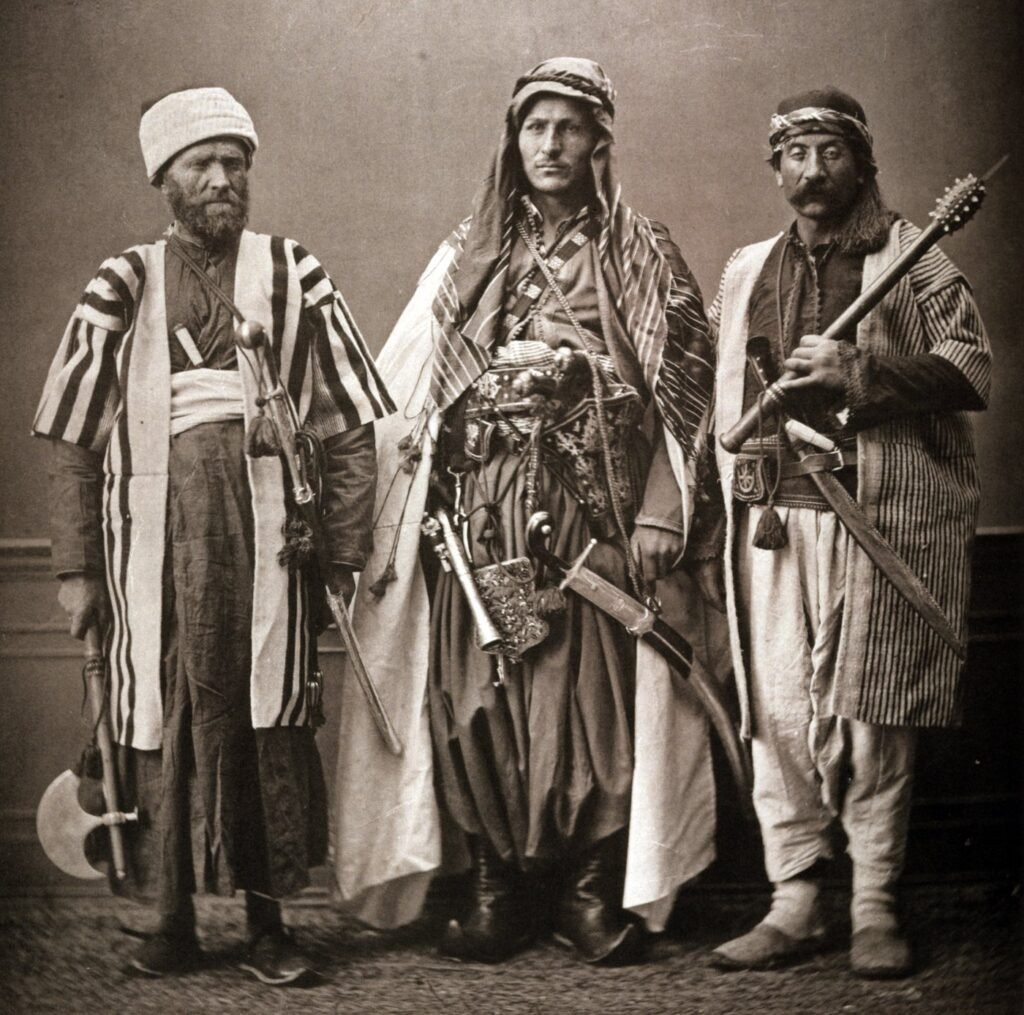
The Jewish population of the region was small but old and varied. Damascus and Aleppo had Arabic-speaking Jewish communities of great antiquity, joined since the sixteenth century by Sephardim descended from exiles from Spain. Beirut and Sidon had smaller communities, and there were Jewish families in mountain towns such as Deir al-Qamar and Hasbaya. In Palestine, the Jews of Jerusalem, Hebron, Safed and Tiberias were a mixture of long-established Sephardi and Arabic-speaking communities and of Ashkenazi immigrants who had come, mainly for religious reasons, from eastern Europe since the late eighteenth century. In 1881–82 the Ottoman registers counted about 15,000 Jewish Ottoman subjects in the three districts that became Mandatory Palestine, and historians estimate a further five to ten thousand foreign Jews living there under consular protection.[3]
The decades after 1860 also brought a new Muslim population to the region. After the Russian conquest of the north-western Caucasus in the 1860s, and again after the Russo-Turkish war of 1877–78, the Ottoman state received hundreds of thousands of Circassian, Chechen and other Muslim refugees, the مهاجرين (muhājirīn), and settled many of them on the frontiers of cultivation in its Arab provinces: in the Golan, where Quneitra became a Circassian town; around Amman, which was refounded as a Circassian settlement in 1878; in villages of Galilee such as Kfar Kama and Rehaniya; and on the edges of the Syrian steppe near Homs, Hama, Aleppo and Raqqa. The Ottomans used them, as they used Kurdish and Turkmen settlers, to secure the frontier against the Bedouin and to extend farming. Their numbers in the Levant were modest compared with those in Anatolia, but they added a new strand to the Sunni majority and created communities that survive in Syria, Jordan and Israel.[14]
| Area and date | Total | Muslims | Christians | Jews | Druze | Source |
|---|---|---|---|---|---|---|
| Palestine, c. 1850 | c. 350,000 | c. 85% | c. 11% | c. 4% | – | Schölch (1985), via compiled tables |
| Palestine, 1881–82 (Ottoman citizens) | 462,465 | 403,795 (87%) | 43,659 (9%) | 15,011 (3%) | – | McCarthy (1990), Ottoman registers |
| Palestine, 1890 | c. 532,000 | c. 432,000 | c. 57,000 | c. 43,000 | – | DellaPergola (2001), after Bachi |
| Palestine, 1914 | c. 689,000 | c. 525,000 | c. 70,000 | c. 94,000 | – | DellaPergola (2001), after Bachi |
| Palestine, 1914–15 (corrected, citizens) | 722,143 | 602,377 | 81,012 | 38,754 | – | McCarthy (1990) |
| Mount Lebanon, 1895 (official estimate) | 399,530 | 30,422 (7.6%) | 319,296 (79.9%) | – | 49,812 (12.5%) | Ottoman estimate, via compiled tables |
| Mount Lebanon, 1913 (census) | 414,747 | 37,942 (9.1%) | c. 329,500 (79.4%) | – | 47,290 (11.4%) | Ottoman census, via compiled tables |
The table shows why the Jewish figures for Palestine before 1914 are disputed. McCarthy’s corrected series counts only Ottoman citizens, and so excludes the many Jews who were foreign nationals; Bachi and DellaPergola include them, and so give a Jewish population more than twice as large on the eve of the First World War. Both approaches are defensible for different purposes. Neither can be checked against a full contemporary census, because none was taken.[3][1]
One feature of the baseline deserves emphasis because it is easily forgotten. In 1860 the Christian share of the population of the Levant was rising, not falling. Courbage and Fargues argue that the Christian communities of Ottoman Syria and Palestine grew faster than the Muslim majority for most of the nineteenth century, because their mortality fell first, and that the same communities would begin to shrink in relative terms only in the twentieth. The massacres of 1860 in the Lebanese mountain and in Damascus, terrible as they were, did not reverse that trend; the Christian population of Damascus recovered within a generation, and the Christian population of Mount Lebanon grew under the Mutasarrifate until emigration began to drain it.[2][23][21]
4. The Mutasarrifate of Mount Lebanon, 1861–1914
The settlement that followed the war of 1860 created, in the Règlement Organique of 1861 and its revision of 1864, a new kind of polity. Mount Lebanon, متصرفية جبل لبنان (Mutaṣarrifiyyat Jabal Lubnān), became an autonomous district governed by a non-Lebanese Ottoman Catholic Christian, the مُتَصَرِّف (mutaṣarrif), appointed by the Porte with the approval of the European powers. He was advised by an administrative council whose twelve seats were distributed among the communities of the mountain: after 1864, four Maronites, three Druze, two Greek Orthodox, one Greek Catholic, one Sunni and one Shi‘i. It was the first time in the region that political representation was formally apportioned by sect, and in that sense the Mutasarrifate was the ancestor of the Lebanese confessional system.[21][16]
The district was smaller than the later state. Beirut, Tripoli, Sidon and Tyre, the Beqaa valley, the Akkar plain and the hill country of Jabal ‘Amil were excluded, and remained in the provinces of Damascus and, after 1888, Beirut. What was left was a highland of terraced villages, overwhelmingly Christian, with Druze concentrated in the Shuf and southern Matn and a small Muslim presence. The Ottoman figures, which come from administrative estimates and a census of 1913, show a Christian share of about four-fifths throughout the period and a Maronite share of well over half.[21][4]
| Community | 1895 (estimate) | Share | 1913 (census) | Share |
|---|---|---|---|---|
| Maronite | 229,680 | 57.5% | 242,308 | 58.4% |
| Greek Orthodox | – | – | 52,356 | 12.6% |
| Greek Catholic (Melkite) | – | – | 31,936 | 7.7% |
| All Christians | 319,296 | 79.9% | c. 329,500 | 79.4% |
| Druze | 49,812 | 12.5% | 47,290 | 11.4% |
| Shi‘a | – | – | 23,413 | 5.6% |
| Sunni | – | – | 14,529 | 3.5% |
| All Muslims (excluding Druze) | 30,422 | 7.6% | 37,942 | 9.1% |
| Total | 399,530 | 100% | 414,747 | 100% |
Figures as compiled from Ottoman sources in the standard secondary literature; the 1895 estimate does not distinguish Christian churches other than the Maronites, and the 1913 Christian total is derived from the published shares. Note that these figures describe residents of the mountain only, not the coastal cities.[4][21]
Two things are striking about the numbers. The first is how slowly the population grew. Between 1895 and 1913 the recorded population of the mountain rose by less than 4 per cent, an annual rate of about 0.2 per cent, at a time when mortality was falling and families were large. The explanation is emigration, which by the 1890s was removing a large part of each generation; it is discussed in the next section. The second is the shape of the Druze figures. The Druze had been the dominant lords of much of the mountain before the nineteenth century. By 1913 they were barely one in nine of its inhabitants and had fallen behind the Greek Orthodox, a reversal that reflected Christian demographic growth, Druze migration to the Hawran, and the political consequences of the wars of 1841–45 and 1860.[21][26]
Engin Akarlı’s study of the Mutasarrifate, The Long Peace (1993), argues that the regime was more successful than its reputation. It kept the peace for half a century; it allowed the growth of a Maronite-led civil society of schools, presses and municipal life; and it institutionalised the sharing of offices among communities in a way that the leaders of the mountain largely accepted. Its weakness was economic. The silk industry, on which much of the mountain depended, was exposed to European prices, and it went into crisis in the 1880s and 1890s. The mountain was too small and too poor to employ its growing population, and the autonomy that protected it also cut it off from the coast. Emigration was the solution that tens of thousands of families chose.[21][26]
The Mutasarrifate also shaped the sectarian geography of the coast. Beirut, outside its borders, grew from a town of perhaps 15,000 in the 1840s into a port city of well over 100,000 by 1914, absorbing migrants from the mountain, from Damascus after 1860 and from the Syrian interior. Leila Fawaz has shown how Christian merchants and refugees transformed the city in the decades after 1860, so that by the end of the century Christians were, on most estimates, the largest group in the city and a new class of Christian and Muslim merchants who traded with Europe. Tripoli, Sidon and Tyre remained predominantly Sunni or, in the case of the southern countryside, Shi‘i. These coastal and inland regions would be joined to the mountain in 1920 to form Greater Lebanon, and the balance between mountain and periphery would become the central demographic question of the new state.[22][27]
The province of Beirut created in 1888, which stretched from Latakia in the north to the district of Nablus and Acre in the south, illustrates how different the Ottoman units were from the later states. Its Ottoman yearbooks recorded a population that was predominantly Sunni along the coast, with large Greek Orthodox communities in Beirut, Latakia and the Kura, Alawites in the hinterland of Latakia, Shi‘a in Jabal ‘Amil and the coastal hinterland of Tyre and Sidon, and Muslim and Christian Arabs in northern Palestine. Karpat’s compilation of the Ottoman returns shows the province growing steadily in the last decades of the empire, as the port of Beirut drew migrants and trade from the whole region. The coastal districts that would later be joined to Mount Lebanon were therefore already, before 1914, part of a single provincial society that linked Beirut to Latakia and to Haifa and Acre, and the mandate borders of 1920 cut through it.[14][22]
Mount Lebanon was not the only place where Ottoman reforms produced communal institutions. In Palestine, the Jerusalem district had its own administrative council on which representatives of non-Muslim communities sat; in Damascus and Aleppo the provincial councils established under the Vilayet Law of 1864 also included Christian and Jewish members. What distinguished Mount Lebanon was that sectarian apportionment was not a supplement to a Muslim-majority administration but its organising principle. That model would be carried into the constitution of the Lebanese Republic and, through it, into the National Pact of 1943.[16][12]
5. The Mahjar and Emigration from the 1880s
The Arabic word المهجر (al-mahjar), the place of emigration, came to mean the whole world of Syrian and Lebanese communities in the Americas, West Africa and Australia. Emigration began on a small scale in the 1870s and became a mass movement in the 1880s and 1890s. Its causes were many: the crisis of the silk industry, the subdivision of land among large families, the example of early emigrants who sent money home, the new steamship lines from Beirut, and, after the 1908 revolution, the extension of conscription to Christians. Its destinations were the United States, Brazil, Argentina, Mexico, Cuba and other parts of Latin America, and later West Africa and Australia.[26][28]
Kemal Karpat’s study of Ottoman emigration, published in the International Journal of Middle East Studies in 1985, used Ottoman and receiving-country records to estimate the scale of the movement. The numbers are uncertain because many emigrants left illegally, travelled on false papers or returned and left again, and because receiving countries recorded them variously as “Turks”, “Syrians”, “Asiatic Turks” or, from 1899 in the United States, “Syrians” as a separate category. Historians generally estimate that some hundreds of thousands of people left Ottoman Syria, including Mount Lebanon and Palestine, between the 1880s and the First World War, and that Mount Lebanon lost a large fraction of its population: estimates commonly range from about a fifth to a third of its inhabitants, though none rests on a full count. Akram Khater’s Inventing Home (2001) emphasises that this was not a one-way movement; a substantial minority of emigrants returned, often with capital that transformed village houses, landholding and the status of women.[28][26][29]
What matters for the demographic story is who left. The emigrants were overwhelmingly Christian. Mount Lebanon was itself mostly Christian, but even in mixed regions Christians were more likely to emigrate than Muslims, because they had better access to mission education and to information about the Americas, because they were less tied to Ottoman military and administrative careers, and because early migrant networks were Christian. The pattern persisted for decades. The official Lebanese census of 1932, discussed below, recorded about 255,000 emigrants, of whom roughly 85 per cent were Christians, against a resident population of about 793,000. Maronites alone accounted for more than 123,000 of the emigrant total, Greek Orthodox for 57,000 and Greek Catholics for almost 30,000; Sunni, Shi‘i and Druze emigrants together numbered fewer than 40,000.[8][20]
| Community | Emigrants recorded |
|---|---|
| Maronite | 123,397 |
| Greek Orthodox | 57,031 |
| Greek Catholic | 29,627 |
| Sunni | 17,205 |
| Shi‘a | 11,501 |
| Druze | 8,750 |
| All Christians | 215,844 (84.7%) |
| All non-Christians | 39,143 (15.3%) |
Source: official 1932 figures as reported by The Beiruter (2026) and discussed by Maktabi (1999). The emigrant figures are registrations, not a count of people living abroad in 1932, and they exclude emigrants who had left Ottoman Syria before the creation of Greater Lebanon and were never registered.[8][20]
The size of the diaspora today is a matter of definition and, often, of politics. Brazil is home to the largest community of Lebanese descent, but estimates of its size range from about 900,000 to as many as ten million, depending on whether one counts emigrants, their children or all those with any Lebanese ancestor. Estimates of the worldwide Lebanese diaspora vary accordingly, from about one million to fourteen million. The higher figures are often quoted by Lebanese politicians; they cannot be checked, and they include millions of people with no legal or social connection to Lebanon. A more useful measure is the number of emigrants who still hold Lebanese registration. On the 2026 electoral roll, 144,406 voters registered to vote abroad, of whom about 53 per cent were Christian.[8][29]
The receiving countries kept their own records, which tell a story of their own. In the United States the immigration service began to record “Syrians” as a separate group in 1899, and later censuses recorded many Arabic-speaking Christians from Mount Lebanon and Syria under headings such as “Turkey in Asia”. In Brazil and Argentina the immigrants were registered on arrival as “turcos”, Turks, because they carried Ottoman passports, a name that stuck to the community for generations. In West Africa, the Lebanese of Senegal, Sierra Leone and Côte d’Ivoire grew from a few traders before 1914 into communities of tens of thousands, Christian at first and increasingly Shi‘i after the 1920s. Australia’s Lebanese community, small before the Second World War, grew rapidly after 1975, when the civil war brought a new and more Muslim wave of migration. The Mahjar thus changed its confessional character over time, as the communities that had sent few emigrants in the 1880s began to send many in the 1970s.[29][28]
The Mahjar was not only Lebanese. Palestinian Christians from Bethlehem, Beit Jala and Ramallah emigrated to Latin America from the 1870s, and by the twentieth century Chile, Honduras and El Salvador had substantial communities of Palestinian origin; Chile’s is commonly said to be the largest outside the Arab world, though estimates are imprecise. Syrian Christians from Homs, Aleppo and the Qalamun emigrated in large numbers to Brazil and Argentina. The Syrian–Lebanese communities of the Americas produced presidents, industrialists and writers, among them the poets of al-Rābiṭa al-Qalamiyya in New York, Kahlil Gibran and Mikhail Naimy, and the Brazilian and Argentine Syrian-Lebanese elites.[29]
The Mahjar established three patterns that recur in the rest of this story. First, emigration was confessionally selective: Christians left in greater numbers, and their departure slowly reduced the Christian share of the homeland population. Second, emigrants did not disappear from the political arithmetic. Lebanese governments and parties have argued for a century about whether emigrants and their descendants should be counted as citizens, and their inclusion or exclusion changes the confessional balance. Third, the remittances and return migration of the Mahjar tied the villages of the mountain to a global economy, so that the decision to leave became normal, almost expected, for each generation of young Lebanese, Syrians and Palestinians.[26][20]
6. War, Famine and Refuge, 1914–1923
The First World War was the greatest demographic catastrophe in the modern history of the Levant before the Syrian war of the twenty-first century, and in proportion to population it was probably greater. Three disasters overlapped. The first was famine. The Allied naval blockade of the eastern Mediterranean cut the coast off from imported grain; the Ottoman Fourth Army under Cemal Pasha requisitioned food and transport animals and restricted the movement of grain into Mount Lebanon; locusts destroyed much of the harvest of 1915; and the collapse of remittances from the Americas left a mountain dependent on emigrant money without the means to buy food at inflated prices. The second was disease, especially typhus, cholera and malaria, which spread among the hungry and the displaced. The third was deportation and massacre, which brought hundreds of thousands of Armenian and Syriac Christian survivors from Anatolia into the Syrian provinces.[30][31]
How many died in Mount Lebanon is not known with any precision. The figure most often quoted, in Lebanese historiography and in popular accounts, is about 200,000 deaths, out of a pre-war population of about 400,000, which would make the famine, remembered in Arabic as مجاعة جبل لبنان (majāʿat Jabal Lubnān) and among Maronites by the Syriac word ܟܦܢܐ (kafno, hunger), one of the deadliest events of the war anywhere in proportion to population. Historians treat the figure with caution. It derives from contemporary relief and consular estimates and later communal memory rather than from a count, and it is not clear whether it refers to the Mutasarrifate alone or to a wider region. Linda Schilcher’s study of the famine in Greater Syria is often cited for an estimate of the order of half a million deaths across the Syrian provinces as a whole; Melanie Tanielian’s Charity of War (2018) reconstructs the politics of relief in Beirut and the mountain without endorsing any single total. What is certain is that the losses were very heavy, that they fell overwhelmingly on the Christian, mainly Maronite, villages of the mountain, and that they were followed by renewed emigration after 1919.[30][31]
The demographic effect on the mountain was less visible in later statistics than one might expect, because the census of 1932 counted a population that had partly recovered and because Greater Lebanon, created in 1920, added large Muslim regions. But it is part of the explanation of why the Christian majority recorded in the Mutasarrifate in 1913, about four-fifths, became a bare majority in the new state, and why Maronite leaders insisted on counting emigrants as Lebanese.[20][27]
Relief, when it came, also had demographic consequences. Tanielian shows that the Beirut municipality, the Ottoman authorities, local charities, the Maronite Church and, after the war, American and European relief organisations competed to feed the starving and to claim credit for doing so. Orphanages run by missionaries and by the churches took in thousands of children, Lebanese and Armenian, and a number of them later emigrated with the help of the same networks. The American Near East Relief, which worked across Syria, Lebanon and Anatolia after 1918, was one of the largest humanitarian operations of its time. The memory of the famine, preserved in Maronite and Lebanese nationalist writing, became one of the arguments for a separate Lebanese state under French protection, on the grounds that the mountain had been abandoned, or deliberately starved, by the Ottoman authorities.[30][27]
The deportations of 1915–16 sent Armenians from Anatolia south through Aleppo to the Syrian desert. Many died on the marches or in the camps around Deir ez-Zor and along the Euphrates; others survived in Aleppo, Damascus and the towns of the north. After the war, the French Mandate became a refuge for Armenians from Cilicia when France withdrew from that region in 1921, and for further waves from Turkey in the 1920s. By the 1930s Armenians formed a large community in Aleppo and a substantial one in Beirut, where the camp at Karantina and the later quarter of Bourj Hammoud were centres of Armenian settlement. The Lebanese census of 1932 recorded more than 25,000 Armenian Orthodox residents, and the Syrian census of 1943 counted Armenians among a Christian population of about 400,000.[12][13][20][9]
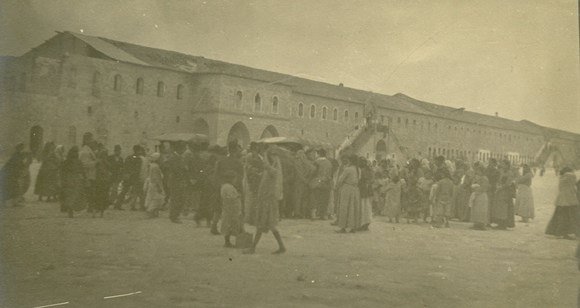
The Syriac-speaking Christians of south-eastern Anatolia and northern Mesopotamia, Syriac Orthodox, Syriac Catholics, Chaldeans and members of the Church of the East, suffered massacres during the war that their descendants call ܣܝܦܐ (Sayfo), the sword. Survivors and later refugees from Turkey and Iraq settled in the Jazira, the plain between the Tigris and the Euphrates in north-eastern Syria, where the French encouraged settlement and the new towns of Hasakah and Qamishli grew in the 1920s. After the massacre of Assyrians at Simele in northern Iraq in 1933, the League of Nations and the French authorities resettled several thousand Assyrians in villages along the Khabur river. Kurds also arrived in the Jazira from Turkey in large numbers in the 1920s and 1930s, fleeing the suppression of Kurdish revolts. The result was a new frontier society of Kurds, Arabs, Syriac Christians and Armenians, with a Christian share far higher than the Syrian average.[12][13]
Laura Robson’s States of Separation (2017) places these movements in the context of a wider policy of the period: the use of population transfer, refugee settlement and minority protection as tools of imperial rule. In Syria and Lebanon, the French welcomed Armenian and Syriac refugees partly for humanitarian reasons and partly because Christian refugees could be settled as a loyal population in strategic districts. The same logic applied, in different ways, to the British in Iraq and Palestine. The interwar Levant was therefore shaped not only by natural increase and emigration but by deliberate demographic engineering.[13][12]
| Group | Period | Main destinations | Scale |
|---|---|---|---|
| Armenians (deportation survivors and later refugees) | 1915–1930s | Aleppo, Beirut, Damascus, Jazira | Many tens of thousands; Lebanon recorded 25,462 Armenian Orthodox residents in 1932 |
| Syriac Christians and Chaldeans | 1915–1930s | Jazira, Aleppo, Beirut | Several tens of thousands (estimates vary) |
| Assyrians from Iraq after Simele | 1933–1937 | Khabur valley | Several thousand |
| Kurds from Turkey | 1920s–1930s | Jazira, Kurd Dagh, Aleppo | Tens of thousands (contested; central to later citizenship disputes) |
| Russian and Caucasian émigrés, others | 1920s | Cities | Small |
Sources: Robson (2017), White (2011), compiled census tables. The scale column gives ranges only where the secondary literature agrees on an order of magnitude.
The same years brought the first large-scale emigration of Jews from Damascus and Aleppo, mostly to the Americas, Egypt and Palestine, and a new movement of Jewish immigrants into Palestine after the Balfour Declaration of 1917. In Palestine itself the war caused severe losses, through hunger, disease, conscription and the expulsion of foreign Jews by the Ottoman authorities. The Jewish population of Palestine is estimated to have fallen from about 94,000 in 1914 to about 84,000 at the British census of 1922, and the non-Jewish population also suffered, though it grew again quickly in the 1920s.[1][32]
7. Mandates and the Making of Minorities
The peace settlement after 1918 divided the Arab provinces of the Ottoman Empire between Britain and France, under mandates of the League of Nations confirmed in 1922 and in force from 1923. France took Syria and Lebanon; Britain took Palestine, Transjordan and Iraq. The new borders, drawn partly on the lines of the Sykes–Picot agreement of 1916 and partly by later negotiation, cut across old provinces and created states in which the arithmetic of religion was new. A Christian or Druze who had been one subject among many of a Muslim empire became a member of a “minority” in a state that claimed to represent a nation.[12][13]
Benjamin White’s The Emergence of Minorities in the Middle East (2011) argues that the very idea of a religious “minority” in the modern sense, a group defined against a national majority and entitled to protection, was a product of this period. The Ottoman millets had been corporate communities of a ruling empire, not minorities of a nation. The mandates introduced representative institutions, national citizenship, borders and censuses, and with them the question that would dominate the politics of the region: how many of each community there were, and what share of power they should therefore have.[12]
French policy in Syria made the question explicit. In 1920 France proclaimed the State of Greater Lebanon, دولة لبنان الكبير (Dawlat Lubnān al-Kabīr), adding to the old mountain the coastal cities of Beirut, Tripoli, Sidon and Tyre, the Beqaa valley, the Akkar and Jabal ‘Amil. The rest of its mandate it divided, at various times between 1920 and 1936, into a State of Damascus, a State of Aleppo, an Alawite state centred on Latakia, a Druze state in the Jabal al-Druze, and the autonomous Sanjak of Alexandretta. Damascus and Aleppo were merged into a State of Syria in 1925; the Alawite and Druze states were incorporated into Syria in 1936 and, after a further period of separate administration, finally in 1942; the Sanjak, with its mixed Turkish, Arab Alawite, Sunni Arab, Armenian and Christian population, was ceded to Turkey in 1939, an event that set off a further movement of Armenians and Arabs south into Syria.[12][33]
The making of Greater Lebanon changed its confessional character. The old Mutasarrifate had been nearly four-fifths Christian. The new state, according to the French count of 1922, was 56.5 per cent Christian, with Sunnis 19.8 per cent, Shi‘a 16.7 per cent and Druze 6.9 per cent. The Christian majority was real but narrow, and depended on the inclusion of Christians in the coastal cities and the Beqaa. Maronite leaders had pressed for the larger borders, on the grounds that the mountain could not survive economically without the coast and the grain of the Beqaa. Some, already in the 1920s, warned that the new Muslim regions would grow faster than the Christian core. The warnings proved correct.[27][20]
The French mandate in Syria also reshaped the north through a series of resettlements that are easily forgotten. When the Sanjak of Alexandretta was transferred to Turkey in 1939, most of its Armenian population left rather than become Turkish citizens. The Armenians of Musa Dagh, the mountain villages whose resistance in 1915 had become famous, were resettled by the French authorities at Anjar in the Beqaa valley of Lebanon, where their descendants still live; others went to Aleppo and Beirut. Many Arab Alawites and Sunnis from the sanjak also moved south into Syria. At the same time the Jazira, in the far north-east, was filling with Kurdish, Syriac and Armenian refugees from Turkey, Assyrians from Iraq and Arab tribes settling as farmers, and its population rose sharply in the 1920s and 1930s. The French encouraged this settlement, partly to develop the region and partly to build up communities whose loyalty to the mandate was thought to be more secure than that of the Sunni Arab nationalists of Damascus and Aleppo.[12][13][33]
The mandate also shaped the composition of the Syrian state through what it left out. The Great Syrian Revolt of 1925–27, which began in the Jabal al-Druze under Sultan al-Atrash and spread to Damascus and the Ghouta, was suppressed with heavy loss of life, including the French bombardment of Damascus in October 1925. Philip Khoury’s history of the mandate describes how the French drew on minority recruits, Alawites, Druze, Circassians, Armenians and Kurds, for the Troupes spéciales du Levant, the local force that later became the nucleus of the Syrian and Lebanese armies. That recruitment pattern, more than any census, foreshadowed the role that rural minorities, and above all the Alawites, would later play in Syrian politics.[33][24]
In Palestine, the British census of 1922 and its successor of 1931, discussed below, were conducted in a different political setting: the Mandate incorporated the Balfour Declaration and obliged Britain to facilitate Jewish immigration. The Mandate counted religion first and nationality second, and it treated Muslims, Christians, Jews and Druze as the primary categories. Arab Christians were thus counted separately from Arab Muslims, and Jews of all origins together. The categories mattered for the proposals for representative institutions that Britain floated in the 1920s and 1930s, all of which foundered on the question of whether seats should be allocated by community and in proportion to which numbers.[32][34]
Three features of the mandate era shaped the later demography of every state in the region. First, the borders were fixed, and with them the populations to whom future censuses would apply. Second, the census itself became a political instrument. The French counted in Lebanon in 1921–22 and 1932 and in Syria at intervals; the British counted in Palestine in 1922 and 1931 and relied thereafter on estimates. Third, communities were assigned legal personalities that governed marriage, inheritance and often political representation, so that one’s religious registration acquired a permanent public significance. In Lebanon that significance has not diminished in the century since.[12][20]
8. Lebanon, the 1932 Census and the National Pact
The census of 1932 is the most consequential count in the history of the region, and the last official census of Lebanon. It was conducted by the French mandatory authorities and the Lebanese government as part of the registration of citizens after the Treaty of Lausanne of 1923, which settled the nationality of former Ottoman subjects. Its purpose was administrative and political: to establish who was a Lebanese citizen and, by implication, how parliamentary seats and public offices should be shared. It counted both residents and emigrants, an approach that was itself controversial.[20]
The census took place in a political context that gave every number a meaning. The constitution of 1926 had created a parliament in which seats were distributed by community, and the census was expected to establish the ratio. It was also a census of nationality. The Treaty of Lausanne allowed former Ottoman subjects living abroad to opt for the nationality of the new states created from the empire, and the Lebanese authorities used the census to register those who had done so. That is why the 1932 count includes a category of emigrants at all: they were being counted as Lebanese nationals who happened to live abroad. The decision gave the Maronite and Orthodox communities, with their large emigrant populations, a weight in the census they would not have had on residence alone.[20][27]
Rania Maktabi’s study of the census, published in the British Journal of Middle Eastern Studies in 1999, shows how the rules of the count favoured Christians. The rules on which emigrants could be registered, and on which residents counted as citizens, worked to the advantage of the Christian communities. Large numbers of Christian emigrants were entered on the registers, while residents whose nationality was unsettled, among them many Kurds, Bedouin and migrants from the Syrian interior, were left out or counted separately. Armenian refugees, almost all Christian, had been granted citizenship in 1924 and were counted. Maktabi concludes that the census was shaped by political choices that produced the result its sponsors wanted: a Christian majority.[20]
The published figures exist in more than one form, which is a source of confusion. A widely reproduced table gives a resident population of 785,543, of whom 49.97 per cent were Christians, 42.03 per cent Muslims, 6.75 per cent Druze and 1.25 per cent others. A second set of official figures, reported recently from Lebanese archives, gives residents of 396,946 Christians against 396,450 non-Christians, a Christian margin of fewer than 500 people, and adds the 254,987 registered emigrants, among whom Christians were 84.7 per cent. On that basis the combined total of residents and registered emigrants was about 58.5 per cent Christian. The ratio of six Christians to five Muslims that governed Lebanese politics for half a century rests on this second reading.[4][8][20]
| Community | 1922 | Share | 1932 | Share |
|---|---|---|---|---|
| Maronite | 199,182 | 31.7% | 226,378 | 28.8% |
| Greek Orthodox | 81,409 | 12.9% | 76,522 | 9.7% |
| Greek Catholic (Melkite) | 42,426 | 6.7% | 45,999 | 5.9% |
| Armenian Orthodox | – | – | 25,462 | 3.2% |
| Other Christians | 32,651 | 5.2% | 18,183 | 2.3% |
| All Christians | 355,668 | 56.5% | 392,544 | 50.0% |
| Sunni | 124,786 | 19.8% | 175,925 | 22.4% |
| Shi‘a | 104,947 | 16.7% | 154,208 | 19.6% |
| Druze | 43,633 | 6.9% | 53,047 | 6.8% |
| Others (Jews, Baha’is etc.) | – | – | 9,819 | 1.3% |
| Total | 629,034 | 100% | 785,543 | 100% |
Source: compiled census tables, following Maktabi (1999). The 1922 “other Christians” figure includes Syriac Catholics and Protestants not separately listed in some versions; the 1932 figure includes Armenian Catholics, Syriac Catholics and Orthodox, Chaldeans and Protestants. An alternative official version of the 1932 resident total is 793,396 (396,946 Christians, 396,450 non-Christians).[4][20][8]
The constitution of 1926 had already provided, in its Article 95, that communities should be equitably represented in public employment and the cabinet “as a provisional measure”. The National Pact, الميثاق الوطني (al-Mīthāq al-Waṭanī), agreed orally in 1943 between the Maronite president Bishara al-Khuri and the Sunni prime minister Riad al-Sulh, converted that principle into a durable formula. The president would be a Maronite, the prime minister a Sunni and the speaker of parliament a Shi‘i; parliament would be elected in the ratio of six Christians to five Muslims, Druze counting with the Muslims; and, in political terms, the Christians would renounce French protection and the Muslims would renounce union with Syria. The ratio was derived from the census of 1932 and from the official estimates that followed it.[27][19]
The estimates of the 1940s and 1950s continued to show a Christian majority. The official figures for 1943 give a population of 1,046,421, of whom 52.1 per cent were Christian; for 1951, 1,283,940, 54.5 per cent Christian; and for 1956, 1,407,868, 54.7 per cent Christian, with Sunnis 20.3 per cent, Shi‘a 17.8 per cent and Druze 6.3 per cent. These figures were not censuses but estimates based on registration, and registration in Lebanon is not residence: a person is registered according to his or her father’s community and village of origin, wherever he or she lives. The rising Christian share in these estimates, at a time when Muslim fertility was higher, is generally attributed to the continued inclusion of emigrants and to the naturalisation of Christian refugees and returnees, and should be treated with scepticism.[4][19][20]
| Year | Total | Christians | Sunni | Shi‘a | Druze |
|---|---|---|---|---|---|
| 1943 | 1,046,421 | 52.1% | 21.3% | 19.2% | 6.9% |
| 1951 | 1,283,940 | 54.5% | – | – | – |
| 1956 | 1,407,868 | 54.7% | 20.3% | 17.8% | 6.3% |
Source: official estimates as compiled in the standard secondary tables. These are registration-based figures, not censuses.[4]
The decision not to repeat the census was political from the start. A new count would have tested the foundations of the Pact, and every government after 1943 had an interest in avoiding it. Lebanese demographers and sociologists, among them Muhammad Faour, have argued that by the 1950s or 1960s the Muslim population, especially the Shi‘a, had overtaken the Christians through higher fertility and lower emigration, and that the Pact therefore rested on an increasingly fictional majority. The absence of a census became one of the grievances that fed the civil war of 1975, and it has been preserved, by consensus of the confessional leaderships, ever since.[19][27]
9. Censuses and Aliyot in Mandate Palestine
Palestine had been, at the end of the Ottoman period, a predominantly Muslim Arab country with a substantial Christian Arab minority and a Jewish community that was small but growing quickly. Between 1918 and 1948 the balance changed more rapidly than anywhere else in the region, and for a reason that was new: organised, ideologically motivated immigration. The waves of Jewish immigration that Zionist historiography calls עליות (aliyot, “ascents”) began before the Mandate, but it was under British rule that they reshaped the country.[1][35]
The First Aliyah, conventionally dated from 1882 to 1903, brought nearly 35,000 Jews on the Jewish Virtual Library’s count, mainly from the Russian Empire and Romania, with a smaller number from Yemen; almost half of them left again within a few years. The Second Aliyah, from 1904 to 1914, brought about 40,000, again with a high rate of re-emigration, and included the young socialist pioneers who founded the first collective settlements. The Third Aliyah, from 1919 to 1923, brought about 40,000, relatively few of whom returned; the Fourth, from 1924 to 1929, about 82,000, of whom some 23,000 left; and the Fifth, from 1929 to 1939, nearly 250,000 by 1940, many of them refugees from Nazi Germany and central Europe, 174,000 of them in the four years 1933–36 alone. Between 1939 and 1948 the British White Paper restricted legal immigration, and about 110,000 more took part in the clandestine immigration known as עלייה ב׳ (Aliyah Bet), many of them intercepted and interned in Mauritius and, after 1946, in Cyprus. Over the whole Mandate period, legal and clandestine immigration together brought about 480,000 Jews, close to nine-tenths of them from Europe. These are round figures from a single compilation; other histories give somewhat different totals according to the dates and definitions used.[36][1]
The British took two censuses. The first, conducted on 23 October 1922 under J. B. Barron, counted 757,182 people: 590,890 Muslims, 83,794 Jews, 73,024 Christians and 7,028 Druze, with small numbers of Samaritans, Baha’is and others. The Bedouin of the Beersheba district were estimated, not counted, at 72,898. The second census, of 18 November 1931, conducted under E. Mills, counted 1,035,821 people: 759,717 Muslims, 174,610 Jews, 91,398 Christians and 9,148 Druze. No further census was taken. The Mandate government’s later figures, including those published in the Survey of Palestine prepared for the Anglo-American Committee of Inquiry in 1946 and the village statistics of 1945, are estimates based on the 1931 census, registered births and deaths, and immigration records.[32][34][37]
| Year | Muslims | Christians | Jews | Others/Druze | Total | Source |
|---|---|---|---|---|---|---|
| 1922 (census) | 590,890 | 73,024 | 83,794 | c. 9,500 | 757,182 | Barron (1923) |
| 1931 (census) | 759,717 | 91,398 | 174,610 | c. 10,100 | 1,035,821 | Mills (1933) |
| 1945 (estimate) | 1,061,270 | 135,550 | 553,600 | c. 14,100 | 1,764,520 | Mandate estimates, Survey of Palestine |
| 1947 (reconstruction) | c. 1,181,000 | c. 143,000 | c. 630,000 | – | c. 1,970,000 | DellaPergola (2001) |
The Christian community grew in absolute numbers throughout the Mandate, from about 73,000 to about 140,000, and its share of the population remained close to 8 per cent. Christians were disproportionately urban, concentrated in Jerusalem, Bethlehem, Nazareth, Jaffa, Haifa and Ramallah; they were divided among Greek Orthodox, Latin Catholics, Melkites, Armenians, Anglicans and smaller churches, and they included a substantial number of foreign clergy and residents. The Muslim population grew rapidly, by about 2.4 per cent a year between 1931 and 1945 on the Mandate figures, as mortality fell sharply and fertility remained high. The Jewish population grew faster still, by immigration, rising from about 11 per cent of the total in 1922 to about 31 or 32 per cent by 1947.[34][1]
One question that has generated more heat than light is whether the Arab population of Palestine was itself swollen by immigration from neighbouring countries. Some writers have claimed, on scant evidence, that a large part of the Arab population of 1947 consisted of recent immigrants drawn by the economic growth of the Zionist sector. The demographic evidence does not support the claim. The Israeli statistician Roberto Bachi estimated net Arab immigration between 1922 and 1945 at about 40,000 to 42,000, plus some 9,700 people added by border adjustments, a small fraction of the growth of the Arab population in that period. McCarthy, from the Ottoman registers, reached the same conclusion for the late Ottoman period: “The vast majority of the Palestinian Arabs resident in 1947 were the sons and daughters of Arabs who were living in Palestine before modern Jewish immigration began.” The growth of the Arab population was overwhelmingly the result of natural increase.[3]
The demographic transformation of Mandate Palestine was also spatial. Jewish land purchase and settlement concentrated the Jewish population in the coastal plain, the Jezreel valley, eastern Galilee and the cities of Tel Aviv, Haifa and Jerusalem. By 1945, according to the Mandate village statistics compiled by the government and later republished by the Palestinian historian Sami Hadawi, Jews owned a minority of the land, about 6 to 7 per cent of the country’s total area by the usual reckoning, but formed a majority or large minority in several sub-districts. The partition plan adopted by the United Nations General Assembly on 29 November 1947 allotted the proposed Jewish state about 55 per cent of the territory; on the figures then available, its population would have been roughly half Jewish and half Arab, with the Arab share higher if the Bedouin of the Negev were counted. Contemporary estimates of the exact proportions varied, and the plan was never implemented in the form proposed.[38][35]
The Mandate censuses also recorded a society in which religious identity and political identity were becoming fused. Palestinian Arab nationalism drew Muslims and Christians together; the Muslim–Christian Associations of the early 1920s were among its first organisations, and Christians such as Khalil Sakakini and the Orthodox newspaper Filastin of Jaffa were prominent in it. Jewish immigration, overwhelmingly from Europe, created a Jewish community, the יישוב (Yishuv), that was ethnically and culturally distinct from both the old Sephardi community of the Ottoman period and the Arab majority. By 1948 the categories of the Mandate census, Muslims, Christians and Jews, were becoming the categories of two national movements in conflict.[39]
The Jewish population recorded by the Mandate was itself diverse. The census of 1922 counted a community still shaped by the Ottoman period: the old Sephardi and Arabic-speaking families of Jerusalem, Hebron, Safed and Tiberias, Yemenite Jews who had arrived since the 1880s, Bukharan, Persian, Kurdish and Moroccan Jews, and the Ashkenazi religious communities of the four holy cities, alongside the newer Zionist settlers of the coastal plain and the valleys. By 1931, after the Third and Fourth Aliyot, immigrants from Poland and the Soviet Union dominated, and by 1947 the arrivals of the 1930s from Germany, Austria and central Europe and the Holocaust survivors had made the Yishuv overwhelmingly European in origin. The Jews of the Arab world, who would later become so large a part of Israel’s population, were still mostly in their countries of birth.[34][1][36]
10. War, Flight and Expulsion in 1948
The war that began after the UN partition vote in November 1947 and ended with the armistice agreements of 1949 transformed the population of Palestine in eighteen months more completely than the previous century had done. Palestinians call it النكبة (al-Nakba), the catastrophe; for Israelis it is the War of Independence. Its demographic outcome was the creation of a Jewish-majority state over about 78 per cent of Mandatory Palestine, the flight and expulsion of most of the Arab population of that territory, and the division of the remainder between Jordanian rule in the West Bank and East Jerusalem and Egyptian administration in Gaza.[35][38]
The number of Palestinian refugees is itself contested, and the range of estimates reflects different methods and different political interests. The United Nations Conciliation Commission for Palestine, reporting in 1949, estimated the number of Arab refugees from the territory held by Israel at about 711,000. UNRWA’s initial registration counted many more, about 914,000, because it included people in need who were not refugees in the strict sense and because registration was imperfect; by June 1951 the agency had reduced the figure to about 876,000 after removing duplicates and ineligible names. Israeli official estimates at the time were lower, generally between 520,000 and 600,000; Palestinian and Arab estimates were higher. The Palestinian Central Bureau of Statistics today gives a figure of 957,000 displaced. Most historians now work with a range of about 700,000 to 750,000.[35][40][41]
| Estimate | Source |
|---|---|
| c. 520,000–600,000 | Israeli official estimates of the period, as summarised by Morris (2004) |
| c. 711,000 | UN Conciliation Commission for Palestine (1949) |
| c. 726,000 | Final UN estimate for 1949, as summarised in the secondary literature |
| c. 914,000 (initial), 876,000 (June 1951) | UNRWA registration |
| c. 750,000 | UNRWA’s present description of the caseload when it began operations in 1950 |
| c. 700,000–750,000 | Consensus range in recent scholarship |
| c. 957,000 | Palestinian Central Bureau of Statistics (2025) |
The causes of the exodus have been the subject of one of the most intensive historiographical debates in modern history. Benny Morris, whose The Birth of the Palestinian Refugee Problem (1988; revised 2004) opened the debate in Israel on the basis of newly declassified archives, concluded that the exodus was the product of war, fear, the collapse of Palestinian society, expulsions by Jewish and Israeli forces in a number of cases, and massacres such as that at Deir Yassin in April 1948, and that there was no single master plan but a growing consensus among Israeli leaders that the refugees should not be allowed to return. Other historians, Palestinian and Israeli, have argued that expulsion was more systematic than Morris allows; others again have stressed the role of Arab leaders and of the Arab states’ invasion in May 1948. On the demographic outcome there is less disagreement. Walid Khalidi’s All That Remains (1992) documents 418 Palestinian villages depopulated and largely destroyed; Morris’s count is somewhat lower, depending on what is counted as a separate locality.[35][38]
The Arab population that remained in Israel at the end of the war numbered about 160,000, of whom perhaps a quarter were internally displaced, unable to return to their villages though they remained within the new state. They became citizens of Israel but lived under military government until 1966. Their religious composition differed from that of the pre-war Arab population: Christians and Druze were over-represented among those who stayed, partly because Galilee, where both communities were concentrated, was conquered late in the war and in some cases by negotiation, and partly because some Druze leaders had aligned themselves with the Jewish side. Nazareth, the largest Christian Arab town, was not depopulated. The Christian population of Israel in 1949 has been estimated at about 34,000, and the Druze at about 14,500.[35][42][43]
The internally displaced, whom Israeli law came to call “present absentees”, are a demographic category peculiar to this conflict. They were citizens of the new state, counted in its population, but their land and houses in the villages they had left were treated as absentee property under the Absentees’ Property Law of 1950 and placed under the control of a state custodian. Most settled in neighbouring Arab villages and towns, especially in Galilee, and their descendants today form a substantial part of the Arab population of places such as Nazareth, Shefa-‘Amr and the villages around them. In census terms they are invisible, since Israeli statistics record residence and population group rather than origin; in social and political terms they have remained a distinct presence, and the memory of their villages is one of the threads that ties Arab citizens of Israel to the refugees outside.[35][38]
The war also displaced Jews. The Jewish Quarter of the Old City of Jerusalem surrendered to the Jordanian Arab Legion in May 1948 and its inhabitants were expelled or taken prisoner; the Etzion bloc south of Bethlehem, Atarot, Neve Yaakov and a few other settlements in the area that became Jordanian were abandoned or overrun. The numbers were small, a few thousand, compared with the Arab exodus. But they meant that, from 1949 until 1967, there were no Jews living in the West Bank or the Gaza Strip, just as there were almost no Arabs living in the former Arab quarters of Jaffa, Haifa, West Jerusalem, Lydda and Ramle, which were resettled with Jewish immigrants.[35]
The refugees went to the West Bank, which Jordan annexed in 1950, to the Gaza Strip, to Jordan, Lebanon and Syria, and in smaller numbers to Egypt and Iraq. In Lebanon about 100,000 refugees arrived in 1948, mostly from Galilee and the coast; they included Christians from the towns of Haifa and Jaffa, a number of whom were later naturalised, as well as Muslims, the large majority, who were not. In Syria the refugees, about 85,000 to 100,000 at first, were given most of the rights of citizens without citizenship itself. In Jordan they were made citizens. In Gaza, a coastal strip of about 365 square kilometres, the refugees outnumbered the original inhabitants by about two to one. These different legal regimes shaped the later demography of each host country, and in Lebanon above all they became part of the confessional arithmetic.[40][35]
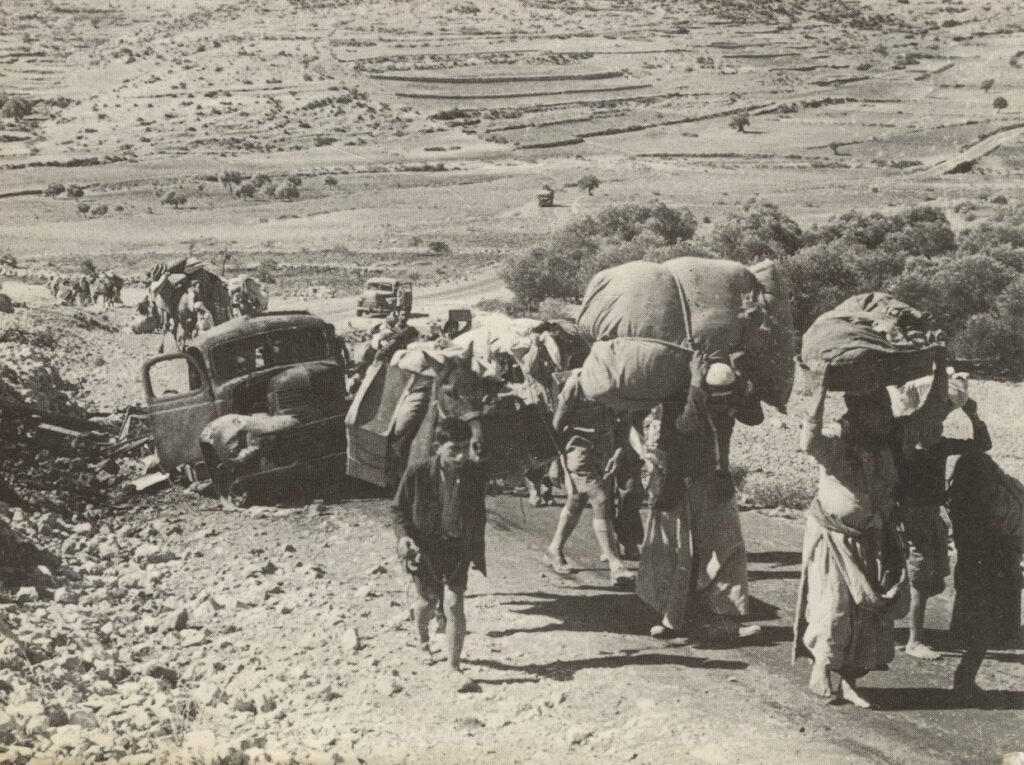
The demographic consequences were permanent. Within Israel, the Jewish share of the population, which had been about 55 or 60 per cent in the area of the future state at the time of partition, rose to over 80 per cent immediately after the war and to almost 90 per cent with the mass immigration of 1948–51. The Palestinian people, by contrast, became a nation largely of refugees and their descendants. UNRWA, which began operations in 1950 for about 750,000 refugees, says that some 5.9 million Palestine refugees are now eligible for its services in Jordan, Lebanon, Syria, the West Bank and Gaza, a figure that includes descendants through the male line and is therefore not comparable with the original number of refugees.[40][5]
11. The Jews of the Arab Lands Leave
The war of 1948 had a second demographic consequence, less often discussed in accounts of the Levant: the end, within a generation, of almost all the Jewish communities of the Arab world. In 1948, on the country figures compiled by the Jewish Virtual Library, about 851,000 Jews lived in the Arab states of the Middle East and North Africa; by 2018 about 3,300 remained. Of some 820,000 Jewish refugees from these countries between 1948 and 1972, the same compilation estimates that about 586,000 were resettled in Israel and more than 200,000 found refuge in Europe and the Americas. Other compilations give totals of the same order but differ in detail, and the figures for individual countries are estimates rather than counts.[44]
The causes varied by country and period: anti-Jewish riots and pogroms, legal discrimination and confiscation, the identification of Jews with Zionism and Israel by Arab nationalist governments, the pull of Zionism itself, and the decolonisation of North Africa. In Iraq, a community of about 135,000 in 1948 had fallen to about 6,000 a decade later, most of it airlifted to Israel in 1950–51 in the operation known as Ezra and Nehemiah, after the government permitted emigration on condition of the loss of citizenship; in Yemen and Aden, a community of about 63,000 fell to about 4,300 over the same decade, most of it flown to Israel in 1949–50; in Egypt, a community of about 75,000 dwindled to about 15,000 by 1958, above all after the Suez crisis of 1956; in Morocco, the largest, about 265,000 Jews in 1948 left in stages until the 1970s, for Israel and France. The Levantine communities of Syria and Lebanon were smaller, but their history illustrates the general pattern and their remnants are counted in the statistics of this article.[44]
Syria’s Jews had been among the oldest communities of the diaspora. The census of 1943 recorded 29,770 Jews in Syria, about one per cent of the population. Estimates for 1947–48 vary widely: the Jewish Virtual Library gives 30,000 in its regional table and 40,000 in its country survey, while other estimates put the community as low as about 15,000 by 1947, and the gap reflects both emigration in the 1940s and differences in what was counted. After the UN partition vote of November 1947, riots broke out in Damascus and Aleppo; in Aleppo synagogues, schools and homes were burned, and the government froze Jewish bank accounts. Emigration was then restricted and Jewish property sales were banned. By 1958 the community was estimated at about 5,000, and the census of 1960 recorded 4,860 Jews.[9][44][11][45]
For the next three decades the Jews of Syria lived under restrictions on movement, property and employment, and under the surveillance of the security services. The community was estimated at about 4,000 in 1968 and about 4,500 in 1978. United States pressure after the Madrid peace conference of 1991 helped persuade the government of Hafez al-Assad to lift the restrictions, and in 1992 it formally permitted Jews to emigrate. Thousands left within a few years, mainly for Brooklyn and New Jersey, where a large Syrian Jewish community already lived, and in smaller numbers for Israel and Mexico; an operation in late 1994 brought 1,262 Syrian Jews to Israel. About 250 remained in Damascus a year later and about 150 by 2001. In 2025, after the fall of the Assad regime, the Jewish Virtual Library counted six.[44][11]
Lebanon’s Jewish community followed a different course. Concentrated in Beirut’s Wadi Abu Jamil quarter, with smaller communities in Sidon and in the mountain, it grew after 1948, the only Arab Jewish community to do so, because Jews from Syria and Iraq sought refuge there and because the Lebanese state, with its confessional logic, recognised Jews as one of its communities and protected them during the war of 1948. There had been anti-Jewish rioting in Tripoli in 1945, but in Beirut the community lived in relative security. Estimated at about 5,200 in 1948, it numbered about 9,000 by 1951, of whom 6,961 were Lebanese citizens and about 2,000 recent arrivals from Syria and Iraq. Emigration increased after the Lebanese crisis of 1958 and particularly after the war of 1967; the community was put at about 3,000 in 1968 and about 400 ten years later. The civil war of 1975–90 and the kidnapping and murder of several community leaders in the 1980s completed the departure. By 2005 estimates of those remaining in Beirut ranged from about 40 to 200, and the US State Department put the community at only 70 to 100 people in 2023.[46][44][47][48]
A striking illustration of the Lebanese registration system is that the Jewish community still exists on paper. The electoral roll of 2022 listed 4,320 voters registered as members of the “Israelite” community, almost all of whom live abroad or are deceased but whose names remain on the register by descent. The figure measures the persistence of the confessional system rather than the number of Lebanese Jews.[7]
| Date | Syria | Lebanon | Source |
|---|---|---|---|
| 1943 | 29,770 (census) | not separately published | Syrian census of 1943, as tabulated by Khalifa |
| 1947–48 | c. 15,000–40,000 (estimates differ) | c. 5,000–5,200 | Jewish Virtual Library; other estimates |
| 1951–60 | c. 5,000 (1958); 4,860 (1960 census) | c. 9,000 (1951); c. 6,000 (1958) | Jewish Virtual Library; Samman |
| 1968 | c. 4,000 | c. 3,000 | Jewish Virtual Library |
| 1978 | c. 4,500 | c. 400 | Jewish Virtual Library |
| 1995–2001 | c. 250 in Damascus (1995); c. 150 (2001) | under 200 | Jewish Virtual Library |
| 2005 | under 200 | c. 40–200 (Beirut) | Jewish Virtual Library; HuffPost |
| 2022–25 | 6 (2025) | 70–100 resident (2023); 4,320 on electoral roll (2022) | Jewish Virtual Library; US State Department; Information International |
Figures for both countries in the 1940s and 1950s are particularly uncertain, and the compilations do not always agree with each other; the Lebanese census of 1932 grouped Jews with “others”.[9][44][11][46][45][47][48][7]
The disappearance of these communities is part of the sectarian history of the Levant as much as the decline of Christians or the displacement of Palestinians. It also shaped the demography of Israel, where Jews from the Arab world and Iran, known collectively as מזרחים (Mizrahim), and their descendants were for several decades the majority of the Jewish population, before the immigration from the former Soviet Union in the 1990s and intermarriage among Jews of different origins blurred the categories.[44][1]
The absorption of these immigrants shaped the geography of Israel. Many of the Jews from Iraq, Yemen, Morocco and elsewhere spent their first years in the transit camps, the מעברות (ma‘barot), of the early 1950s, and were then settled in new “development towns” in the Negev and Galilee and in the abandoned Arab quarters of the mixed cities, often in the same districts from which Palestinians had fled. The demographic exchange that some Israeli writers later described, the departure of Palestinian Arabs and the arrival of Jews from the Arab world in roughly comparable numbers, was not an agreed or symmetrical process; the two movements had different causes, and neither population was consulted. But in purely numerical terms it is true that the Jewish immigration from Arab countries after 1948 was of the same order of magnitude as the Palestinian exodus of 1947–49.[44][35]
12. Israel since 1948 – Immigration, Natural Increase and New Categories
At its foundation in May 1948 Israel had, according to its Central Bureau of Statistics, about 806,000 inhabitants. At the end of 2025 it had 10.178 million. No other state in the region has grown so fast, and no other has changed its composition so deliberately. Its population history falls into three broad phases: the mass immigration of 1948–51 and the arrival of the Jews of the Arab world and Iran in the 1950s and 1960s; a long period of moderate immigration and high natural increase from the 1960s to the late 1980s, during which the territories occupied in 1967 were held outside the state’s population statistics except for East Jerusalem and the Golan Heights; and the arrival from 1989 of about a million immigrants from the former Soviet Union, followed by the growth, through high fertility, of the ultra-Orthodox Jewish community.[5][1][49]
The mass immigration of the first years more than doubled the Jewish population. About 688,000 immigrants arrived between May 1948 and the end of 1951, on the official annual figures: Holocaust survivors from Europe and the internment camps of Cyprus, almost the whole Jewish community of Yemen, most of that of Iraq, and large numbers from Libya, Romania, Poland, Bulgaria and Turkey. In the 1950s and 1960s they were followed by Jews from Morocco, Tunisia, Egypt and Iran. Immigrants from the Muslim world and their children came to form, by most measures, a majority of the Jewish population for several decades. A 2019 study by Noah Lewin-Epstein and Yinon Cohen, using a definition based on grandparents’ birthplace, classified about 45 per cent of Israeli Jews as Mizrahi, 32 per cent as Ashkenazi, 12.4 per cent as of post-1989 Soviet origin and about 3 per cent as Ethiopian, with the rest of mixed or other origin.[49][44][50]
The Arab population that remained after 1948, about 160,000 people, grew by natural increase from a small base. Its composition was distinctive. Most were Sunni Muslims, in the villages of Galilee, the “Little Triangle” along the armistice line with the West Bank, the mixed cities and the Negev Bedouin. But Christians and Druze formed a larger share than they had before the war. In 1949 the Druze numbered about 14,500; the Central Bureau of Statistics counted about 152,000 in early 2024, including the Druze of the Golan Heights, most of whom do not hold Israeli citizenship. Christians, about 34,000 in 1948, numbered 184,200 at the end of 2025, or 1.9 per cent of the population, of whom 78.7 per cent were Arabs. The remainder are mostly non-Arab Christians who arrived with immigrants from the former Soviet Union.[42][43]
The Druze in Israel are a separate legal community, recognised as such in 1957, and Druze men have been conscripted into the army since 1956, unlike other Arab citizens. The Circassians, Sunni Muslims descended from refugees settled by the Ottomans in the 1870s after the Russian conquest of the Caucasus, number a few thousand, living mainly in the villages of Kfar Kama and Rehaniya, and are also conscripted. The Bedouin of the Negev and the Galilee are mostly Sunni Muslims; many in the Negev live in villages that the state does not recognise. These distinctions within the Arab population, between Muslims, Christians, Druze and Bedouin, are recorded in Israeli statistics more carefully than in those of any neighbouring state.[42]
Fertility differences have shaped the composition of Israel more than any other factor since the 1960s. Muslim Arab fertility was very high in the 1960s, above eight children per woman, and fell steeply thereafter; it is now close to that of the Jewish majority. Druze fertility, which peaked at 7.92 in 1964, had fallen to 1.85 by 2022 according to the Central Bureau of Statistics, below the national average. Arab Christian fertility is lower still, at 1.48, and Christians as a whole, at 1.61, have the lowest fertility of any religious group. Jewish fertility, by contrast, has remained unusually high for a developed country, at about three children per woman, and has risen at times, chiefly because of the fertility of the ultra-Orthodox and the religious Zionist communities. The Jewish share of the population, which fell from about 89 per cent in the early 1950s to about 82 per cent by the late 1980s, has since been roughly stable, at about three-quarters if the category “Jews and others” is used.[42][43][5]
The immigration from the former Soviet Union between 1989 and the mid-2000s, more than a million people, with almost 200,000 arriving in 1990 alone, changed the Jewish population in another way. Many of the immigrants qualified under the Law of Return, which since 1970 has extended the right of immigration to anyone with a Jewish grandparent and to their spouses, but were not Jewish according to the Orthodox religious law that governs personal status in Israel. The Central Bureau of Statistics created the category “others” for them and other non-Arab residents without a recognised religion. The result is that “Jews and others”, 7.771 million or 76.3 per cent of the population at the end of 2025, is now the more common headline figure, while Arabs numbered 2.147 million, or 21.1 per cent, and foreign residents 260,000, or 2.6 per cent.[5][49]
The ultra-Orthodox, or חרדים (Haredim), have become the fastest-growing major community in the region. The Israel Democracy Institute estimated that there were 1,452,350 Haredim in Israel in 2025, 14.3 per cent of the population, up from about 750,000 in 2009, and projected that they would reach about 16 per cent by 2030. Another research body, the Haredi Institute for Public Affairs, uses a narrower definition and gives about 1.26 million, or 12.5 per cent. The growth of the Haredi community has raised political questions, about military service, the labour market and education, that are in some respects the Israeli equivalent of Lebanon’s confessional arithmetic: a debate about the consequences of differential fertility for the character of the state.[51]
Two smaller immigrations completed the picture. The Jews of Ethiopia, the Beta Israel, were brought to Israel in large numbers in the airlifts of Operation Moses in 1984–85 and Operation Solomon in May 1991, and in smaller movements before and since; their descendants are counted as about 3 per cent of Israeli Jews in the 2019 study cited above. And since the 1990s Israel has received large numbers of non-Jewish labour migrants from Asia, eastern Europe and Africa, and asylum seekers from Eritrea and Sudan, most of whom are counted among the 260,000 “foreigners” whom the Central Bureau of Statistics now lists separately within its population total. Both groups have added to the religious variety of the country in ways that its founding categories did not anticipate: the Ethiopian community brought its own religious traditions, and the foreign workers include many Christians, whose churches now stand in south Tel Aviv.[50][5]
The Arab population of Israel has grown, by natural increase, from about 160,000 in 1949 to more than two million, a thirteenfold rise in three-quarters of a century, even as its share of the total has stayed close to a fifth because Jewish immigration has kept pace. Within it, the Muslim share has risen and the Christian and Druze shares have fallen, for the same reasons of differential fertility that apply in Lebanon and the West Bank. The Negev Bedouin, whose fertility remained very high for longest, have been the fastest-growing part of the Arab population, while Christian Arabs, the most urban and educated, have the lowest fertility of any group in the country. Israel’s Arab citizens therefore reproduce in miniature the regional pattern of this essay: a Christian community whose numbers grow slowly while its share declines.[43][5]
| Date | Total | Jews (or Jews and others) | Arabs | Of which Christians (all) | Druze | Source |
|---|---|---|---|---|---|---|
| May 1948 | c. 806,000 | c. 650,000 | c. 156,000 | c. 34,000 (1948) | c. 14,500 (1949) | CBS |
| 2008 | 7.3 million | 75.6% Jews | c. 20% | – | – | CBS |
| 2022 | c. 9.6 million | 73.6% Jews; 4.8% others | 18.1% Muslim | 1.9% | 1.6% | CBS, as compiled |
| End 2025 | 10.178 million | 7.771m Jews and others (76.3%) | 2.147m (21.1%) | 184,200 (1.9%) | c. 152,000 (2024) | CBS |
| Haredim, 2025 | – | 1.45m (14.3%, IDI); 1.26m (12.5%, Haredi Institute) | – | – | – | IDI; Haredi Institute |
Figures for 1948 are approximate and the division between Jews and Arabs at that date depends on the date chosen during the war; the CBS figure of 806,000 includes about 650,000 Jews. Since 1967 the CBS figures include East Jerusalem and the Golan Heights.
Emigration has also become a factor. The Central Bureau of Statistics estimated that about 69,300 Israelis left the country in 2025, continuing a negative migration balance that began after the war of October 2023. Most were Jews; many were former immigrants from the Soviet Union and elsewhere. Emigration is not yet large enough to change the composition of the population, but it is a reminder that the Mahjar of the Levant has never been confined to Arabs.[5]
The figures above include the Israelis living in the occupied West Bank, whom the Central Bureau of Statistics counts as residents of Israel. That anomaly, the counting of settlers as part of Israel while the Palestinians around them are counted by the Palestinian Authority, is one of the reasons why demographic statements about “the land between the river and the sea” are so frequently disputed.[5][18]
13. West Bank, Gaza and Jerusalem since 1967
The war of June 1967 brought the West Bank, East Jerusalem and the Gaza Strip, together with the Golan Heights and Sinai, under Israeli control. It also created a second wave of Palestinian refugees. The Palestinian Central Bureau of Statistics estimates that over 200,000 Palestinians were displaced in 1967, many of them refugees of 1948 for the second time, mainly from the West Bank to Jordan; Israeli and other estimates vary. In the Golan Heights, most of the Syrian population fled or was expelled during and after the war, leaving a Druze population in four villages and the Alawite village of Ghajar, which Israel annexed together with the Golan in 1981.[41][35]
The demographic history of the occupied territories since 1967 is shaped by three things: high Palestinian natural increase, emigration, and the growth of Israeli settlement. Palestinian fertility in the territories was among the highest in the world in the 1980s and early 1990s, especially in Gaza, and has since fallen substantially, though it remains above replacement level. Emigration, chiefly to Jordan, the Gulf, the Americas and Europe, has been continuous. Israeli settlement, which began in 1967 and accelerated after 1977, has created a population of several hundred thousand Israelis living beyond the 1949 armistice line. The European Union’s office in Jerusalem reported in July 2026 that more than 750,000 Israeli settlers lived in the West Bank and East Jerusalem in 2025, about 15 per cent of the total population of the West Bank including East Jerusalem.[52][18]
The Palestinian Central Bureau of Statistics conducted censuses in 1997, 2007 and 2017. Its estimates for mid-2025 put the population of the State of Palestine, the West Bank including East Jerusalem and the Gaza Strip, at about 5.61 million. The bureau reported that Gaza’s population had fallen to 2,114,301, about 10 per cent below what had been projected for mid-2025, as a result of deaths, departures and falling births; it gave the number of Palestinians killed in Gaza since October 2023 as more than 57,000 by the end of June 2025, with about 11,000 missing, and estimated that about 100,000 people had left the territory. It put the number of Palestinians worldwide at about 15.2 million, half of them outside historic Palestine: about 5.61 million in the State of Palestine, 1.9 million in Israel and about 7.8 million in the diaspora, 6.5 million of them in Arab countries. These figures, like all figures from Gaza after October 2023, are provisional and contested, and the casualty figures in particular continued to rise after the dates cited.[18]
Gaza has a demographic history of its own. Before 1948 it was a district of about 80,000 people around a Sunni Muslim market town with a small Greek Orthodox community. The arrival of about 200,000 refugees in 1948–49 made it, from the start, a territory in which refugees outnumbered the original inhabitants by about two to one, and it remains one in which a large majority of the population are registered refugees or their descendants. Under Egyptian administration until 1967, Israeli occupation from 1967 to 2005, and Hamas rule from 2007, it combined very high fertility with very limited emigration, and its population grew to more than two million in a territory of about 365 square kilometres, one of the most densely populated places on earth. Its Christian community, a few thousand at most, was always a tiny fraction of the whole, and has dwindled through emigration to the West Bank and abroad.[40][18]
East Jerusalem has a distinct status. Israel annexed it in 1967 and extended the city’s boundaries, and its Palestinian residents hold Israeli permanent residency rather than citizenship; they are counted in Israel’s population statistics and, separately, by the Palestinian Central Bureau of Statistics as residents of the Jerusalem governorate of the West Bank. The Jerusalem Institute for Policy Research and the Israeli Central Bureau of Statistics have recorded a rising Arab share of the population of the municipality since 1967, from about a quarter at the time of annexation to close to two-fifths in recent years; the European Union report cited above gives Palestinians as 40 per cent of the city’s population. Christians form a small and declining part of this Arab population.[52][53]
The decline of Palestinian Christians is one of the clearest demographic trends of the past century. In the Mandate census of 1922, Christians formed almost a tenth of the population of Palestine; Bethlehem, Beit Jala, Beit Sahour, Ramallah and Nazareth were Christian-majority towns, and Jerusalem and Jaffa had large Christian communities. In the Palestinian census of 2017, the bureau counted 46,850 Christians in the West Bank and Gaza, about 1 per cent of the population: 45,712 in the West Bank and 1,138 in Gaza. Nearly three-quarters of West Bank Christians lived in three governorates: Bethlehem, with 23,165, Ramallah and al-Bireh, with 10,255, and Jerusalem, with 8,558. In Bethlehem governorate, Christians were about 11 per cent of the population. In Gaza the community, estimated at about 3,000 in 2009, had fallen to about 1,100 by the late 2010s, before the war in which the churches of St Porphyrius and the Holy Family in Gaza City became shelters and in which church compounds were struck.[6][54][55]
| Date and area | Christians | Share of population | Source |
|---|---|---|---|
| Mandatory Palestine, 1922 | 73,024 | 9.6% | Barron (1923) |
| Mandatory Palestine, 1931 | 91,398 | 8.8% | Mills (1933) |
| Mandatory Palestine, 1945 | 135,550 | 7.7% | Mandate estimates |
| West Bank, 1949 | 51,053 | – | PSR (2020), citing official figures |
| West Bank, 1961 (Jordanian census) | 45,855 | – | PSR (2020) |
| West Bank and Gaza, 1967 | 42,719 | c. 6% (as given by PSR) | PSR (2020) |
| West Bank and Gaza, 1997 census | 40,055 | 1.5% | PCBS, via PSR (2020) |
| West Bank and Gaza, 2007 census | 42,565 | 1.2% | PCBS, via PSR (2020) |
| Palestinian territories, 2009 | c. 50,000 | c. 1–2% | Compiled estimates |
| West Bank and Gaza, 2017 census | 46,850 | c. 1% | PCBS |
| Gaza Strip, mid-1990s / 2009 / 2022 | c. 5,000 / c. 3,000 / c. 1,100 | under 0.1% (2022) | Compiled estimates |
| Israel (all Christians), end 2025 | 184,200 | 1.9% of Israel | CBS |
The Palestinian censuses allow the recent trend to be followed more exactly. According to the Palestinian Center for Policy and Survey Research (PSR), which compiled the official figures for a study of Christian emigration published in 2020, the West Bank had 51,053 Christians in 1949, and the Jordanian census of 1961 counted 45,855. In 1967, at the start of the occupation, the territories had 42,719 Christians. The Palestinian censuses counted 40,055 in 1997, or 1.5 per cent of the population; 42,565 in 2007, or 1.2 per cent; and 46,850 in 2017, or 1 per cent. In other words, the number of Christians in the West Bank and Gaza has been nearly stable for seventy years while the Muslim population around them has grown several times over. Their share has fallen because they have hardly grown, not because they have disappeared.[56][6]
The same PSR study, a survey of 995 Christian adults in the West Bank and Gaza conducted in January and February 2020, found that the wish to emigrate was much higher among Christians than among Muslims, almost twice as high in the West Bank. Most of those who wished to leave gave economic reasons; smaller numbers cited education, the search for a safer, more stable and less corrupt place, and greater liberties and religious tolerance, and some cited the conditions of the occupation. A large proportion said they had relatives abroad who would help them if they decided to go. The survey gives a rare quantitative view of the mechanism, described by Courbage and Fargues for the region as a whole, by which earlier emigration makes later emigration easier.[56][2]
The Palestinian Christian decline has several causes. The most important, as Courbage and Fargues argued, is differential demography: Christians had lower fertility than Muslims and higher emigration, and their share therefore fell even while their absolute numbers grew for most of the twentieth century. The 1948 war displaced Christian as well as Muslim communities, particularly in Jaffa, Haifa, West Jerusalem and Lydda, and many Christian refugees, being more urban and better educated, emigrated onward to the Americas and Europe. After 1967 the economic difficulties of occupation, the separation barrier built in the 2000s around Bethlehem and Jerusalem, land loss and the insecurity of two intifadas encouraged further emigration, while the diaspora in Chile, Honduras, the United States and elsewhere offered an established destination. Christian leaders have also pointed to social pressures and occasional sectarian incidents. The relative weight of these factors is debated and differs between places and periods.[2][6][56]
The demographic debate about the land between the Jordan and the Mediterranean has become central to Israeli and Palestinian politics. Taken together, the Israeli and Palestinian statistical offices count about 7.7 to 7.8 million Jews and others and slightly more than 7 million Arabs, including Arab citizens of Israel and Palestinians in East Jerusalem, the West Bank and Gaza, once the East Jerusalemites counted by both offices are taken only once. The exact balance depends on the treatment of non-Jewish “others”, of the Palestinian population figures for Gaza and East Jerusalem, and of emigration, and it is disputed by demographers on both sides. What is not disputed is that the two populations are now of similar size, and that the balance of the late Ottoman period, when Jews were somewhere between a few per cent and about a seventh of the population, depending on the date and the estimate, has been transformed beyond recognition.[5][18][1]
14. Syria from the Mandate Census to the Ba’ath
Syria became independent in 1946 with a population of about three million and a sectarian composition that the French had counted, in one form or another, several times. The census of 1943 is the most useful benchmark. It recorded 2,860,411 people: 1,971,053 Sunni Muslims, 68.9 per cent; 403,036 Christians, 14.1 per cent; 325,311 Alawites, 11.4 per cent; 87,184 Druze, 3.0 per cent; 28,527 Ismailis, 1.0 per cent; 29,770 Jews, 1.0 per cent; 12,742 Twelver Shi‘a; and 2,788 Yazidis. Figures for 1953 gave a population of 3,655,904, with Sunnis 70.5 per cent, Christians 13.1 per cent, Alawites 10.9 per cent, Druze 3.1 per cent and 31,647 Jews.[9][15]
The ethnic categories are harder to recover, because the census counted religion and not language. Most Sunnis were Arabs, but they included Kurds, the largest non-Arab group, concentrated in the Jazira, the Kurd Dagh north-west of Aleppo and the Kurdish quarters of Damascus; Turkmen; and Circassians and Chechens settled by the Ottomans. Christians included Arabic-speaking Greek Orthodox and Greek Catholics, Syriac Orthodox and Catholics, Armenians, who were then a large part of the population of Aleppo, and smaller communities. Estimates for the period before 2011 commonly put the Kurds at about 8 to 10 per cent of the population, the Alawites at 10 to 12 per cent, the Druze at about 3 per cent, the Ismailis at about 1 to 1.5 per cent and the Christians at anywhere from about 5 to 10 per cent; none of these figures rests on a published census.[17][10]
| Group | 1943 census | 1953 figures | 1960 census | c. 2010 estimates |
|---|---|---|---|---|
| Total population | 2,860,411 | 3,655,904 | 4,403,172 (Syrian nationals) | c. 21–22.5 million |
| Sunni Muslims (all ethnicities) | 68.9% | 70.5% | c. 75% | c. 70–75% |
| Alawites | 11.4% | 10.9% | c. 11% | c. 10–12% |
| Christians (all churches) | 14.1% | 13.1% | 7.8% (suspect) | c. 5–10% |
| Druze | 3.0% | 3.1% | c. 3% | c. 3% |
| Ismailis | 1.0% | 1.0% | c. 1% | c. 1–1.5% |
| Twelver Shi‘a | 0.4% | 0.4% | – | under 1% |
| Jews | 29,770 | 31,647 | 4,860 | a few dozen to a few hundred |
Sources: 1943 and 1953 as tabulated by Mustafa Khalifa from the census of 1943 and later official figures; 1960 from the census breakdown published by Mouna Samman, whose sharp fall in the Christian share is inconsistent with the earlier figures and with later estimates and should be treated with caution; c. 2010 from the range of scholarly and governmental estimates summarised in the House of Commons Library and other sources.[9][45][10]
Syria published no religious breakdown from its later censuses, held in 1970, 1981, 1994 and 2004, the last of which counted about 17.9 million people. The silence was political. The Ba‘ath Party, which seized power in 1963, was officially secular and Arab nationalist, and regarded sectarian identity as a relic of the past and a tool of imperial division. At the same time, as Nikolaos van Dam and Hanna Batatu showed in their studies of the regime, power within the party and the army came to rest disproportionately with officers from the minority communities, above all the Alawites, but also Druze and Ismailis in the 1960s. The rise of Hafez al-Assad, an Alawite officer from Qardaha, who took power in 1970, consolidated that pattern. Publishing figures that showed how small the Alawite community was would not have served the regime.[57][24]
Two developments in the Ba‘ath period shaped the demography of minorities in the north-east. The first was the exceptional census of al-Hasakah province in October 1962, carried out under Decree No. 93 of August 1962, before the Ba‘ath came to power. According to Human Rights Watch, it stripped some 120,000 Kurds of Syrian citizenship, on the grounds that they could not prove residence in Syria before 1945, and turned them into أجانب (ajānib, foreigners) in their own country. Their status was inherited by their children; by the mid-1990s the government counted 142,465 stateless Kurds, and Human Rights Watch reported estimates of well over 200,000, as well as a further group of unregistered Kurds, the مكتومين (maktūmīn). The second was the “Arab belt” policy of the 1970s, which settled Arab families along the Turkish border in the Jazira. In April 2011, at the start of the uprising, the government issued a decree granting citizenship to many of the ajānib.[58]
The Kurds of Syria were, by most estimates, the largest group whose identity the census categories ignored. Concentrated in the Jazira, around Kobani on the Euphrates and in the Kurd Dagh around Afrin, and with old communities in the Kurdish quarter of Damascus, they were counted as Sunni Muslims, and Syrian governments under the Ba‘ath treated Kurdish identity as a threat to Arab national unity, restricting the use of the language and the registration of Kurdish names. Estimates of their number before 2011 commonly ranged from about 8 to 10 per cent of the population, but because the stateless were not on the civil register and Kurdish identity was not recorded, no figure can be checked. The question of how many Syrian Kurds there are, like the question of how many Lebanese Christians there are, has remained a matter of politics rather than of statistics.[58]
Christians in Syria under the Ba‘ath had an ambiguous position. The regime protected their churches and allowed them a measure of communal autonomy, and many Christians saw it as a guarantee against Sunni Islamist rule, especially after the uprising of the Muslim Brotherhood in 1979–82 and the destruction of much of Hama by the army in February 1982, in which estimates of those killed range from several thousand to tens of thousands. But Christian numbers continued to decline relative to the population as a whole, as fertility fell and emigration, to Lebanon, Europe, the Americas and Australia, continued. The Christian share of 14 per cent recorded in 1943 had fallen, on most estimates, to well under 10 per cent by 2011. Community leaders’ estimates of the absolute number before 2011, often of the order of a million or more, have never been tested by a count.[2][17][10]
The Ba‘ath period also moved Syria’s communities geographically. Alawites, once almost confined to the coastal mountains and the countryside of Homs and Hama, moved in large numbers to Latakia, Tartus, Homs and Damascus, as soldiers, officials and employees of the state. The army and security services settled whole Alawite neighbourhoods on the outskirts of Damascus. Druze and Ismailis followed similar paths on a smaller scale. Christians moved from the villages of the Wadi al-Nasara, the Qalamun and the Hawran to Damascus, Homs and Aleppo, and from there abroad. The great rural exodus of the 1970s and 1980s, combined with the very rapid growth of the Sunni Arab population of the countryside, transformed the cities that had been the old centres of Christian, Jewish and Sunni notable life. By the eve of the war, Damascus and Aleppo were cities of several million, surrounded by belts of informal suburbs inhabited largely by rural Sunni migrants, many of whom would join the uprising in 2011.[24][17][57]
Syria was also, in the decades before 2011, a country of refuge. The Palestinian refugees of 1948 and their descendants, given most of the rights of Syrian citizens without citizenship, numbered more than half a million registered with UNRWA by 2011, concentrated in Damascus, especially the Yarmouk camp, and in Aleppo, Homs and Latakia. After the American-led invasion of Iraq in 2003, and especially during the sectarian violence of 2006–08, Syria received many hundreds of thousands of Iraqi refugees, among them a disproportionate number of Iraqi Christians and Mandaeans; estimates of the number at the peak ranged up to about one and a half million, and were contested. Dawn Chatty’s Syria: The Making and Unmaking of a Refuge State (2018) describes how the country absorbed Armenians, Circassians, Kurds, Palestinians and Iraqis over a century before itself becoming the source of the largest refugee movement of the twenty-first century.[17][40]
The demographic composition of Syria on the eve of the war can therefore be described only in ranges. Its population was about 21 to 22.5 million; Sunni Arabs were the majority, on most estimates around 60 to 65 per cent; Kurds were the largest ethnic minority, at around 8 to 10 per cent; Alawites around a tenth or more; Christians somewhere between 5 and 10 per cent; Druze about 3 per cent; Ismailis about 1 per cent; Twelver Shi‘a, Yazidis, Turkmen, Circassians and others smaller groups. What is clear is that the long trend of the twentieth century, a falling Christian share and a rising Sunni majority, had been under way for several decades before the war accelerated it.[10]
15. Syria since 2011, and after Assad
The uprising that began in March 2011 and the war that followed displaced more Syrians than any event since the formation of the state, and they displaced them in ways that were partly sectarian. More than 13 million Syrians were forced from their homes over the course of the war on UNHCR’s count, including more than 6 million who became refugees abroad. The UN human rights office estimated in June 2022 that 306,887 civilians had been killed between March 2011 and March 2021, an estimate of direct civilian deaths only, which excluded combatants and the far larger number who died indirectly. Totals that include combatants and indirect deaths are much higher, though no figure is agreed.[59][60]
The war was not a sectarian conflict in origin, and it never became one in any simple sense; Sunni Arabs were found on every side, and the regime drew support from Sunni business elites and from many urban Sunnis, as well as from the minorities. But its geography and its violence had sectarian dimensions. The core of the armed opposition was drawn from Sunni Arab towns and countryside, and the regime’s security forces and militias were disproportionately Alawite; the regime presented itself as the protector of minorities against Islamist extremism; jihadist groups, including the Islamic State, attacked Alawites, Christians, Druze, Ismailis, Shi‘a and Yazidis as heretics or unbelievers; and the population movements of the war tended to concentrate communities in areas where their own side was dominant. In February 2015 the Islamic State abducted more than two hundred Assyrian Christians from villages along the Khabur river; the Christian population of the north-east never recovered.[10][17]
Most refugees fled to neighbouring countries. UNHCR currently counts about 1.57 million Syrian refugees registered in Egypt, Iraq, Jordan and Lebanon, a further 2.2 million registered by the government of Türkiye, and tens of thousands in North Africa. At the end of August 2014, when the total first passed three million, UNHCR counted about 1.14 million registered in Lebanon alone; by 2023 UNHCR and other organisations estimated the number of Syrian refugees there at about 1.5 million, in a total population of about 5.3 million. Large numbers also sought asylum in Europe, chiefly in Germany and Sweden, especially in 2015–16. The refugees were overwhelmingly Sunni Arabs and Kurds, because the war was fought mostly in Sunni regions, though Christians, Druze and others also left.[61][62][48]
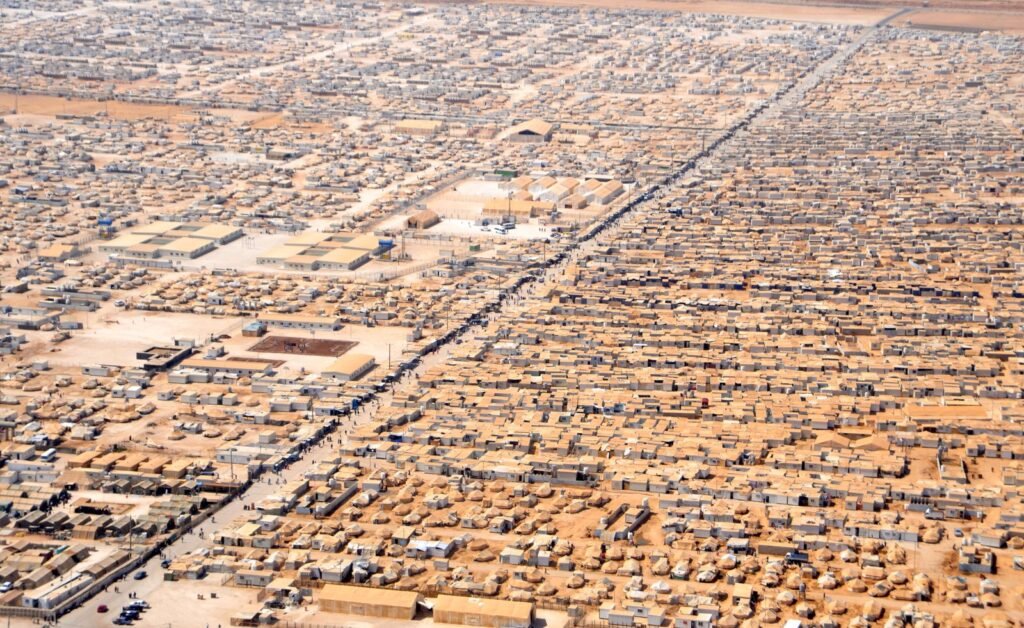
The Christian population of Syria fell more steeply, in proportion, than that of any other major group. Estimates of the number of Christians before the war, as noted above, ranged from about 5 to 10 per cent of the population. In 2021 the Assyrian Democratic Organisation, a Syriac Christian opposition party, told the Kurdish broadcaster Rudaw that the Christian share had fallen from eight to ten per cent before the war to about three per cent, a reduction of about two-thirds. These estimates rest on church registers, diaspora organisations and surveys rather than on a count, and they should be treated as orders of magnitude; but they are consistent with the decline of Christian communities in Aleppo, Homs, the Khabur valley and the Jazira reported by journalists and church leaders throughout the war. The causes were the general violence and economic collapse, the targeting of Christians by jihadist groups, conscription, and the existence of established diasporas abroad which made emigration easier.[63][10]
Other minorities suffered in particular ways. The Yazidis of the Syrian Jazira and the Afrin region, a small community whose numbers were never counted reliably, were caught between the Islamic State, which massacred and enslaved Yazidis across the border in Iraq in 2014, and the later fighting around Afrin. The Kurds of the north-east, many of whom had only recently received citizenship, established an autonomous administration that controlled much of the Jazira and the Euphrates valley for most of the war; their territory received Arab, Christian and Yazidi displaced persons as well as losing many of its own people to emigration, especially to Iraqi Kurdistan, Turkey and Germany. The Alawite community, though not displaced on the scale of Sunni regions, bore a very heavy share of military casualties, since its young men formed a large part of the regime’s forces and militias. None of these losses can yet be stated with numerical precision.[10][17]
On 8 December 2024 the Assad regime collapsed after a rapid offensive led by Hay’at Tahrir al-Sham, and Bashar al-Assad fled to Russia. According to the House of Commons Library, Ahmed al-Sharaa, the HTS leader formerly known as Abu Mohammad al-Jolani, was declared transitional president in January 2025. A constitutional declaration of March 2025 retained Islamic jurisprudence as the “main source of legislation” and required the president to be a Muslim; an interim parliament first met in July 2026. The new authorities promised to protect minorities, and there was a genuine return of refugees: by the UNHCR estimate, about 1.85 million Syrians had returned from abroad between 8 December 2024 and 19 November 2026, including some 694,000 Syrians known to UNHCR who had returned from Lebanon between January 2025 and the end of September 2026. Many more internally displaced people returned to their homes within the country.[10][64][65]
The transition was also marked by sectarian violence that tested those promises. In March 2025, after attacks by forces loyal to the old regime on government security forces in the coastal provinces, government-aligned forces and armed groups killed about 1,400 people, most of them Alawite civilians, according to figures summarised by the House of Commons Library. In April 2025 clashes in Druze suburbs of Damascus killed more than a hundred people. In June 2025 a suicide attack on a church in Damascus killed 25 worshippers. In July 2025 fighting in Suwayda, the Druze heartland of the south, between Druze militias, Bedouin tribal fighters and government forces, with Israeli airstrikes in support of the Druze, killed about 1,700 people and displaced about 200,000, according to the UN Commission of Inquiry on Syria, which reported in March 2026 that about 155,000 remained displaced. Suwayda remains largely outside government control. The authorities announced charges against about 565 people in connection with the violence. In January 2026 the government and the Kurdish-led Syrian Democratic Forces reached an agreement on the integration of the SDF into state institutions.[10][66]
| Indicator | Figure | Source and date |
|---|---|---|
| Civilians killed, March 2011–March 2021 | 306,887 | OHCHR (June 2022) |
| Forcibly displaced (inside and outside Syria) | over 13 million, at least 6.7 million abroad | UN-based estimates, late 2025 |
| Refugees registered in Egypt, Iraq, Jordan and Lebanon | c. 1.57 million | UNHCR (2026) |
| Refugees registered by Türkiye | c. 2.2 million | UNHCR (2026) |
| Returns from abroad since 8 December 2024 | c. 1.85 million | UNHCR estimate (19 November 2026) |
| Returns from Lebanon, January 2025–September 2026 | c. 694,000 known to UNHCR | UNHCR (30 September 2026) |
| Coastal violence, March 2025 | c. 1,400 killed, mostly Alawites | House of Commons Library (2026) |
| Suwayda, July 2025 | c. 1,700 killed; c. 200,000 displaced; c. 155,000 still displaced (March 2026) | UN Commission of Inquiry (March 2026) |
| Christians as share of population | c. 5–10% (pre-2011) to under 2–2.5% (2022) | Compiled estimates; Assyrian Democratic Organisation |
It is too early to say how the transition will change the composition of Syria in the long run. The return of refugees, if sustained, will increase the Sunni Arab share of the resident population, since most refugees were Sunni. The violence against Alawites and Druze in 2025 has encouraged both communities to look for protection, the Druze partly to Israel and to local self-government; some Alawites crossed into northern Lebanon in 2025, though how many have stayed there is not reliably known. The Christian communities, now much smaller, have sought guarantees from the new government and from foreign patrons. The Kurds of the north-east have negotiated integration with Damascus on terms that remain to be tested. And the Jews of Damascus, about six people in April 2025, have become a symbol of what has been lost rather than a community. None of these outcomes can yet be expressed in reliable numbers.[10][11]
16. The Shi‘a Rise and the Strained Pact in Lebanon, 1943–1975
The National Pact froze a confessional balance at the moment when the demographic forces that would undo it were gathering strength. In the three decades after independence Lebanon’s population roughly doubled, its capital grew into one of the great cities of the eastern Mediterranean, and its communities changed their relative size in ways that no official figure acknowledged. The community whose rise most transformed the country was the one that the Pact had treated as the junior partner among Muslims: the Shi‘a.[19][27]
In 1932 the Shi‘a were recorded as 19.6 per cent of the resident population, the third community after the Maronites and the Sunnis. They were overwhelmingly rural, concentrated in Jabal ‘Amil in the south and in the Baalbek–Hermel region of the northern Beqaa, with high fertility, low levels of education, and little representation in the state apart from the office of speaker of parliament and the patronage of a few landed families. Their emigration rate was low, and those who did emigrate went in large numbers to West Africa rather than the Americas; the census of 1932 recorded only about 11,500 Shi‘i emigrants against more than 123,000 Maronites. From the 1950s onward, the mechanisation of agriculture, the poverty of the south and, later, Israeli–Palestinian fighting along the border drove a massive migration from the countryside to Beirut, where the Shi‘a settled in the eastern suburbs and in the southern suburbs that came to be known as الضاحية (al-Ḍāḥiya).[8][25]
Max Weiss’s In the Shadow of Sectarianism (2010) shows how, under the Mandate, the French recognition of a separate Ja‘fari court system in 1926 helped turn the Shi‘a of Lebanon from a loosely connected population into a legally constituted community, with institutions that would later become vehicles for political mobilisation. In the 1960s and 1970s the Iranian-born cleric Musa al-Sadr founded the Supreme Islamic Shi‘i Council and the Movement of the Deprived, حركة المحرومين (Ḥarakat al-Maḥrūmīn), arguing that the Shi‘a were the largest and most neglected community in the country and demanding a share of power to match. The armed wing of the movement, Amal, was formed in 1974–75. Its claim to represent the largest community was impossible to test without a census, and that was part of its force.[25]
Demographers working with indirect evidence, such as school enrolment, electoral registers, and surveys of fertility, broadly agree on the direction of change, though not on its timing. Muslim fertility in Lebanon was considerably higher than Christian fertility in the 1950s and 1960s; Shi‘i fertility was the highest of all. Christian emigration continued, while Muslim emigration, though rising, remained lower. Courbage and Fargues concluded that Muslims had probably become a majority of Lebanon’s resident citizens by the 1960s, and that the Shi‘a had become the largest single community by the 1970s or 1980s. Muhammad Faour, using the electoral registers, has charted the same shift. All these estimates concern registered citizens; they exclude the Palestinian refugees, who by 1975 numbered several hundred thousand and were overwhelmingly Sunni Muslim.[2][19]
The Palestinian presence was the second great change of this period. The refugees of 1948, about 100,000 at first, grew by natural increase and by further arrivals after 1967 and, especially, after the expulsion of the Palestinian guerrilla organisations from Jordan in 1970–71. The Cairo Agreement of 1969 gave the Palestine Liberation Organization a large measure of autonomy in the camps and the right to operate against Israel from southern Lebanon. In confessional terms the Palestinians were an outside population, not citizens, and with a few exceptions not eligible for naturalisation; but their presence, their arms, and their alliance with the Lebanese left and many Sunni Muslims, altered the balance of power and alarmed the Maronite parties, who saw them as a threat to the Christian character of the state.[35][27]
Christian emigration did not stop in the years of prosperity before 1975. The crisis of 1958, when a short civil conflict pitted supporters of President Camille Chamoun against Arab nationalists inspired by Nasser’s United Arab Republic, encouraged a new wave of departures, and the growth of Beirut’s economy drew rural Christians as well as Shi‘a into the capital, where many prepared to emigrate further. At the same time Shi‘i emigration to West Africa, which had begun before the First World War, grew into a large and prosperous network of traders in Senegal, Sierra Leone, Côte d’Ivoire and Nigeria, whose remittances funded the building of the southern towns. By the 1970s the diaspora was no longer an almost entirely Christian phenomenon, although the census-era emigrants on the registers remained overwhelmingly Christian.[29][25]
The south, where the Shi‘a were concentrated, was the region most affected by the conflict between Israel and the Palestinian guerrillas after 1968. Israeli raids and shelling, and the presence of armed Palestinian groups, drove tens of thousands of villagers north to the suburbs of Beirut in the late 1960s and 1970s, adding to the economic migration already under way. The shanty districts of the eastern and southern suburbs, Nabaa, Burj Hammoud’s margins, Karantina and the beginnings of the Dahiya, became mixed districts of Shi‘i migrants, Palestinians, Kurds, Armenians and poor Christians. When the war began in 1975 these districts were among the first to be fought over and cleared.[25][27]
The confessional system itself made the demographic question more acute. Parliamentary seats, the major offices of state and positions in the civil service and army were distributed by sect on the basis of a ratio set in 1943. Every community that believed itself to be growing, above all the Shi‘a and, in a different way, the Sunnis, could argue that the ratio denied it its due; every community that believed itself to be shrinking, above all the Maronites, had an interest in preserving it. Kamal Salibi’s A House of Many Mansions (1988) describes the period as one in which Lebanese of every community were invited to imagine themselves as members of a single nation while living within institutions that assumed the opposite. The civil war that broke out in April 1975 had many causes, Palestinian, regional, social and economic. The frozen demographic arithmetic of the Pact was one of them.[27][19]
17. Lebanon since 1975 – War, Taif, Refugees and the Missing Census
The civil war of 1975–90 killed, on the most commonly cited estimates, between 120,000 and 150,000 people, injured some 300,000, displaced more than a million at one time or another, and led to the emigration of almost a million Lebanese, according to a European Union Institute for Security Studies assessment. It also redrew the confessional map of the country. Militias expelled or drove out minorities from the areas they controlled: Christians from the Shuf after the Mountain War of 1983–84, Muslims and Palestinians from East Beirut and the slum districts of Karantina and Tal al-Za‘tar in 1976, Christians from Damour and other southern towns in the same year. The so-called Green Line divided a mostly Christian East Beirut from a mostly Muslim West Beirut. The mixed villages of the Mutasarrifate, which had survived the war of 1860, did not all survive the war of 1975.[67][27]
The war also accelerated the emigration of Christians, although, unlike in earlier periods, Muslims emigrated in large numbers too. Data from the electoral registers on Lebanese who emigrated between 1992 and 2007, cited by Information International, show Shi‘a at about 27.5 per cent, Maronites at about 24 per cent and Sunnis at about 23 per cent of the emigrants, a far more even distribution than that of the 1932 census. Shi‘i emigrants went to West Africa, the Gulf, Germany, the United States and Australia; Christians went to France, Canada, the United States, Australia and Latin America. The confessional selectivity that had marked the Mahjar of the 1880s was weakening, but Christian emigration remained, in proportion to population, higher.[8][7]
The decades after Taif added two new causes of departure. The first was the long Israeli occupation of a strip of southern Lebanon, from 1978 and in a larger zone from 1985 until the withdrawal of May 2000, and the repeated wars between Israel and Hezbollah, in 1993, 1996, 2006 and 2023–24, which displaced the predominantly Shi‘i population of the south and the Dahiya again and again. The second was economic. The financial collapse that began in 2019, the loss of most of the value of the Lebanese pound and of bank deposits, and the explosion at the port of Beirut on 4 August 2020 produced a new wave of emigration among the young and the educated of every community. No reliable count of that emigration exists, and estimates circulated in the Lebanese press vary widely; but the composition of the overseas electoral lists in 2026, about 53 per cent Christian, is consistent with a continuing outflow in which Christians remain over-represented.[8][67]
The Taif Agreement, اتفاق الطائف (Ittifāq al-Ṭā’if), negotiated by Lebanese deputies in Saudi Arabia in October 1989 and incorporated into the constitution in 1990, ended the war on terms that acknowledged demographic change without counting it. It replaced the six-to-five ratio in parliament with equal representation of Christians and Muslims, the Druze counting with the Muslims, and enlarged the chamber; parliament has had 128 seats since 1992. It reduced the powers of the Maronite president in favour of the Sunni prime minister and the cabinet, and strengthened the position of the Shi‘i speaker. It also called, in principle, for the eventual abolition of political sectarianism, a step that has never been taken. Taif therefore converted a Christian majority on paper into parity on paper, at a time when Christians were, on every independent estimate, a minority of the citizen population.[27][19]
The naturalisation decree of June 1994, No. 5247, was the largest single change to the citizen body since 1932. According to Guita Hourani of the Lebanese Emigration Research Center, it naturalised 157,216 people from eighty countries, of whom over 42 per cent were Syrian nationals, 36 per cent stateless people, many of them Bedouin and residents of disputed border villages, and 16 per cent Palestinians. About three-quarters were Muslims, mostly Sunni. Information International estimated that, with spouses and children, the number had grown to about 217,000 by the end of 2011. Christian parties challenged the decree as a deliberate alteration of the confessional balance; the Maronite League appealed against it in the courts, and the dispute rumbled on for years.[68][7]
Without a census, the best available evidence for the composition of the citizen population is the electoral roll, which lists all Lebanese citizens aged 21 and over by sect, including those living abroad. It is not a perfect measure. It overstates communities with high emigration, because emigrants and their descendants remain on the roll, and it understates communities with young age structures, because children are not on it. With those caveats, its figures show a consistent trend.[7][8]
| Community | Voters 2022 | Share 2022 |
|---|---|---|
| Sunni | 1,170,895 | 29.5% |
| Shi‘a | 1,163,256 | 29.3% |
| Maronite | 766,277 | 19.3% |
| Greek Orthodox | 261,285 | 6.6% |
| Druze | 221,771 | 5.6% |
| Greek Catholic | 171,150 | 4.3% |
| Armenian Orthodox | 84,031 | 2.1% |
| Alawite | 38,537 | 1.0% |
| Jewish (“Israelite”) | 4,320 | 0.1% |
| All Muslims incl. Druze | – | 65.4% |
| All Christians | – | 34.5% |
| Total, 2022 | 3,967,507 | 100% |
| Total, 2026 | 4,144,025 | c. one-third Christian; one Interior Ministry tally: Christians 33.2%, Sunni 30.2%, Shi‘a 29.9% |
Sources: Information International (2022), shares calculated from its published figures; The Beiruter (September 2026) for 2026, reporting Information International and a Ministry of Interior tally. The roll covers citizens aged 21 and over, resident or abroad. Smaller communities are not listed separately.[7][8]
The figures for 2026 show the Christian share of the roll at about one-third, roughly the reverse of the ratio on which the Pact was founded. Independent estimates of the resident citizen population, which exclude emigrants but include children, put the Christian share lower. The research firm Statistics Lebanon, as reported by the US State Department in its religious freedom report for 2023, estimated that 69.3 per cent of the citizen population was Muslim, 31.2 per cent Sunni, 32.2 per cent Shi‘a and small numbers of Alawites and Ismailis, with 5.5 per cent Druze counted among Muslims for this purpose, and 30.5 per cent Christian. The Pew Research Center, in its 2025 study of the global religious landscape in 2020, estimated that Muslims were 67.8 per cent and Christians 27.9 per cent of Lebanon’s total population, a figure that includes non-citizens. All these figures are estimates and should be quoted as ranges.[48][69]
| Date | Christian share | Basis | Source |
|---|---|---|---|
| 1913 | 79.4% | Mount Lebanon Mutasarrifate only | Ottoman census, as compiled |
| 1922 | 56.5% | Greater Lebanon, residents | French count |
| 1932 | 50.0% (residents); c. 58.5% (residents and emigrants) | Last official census | Maktabi (1999); The Beiruter (2026) |
| 1956 | 54.7% | Official registration estimate | As compiled |
| 2020 | 27.9% | Total population incl. non-citizens | Pew (2025) |
| 2023 | 30.5% | Citizen population | Statistics Lebanon, via US State Department |
| 2022 | 34.5% | Electoral roll, citizens 21+ incl. abroad | Information International |
| 2026 | c. 33% | Electoral roll | The Beiruter, reporting Information International and Interior Ministry |
Two non-citizen populations complicate every estimate. The first is the Palestinians. UNRWA lists about 489,000 Palestine refugees registered in Lebanon, but registration does not imply residence, and a census conducted in 2017 by the Lebanese–Palestinian Dialogue Committee and the national statistics office counted 174,422 Palestinian refugees living in camps and gatherings. The second is the Syrian refugees. At the peak, the Lebanese government estimated about 1.5 million Syrians in the country, of whom over a million were registered with UNHCR before registration was suspended in 2015; since the fall of the Assad regime, UNHCR has recorded about 694,000 returns from Lebanon to Syria between January 2025 and September 2026. Both populations are overwhelmingly Sunni Muslim, and both have been treated by successive Lebanese governments, and by the Christian parties especially, as a demographic threat to the confessional balance.[40][70][64]
Why has Lebanon not held a census? The answer is the same as in 1943. A count would expose the gap between the formal equality of Christians and Muslims under Taif and the real size of each community, and would strengthen demands, especially from the Shi‘a, for a revision of the system. It might also reveal the size of each community abroad and so reopen the old argument about emigrants. Every confessional leadership has something to lose from a census, and none has enough to gain to insist on one. The Lebanese state therefore governs by registration rather than counting, and the most important number in its politics is one that no official will publish.[19][20]
18. Five Cities – Jerusalem, Haifa, Beirut, Damascus and Aleppo
National totals conceal the places where the change was most visible. The cities of the Levant were always more mixed than the countryside, and their composition has shifted more rapidly, because they absorbed migrants, refugees and immigrants, lost their minorities in wartime first, and were where emigrants usually departed from. Five cities illustrate the range of experience.
Jerusalem was already, by the late Ottoman period, a city with a Jewish majority within its walls and new suburbs, though the surrounding district was overwhelmingly Arab. The British census of 1922 counted 62,578 people in the city: 33,971 Jews, 13,413 Muslims and 14,669 Christians. In 1931 the figures were about 51,200 Jews, 19,900 Muslims and 19,300 Christians, out of about 90,500. The city was divided in 1948, the Jewish population of the Old City was expelled, and Arab residents of the western neighbourhoods, among them many Christians of Katamon, Talbiyeh and the German Colony, fled or were driven out. After the war of 1967 Israel extended the municipal boundaries to include East Jerusalem and a ring of Palestinian villages; in the expanded municipality Palestinians made up about 26 per cent of the population in 1967, according to the Jerusalem Institute for Israel Studies. Since then the Arab share has risen, through higher fertility and the movement of Jewish residents to the suburbs and the coastal plain, to about two-fifths of the municipality. The Christian population, by contrast, has fallen in both absolute and relative terms; the Israeli Central Bureau of Statistics counted about 13,400 Christians in Jerusalem at the end of 2025.[32][34][71][52][43]
Haifa grew from a small port into the industrial capital of Mandate Palestine. Its 1922 population of 24,634 comprised 9,377 Muslims, 8,863 Christians, 6,230 Jews, 152 Baha’is and 12 Druze; by 1931 it had more than doubled to 50,403, with 20,324 Muslims, 15,923 Jews and 13,824 Christians. By 1945 Jews were the majority. In April 1948, after the battle for the city, most of its Arab population of some 60,000 or more fled, and only a few thousand remained, many of them Christians who took refuge in the Wadi Nisnas quarter. Haifa today is a predominantly Jewish city with an Arab minority in which Christians are unusually prominent; the Central Bureau of Statistics counted about 18,800 Christians in the city at the end of 2025, almost as many as in Nazareth, with 18,900.[32][34][35][43]
Nazareth, the largest Arab city in Israel, is the counter-example: a city that was not depopulated in 1948. Its population, which had a Christian majority under the Mandate, was swelled by internally displaced Muslims from the surrounding villages, and over the following decades Muslim natural increase turned it into a Muslim-majority city with a large Christian minority. The Central Bureau of Statistics counted about 18,900 Christians there at the end of 2025, the largest Christian community of any locality in Israel. A Jewish town founded beside it in 1957, Nazareth Illit, since renamed Nof HaGalil, has attracted a growing Arab population of its own, a small sign of how settlement and natural increase continue to rearrange the population of Galilee.[43][35]
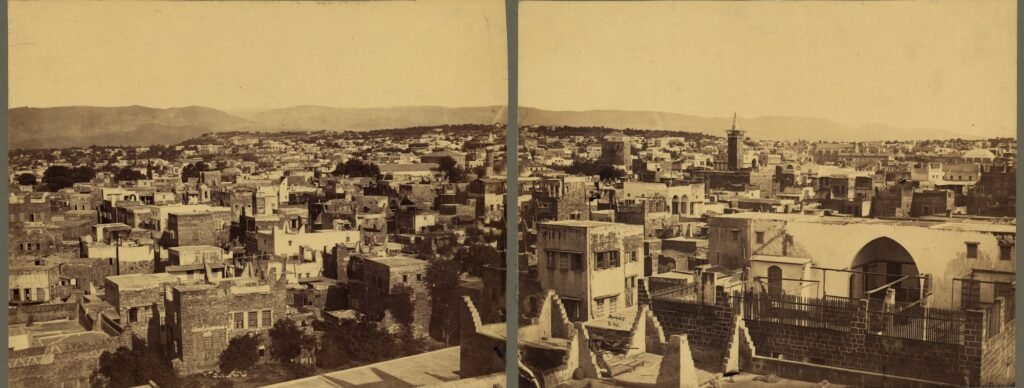
Beirut is the clearest example of a city transformed by the movements described in this article. In the 1840s it was a modest walled port; after 1860 it received Christian refugees from Damascus and the mountain; it then grew into the commercial capital of the Levant, absorbing Armenian refugees in the 1920s, Palestinian refugees after 1948, rural Shi‘a from the 1950s onward and Kurdish, Syrian and other migrant workers throughout. During the civil war it was partitioned along the Green Line between a Christian east and a Muslim west, and many neighbourhoods were emptied of their minorities. Since 1990 the city and its suburbs have been rebuilt along largely confessional lines: Christian Achrafieh and the northern Matn; Sunni Tariq al-Jadida and Ras Beirut, with a Christian minority; the Shi‘i Dahiya to the south; the Armenian quarter of Bourj Hammoud. Beirut has no census, and its municipal electoral roll, which lists only those registered in the city by descent, is a poor guide to its actual residents; the large majority of the people who live in Greater Beirut are registered elsewhere.[22][27][25]
Damascus has been an overwhelmingly Sunni city through the whole period, with a Christian quarter around Bab Tuma and Bab Sharqi in the Old City, a historic Jewish quarter, Shi‘i communities around the shrines of Sayyida Zaynab and Sayyida Ruqayya, and, from the late twentieth century, large Alawite neighbourhoods associated with the army and security services, such as Mezzeh 86. The massacre of July 1860 killed many thousands of its Christians and destroyed the Christian quarter; Eugene Rogan has shown how the Ottoman state, by punishing the perpetrators, executing the governor and rebuilding the quarter, ensured that most of the survivors stayed. The city’s Jewish population, after the departures of 1948–92, has almost disappeared. Its Christian population has declined relatively since the 1940s and absolutely since 2011; in June 2025 a suicide bomber killed 25 worshippers at the Mar Elias church in the Dweila district.[23][10][11]
Aleppo, the largest city of Syria before 2011, had the largest Christian population in the country, perhaps a tenth or more of its inhabitants on most estimates: Armenians, many of them descendants of survivors of 1915, Syriac Orthodox and Catholics, Greek Orthodox and Greek Catholics, Maronites and Latins. It also had an ancient Jewish community that did not survive the pogrom of 1947 and the emigration that followed. Between 2012 and 2016 the city was divided between government and opposition forces and much of the old city was destroyed; the Christian population, concentrated in the western quarters held by the government, fell steeply through emigration, by the accounts of the city’s bishops and clergy.[17][12]
| City and year | Jews | Muslims | Christians | Total | Source |
|---|---|---|---|---|---|
| Jerusalem, 1922 | 33,971 | 13,413 | 14,669 | 62,578 | British census, as compiled |
| Jerusalem, 1931 | c. 51,200 | c. 19,900 | c. 19,300 | 90,053 | British census, as compiled |
| Jerusalem (Israeli municipality), 1967 | c. 195,700 | 54,963 | 12,646 | 263,307 | Israeli count, as compiled |
| Haifa, 1922 | 6,230 | 9,377 | 8,863 | 24,634 | British census |
| Haifa, 1931 | 15,923 | 20,324 | 13,824 | 50,403 | British census |
The city figures confirm the national pattern on a smaller scale. Where Jewish immigration was heaviest, as in Haifa and Jerusalem, the Jewish share rose steeply between 1922 and 1948 and the Arab population was then largely displaced from the western parts of both cities. Where there was no immigration, as in Damascus and Aleppo, change came through differential fertility and emigration until the war of 2011 brought displacement on a scale comparable to that of 1948. In Beirut, all of these forces operated at once, and the absence of a census means that its composition is a matter of estimate and argument.[1][2]
19. A Comparative Ledger of Five Communities across Four States
It is useful, after following each state separately, to follow the main communities across the borders, since most of them predate the borders and several remain transnational. This section draws together the figures already given, and adds no new numbers of its own.
Christians. In 1860 Christians were perhaps a seventh to a fifth of the population of the Levant as a whole, on the estimates discussed above: a large majority in Mount Lebanon, about a tenth in Palestine, and something like an eighth or more in the Syrian provinces. Their share probably rose for the rest of the nineteenth century. In the 1940s they were about 50 to 55 per cent of the residents of Lebanon on the official figures, about 14 per cent of Syria’s population in 1943, and about 8 per cent of Palestine’s in 1945. Today they are perhaps 28 to 35 per cent of Lebanon’s citizens, depending on the measure; probably 2 to 3 per cent of Syria’s population on the rough estimates available; about 1.9 per cent of Israel’s; and about 1 per cent of the population of the West Bank and Gaza. In absolute numbers, Lebanon remains home to by far the largest Christian population in the four states, of the order of one and a half million registered citizens, many of them living abroad, followed by Syria and Israel. The largest Levantine Christian populations in the world, however, now live in the Americas.[8][9][43][6]
Druze. The Druze have remained a compact community spread across three states: Lebanon, where they are about 5.5 per cent of citizens and hold a fixed share of parliamentary seats and the post of chief of staff by convention; Syria, where they are about 3 per cent, concentrated in Suwayda and the suburbs of Damascus such as Jaramana and Sahnaya; and Israel, where they number about 152,000 including the Golan. Their share has been stable for a century, thanks to a closed religious community that neither proselytises nor accepts converts and to fertility which, high until the 1960s, has since fallen to below the national averages. In 2025 the Druze of Syria suffered some of the worst violence directed at them in modern times, and the relationship of the Suwayda Druze with Damascus, Israel and the Druze of Lebanon and Israel became a question of international politics.[42][7][10][66]
Alawites. The Alawites are almost entirely a Syrian community, with a small population in northern Lebanon, concentrated in Tripoli’s Jabal Mohsen and the Akkar, and a larger population across the border in Turkey’s Hatay province, which was the Sanjak of Alexandretta. They made up 11.4 per cent of Syria’s population in 1943, and are commonly estimated at about a tenth or a little more in recent decades. Their history in the twentieth century was one of extraordinary social mobility, from impoverished mountain peasants to the core of the officer corps and the security state, as Batatu documented; their history since December 2024 has been one of vulnerability, culminating in the killings on the coast in March 2025. Lebanon’s electoral roll of 2022 lists 38,537 Alawite voters.[24][9][7][10]
Armenians and Syriac Christians. Two communities that barely figure in the baseline of 1860 became important parts of the Levant’s population after 1915. The Armenian survivors of the deportations and their descendants formed, at their peak in the middle of the twentieth century, large communities in Aleppo and Beirut, and Lebanon recognised the Armenian Orthodox and Armenian Catholic churches among its official communities and gave them reserved seats in parliament; the 2022 electoral roll lists 84,031 Armenian Orthodox voters. Since the 1960s, emigration to Armenia, France, the United States and elsewhere has reduced both communities, and the Syrian war accelerated the departure from Aleppo. The Syriac communities of the Jazira, Syriac Orthodox, Syriac Catholic and Assyrian, followed a similar path, from refugee settlement in the 1920s and 1930s to emigration, chiefly to Sweden, Germany and the Netherlands, from the 1970s onward, and to the near-emptying of the Khabur villages after 2015.[12][7][17]
Shi‘a. Twelver Shi‘a are the largest community in Lebanon on most estimates, a small minority in Syria, and almost absent from Israel and Palestine; a few Shi‘i villages of upper Galilee were depopulated in 1948. In Lebanon their share of the recorded population rose from 19.6 per cent in 1932 to about 29 to 32 per cent today, depending on the measure, and their political weight rose with it, through Amal and later Hezbollah. The Shi‘a have also built one of the largest Lebanese emigrant networks, in West Africa, the Gulf, Europe and the Americas, which since the 1990s has made their emigration rate comparable to that of the Christians.[25][7][8]
Sunnis. Sunni Muslims have been the majority of the region throughout the period, and their share has risen in Syria and among Palestinians and in Lebanon, where it has grown from about 22 per cent of residents in 1932 to about 30 per cent of citizens today. They are also the community whose internal diversity the statistics most conceal: Arabs, Kurds, Turkmen, Circassians and Chechens in Syria; Palestinian refugees, naturalised Syrians and Bedouin in Lebanon; Negev Bedouin and Galilean villagers in Israel. In Syria the Sunni Arab population of the countryside bore the brunt of the war after 2011 and supplied most of its refugees, and the return of refugees since 2024 is, in demographic terms, largely a Sunni return. In Lebanon, by contrast, Sunni politics has been shaped by the fear of decline relative to the Shi‘a, and by the debate over whether Palestinian and Syrian Sunnis should ever be counted as Lebanese.[10][19][64]
Jews. The Jews have undergone the most dramatic change of any community in the region. In 1860 they were a small minority everywhere, perhaps fifteen to twenty-five thousand in Palestine and a few tens of thousands in Syria and Lebanon together. Today they are about three-quarters of Israel’s population, more than seven million people, and are almost absent from Syria and Lebanon. That transformation was the work of immigration, on a scale and with a political purpose unique in the region, together with the exodus of the Jews of the Arab world after 1948.[1][5][44]
| Community | c. 1860–1914 | Mid-twentieth century | Today (2020–26) |
|---|---|---|---|
| Christians, Lebanon | c. 80% of Mount Lebanon (1913) | 50–55% (1932–56, official) | c. 28–35% (estimates and rolls) |
| Christians, Syria | c. 12% (1920) | 14.1% (1943) | probably c. 2–3% (2022 estimates) |
| Christians, Palestine / Israel / WB–Gaza | c. 9–11% of Palestine | 7.7% of Palestine (1945) | 1.9% of Israel; c. 1% of WB–Gaza |
| Druze | 12.5% of Mount Lebanon (1895) | 6.8% Lebanon (1932); 3.0% Syria (1943) | c. 5.5% Lebanon; c. 3% Syria; c. 1.5% Israel |
| Alawites, Syria | not counted | 11.4% (1943) | c. 10–12% (estimates) |
| Shi‘a, Lebanon | 5.6% of Mount Lebanon (1913) | 19.6% (1932) | c. 29–32% (rolls and estimates) |
| Jews, Palestine / Israel | c. 3–14% of Palestine (1880s–1914, depending on source) | c. 32% of Palestine (1947) | c. 76% of Israel (“Jews and others”) |
| Jews, Syria and Lebanon | small communities | 29,770 in Syria (1943) | a handful in Damascus; under 100 in Lebanon |
Sources: as cited in earlier tables. The shares are not strictly comparable across columns because the territories, definitions and methods differ.[4][9][1][5]
The ledger shows two contrasting patterns. On one side are the communities whose share of the region has fallen: Christians in every state, Jews in Syria and Lebanon, and, in Palestine, the Arab majority of the Mandate period within the territory that became Israel. On the other are the communities whose share has risen: Jews in Israel, through immigration; Sunni Muslims in Syria and among Palestinians, through natural increase and, in Syria, the departure of Christians; and the Shi‘a in Lebanon. The Druze and, until 2024, the Alawites have been relatively stable. What distinguishes the falling from the rising communities is less a matter of religion than of the timing of the demographic transition, the opportunities for emigration, and the incidence of war.[2][1]
20. What Changed, and Why
The communities of the Levant in 1860 and in 2026 bear the same names, Maronite and Orthodox, Sunni and Shi‘i, Druze and Alawite, Jewish and Muslim, but almost everything else about them has changed: their size, their location, their legal status and the borders within which they are counted. Five forces explain most of the change, and it is worth restating them now that the evidence has been laid out.
The first is natural increase, and above all the differences in its timing. As Courbage and Fargues argued, Christians and, among Muslims, the urban Sunni middle classes experienced falling mortality and, later, falling fertility earlier than rural Muslims, Shi‘a and Bedouin. For much of the nineteenth century this worked in favour of Christians; for most of the twentieth it worked against them. The same mechanism explains a large part of the rise of the Shi‘a in Lebanon and of Sunni Arabs in Syria and Palestine, and, in reverse, the persistence of high Jewish fertility in Israel. In recent decades fertility has converged across communities in Lebanon, Israel and, more slowly, Syria and Palestine, and the effect of this force is weakening.[2][42][43]
The second is emigration, which has removed a far larger share of the region’s Christians than of its Muslims for a century and a half. The Mahjar of the 1880s to the 1920s, the emigration of the civil war years in Lebanon, the departure of Palestinian Christians from Bethlehem, Jerusalem and Ramallah, and the flight of Syrian Christians since 2011 all point in the same direction. Emigration also explains the paradox of Lebanon’s statistics, in which the electoral roll and the resident population tell different stories, and in which the diaspora is counted, or not counted, according to political convenience.[26][8]
The third is immigration and refuge. The Levant has received, in the period covered here, Circassians and Chechens from the Caucasus, Armenians and Syriac Christians from Anatolia, Kurds from Turkey, Jewish immigrants from Europe, the Arab world and the former Soviet Union, Palestinian refugees in Lebanon, Syria and Jordan, Iraqi refugees in Syria, and Syrian refugees in Lebanon. Some of these movements, notably the Zionist immigration to Palestine and Israel, were organised and were intended to change the population; others were the result of persecution and war elsewhere. All of them changed the composition of the states that received them.[13][17][1]
The fourth is war and violence. The war of 1860 in Mount Lebanon and Damascus; the famine, deportations and massacres of 1915–18; the war of 1948 and the Palestinian Nakba; the exodus of the Jews of the Arab world; the Lebanese civil war; the occupation and wars in the Palestinian territories; and the Syrian war since 2011 have each killed, displaced or driven out a large part of one or more communities. Violence has often been the trigger for movements that demographic and economic pressures had prepared, and its effects have been longest-lasting where those who left were not allowed or did not wish to return.[35][60][16]
The fifth is the making of borders and categories. The Ottoman millets, the French and British mandates, the Lebanese confessional constitution, the Israeli Law of Return and population registry, and the citizenship rules of Syria and Lebanon have defined who is counted, as what and where. The census of 1932 in Lebanon, the exceptional census of 1962 in al-Hasakah, the classification of Soviet immigrants as “others” in Israel, and the treatment of East Jerusalem in both Israeli and Palestinian statistics are examples of how the categories themselves shape the numbers.[20][58][12][5]
These forces have rarely worked alone. The Christian decline in Syria after 2011 combined war, emigration and the long-run effect of low fertility; the rise of the Shi‘a in Lebanon combined high fertility, rural migration to Beirut, the absence of a census and the political mobilisation of the 1970s; the Jewish majority in Israel was created by immigration, war and the exodus of Jews from the Arab world, and has been sustained by fertility. The relative importance of each force varies by community and period, and historians and demographers disagree about the weights. But an explanation that relies on only one of them, whether persecution, or fertility, or colonial manipulation, will misread the evidence.[2][19][13]
It follows that any single figure for the sectarian composition of one of these states should be read with its source, its date and its definition. A Christian share of a third of Lebanon’s electoral roll and of about 28 per cent of its total population are both defensible; a Christian population of Syria of a few hundred thousand or of a million may each be quoted by someone with a reason to quote it; the Jewish share of Israel is three-quarters or a little less, depending on whether “others” are included. The tables in this article have tried to give ranges where the figures are contested and to name their sources. They have also tried to show that, over a century and a half, the direction of change has been clearer than its exact magnitude.[19][5][10]
A second conclusion is that the communities of the Levant have always been larger than their states. Lebanese emigrants and their descendants outnumber the residents of Lebanon by any plausible count; Palestinians outside historic Palestine number about as many as those inside it; Syrians abroad, refugees and emigrants, are counted in millions; Syrian Jews live in Brooklyn and Mexico City, and Iraqi, Moroccan and Yemenite Jews in Israel; Armenian families of Aleppo and Beirut live in Glendale and Yerevan; the Syriac Christians of the Jazira have become Swedish. Any account of sectarian composition confined to residents of the four states describes only part of each community, and an increasingly small part for those, above all the Christians, whose diaspora has grown fastest. In that sense, too, the confessional arithmetic of the Lebanese electoral roll, which counts the absent, is not simply an anomaly. It is a recognition, for its own political purposes, of a regional fact.[29][18][44]
What is the prospect? The most predictable trends are those driven by age structure. Israel’s Haredi share will continue to rise for at least a generation; the populations of the West Bank and Gaza will continue to grow, if more slowly; Lebanon’s Christian share will continue to fall gently through emigration and ageing, unless the political settlement changes the incentives to leave. Syria is the least predictable: the scale of return, the security of the minorities, and the policy of the new government towards the communities that the Assad regime claimed to protect will decide whether the country’s religious diversity, already much diminished, survives. The precedent of the last 166 years is not encouraging. But the history of Mount Lebanon after 1860, where a negotiated system allowed communities that had fought one another to live together for half a century, is a reminder that demographic change does not by itself decide whether a plural society can endure. Institutions, and the choices of those who run them, matter as much as numbers.[21][51][10]
Share this article
References
- Sergio DellaPergola, “Demography in Israel/Palestine: Trends, Prospects, Policy Implications”, paper presented to the XXIV General Population Conference of the IUSSP, Salvador de Bahia, August 2001 *
- Youssef Courbage and Philippe Fargues, Christians and Jews under Islam, trans. Judy Mabro (London: I. B. Tauris, 1997) *
- Justin McCarthy, The Population of Palestine: Population History and Statistics of the Late Ottoman Period and the Mandate (New York: Columbia University Press, 1990) *
- Joseph Chamie, Religion and Fertility: Arab Christian-Muslim Differentials (Cambridge: Cambridge University Press, 1981), p. 29 (tables of the 1895 estimate, the 1913 and 1922 censuses and the official estimates of 1943–56) *
- Israel Central Bureau of Statistics, “Population of Israel on the Eve of 2026”, press release 422/2025, 31 December 2025 *
- Palestinian Central Bureau of Statistics, Population, Housing and Establishments Census 2017: Population Final Results, Detailed Report (Ramallah: PCBS) *
- Information International, The Monthly, electoral-roll figures by sect for the 2022 Lebanese parliamentary election *
- “Lebanon’s Electorate: Who Is Lebanon Counting?”, The Beiruter, 18 September 2026 *
- Mustafa Khalifa, “The Impossible Partition of Syria”, Arab Reform Initiative, October 2013, p. 3 (table of the 1943 census and 1953 figures by religion) *
- House of Commons Library, Syria in 2026: Minority Religious and Ethnic Groups after Assad, Research Briefing CBP-10429, 1 September 2026 *
- “Jews in Islamic Countries: Syria”, Jewish Virtual Library (consulted 23 November 2026) *
- Benjamin Thomas White, The Emergence of Minorities in the Middle East: The Politics of Community in French Mandate Syria (Edinburgh: Edinburgh University Press, 2011) *
- Laura Robson, States of Separation: Transfer, Partition, and the Making of the Modern Middle East (Oakland: University of California Press, 2017) *
- Kemal H. Karpat, Ottoman Population, 1830–1914: Demographic and Social Characteristics (Madison: University of Wisconsin Press, 1985) *
- A. H. Hourani, Minorities in the Arab World (London: Oxford University Press for the Royal Institute of International Affairs, 1947) *
- Ussama Makdisi, The Culture of Sectarianism: Community, History, and Violence in Nineteenth-Century Ottoman Lebanon (Berkeley: University of California Press, 2000) *
- Dawn Chatty, Syria: The Making and Unmaking of a Refuge State (London: Hurst, 2018) *
- Palestinian Central Bureau of Statistics, “PCBS Presents the Conditions of the Palestinian Population on the Occasion of the World Population Day, 11/07/2025”, 10 July 2025 *
- Muhammad A. Faour, “Religion, Demography, and Politics in Lebanon”, Middle Eastern Studies 43, no. 6 (2007): 909–921 *
- Rania Maktabi, “The Lebanese Census of 1932 Revisited: Who Are the Lebanese?”, British Journal of Middle Eastern Studies 26, no. 2 (1999): 219–241 *
- Engin Deniz Akarlı, The Long Peace: Ottoman Lebanon, 1861–1920 (Berkeley: University of California Press; London: Centre for Lebanese Studies and I. B. Tauris, 1993) *
- Leila Tarazi Fawaz, Merchants and Migrants in Nineteenth-Century Beirut (Cambridge, MA: Harvard University Press, 1983) *
- Eugene L. Rogan, “Sectarianism and Social Conflict in Damascus: The 1860 Events Reconsidered”, Arabica 51, no. 4 (2004): 493–511 *
- Hanna Batatu, Syria’s Peasantry, the Descendants of Its Lesser Rural Notables, and Their Politics (Princeton: Princeton University Press, 1999) *
- Max Weiss, In the Shadow of Sectarianism: Law, Shi‘ism, and the Making of Modern Lebanon (Cambridge, MA: Harvard University Press, 2010) *
- Akram Fouad Khater, Inventing Home: Emigration, Gender, and the Middle Class in Lebanon, 1870–1920 (Berkeley: University of California Press, 2001) *
- Kamal Salibi, A House of Many Mansions: The History of Lebanon Reconsidered (London: I. B. Tauris, 1988) *
- Kemal H. Karpat, “The Ottoman Emigration to America, 1860–1914”, International Journal of Middle East Studies 17, no. 2 (1985): 175–209 *
- Albert Hourani and Nadim Shehadi (eds), The Lebanese in the World: A Century of Emigration (London: Centre for Lebanese Studies and I. B. Tauris, 1992) *
- Melanie S. Tanielian, The Charity of War: Famine, Humanitarian Aid, and World War I in the Middle East (Stanford: Stanford University Press, 2018) *
- Linda Schatkowski Schilcher, “The Famine of 1915–1918 in Greater Syria”, in John P. Spagnolo (ed.), Problems of the Modern Middle East in Historical Perspective: Essays in Honour of Albert Hourani (Reading: Ithaca Press, 1992), 229–258 *
- J. B. Barron (comp.), Palestine: Report and General Abstracts of the Census of 1922 (Jerusalem: Government of Palestine, 1923) *
- Philip S. Khoury, Syria and the French Mandate: The Politics of Arab Nationalism, 1920–1945 (Princeton: Princeton University Press, 1987) *
- E. Mills, Census of Palestine 1931: Population of Villages, Towns and Administrative Areas (Jerusalem: Government of Palestine, 1932) *
- Benny Morris, The Birth of the Palestinian Refugee Problem Revisited (Cambridge: Cambridge University Press, 2004) *
- “Immigration to Israel”, Jewish Virtual Library, articles on the First to Fifth Aliyot (1882–1939) and on Aliyah Bet (1939–1948) (consulted 23 November 2026) *
- Government of Palestine, A Survey of Palestine, prepared for the Anglo-American Committee of Inquiry (Jerusalem: Government Printer, 1946) *
- Walid Khalidi (ed.), All That Remains: The Palestinian Villages Occupied and Depopulated by Israel in 1948 (Washington, DC: Institute for Palestine Studies, 1992) *
- Rashid Khalidi, Palestinian Identity: The Construction of Modern National Consciousness (New York: Columbia University Press, 1997) *
- UNRWA, “Palestine Refugees” (consulted 23 November 2026) *
- Palestinian Central Bureau of Statistics, statement by Dr Ola Awad on the conditions of the Palestinian people on the occasion of World Refugee Day, 20 June 2025 *
- Israel Central Bureau of Statistics, “The Druze Population of Israel”, press release 124/2024 *
- Israel Central Bureau of Statistics, “Christians in Israel”, Christmas 2025 press release 413/2025 *
- “Fact Sheet: Jewish Refugees from Arab Countries”, Jewish Virtual Library, with table of Jewish populations in Arab countries, 1948–2018 (consulted 23 November 2026) *
- Mouna Liliane Samman, La population de la Syrie: étude géo-démographique (Paris: ORSTOM, 1978), table of the population of Syrian nationality by religion, census of 1960 *
- “Lebanon Virtual Jewish History Tour”, Jewish Virtual Library (consulted 23 November 2026) *
- “Lebanon’s Jews: Loyalty to Whom? BBC Documentary Tracks Vanished Community”, HuffPost, 26 September 2010 *
- US Department of State, 2023 Report on International Religious Freedom: Lebanon (2024) *
- “Total Immigration to Israel by Year (1948–Present)”, Jewish Virtual Library, from Israel Central Bureau of Statistics data (consulted 23 November 2026) *
- Noah Lewin-Epstein and Yinon Cohen, “Ethnic Origin and Identity in the Jewish Population of Israel”, Journal of Ethnic and Migration Studies 45, no. 11 (2019): 2118–2137 *
- Israel Democracy Institute, Annual Statistical Report on Ultra-Orthodox (Haredi) Society in Israel 2025 *
- Office of the European Union Representative (West Bank and Gaza Strip, UNRWA), 2025 Report on Israeli Settlements in the Occupied West Bank, including East Jerusalem, 6 July 2026 *
- Jerusalem Institute for Policy Research, Statistical Yearbook of Jerusalem 2025, Table III/1: Population of Israel and Jerusalem, by Population Group, 1922–2023 *
- “FACTBOX – Christians in Israel, West Bank and Gaza”, Reuters, 10 May 2009 (archived copy) *
- “Faithful Few: Can Gaza’s Christian Community Survive?”, The Guardian, 23 December 2018 *
- Palestinian Center for Policy and Survey Research, “Public Opinion Poll: Migration of Palestinian Christians”, fieldwork 27 January–23 February 2020 *
- Nikolaos van Dam, The Struggle for Power in Syria: Politics and Society under Asad and the Ba‘th Party (London: I. B. Tauris; first published 1979) *
- Human Rights Watch, Syria: The Silenced Kurds (New York: Human Rights Watch, October 1996) *
- UNHCR, “Syrian Arab Republic” country page (consulted 23 November 2026) *
- UN Office of the High Commissioner for Human Rights, “UN Human Rights Office estimates more than 306,000 civilians were killed over 10 years in Syria conflict”, 28 June 2022 *
- UNHCR Operational Data Portal, “Syria Regional Refugee Response” (consulted 23 November 2026) *
- UNHCR, “Needs Soar as Number of Syrian Refugees Tops 3 Million”, 29 August 2014 *
- Karwan Faidhi Dri, “Syria’s Christian Population Reduced by Two-Thirds since 2011: Party”, Rudaw, 9 August 2021 *
- UNHCR, “Syrian Arab Republic: Comprehensive Overview of Refugee Returns” dashboard, 19 November 2026, via ReliefWeb *
- PRISM, “Return of Syrian Refugees and Displaced People”, November 2026 *
- “Syria: UN Commission Documents Grave Violations in July 2025 Escalation in Sweida”, UN News, 27 March 2026 *
- Florence Gaub, “Lebanon’s Civil War: Seven Lessons Forty Years On”, EU Institute for Security Studies Alert 21, April 2015 *
- Guita Hourani, “The 1994 Naturalisation Decree”, EUDO Citizenship / GLOBALCIT, November 2011 *
- Pew Research Center, “How the Global Religious Landscape Changed from 2010 to 2020”, 9 June 2025 *
- Lebanese Palestinian Dialogue Committee, Central Administration of Statistics and PCBS, “Key Findings of the Population and Housing Census of Palestinian Camps and Gatherings in Lebanon 2017”, 21 December 2017 *
- Meir Kraus and Caroline Kahlenberg, Separation from Palestinian Neighborhoods in East Jerusalem (Jerusalem: Jerusalem Institute for Israel Studies, n.d.) *
Related reading

Minsk and the Book of Books
For four centuries Minsk was one of the great Jewish cities of Lithuania and the Russian Empire: a city of yeshivot and study houses, of Aryeh Leib Gunzberg and the Gadol of Minsk, of maskilim, Hebrew teachers and Zionists. This long read follows how its Jews studied the Hebrew Bible, from the first customs farmers to the ghetto, the Soviet silence and the small community of today.

Simon Schama and the Art of History
For more than half a century Simon Schama has bet that scholarship and storytelling are not rivals. This long read follows his work from the Dutch Republic, the French Revolution and Rembrandt to his lifelong engagement with Jewish history: Two Rothschilds, The Story of the Jews and his writing on antisemitism, weighed against what critics and admirers have said.
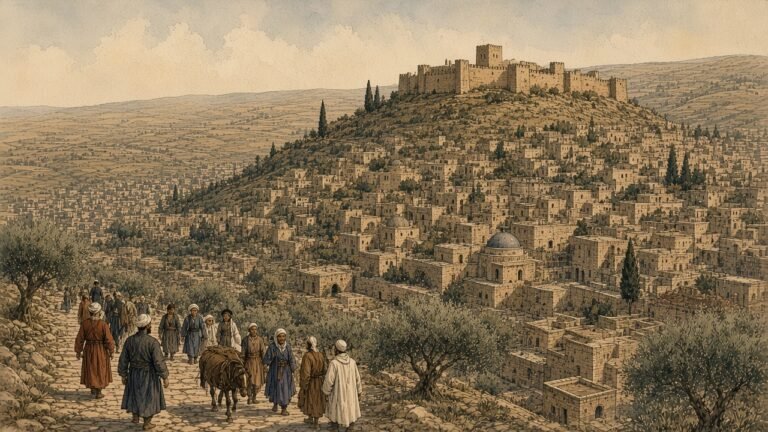
The Heights of Safed
After the expulsion from Spain and the Ottoman conquest of 1516, a hill town in Upper Galilee became, for a few decades, one of the most productive Jewish centres in the world: a town of looms, of Joseph Karo’s Shulchan Arukh, of the fellowship around Isaac Luria, and, in 1577, of the first Hebrew books printed in the Land of Israel.