History
The War of 1860 on Mount Lebanon
Contents ▾
LEBANON · 1860 · SCHOLARLY NOTE
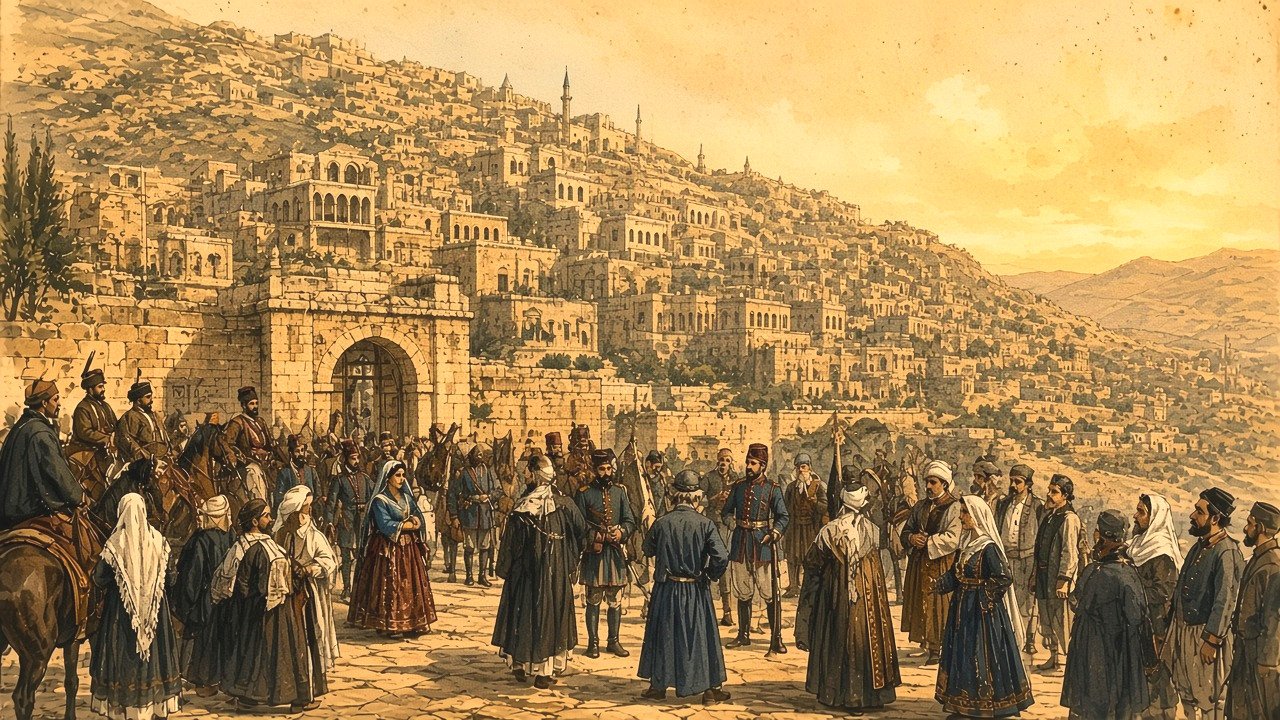
In the late spring and summer of 1860, known in Arabic as حرب ١٨٦٠ (Ḥarb 1860, the war of 1860), civil war on جبل لبنان (Jabal Lubnān, Mount Lebanon) between Druze and Maronite communities was followed, in July, by a massacre of Christians in Damascus (دمشق). The crisis ended in an international settlement and in the متصرفية جبل لبنان (Mutasarrifate of Mount Lebanon), created by the Règlement Organique of 1861.
| FIGHTING BEGINS | HASBAYA AND RASHAYA | DAMASCUS | RÈGLEMENT ORGANIQUE |
|---|---|---|---|
| Late May 1860, Mount Lebanon | 3–4 June and the days that followed | 9 July 1860, Bāb Tūmā | 9 June 1861, Mutasarrifate |
1. The Short Answer
The war of 1860 was a short, concentrated collapse of an already fragile order on Mount Lebanon, and then a riot and massacre in the Christian quarter of Damascus. On the mountain the principal combatants were Druze and Maronite, though Greek Catholic and Greek Orthodox villagers were drawn in, especially at زحلة (Zahlé) and in وادي التيم (Wādī al-Taym). In the towns of دير القمر (Deir al-Qamar), حاصبيا (Hasbaya) and راشيا (Rashaya), thousands of Christians were killed in June. On 9 July the violence jumped the mountain and fell on باب توما (Bāb Tūmā) in Damascus. The Algerian amir عبد القادر الجزائري (ʿAbd al-Qādir al-Jazāʾirī) and his retainers saved many thousands of Christians there. The Ottoman foreign minister فؤاد باشا (Fuad Pasha) arrived to punish and to rebuild; a French expeditionary force landed at Beirut in August; and in June 1861 the European powers and the Porte replaced the old mountain regime with a new autonomous province under a Christian governor appointed from Istanbul.[1]
The argument of this note is straightforward. The war was not a sudden eruption of eternal hatreds, and it was not simply a European plot. It grew out of the fall of the Shihab emirate, the Egyptian occupation of Syria, the clumsy partition of the mountain into two governorships in the 1840s, a peasant revolt in Kisrawan, and a tightening of sectarian politics under the Tanzimat. The settlement that followed did bring a long peace to the mountain. It also wrote communal representation into the government of Mount Lebanon, a precedent that later Lebanese constitutions never quite escaped.[2][3]
2. The Mountain and the Emirate
Mount Lebanon in the early nineteenth century was not a nation-state and not a simple mosaic of hostile sects. It was a mountain principality inside the Ottoman Empire, ruled for generations by the Shihab emirs, who worked through a hierarchy of local notable families: Khazin and other Maronite sheikhs in the north, Jumblatt, Imad, Abu Nakad and their rivals among the Druze of the Shuf and the southern slopes, with mixed villages and mixed lordships in between. Peasants owed dues and labour to their lords; silk, already important, was becoming more so as French demand pulled the mountain into a Mediterranean market. Religious identity mattered, but it was not yet the only or even the chief organising principle of politics.[2]
The unit of power was the notable house, not the sect as a whole. A Jumblatt or a Khazin collected dues, judged disputes, and raised armed men from villages that might themselves be mixed. Peasants moved between protection and flight; sheikhs rose and fell by marriage, Ottoman favour, and force. Silk, already old in the mountain, tightened these bonds and loosened them at the same time. French demand, especially from Lyon, put money into Maronite and mixed districts and tied the harvest to a European market that did not pause for a local feud. When the political settlement of the mountain later failed, that market did not cause the war, but it had already changed who had cash, who had debts, and who could appeal to a consul.[2][3]
The Tanzimat reforms, and the growing presence of European consuls after the Egyptian withdrawal, changed the stakes. Imperial edicts promised equality before the law to Muslims, Christians and Jews. In practice that promise was uneven, but it was visible enough to matter. Christian merchants and clerks, already well placed in the silk trade with Lyon and in the business of the ports, found new offices and new protectors. Druze and Sunni notables saw old hierarchies questioned. None of this made a massacre inevitable. It did mean that, when the mountain’s political settlement failed, economic and legal grievances were ready to be told as communal ones.[2][3]
The last great Shihab prince, بشير الثاني الشهابي (Bashir II Shihab), ruled, with interruptions, from the late eighteenth century until 1840. His state-building was ruthless and modernising in the manner of his sometime patron, Muhammad Ali Pasha of Egypt. When Ibrahim Pasha occupied Syria in the 1830s, Bashir II attached himself to the Egyptian regime, disarmed opponents, favoured those who would serve him, and tightened fiscal extraction. Egyptian rule in Syria, like Muhammad Ali’s rule in Egypt, promised order and delivered conscription, corvée and new taxes. It also unsettled the old balance among communities. When the European powers forced the Egyptians out of Syria in 1840, Bashir II fell with them. He was deposed and sent into exile. The emirate, as a working system, did not long survive his departure.[4][5]
The campaign of 1840 itself was a European and Ottoman intervention, not a mountain revolt. British, Austrian and Ottoman forces, acting to roll back Muhammad Ali’s Syrian conquests, landed on the coast and broke the Egyptian position. Bashir II, having chosen the losing side, was taken off the mountain and sent into exile, first to Malta and later to the Ottoman capital. Behind him he left a principality without a prince who could command both Druze and Maronite notables. Attempts to install a weaker Shihab, and then to do without a single emir at all, opened the years of fighting that followed. The vacuum was political before it was sectarian, but it was quickly filled in sectarian language.[4][5][3]
3. Two Governors and a Peasant Revolt
What replaced the emirate was a European and Ottoman compromise. After further fighting in 1841 and 1845, the mountain was divided into two qaimaqamates, or governorships: a northern district under a Christian qaimaqam and a southern district under a Druze qaimaqam, both theoretically subject to the Ottoman governor on the coast. The arrangement, associated with the 1845 règlement of Shakib Efendi, was meant to keep the peace by giving each of the two strongest communities a territory of its own. In the mixed districts, especially the Matn, it did the opposite. Questions of jurisdiction, tax, and protection became sectarian questions. Murders were answered by murders. Consuls kept count. The mountain learned to speak of itself, more and more, in communal terms.[2][3]
The first years after 1840 were themselves a small civil war. In 1841, and again in 1845, Druze and Maronite armed bands burned villages and drove neighbours from mixed country, especially where the new line between the two governorships was hardest to draw. The règlement associated with شكيب أفندي (Shakib Efendi) in 1845 tried to tidy the partition: each qaimaqam was to have a council on which the communities were represented, and the mixed districts were to be administered with an eye to both sides. On paper this was a compromise. In the Matn and in other mixed neighbourhoods it became a permanent argument about whose official had the right to arrest, to tax, and to protect. A murder that might once have been a matter for a sheikh’s mediation was now a test of which governorship, and which consul, would answer it.[2][3]
In 1858 a different kind of revolt broke out in Kisrawan, in the Christian north. Maronite peasants, led by the blacksmith and village strongman طانيوس شاهين (Tanyus Shahin), rose against their own lords, the Khazin sheikhs, refused dues, and for a time ran a rough popular government of their own. It was a social rising before it was a sectarian one, but it was not sealed off from the fears of the south. Armed bands, proclamations, and the spectacle of peasants unseating sheikhs travelled. Druze notables, who had no place in Shahin’s vision of a liberated Christian mountain, watched with alarm. By the spring of 1860 the Kisrawan movement and the older Druze–Maronite quarrel had become entangled. Random killings in mixed country, each followed by retaliation, had already made the season dangerous before the main fighting began.[2]
Shahin’s movement is sometimes called a peasant republic, and the phrase is useful so long as it is not made too tidy. For two years Kisrawan ran without its old lords. Dues were refused, sheikhs were driven out, and village assemblies, backed by armed men, claimed to govern in the name of the common people. The Maronite Church was divided: some clergy had long been closer to the peasantry than to the Khazin houses, while the patriarchate feared both social levelling and a war with the Druze that the north could not contain. Shahin issued proclamations that mixed social justice with a Christian language of liberation. In the Shuf that combination was heard, not unreasonably, as a threat. By the time the Kisrawan bands looked south in 1860, the revolt had already taught the mountain that armed peasants could unseat a hierarchy, and that lesson travelled faster than any settlement from Beirut.[2]
The Ottoman governor on the coast, Khurshid Pasha, had troops, but not a settled policy that the communities trusted. European consuls in Beirut wrote home in a rising tone of alarm. The mixed villages of the Matn, where the line between the two qaimaqamates was hardest to draw, became the first theatre in which rumour, honour and armed bands could turn a local murder into a general war. By May the mountain was, in effect, waiting for a spark.
4. The War of May and June
Full-scale hostilities opened in the last week of May 1860. Christian armed men, some of them connected with the Kisrawan mobilisation, moved south towards the mixed districts and the approaches to the Shuf. Druze forces assembled to meet them. Who struck first, and with what intention, remains disputed in the sources, as Ussama Makdisi has emphasised; what is not disputed is that the skirmishes of late May became a war.[2]
The first serious fighting was in the mixed country of the Matn, around villages such as بيت مري (Beit Miri), where Druze and Christians lived close enough for a single killing to empty a road. Houses were burned, harvests were left, and each side sent for kinsmen from further north or further into the Shuf. Within days the war had a geography: a Christian mobilisation pressing south from Kisrawan and the northern districts, a Druze mobilisation gathering from the Shuf, the Wadi al-Taym, and, as the fighting widened, from Druze country beyond the mountain in the Ḥawrān. Once those two movements met, the towns that lay in their path—Deir al-Qamar, Zahlé, Hasbaya, Rashaya—became the places where a rural war turned into a massacre.[1][3]
The worst killing was not in open battle but in the towns where Christian populations were dense and then trapped. Deir al-Qamar, the old princely town of the mountain, was besieged at the end of May by Druze forces associated with the Nakad, Imad and Jumblatt leaderships. By early June the town was short of food. A relief convoy of grain attributed to the Ottoman governor, Khurshid Pasha, did not arrive in any useful way. When the town fell in mid-June, a massacre of Christians followed. Contemporaries and later historians disagree about exact numbers, which were inflated and contested at the time; they agree that the death toll ran into the thousands and that the sack of Deir al-Qamar became the emblem of the mountain war.[1][3]
Zahlé’s fall had a different geography and a similar ending. The town looked east over the Beqaa rather than down towards the coast, and its leading community was Greek Catholic rather than Maronite, with close ties to the agricultural plain and to Damascus itself. Its defence was organised, and for a time successful, which made the eventual breach the more complete. When Druze and allied forces entered, houses and churches were plundered and many of the defenders and of the males who had remained were killed. Zahlé’s notables, like those of Deir al-Qamar, would later be among the loudest voices at Beirut, pressing consuls and commissioners for a settlement that could not be undone by the next season of raids.[1][3]
Zahlé, the large Greek Catholic town on the edge of the Beqaa, was attacked and taken in the same mid-June days. Further south, in Wadi al-Taym, the fighting took a particularly bitter form at Hasbaya and then at Rashaya. At Hasbaya, in the first days of June, Christians who had already been skirmishing with Druze fighters were persuaded, on the advice of the local Ottoman officer Uthman Bey, to take refuge in the government house and to give up their arms. Some four hundred others sheltered in the house of Nayifa, sister of the Druze leader Saʿid Jumblatt. On 3 and 4 June a reinforced Druze force overwhelmed the town. Men of the Shihab family, including the emir Saʿd al-Din, were killed, and a large number of Christian males who had taken refuge in the government house were massacred. Women were, in the main, spared. Rashaya suffered a similar fate in the days that followed. British consular reporting later treated Uthman Bey’s conduct as, at best, a failure of protection and, at worst, a deception.[1][3]
Rashaya, a few hours away in the same valley, followed a similar pattern in the days after Hasbaya fell. Christians gathered for protection, Ottoman authority failed to hold the town, and a Druze assault ended in the killing of a large number of Christian males. Wadi al-Taym was not a footnote to the war on the high mountain: it was one of its principal killing grounds, and it tied the Shuf to the approaches of Damascus. Refugees from Hasbaya and Rashaya carried the news of the government house, and of Uthman Bey, into the Beqaa and towards the city. By mid-June the question was no longer whether the mountain war would remain a mountain war, but how far its fear, and its example, would travel.[1][3]
Beirut itself, the growing port at the foot of the mountain, was not sacked, but it was filled with refugees. Missionary and consular estimates of the Christian dead on the mountain and in the adjacent districts varied widely. A letter from the American consulate at Beirut, written at the end of June and later printed in the New York press, reported a missionary estimate of more than ten thousand Christian dead. Such figures cannot be treated as a census. They do record the scale on which contemporaries understood the disaster.[1]
Khurshid Pasha’s role remains one of the bitter questions of the war. Christian survivors and several European consuls accused the Ottoman authorities of failing to relieve the besieged towns, of disarming Christians more readily than Druze, and, in some places, of looking on. Ottoman officials, and later some historians, replied that the state was weak on the mountain, that its garrisons were small, and that the speed of the collapse outran any ordinary reinforcement. The safer conclusion, and the one this note adopts, is that Ottoman protection failed at the decisive moments—at Deir al-Qamar, at Hasbaya, at Rashaya—whether through incapacity, delay, or something worse, and that this failure is itself part of the history.[1][3]
5. Damascus in July
Damascus had not been the scene of the mountain war, but it was not sealed off from it. News of the massacres, the arrival of refugees, and older city tensions—economic rivalry, resentment of Christian gains under the Tanzimat, memories of the Egyptian occupation—prepared a grim week. On 9 July 1860 the Christian quarter of Bāb Tūmā was attacked. Houses were plundered and burned, and over the following days thousands of Christians were killed. As in the mountain, precise totals are uncertain; the event itself is not.[1][6][7]
The riot lasted several days, conventionally dated from 9 July into the 11th, and it was not a spontaneous street brawl that happened to turn deadly. Crowds moved on Bāb Tūmā with the knowledge that the Christian quarter was both a symbol of recent privilege and a store of movable wealth. Irregulars, city poor, and men who had come in from the surrounding countryside took part; so, the later trials would claim, did soldiers who should have been a garrison. Ahmad Pasha, the Ottoman governor, did not throw his force between the crowd and the quarter in time to stop the killing. Whether that was panic, complicity, or a collapse of command was argued at once, and was among the questions Fuad Pasha later answered with a death sentence. What can be said with certainty is that, for two or three days, the imperial city failed to protect a community that lived inside its walls.[1][7][15]
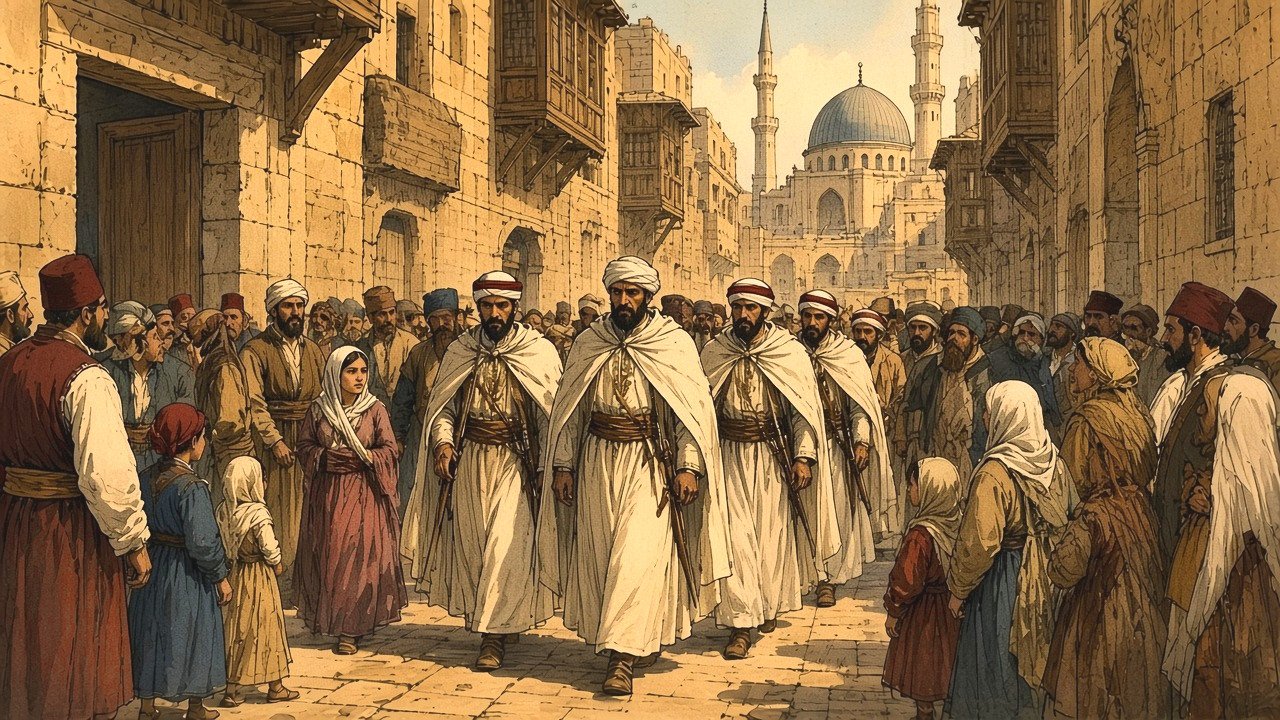
The great counter-figure of those days was ʿAbd al-Qādir al-Jazāʾirī, the Algerian amir who had fought the French for fifteen years, been taken to France as a captive, and, after his release, been settled by the Ottomans in Damascus. In mid-June, as rumours of danger thickened, he went to the French consulate and asked for the means to arm a thousand of his Algerian followers in order to protect Christians if the city broke. The acting consul, Lanusse, authorised the expenditure, a decision later defended to Paris. When the riot began on 9 July, ʿAbd al-Qādir—who had been outside the city—returned, and he and his men brought Christians into his own residence and other places of shelter, and escorted others to safety. Consular estimates of those he saved ranged from about eleven thousand to fifteen thousand. The numbers, again, are not a register; the act is one of the best-attested rescues of the nineteenth-century Levant.[6][7]
The rescue had a history of its own. ʿAbd al-Qādir had lived in Damascus long enough to be known there as a scholar, a notable, and the head of an Algerian following that was armed, disciplined, and loyal to him rather than to the city’s factions. His earlier war against France, and his later captivity, had not left him a client of the consulate, but they had created a channel: when he asked Lanusse for money to buy arms in June, he was asking a government he had fought to help him protect Ottoman Christians. That the request was granted, in secret and at a civil servant’s risk, tells as much about the fear in the city before 9 July as it does about the amir. After the riot, European visitors and local Christians made him a hero, and the reputation has lasted. It should not be allowed to flatten the event. He saved thousands; he did not prevent the massacre; and the city that honoured him was the same city that had failed to defend Bāb Tūmā.[6][7]
The Ottoman governor of the city, Ahmad Pasha, failed to stop the massacre and was later among those put to death. Not every Muslim notable joined the riot; some, like ʿAbd al-Qādir, stood against it, and the later memory of the event in Damascus has always had to hold together the fact of the killing and the fact of the rescue.[7]
The weeks after 9 July were a humanitarian crisis as well as a political one. Survivors had to be fed, housed and, where possible, returned to streets that had been burned out. European consulates, missions, and local notables all ran relief of a sort; ʿAbd al-Qādir’s household remained a shelter. The reconstruction of Bāb Tūmā, paid for in part by the indemnities Fuad Pasha exacted, became one of the visible signs that the empire intended the city to go on. It did not restore the dead, and it did not erase the fear that the riot had taught.
6. Jews in the Aftermath
The Jews of Damascus, whose long history on this site is sketched in the note on the city[13], were not the intended victims of the July attack, which fell on the Christian quarter. They were, however, pulled into the aftermath. Some Greek Catholic Christians accused Jews of having taken part in the plunder or the killings. Fuad Pasha’s emergency tribunals, set up to punish the guilty quickly, accepted denunciations with very little process. Jews were arrested. The British consul, James Brant, reported that Christians were also using the threat of accusation to extort money. Some of the imprisoned were maltreated; at least one died in custody. Foreign representatives, who had been willing to tolerate summary procedure against Muslims charged with murder, protested when the same machine was turned on Jews.[8][9]
The worst of the Jewish arrests came not in the first days of the riot but after it, and they grew when Fuad Pasha moved down to Beirut and left a temporary authority behind him in Damascus. Consular correspondence from the autumn and winter of 1860 describes a grim bazaar of denunciation: a Christian accusation, an arrest, a demand for money, a prisoner held until evidence that might never arrive was produced. Some plaintiffs did not appear. At least one Jew died of the conditions of imprisonment, and others were tortured. The British consulate’s protest was not a claim that no Jew could have looted in the chaos of July, which no one was in a position to know with certainty, but a claim that the tribunals, once they accepted denunciation as proof, had ceased to be a search for the killers of Bāb Tūmā and had become a danger to a community that the riot itself had not targeted.[8]
These accusations had a local history. Jewish–Christian competition in Damascus, especially between prominent families such as the Jewish Farhi and the Greek Catholic Bahri, had already been poisoned by the Damascus Affair of 1840, a blood libel against the Jewish community that is a different event from the massacre of 1860 and should not be folded into it. The 1860 arrests look, in the surviving consular and Ottoman correspondence, less like proof of Jewish participation than like a settling of scores in a city where the courts had been replaced by denunciation. That is how later scholarship has read them, and this note follows that reading.[8][9]
On the mountain and in the ports the war also moved people. Beirut, already rising as a harbour of silk and consuls, received Christian refugees in large numbers, and Jewish families from mountain towns, including Deir al-Qamar, were among those who made their way to Beirut and Sidon in the years that followed. The later growth of Beirut’s Jewish community, from the 1860s onward, belongs to that wider shift from the interior towards the coast, a history continued on this site in the notes on the Safra house and on the Jews of the Arab lands.[10][11]
7. Fuad Pasha and the French Expedition
The Porte’s answer was to send Fuad Pasha, the most able of the Tanzimat ministers, with extraordinary powers. He reached the Syrian coast in July and was in Damascus before the end of the month. His policy was speed and terror in the service of restoration: public executions, including of officials and of men of standing in the city; heavy indemnities; orders to rebuild; and a temporary machinery of justice that, as the Jewish cases showed, could be abused even as it punished real killers. He was determined that the empire, not a European army, should be seen to have restored order.[3][8]
The tribunals were the centre of that policy. Fuad Pasha wanted speed, publicity, and a demonstration that the empire would kill its own officials if they had failed it. Ahmad Pasha was among those executed; so were soldiers and a number of Damascene notables whom the new courts found guilty of murder or of failing to prevent it. Indemnities were imposed on the city to pay for the rebuilding of the Christian quarter and for relief. The method was effective in the short term, and it was also crude. The same extraordinary procedure that hanged men for the massacre later, as the Jewish cases showed, allowed a personal enemy to put a neighbour in prison with a word. Fuad left Damascus having restored a kind of order and having shown, to Istanbul and to the powers, that an Ottoman minister could still act. Whether the courts had done justice in every case is a different question, and the surviving correspondence does not allow a simple yes.[15][8][3]
Beside the executions and the indemnities sat an international commission of the signatory powers, meeting chiefly at Beirut, to inquire into the massacres, to press for punishment and compensation, and to help design a new government for the mountain. It was diplomacy by committee, and it was not disinterested: France spoke as the protector of the Maronites, Britain was wary of a French protectorate in all but name, and the Porte wanted to keep Syria. The commission’s practical result was not a European colony but a negotiated statute, the Règlement Organique, which tried to place the mountain under a governor whom no single local faction could claim as its own.[1][12]
The commission sat through the autumn and winter, taking testimony, arguing over blame, and drafting the outlines of a new statute while Fuad Pasha continued to administer the country. Its members were not historians, and their minutes are not a complete record of the war; they are a record of what the powers thought they could impose, and of what the Porte would accept. France pressed for a settlement that would secure the Maronites without formally detaching the mountain from the empire. Britain preferred Ottoman restoration with as little French military colour as possible. The other signatories, Austria, Prussia and Russia, added their own weight. The compromise that emerged in June 1861 was therefore already a month-by-month negotiation, not a single stroke of a pen after the landing at Beirut.[1][12][15]
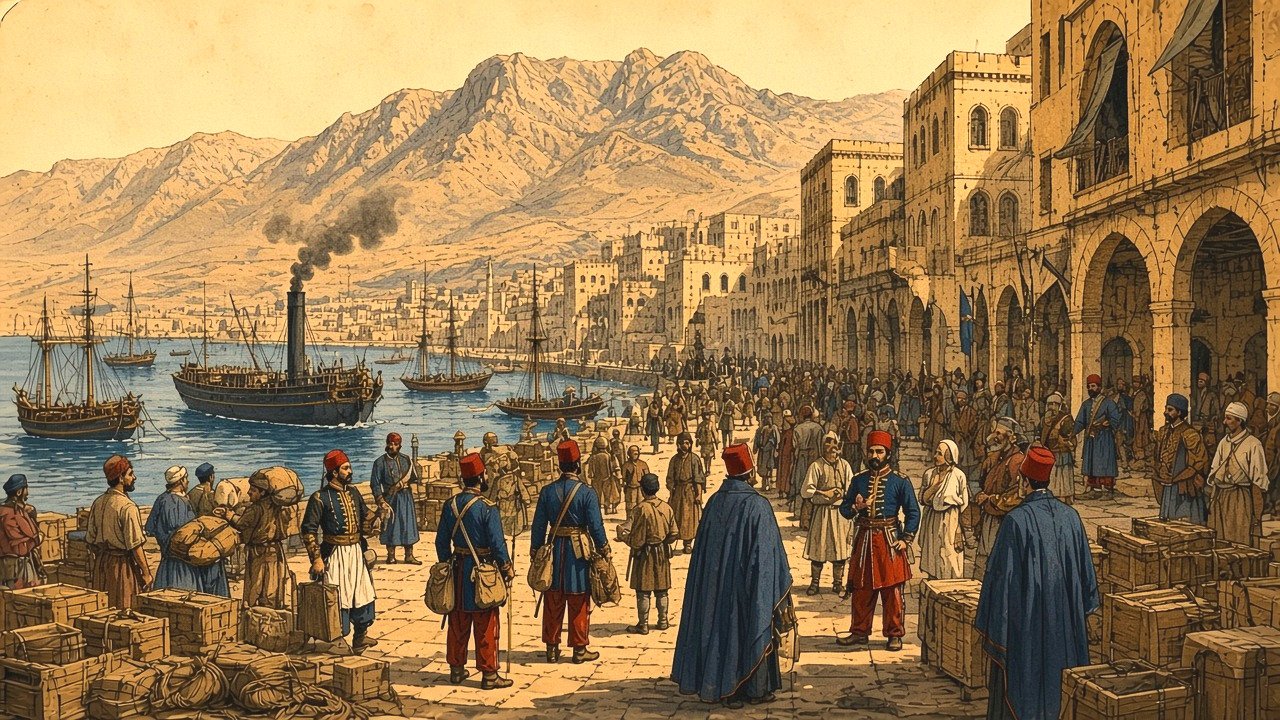
Europe did not wait. France, invoking its old claim to protect Ottoman Catholics, pressed for an armed intervention. On 3 August 1860 the Ottoman government agreed that up to twelve thousand European soldiers might be sent to Syria; a formal convention followed in Paris on 5 September, signed with France, Great Britain, Austria, Prussia and Russia. France was to furnish half the force. A French expeditionary corps of some six thousand men, under General Beaufort d’Hautpoul, landed at Beirut on 16 August 1860. By then Fuad Pasha had already broken the back of the violence. The French remained until June 1861, longer than the British thought necessary, and their presence was as much a political fact as a military one: a reminder that the mountain now lay under international eyes.[1][12]
Beaufort d’Hautpoul was not a stranger to Syria. He had served in the 1830s on Ibrahim Pasha’s staff during the Egyptian campaigns, and he came back as the commander of a European force that was, officially, to help the sultan’s minister rather than to replace him. His instructions were to work with Fuad Pasha. In the field that cooperation was real enough, and limited enough: the French marched, showed the flag in the ruined districts, and stayed through the winter and spring, while Fuad continued to insist that Ottoman sovereignty had been restored. London’s objection to a prolonged occupation was consistent and public. The force left in June 1861, in the same week as the Règlement, having done less fighting than had been feared and more political work than the size of the corps might suggest.[1]
8. The Règlement and What Lasted
The diplomatic settlement was the Règlement Organique, agreed on 9 June 1861 and given international standing by the Beyoğlu Protocol of the same day. Mount Lebanon was separated from the ordinary administration of Ottoman Syria and made a mutasarrifate, an autonomous province under a Christian mutasarrif appointed by the sultan with the assent of the powers. The first holder of the office, داود باشا (Daud Pasha, Garabed Artin Davoudian), was an Armenian Catholic from Constantinople, a man of the imperial centre rather than of the mountain factions. A council representing the communities sat beside him. A further convention in 1864 confirmed the statute, adjusted the districts, and fixed a council of twelve: four Maronites, three Druze, two Greek Orthodox, one Greek Catholic, one Sunni and one Shiʿa. In that form the Règlement lasted until the First World War.[12]
Daud Pasha’s first years set the pattern. The mutasarrif was an outsider, usually a non-Lebanese Ottoman Christian, chosen so that he would not be the client of a mountain family. He answered to Istanbul, but he governed under rules the powers had countersigned, and he could be unseated if those rules were broken. Roads, a small gendarmerie, and a more regular tax system followed. The arrangement did not abolish inequality, and it did not make the Druze forget Deir al-Qamar or the Maronites forget Hasbaya. It did make another general war on the mountain much harder to start, and for half a century that proved enough.[12]
The 1864 revision made that peace look more permanent than the three-year trial first agreed at Beyoğlu. An additional Maronite district was formed, the council was settled at twelve, and the statute was treated thereafter as the ordinary law of the mountain rather than as a temporary international experiment. Later mutasarrifs, almost all of them Ottoman Christians from outside Mount Lebanon, inherited Daud Pasha’s position: strong enough to keep the factions from a general war, never strong enough to be a prince in the old Shihab sense. The arrangement was ended by the First World War, when the empire, fighting for its life, could no longer tolerate a province under European guarantee. What followed, first in wartime and then under the French Mandate, was a different story, but it began from a mountain that had already been taught to count its people by community.[12]
The mutasarrifate is often described as a long peace, and compared with 1841, 1845 and 1860 it was. Silk and the port of Beirut flourished; the mountain was no longer a battlefield. The price was a constitution of communities. Politics would henceforth be organised, officially, by sect. That was a solution to a real war. It was also a template, and later Lebanese history, from the French Mandate to the civil war of 1975–90, would return again and again to the problem that 1860 had posed and that 1861 had institutionalised: how a small country of many communities is to be governed without another collapse into communal killing.[2][12]
No straight line should be drawn from the Règlement Organique to the Lebanese National Pact or to the civil war of 1975. The Mandate, independence, and the later confessional constitutions had their own authors and their own wars. What 1861 did contribute, and what is harder to argue away, was a proven method: a small Lebanese territory, internationally noticed, governed through the official representation of its sects. When later statesmen looked for a way to keep the peace among communities that remembered 1860, they found the method already in the mountain’s own nineteenth-century law. That is a legacy, not a destiny. It is also why the war of 1860 still belongs to the political present of the country, and not only to its dead.[2][12]
Two other legacies belong with that institutional one. The first is the memory of ʿAbd al-Qādir, still invoked as a model of Muslim protection of neighbours in a city that had also produced a massacre. The second is a shift in the human map. Christians who had survived the mountain and the riot, and Jews who found the interior less secure or less profitable than before, were part of the movement towards Beirut and the coast. The war of 1860 lasted only a few months. The order it destroyed, and the order it created, lasted much longer.[7][11]
This site is concerned with transmission as well as with states: with how communities copy, tax, teach, bury and remember. The war of 1860 matters here because it shows a society being reorganised around religion as a political category, and because the Jewish communities of Damascus and of the Lebanese coast were caught in that reorganisation even when they were not its principal target. The mountain’s new statute, the city riot, the rescue, and the later drift to Beirut are parts of a single history. To tell only the massacre, or only the Règlement, is to tell half of it.
Share this article
References
- 1860 civil conflict in Mount Lebanon and Damascus *
- Ussama Makdisi, The Culture of Sectarianism: Community, History, and Violence in Nineteenth-Century Ottoman Lebanon (Berkeley: University of California Press, 2000) *
- Leila Tarazi Fawaz, An Occasion for War: Civil Conflict in Lebanon and Damascus in 1860 (Berkeley: University of California Press, 1994) *
- Bashir Shihab II *
- “Muhammad Ali Pasha and the Making of Modern Egypt” *
- Emir Abdelkader *
- “Amīr ʿAbd al-Qādir and the Damascus incident in 1860”, in Études sur les villes du Proche-Orient, XVIe–XIXe siècles (Damascus: Presses de l’Ifpo) *
- “Blood libels, Elite Competition and Inter-Confessional Violence: Jewish–Christian Relations in Ottoman Damascus in the first part of the nineteenth century”, Cahiers de la Méditerranée *
- “Damascus”, The Jewish Encyclopedia (New York: Funk and Wagnalls, 1901–1906) *
- “Damascus”, Jewish Virtual Library *
- “Lebanon”, Jewish Virtual Library *
- Mount Lebanon Mutasarrifate *
- “Damascus” *
- “Damascus”, Encyclopedia.com
- Mehmed Fuad Pasha *
Related reading

The Unfinished Republic
In the late spring and summer of 1860, known in Arabic as حرب ١٨٦٠ (Ḥarb 1860, the war of 1860), civil war on جبل لبنان (Jabal Lubnān, Mount Lebanon) between Druze and Maronite communities was followed, in July, by a massacre of Christians in Damascus. The fighting on the mountain lasted only weeks. The settlement that closed it has lasted, in one form or another, for more than a century and a half. By the Règlement Organique of 9 June 1861, the European powers and the Ottoman Porte carved out the متصرفية جبل لبنان (Mutasarrifate of Mount Lebanon): an autonomous province under a Christian governor appointed from Istanbul with the assent of the powers, and a council whose seats were counted by community. The mountain was given a long peace, a special status, and a habit of thinking of itself as a collection of sects under international guarantee. It was not given its ports, or the grain of the Beqaa, or a state that Lebanese themselves would govern. That inheritance — a peace bought by confessional arithmetic, autonomy under outside eyes, a truncated geography — is where the modern history of Lebanon begins.
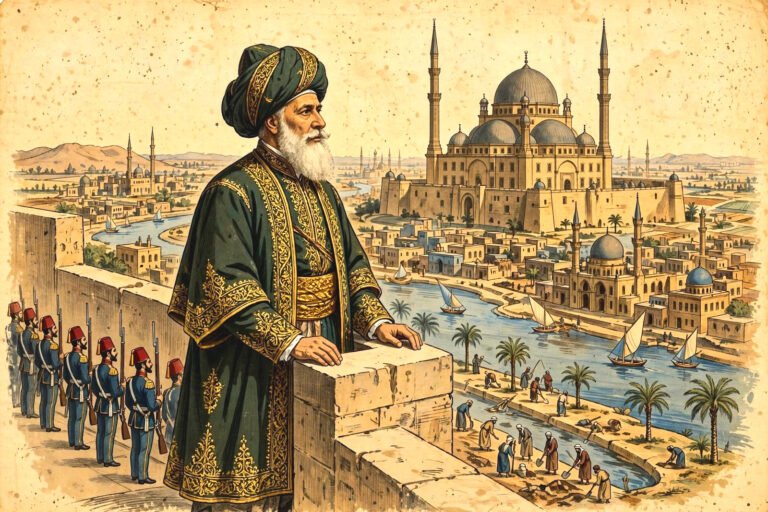
Muhammad Ali Pasha and the Making of Modern Egypt
Muhammad Ali Pasha (1769–1849), known in Ottoman Turkish as Mehmed Ali Pasha and in Arabic as Muhammad Ali Basha (محمد علي باشا), ruled Egypt from 1805 to 1848 and founded the dynasty that governed Egypt and Sudan until 1953.

From Sefarad to Salonica
How the Jews expelled from Spain and Portugal in the 1490s rebuilt their world in an Ottoman port, and how, in a city where Greek and Jewish scholars had read the Bible since Paul, Cyril and Methodius and Eustathios, the rabbis, commentators and printers, the upheaval of Sabbatai Zevi, the Ladino press and the great fire of 1917 made Salonica the largest Sephardic city on earth until its destruction in 1943.