History
The Unfinished Republic

Contents ▾
LEBANON · 1860–2026 · LONG READ
In the late spring and summer of 1860, known in Arabic as حرب ١٨٦٠ (Ḥarb 1860, the war of 1860), civil war on جبل لبنان (Jabal Lubnān, Mount Lebanon) between Druze and Maronite communities was followed, in July, by a massacre of Christians in Damascus. The fighting on the mountain lasted only weeks. The settlement that closed it has lasted, in one form or another, for more than a century and a half. By the Règlement Organique of 9 June 1861, the European powers and the Ottoman Porte carved out the متصرفية جبل لبنان (Mutasarrifate of Mount Lebanon): an autonomous province under a Christian governor appointed from Istanbul with the assent of the powers, and a council whose seats were counted by community. The mountain was given a long peace, a special status, and a habit of thinking of itself as a collection of sects under international guarantee. It was not given its ports, or the grain of the Beqaa, or a state that Lebanese themselves would govern. That inheritance — a peace bought by confessional arithmetic, autonomy under outside eyes, a truncated geography — is where the modern history of Lebanon begins.[1][2][3]
This essay follows that inheritance from the war of 1860 and the Great Famine of 1915–18 through the making of Greater Lebanon, independence and the National Pact, civil war, Syrian tutelage, the Cedar Revolution, the collapse of 2019, the port explosion of 4 August 2020, and the war and fragile opening of 2023–26. It is a narrative history, not a chronicle of every cabinet. The argument is straightforward. Lebanon’s crises have not been a random succession of misfortunes. They have been the repeated collision of four conditions: a geography that is at once a refuge and a corridor; a demography that shifts while political formulae stay frozen; a regional position that invites larger wars onto a small stage; and an economic model built on confidence, services, remittances and external inflows, which prospers while the inflows last and breaks when they stop. The 1860 settlement taught the mountain to count its people by community. Every later bargain, from the constitution of 1926 and the National Pact of 1943 to the Taif Agreement of 1989, has rewritten the arithmetic without quite escaping it.
The war of 1860 itself is the subject of an earlier note on this site. What follows begins with what that war left behind.[1]
| 1860 | 1861 | 1915–18 | 1 SEPT 1920 | 22 NOV 1943 |
|---|---|---|---|---|
| War on Mount Lebanon | Mutasarrifate created | Great Famine | Greater Lebanon proclaimed | Independence Day |
| 13 APR 1975 | 22 OCT 1989 | 14 FEB–26 APR 2005 | 4 AUG 2020 | 9 JAN 2025 |
| Civil war begins | Taif Agreement | Cedar Revolution | Beirut port explosion | Joseph Aoun elected |
1. The inheritance of 1860
The Règlement did not invent communal life on Mount Lebanon. Maronite, Druze, Greek Orthodox, Greek Catholic, Sunni and Shiʿa communities were already old, with churches, waqfs, family networks and memories of their own. What the settlement of 1861 did was to write that communal map into the government of the mountain and to place the whole arrangement under a European guarantee. After a three-year trial, the revision of 1864 confirmed the statute and fixed a council of twelve: four Maronites, three Druze, two Greek Orthodox, one Greek Catholic, one Sunni and one Shiʿa. In that form the Mutasarrifate lasted until the First World War.[3][4]
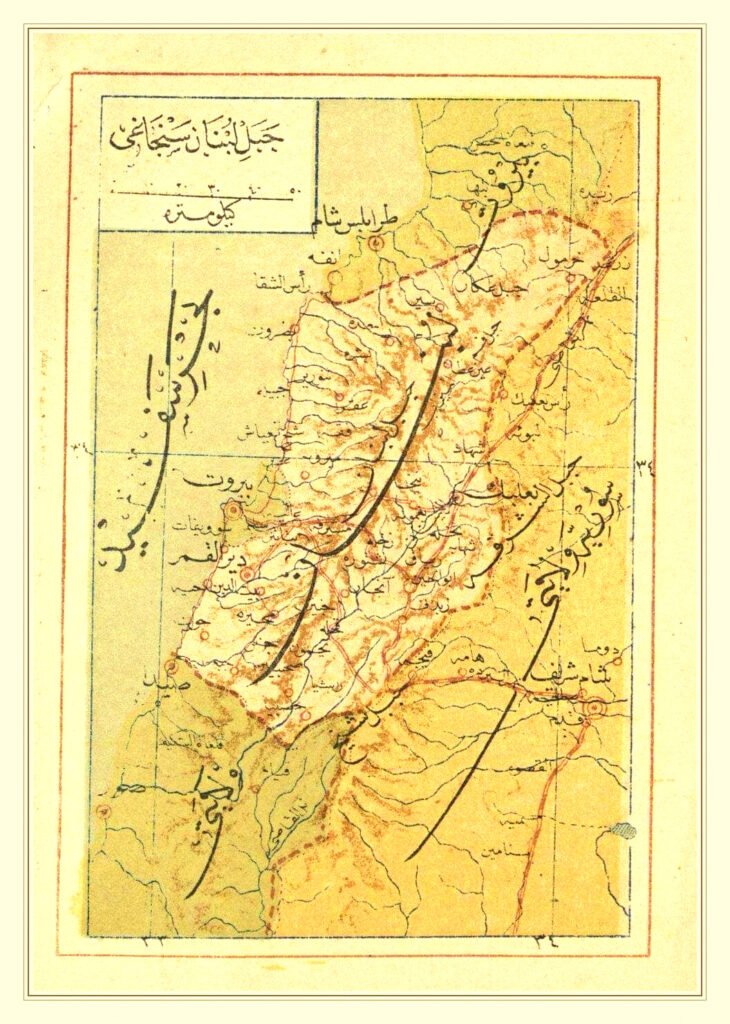
The first mutasarrif, داود باشا (Daud Pasha, Garabed Artin Davoudian), was an Armenian Catholic from Constantinople, a man of the imperial centre rather than of the mountain factions. That choice set a lasting pattern. The governor was to be a Christian, and almost always a non-Lebanese Ottoman Christian, approved by the powers, strong enough to keep the factions from a general war and never strong enough to become a prince in the old Shihab sense. Roads, a small gendarmerie and a more regular tax system followed. The mountain was exempted from ordinary Ottoman conscription. Taxation was comparatively light. For half a century the arrangement worked well enough that later generations would remember المتصرفية (al-Mutasarrifiyya) as a time of stone villages, mulberry orchards and a popular maxim: “Happy is he who owns a goat’s resting place in Mount Lebanon.”[4][5]
The peace was real, and it was purchased at a price. The Mutasarrifate was landlocked and geographically truncated. It excluded the great coastal ports of Beirut, Tripoli and Sidon, the fertile Beqaa Valley to the east, and the hills of Jabal Amil to the south. In 1888 Istanbul reorganised the littoral by creating the Vilayet of Beirut, a coastal province stretching, at its widest, from Latakia to Nablus, with Beirut as its capital. The Beqaa, including Baalbek, Zahle, Rashaya and Hasbaya, belonged to the Vilayet of Syria, administered from Damascus. The mountain that had been taught to govern itself as a special Christian-majority district was cut off, administratively, from the ports that sold its silk and from the plains that grew its grain. That separation would become lethal in wartime.[4][5]
The 1860 settlement also taught a political lesson that outlived the Ottoman Empire. Offices, tax assessments and the right to be heard were distributed by sect. Within each sect they tended to go to notable families, the الزعماء (zuʿamāʾ), whose power rested on land, kinship and clientele. A Lebanese subject of the Mutasarrifate learned to seek protection from a patron and a community, not from an impersonal state, and to see politics as the distribution of posts and favours among families. That clientelist logic, joined to confessional quotas, would survive the constitution of 1926, the National Pact of 1943 and the Taif Agreement of 1989. When later observers described Lebanon as a country of zuʿamāʾ, they were describing a pattern already visible in the decades after 1861.[5]
The settlement was, finally, an international fact. Britain, France, Russia, Austria and Prussia (and later Italy) had countersigned the Règlement. The mountain’s autonomy existed because European diplomacy required it, and it could be suspended when a greater war made that diplomacy worthless. In 1915 that is what happened. The long peace of the Mutasarrifate did not fail because the mountain forgot 1860. It failed because the empire that guaranteed the peace was fighting for its life, and because a mountain that exported silk and imported grain could not feed itself when the sea and the interior were both closed.[4][5]
2. The mountain world, 1861–1914
By 1900 the territory that would become the Republic of Lebanon still did not exist as a single jurisdiction. The Mutasarrifate was one piece of a late Ottoman mosaic. Around it lay the Vilayet of Beirut and the Syrian interior. The mutasarrifs of the turn of the century — Naoum Pasha, a Greek Catholic Syrian, from 1892 to 1902; Muzaffer Pasha, a Polish Roman Catholic, from 1902 to 1907; Yusuf Pasha from 1907 to 1912; and Ohannes Pasha, an Ottoman Armenian Catholic, from 1912 until the wartime collapse — continued the old rule: Christian, non-Lebanese, acceptable to the powers. Lebanese politics in this period was politics by petition, by council, by church, by family and by the post from America.[4][5]
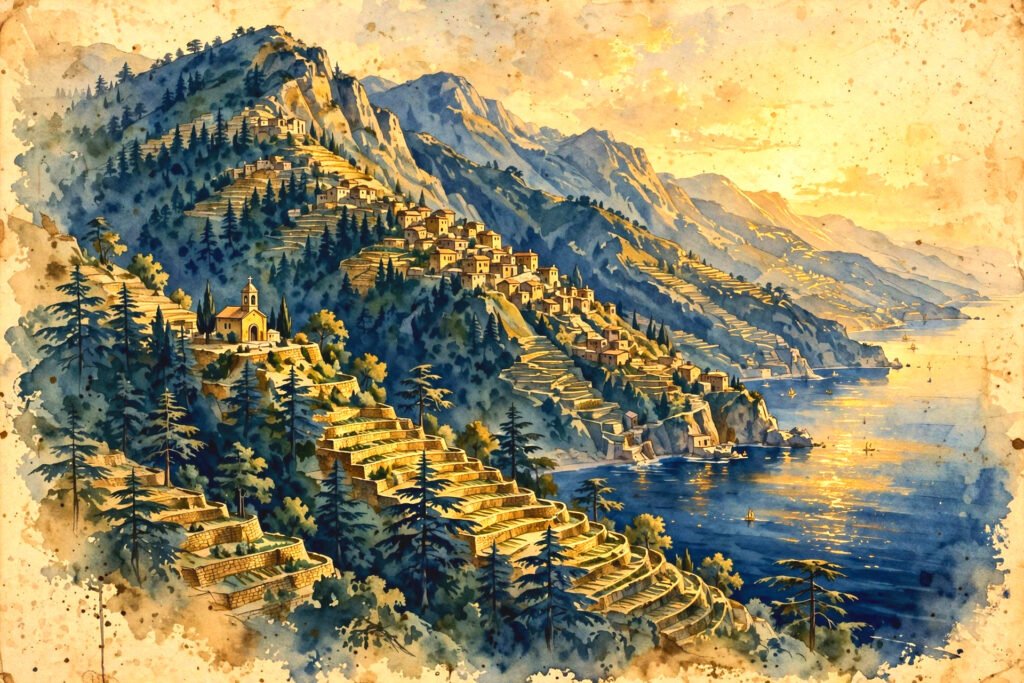
Silk was the mountain’s cash crop. From the 1840s, French merchants from Lyon had invested in mechanised reeling factories, the karkhanas, on the slopes. By the first decade of the twentieth century nearly half of Mount Lebanon’s cultivable land was said to be under mulberry, and raw silk accounted for the great bulk of the district’s exports, almost all of it shipped through Beirut to France. The monoculture drew peasants — men and, especially, young women — into wage labour, monetised the rural economy, and tied Maronite and Druze villages to the fortunes of the French franc and the global textile trade. It also replaced subsistence grain with an inedible tree. Prosperity and vulnerability grew together.[5]
Beirut, meanwhile, was becoming something the mountain was not: a multi-confessional port city, open to European capital, missionary education and Arabic print. It had grown from a modest walled town of perhaps ten thousand people around 1830 to a city of more than 120,000 by 1900. The Syrian Protestant College, founded in 1866 and later the American University of Beirut, and the Jesuit Université Saint-Joseph, founded in 1875, trained doctors, lawyers, journalists and clerks. Printing presses issued newspapers, journals and translations. Intellectuals of the Arab النهضةة (Nahḍa, the awakening) — among them Butrus al-Bustani, Jurji Zaydan, Yaʿqub Sarruf and Farah Antun — debated constitutionalism, science, women’s education, and the meaning of Arab and Syrian identity inside a reforming empire. When the Young Turk Revolution restored the Ottoman constitution in July 1908, Beirut celebrated across communal lines. For a moment, Ottoman citizenship seemed to promise equality without partition.[5]
Beneath that vitality lay pressure. Mount Lebanon’s population density was among the highest in the empire. When silk prices stagnated in the 1890s and early 1900s, under competition from East Asian silk and, later, artificial fibres, families turned to emigration. Between about 1890 and 1914, a very large share of the mountain’s people — commonly estimated in the region of 120,000 to 150,000, perhaps a third of the district — boarded steamships in Beirut for New York, Boston, São Paulo, Buenos Aires, Montreal, Sydney and West Africa. Recorded at first as “Turks” and later as “Syrians,” they built the مهاجر (Mahjar) communities that would define Lebanese life abroad for the next century. In New York, writers including Gibran Khalil Gibran, Mikhail Naimy and Ameen Rihani formed the Pen League (al-Rābiṭa al-Qalamiyya). Remittances came back as stone houses with red Marseille tiles, as village schools, and as a financial lifeline that would outlast silk itself. Emigration was already, before the famine, both a safety valve and a second Lebanon.[5]
Politics after 1908 fractured into competing maps of the future. As the Committee of Union and Progress in Istanbul moved towards centralisation, notables in Beirut — among them Salim Ali Salam, Ahmad Mukhtar Bayhum and Petro Trad — formed a reform society in 1913 and pressed for administrative decentralisation, Arabic as an official language, and local control of provincial revenues. Representatives from Beirut and the mountain went to the First Arab Congress in Paris that June. A second current, predominantly Maronite, argued for لبنانوية (Lubnāniyya, Lebanism): that Mount Lebanon possessed a historical personality of its own, and that it could survive only if restored to “natural” boundaries by the annexation of Beirut, Tripoli, Sidon, Tyre, the Beqaa and Akkar, preferably under French protection. Publicists such as Bulus Nujaym (writing as M. Jouplain), Yusuf al-Sawda and Auguste Adib gave that programme its early literature. A third current, stronger among some Greek Orthodox, Druze and Sunni intellectuals, held that the mountain and the coast were parts of بلاد الشام (Bilād al-Shām, geographic Syria) and should not be partitioned along sectarian lines. All three visions would still be visible, under new names, a century later.[5]
Population figures from the period should be handled with care, but the official estimates of the Mutasarrifate are clear enough about its character. In 1895 the district was put at about 400,000 people, overwhelmingly Christian, with Druze and Muslim minorities; in 1913 at a little over 414,000, still about four-fifths Christian. Those numbers describe a polity that was not yet the Lebanon of 1920. They also explain why the enlargement of the state, when it came, would be felt as a revolution in the meaning of the word itself.[4]
Religious life was dense and institutional. The Maronite Patriarchate at Bkerke was a political actor, with land, schools and channels to Paris and Rome. Druze sheikhs, Sunni muftis, Shiʿa clerics, Greek Orthodox bishops and Armenian churches ran schools, personal-status courts and welfare. The Ottoman state, retreating from direct provision on the mountain, left a vacuum that communal institutions filled. A child of 1900 was more likely to be educated by a church or a mission than by a state school, married in a religious court, and buried in a communal cemetery. Confessionalism would later feel natural, even inevitable, because for most people the community was the state they actually met.[5]
3. The Great Famine, 1915–1918
The First World War destroyed the Mutasarrifate’s peace and then the Mutasarrifate itself. The Ottoman Empire entered the war on the side of the Central Powers. Allied naval forces blockaded the eastern Mediterranean, cutting the coastal trade that had brought grain from the interior and from Egypt, and interrupting the remittances on which mountain households had come to depend. Cemal Pasha (Djemal Pasha), commanding in Syria, requisitioned pack animals, carts and harvests for the Fourth Army, and restricted the movement of wheat from the Hauran and the Beqaa into the mountain — partly for military reasons, and partly from suspicion of a population whose leading church looked to France. In the spring of 1915, swarms of desert locusts stripped crops, orchards and mulberry trees. Ottoman paper currency, the kaime, lost value against gold; merchants hoarded grain. The silk economy, already weakened, collapsed. A mountain that had planted mulberry instead of wheat had no domestic food reserve.[5][6][7]

What followed, between 1915 and 1918, was the greatest demographic catastrophe in modern Lebanese history: the Great Famine of Mount Lebanon, المجاعة (al-Majāʿa), known in Syriac as ܟܦܢܐ (Kafno). By the winter of 1916–17, starvation had reached towns and villages across the district and the coast. People ate grass, acorns, carob and orange peel. Typhus, cholera and dysentery moved through weakened communities. American missionaries at the Syrian Protestant College, and writers of the Mahjar including Gibran, left accounts of emaciated children in the streets of Beirut and Bsharri, and of bodies unburied. The death toll is not known with precision, and honest historians give a range rather than a single figure. Common estimates fall between about 100,000 and 200,000 dead in Mount Lebanon and Beirut, from a pre-war mutasarrifate population a little over 400,000: perhaps a third, in the higher estimates approaching half. Per capita, the mortality was among the worst of any territory in the war. The famine was not a natural disaster that happened to coincide with a war. It was the result of blockade, requisition, ecological shock, speculation and political choice, and it taught a generation that dependence on external powers, Ottoman or European, could be lethal.[5][6][7]
The war also ended the mountain’s special status in law. Cemal Pasha suspended the autonomy of the Mutasarrifate. Using papers seized from abandoned French consulates, Ottoman military tribunals at Aley tried intellectuals, journalists and notables for treason. On 21 August 1915, and again on 6 May 1916, thirty-two men — Muslims and Christians, among them ʿAbd al-Karim al-Khalil, Shaykh Ahmad Tabbara, Petro Paoli, and the brothers Philippe and Farid al-Khazen — were hanged in Beirut’s ساحة البرج (Sāḥat al-Burj, Cannon Square), later Martyrs’ Square. The executions did not create Lebanese nationalism by themselves. They did make loyalty to the empire much harder to defend, and they gave the future republic a civic shrine in the middle of the port city.[5][7]
Emigration, already a habit, became a flood. Villages emptied. Remittances, when they could still arrive, were more necessary and less certain. Politically, some Lebanese looked to the Arab Revolt launched by Sharif Hussein of Mecca in 1916, and to the short-lived Arab government that his son Faysal would establish in Damascus in 1918. Others looked more firmly than ever to France. The question that the famine left behind was not only how the mountain would be fed. It was whether the mountain would be part of an Arab kingdom, or a separate state under a new protector, or something not yet named.[5][7]
That question was not answered in Beirut or in Bkerke. The Sykes–Picot Agreement of 1916, secretly negotiated between Britain and France, divided Ottoman Syria into zones of influence. At San Remo in the spring of 1920 the two powers revised the map again, and France received a League of Nations mandate over the Levant from the Euphrates to the sea. Faysal’s kingdom in Damascus was brief. In July 1920 General Henri Gouraud’s forces defeated his army at Maysalun. For those who had hoped for Arab unity, Maysalun was a warning. For those who had hoped for a separate Lebanon under French protection, it was a promise. The famine had shown what it meant for the mountain to be cut off from its ports and its grain. The French answer, and the Maronite answer that had been prepared before the war, was to enlarge the mountain until it included both.[5][7]
4. Greater Lebanon and the Mandate
On 1 September 1920, from the steps of the Résidence des Pins in Beirut, Gouraud proclaimed the State of Greater Lebanon — État du Grand Liban, دولة لبنان الكبير. The Maronite Patriarch Elias Hoayek stood with him; so, in the official picture of the day, did the Mufti of Beirut, Mustafa Naja. The new state joined the old Mutasarrifate to Beirut, Tripoli, Sidon and Tyre, to Akkar in the north, to the Beqaa, and to Jabal Amil in the south. In territorial terms it was, already, the Lebanon of today, some 10,400 square kilometres, never more than about ninety kilometres deep, with roughly two hundred and ten kilometres of coast. In demographic terms it was a different country. The Christian majority of the mountain, perhaps four-fifths in 1913, became a bare majority in the larger state, or something very close to a plurality, with large Sunni, Shiʿa, Druze and Orthodox populations now inside the borders. The decision mixed French strategy, Maronite lobbying — Patriarch Hoayek had led a Lebanese delegation to the Paris peace conference in 1919 — and the economic lesson of the famine. It also created the structural paradox that has organised Lebanese politics ever since: a state large enough to feed and trade, and too mixed for any single community to own.[5][8]

Many Sunni notables in the coastal cities had preferred union with Faysal’s Syria. The American King–Crane Commission, touring the Levant in 1919, recorded that preference. Early censuses and institutions were, in some Sunni quarters, boycotted as the furniture of an artificial amputation. The Mandate, formalised by the League of Nations in 1923, proceeded anyway, and treated Lebanon as a distinct entity from Syria. On 23 May 1926 France promulgated a constitution, drafted largely by a committee associated with Michel Chiha, the Beirut banker and constitutional thinker, and modelled on the French Third Republic: a president, a prime minister, a cabinet, a chamber of deputies. Article 95 provided for “equitable” confessional representation in public office and the cabinet, and described the arrangement as transitional. Charles Debbas, a Greek Orthodox lawyer, became the first president of the Lebanese Republic. The provisional article would still be there, in spirit, a century later.[5][8]
In 1932 the authorities conducted a census — the only official census in the history of the Lebanese state. It counted 785,543 people. Christians were recorded at a little over half the resident population: Maronites the largest single community, then Greek Orthodox and Greek Catholics; Muslims, taken together, a little under half, with Sunnis, Shiʿa and Druze as the principal communities. From those figures a parliamentary ratio of six Christians to five Muslims was later derived. The census has been studied, criticised and defended ever since, and no Lebanese government has dared to repeat it. Numbers in Lebanon are not a technical matter. They are a claim about who the country is for. The 1932 count froze a photograph of a society that was already changing through emigration, differential birth rates and the unfinished absorption of the coastal cities, and then treated the photograph as a constitution.[8][9]
The Mandate years were not only a story of formulae. They were a period of road-building, of legal codification, of a growing Beirut, and of a political class learning to work a parliament. They were also a period of strikes, of protests against French privilege, and of a deepening argument about whether Lebanon was a refuge for its Christian communities, an Arab state among Arab states, or a merchant republic that could be both. The Second World War decided the timing of independence, if not its terms. When France fell in 1940, the Mandate administration at first followed Vichy. In June and July 1941, British, Commonwealth and Free French forces invaded Syria and Lebanon. General Georges Catroux promised independence; Britain, through Major-General Sir Edward Spears, had its own reasons to encourage Lebanese nationalists to treat the promise as a fact. The promise was not, at first, honoured in full.[5][8]
5. Independence and the National Pact
Parliamentary elections in the summer of 1943 returned a majority for Bishara al-Khoury’s Constitutionalists. On 21 September, parliament elected Khoury president; he appointed Riad al-Solh prime minister. Together they gave Lebanon its founding bargain, the الميثاق الوطني (al-Mithāq al-Waṭanī, the National Pact), set out in Solh’s ministerial statement of 7 October 1943. It was an unwritten gentlemen’s agreement, and it has been treated ever since as if it were a constitution.[10]
The Pact rested on a double renunciation and a rigid allocation of offices. Christians would renounce French protection and Western military guarantees; Muslims would renounce political union with Syria or a larger Arab state. Lebanon would be a sovereign country with an “Arab face” (dhū wajh ʿarabī), cooperating with Arab states while keeping its own borders and institutions. The presidency of the republic would be reserved for a Maronite, the premiership for a Sunni, and the speakership of parliament — a convention later solidified — for a Shiʿa. Parliamentary seats would follow the 6:5 Christian-to-Muslim ratio derived from 1932. The Pact was a compromise, and it was also a gamble: that fixed communal shares could produce a national government; that Lebanon could be Arab and distinct; that a state built on sectarian representation might, in time, become a state built on citizenship.[10]
In November 1943, parliament voted to strike the Mandate’s privileges from the constitution and to adopt a new flag: red, white and red, with a green cedar. The French Delegate-General, Jean Helleu, had the leading men arrested before dawn on 11 November — Khoury, Solh, Camille Chamoun, Adel Osseiran, Salim Takla, and the deputy Abdul Hamid Karami — and imprisoned in the citadel at Rashaya. Two ministers who escaped, Habib Abu Shahla and Emir Majid Arslan, proclaimed a provisional government at Bshamoun. Strikes closed the cities. Christians and Muslims demonstrated together. Britain pressed de Gaulle’s committee in Algiers. On 22 November the prisoners were released and returned to Beirut. That date is Independence Day. In 1945 Lebanon became a founding member of the Arab League and of the United Nations. The last French and British troops left on 31 December 1946.[5][10]
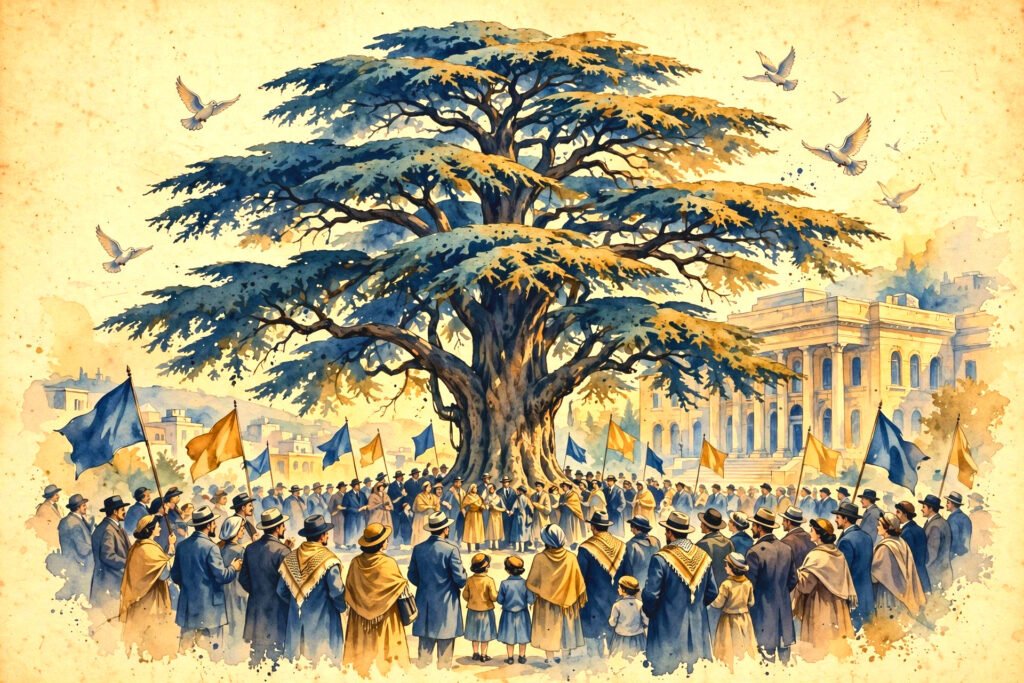
The Pact gave Lebanon a way to be Arab without being Syrian, and Lebanese without being merely Maronite. For Muslims it offered a share of power and a recognition that the state was Arab. For Christians it offered the presidency and the memory of a slight majority. In the late 1940s the republic was a functioning, if fragile, democracy, with a lively press and a growing merchant economy. The first great test came from outside. The war of 1948, in which Lebanon played only a limited military part, drove some 100,000 Palestinian refugees into the country. They were housed at first in tented camps, later in settlements administered by UNRWA around Beirut, Sidon, Tyre and Tripoli. They were not given citizenship, in large part because naturalising a predominantly Sunni population would have upset the arithmetic of 1932. Over the following decades the camps became permanent, poor, and politically explosive. A humanitarian emergency was treated as a demographic problem, and a demographic problem was left to become a military one.[5][10]
Internally, Khoury’s second term — secured by a constitutional amendment in 1948, after parliamentary elections in 1947 that were widely regarded as manipulated — ended in discredit. In September 1952 an unlikely coalition, from Kamal Jumblatt’s socialists to Camille Chamoun and Pierre Gemayel of the Phalange (Kataeb), organised a general strike later nicknamed the “Rosewater Revolution” because it was accomplished without gunfire. Khoury resigned on 18 September. Chamoun became the second president of the independent republic.[5]
6. The merchant republic and the crisis of 1958
The 1950s and 1960s entered memory, and tourist literature, as a golden age, when Beirut was called the Paris of the Middle East. The prosperity was real enough, and it was not an accident. It was the product of a deliberately laissez-faire model, designed by a merchant-banking elite and favoured by misfortunes elsewhere in the Arab world. Capital, talent and tourists came to a city that had a free press, numbered bank accounts, a flexible lira, and an airport on the way from Europe to Asia. The port, the bank and the currency became the three institutions of the “merchant republic.” Culture flourished with them: the Beirut book trade, the Baalbek Festival from 1956, the voices of the Rahbani brothers and Fairuz, a press that was the freest in the Arab world. For those who lived inside the boom, especially in Beirut and on the mountain, the formula of 1943 seemed to have been vindicated.[5][11]
The boom was also uneven. Growth concentrated in the capital and in Mount Lebanon, leaving the south, the Beqaa and Akkar poorer and less served. Rural migration ringed Beirut with a “belt of misery” (ḥizām al-buʾs). Confessional shares in office did not correspond to the new geography of class. And the regional weather changed. After the Suez crisis of 1956, Gamal Abdel Nasser’s pan-Arabism stirred Lebanon’s Muslim quarters and the left, who saw in Chamoun’s Western alignment — and in his acceptance of the Eisenhower Doctrine in 1957 — a breach of the Pact’s neutrality. Chamoun’s parliamentary elections of 1957, which helped to sideline opponents including Jumblatt, Saeb Salam and Rashid Karami, and rumours that he might seek a second term, completed the polarisation.[11][12]
In February 1958 Egypt and Syria merged in the United Arab Republic. In May the assassination of Nasib al-Matni, a Maronite editor critical of Chamoun, helped to trigger an armed rising in Tripoli, West Beirut, the Chouf and the Beqaa, with weapons moving across the Syrian border. On 14 July a coup in Baghdad overthrew the Hashemite monarchy. Chamoun invoked the Eisenhower Doctrine. On 15 July, United States Marines landed at Khaldeh, south of Beirut — the first military operation under the doctrine. The intervention was limited, and it was not a conquest. A compromise, brokered in part by the American diplomat Robert Murphy, allowed Chamoun to finish his term. On 31 July parliament elected the army commander, General Fouad Chehab, president. The army, which Chehab had kept above the factions, was the one national institution that still had credit on both sides of the conflict.[12][13]
Chehab’s presidency (1958–64), remembered as Chehabism (al-Shihābiyya), was the republic’s most serious attempt at state-building. His slogan, “no victor and no vanquished” (lā ghālib wa-lā maghlūb), was a theory of government as well as a ceasefire. With the French Dominican economist Louis-Joseph Lebret and the IRFED mission, Chehab tried to push roads, electricity, water and schools into the neglected peripheries. He established the Central Bank (Banque du Liban), the National Social Security Fund, a Civil Service Council intended to curb patronage in hiring, and a Central Inspection Board. He brought Muslim and left-wing leaders into government, including Rashid Karami as prime minister and Jumblatt in the cabinet. The project had a shadow: a reliance on the army’s intelligence service, the Deuxième Bureau, to watch and manage the zuʿamāʾ. By the late 1960s Chamoun, Gemayel and Raymond Eddé had formed a Tripartite Alliance against Chehabist controls and in favour of a return to laissez-faire politics. The attempt to build a state strong enough to stand above the communities produced, as its counterpart, a coalition to keep the state from becoming too strong.[13]
Chehabism did not solve the Palestinian question, which after 1967 would overwhelm the domestic argument, and it did not abolish confessionalism. It did show that the Lebanese state could, for a few years, be more than a clearing house for notables. The later collapse of that ambition is part of the tragedy. So is the fact that, when the state later failed, people would remember Chehab as evidence that failure had not been inevitable.
7. The road to war, 1967–1975
The Arab–Israeli war of 1967 changed Lebanon’s internal balance without Lebanon having chosen the fight. The defeat of Egypt, Syria and Jordan, and the Israeli occupation of the West Bank, Gaza, Sinai and the Golan, radicalised Palestinian politics and sent a new wave of fighters and civilians towards a country that already hosted the refugees of 1948. After Black September in Jordan in 1970, the Palestine Liberation Organisation moved its principal base to Beirut and the south. Lebanon, the weakest of the Arab states on Israel’s border, became the main stage of a struggle that was not, in origin, Lebanese.[5][14]
The Cairo Agreement of 1969, negotiated under Egyptian auspices, gave the PLO the right to bear arms in the camps and to operate from southern Lebanon, while formally affirming Lebanese sovereignty. In practice it created what critics called a state within the state. Cross-border raids brought Israeli reprisals, including the December 1968 commando attack on Beirut airport that destroyed a dozen Middle East Airlines aircraft on the ground. Villages in the south emptied towards Beirut’s southern suburbs, the Dahiya. The Lebanese army, still relatively small and still cautious about opening an internal front, could not, or would not, restore a monopoly of force.[5][14]
Domestic politics were already armed before the first shots of 1975. On one side, the Lebanese National Movement, led by Kamal Jumblatt, brought together leftist, Nasserist, communist and mostly Muslim parties who saw the Palestinian cause as a lever to dismantle a Maronite-weighted confessional system and to redress social inequality. On the other, the Christian right — Pierre Gemayel’s Kataeb, Chamoun’s National Liberal Party, and the camp around President Suleiman Frangieh, elected in 1970 by a single vote — saw the armed PLO as an existential threat, a magnet for Israeli retaliation, and a challenge to the Pact itself. In the south, the Iranian-born cleric Musa al-Sadr had founded, in 1974, the Movement of the Dispossessed (Ḥarakat al-Maḥrūmīn) and its armed wing, Amal, to give the long-marginalised Shiʿa a political and military voice of their own. Strikes by tobacco farmers, factory workers and students added a social crisis to the national one. Militias trained in the mountains and in the camps. Weapons arrived from many directions.[5][14]
On 13 April 1975 the fuse was lit in ʿAin al-Rummaneh, a Christian suburb of Beirut. In the morning, gunmen fired on a church ceremony attended by Pierre Gemayel; four people were killed, including a bodyguard. Hours later, Phalangist militiamen ambushed a bus carrying Palestinians towards the Tel al-Zaatar camp, killing twenty-seven passengers. Barricades went up. A fifteen-year war had begun. It is important not to pretend that a single massacre explains a war, or that the war was only a Lebanese civil conflict, or only a regional one. It was both, and then it became several wars at once.[5][14]
8. The fifteen-year war, 1975–1990
The Lebanese civil war was not one war but a series of wars, with shifting alliances, foreign armies, and massacres that emptied mixed neighbourhoods and made return harder with each year. Common estimates of the dead fall between 120,000 and 150,000; hundreds of thousands were wounded; nearly a million people were displaced inside the country, and hundreds of thousands more left for good. These figures, like all large numbers in this history, are orders of magnitude rather than a register. Lebanon has never had a complete wartime accounting, or a truth commission that could produce one.[14][15]
In the first phase, 1975–76, Beirut was cut along the Damascus Road into a predominantly Christian East and a predominantly Muslim and Palestinian West, separated by the desolate strip that came to be called the Green Line.
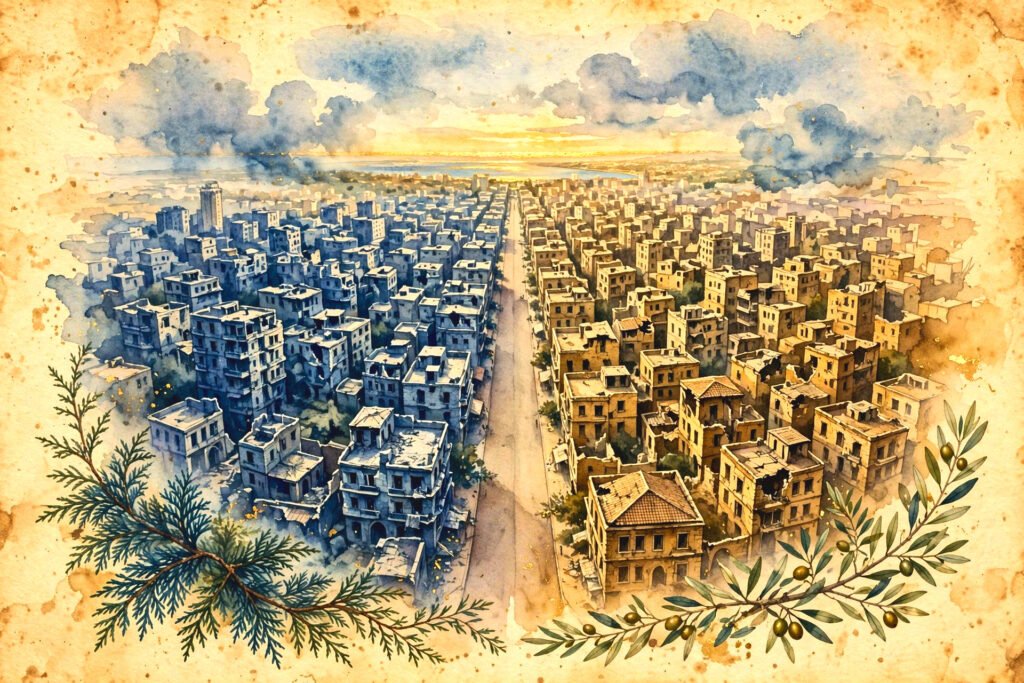
In January 1976, Christian militias overran and destroyed the poor Muslim–Palestinian shantytown of Karantina in the east of the city. Days later, PLO and National Movement forces sacked the Christian coastal town of Damour. By the spring, a joint offensive had pushed Christian forces back towards the mountain and seemed to threaten the state’s partition. In June, President Hafez al-Assad of Syria sent his army into Lebanon — at first, against the left and the PLO, and in defence of the existing order and of a Christian camp he did not intend to see collapse. Assad feared a radical victory that might bring an Israeli invasion and unsettle Damascus. Syrian armour entered the Beqaa and moved on Beirut and Sidon. In August, after a long siege, Christian militias took the Tel al-Zaatar camp. In October, Arab League summits in Riyadh and Cairo authorised an Arab Deterrent Force composed overwhelmingly of Syrian troops. They would remain, in one form or another, for twenty-nine years.[5][14]
Alliances then turned. In March 1977 Jumblatt was assassinated near a Syrian checkpoint in the Chouf; his son Walid took over the Progressive Socialist Party. Syria fell out with the Christian militias, now being gathered by Bashir Gemayel, Pierre’s younger son, into the Lebanese Forces. The “Hundred Days’ War” of 1978 brought heavy shelling of East Beirut. Meanwhile the south had its own war. After a Palestinian attack inside Israel, Israeli forces invaded up to the Litani River in March 1978 (Operation Litani), then handed a border strip to the Israeli-backed South Lebanon Army of Saad Haddad. The United Nations Security Council created UNIFIL by Resolution 425. The force would still be there a half-century later, a monument to a sovereignty that could be declared more easily than it could be exercised.[14][16]
On 6 June 1982 Israel invaded again, in Operation Peace for Galilee, with the aims of destroying the PLO’s military and political infrastructure in Lebanon and of installing a friendly government in Beirut. Israeli forces drove up the coast, fought Syrian air defences in the Beqaa, and laid a siege of some ten weeks to West Beirut, cutting water, electricity and food, and bombarding the city. A ceasefire brokered by the American envoy Philip Habib provided for the evacuation of Yasser Arafat and more than 11,000 PLO fighters under a Multinational Force of American, French and Italian troops. On 23 August, with Israeli soldiers around the capital, parliament elected Bashir Gemayel president. Twenty-two days later, on 14 September, a bomb at the Kataeb headquarters in Ashrafieh killed him before he could take office. The assassin, Habib Shartouni, belonged to the Syrian Social Nationalist Party. Israeli troops entered West Beirut. Between 16 and 18 September, Lebanese Forces militiamen were permitted to enter the Sabra and Shatila Palestinian camps, where they massacred unarmed Palestinian and Lebanese civilians. Estimates of the dead range from about 800 to as many as 3,500. Israeli forces controlled the perimeter and illuminated the camps with flares. The massacre became, for the world, the emblem of the invasion; for many Lebanese, it was one atrocity in a war that had already produced too many.[5][14]
Bashir’s brother Amine was elected president. The multinational force returned. In May 1983, under American pressure, Gemayel signed an agreement with Israel that amounted to a peace and security treaty. Syria and its Lebanese allies rejected it. When Israeli forces withdrew from the Chouf in September 1983, the War of the Mountain broke out between the Lebanese Forces and Walid Jumblatt’s Druze militia. With Syrian artillery behind them, Druze forces drove the Lebanese Forces out and expelled tens of thousands of Christian villagers — on some counts more than 150,000 — from the Chouf, in a campaign of mutual killing and displacement that reopened, in a new generation, the wounds of 1860.[5][14]
A new force was already forming among the Shiʿa of the south and the Beqaa. Inspired by the Iranian revolution of 1979, and hardened by the Israeli occupation, groups assisted by Iranian Revolutionary Guards coalesced as حزب الله (Ḥizbullāh, the Party of God), which announced itself in an open letter in February 1985. In April 1983 a truck bomb destroyed the American embassy in Beirut, killing sixty-three people. On 23 October 1983, twin truck bombs struck the American Marine barracks and the French paratroopers’ headquarters, killing 241 American servicemen and 58 French paratroopers. By February 1984 the Lebanese army had begun to split along communal lines; Amal and the Progressive Socialist Party took West Beirut; the May 17 Agreement was abrogated; the multinational force left. What remained was militia rule: the Lebanese Forces in the east and the mountain; Amal, the PSP and Hezbollah contesting the west and the south; a Syrian-backed order in much of the north and the Beqaa; an Israeli “security zone” in the far south. Between 1985 and 1988, Amal besieged the Palestinian camps in the War of the Camps. Western hostages were taken in the streets of the capital. Daily life did not stop — schools, including the American University of Beirut, continued under fire, even after the assassination of the university’s president, Malcolm Kerr, in 1984 — but the state, as a single authority, had gone.[5][14][17]
When Amine Gemayel’s term ended in September 1988 without a presidential election, he appointed the army commander, General Michel Aoun, to head an interim military cabinet. The sitting prime minister, Selim al-Hoss, rejected the appointment. Lebanon had two governments. In March 1989 Aoun declared a “war of liberation” against Syrian forces. Months of artillery fire across Beirut killed more than a thousand civilians. Arab League mediation brought the surviving members of the 1972 parliament to the Saudi resort of Taif. On 22 October 1989 they signed the Document of National Accord, the Taif Agreement. The old 6:5 ratio in parliament became equality: 128 seats, sixty-four Christian and sixty-four Muslim. Executive power moved from the Maronite president towards the Council of Ministers as a body, strengthening the Sunni prime minister and the Shiʿa speaker. Militias were to disarm, with a crucial exception: Hezbollah would keep its weapons as an “Islamic resistance” against the Israeli occupation in the south. Syria was recognised as having a special relationship with Lebanon and a role in helping the state restore sovereignty. Aoun rejected the accord because it set no firm date for a Syrian withdrawal. In 1990 he fought, ruinously, an intra-Christian war against Samir Geagea’s Lebanese Forces. On 13 October 1990, as the world was absorbed by Iraq’s invasion of Kuwait, Syrian forces stormed the presidential palace at Baabda. Aoun took refuge in the French embassy and left for exile in Paris. The civil war, after fifteen years, was over.[5][14]
Taif did not abolish confessionalism. It rebalanced it, and it placed the peace under Syrian custody. The 1860 logic — peace through communal arithmetic, guaranteed by a stronger outside power — had been written once more, in a new hand, for a larger country.
9. Reconstruction, tutelage, and the Cedar Revolution
The Second Republic was born under Syrian supervision. Presidents Elias Hrawi (1989–98) and, after him, the former army commander Émile Lahoud presided over a system whose real centre of gravity lay, for many years, with Syrian military intelligence at Anjar, under Ghazi Kanaan and later Rustom Ghazaleh. The 1991 Treaty of Brotherhood, Cooperation and Coordination formalised the imbalance. A general amnesty integrated many wartime leaders into cabinets; Christian opponents of the Syrian order were pushed aside. Aoun remained in France. Geagea was arrested in 1994 and spent eleven years in prison.[5][18]
In October 1992, in the midst of a currency crisis, Rafic Hariri became prime minister. A Sunni businessman from Sidon who had made a fortune in Saudi Arabia, Hariri made reconstruction the organising idea of the post-war years. His vehicle in the capital was Solidere, a private company with extraordinary rights over the ruined historic centre. Martyrs’ Square and the streets around Place de l’Étoile were rebuilt as a polished district of restored Mandate façades, shops and cafés. Admirers saw a city returned to the world. Critics saw the privatisation of memory and the erasure of a working-class downtown. To finance the work, and to support a currency that was pegged, from 1997, at 1,507.5 lira to the dollar, successive governments sold high-interest treasury paper largely to Lebanese banks. The model produced a new airport, highways and a glossy central Beirut. It also raised public debt from about two billion dollars in 1992 to more than thirty-five billion by 2004, and it tied the solvency of the banks to the solvency of the state. The fuse of the later collapse was laid in the years of apparent recovery.[18][19]
The south remained a war. Hezbollah’s campaign against the Israeli occupation and the South Lebanon Army continued through the 1990s, through Israeli operations including Accountability in 1993 and Grapes of Wrath in 1996, when shells struck a United Nations compound at Qana and killed more than a hundred civilians who had taken shelter there. On 24 May 2000, Prime Minister Ehud Barak completed a unilateral Israeli withdrawal. The South Lebanon Army collapsed. Across much of the Arab world the retreat was received as a rare unconditional Israeli withdrawal from Arab land, and it made Hassan Nasrallah, Hezbollah’s secretary-general, a figure of more than Lebanese importance. Hezbollah did not disarm. It pointed to the disputed Shebaa Farms, on the slopes of Mount Hermon, and to a role as defender of the south that the Lebanese state was not trusted, or not permitted, to monopolise.[5][17][18]
The post-war bargain between Hariri and Damascus broke in 2004, when Bashar al-Assad, who had succeeded his father in 2000, forced an extension of Lahoud’s presidential term. Hariri resigned, and quietly supported United Nations Security Council Resolution 1559, co-sponsored by the United States and France, which called for the withdrawal of foreign forces and the disbanding of militias. On 14 February 2005 a truck bomb with a ton of explosive destroyed Hariri’s motorcade near the St George Hotel on the seafront, killing him and twenty-one others, among them the former minister Bassel Fleihan.[5][20][21]
The assassination produced the most important popular mobilisation of the post-war period. Hundreds of thousands of Lebanese — Sunni, Christian and Druze in the first wave — came to Martyrs’ Square to demand a Syrian withdrawal. After a large counter-demonstration organised by Hezbollah on 8 March, a still larger crowd gathered on 14 March, filling the centre of Beirut with Lebanese flags. The two dates became the names of the two camps that would organise the next decade: March 8 and March 14. Under the pressure of the streets and of international isolation, the last Syrian soldiers left on 26 April 2005, twenty-nine years after they had first arrived. The Cedar Revolution, انتفاضة الاستقلال (Intifāḍat al-Istiqlāl), had recovered a formal sovereignty. It had not settled the question of arms, or of who would answer for Hariri’s death, or of how a country so long run from Anjar would now run itself.[5][21]
10. Polarisation, 2006, and the Syrian spillover
The Syrian withdrawal split Lebanese politics rather than unifying it. March 14, led by Saad Hariri’s Future Movement, Jumblatt’s party, the Lebanese Forces — Geagea was released in July 2005 — and the Kataeb, and backed by Washington, Paris and Riyadh, demanded Hezbollah’s disarmament and an international tribunal. March 8, led by Hezbollah and Amal, and backed by Iran and Syria, gained a major Christian partner in February 2006, when Michel Aoun, home from exile, signed a memorandum of understanding with Hezbollah at Mar Mikhael. Between 2005 and 2008 a series of bombings killed anti-Syrian journalists and politicians, among them Samir Kassir, George Hawi, Gebran Tueni, Pierre Amine Gemayel and Walid Eido.[5]
On 12 July 2006 Hezbollah crossed the border, ambushed an Israeli patrol, killed eight soldiers and captured two, seeking a prisoner exchange. Israel answered with a thirty-four-day air, naval and ground war. Aircraft struck the airport, bridges, power and fuel, and flattened much of the Dahiya and villages in the south; Hezbollah fired some four thousand rockets into northern Israel. When Security Council Resolution 1701 halted the fighting on 14 August, about 1,200 people had been killed in Lebanon, most of them civilians, and about 160 Israelis, most of them soldiers; around a million Lebanese had been displaced. Hezbollah called the outcome a “divine victory,” meaning that it had survived an encounter with a far stronger army and had not been disarmed. The state, once again, had been a battlefield rather than a referee. Resolution 1701 called for the south to be free of non-state arms and for the Lebanese army and UNIFIL to deploy there. Implementation would be argued over for the next twenty years.[15][17][22]
In November 2006, March 8 ministers left Fouad Siniora’s cabinet. An eighteen-month protest camp occupied the rebuilt downtown. In May 2008, after the government moved against Hezbollah’s fibre-optic network and the security arrangements at the airport, Hezbollah and its allies took West Beirut in a brief, decisive use of force, and fought Jumblatt’s men in the mountain. To avoid a return to civil war, Arab mediators convened the parties in Doha. The Doha Agreement produced a president, the army commander Michel Suleiman, and gave the opposition a blocking third in the cabinet — a veto written into the executive. In 2011, March 8 ministers brought down Saad Hariri’s government as the Special Tribunal for Lebanon prepared indictments of Hezbollah members for the Hariri assassination. The tribunal would grind on for years, at great cost, and would not transform Lebanese politics.[5]
The Syrian war, beginning in 2011, then laid a new weight on a system already jammed. The government announced a policy of “dissociation.” Hezbollah, from 2013, fought openly in Syria to defend the Assad regime. Sunni militants crossed in the other direction. Tripoli saw sectarian clashes; the Dahiya saw bombings. More than a million Syrian refugees entered a country of perhaps four million citizens — estimates vary, and all are political — giving Lebanon, for a time, the highest number of refugees per capita in the world, and placing schools, hospitals, electricity and water under a strain they were not built to bear. From May 2014 to October 2016 the presidency stood vacant for twenty-nine months, until a bargain among Hariri, Geagea and Hezbollah made Aoun president and brought Hariri back as prime minister. The formula looked, again, like a settlement. It was, in fact, the last arrangement of a political economy already running out of dollars.[5][23]
11. Collapse, the thawra, and the port
By 2019 the post-war model was exhausted. For a generation, the state had borrowed foreign currency at high interest from Lebanese banks to defend the peg of 1,507.5 lira to the dollar, while producing too little and spending too much, especially on a decaying electricity sector. From 2016 the Central Bank, under Riad Salameh, who had governed it for nearly three decades, used increasingly elaborate “financial engineering” to attract dollars into the system. The World Bank would later describe the arrangement, in essence, as a state-sponsored Ponzi scheme. When the inflows slowed, the circle broke.[19][24]
In mid-October 2019, wildfires swept the mountain while state firefighting equipment sat idle for want of funds. On 17 October the cabinet approved a package of taxes, including a fee on WhatsApp calls. That evening, crowds came into the centre of Beirut, and within days demonstrations had spread to Tripoli, Sidon, Tyre, Nabatieh and Baalbek. The ثورة (thawra) of 17 October was the first mass movement in modern Lebanon to take as its target, not a foreign army or a single party, but the entire ruling class, across every sect, under the chant كلن يعني كلن (kellon yaʿnī kellon, “all of them means all of them”). Saad Hariri resigned on 29 October. The uprising did not produce a new order. While it filled the squares, the commercial banks closed, then imposed informal capital controls that trapped depositors’ savings, even as well-connected clients were widely reported to have moved money abroad. The lira, long held at a fiction of stability, went into free fall, losing, over the next three years, almost all of its value on the parallel market — from 1,507 to figures that, at the worst, approached 100,000 to the dollar. The middle class was hollowed out. Poverty, on some estimates, rose above three quarters of the population. The World Bank judged the contraction of 2019–21 among the most severe peacetime collapses recorded anywhere in modern times.[19][24][25]
On 4 August 2020, at 6:07 in the evening, a fire in Hangar 12 at the port of Beirut detonated some 2,750 tonnes of ammonium nitrate that had been stored there, unsafely, since the cargo’s arrival on the abandoned ship Rhosus in 2013, despite repeated warnings from customs, port and security officials. The explosion was one of the largest non-nuclear blasts ever recorded. It killed at least 218 people, injured some 7,000, and displaced around 300,000. It wrecked hospitals, schools, and the historic quarters of Gemmayzeh and Mar Mikhael, and it split the port’s grain silos like a broken tooth. Grief turned, very quickly, to rage at negligence and impunity. The government of Hassan Diab resigned. A domestic investigation, later associated with Judge Tarek Bitar, was obstructed by injunctions and political pressure. No senior official has been held to account. The port, which had handled the bulk of the country’s imports, including most of its food, was both a lifeline and a fiefdom. The nitrate had stayed in the hangar for years because responsibility was divided, and because division is how the Lebanese state often prefers to work.[15][26]
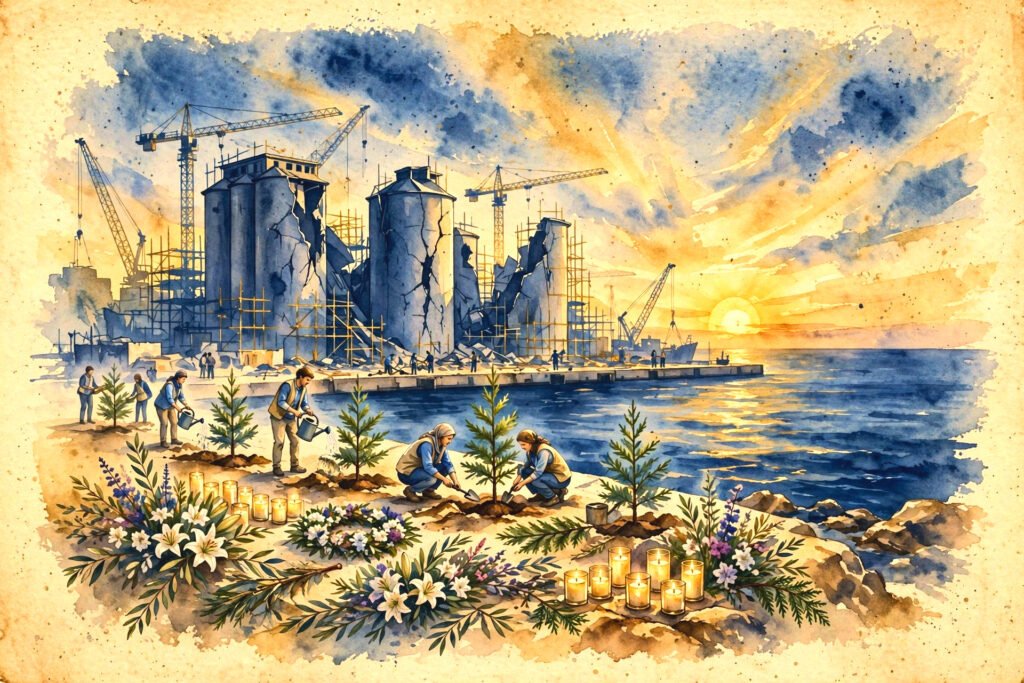
A new government under Najib Mikati was formed in September 2021. In October 2022, days before Aoun’s term ended without a successor, Lebanon and Israel signed an American-mediated agreement on their maritime boundary, a rare piece of diplomacy in a time of institutional emptiness. From that October until January 2025 the presidency was again vacant. A caretaker cabinet of limited powers presided over shortages of electricity, medicine and clean water, and over a departure of doctors, engineers, teachers and the young that felt, to many families, like a second famine, this time of people rather than of bread.[5]
12. Another war, another opening, 2023–2026
On 8 October 2023, the day after Hamas’s attack on southern Israel, Hezbollah opened what it called a “support front” for Gaza, firing on Israeli positions along the southern border. For nearly a year the exchange was, by the standards of 2006, contained, though it emptied a belt of villages on both sides of the frontier. In September 2024 the war widened. In mid-month, explosions of pagers and walkie-talkies used by Hezbollah members struck across Lebanon. A heavy Israeli air campaign followed, over the south, the Beqaa and the Dahiya. On 27 September, bunker-busting bombs hit Hezbollah’s underground headquarters in Haret Hreik and killed Nasrallah, the movement’s leader for thirty-two years, together with much of his senior military command. An Israeli ground operation into border villages followed. A ceasefire, brokered by the United States and France, was signed on 26 November and took effect on 27 November. It provided for an Israeli withdrawal, for the deployment of the Lebanese army and UNIFIL south of the Litani, and for Hezbollah to move heavy weapons north of the river.[17][27]
The human and material cost of the 2024 war is still being counted, and the published figures do not yet agree. Estimates of those killed in Lebanon range from under three thousand to more than four thousand; well over a million people were displaced; hundreds of thousands of homes were damaged or destroyed. Reconstruction needs have been put in the region of eleven billion dollars. Implementation of the ceasefire was imperfect. Israeli forces remained, after the February 2025 withdrawal date, at a handful of points in the south; Hezbollah’s disarmament south of the Litani was incomplete; clashes flickered on. Even so, the truce held long enough for many of the displaced to start going home, and long enough for Lebanese politics, frozen for years, to move.[15][27]
Twelve days after the ceasefire, on 8 December 2024, Syrian rebel forces entered Damascus and overthrew Bashar al-Assad, ending fifty-four years of Assad family rule and cutting the overland corridor that had supplied Hezbollah from Iran through Iraq and Syria. Weakened by the war and stripped of that strategic depth, Hezbollah was less able to veto the filling of state offices. On 9 January 2025, after more than two years without a president, parliament elected the army commander, General Joseph Aoun. He appointed as prime minister Nawaf Salam, a jurist and diplomat, then president of the International Court of Justice. A government with a reform brief was formed in February 2025. In August the cabinet approved a plan to bring weapons under state control — a sentence that, in Lebanese history, is easier to write than to carry out.[5][27][28]
As of late 2026 the opening remains fragile. The army’s deployment in the south, the negotiation of an IMF programme, the restructuring of a banking sector whose gap with depositors has been estimated in tens of billions of dollars, the investigation of the port explosion, and the rebuilding of towns from Tyre and Bint Jbeil to the Beqaa — these are the tests by which the new chapter will be judged. Lebanon has been here before: in 1861, in 1943, in 1958, in 1990, in 2005. Each time a settlement has promised that the state would, at last, monopolise force, reform its bargain, and earn a living without eating its own seed corn. Each time the four conditions — geography, demography, region, and a confidence economy — have been waiting. The present attempt is not therefore doomed. It is only not the first.[19][27][28]
13. A country larger than its borders
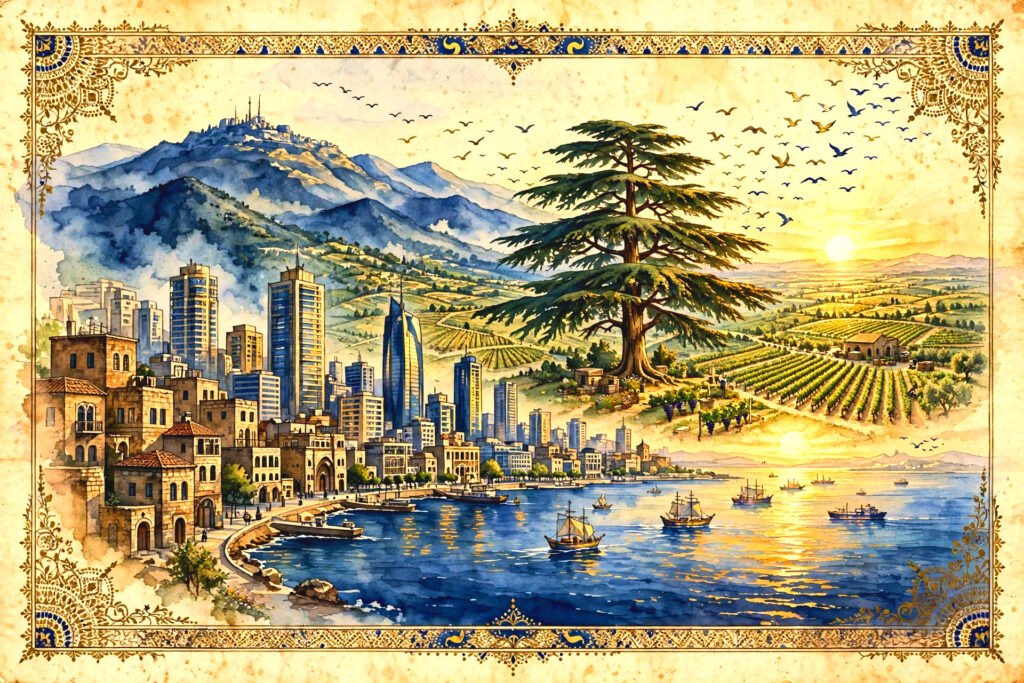
Any history of Lebanon that stopped at the frontier would miss half the country. The diaspora, built in the silk years, swollen by the famine, by the civil war and by the collapse after 2019, is larger, on some counts much larger, than the resident population. Estimates range so widely — from about four million to more than ten, in the most expansive claims fourteen — that the only honest statement is that no one knows, and that the uncertainty is itself a political fact. What can be said is that remittances, in the years after 2019 often put at around six billion dollars a year, have been the most stable source of foreign currency in the collapse, and that Lebanese schools, newspapers, clinics and family houses have long been maintained by money earned in São Paulo, Lagos, Paris, Detroit and the Gulf. Emigration has saved the mountain more than once. It has also drained it, leaving a republic whose professional classes can live anywhere, and whose politics is too often left to those who cannot, or will not, leave.[5][15][29]
Culture has been a form of continuity when institutions have not. The universities — the American University of Beirut, Saint Joseph, the Lebanese University — kept teaching through war. Fairuz’s voice, the Rahbanis’ songs, the novels and poems of the Mahjar and of the later generations, the newspapers An-Nahar, As-Safir and L’Orient-Le Jour, the theatres and the films that documented the war, have given Lebanese a language in which to recognise one another across the Green Line and across oceans. The cedars of the high mountain, now protected in a reserve that is a World Heritage site, have been made to carry more symbolism than any tree should have to bear. They remain, even so, a useful emblem: old, reduced, still standing, and not the property of a single community.[5][17]
The confessional system has been both a protection and a constraint. It has prevented any one community from capturing the state completely, and it has given minorities a formal share in power that simple majoritarianism would have denied them. It has also made every public office a communal possession, obstructed impersonal institutions, and turned each national crisis into a zero-sum count of winners and losers. Alternatives have been proposed for decades: a senate to represent communities, a lower house elected without communal lists; a gradual fading of Article 95, as the 1926 constitution once promised; a civil personal-status law. None has been adopted, because each would require the communities to trust a state that has given them, too often, reason not to. The absence of a census since 1932 is not an administrative oversight. It is the system’s way of refusing to look in the mirror.[9][10]
What, then, has a century and a half changed? The map has changed: a mountain district became a coastal state. The guarantee has changed: the powers of 1861 gave way to the Mandate, to the National Pact’s inward bargain, to Syrian tutelage, to a crowded field of patrons and enemies. The arithmetic has changed: 6:5 became 5:5; the presidency lost some of its old pre-eminence. The economy has changed, from silk to banking and remittances, and then to a wrecked currency and a cash-dollar improvisation. The regional weather has changed, again and again. What has not changed enough is the weakness of the state as a state: its difficulty in monopolising force, in taxing fairly, in delivering electricity, in protecting a port from its own negligence, in telling its citizens that they are citizens first. Beirut has been rebuilt more than once, and each rebuilding has been a little more glossy and a little less shared. The provinces have paid, repeatedly, for decisions taken on the coast and for wars that arrived from over the border.
Lebanon is neither a miracle nor a failure, though it has been called both, usually by people who needed it to be one or the other. It is a small, densely inhabited, ferociously talented country that invented, under imperial collapse and regional war, a fragile formula for living together, and that has spent the subsequent decades testing, breaking and partly repairing that formula. The people who have done the repairing are not only ministers. They are the teachers who opened schools on Monday mornings after nights of shelling, the doctors who worked by generator light, the families who sent money home, the protesters of 2005 and of 2019 who filled squares without a militia at their back, the port workers and the civil servants who warned about Hangar 12 and were not heard, the villagers who have gone back to the south after 2000, after 2006, and after 2024.
The question after 2026 is the same question that the Règlement of 1861 did not answer, and that the Pact of 1943 answered only for a time. Can a country that was taught, after a civil war on a mountain, to count itself by community, learn to count itself as a single public? Can a state that has so often been a corridor for other people’s wars become, at last, a sovereign thing, armed only in its own name, and useful to the people who live in it? The historical record does not authorise easy optimism. It does authorise a refusal to treat the next failure as fate. Lebanon has been remade before. The unfinished republic remains, as it has been since the famine and the Mandate, a country still in the act of becoming one.
On the illustrations
Seven of the pictures in this essay are watercolours made for nekud.click in the site’s house style — deep scholarly blue and antique gold on warm parchment, intended to be read as pauses in the text rather than as evidence. They are illustrations, not historical photographs, and they do not depict named historical persons as if from the life. The first picture is a late Ottoman map of the Mutasarrifate, reproduced from the research files; its exact date and cartographer were not established in those files. A 16:9 crop of the Mount Lebanon watercolour is supplied separately for use as a featured image.
Share this article
References
- “The War of 1860 on Mount Lebanon”, nekud.click, https://nekud.click/the-war-of-1860-on-mount-lebanon/ *
- Ussama Makdisi, The Culture of Sectarianism: Community, History, and Violence in Nineteenth-Century Ottoman Lebanon (Berkeley: University of California Press, 2000), https://publishing.cdlib.org/ucpressebooks/public/book/the-culture-of-sectarianism-community-history-and-violence-in-nineteenth-century-ottoman-lebanon.html *
- Leila Tarazi Fawaz, An Occasion for War: Civil Conflict in Lebanon and Damascus in 1860 (Berkeley: University of California Press, 1994), https://archive.org/details/occasionforwarci0000fawa *
- “Mount Lebanon Mutasarrifate”, https://en.wikipedia.org/wiki/Mount_Lebanon_Mutasarrifate *
- Kamal Salibi, “How It All Began”, https://lib-webarchive.aub.edu.lb/BorreLudvigsen/mp_/http://almashriq.hiof.no/lebanon/900/902/Kamal-Salibi/ *
- American University of Beirut Libraries, online exhibits on Lebanon in the First World War. *
- Encyclopaedia Britannica, entries on Lebanon under the French Mandate, the post-independence period, and the Lebanese Civil War. *
- “Greater Lebanon”, https://en.wikipedia.org/wiki/Greater_Lebanon *
- Rania Maktabi, “The Lebanese Census of 1932 Revisited”, British Journal of Middle Eastern Studies. *
- “Lebanon: The National Pact”, U.S. Library of Congress Country Studies, https://countrystudies.us/lebanon/77.htm *
- Sami E. Baroudi, “Continuity in Economic Policy in Postwar Lebanon”, Arab Studies Quarterly. *
- “The Eisenhower Doctrine, 1957”, Office of the Historian, U.S. Department of State, https://history.state.gov/milestones/1953-1960/eisenhower-doctrine *
- Tarek Abou Jaoude, “Chehabism Revisited: The Consequences of Reform in Lebanon”, Middle Eastern Studies. *
- “Lebanese Civil War”, https://en.wikipedia.org/wiki/Lebanese_civil_war *
- World Bank Group, Lebanon country overview, and Beirut Rapid Damage and Needs Assessment (2020), https://www.worldbank.org/ext/en/country/lebanon *
- United Nations Security Council Resolution 425 (1978), and UNIFIL official timelines. *
- United Nations Security Council Resolution 1701 (2006), https://www.un.org/unispal/document/auto-insert-186298/ *
- Talal Nizameddin, “The Political Economy of Lebanon under Rafiq Hariri”, Arab Studies Quarterly; Samer Srouji, Capturing the State: A Political Economy of Lebanon’s Public Debt Crisis 1992–2004. *
- World Bank Group, Lebanon country overview, https://www.worldbank.org/ext/en/country/lebanon *
- United Nations Security Council Resolution 1559 (2004). *
- “Syria completes withdrawal of its forces from Lebanon”, UN News, April 2005, https://news.un.org/en/story/2005/04/133712 *
- United Nations Security Council Resolution 1701 (2006). *
- UNHCR, Lebanon operational updates, https://reporting.unhcr.org/operational/operations/lebanon *
- International Monetary Fund, Lebanon 2019 Article IV Consultation, https://www.elibrary.imf.org/view/journals/002/2019/312/article-A001-en.xml; IMF staff visit to Lebanon, May 2024, https://www.imf.org/en/News/Articles/2024/05/22/pr24173-lebanon-imf-staff-concludes-visit *
- Coverage and chronology of the 17 October 2019 protests, as synthesised in the research files; see also https://en.wikipedia.org/wiki/2019–2021_Lebanese_protests *
- Human Rights Watch, “Lebanon: Evidence Implicates Officials in Beirut Blast”, August 2021, https://www.hrw.org/video-photos/interactive/2021/08/02/lebanon-evidence-implicates-officials-beirut-blast-targeted *
- Chronology of the 2024 war, ceasefire and 2025–26 political opening, as synthesised in the research files (published estimates of casualties and displacement disagree; see the notes accompanying this draft). *
- International IDEA, Lebanon political developments, January–February 2025. *
- “Lebanese diaspora”, https://en.wikipedia.org/wiki/Lebanese_diaspora *
Related reading

The War of 1860 on Mount Lebanon
In the late spring and summer of 1860, known in Arabic as حرب ١٨٦٠ (Ḥarb 1860, the war of 1860), civil war on جبل لبنان (Jabal Lubnān, Mount Lebanon) between Druze and Maronite communities was followed, in July, by a massacre of Christians in Damascus (دمشق). The crisis ended in an international settlement and in the Mutasarrifate of Mount Lebanon, created by the Règlement Organique of 1861.
Muhammad Ali Pasha and the Making of Modern Egypt
Muhammad Ali Pasha (1769–1849), known in Ottoman Turkish as Mehmed Ali Pasha and in Arabic as Muhammad Ali Basha (محمد علي باشا), ruled Egypt from 1805 to 1848 and founded the dynasty that governed Egypt and Sudan until 1953.

From Sefarad to Salonica
How the Jews expelled from Spain and Portugal in the 1490s rebuilt their world in an Ottoman port, and how, in a city where Greek and Jewish scholars had read the Bible since Paul, Cyril and Methodius and Eustathios, the rabbis, commentators and printers, the upheaval of Sabbatai Zevi, the Ladino press and the great fire of 1917 made Salonica the largest Sephardic city on earth until its destruction in 1943.