History
Muhammad Ali Pasha and the Making of Modern Egypt
Contents ▾
EGYPT · STATE BUILDING · SCHOLARLY NOTE
Muhammad Ali Pasha (1769–1849), known in Ottoman Turkish as Mehmed Ali Pasha and in Arabic as Muhammad Ali Basha (محمد علي باشا), ruled Egypt from 1805 to 1848 and founded the dynasty that governed Egypt and Sudan until 1953.
| LIFE & REIGN | MASSACRE OF THE MAMLUKS | FIRST PEASANT CONSCRIPTION | HEREDITARY FIRMAN |
|---|---|---|---|
| 1769–1849 · Wali 1805–1848 | Cairo Citadel, 1811 | Nizam al-Jadid, 1823 | Egypt and Sudan, 1841 |
1. The Short Answer
An Albanian Ottoman commander who arrived in Egypt as a subordinate officer, he became Wali, builder of a conscript army, creator of a fiscal monopoly, patron of schools and presses, conqueror of Arabia, Sudan and Syria, and challenger to the Ottoman sultan. On this hub he matters as a transmission figure of a different order—not a scribe or commentator, but a ruler who remade the institutions through which a society copied, taxed, taught, healed, and remembered itself.
Muhammad Ali Pasha transformed a disordered Ottoman province into a centralised, militarised, and revenue-extracting state that contemporaries and later historians have called modern Egypt. The transformation rested on five linked operations. First, the elimination of rival power holders, above all the Mamluks and the autonomous ulama, between 1805 and 1815. Second, the seizure of land revenue through the abolition of tax farming, the survey and confiscation of iltizam and waqf holdings, and the imposition of a state monopoly over the purchase and sale of crops. Third, the construction of a new army and navy from conscripted Egyptian peasants, trained by European officers, supplied by state factories, and supported by new schools for medicine, engineering, veterinary science, and translation. Fourth, the redirection of agriculture toward long-staple cotton, the expansion of perennial irrigation through canals and barrages, and the attempt, ultimately limited, to industrialise textile and armaments production. Fifth, the use of that army for imperial expansion into Arabia, Sudan, Crete, Greece, and Syria, an expansion that brought Egypt into direct conflict with the Ottoman Empire and with the European Concert, and that ended in the London settlement of 1840 and the hereditary firman of 1841.
The prevailing historical view has long described Muhammad Ali as the Father of Modern Egypt, the first ruler since the Ottoman conquest of 1517 to divest the Porte of its power in Egypt and to lay the foundation for a modern Egyptian state[1]. A second tradition, associated with Khaled Fahmy and Afaf Lutfi al-Sayyid Marsot, insists that he be understood as an Ottoman reformer, ambitious and problematic, who exploited Egyptian manpower and resources for dynastic ends and whose court spoke Turkish rather than Arabic[2]. The two views are not simply opposed. The institutions he built endured—centralised administration, a professional bureaucracy, a standing army recruited from the peasantry, a state school system, a government press, and a cotton economy tied to world markets. The human cost also endured in memory—conscription, corvee labour, heavy taxation, flight from villages, self-mutilation to avoid service, revolt in Upper Egypt and in Syria, and the brutal conquest of Sudan. This note treats both achievements and costs as part of a single history of state building, and it follows the evidence from Egyptian chroniclers, Ottoman firmans, European consular reports, and modern scholarship.
2. Scope, Terms, and Historiography
Muhammad Ali is the name used uniformly in Egyptian and Arab historical scholarship. In Ottoman Turkish the same name appears as Mehmed or Mehmet Ali. The distinction matters in the Latin alphabet, but not in Arabic, where the spelling Muhammad is consistent. Historians who accentuate the Egyptian character of his rule tend to prefer Muhammad, while historians who accentuate the Ottoman character tend to prefer Mehmed or Mehmet. This note uses Muhammad Ali, following Egyptian usage, and retains Ottoman titles where they clarify function—Wali for the Ottoman viceroy or governor, Pasha for the rank conferred upon him, Khedive for the title later claimed by his dynasty, and iltizam for tax farming, waqf for pious endowment, ulama for the religious scholars, fellahin for the peasantry, and Nizam al-Jadid for the New Order army.
The sources for the reign are uneven. Abd al-Rahman al-Jabarti, the Azhar-trained chronicler of Cairo, kept a monthly chronicle that became Ajaib al-Athar fi al-Tarajim wa al-Akhbar, a world-famous text by virtue of its eyewitness accounts of the French invasion and of Muhammad Ali’s seizure of power. Al-Jabarti criticised Muhammad Ali sharply, and his chronicle was banned until 1879. Ottoman archives preserve firmans, tax surveys, and military orders. French and British consular correspondence, especially the reports sent to London by Murray to Palmerston in September 1849, records the admiration and alarm with which European observers watched the Pasha. Modern scholarship divides, broadly, into the Father of Modern Egypt school, represented by Henry Dodwell in The Founder of Modern Egypt—A Study of Muhammad Ali, Arthur Goldschmidt, Albert Hourani, and P. J. Vatikiotis, and the Foreign Ruler or Ottoman reformer school, represented by Morroe Berger, William L. Cleveland, Khaled Fahmy in All the Pasha’s Men—Mehmed Ali, His Army and the Making of Modern Egypt, and Marsot in Egypt in the Reign of Muhammad Ali.
The debate concerns whether modernity in Egypt began as a national or as an imperial project. This note adopts the position now common in specialist literature—Muhammad Ali was an Ottoman governor who, because Egypt offered an opening after the French occupation, was able to do what Sultan Selim III could not do in Istanbul, namely to destroy entrenched intermediaries and to rebuild the state around a single centre[3].
The chronological frame is 1769 to 1849 for the life, 1805 to 1848 for the reign, and 1805 to 1953 for the dynasty. The geographical frame is Egypt as the core, with the Nile Valley from Alexandria to Aswan and the Delta as the fiscal base, and Arabia, Sudan, Crete, Greece, and Syria as the successive peripheries of expansion. The thematic frame is state building in the sense used by historians of the early modern world—the monopolisation of violence, the centralisation of revenue, the creation of a bureaucracy, and the production of legitimacy through law, education, and monumental architecture.
3. Kavala to Cairo: Origins in an Ottoman Border Town
Muhammad Ali was born on 4 March 1769 in Kavala, a port town in the Sanjak of Kavala, Rumelia Eyalet, in Ottoman Macedonia, now in northeastern Greece. His father, Ibrahim Agha, was a tobacco and shipping merchant and commander of a small provincial military force maintained by the governor of Kavala. His mother, Zainab, was the daughter of Husain Agha. His paternal great-grandfather is said to have come from Korca in Albania, a point that has generated competing claims about Albanian, Turkish, Kurdish, and Anatolian origins. Britannica notes that his ethnic background is unknown, though he may have been Albanian and was certainly a Muslim and an Ottoman subject. His father died when Muhammad Ali was a boy, and he was brought up by the governor of Kavala. At eighteen he was married to a relative of the governor, Emina of Nosratli, a wealthy widow who became the mother of five of his children. He later married several other wives and is reported to have fathered as many as ninety-five children, a figure that belongs less to demography than to the politics of a dynastic household in which sons were placed in command of provinces and armies.
Kavala taught three lessons that stayed with him. The first was the tobacco trade. Muhammad Ali became involved in tobacco, an experience that may account for his later commercial interests and for his instinct that a state could make money by buying cheap from producers and selling dear to foreign markets. The second was tax collection. His uncle, the Ayan or Corbaci Husain Agha, rewarded his hard work with the rank of Bolukbashi for the collection of taxes in Kavala. The third was the fragility of Ottoman provincial order. Kavala, like Egypt, was a place where local notables, military households, and imperial officials negotiated power, and where a man who could hold a coalition together and pay his soldiers on time could rise quickly.
In 1798 Egypt, at that time a semiautonomous province of the Ottoman Empire, was occupied by a French force under Napoleon Bonaparte. The occupation lasted three years, from 1798 to 1801, and disrupted the traditional political and economic structure of the country. Muhammad Ali arrived in Egypt in 1801 as second in command of a 300-man Albanian regiment sent by the Ottoman government to oust the French. His commanding officer was soon killed, and Muhammad Ali succeeded him. The expedition landed at Aboukir in the spring of 1801. With great political skill, he managed by 1805 to be named Wali, the Ottoman sultan’s viceroy in Egypt, with the rank of Pasha. The path from Kavala volunteer to Wali in four years is the central puzzle of his biography. It cannot be explained by military brilliance alone. It was achieved by forming alliances with one set of opponents against another, by appearing as the champion of the people, and by forestalling popular opposition until he had consolidated power.
The French occupation matters for two reasons. It weakened the Mamluks, the military caste that had dominated Egypt for more than six centuries, and it demonstrated to Egyptian and Ottoman observers that European drill, artillery, and administration could defeat older forms of warfare. The French brought savants, printing, and a vision of Egypt as a laboratory for reform. They also brought requisition, taxation, and revolt. When they left, they left a vacuum. The Mamluks had governed Egypt before the French invasion and still retained power in the region. The Ottomans sought to restore direct rule. The Albanians, sent to expel the French, stayed to claim the spoils. The Egyptian population, weary of the power struggle, sought a protector who could guarantee bread, security, and a measure of justice. Muhammad Ali learned to speak to each audience in its own language—to the Ottomans as a loyal servant, to the ulama as a defender of religion, to the Albanians as a paymaster, and to the Cairene crowd as a man of the people.
4. The Vacuum: French Occupation, Mamluks, Ottomans, and Albanians, 1798–1805
Egypt had been a province of the Ottoman Empire since 1517. Since the early eighteenth century it had been dominated by a cluster of largely autonomous Mamluk beys. The Mamluks were members of a politically powerful military class, originally slave-soldiers recruited from the Caucasus and Central Asia, trained into a first-class cavalry, and reproduced through purchase and manumission rather than heredity. They controlled iltizam, the tax farms that diverted most of the revenue of the land to themselves and to other notables. They maintained households, retinues, and commercial interests. They were, in the language of later historians, a ruling oligarchy that had long since ceased to be an efficient administration.
The French invasion of 1798 exposed that oligarchy. Napoleon landed at Alexandria on 2 July 1798 with 36,000 veterans and hundreds of civilian experts, intending to make Egypt a French colony and to threaten British interests in India. The Mamluk cavalry, magnificent in charge, was shattered by French squares and artillery at the Battle of the Pyramids. The French occupied Cairo, levied taxes, established a Divan, and attempted to govern through Egyptian intermediaries. The occupation provoked resistance, including revolts in Cairo, and it ended with Anglo-Ottoman victory in 1801. The French withdrawal left a power vacuum that lasted four years.
The civil war of 1803 to 1807 was a three-way and at times four-way struggle between the Ottoman Empire, the Mamluks who had ruled Egypt for centuries, and Albanian mercenaries in the service of the Ottomans, with British intervention as a fourth force. During this period Muhammad Ali used his loyal Albanian troops to work with both sides, gaining power and prestige. He allied in 1801 with the Egyptian leader Umar Makram and with the Sheikh of Al-Azhar. During the infighting between Ottomans and Mamluks between 1801 and 1805, he carefully acted to gain the support of the general public. Al-Jabarti records that Makram discovered Muhammad Ali’s intention to seize power for himself, a discovery that led in 1809 to Makram’s exile to Damietta.
In May 1805 a revolt broke out in Cairo against the Ottoman viceroy, Khurshid Pasha. The ulama invested Muhammad Ali as viceroy. For some weeks there was street fighting, and Khurshid was besieged in the Citadel. In July Sultan Selim III confirmed Muhammad Ali in office and the revolt ended. The confirmation was reluctant. Selim III could not oppose the ascension, because Muhammad Ali appeared as the champion of the people and because Istanbul was preoccupied with its own crises. The new Wali had not yet secured Egypt. He had secured Cairo and the title. The rest of the work, the destruction of the Mamluks, the subjugation of the ulama, the pacification of the Bedouin, and the creation of a new fiscal and military order, remained to be done.
The British expedition of 1807 tested the new regime. After the renewal of war between Britain and Napoleonic France in 1803, Egypt again became an area of strategic significance. On 17 March 1807 a British fleet appeared off Alexandria with nearly 5,000 troops under General Alexander Mackenzie-Fraser, and commenced the Alexandria expedition, also called the Fraser expedition. The British occupied Alexandria but failed to capture Rosetta, and after a defeat at the hands of Muhammad Ali’s forces, were allowed to withdraw. The victory mattered. It demonstrated that the new Wali could defend Egypt against a European power, it discredited those Mamluks who had hoped for British help, and it allowed Muhammad Ali to present himself as the protector of Egypt rather than as an Ottoman appointee.
5. Seizure and Consolidation: The Ulama, the Mamluks, and the Citadel, 1805–1811
Nowhere in the Ottoman Empire was there greater opportunity for a total restructuring of society than in Egypt. The three-year French occupation had disrupted the traditional political and economic structure. Continuing the task begun by the French, Muhammad Ali put an end to Egypt’s traditional society. He eliminated the Mamluks, the former ruling oligarchy, expropriated the old landholding classes, turned the religious class into pensioners of the government, restricted the activities of the native merchant and artisan groups, neutralised the Bedouin, and crushed all movements of rebellion among the peasants. The task of rebuilding Egypt along modern lines now lay before him.
The ulama were the first allies and the first rivals to be neutralised. In 1805 they had invested Muhammad Ali as Wali, and Umar Makram, the Naqib al-Ashraf, had been the popular tribune who mobilised Cairo against Khurshid Pasha. By 1809 Muhammad Ali had divided and outmanoeuvred the ulama, exiling Makram to Damietta and later to Tanta, where he died in 1822. The move was characteristic—use a popular leader to gain power, then remove him before he can become a rival centre of legitimacy. The ulama as a class were not destroyed. They were pensioned. By taxing waqf endowments, which had previously been tax-free, Muhammad Ali took revenue away from the local elite, Mamluks and ulama, weakening opposition to his reforms and turning religious institutions into dependents of the state. Al-Azhar remained a centre of learning, but it no longer controlled the fiscal base that had made it independent.
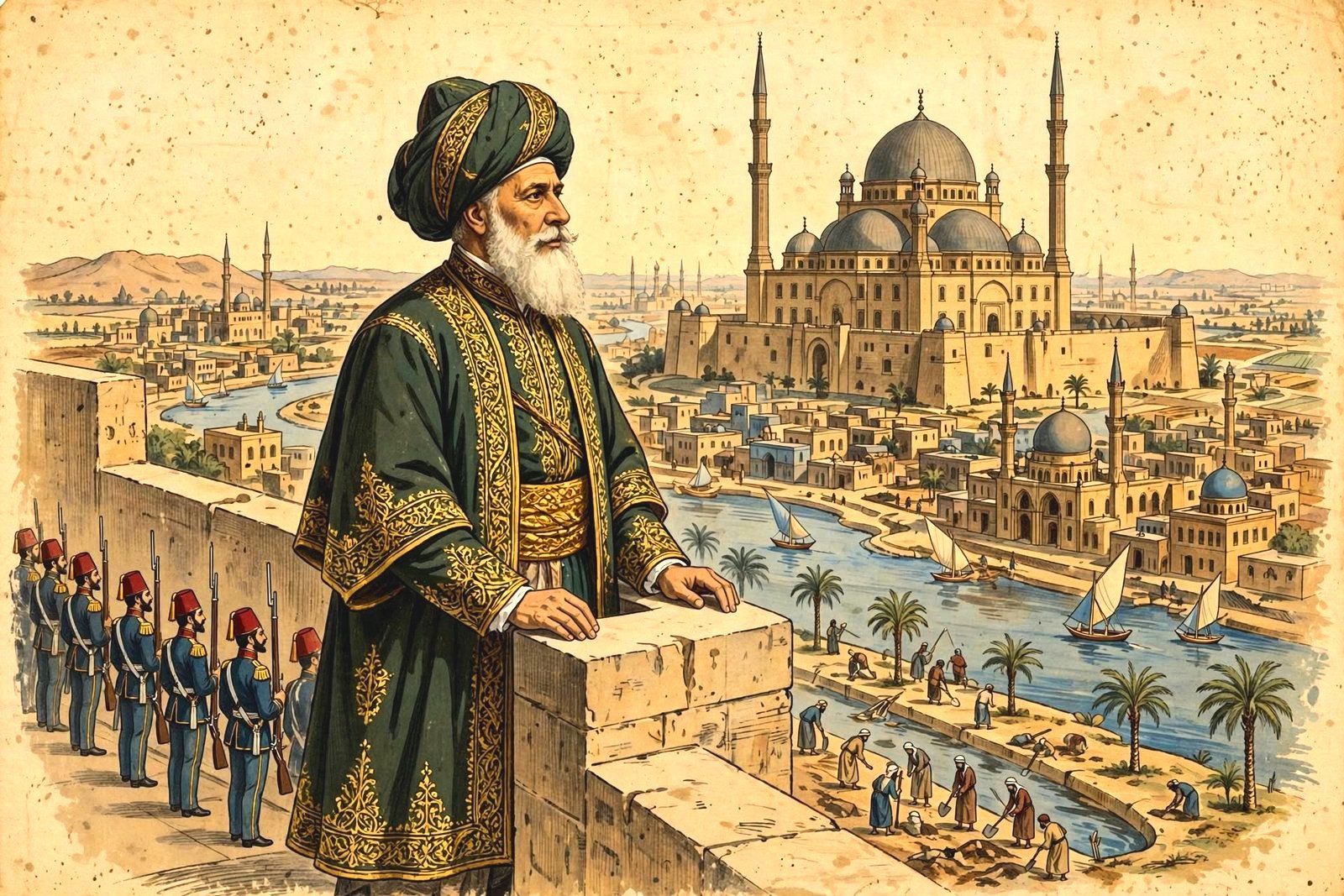
The Mamluks posed the greatest threat. They had controlled Egypt for more than six hundred years, and over that time they had extended their rule extensively throughout Egypt. Muhammad Ali’s approach was to eliminate the Mamluk leadership, then move against the rank and file. The event is known as the Massacre of the Citadel, or the Massacre of the Mamluks, on 1 March 1811. Muhammad Ali invited the Mamluk leaders to a celebration at the Cairo Citadel in honour of his son Tusun Pasha, who was to lead a military expedition into Arabia. The event was held to invest Tusun with a pelisse and the command of the army. The Mamluks were warmly welcomed, treated to coffee, sweetmeats, and polite conversation. When the time came for the procession they had to go down a narrow, winding passageway between high walls in single file, the Bab al-Azab. Suddenly the gates at each end were slammed shut and the Wali’s soldiers appeared on top of the walls and opened a murderous fire with muskets.
Reports vary about how many died. William Cleveland claims seventy-four killed, H. Wood Jarvis claims nearly five hundred, and popular accounts speak of some five hundred notables assembled and a total of perhaps three thousand Mamluks hunted down in Cairo and elsewhere in Egypt. Whatever the actual number, the event dealt a serious blow to the Mamluks. After the leaders were killed, Muhammad Ali dispatched his army throughout Egypt to rout the remainder of the Mamluk forces. Ibrahim Pasha expelled their survivors from Upper Egypt, effectively destroying them as a political force. One Mamluk, Amin Bey, is said to have escaped by leaping his horse over the Citadel wall, a legend that entered Egyptian folklore and European engraving. The legend matters because it shows how the massacre was remembered—not as a battle, but as a trap, a piece of theatre in which hospitality became slaughter.
The massacre must be understood in its Ottoman context. It was not the only massacre of a military caste in the early nineteenth century. Sultan Mahmud II would destroy the Janissaries in Istanbul in 1826 in the Auspicious Incident. Muhammad Ali’s massacre preceded it by fifteen years and was more complete in Egypt because the Mamluks, unlike the Janissaries, had no urban base left after the French occupation and the civil war. The massacre also cleared the way for the fiscal reforms that followed. With the Mamluks gone, there was no class capable of defending iltizam against confiscation. With the ulama pensioned, there was no class capable of defending waqf against taxation. With the Bedouin neutralised through a combination of subsidy and punishment, there was no force capable of interrupting the canal and tax system. The Pasha had, in the language of Britannica, crushed the elements that might have served as instruments of change, and he had done so at the outset of his regime.
The consolidation was not only violent. Muhammad Ali moved fast to centralise control by inviting many friends and relatives to settle in Egypt and by appointing them in key positions within the provinces. He partitioned Egypt into provinces responsible for collecting taxes and maintaining order. He depended essentially upon members of his own family, particularly Ibrahim, and loyal servants such as his Armenian confidant Boghos Bey. Characteristic of his governmental system were councils of officials, convened to deliberate on public business, and administrative departments, divans, that bore some resemblance to the ministries of European governments. In local administration, he established a highly centralised system with a clear chain of command from Cairo through the provincial governors down to the village headmen. Initiative was not encouraged, but firm control had taken the place of anarchy.
“I am well aware that the Ottoman Empire is heading by the day toward destruction… On its ruins I will build a vast kingdom… up to the Euphrates and the Tigris.”
Attributed to Muhammad Ali, French military correspondence
The quotation, attributed to Muhammad Ali and preserved in French military correspondence, may be apocryphal in its exact wording. Its sentiment is not. From the beginning Muhammad Ali saw Egypt not as a province to be administered for Istanbul, but as the base for a dynastic empire that would succeed the Ottomans. That vision explains the scale of his reforms. He was not building a province. He was building a kingdom.
6. The Fiscal State: Land, Tax, and Monopoly, 1805–1815
Muhammad Ali’s goal was for Egypt to leave the Ottoman Empire and be ruled by his own hereditary dynasty. To do that, he had to reorganise Egyptian society, streamline the economy, train a professional bureaucracy, and build a modern military. His first task was to secure a revenue stream for Egypt. To accomplish this, he nationalised all the iltizam lands of Egypt, thereby officially owning all the production of the land.
Gradually, between 1805 and 1815, Muhammad Ali eroded the system of tax farming that had diverted most of the revenues to the Mamluks and other notables, imposed the direct levy of taxes, expropriated the landholders, and carried out a new tax survey. He accomplished the state annexation of property by raising taxes on the tax-farmers who had previously owned the land throughout Egypt. The new taxes were intentionally high, and when the tax-farmers could not extract the demanded payments from the peasants who worked the land, Muhammad Ali confiscated their properties. The other major source of revenue was a new tax on waqf endowments, which were previously tax-free. Through these endowments, personal income could be set aside for schools or other charitable purposes. As well as raising revenue to fund his new military, this tax took revenue away from the local elite.
In practice, Muhammad Ali’s land reform amounted to a monopoly on trade in Egypt. He required all producers to sell their goods to the state. The state in turn resold Egyptian goods, within Egypt and to foreign markets, and retained the surplus. The practice proved very profitable for Egypt with the cultivation of long-staple cotton, a new cash crop. Muhammad Ali thus became effectively the sole landholder in Egypt, with a monopoly over trade in crops, although later in his reign he made considerable grants of land to his family and dependents. The monopoly system was extended in due course from primary materials to manufactures, with the establishment of state control over the textile industry.
| Reform | Date | Mechanism | Consequence |
|---|---|---|---|
| Abolition of iltizam | 1805–1815 | Direct levy, new survey, confiscation | State becomes sole landholder |
| Taxation of waqf | 1809–1813 | Endowments taxed, ulama pensioned | Religious elite dependent on state |
| Crop monopoly | 1810s–1820s | Producers sell to state at fixed price | Surplus retained by state |
| Provincial reorganisation | 1810s | Ten provinces, governors, village headmen | Centralised chain of command |
| Divans and councils | 1820s–1830s | Departments resembling ministries | Professional bureaucracy |
The fiscal state was not a free market. It was a plantation state. The Pasha’s government fixed prices, controlled transport, and punished evasion. The system was resented by European merchants in Egypt and clashed with the economic doctrine of free trade upheld by the British government. Although a free-trade convention concluded between Britain and the Ottoman Empire in 1838, the Convention of Balta Liman, was technically binding on Egypt, Muhammad Ali succeeded in evading its application up to and even after the reversal of his fortunes in 1840–41. The convention abolished all monopolies and allowed British merchants and their collaborators to have full access to all Ottoman markets and to be taxed equally to local merchants. In a move designed to weaken the power of Muhammad Ali, the convention also forbade the formation of commercial monopolies in the Ottoman domains. The convention struck the death knell to the system of monopolies, though its application regarding Egypt was delayed for some years.
The fiscal reforms created a state that knew its subjects in a way the Mamluks never had. That knowledge was the precondition for both development and extraction.
7. Cotton, Canals, and Factories: Agriculture and Industry
To help improve production, Muhammad Ali expanded the land used for agriculture and overhauled the irrigation system, largely completed by the corvee, or forced peasant labour. He improved Egypt’s irrigation system, on which its agriculture depended. He introduced new crops, such as cotton, which promised high cash returns. He reorganised the administrative structure of the government to ensure strict control of the economy.
The central agricultural innovation was long-staple Jumel cotton, introduced as a major crop in 1820 after French engineer Louis Alexis Jumel identified a fine variety in a Cairo garden. It commanded a premium in Britain and France, and the Pasha made its sale a state monopoly.
The irrigation works were the material base of cotton. Cultivable land increased by eighteen per cent between 1813 and 1830. The Mahmudiya Canal, commissioned in 1819 to connect the Nile with Alexandria, was dug by corvee labour and made Alexandria the principal port of Egypt.
In addition to bolstering the agricultural sector, Muhammad Ali built an industrial base for Egypt. His motivation was primarily an effort to build a modern military. Consequently, he focused on weapons production. Factories based in Cairo produced muskets and cannons. With a shipyard he built in Alexandria, he began construction of a navy. By the end of the 1830s, Egypt’s war industries had constructed nine 100-gun warships and were turning out 1,600 muskets a month. The industrial innovations were not limited to weapons production. Muhammad Ali established a textile industry in an effort to compete with European industries and produce greater revenues for Egypt. While the textile industry was not successful, the entire endeavour employed tens of thousands of Egyptians. Additionally, by hiring European managers, he was able to introduce industrial training to the Egyptian population.
Egypt under Muhammad Ali in the early nineteenth century had the fifth most productive cotton industry in the world, in terms of the number of spindles per capita. The industry was initially driven by machinery that relied on traditional energy sources, such as animal power, water wheels, and windmills, which were also the principal energy sources in Western Europe before steam. It was under Muhammad Ali that steam engines were introduced to Egyptian industrial manufacturing. Power looms were imported for industrial textile production. The factories were state-owned, state-managed, and state-supplied. They were not private enterprises in the European sense. They were departments of the Pasha’s household writ large.
The industrial experiments failed, largely because Egypt lacked sources of power, a native managerial class, and a trained working class. Even the agricultural sector declined ultimately because of administrative mismanagement, excessive taxation, military conscription of the peasantry, and his monopolisation of trade. By the mid-1830s Muhammad Ali’s policy of turning Egypt into a massive plantation for his own benefit had reached a point of diminishing returns. Furthermore, his financial requirements had greatly increased because of his military campaigns. Laura Panza and Jeffrey Williamson, in a much-cited economic history, asked whether Muhammad Ali fostered industrialisation in early nineteenth-century Egypt, and answered that the attempt was real, but that it was constrained by factor endowments, by the cost of coal, and by the competition of British textiles after Balta Liman. The factories did not create a self-sustaining industrial revolution. They created a skilled, if narrow, workforce, a cadre of engineers and managers, and a precedent for state-led industrialisation that would be invoked by later Egyptian rulers from Ismail to Nasser.
The corvee was the dark side of the canal and factory system. To staff his new industries, Muhammad Ali employed a corvee labour system. The peasantry objected to these conscriptions and many ran away from their villages to avoid being taken, sometimes fleeing as far away as Syria. A number of them maimed themselves so as to be unsuitable for combat or labour—common ways of self-maiming were blinding an eye with rat poison and cutting off a finger of the right hand, so as to be unable to fire a rifle. The corvee assembled work gangs of one hundred thousand or more at a time on canals. The human cost was enormous, and it is recorded in European consular reports, in al-Jabarti’s chronicle, and in the petitions of village headmen. The canals that made cotton possible were dug by men who had not chosen to dig them.
8. The New Army: Conscription, the Nizam al-Jadid, and the Cost of Discipline
The old-style military forces, including the Albanians, on whom Muhammad Ali relied against his internal opponents and who conquered the Hejaz, Najd, and the Sudan, were heterogeneous and unruly. An attempt to introduce Western methods of training in 1815 provoked a mutiny. Muhammad Ali then decided to form an army of slave troops dependent wholly upon himself and trained by European instructors. The conquest of Sudan was intended to provide the recruits. But the slaves, encamped at Aswan, died wholesale, and Muhammad Ali had to seek most of his troops elsewhere. In 1823 he took the momentous step of conscripting Egyptian peasants for the rank and file of his new model army.
The new army was called al-Nizam al-Jadid, the New Order, a name borrowed from Sultan Selim III’s Nizam-i Cedid. In 1805, as soon as Muhammad Ali gained some independence from the Ottoman Empire and consolidated his position as Wali in Cairo, he began conscripting skilled labourers to work on government projects. His model was the conscript armed force instituted by Selim III. The existing Egyptian military force, to which the Mamluks sent their own retainers for use by the state, was then replaced by 1822 with a new, drafted, regular army called al-Nizam al-Jadid. The first four thousand men called up came from Upper Egypt. Those from the region between Manfalut and Qina were assembled at a training camp near Farshut, and those from the region between Qina and Aswan were gathered in Aswan. Their initial tour of duty was set at three years. Their replacements were selected from lists of prospective draftees drawn up by the officers in charge of the training camps as part of a comprehensive system of village census taking. Conscripts were drilled according to European procedures and organised into defined regiments, with a centralised command structure to supervise the distribution of arms, clothing, and other equipment.
The officers were mostly Turkish-speaking Ottomans, directed by Sulayman Pasha, born Colonel Joseph Seve, a former French officer who had converted to Islam. Conscription was brutally administered. The army was presented not as a foreign imposition, but as a defence of Islam and of Egypt.
Regular infantry and artillery units were complemented by a flotilla of warships built along European lines in government yards. Both the new army and navy played major roles in the Egyptian campaigns in the Aegean Sea and Syria after 1824. Both were also strictly limited by Britain after Muhammad Ali’s capitulation to the European powers in 1838. Thus ended this army as a great power instrument, though its institutional legacy remained.
Khaled Fahmy’s All the Pasha’s Men offers the most influential revisionist account of this army. Fahmy argues that the army was not simply a tool of the Pasha. It was a site where Egyptian peasants encountered modern discipline, medicine, and bureaucracy for the first time. Soldiers were vaccinated, examined, fed, clothed, and punished according to written regulations. They learned to march, to read orders, to keep time, and to obey a hierarchy that was not kinship. The army was, in Fahmy’s phrase, the making of modern Egypt, not because it won battles, but because it created a population that could be counted, inspected, and governed. The Pasha’s men were the first Egyptians to be governed as individuals by a state that kept files on their bodies.
The cost was recorded in revolt. In 1824 a native rebellion broke out in Upper Egypt headed by one Ahmad, an inhabitant of al-Salimiyyah, a village situated a few miles above Thebes. He proclaimed himself a prophet, and was soon followed by between twenty thousand and thirty thousand insurgents, mostly peasants, but some of them deserters from the Nizam al-Jadid, for that force was yet in a half-organised state. The peasants were angered by many of Ali’s reforms, especially the introduction of conscription and the increase in taxes and forced labour. The insurrection was crushed by Muhammad Ali, and about one fourth of Ahmad’s followers perished, but he himself escaped and was never heard of again. Few of these unfortunates possessed any other weapon than the long staff, the nabbut, of the Egyptian peasant; still they offered an obstinate resistance, and the combat in which they were defeated resembled a massacre.
The army’s social composition mattered for the future. The rank and file were Egyptian fellahin. The officers were Turkish-speaking Ottomans, Albanians, Circassians, and Europeans. The divide between a Turkish-speaking officer corps and an Arabic-speaking rank and file would persist into the twentieth century and would fuel the Urabi revolt of 1881–82, in which Egyptian officers demanded promotion and equality. Muhammad Ali created an Egyptian army without creating Egyptian officers. He created a bureaucracy without creating a bourgeoisie. He created a state without creating a nation. That paradox is the core of the Fahmy critique—the institutions of modernity were built, but they were built to serve a dynasty, not a people.
9. Schools, Press, Medicine: The Knowledge State
These changes necessitated the training of officers and officials in the new Europeanised ways of working, and this in turn resulted in the creation of a range of educational institutions alongside the traditional Muslim schools that prepared the ulama. Much of the foundation work was done by expatriates, while missions of Egyptian students were sent to Europe, especially to Paris.
Muhammad Ali sent promising citizens to Europe to study. Again the driving impulse behind the effort was to build a European-style army. Students were sent to study European languages, primarily French, so they could in turn translate military manuals into Arabic. He then used both educated Egyptians and imported European experts to establish schools and hospitals in Egypt. The European education also provided talented Egyptians with a means of social mobility. A byproduct of Muhammad Ali’s training programme was the establishment of a professional bureaucracy.
In the 1820s, Muhammad Ali sent the first educational mission of Egyptian students to Europe. This contact resulted in literature that is considered the dawn of the Arabic literary renaissance, known as the Nahda. To support the modernisation of industry and the military, Muhammad Ali set up a number of schools in various fields where French texts were studied. Rifaa al-Tahtawi supervised translations from French to Arabic on topics ranging from sociology and history to military technology, and these translations have been considered the second great translation movement, after the first from Greek into Arabic.
The most famous mission was that of 1826, when Muhammad Ali sent a major mission of forty-four young men to France to study disciplines needed by a modernising Egyptian state. Rifaa Rafi al-Tahtawi, born 1801, accompanied them as imam, then returned as one of modern Egypt’s most influential educators and translators. Al-Tahtawi had been a student at al-Azhar, and his teacher Hasan al-Attar had put forward his name to join the first group to Paris. On 13 April 1826, dressed in the robes and turban of a scholar of al-Azhar, al-Tahtawi boarded a French brig at Alexandria and left Egyptian soil for the first time. He remained in Paris for five years, documenting his observations of European culture in Takhlis al-Ibriz fi Talkhis Bariz, translated as An Imam in Paris, published by the government press in 1835. In Paris he studied French, history, geography, and the institutions of the French state. He returned to Egypt to supervise the School of Languages, to direct translation, and to write a vision of Egypt as a state that could learn from Europe without ceasing to be Muslim and Arab. He thus was a pioneer both in the interpretation of European culture to Egypt and in the renaissance of literary Arabic.
The establishment of a government printing press in 1822 facilitated the wide dissemination of the new books. In 1819–21, his government founded the first indigenous press in the Arab world, the Bulaq press. The Bulaq press published the official gazette of Muhammad Ali’s government, al-Waqai al-Misriyya, as well as translations of military manuals, medical texts, and geographical works. The press was not a free press. It was a state press. It published what the Pasha needed—orders, textbooks, and translations. It did not publish dissent. Yet it created a reading public for Arabic prose on technical subjects, and it made Cairo, for a time, the centre of Arabic printing.
Medicine was the most intimate of the new schools. In 1827 Muhammad Ali invited the French physician Antoine-Barthelemy Clot, known as Clot Bey, to found the Qasr al-Ayni School of Medicine at the army hospital of Abu Zaabal, which later transferred to Cairo. The Army Medical School had a difficult beginning, with religious officials opposed to dissection of corpses for anatomy lessons. Clot Bey argued that a healthy army required healthy soldiers, and that healthy soldiers required doctors who understood anatomy, vaccination, and hygiene. Venereal diseases, especially syphilis, were common among soldiers, and smallpox outbreaks led to high childhood mortality. Clot Bey’s solution was a school to train doctors who could treat soldiers and, by extension, the population from which soldiers were drawn.
In 1832, Muhammad Ali allowed Clot Bey to establish a School of Medicine for women. The school would produce hakimas, doctoresses, to treat women and children. The school of medicine for women followed a French model. The first two years of training provided Arabic literacy in order to communicate with patients. The following four included training in obstetrics, pre- and post-natal care, dressing wounds, cauterisation, vaccination, scarification, cupping, application of leeches, and identification and preparation of common medicines. Students were provided housing, food, clothes, and a monthly allowance from the state. Graduates served at the Civil Hospital in Cairo or at health centres throughout Egypt. Some stayed at the school to serve as instructors. Marriages were arranged by the state to male doctors. Once married, hakimas were given the title of Effendi, the rank of second lieutenant, and a monthly salary of 250 piasters.
Licensed hakimas treated women and children, providing vaccinations and delivering children. They served a fundamental role in reducing the incidence of smallpox during the nineteenth century by vaccinating approximately six hundred children a month in the Civil Hospital. They checked and treated women, mainly prostitutes, for venereal diseases. Another important task was the forensic examination of women. In this respect, hakimas operated in a legal setting. Their examination was used as evidence in cases involving unnatural death, suspected premarital loss of virginity, or miscarriage.
Contemporary and modern historians have viewed the creation of a school of medicine for women and the position of hakima as an example of modernisation and reform for women under Muhammad Ali. Khaled Fahmy argues against this view. Fahmy insists that the hakimas were not created to liberate women, but to make women’s bodies legible to the state—to count births, to control prostitution, to examine virginity, and to produce healthy future soldiers. The school was a medical school, but it was also a police school. The hakimas were state agents who entered the harem and the household, spaces that male doctors could not enter under Egyptian law, and who reported what they saw. The debate over the hakimas encapsulates the larger debate over Muhammad Ali—were his reforms emancipatory or disciplinary? The answer, in Fahmy’s account, is that they were both, and that the discipline was the condition of the emancipation.
Law followed medicine. Muhammad Ali started his renovations in law by moving towards more effective control over crime within Egypt. Most notably he did this by passing his first penal legislation in 1829, in an effort to get a stronger hold over the population. By this time, Muhammad Ali was already moving towards an establishment of an independent state, which he first expressed in 1830 by creating a state of law and order where Christians within Egypt could be safe, a way to pull influence from Europe. He implemented a police force, most well known within Cairo and Alexandria, that functioned not just as a form of authority over the law, but also as a form of a public prosecutor’s office. Renovation of evidence used within the courts, that previously would not be used, started to be part of the system, the biggest one being autopsy reports, becoming an important asset among investigations and trials alike. With the use of non-Sharia evidence, the process of law worked around the strict Sharia rule of evidence, which restricted the use of certain forms of evidence. Autopsy became an important form of evidence used within criminal law in Egypt, even being used after Muhammad Ali’s reign among his successors in the 1850s.
10. Empire: Arabia, Sudan, Crete, Greece, and Syria
Muhammad Ali’s military exploits would not have been possible but for radical changes in the administration of Egypt itself. They also made those changes necessary. Each campaign required more revenue, more conscripts, more factories, and more schools. Each campaign also created a new periphery that had to be governed, taxed, and defended. The empire was both the product and the cause of the state.
The first campaign was into Arabia. The holy cities of Mecca and Medina had been captured by the House of Saud, who had embraced a literalist Hanbali interpretation of Islam known as Wahhabism. Armed with their newfound religious zeal, the Saudis began conquering parts of Arabia. This culminated in the capture of the Hejaz region by 1805. With the main Ottoman army tied up in Europe, Sultan Mahmud II turned to Muhammad Ali to recapture the Arabian territories. Muhammad Ali in turn appointed his son Tusun to lead a military expedition in 1811. The campaign was initially turned back in Arabia; however, a second attack was launched in 1812 that succeeded in recapturing the Hejaz.
While the campaign was successful, the power of the Saudis was not broken. They continued to harass Ottoman and Egyptian forces from the central Nejd region. Consequently, Muhammad Ali dispatched another of his sons, Ibrahim, at the head of another army to finally rout the Saudis. After a two-year campaign, the Saudis were crushed and most of the Saudi family was captured. The family leader, Abdullah ibn Saud, was sent to Istanbul and executed. The second campaign was into Sudan. Muhammad Ali next turned his attention to military campaigns independent of the Porte, beginning with Sudan, which he viewed as a valuable addition of territory, gold, and slaves. In July 1820 Muhammad Ali sent an army under his son Ismail to conquer Sudan. Muhammad Ali was interested in the gold and enslaved people that Sudan could provide and wished to control the vast hinterland south of Egypt. He wanted a large and steady supply of slaves to train into a modern army to deploy in other parts of his empire to further his grand territorial ambitions. An army of Sudanese slaves would enable him to dispense with the mutinous Albanian and Turkish troops on whom he had been obliged to rely until then.
The invading army consisted of approximately four thousand troops in 1820, many of them Albanian soldiers who formed the core of his early military forces, supported by Ottoman officers, artillery, and Bedouin auxiliaries. Ali’s troops made headway into Sudan in 1821, but met with fierce resistance by the Shaigiya. Ultimately, the superiority of the Egyptian troops and firearms ensured the defeat of the Shaigiya and the subsequent conquest of Sudan. Ali now had an outpost from which he could expand to the source of the Nile in Ethiopia and Uganda. His administration captured slaves from the Nuba Mountains and west and south Sudan, all incorporated into a foot regiment known as the Gihadiya, composed of the recently defeated Shaigiya who now took service under the invaders in exchange for keeping their domains.
The collection of taxes under Muhammad Ali’s regime amounted to virtual confiscation of gold, livestock, and enslaved people, and opposition to his rule became intense, eventually erupting into rebellion and the murder of Ismail in 1822. Egyptian and European consular records give partial figures—the 1820–22 Sudan campaign was intended to raise tens of thousands of slave soldiers, and contemporaries record about twenty thousand captives sent north to the training camps at Aswan and Manfalut, where the great majority died. The scheme proved successful by the early 1820s in the sense that it delivered captives, but it failed as a military project. The slaves, encamped at Aswan, died wholesale from disease, climate, and malnutrition. The conquest of Sudan nevertheless created an African empire that was to be expanded under his successors, and it made Egypt master of one of the principal channels of the slave trade. Ali’s reign in Sudan, and that of his immediate successors, is remembered in Sudan as brutal and heavy-handed, contributing to the popular independence struggle of the self-proclaimed Mahdi, Muhammad Ahmad, in 1881.
The third campaign was into Crete and Greece. After the outbreak of the Greek insurrection against Ottoman rule in 1821, Muhammad Ali, at Mahmud’s request, suppressed the Cretan revolt in 1822. In 1825 Ibrahim began a victorious campaign in the Morea in southern Greece, where his military success provoked intervention by the European powers. The Ottoman army proved ineffectual in its attempts to put down the revolt as ethnic violence spread as far as Constantinople. With his own army proving ineffective, Sultan Mahmud II offered Muhammad Ali the island of Crete in exchange for his support in putting down the revolt. Ibrahim’s campaign in the Morea was tactically successful but politically disastrous. His military success provoked intervention by the European powers and brought on the destruction of the Ottoman and Egyptian fleets at the Battle of Navarino on 20 October 1827. A combined British, French, and Russian navy sank the entire Egyptian and Ottoman fleet in October 1827. The Morea was evacuated the following year. The destruction at Navarino taught Muhammad Ali that Egypt could defeat the Ottomans on land, but could not defeat the European Concert at sea.
The fourth campaign was into Syria, and it was the decisive one. In 1831 Muhammad Ali embarked upon the invasion of Syria. His pretext was a quarrel with the governor of Acre, Abdullah Pasha, over fugitive peasants and conscripts who had fled to Syria to escape taxation and service. Deeper considerations were involved, particularly the growing strength of the sultan, which might threaten his own autonomy. Syria, moreover, was strategically important, and its products, especially timber, usefully complemented the Egyptian economy. The viceroy’s forces, commanded by Ibrahim, defeated the Ottomans at Homs and at Konya near Konya in Anatolia in December 1832, and in 1833 the sultan ceded his Syrian provinces to Muhammad Ali. In November 1831 the armies of Mehmed Ali invaded Syria; the Turks were defeated at the decisive battle of Konya on 21 December 1832, and Constantinople would have been attacked but for the assistance rendered to the Porte by Russia. By the Convention of Kutahya, signed on 14 May 1833, it was agreed that Mehmed Ali should receive the governorship of Egypt, Candia, and Syria, and his son Ibrahim the collectorship of Adana.
Ibrahim governed Syria from 1832 to 1840 as a reformer in his father’s image. He imposed centralised taxation, conscription, disarmament of the population, and a degree of religious toleration that favoured Christians and Jews. He built roads, suppressed Bedouin raiding, and attempted to apply the Egyptian monopoly system to Syrian agriculture. The reforms provoked resistance. In 1834 a peasant revolt broke out in Palestine and Transjordan, part of the Syrian Peasant Revolt of 1834–35. As part of Muhammad Ali’s modernisation policies, Ibrahim Pasha imposed conscription and disarmament. The revolt was suppressed, rebel leaders were executed, Egyptian rule was reasserted, conscription orders were carried out, and ten thousand peasants were deported to Egypt. The revolt showed that the Egyptian model could not be transplanted to Syria without provoking the same resistance it had provoked in Egypt, and that Ibrahim’s army, for all its discipline, was an army of occupation.
In 1839 Ottoman forces re-entered Syria but were defeated by Ibrahim at the Battle of Nizip on 24 June 1839. A fortnight later Mahmud II died, and the Ottoman Empire seemed on the verge of dissolution. The Ottoman fleet, under Ahmed Fevzi Pasha, deserted to Muhammad Ali and anchored at Alexandria, handing over the entire fleet to the Pasha. The moment was the apex of Muhammad Ali’s power. He controlled Egypt, Sudan, Arabia, Crete, and Syria, he had defeated the Ottoman army in the field, and he possessed the Ottoman fleet. He seemed on the verge of becoming sultan himself, or at least of founding a new empire stretching from the Nile to the Euphrates and the Tigris.
11. The European Concert and the Settlement of 1840–41
It was saved only by European intervention. In 1840 the European powers compelled Ibrahim to evacuate Syria. Muhammad Ali’s Arabian empire, which since 1833 had extended into Yemen, crumbled at the same time. Although in 1841 the new sultan, Abdulmejid I, conferred on the family of Muhammad Ali the hereditary rule of Egypt, the viceroy’s powers were declining.
The intervention was the Convention of London, signed on 15 July 1840 by Great Britain, Russia, Austria, and Prussia. France, which had sympathised with Muhammad Ali, was excluded. The convention granted Muhammad Ali hereditary sovereignty over Egypt and granted him lifelong control of the southern part of the Syrian region, including the pashalik of Acre, on condition that he withdraw from the rest of Syria, from Adana, from Crete, and from Arabia, and reduce his army. Muhammad Ali refused. A British fleet under Admiral Stopford bombarded Beirut and Acre, and British and Ottoman troops landed in Syria. Ibrahim, cut off from Egypt and facing a rising against Egyptian rule, evacuated Syria in late 1840. The British government, which had negotiated with Austria, Prussia, and Russia to sign the Convention of London, had decided that the Pasha’s bid for independence and expansionist policies undermined the peace in Europe and seriously threatened British interests in Asia, especially the route to India through the eastern Mediterranean.
In 1841 the Ottoman sultan issued a firman ordering Muhammad Ali to reduce the size of his army, but also bestowing on him the hereditary rule of Egypt and Sudan. The firman of 13 February 1841, confirmed by a second firman in June, granted hereditary rule to the oldest male member of Muhammad Ali’s family, subject to the sultan’s suzerainty, to Ottoman law, and to a limit on the army of eighteen thousand men. The Pasha’s power was still subjected to restraints, and the sultan’s suzerain rights remained intact. The mini-empire he had founded had to be dismantled; in exchange, the Ottoman sultan granted him hereditary rule of Egypt and Sudan.
The settlement was a defeat and a victory. It was a defeat because the dream of an empire up to the Euphrates and the Tigris was ended, because Syria, Arabia, and Crete were lost, and because the army was capped and the monopoly was undermined by Balta Liman. It was a victory because the dynasty was secured. For the remaining years of his reign Muhammad Ali devoted all his energy to domestic policy. The hereditary principle meant that Egypt would no longer be a province whose governor could be dismissed at will. It would be a dynastic state within the Ottoman Empire, a state that would, in time, become a khedivate, then a sultanate, then a kingdom, then a republic.
The European intervention also revealed the new structure of international politics. The Eastern Question, the question of what would happen to the Ottoman Empire as it declined, was no longer a question for Istanbul alone. It was a question for London, Paris, St. Petersburg, Vienna, and Berlin. Muhammad Ali had forced that question by building a state strong enough to threaten Istanbul. He had also shown that no state in the eastern Mediterranean could survive without European consent. The lesson would be repeated in 1882, when Britain occupied Egypt to protect the Suez Canal and the Khedivate, and in 1956, when Britain, France, and Israel intervened at Suez.
12. Peasants, Bedouin, Women, and the Limits of the State
The history of Muhammad Ali is often written from the Citadel, from the Divan, and from the battlefield. It can also be written from the village, from the canal bank, and from the barracks. From that perspective, the reign looks different. The state that built canals and schools also built a system of surveillance that counted, taxed, conscripted, and punished. The state that vaccinated children also examined women for virginity. The state that printed books also censored them. The state that abolished the Mamluks also created a new elite of Turkish-speaking officers and Armenian and Coptic bureaucrats who spoke for the Pasha, not for the fellahin.
The Bedouin offer a case study. Muhammad Ali co-opted them, settled some, used others as auxiliaries, and punished raiders. They remained a frontier population, governed by subsidy and force, never fully integrated into the conscript army or the tax system.
Women offer a second case study. The hakimas were state agents. The factories employed women at low wages. The schools for girls were intended to produce wives for officers and doctors, not independent professionals. The reforms did not create feminism. They created a state that could govern women more directly than the household or the sharia court had done.
The fellahin offer a third case study. The peasantry paid for the state in three currencies—tax, labour, and sons. Tax was levied in cash and in kind, and it was collected by village headmen who were themselves accountable to provincial governors. Labour was levied as corvee for canals, barrages, and factories, and as conscription for the army and navy. Sons were levied as conscripts for the Nizam al-Jadid, as workers for the factories, and as students for the schools. The peasantry resisted in the ways available to it—flight, self-mutilation, desertion, revolt, and petition. Flight to Syria was so common that it became a pretext for the invasion of Syria. Self-mutilation, blinding an eye or cutting off a finger, was a rational response to a system that valued a whole body for war. Desertion from the army was endemic. Revolt, as in Upper Egypt in 1824 and in Palestine in 1834, was episodic but recurrent. Petition, through the village headman or the ulama, was the most common form of resistance, and it often succeeded in reducing a tax or delaying a levy.
The limits of the state were also ecological. Egypt lacked coal, and its factories could not compete with British steam-powered mills once Balta Liman opened the market. Egypt lacked timber, and its navy depended on imported wood from Syria and Anatolia. Egypt lacked a native managerial class, and its factories depended on European managers who left when the state could no longer pay them. Egypt lacked a system of credit, and its monopoly depended on the Pasha’s personal treasury. When the Pasha’s health failed, the system faltered. The state was strong because it was centralised. It was fragile because it was personal.
13. Decline, Senility, Succession, and Death, 1841–1849
For the remaining years of his reign Muhammad Ali devoted all his energy to domestic policy. After his death in 1849 the governorship of Egypt was passed on according to the 1841 rescript to the oldest male member of Muhammad Ali’s family, but in 1867 Ismail, his grandson and third successor, managed to change the conditions of hereditary rule to maintain the governorship in his own line.
The decline was physical and political. In the late 1840s, owing to his failing lucidity, Muhammad Ali retired from office. Marsot notes that the silver nitrate his doctors gave him earlier to cure his dysentery was taking its toll, a detail that belongs to the medical history of the reign as much as to its political history. In 1848 rule was officially transferred to Muhammad Ali’s son Ibrahim, who died shortly thereafter. Ibrahim, mortally ailing, had travelled to Constantinople to request that the sultan recognise him as ruler of Egypt and Sudan even though his father was still alive. On the ship returning home, Ibrahim, gripped by fever and guilt, succumbed to seizures and hallucinations. He survived the journey, but he died in November 1848, a few months after taking power. The next viceroy was Abbas I, the eldest grandson of Muhammad Ali, who reigned from 1848 to 1854.
Muhammad Ali himself died on 2 August 1849, aged eighty, at Ras el-Tin Palace in Alexandria, and was buried in his mosque in the Citadel. The British consul Murray wrote to Palmerston in September 1849—the attachment and veneration of all classes in Egypt for the name of Muhammad Ali are prouder obsequies than any of which it was in power of his successor to confer. The old inhabitants remember and talk of the chaos and anarchy from which he rescued this country; the younger compare his energetic rule with the capricious, vacillating government of his successor; all classes, whether Turk or Arab, not only feel, but do not hesitate to say openly that the prosperity of Egypt has died with Muhammad Ali. In truth, my Lord, it cannot be denied, that Muhammad Ali, notwithstanding all his faults, was a great man.
The obituary captures the ambivalence that has defined his reputation. He was a great man, and he was a man of faults. He rescued Egypt from chaos and anarchy, and he created a new chaos of conscription and taxation. He built a state, and he built it on the bodies of peasants and slaves. He founded a dynasty, and he left it to a grandson who would undo much of his work.
The mosque that bears his name, built on the Citadel between 1830 and 1848, is the most visible monument of the reign. It is a symbol of the central paradox—a mosque built by a man who taxed waqf and pensioned the ulama, in Ottoman style, by a man who sought to leave the Ottoman Empire, dominating the Citadel where the Mamluks were massacred.
14. Dynasty and Afterlife, 1849–1952
When the British occupied Egypt in 1882 they kept members of Muhammad Ali’s family as titular governors under the titles first of Khedive from 1882 to 1914, then Sultan from 1914 to 1923, then King from 1923 to 1952. In 1952 a military coup led by Gamal Abd al-Nasir forced King Farouk, the last of Muhammad Ali’s descendants, to abdicate, and in 1953 the monarchy was abolished and Egypt was declared a republic. The dynasty thus ruled for nearly a century and a half. Its later rulers, Said, Ismail, Tewfiq, Abbas Hilmi II, Fuad I, and Farouk, inherited the centralised state, the cotton economy, the army, and the debt that Muhammad Ali had created. Ismail built the Suez Canal and bankrupted the state. Tewfiq lost the state to British occupation. Farouk lost it to the Free Officers. The dynasty ended as it began—with a soldier claiming to rescue Egypt from chaos.
Much of the historical debate regarding Muhammad Ali reflects the simultaneous political struggles which occurred in Egypt during the twentieth century. Later, Nasser and his revolutionary republican regime promoted an alternative narrative which portrayed Muhammad Ali as a foreign conqueror, not a national founder. That narrative served the republic. The earlier narrative, that of the Father of Modern Egypt, served the monarchy. Both narratives use the same facts. Both are incomplete. The Pasha was both founder and conqueror, both Ottoman and Egyptian, both moderniser and despot. The task of the historian is not to choose one label, but to show how the same institutions could be both.
15. Place on the Map
Muhammad Ali Pasha transformed Egypt into a regional power which he saw as the natural successor to the decaying Ottoman Empire. He built a state that could tax, conscript, educate, heal, print, and wage war on a scale that no earlier Egyptian ruler had attempted. He did so by destroying the old intermediaries, by monopolising land and trade, by conscripting peasants, by importing European knowledge, and by expanding into Arabia, Sudan, and Syria until Europe stopped him. He left a dynasty, a bureaucracy, a cotton economy, and a memory of both rescue and oppression. He is hailed as having cleared the path for the creation of an independent Egyptian state, even though many of his reforms and institutions were abandoned, some before his death.
On this hub, the Pasha matters because he shows how a state is made—not by ideas alone, but by the daily work of counting villages, digging canals, drilling soldiers, translating manuals, vaccinating children, and collecting taxes. The work was violent, and it was creative. It made modern Egypt possible, and it made modern Egypt costly. That double truth is the proper epitaph for the man from Kavala who became the Wali of Egypt.
Share this article
References
- Muhammad Ali of Egypt *
- Khaled Fahmy, All the Pasha’s Men *
- “Muhammad Ali, Pasha and Viceroy of Egypt”, Britannica *
- “Egypt, Muhammad Ali and his successors”, Britannica
- “Muhammad Ali”, Encyclopedia.com
- “Nizam al-Jadid”, Encyclopedia.com
- “The Mamelukes are massacred in Egypt”, History Today
- Treaty of Balta Liman
- “Jews of Cairo”
- “Ashkenazi Jews”
Related reading

The Unfinished Republic
In the late spring and summer of 1860, known in Arabic as حرب ١٨٦٠ (Ḥarb 1860, the war of 1860), civil war on جبل لبنان (Jabal Lubnān, Mount Lebanon) between Druze and Maronite communities was followed, in July, by a massacre of Christians in Damascus. The fighting on the mountain lasted only weeks. The settlement that closed it has lasted, in one form or another, for more than a century and a half. By the Règlement Organique of 9 June 1861, the European powers and the Ottoman Porte carved out the متصرفية جبل لبنان (Mutasarrifate of Mount Lebanon): an autonomous province under a Christian governor appointed from Istanbul with the assent of the powers, and a council whose seats were counted by community. The mountain was given a long peace, a special status, and a habit of thinking of itself as a collection of sects under international guarantee. It was not given its ports, or the grain of the Beqaa, or a state that Lebanese themselves would govern. That inheritance — a peace bought by confessional arithmetic, autonomy under outside eyes, a truncated geography — is where the modern history of Lebanon begins.

The War of 1860 on Mount Lebanon
In the late spring and summer of 1860, known in Arabic as حرب ١٨٦٠ (Ḥarb 1860, the war of 1860), civil war on جبل لبنان (Jabal Lubnān, Mount Lebanon) between Druze and Maronite communities was followed, in July, by a massacre of Christians in Damascus (دمشق). The crisis ended in an international settlement and in the Mutasarrifate of Mount Lebanon, created by the Règlement Organique of 1861.

From Sefarad to Salonica
How the Jews expelled from Spain and Portugal in the 1490s rebuilt their world in an Ottoman port, and how, in a city where Greek and Jewish scholars had read the Bible since Paul, Cyril and Methodius and Eustathios, the rabbis, commentators and printers, the upheaval of Sabbatai Zevi, the Ladino press and the great fire of 1917 made Salonica the largest Sephardic city on earth until its destruction in 1943.