The silver prince
Benjamin Guggenheim was the fifth of Meyer’s sons, born on 26 October 1865. Encyclopedia Titanica gives his birthplace as New York, but the family was then living in Philadelphia, where the other sons of that decade were born, and the family histories place his birth there.[1][2] He was the handsomest of the brothers, the most restless and, by common consent, the least suited to the discipline of a family partnership. He left Columbia without a degree and went to Leadville, where he learned the mining and smelting trades at first hand, and later ran the Pueblo smelter.[2][3] Newspapers would later call him the silver prince.
He was also the first to leave. In 1900 and 1901 Benjamin withdrew from M. Guggenheim’s Sons, in disagreement with his brothers over the direction of the firm and the terms of the merger with American Smelting, and took his share of its capital with him.[2][3] The decision was made just before the firm’s copper ventures began, and it cost him and his heirs a share in the greatest profits the family ever made. His daughter Peggy, who would be known all her life as the poor relation among the Guggenheims, observed in her memoirs that her father’s departure from the family firm had left her branch of the family far less rich than the others.[4][5]
Florette Seligman
On 24 October 1894 Benjamin married Florette Seligman, the daughter of James Seligman of the banking firm of J. and W. Seligman.[1] The Seligmans were among the oldest and grandest of the German-Jewish families of New York, and they regarded the Guggenheims, who were richer, as parvenus. The family histories and Peggy’s biographers describe the condescension with which the older banking dynasty regarded the newly rich miners, although the first Seligmans had themselves begun as pedlars.[2][3][5] The couple had three daughters: Benita Rosalind, born in 1895, Marguerite, always called Peggy, born in 1898, and Barbara Hazel, born in 1903.[1]
The marriage was not happy. Florette came from a family famous for its eccentricities, and Benjamin was frequently absent and openly unfaithful. Peggy’s memoir describes a childhood of governesses and great houses on the Upper East Side, of a mother obsessed with small economies in the midst of great wealth, and of a father who was charming, distant and often abroad.[4][5]
Paris and the pump company
After leaving the family firm Benjamin went into business on his own account. He invested in the International Steam Pump Company, a manufacturer of pumps and machinery, became its president, and expanded its plants in the United States and Europe.[2][1] He also maintained an apartment in Paris, where he spent much of his time in the years before 1912, and where his companion was a French singer, Léontine Aubart.[1][5] His business affairs were less successful than his brothers’ and less carefully managed, and some of his investments lost money.
In the spring of 1912 Benjamin was in Europe and had planned to return to New York. He took a passage on the new White Star liner, the largest ship in the world, then making her maiden voyage.[2][3] He boarded the Titanic at Cherbourg on 10 April 1912, with his valet, Victor Giglio, on ticket number 17593, which cost £79 4s; other sources give a lower figure. His chauffeur, René Pernot, travelled in second class. Madame Aubart and her maid were also on board.[1] His cabin was B-82.[1]
Benjamin’s business career after he left the family firm was more successful than the family’s later legend allowed. He took control of the International Steam Pump Company, a manufacturer of pumping machinery for industry and public works, and in the years before his death the company expanded its plants and, by the family historians’ account, did well.[1][2] But his fortune remained far smaller than those of his brothers, partly because he had given up his share in the family’s future profits when he left the partnership, and partly because some of his own investments did badly.[2][3] When his estate was settled after his death it was found to be worth much less than the family had supposed, and his brothers quietly helped to support his widow and daughters.[5][3] Peggy later wrote that she discovered only years afterwards that her uncles had been paying for the family’s comforts after her father’s death.[4][5]
The night of 14 April 1912
Late on the night of 14 April the Titanic struck an iceberg in the North Atlantic. Encyclopedia Titanica, drawing on the account of the bedroom steward Henry Samuel Etches, describes how Etches helped Benjamin into his lifebelt, despite his protest that it would hurt, made him put on a thick sweater and sent him up to the boat deck.[1] Etches, who survived, gave the newspapers the rest of the story. Benjamin returned to his cabin and changed into evening dress, and his valet did the same. He was heard to say, in the words reported by Etches, “We’ve dressed up in our best and are prepared to go down like gentlemen.” He asked the steward, if anything should happen to him, to tell his wife in New York that he had done his best in doing his duty.[1]
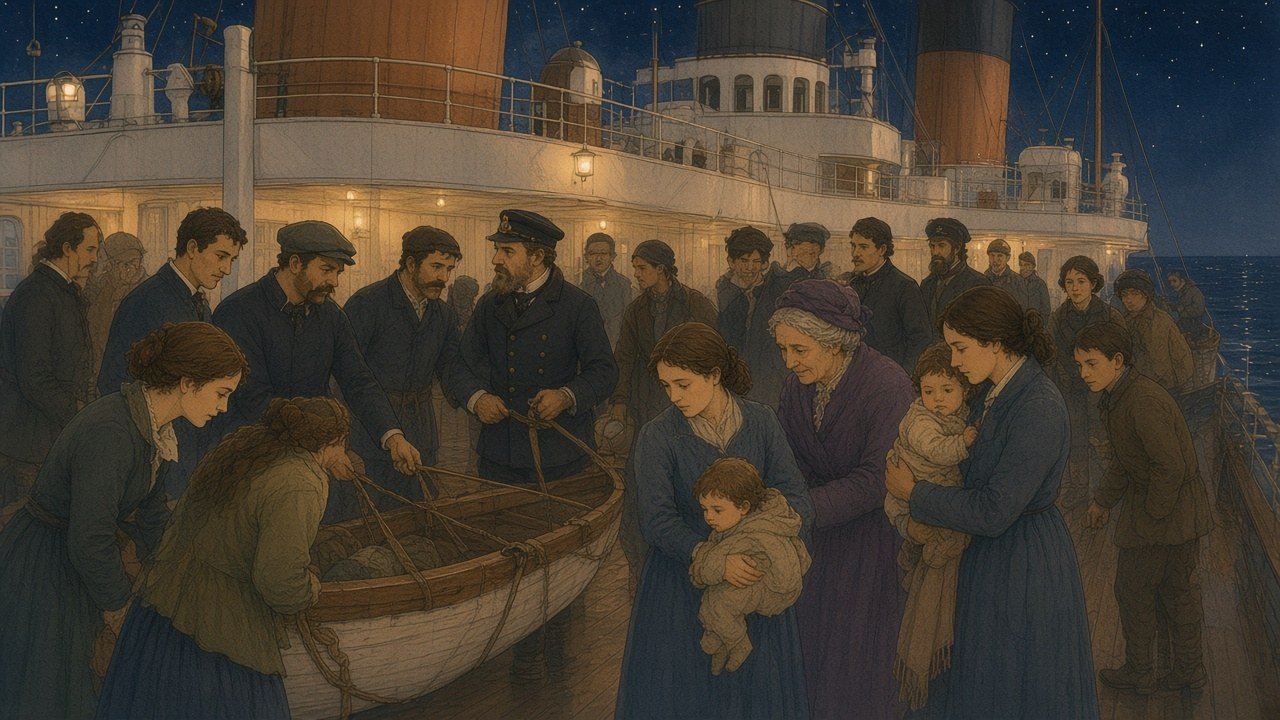
The words were widely reported in the days after the sinking, in the New York Times, the Washington Times and newspapers across the Atlantic, and versions of them multiplied; one headline of 20 April 1912 had him saying, “Tell them no woman died because I was coward.”[1] They became part of the legend of the Titanic, and the image of the millionaire in evening clothes, waiting calmly on deck, entered popular memory through books and films. Benjamin, Giglio and Pernot were all lost. Madame Aubart and her maid survived.[1] His body was never recovered.
His brothers did not know for several days whether he was alive. Simon Guggenheim, who had just left the Senate, went to New York to meet the rescue ship Carpathia when she brought the survivors in, and learned there that Benjamin was not among them.[1][2] The loss came at a moment when the family’s fortunes were at their height, and the most famous Guggenheim death became, in a sense, the family’s most famous story.
The Titanic carried several of the most prominent Jews in America, and the Jewish community mourned them alongside the rest of the nation. Isidor Straus, co-owner of Macy’s, and his wife Ida, who refused to leave him and get into a lifeboat, were lost with Benjamin, and synagogues in New York and elsewhere held memorial services in the following days.[1] The newspapers that reported Benjamin’s last words placed him in a roll of honour of rich men who had given up their places to women and children, and his reputation as a pleasure-loving absentee husband was quietly set aside.[1][5] His daughter Peggy, who adored him, never forgot either the father or the legend, and her biographers trace to his death the restlessness and the search for a substitute family that marked much of her life.[5][6]
The heirs
When Benjamin’s affairs were examined, his estate proved to be much smaller than had been supposed. His investments had not prospered, and he had spent heavily. The New York Times reported in 1918 that the estate was valued at $3,551,994, a large sum by any ordinary standard but small beside the fortunes of his brothers.[1] The brothers quietly made good some of the losses and looked after the widow and her daughters, a generosity that Peggy later recorded with mixed feelings, since it reminded her branch of the family of its dependence.[4][2]
The three daughters had lives marked by tragedy. Benita married in 1919 and died in childbirth in 1927. Hazel, the youngest, married several times; in 1928 her two small sons fell thirteen storeys to their deaths from a New York apartment building, a tragedy that the newspapers reported at length and that the authorities ruled an accident. She became a painter and lived until 1995.[1][5] Florette died in New York in 1937.[1]
The middle daughter inherited her share of her father’s estate when she came of age in 1919. It was enough, in the Paris of the 1920s, to make her very rich by the standards of the artists and writers among whom she chose to live, though far less than the fortunes of her cousins.[4][5][7] It was in the art world, not in mining or finance, that she would make her name, and her story is told in a later chapter. The next chapter turns to her cousin Harry and to the strangest of all the family’s enterprises: the promotion of flight.
References
OpenClose
- Encyclopedia Titanica, “Mr Benjamin Guggenheim” *
- Irwin Unger and Debi Unger, The Guggenheims. A Family History (New York: HarperCollins, 2005), print *
- John H. Davis, The Guggenheims. An American Epic (New York: William Morrow, 1978), print *
- Peggy Guggenheim, Out of This Century. Confessions of an Art Addict (New York: Universe Books, 1979), print *
- Francine Prose, Peggy Guggenheim. The Shock of the Modern (New Haven: Yale University Press, 2015), print *
- Mary V. Dearborn, Mistress of Modernism. The Life of Peggy Guggenheim (Boston: Houghton Mifflin, 2004), print *
- Peggy Guggenheim Collection, “About Peggy” *
The family tree, timeline, places, glossary and select bibliography for the whole history are on the Guggenheim index page.