A naval aviator
Harry Frank Guggenheim, Daniel’s second son, was born on 23 August 1890. He was educated at the Sheffield Scientific School at Yale, which he left after a short time, and at Pembroke College, Cambridge, where he took a degree, before joining the family’s business in Chile and at American Smelting.[1][2] When the United States entered the First World War in 1917, Harry joined the Naval Reserve and trained as a pilot. He served in France and Italy as a naval aviator and returned convinced that flying would transform the world.[1][3]
Harry was the grandson who had seemed most likely to lead the family firm. He had worked at Chuquicamata and in the firm’s offices, and he had been, in Glaser-Schmidt’s phrase, the leading spirit of the Chilean ventures after his father’s retirement. When the brothers decided in 1923 to sell Chuquicamata, against his advice, he resigned from Guggenheim Brothers.[4] He turned his energy instead to the cause of aviation, and he persuaded his father to join him.
A fund for aeronautics
In 1925 Daniel Guggenheim gave New York University the money to found a school of aeronautics, one of the first in the country.[3][1] The next year father and son went much further. On 16 June 1926 they established the Daniel Guggenheim Fund for the Promotion of Aeronautics, with Harry as its president, endowed with $2.5 million by Daniel. Between 1926 and 1930 the Fund disbursed some $3 million.[5][3] The Library of Congress, which holds its records, notes that they span the years 1925 to 1943, with most of the material dating from 1926 to 1930.[5]
The Fund’s purpose was to make aviation safe, practical and commercially viable at a time when it was still dangerous and largely military. It gave grants to found schools and research centres of aeronautical engineering at universities across the country: at the California Institute of Technology, where the Guggenheim Aeronautical Laboratory became a world centre of research, at the Massachusetts Institute of Technology, Stanford, the University of Michigan, the University of Washington and others, and it supported an airship institute at Akron in Ohio.[3][5] Richard Hallion, the historian of the Fund, argues that these schools trained a generation of engineers who built the American aircraft industry.[3]
The Fund also financed practical experiments. In 1927 it sponsored a model airline on the west coast to show that passenger services could be run safely and at a profit. In 1929 it organised a competition for safe aircraft, which offered prizes for designs that could fly slowly and land in short distances; the winner was a Curtiss biplane called the Tanager. In the same year it supported the experiments in blind flying in which the army pilot James Doolittle took off, flew a circuit and landed using instruments alone, a demonstration that made flying in fog and darkness possible.[3][1]
Lindbergh’s tour
The Fund’s most famous enterprise followed Charles Lindbergh’s solo flight from New York to Paris in May 1927. Harry Guggenheim had met Lindbergh before the flight, and after it the Fund sponsored a three-month tour in which Lindbergh flew the Spirit of St. Louis to every state of the Union, landing in scores of cities and speaking to enormous crowds about the future of air transport.[3][1] Lindbergh became a close friend of Harry’s and a frequent guest at his house on Long Island, where he wrote his account of the flight.[1]
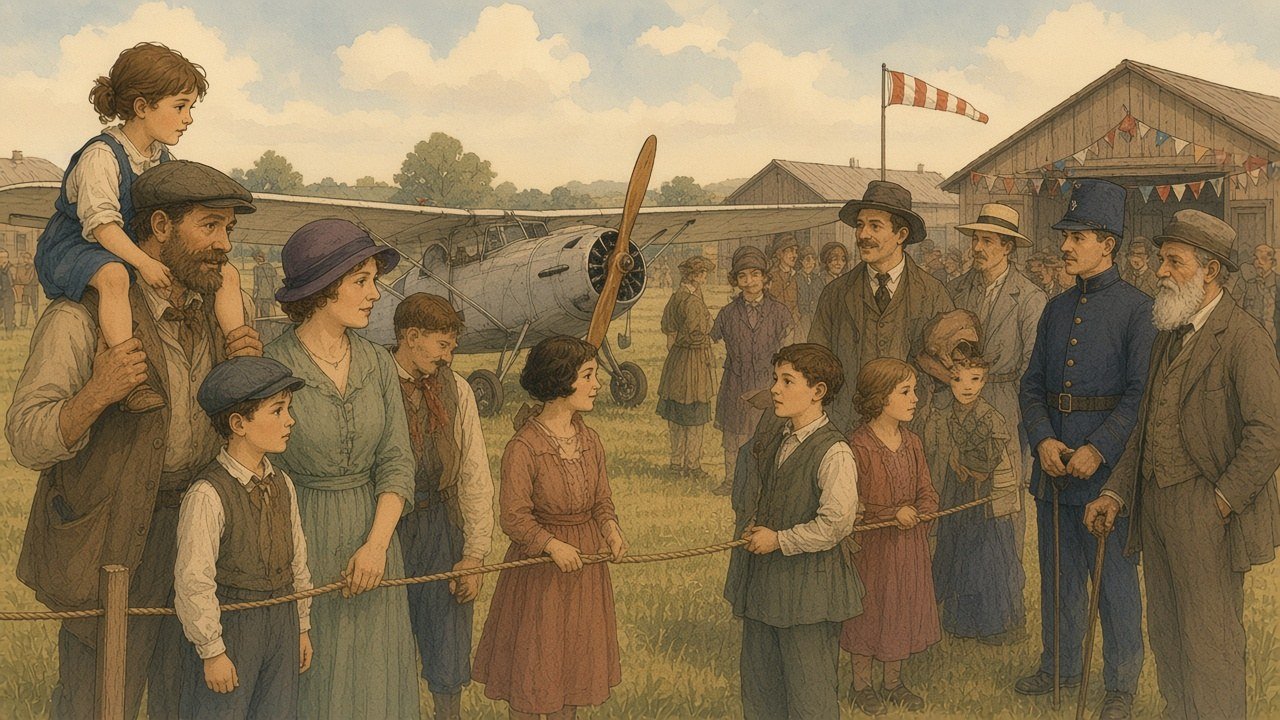
The Fund was designed from the beginning to spend its money and close, rather than to become a permanent institution, and it was wound up at the beginning of 1930, having disbursed about $3 million in four years.[5][3] Its legacy lay in the institutions it had founded. The Guggenheim schools and laboratories trained many of the engineers who designed American aircraft in the 1930s and 1940s, and Theodore von Kármán, brought from Germany to direct the Guggenheim Aeronautical Laboratory at Caltech, became one of the founders of the Jet Propulsion Laboratory.[3] The Daniel Guggenheim Medal, established in 1928 for achievement in aeronautics, is still awarded.[3]
Goddard at Roswell
It was through Lindbergh that the Guggenheims came to support Robert Goddard. Goddard, a physicist at Clark University in Worcester, Massachusetts, had been experimenting with rockets since before the war, and in March 1926 he had launched the first rocket powered by liquid fuel. His work had been funded on a modest scale by the Smithsonian Institution and the Carnegie Institution, and much of the press treated it as a joke.[6][7] On 22 November 1929 Lindbergh, who had read about Goddard’s experiments, telephoned him, and the two met the next day.[7] Lindbergh took his enthusiasm to Harry Guggenheim, and through him to Daniel.
In July 1930 Clark University announced that Daniel Guggenheim had made a grant for the continuation of the work.[8] The sums are reported differently. The Smithsonian’s magazine says that the Guggenheims agreed to provide an initial grant of $50,000, and that before the project was over they had spent some $188,500 on Goddard’s work.[7] Goddard’s own papers refer to the terms agreed when “the grant of $100,000 was made by Mr. Guggenheim”; the grant appears to have been promised as $50,000 a year for two years, with continuation subject to review.[8] With the money Goddard took leave from Clark and moved to the high plateau near Roswell, New Mexico, where for most of the 1930s he built and launched larger rockets, developing gyroscopic stabilisation, steering vanes in the exhaust and fuel pumps that would become standard in rocketry.[7][6]
Daniel Guggenheim did not live to see the work well under way. He died on 28 September 1930. Goddard wrote to the family from Roswell that he was deeply sorry, and that he keenly regretted that Daniel could not have lived to see the work progress.[8] Harry continued to support Goddard through the Daniel and Florence Guggenheim Foundation. In September 1935 he and Lindbergh flew to Roswell to watch a launch, and saw two failures; Lindbergh recalled that Goddard was as mortified as a parent whose child misbehaves in front of company.[7] After the Second World War, Harry’s foundation established Daniel and Florence Guggenheim Jet Propulsion Centers at Caltech and Princeton, and the name of Guggenheim became permanently linked with American rocketry.[3][6]
Harry’s interests reached well beyond aviation. He was a successful breeder and owner of racehorses, and under the name Cain Hoy Stable he won the Kentucky Derby in 1953 with Dark Star, a colt that defeated the favourite, Native Dancer, in one of the most famous upsets in the history of the race.[1] In 1929 he created a foundation of his own, the Harry Frank Guggenheim Foundation, for general philanthropic purposes; about thirty years later he turned it towards the study of the causes and control of violence, which he regarded as one of the great unsolved problems of humanity.[9] His association with Goddard, Lindbergh and the Fund for the Promotion of Aeronautics remained the part of his life he valued most, and he spoke of it until the end.[3][1]
Harry in Havana and on Long Island
In 1929 President Herbert Hoover appointed Harry ambassador to Cuba. He presented his credentials on 21 November 1929 and left his post on 2 April 1933.[2] His years in Havana coincided with the dictatorship of Gerardo Machado, and his efforts to mediate between the government and its opponents brought him criticism from both sides; he left at the end of the Hoover administration, shortly before Machado’s fall.[1]
In 1939 Harry married Alicia Patterson, the daughter of Joseph Medill Patterson, founder of the New York Daily News, and a member of the family that owned the Chicago Tribune. It was the third marriage for each of them. According to the Alicia Patterson Foundation, they were on their honeymoon at Goddard’s rocket station in New Mexico when they learned that a newspaper plant was for sale in Hempstead, on Long Island; on 5 April 1940 Harry agreed to buy it for about $50,000.[10] The first issue of Newsday came off the presses on 3 September 1940.[10][11] Alicia was its editor and publisher, Harry its majority owner and president, and the paper grew with the suburbs of Long Island after the war into one of the most successful newspapers in the country.[11]
The partnership was stormy, and their political quarrels were conducted partly in the paper’s editorial pages. After Alicia’s death in 1963 Harry became publisher and hired Bill Moyers, a former aide to President Lyndon Johnson, to run the paper; their political differences led to Moyers’s departure in 1970, and in 1971 Harry sold Newsday to the Times Mirror Company.[11] He died on 22 January 1971.[2] He was also, after the death of his uncle Solomon in 1949, president of the Solomon R. Guggenheim Foundation, and it was under his presidency that the Guggenheim Museum was completed and opened.[12]
References
OpenClose
- Irwin Unger and Debi Unger, The Guggenheims. A Family History (New York: HarperCollins, 2005), print *
- Office of the Historian, US Department of State, “Harry Frank Guggenheim (1890 to 1971)” *
- Richard P. Hallion, Legacy of Flight. The Guggenheim Contribution to American Aviation (Seattle: University of Washington Press, 1977), print *
- Elisabeth Glaser-Schmidt, “The Guggenheims and the Coming of the Great Depression in Chile, 1923-1934,” Business and Economic History 24, no. 1 (1995), 176 to 185 *
- Library of Congress, Manuscript Division, “Daniel Guggenheim Fund for the Promotion of Aeronautics records,” finding aid *
- NASA, “Dr. Robert H. Goddard, American rocketry pioneer” *
- “Reaching toward space,” Smithsonian Magazine *
- Esther C. Goddard and G. Edward Pendray (eds), The Papers of Robert H. Goddard, vol. 2, 1925 to 1937 (New York: McGraw-Hill, 1970), Clark University Digital Commons *
- Harry Frank Guggenheim Foundation, “Our Work” and history *
- Alicia Patterson Foundation, “Alicia Patterson” *
- Columbia University Case Consortium, “The founding of Newsday” *
- New York City Landmarks Preservation Commission, “Solomon R. Guggenheim Museum,” designation report LP-1774, 14 August 1990 *
The family tree, timeline, places, glossary and select bibliography for the whole history are on the Guggenheim index page.