In the decade before the First World War the two greatest collectors in New York were J. P. Morgan and Benjamin Altman, and both were Duveen clients. Altman, the department store owner, had been buying from the firm since 1882, and he was the first American multimillionaire it had secured.[1] Morgan, the most powerful banker in the world, bought on a scale that no one else matched. When he died, in Rome on 31 March 1913, his collections were valued at some $60 million; Altman, who died the same year, left a picture collection worth $20 million.[1][2]
The two deaths changed the market. Altman left his collection to the Metropolitan Museum. Morgan’s heir, his son J. P. Morgan Jr., lent much of his father’s collection to the museum, but he was free to sell, and over the following years a great deal of it passed back into the market. Joseph Duveen was ready.
The Garland porcelains
The first great transaction concerned the Chinese porcelain that had been the foundation of the family’s business. The firm had built up the collection of the New York collector James A. Garland. When Garland died, the Duveens bought the collection and sold it to Morgan; after Morgan’s death they bought it again, now greatly enlarged, for a price said to be $5,000,000, and sold the bulk of it to Henry Clay Frick.[3] The Garland-Morgan collection had been displayed in the Metropolitan Museum’s Chinese porcelain gallery, and Vignon’s research shows how instrumental the firm had been in assembling it.[4]
The story illustrates one of the firm’s habits. The New Yorker observed in 1928 that the Duveens “have sold some of their masterpieces over and over, re-buying them from the estates of their clients”.[3] A collector’s death was not the end of a sale but the beginning of the next one.
Henry Clay Frick
Frick, the coke and steel magnate from Pittsburgh, had been collecting for decades, and Brewer points out that he became a Duveen client only towards the end of his life; most of his early pictures came through other dealers.[1] But once the Morgan estate began to sell, Duveen made himself indispensable to him. In 1914 the firm also very nearly secured for Frick the greatest prize of the age, Leonardo’s Benois Madonna, which went instead to the Tsar of Russia for a world record £310,000, paid to prevent Duveen from buying it for Frick at the same price.[1]
Frick was building a new house on Fifth Avenue at East Seventieth Street, and it needed filling. The Duveens were not only dealers but decorators, and Vignon argues that they understood, unlike their competitors, that decoration was the best way to sell their stock of antiques, sculpture and pictures.[4] They furnished, among others, Morgan’s London house, the Widener “cottage” Miramar at Newport, the Stotesbury mansion Whitemarsh Hall in Pennsylvania, the Huntington residences in Paris, New York and San Marino, James Buchanan Duke’s mansion in Manhattan, and the Frick house.[4]
The Progress of Love
The centrepiece was a set of paintings with a remarkable history. In 1771 and 1772 Jean-Honoré Fragonard painted four large canvases, The Pursuit, The Meeting, The Lover Crowned and Love Letters, for a pavilion at Madame du Barry’s château at Louveciennes. She rejected them. Fragonard kept them rolled up for twenty years, then installed them in about 1790 and 1791 in the salon of his cousin’s villa at Grasse, adding ten more canvases to fill the room.[2]
The fourteen panels stayed at Grasse for more than a century. In 1898 they were sold for 1,250,000 francs to the London dealer Charles Wertheimer, who sold them to Charles Morland Agnew; on 31 January 1899 Agnew sold them to Morgan for £62,000.[2] Morgan hung them in his London house at Princes Gate, prompting Berenson to remark to Isabella Stewart Gardner that the house “looks like a pawnbroker’s shop for Croesuses”. In August 1912 they were shipped to New York, and after Morgan’s death they were lent to the Metropolitan Museum, where they went on show on 18 February 1914.[2]
In February 1915 Joseph Duveen bought the ensemble for $1,250,000 and sold it to Frick at cost.[2] Brewer, following Secrest, gives slightly different details, saying that Morgan bought the panels in 1898 for $350,000 and that Duveen sold them to Frick in 1913 for $1.25 million; the Frick Collection’s own provenance, followed here, gives the later date.[1][2] Vignon explains the logic of selling at cost: “Duveen sold the paintings essentially as cost, knowing that if Frick was happy with the result, the firm had the potential to sell many other furnishings at considerable profits. His strategy proved successful”.[4]
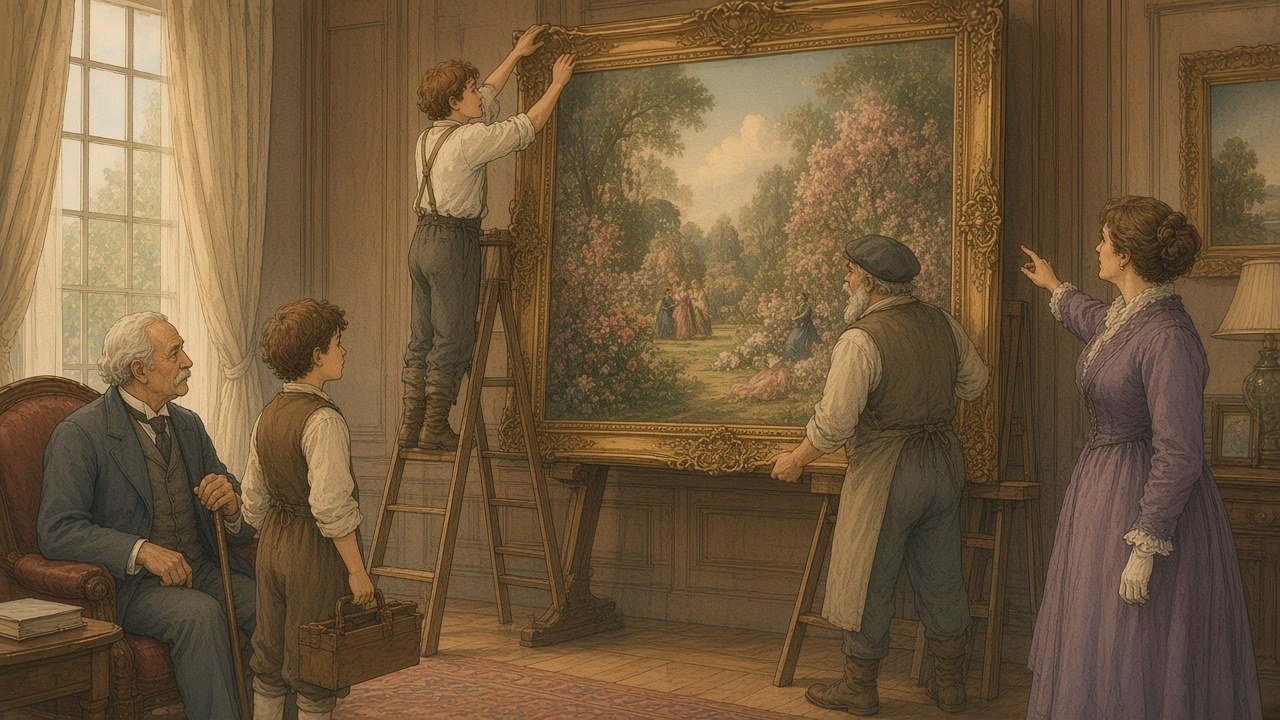
The Fragonard Room
The panels were hung in the spring of 1916 in Frick’s drawing room, which became known as the Fragonard Room. Three of the narrow hollyhock panels did not fit and were put into storage. On 22 May 1916 twenty-five prominent New Yorkers dined at the house to celebrate the installation.[2] The Fragonards were soon joined, through the Duveens, by Louis XVI panelling, a bust by Houdon, gilt-bronze candelabra, Chinese and Sèvres porcelain, a commode by Riesener, a set of eighteenth-century chairs with their original Beauvais tapestry covers, the mantelpiece, the curtains and the chandelier.[4] In 1916 the firm also negotiated the sale of Morgan’s Limoges enamels to Frick.[4] The complete set of fourteen panels was shown together again for the first time in more than a century in 2021.[2]
Joseph worked with the leading decorators of the day, among them Paul and André Carlhian in Paris, with whom he developed an informal partnership, and Sir Charles Carrick Allom, decorator to the British Crown, in London. But he always insisted on being the client’s main contact.[4] He employed the decorators himself, so that the firm supplied not only the works of art but the panelling, mantelpieces and parquet floors as well.[4]
Frick died in December 1919. It was later a matter of court record that he owed Duveen Brothers $2,190,000 at his death.[3] His house became the Frick Collection, and many of the objects in it are there because of the Duveens.
Words worth $250,000
Joseph’s dominance made enemies, and some of them went to law. The New Yorker reported that rival dealers had valued his words at $250,000 apiece, because three of them had brought half-million-dollar libel suits against him for saying two words: “A fake”.[3] The first came in 1915, when the London porcelain dealer Edgar Gorer sued for $500,000, charging that Joseph had spoiled the sale of a Kangxi vase to Frick. According to Gorer’s complaint, Joseph had said: “Gorer knows nothing about porcelains. The real judges are ourselves, my uncle Henry and me, and we intend to stop Gorer from putting these fakes on the market”.[3]
The second came in 1923, when the Paris dealer Joseph Demotte, an authority on Gothic art and, according to the New Yorker, Joseph’s bitterest enemy, sued for $500,000 after Joseph said that an enamel sold by Demotte was a modern imitation rather than thirteenth-century Limoges work. Demotte died before the case came to trial.[3] The third suit, brought by Andrée Hahn, became the most famous art trial of its time and is the subject of a later chapter.
The war years
The First World War closed the European market for buying and drove up the value of what was already in America. The firm’s Paris house carried on; Edward Fowles, who would later own the business, directed it from 1917 to 1938.[5] In January 1914 the firm had held a loan exhibition in New York of British pictures it had sold in the previous three years, the proceeds going to charity, and charitable exhibitions of this kind became a regular part of its public face.[6][7]
In Britain, Joseph gave generously to hospitals during the war. When George V knighted him in 1919, the New Yorker reported, the honour was popular “because of Duveen’s donations to hospitals during the war, and his gifts to the Tate and National Galleries”.[3]
The death of Uncle Henry
The same year brought the death of Henry J. Duveen, who had opened the American market for the family forty years before. The New Yorker gives his death as 1919 and says that it left Sir Joseph the only member of the family active in the firm in America;[3] the archive gives 1918.[8] Henry’s later years had been overshadowed by the customs case, and the firm he had built in New York now belonged entirely to his nephew.
Sir Joseph Duveen, as he now was, entered the 1920s with no rival in his trade. The next decade would bring his most famous sale.
References
OpenClose
- John Brewer, “The Art of the Deal”, The New York Review of Books, 7 October 2004 *
- Christopher Snow Hopkins, “Mapping Provenance. Fragonard’s Progress of Love”, The Frick Collection, 23 December 2021 *
- Alva Johnston, “Noble Merchandise”, The New Yorker, 21 April 1928 *
- Wendy Moonan, “The Family That Brought European Luxury to America’s Gilded Age Tycoons”, 1stDibs Introspective, 1 September 2019 *
- Anne Helmreich, Jill Sterrett and Jacqueline van Ginhoven, “Purpose-Built. Duveen and the Commercial Art Gallery”, Nineteenth-Century Art Worldwide 20, no. 2 (Summer 2021) *
- Duveen Brothers, Catalogue of the Special Loan Exhibition of Old Masters of the British School, New York, January 1914 *
- Duveen Brothers, Special Loan Exhibition of Rare Chinese Porcelains in Aid of Various Charities, at the New Annex Galleries, 302 Fifth Avenue (New York, 1907) *
- Getty Research Institute, Finding aid for the Duveen Brothers records, 1876 to 1981 (accession no. 960015) *
The family tree, timeline, places, glossary and select bibliography for the whole history are on the Duveen index page.