Of all the clients of Duveen Brothers, none spent more lavishly on British art than Henry Edwards Huntington and his wife Arabella. Huntington had made his fortune in railways and in the electric street railways and real estate of Los Angeles, and he was a nephew of Collis P. Huntington, one of the builders of the Central Pacific. Arabella was Collis’s widow. She had been a Duveen client for years before she married Henry in 1913; it was to her that Joseph had first sold Rembrandt’s Aristotle in 1907.[1]
The Huntingtons
After their marriage the couple spent several months each year in Europe, at the Château de Beauregard near Versailles, crossing on Cunard’s Aquitania.[2] The Duveens furnished their houses in Paris, New York and San Marino, and Brewer notes that Joseph used the rivalry between the Huntingtons, Frick and Altman to push up prices.[3][1] In San Marino, outside Pasadena, Huntington was building a library and a collection that he intended to leave to the public.
Joseph’s judgement could protect a client as well as sell to him. In 1913 a rival dealer sold Huntington a supposed portrait by Romney of the Kemble sisters, which Duveen refused to accept as Romney’s work; it turned out, Brewer writes, to be neither a Romney nor a portrait of the Kemble sisters.[1]
The Aquitania story
The best-known account of how the Huntingtons came to buy The Blue Boy comes from S. N. Behrman’s book Duveen of 1951, based on his articles in the New Yorker. In 1921, as the story goes, the Huntingtons booked one of the Aquitania’s two grand suites, the Gainsborough Suite. Duveen was on board and joined them there; Henry noticed a reproduction of Gainsborough’s Blue Boy on the wall and asked whether the real thing was for sale.[2]
The Huntington’s own librarians have pointed out that the story is probably embellished. The painting was already famous, and Henry owned a print of it as early as 1901; Duveen had coveted it for years, and one newspaper spoke of his twenty-year quest. What can be confirmed is that the Huntingtons travelled to France in 1921 and bought the painting shortly afterwards.[2] It was their last crossing together. Henry had already asked Duveen to help him escape from his ten-year lease on the château, because he wanted to spend more time in America, and through Duveen he broke the lease as well as buying the picture.[2]
Arabella did not share her husband’s wish to stay at home. “He thinks he will never come back here,” she wrote to her son Archer a month after Henry’s letter to Duveen, “but he is mistaken. I am devoted to this place never liked any place so well & I won’t give it up if I can help it & I think I can”.[2] In the end, the Huntington’s librarians note, Henry prevailed, as he often did.[2]
A duke in difficulties
The Blue Boy belonged to the Duke of Westminster. It had first been shown at the Royal Academy in 1770 as A Portrait of a Young Gentleman, and by 1798 it was already known by the nickname that stuck; it is thought to show Jonathan Buttall, the son of a wealthy merchant and a friend of the Gainsborough family.[4] The duke, as the Huntington’s account puts it, had fallen on hard times.[2] Joseph bought it from him, and Huntington bought it from Joseph.
The price became part of the legend. Brewer, following Secrest, says that Huntington paid Duveen $728,800;[1] The Art Newspaper gives $728,000, “the then record price”.[4] The New Yorker in 1928 claimed that Duveen had paid $850,000, “the largest sum ever paid for a single work of art”.[5] The higher figure is the one Duveen liked to have repeated, and the two lower figures, which agree closely with each other, are more likely to reflect what Huntington paid. The difference between what Duveen paid the duke and what he charged Huntington was never made public.
Ninety thousand visitors
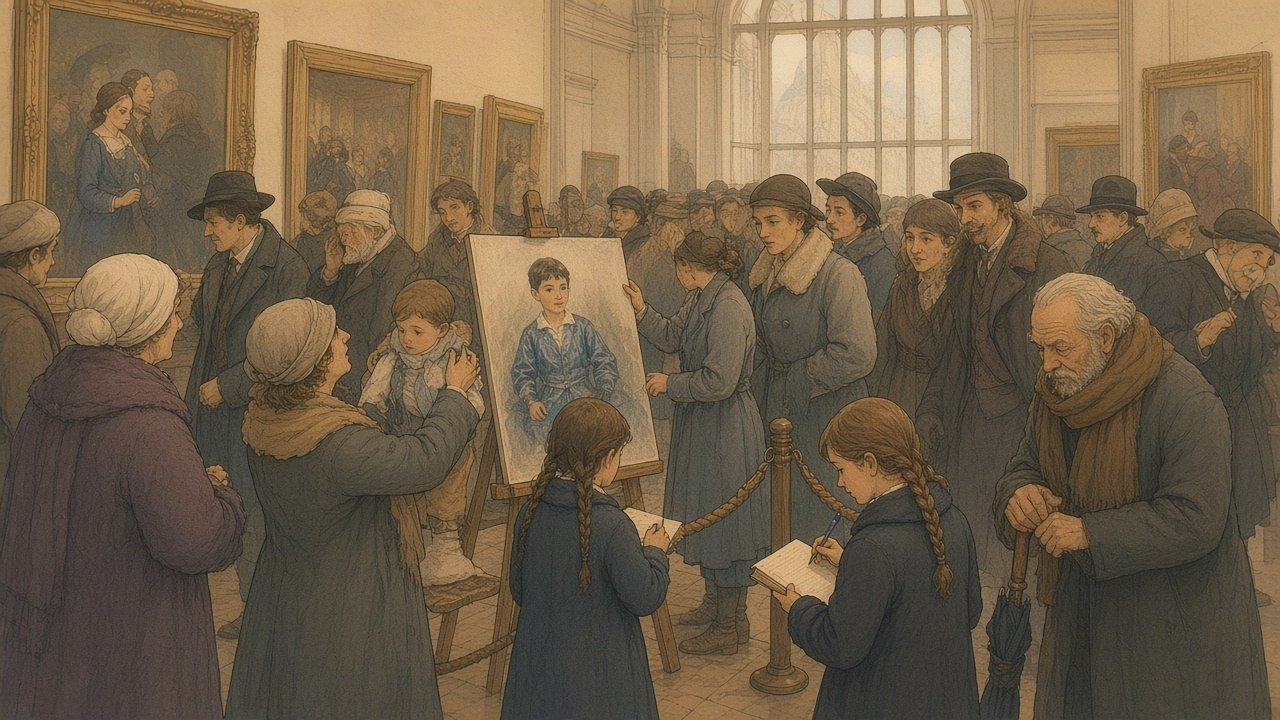
Duveen turned the departure of the painting into a public event. The Blue Boy was cleaned and shown at the National Gallery in London in January 1922, and it caused a sensation; ninety thousand people came to see it that month, and there was an outcry at its loss to the nation.[1] The Ben Uri Research Unit describes queues stretching through Trafalgar Square during the three weeks the picture was on view, and even demonstrations in the streets against the sale.[6] A New York Times correspondent reported that “The Blue Boy is leaving England forever and 90,000 persons seized a last opportunity to see it”, and noted that on one of the stretchers at the back someone had written in pencil “Au revoir. CH.”, the initials of Sir Charles Holmes, director of the National Gallery, whose wish, the paper said, neither he nor any other Englishman expected to see fulfilled.[4] Cole Porter wrote a song, Blue Boy Blues, mourning the painting’s departure.[4]
Once across the Atlantic the painting was shown at the Duveen galleries in New York before being sent in a special case to Huntington’s house in San Marino.[1] It has been on display there since 1928.[4]
Au revoir fulfilled
Holmes’s pencilled farewell was answered a century later. After a three-year conservation project begun at the Huntington in 2017, The Blue Boy was lent to the National Gallery in London for the first time, and went on show there on 25 January 2022, a hundred years to the day after it was last seen in Britain.[4] The gallery’s director, Gabriele Finaldi, called it “without doubt a masterpiece of British art”.[4]
Pretty people
The Blue Boy was only the most famous example of the American vogue for British portraits of the eighteenth century, the pictures that Secrest calls “pretty people”. Brewer notes that the craze pushed prices for a good Gainsborough close to those for a Raphael or a Giorgione.[1] Duveen fed it. In 1926 he paid $377,000 at auction in England for Lawrence’s Pinkie, by the New Yorker’s account the highest price ever paid at public auction, and the picture went to Huntington, in whose collection it has hung near The Blue Boy ever since.[5] The New Yorker gave the auction price in dollars; it was the equivalent of the sterling sum paid at Christie’s.
The Huntington purchases continued after Arabella’s death in 1924. In 1926 and 1927 the Duveens assembled outstanding French eighteenth-century furniture and objects for Henry, who displayed many of them in the Arabella D. Huntington Memorial Art Collection at San Marino, dedicated to his wife.[3] Henry himself died in 1927.
The vogue did not outlast its promoter. Schjeldahl observes that after Duveen’s death the market in Old Masters declined “for want of his interventions”, and that the prices of paintings by Gainsborough, Romney, Lawrence and the other English masters “have never fully bounced back”.[7]
The politics of export
The sale caused lasting resentment in Britain. Brewer describes the outcry at the painting’s departure,[1] and Schjeldahl notes the “sore feelings about Duveen’s systematic export of national treasures” that persisted even when he was raised to the peerage.[7] Duveen answered by making himself one of the most generous benefactors of the British national collections. He had begun with gifts to the Tate and the National Gallery before 1919, and in the 1920s and 1930s his gifts multiplied, as the following chapters describe.
But the Blue Boy also showed his genius for publicity. The farewell exhibition turned a private sale into a national drama, fixed the price in the public mind as a world record, and made the name of Duveen known to millions of people who would never buy a picture.
References
OpenClose
- John Brewer, “The Art of the Deal”, The New York Review of Books, 7 October 2004 *
- Mario Einaudi and Diana W. Thompson, “Stories Aboard the Aquitania”, The Huntington, Verso, 4 September 2015 *
- Wendy Moonan, “The Family That Brought European Luxury to America’s Gilded Age Tycoons”, 1stDibs Introspective, 1 September 2019 *
- Gareth Harris, “The Blue Boy comes home to the UK after 100 years”, The Art Newspaper, 30 June 2021 *
- Alva Johnston, “Noble Merchandise”, The New Yorker, 21 April 1928 *
- Ben Uri Research Unit, “Joseph Duveen”, contributor biography *
- Peter Schjeldahl, “Masterpieces for Sale”, The New Yorker, 8 November 2004 *
The family tree, timeline, places, glossary and select bibliography for the whole history are on the Duveen index page.