Joseph Duveen had a habit, as the archive’s own curators put it, of “criticizing artworks offered by other art dealers”, questioning their artistic worth or their authenticity.[1] Secrest describes his fondness for hyperbole: a work of art was either the most divine object he had ever seen or “the most execrable, ridiculous, shameful, hateful, and obviously false piece of work he had ever seen in his life”.[2] The habit cost him dearly in the most famous case of his career.
A wedding present
In 1919 Harry Hahn, an American from the Midwest who had served in the First World War, married a young Frenchwoman, Andrée Lardoux, in France.[3][4] Among their wedding presents was a portrait of a woman, a version of the painting in the Louvre known as La Belle Ferronière, which was then attributed to Leonardo da Vinci. The New York Times later said that it came from Mrs Hahn’s godmother, Louise de Montaut; other accounts call the donor her aunt.[4][3][1] The couple believed that it was Leonardo’s original and the Louvre’s picture a copy.
They settled in Kansas City and decided to sell. They offered the picture to the Kansas City Art Institute, and the sources disagree about the price: the New York Times later said at least $250,000, the Getty’s account says that an anonymous donor to the Institute had been ready to pay $225,000, and the New Yorker in 1928 said that the painting had been offered for $500,000.[4][1][5] In 1919 Mrs Hahn wrote to Duveen Brothers offering it for sale, but the firm was not interested.[6]
One in the morning
By 1920 the painting was attracting attention in the newspapers. A reporter from the New York World telephoned Duveen, who was in London; it was one in the morning, and a sleepy Duveen, asked what he thought of the portrait, pronounced it a fake.[4][6] He had never seen it. As far as he was concerned, the Louvre had the original, and the Hahns’ picture was one of many copies.[6] According to the New Yorker, he pointed out details that he claimed were unlike Leonardo’s work and said that the original was in the Louvre.[5]
The Hahns sued him, claiming that his remark had wrecked the sale to Kansas City, and asked for $500,000 in damages; the accounts describe the action variously as one for slander and for libel.[1][3][6] The Getty’s account quotes a description of the case as “the world’s most celebrated case of art litigation, a heresy case with a picture as defendant”.[1]
The experts in Paris
The case was filed in New York, but the Louvre’s picture could not travel, so evidence was first taken in Europe. Duveen and his lawyers decided to place the two paintings side by side in Paris and invite a great many experts to pronounce on them.[6] He assembled a formidable panel: Wilhelm von Bode, director of the state museums in Berlin; Sir Charles Holmes, director of the National Gallery in London; Frederik Schmidt-Degener, director of the Rijksmuseum in Amsterdam; and the art historians Bernard Berenson, Adolfo Venturi and Robert Langton Douglas. The Hahns called only one expert, Georges Sortais.[1]
There was an awkward complication. Many in the art world, Duveen and Berenson among them, had expressed doubts about whether even the Louvre painting was by Leonardo.[6] Berenson saw the danger that if he now claimed a Leonardo for the Louvre he would be accused of selling his opinion to help Duveen, and he declined to come. Duveen cabled again: “MUCH DISAPPOINTED. IN FACT CANNOT TAKE REFUSAL. YOU WILL HAVE TO STAND BY AND HELP US. EVERYBODY EXPECTS YOUR OPINION ON THIS MATTER … DO NOT DISAPPOINT ME … JOE”.[6] Berenson went.
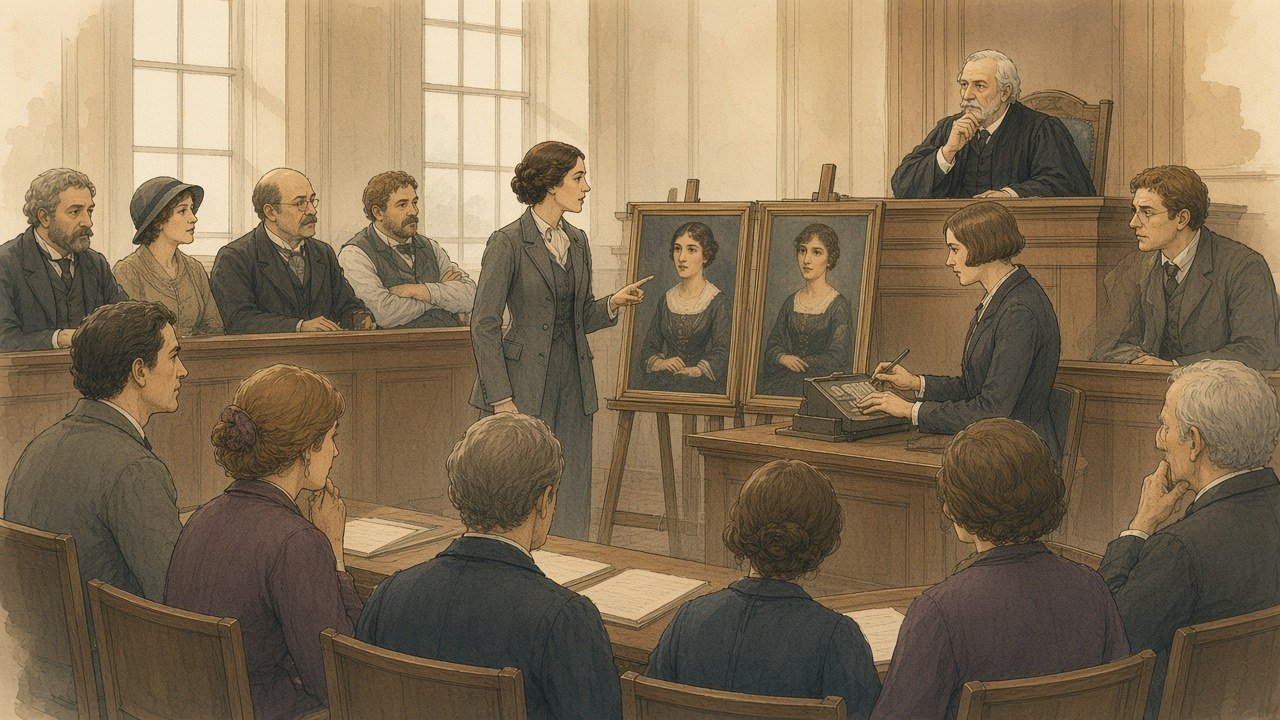
Nearly a hundred people crowded into the American consulate to hear him, in 1923. When the Hahns’ lawyer asked whether a supposed Leonardo in the Prado was painted on canvas or wood, Berenson said he thought wood but that it hardly mattered: “It is not interesting on what paper Shakespeare wrote Hamlet”.[6] The Hahn picture, he testified, failed “to display the vitality and vibrant energy of a Da Vinci”; “the right eye is almost dead”, and the face was “something like a child’s balloon”.[6] Then came the question about whether his opinion had changed since he entered Duveen’s employ, and his reluctant admission that he was paid for his opinions.[6] Mary Berenson whispered to Nicky Mariano, “Bernard has already made a fool of himself”.[6]
Close examination showed many differences between the two pictures. In the Hahn painting the eyes were bigger, the cheeks fuller and the lips strikingly different.[1] The experts closed ranks, and in European society the matter was considered settled: the Louvre picture was the original.[6]
The trial of 1929
The Hahns kept the case alive, and it came to trial in the New York Supreme Court on 6 February 1929.[4] Brewer, who wrote a book on the case, The American Leonardo, describes it as a media circus, with reporters and members of the public queueing every morning for seats.[4] Duveen told the court that his opinion “was formed by my study of all the great pictures of the world”.[4]
The Hahns’ lawyers, sensing that a jury would respond better to material evidence than to a cabal of experts, turned to technical matters. They produced pigment analysis showing that their picture was at least old. They tried to introduce X-ray photographs, but the only witness they could find to read them was a radiologist, and the judge struck out the evidence; Duveen said that he “did not believe in” X-rays.[6] The jury consisted of clerks, estate agents, people from the ladies’ wear and upholstery trades, and two artists.[6]
Ironically, the best technical evidence was on Duveen’s side. Late in the proceedings an expert from Harvard’s Fogg Museum produced X-ray shadowgraphs showing that the Louvre painter had completed the figure and then added the jewellery, while in the Hahn painting flesh and jewellery had been painted together: the Louvre painter had made a decision, and the Hahn painter had copied the result.[6] But Duveen’s team preferred to rest on the superior sensibility of their experts.[6]
A distrust for connoisseurs
It did not work. The jury voted nine to three against Duveen but could not reach a verdict, and said in its statement that its members had been left with “an exotic vocabulary and a distrust for connoisseurs”.[6] The judge ordered a retrial. Rather than face another, Duveen settled out of court for $60,000.[6][1][3] Time magazine, reporting the settlement in 1930, gave a reputed figure of $100,000, but the later accounts based on the records agree on $60,000.[7]
Investigators had meanwhile found that Andrée Hahn had obtained the picture from a relative in France who had been told by several Paris dealers that it had no value, and that the Kansas City Art Institute, the would-be buyer, was an art school operating in the local YMCA.[1] Brewer argues that the trial turned less on attribution than on Duveen’s power in the market, which was deeply resented.[2]
Who was right
Duveen was, on the main question, right. The Hahn picture is widely regarded as a later version of the Louvre painting and not by Leonardo.[2] When the Hahns’ daughter took it to the J. Paul Getty Museum for examination in 2009, the curator Scott Schaefer found it “so much better than we thought … a skillful interpretation”; it was painted on canvas rather than panel, on a red ground typical of French painting from the late seventeenth to the late nineteenth century, and contained lead-tin yellow, which suggested a date before about 1750.[4] It was sold at Sotheby’s in New York in 2010 for $1,538,500.[1]
The Hahns never accepted defeat. Harry Hahn published a book, The Rape of La Belle, in 1946, and negotiations over the picture went on for decades.[3] Duveen, for his part, is said to have told his brother-in-law René Gimpel that he would like to be remembered as “the man of La Belle Ferronière”.[1]
The case marked the end of an era. Cohen argues that it showed millionaires that a connoisseur’s testimony was not something they could bank on if a jury had to decide, and that it began to erode Berenson’s authority long before the jury’s deliberations.[6] Hilaire Belloc and G. K. Chesterton wrote a comic novel after the trial with stereotyped characters modelled on Berenson and Duveen, a reminder of the anti-Semitism that both men met.[6] Yet the case did no lasting harm to Duveen’s business. In the years around the trial he was selling to the richest man in America.
References
OpenClose
- Emmabeth Nanol, “The Man of La Belle Ferronière”, Getty News, 23 May 2013 *
- John Brewer, “The Art of the Deal”, The New York Review of Books, 7 October 2004 *
- Charlotte Gere, “The cautionary tale of America’s other Leonardo”, The Art Newspaper, 1 October 2009 *
- Carol Vogel, “Disputed Painting, Not Leonardo’s, to Be Sold at Sotheby’s”, The New York Times, 11 January 2010 *
- Alva Johnston, “Noble Merchandise”, The New Yorker, 21 April 1928 *
- Rachel Cohen, “Priceless. How Art Became Commerce”, The New Yorker, 8 October 2012 *
- “Art. Sir Joseph and His Brethren”, Time, 21 July 1930 *
The family tree, timeline, places, glossary and select bibliography for the whole history are on the Duveen index page.