London in the last quarter of the nineteenth century was the centre of the world’s art trade. The great auction houses were there, the richest collectors in Europe lived there or passed through it, and the commercial galleries of the West End, crowded into Bond Street, Oxford Street and Regent Street near the Royal Academy, were reinventing the business of selling art.[1] When Joel Duveen opened his London premises in 1879 he entered a crowded and competitive market, and he made his mark in it by the way he showed his goods.
The Duveen lighthouse
The Dictionary of National Biography says that in 1879 the brothers erected fine art galleries adjoining the Pantheon in Oxford Street and at once took an important share in the fine art trade, extending their interests into almost every branch.[2] The scholars who have reconstructed the firm’s premises from its archive are more precise. In the late 1870s and early 1880s Joel’s retail shop was at 357 Oxford Street, which he advertised as carrying “antique works of art, decorative furniture, tapestry, embroidered silks, and general objects of decoration”, with the promise that “the authenticity of every object guaranteed”.[1] By the middle of the 1880s the firm had moved to the upper floors of 175 to 181 Oxford Street, above the china manufacturers W. P. and G. Phillips, and placed furniture in its windows in the way that its neighbours below displayed china and glass, in the manner of the new department stores.[1]
What Londoners remembered was the light. Schjeldahl, following Secrest, describes a “spectacularly illuminated” shop on gaslit Oxford Street that became known as “the Duveen Lighthouse”.[3] The phrase captures something essential about the firm. At a time when many dealers kept dim and cluttered shops, the Duveens understood that luxury goods sold best when they were seen in the best possible conditions, and they spent money on display before they had very much of it to spend.
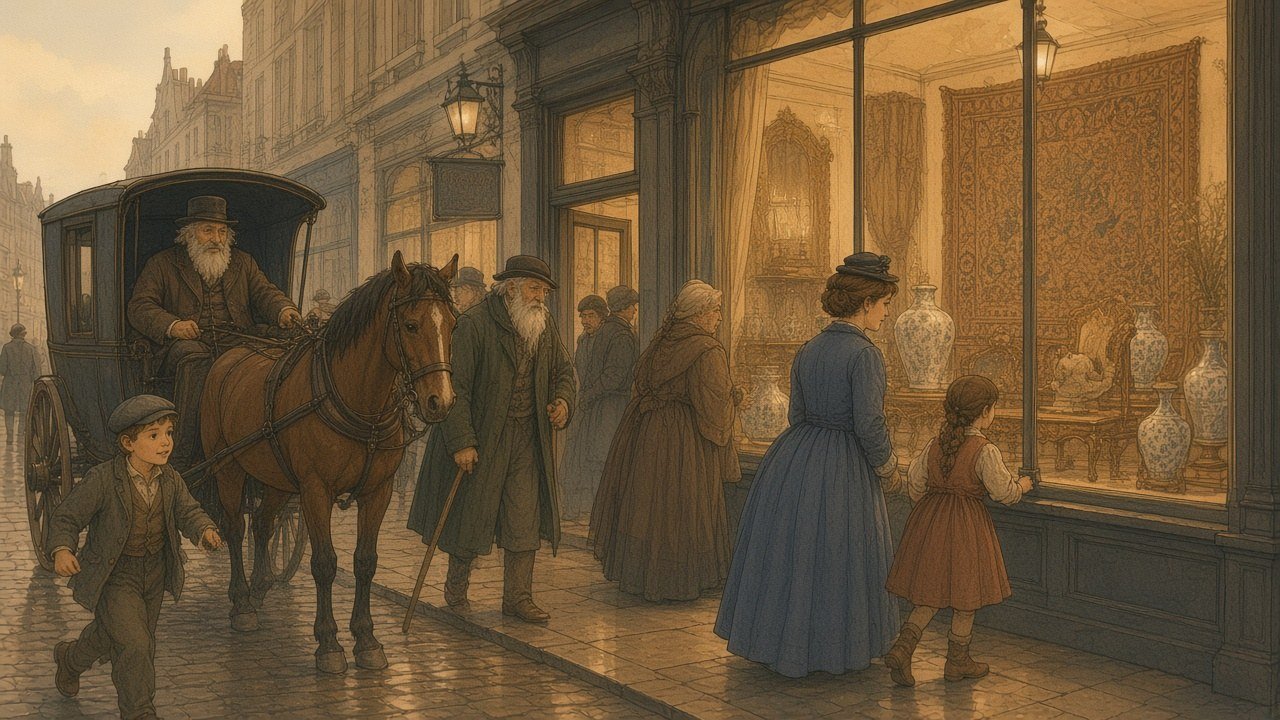
Tapestries and furniture
The Oxford Street business was not yet a picture business. Its advertisements spoke of furniture, tapestries, silks and decorative objects, and the Dictionary of National Biography singles out old tapestry as the branch in which the brothers became the largest purchasers.[1][2] Tapestries suited the firm. They were large, impressive and relatively undervalued, they could furnish a whole room at a stroke, and they appealed to the new taste for historical interiors on both sides of the Atlantic.
Vignon argues that what set the Duveens apart from their competitors was their understanding that decoration was the best way to sell valuable antiques, sculpture and paintings.[4] Rather than selling single objects, they sold rooms, and in time whole houses. This was a lesson learned in London and applied, on a much larger scale, in New York. Its first expression can be seen in the photographs of the firm’s later London showrooms, where objects were arranged as complete domestic interiors, or where wall panels were assembled like a stage set around a particular cycle of tapestries and then taken down again.[1]
A family firm
The London house was a family enterprise in the fullest sense. As Joel’s sons grew up they were brought into the business young; Secrest notes that starting them early and making them proficient in every aspect of the trade became one of Joel’s maxims.[5] Joseph, the eldest, attended school in London and learned the trade from his father, and the archive’s historical note says that he was sent to New York to assist his uncle Henry soon after Henry took charge there.[1][6] His brothers followed him into the firm. Time magazine, writing in 1930, named Ernest, Edward and Benjamin as partners, and noted that another brother, Charles, had left to trade on his own account.[7]
The firm’s relations with the wider family were not always smooth. Jack Duveen, the son of Joel’s sister Betje, dealt in London on his own account, and his memoirs describe a period when there was a “family tiff” with his uncle.[8] A branch of the family descended from the Hangjas side opened a shop in London under the name J. M. Duveen, which Joseph regarded as an appropriation of a name of great commercial value; in 1910 the dispute came to court, and the jury awarded the cousin a farthing in damages for being called “an unscrupulous scoundrel”.[9][10] The firm’s records describe the case as Duveen v. Duveen, heard before Mr Justice Ridley and a jury on 18 and 19 April 1910.[10]
Old Bond Street
In 1894 the firm moved to the most prestigious address in the London trade. When the auctioneers Robinson and Fisher left their rooms at 21 Old Bond Street, the Duveens took the premises and built spacious galleries there in the spring of that year.[2][1] Their neighbours included Lawrie’s Galleries at 15 Old Bond Street, founded in 1893, whose clients included Henry Clay Frick, and a short walk away were Agnew’s purpose-built gallery of 1877 and the Grosvenor Gallery, the “Temple of Art” of Sir Coutts and Lady Lindsay.[1]
The move marks a turning point. Secrest observes that to take charge of an establishment that has risen to the heights of Old Bond Street is not quite the same as having got there in the first place, and it was Joel, not his son, who made the climb.[5] The galleries in Old Bond Street would remain the firm’s London home throughout Joseph’s career.
The first pictures
From 1890 onwards, the Dictionary of National Biography says, the firm began to buy pictures, and it was a large buyer at the Mulgrave Castle sale of 1890 and at the Murrieta sale two years later.[2] The archive’s historical note gives the same two sales as evidence that by the 1890s the firm was buying important paintings.[6] At first the pictures were mainly English portraits of the eighteenth century, the Reynoldses, Gainsboroughs, Romneys and Hoppners that suited the taste of rich buyers who wanted their new houses to look like old ones.
The decision to deal in paintings was a decision about the future of the market. The profits on porcelain and furniture were large, but the greatest prices were being paid for pictures, and the agricultural depression in Britain was beginning to force landed families to sell what they had inherited. Schjeldahl quotes Secrest’s observation that nothing would have persuaded the British landed aristocracy to part with their family heirlooms had there not been a catastrophic change of fortune at the end of the nineteenth century.[3] The Duveens were placed to profit from that change. Brewer adds that the London house was soon sending enormous quantities of stock across the Atlantic: every autumn, he writes, quoting Secrest, it sent the New York branch almost three hundred cases a week for something like six weeks.[11]
The coronation and public life
By the turn of the century the firm was rich and well connected. Joel had become a public figure in the art world of London, a subscriber to national appeals and a friend of officials and critics. The Dictionary of National Biography records that he contributed to the public purchase of Velázquez’s Rokeby Venus for the National Gallery in 1906 and in the same year gave John Singer Sargent’s full-length portrait of Ellen Terry as Lady Macbeth to the national collection of British art at Millbank, having bought it at the sale of Henry Irving’s collection at Christie’s on 16 December 1905 for £1,200.[2] Those gifts belong to the last chapter of Joel’s life, and Chapter 7 describes how they grew into the Turner wing at the Tate.
London had made the Duveens. The city gave them a market among the rich, an apprenticeship in display and access to the great collections when they came up for sale. But the money that would transform the firm was across the Atlantic, and it was Henry Duveen, Joel’s younger brother, who went to fetch it.
References
OpenClose
- Anne Helmreich, Jill Sterrett and Jacqueline van Ginhoven, “Purpose-Built. Duveen and the Commercial Art Gallery”, Nineteenth-Century Art Worldwide 20, no. 2 (Summer 2021) *
- William Roberts, “Duveen, Sir Joseph Joel”, Dictionary of National Biography, 1912 supplement (London: Smith, Elder, 1912) *
- Peter Schjeldahl, “Masterpieces for Sale”, The New Yorker, 8 November 2004 *
- Wendy Moonan, “The Family That Brought European Luxury to America’s Gilded Age Tycoons”, 1stDibs Introspective, 1 September 2019 *
- Meryle Secrest, Duveen. A Life in Art (New York: Alfred A. Knopf, 2004), opening chapter as published by the Library of Congress *
- Getty Research Institute, Finding aid for the Duveen Brothers records, 1876 to 1981 (accession no. 960015) *
- “Art. Sir Joseph and His Brethren”, Time, 21 July 1930 *
- James Henry Duveen, Secrets of an Art Dealer (New York: E. P. Dutton, 1938) *
- Alva Johnston, “Noble Merchandise”, The New Yorker, 21 April 1928 *
- Getty Research Institute, Duveen Brothers records, “Duveen v. Duveen. Notes of proceedings and judgments before Mr Justice Ridley and a jury, 18 to 19 April 1910” *
- John Brewer, “The Art of the Deal”, The New York Review of Books, 7 October 2004 *
The family tree, timeline, places, glossary and select bibliography for the whole history are on the Duveen index page.