Hull in the 1860s was one of the great ports of the North Sea. Its docks handled the trade of the Baltic and the Low Countries, and its ships carried emigrants from the Continent on the first leg of the journey to America. For a young Dutchman with a letter of introduction to a firm of importers it was an obvious place to start. Joel Duveen arrived there in 1866, and the town’s Jewish historians record him as “an enterprising young salesman who came to Hull from Holland” in that year.[1]
He did not arrive as a dealer. His introduction was to Doumouriez and Gotschalk, wholesale importers of Dutch produce, and he was taken on, by Jack Duveen’s account, as an apprentice at fifteen shillings a week, a humiliating wage for a man in his twenties who had been running an ironworks.[2] The curator Charlotte Vignon, who has studied the firm’s records, adds that he spoke little English when he arrived; she dates his arrival to 1865 and his start as an antique dealer to 1868.[3] The differences of a year are typical of the sources for these early years, which rest largely on family memory set down long afterwards.
The trade in blue and white
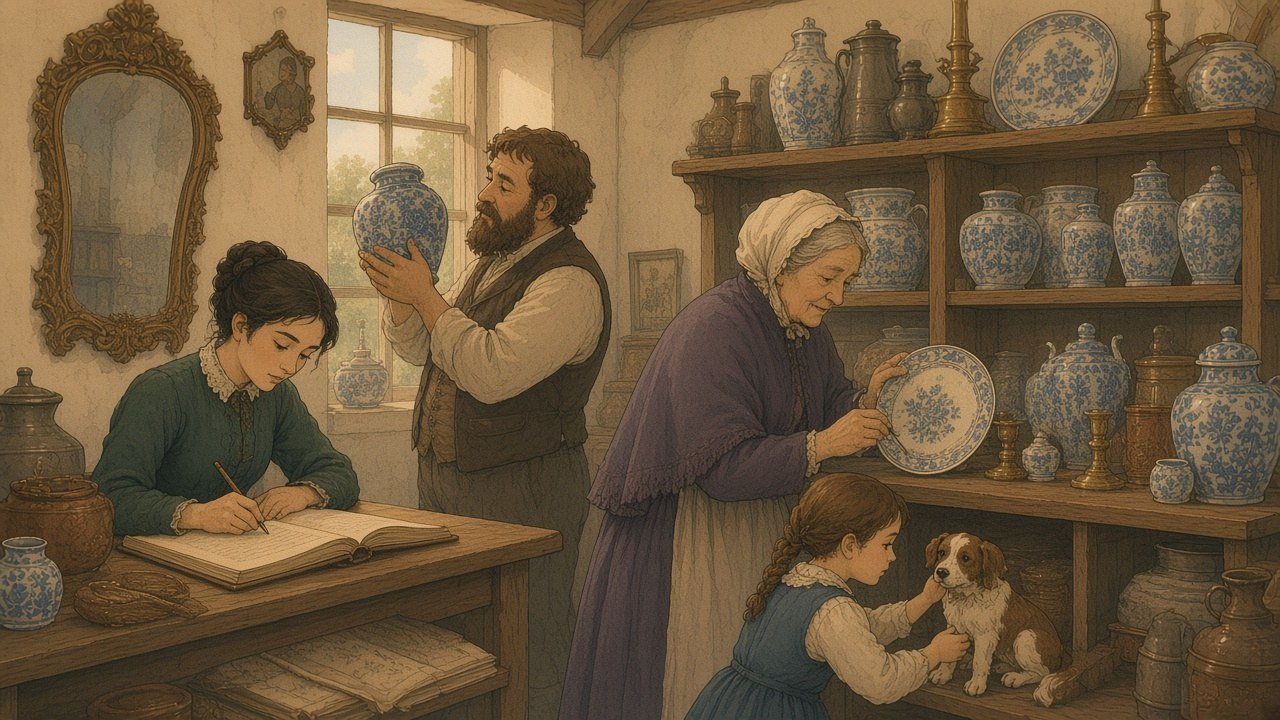
What Joel brought to Hull was knowledge. The Dictionary of National Biography, whose entry on him drew on information from the family, says that he had a good knowledge of Nankin porcelain, “then coming into fashion”, of which whole cargoes had been brought to the Netherlands by the early Dutch traders with China.[4] He bought large quantities of it in various parts of his native country, shipped it to Hull and found a ready market for it in London.[4] He started in Hull as a general dealer, on a site which the Dictionary noted was partly covered, by the time it wrote, by the town’s new public art gallery of 1910.[4] Vignon describes his early stock as the antique Chinese porcelain and Dutch Delftware then fashionable with prosperous Victorian collectors.[3]
The timing was good. The craze for old blue-and-white porcelain, which reached its height in the aesthetic interiors of the 1870s, created a demand in Britain that the old houses of the Netherlands, full of porcelain imported by the Dutch East India Company over two centuries, were well placed to supply. A dealer who could tell the good from the bad, who knew where it was to be found and who could bring it across the North Sea cheaply had a real advantage, and the training Joel had received from his aunt in the Netherlands, as Secrest describes it, included exactly this knowledge of oriental porcelain and of the difference between the genuine article and its many imitations.[2]
The collectors who bought such things could be formidable. Secrest opens her biography with Lady Charlotte Schreiber, the greatest woman collector of English ceramics of her day, who in the 1860s and 1870s hunted china, lace, fans and playing cards across Britain and the Continent.[2] In one story, told by an eyewitness, a rival collector who had received a tip about some fine china in a remote farmhouse was making his slow way there by train when he saw a fly racing past on a parallel road with Lady Charlotte inside it; he knew before he arrived that he was too late. The disappointed buyer, Secrest writes, was Joel Duveen, whom she calls her equal “in terms of energy, dash, and devil-may-care determination”.[2]
Joel Duveen
Secrest describes an early photograph of Joel showing a wide, high-cheeked face, a carefully trimmed beard and moustache and broad, flat hands, with the air of a man about to leap up and dash out of the door.[2] She insists that his more famous son, often treated as a creation entirely his own, was in all essential respects modelled on this father, a man who began with nothing and ended his career as Sir Joseph Duveen, dining with aristocrats and feared by his rivals.[2]
The family’s later memoirs give glimpses of Joel’s methods. Jack Duveen, his nephew, recalled watching him bid at Christie’s for a set of blue-and-white vases and remembered him exclaiming afterwards, in Dutch, that he would have gone far higher in a straight fight; he also recalled Joel refusing to keep a fine object for himself on the ground that a dealer who competed with his own clients was ruined, and advising the young man that “a man who understands his business should never need to have recourse to a saleroom”.[5] The scene belongs to the 1890s and to London rather than to Hull, and it comes from a memoir written for entertainment, but the rule it describes, that the dealer’s business was to find buyers and sellers privately rather than to trust to the auction room, was one the firm followed for the rest of its history.
Rosetta Barnett
In 1869, three years after his arrival, Joel married Rosetta Barnett, the daughter of Abraham Barnett, a Hull pawnbroker who was then trading at 50 Carr Lane.[1][4] Peter Schjeldahl, summarising Secrest’s biography, describes Rosetta as the shrewd sister of one of Joel’s English associates.[6] Either way, the marriage tied the newcomer to the Jewish community of Hull, a community that had grown with the port. Its main synagogue, established in 1826 in Robinson Row, had been almost entirely rebuilt in 1851 to 1852 to accommodate the town’s rapidly growing Jewish population.[1]
Rosetta was by every account a capable partner. The couple had a very large family, though the sources do not agree on its size. The Dictionary of National Biography, informed by the family in 1912, says that she bore ten sons and four daughters; the New York Times, reporting the death of their son Charles in 1940, said that there were twelve children, eight sons and four daughters; Schjeldahl, following Secrest, calls Joseph the first of fifteen children.[4][7][6] The likeliest explanation of the difference is that some of the children died young and were counted by some sources and not by others, but the records that would settle the question have not been published.
The birth of Joseph
The eldest son, Joseph, was born in Hull in 1869, the year of his parents’ marriage, above the family’s antique shop.[6][8] He was given his father’s names in a family where the same names recurred in every generation, and the confusion this causes is considerable. The Dictionary of National Biography calls the father “Sir Joseph Joel Duveen”, while Secrest and most modern writers call him Joel Joseph; the son was Joseph Duveen, later Sir Joseph and finally Lord Duveen, and was usually known as Joe.[4][2][8] In this history the father is Joel and the son Joseph.
Joseph’s childhood was soon moved to London. The scholars who have studied the firm’s buildings point out that his formative years were spent in the capital, where he went to school and learned the trade from his father.[9] But Hull remained part of the family’s identity. When Joel died, Joseph presented Edward Stott’s painting The Good Samaritan to Hull’s new public art gallery as a memorial to his father’s association with the town.[4] After Joseph’s own death in 1939 the Ferens Art Gallery received eighteen items from his estate, which reflect his interest in the British avant-garde of his day and include oil paintings by David Bomberg and Stanley Spencer.[1] The Duveens also gave works now in the collection of the Guildhall.[1]
From Hull to the world
Within a dozen years of his arrival in Hull, Joel had outgrown it. The firm’s archive dates the opening of its London office to 1879, and the Dictionary of National Biography says that in that year the brothers erected fine galleries next to the Pantheon in Oxford Street.[8][4] By then Joel’s younger brother Henry had joined him in England, and by the Dictionary’s account the brothers had already secured the chief American trade in oriental porcelain.[4] Henry would soon be sent across the Atlantic, and the firm’s two bases, London for buying and New York for selling, would take shape.
It is easy to pass quickly over the Hull years, which left few records and no great collections. But the pattern of the firm’s later success was already there. Joel knew where the goods were, in the old houses of a country whose wealth had peaked in the seventeenth century, and he knew where the buyers were, in a richer and newer country across the sea. He was prepared to travel constantly between the two, to buy in bulk and to judge quality quickly. When his son came to do the same thing on a far larger scale, buying the heirlooms of a declining European aristocracy for the new American rich, he was following a method his father had worked out with Chinese porcelain on the quays of Hull.
References
OpenClose
- Hull Jewish Archive Committee, Historical Walking Tour of Jewish Hull (Hull, 2008) *
- Meryle Secrest, Duveen. A Life in Art (New York: Alfred A. Knopf, 2004), opening chapter as published by the Library of Congress *
- Wendy Moonan, “The Family That Brought European Luxury to America’s Gilded Age Tycoons”, 1stDibs Introspective, 1 September 2019 *
- William Roberts, “Duveen, Sir Joseph Joel”, Dictionary of National Biography, 1912 supplement (London: Smith, Elder, 1912) *
- James Henry Duveen, Secrets of an Art Dealer (New York: E. P. Dutton, 1938) *
- Peter Schjeldahl, “Masterpieces for Sale”, The New Yorker, 8 November 2004 *
- “C. J. Duveen Dead. Dealer in Antiques”, The New York Times, 22 July 1940 *
- Getty Research Institute, Finding aid for the Duveen Brothers records, 1876 to 1981 (accession no. 960015) *
- Anne Helmreich, Jill Sterrett and Jacqueline van Ginhoven, “Purpose-Built. Duveen and the Commercial Art Gallery”, Nineteenth-Century Art Worldwide 20, no. 2 (Summer 2021) *
The family tree, timeline, places, glossary and select bibliography for the whole history are on the Duveen index page.