Elias goes east, 1844
Elias David Sassoon was the first of the brothers to go to China. The Jewish Encyclopedia states that he went in 1844 “to open a branch there.”[1] Sotheby’s account says he was sent to Canton, the modern Guangzhou, and calls him “a savvy businessman” who went on to found successful branches of his father’s company in Hong Kong, Shanghai and elsewhere.[2] Kamalakaran, drawing on Madhavi Thampi’s study of Indians in China, adds that Elias arrived at Canton in 1844 and moved to Shanghai about a year later, once he had seen that the best opportunities lay in that coastal city.[3]
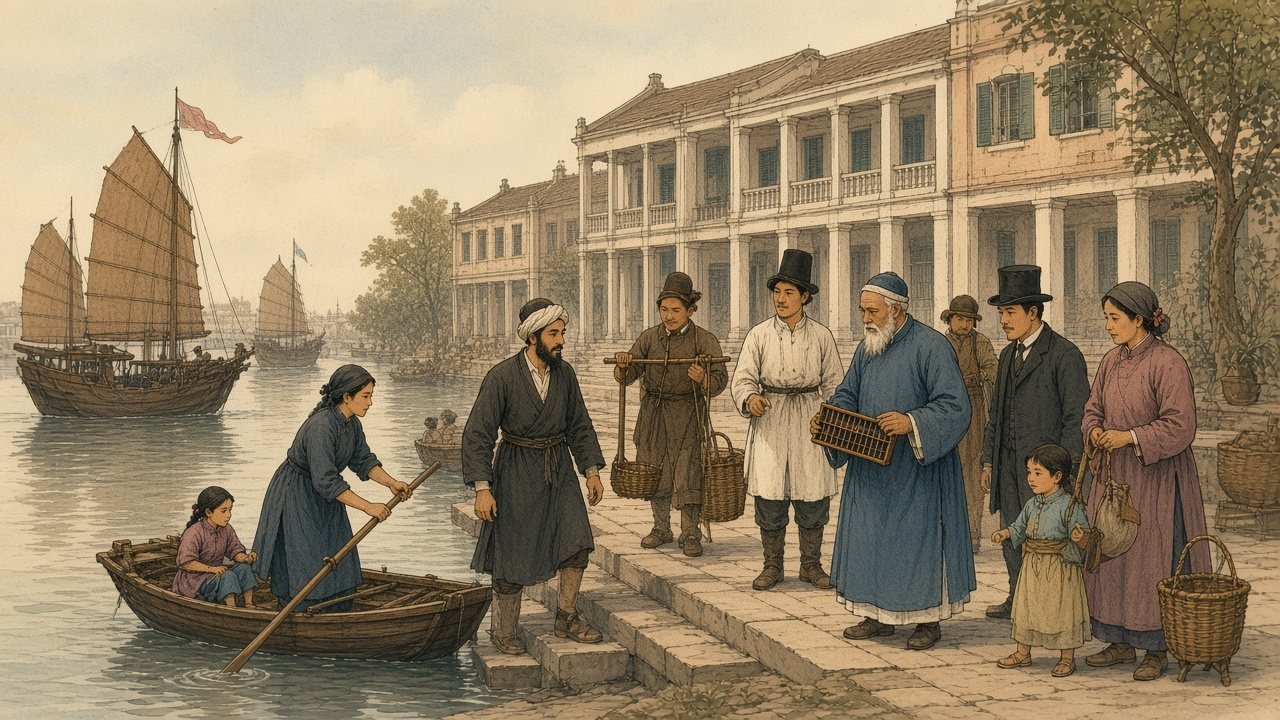
It was a shrewd choice. Under the Treaty of Nanking, Shanghai was one of the five ports opened to British trade and residence, and the new access for foreigners marked the beginning of its transformation into one of China’s major commercial entrepôts. Hong Kong Island, ceded to Britain in 1842, became the other pole of the family’s China business.[4]
The trade that ran through these ports had a simple shape. In Kamalakaran’s summary of the Shanghai Star’s account, the Sassoons “brought China opium and British textile and took away silk, tea and silver.”[3] Indian cotton yarn, Lancashire piece goods and Bombay opium went east. Chinese silk and tea went west to Bombay and London, and so did the silver in which the opium was paid for. A Sassoon partner in Shanghai bought and sold on the family’s account, and he reported by letter, and later by telegraph, to Bombay. His intelligence about Chinese demand and prices shaped what the Bombay house bought.
The China houses
Every one of David Sassoon’s sons who was active in the firm seems to have spent time in the East. S. D. Sassoon, before he went to London in 1858, “conducted the mercantile operations of the China branch of the firm of David Sassoon, Sons & Co.” in Shanghai.[1] Albert served in Shanghai before he returned to Bombay in 1862.[5] Solomon, the Encyclopaedia Judaica says, “was at an early age put in charge of the business interests in Shanghai and Hong Kong,” and later became, after Albert, the most capable businessman of all the brothers.[6] Frederick, the youngest, began his career in Hong Kong in 1873.[5] Reuben and Arthur also served in the East.[2]
The firm’s China business soon went beyond trade in goods. Kamalakaran quotes Thampi’s judgement that the Sassoons “continued with their penchant for seeking newer avenues for profitable investment.” They acted as agents for the North British Fire and Marine Insurance Company, invested in shipping, and in the 1890s, when foreign firms were competing to lend to the Chinese government, the old firm offered sterling loans for railway construction.[3] After foreigners won the right to set up factories in the treaty ports, both Sassoon houses established spinning and weaving plants in China, along with rice, paper and flour mills. Later still they went into breweries and laundries.[3]
Most important of all, in the long run, was land. Under Jacob Sassoon’s leadership of the rival E. D. Sassoon firm, Thampi records, the family began to acquire prime properties in Shanghai, “especially along the waterfront,” through companies such as the Hua Mao Real Estate Company and the Shanghai Real Estate Company. In the nineteenth century the profits from real estate were estimated to be only about one-nineteenth of those from opium. From the early 1920s, with the opium business at an end, property became the most profitable part of the business.[3] The skyline that Victor Sassoon built in the 1920s and 1930s stood on land accumulated over the previous half-century.
Hong Kong and the Baghdadi diaspora
The China houses brought a Jewish community east with them. The Ohel Leah Synagogue records that the Hong Kong Jewish community “was formally established in the 1850s in premises leased by the Sassoon family.”[7] The Jewish Encyclopedia credits Elias with building a synagogue in Hong Kong.[1] The synagogue that stands there today, Ohel Leah, was built by his sons at the turn of the century and is described in Chapter 8. In Shanghai the Baghdadi community grew up around the Sassoon offices in the same way. Its members were clerks, brokers and small traders, many of whom had come east as employees of one Sassoon firm or the other.
Some of those employees later founded dynasties of their own. Elly Kadoorie (1865–1944), also born in Baghdad, started out as an employee of the Sassoons but quickly set out to build his own fortune.[8] The Kadoories, fellow Baghdadi Jews with Shanghai investments, later put their money into Hong Kong and, unlike the Sassoons, remain in business today.[9] The connection shows how far the family’s network stretched, and how much of the Baghdadi presence in the Far East began as a Sassoon payroll.
Japan, Rangoon and the telegraph
By the 1860s and 1870s the Sassoon branches had spread beyond China. The Jewish Encyclopedia lists Calcutta, Shanghai, Canton and Hong Kong as branches of David Sassoon & Co., and says that the business extended “as far as Yokohama, Nagasaki, and other cities in Japan.”[1] Sotheby’s adds Rangoon, Singapore and Kobe.[2] The E. D. Sassoon firm, by the early twentieth century, had houses in Calcutta, Hong Kong, Shanghai, Kobe, London and Manchester.[1]
Distances that had once taken months were shrinking. The opening of the Suez Canal in 1869 cut the sea route between Bombay and Europe. Sotheby’s notes that Albert took advantage of it to found new branches in the Middle East.[5] The telegraph cable to India followed in the next few years. Joseph Sassoon’s research shows the family to have been early and eager users of the new technology. In his words they were “among the pioneers in developing investments and trades that were globally oriented rather than local.”[9] With a cable office in Bombay, a price in Shanghai or a rumour in London could be acted on within a day.
The East made the Sassoons rich, but it also made them different from one another. Some brothers spent formative years in Shanghai and Hong Kong and took the measure of China’s markets for themselves. Others knew China only from letters. That difference would matter when David Sassoon died and his sons had to decide who would lead them.
References
OpenClose
- Joseph Jacobs, Goodman Lipkind and J. Hyams, “Sassoon,” Jewish Encyclopedia, vol. 11 (New York: Funk and Wagnalls, 1906), pp. 66–68 *
- Sotheby’s, “The Sassoons in the Far East” *
- Ajay Kamalakaran, “How the Sassoon family built a business empire in Shanghai from Bombay,” Scroll.in *
- Kenneth Pletcher, “Opium Wars,” Encyclopaedia Britannica *
- Sotheby’s, “The Sassoons in England” *
- “Sassoon,” Encyclopaedia Judaica, 2nd ed. (Detroit: Macmillan Reference, 2007), reprinted at Encyclopedia.com *
- Ohel Leah Synagogue, “Our History” *
- Qiu Xiaolong, “History Has Many Cunning Passages: On Jonathan Kaufman’s The Last Kings of Shanghai,” Los Angeles Review of Books *
- Dinyar Patel, “The Rise and Fall of the Sassoons,” The India Forum, 6 October 2022 *
The family tree, timeline, places, glossary and select bibliography for the whole history are on the Sassoon index page.