A market town in the Pale
The Ephrussi story begins in Berdychiv, a town in the forested country south-west of Kyiv that Russian officials knew as Berdichev. Before the partitions of Poland it belonged to the Radziwiłł princes, and it grew as a fair town from 1765, when its census counted 1,220 Jews in a population of 1,541; the agricultural produce of the neighbouring noble estates was sold at its fairs, and Jews served as the estates’ agents.[1] In the nineteenth century it became one of the great Jewish towns of the Russian Empire. It had 23,160 Jewish inhabitants in 1847 and 46,683 in 1861, when it was the second largest Jewish community in Russia, and the census of 1897 counted 41,617 Jews, 80 per cent of the population.[1] Jewish trading companies and banking houses there had agencies in the Russian interior and even abroad, and in Russian and Jewish literature and folklore, the Encyclopaedia Judaica notes, Berdichev came to epitomise the Jewish town.[1]
The trade that mattered most to the family’s future was the wholesale trade in agricultural produce. A Russian-language account of the family, drawing on the archival literature, describes Berdychiv in the early nineteenth century as a substantial centre of wholesale trade in farm produce, carried on almost entirely by Jews who acted as middlemen between the scattered places of the Pale of Settlement and agents in cities beyond it.[2] A Moscow business magazine adds that for centuries the grain of the Polish landowners’ Ukrainian estates had travelled by river towards Riga and on to Germany and France through just such intermediaries, and it counts the Ephrussi ancestors among them.[3] Those accounts are secondary and popular rather than scholarly, but they agree with the general picture of the town’s economy, and they explain why a Berdychiv family might be well placed when a new grain route opened to the south.
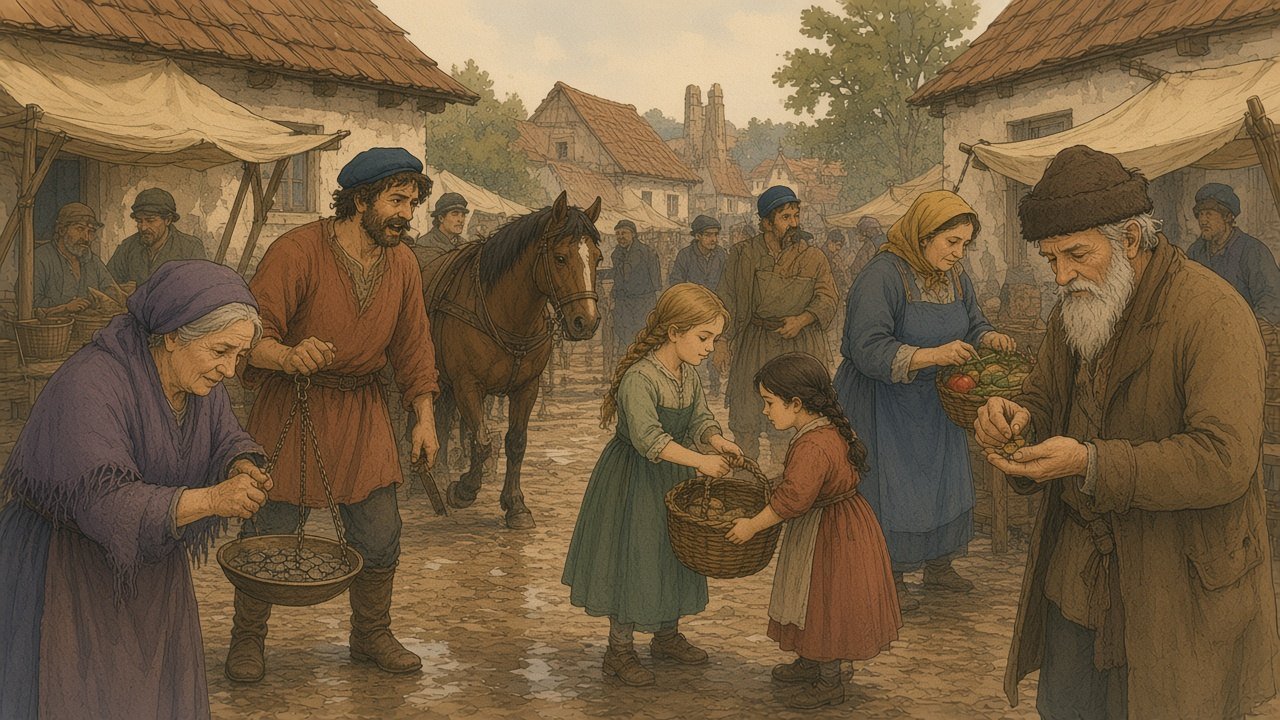
Berdychiv was also a town of bankers. The same business-magazine account remarks that in the age of the Pale this small town south-west of Kyiv rivalled the great cities of the empire in the number of its banking houses.[3] The claim is a journalist’s flourish, but the reality behind it is well attested: the fairs needed credit, the estates needed cash advanced against the harvest, and the merchants who handled the grain also handled the paper that moved it.
Chaim Efrussi
The founder of the dynasty appears in the sources under several names. In Russian documents he is Chaim or Ioakhim Efrussi. In Vienna and Paris the family later called him Charles Joachim Ephrussi, the name used on the family tree prepared by the Jewish Museum in New York for its exhibition of 2021 and 2022.[4] That tree gives his dates as 1793 to 1864 and names Berdichev as his birthplace.[4] The New York museum’s press materials give the same years.[5] The City of Vienna’s historical lexicon, however, gives the father of Ignaz von Ephrussi as Joachim, born in 1789, and a Moscow magazine article settles on 1793, observing that Odessa did not yet exist in the year of his birth.[6][3] The difference of four years cannot be resolved from the sources consulted here, and this history follows the museum’s 1793 while noting the alternative.
Nothing reliable has been found about Chaim’s parents, though the Russian account calls him a hereditary merchant and money-changer, and states that he became a hereditary merchant of the first guild in Berdychiv, the highest rank of the Russian merchant estate, which carried the right to trade outside the Pale.[3][2] What is clear is that he was not a pedlar who struck lucky but a man born into a commercial world with credit, correspondents and a working knowledge of the grain trade, who saw earlier than most where that trade was going.
He married twice. His first wife, Belle Levensohn, died in 1841. His second, Henriette Halperson, was born in Lemberg (Lviv) in 1822 and died in Vienna in 1888.[4] The Vienna lexicon names Henriette as the mother of Ignaz, but the New York family tree implies that Léon and Ignace, born in 1826 and 1829, were children of the first marriage and that the younger children, born in Odessa from 1845, were Henriette’s.[6][4] The Russian account likewise distinguishes the elder sons from Léon’s “younger half-brothers” Michel and Maurice.[2] The family’s Galician connection through Henriette mattered: Lemberg and Brody were the commercial gateways between the Russian Empire and the Habsburg lands, and the Ephrussi would soon look west through exactly that door.
A free port on the Black Sea
The new grain route ran through Odessa. Catherine the Great founded the city in 1794 on the site of the Ottoman fortress of Khadjibey, as a different kind of Russian city: mercantile, booming and open to all nationalities. Thomas de Waal, Edmund de Waal’s brother and a writer on the region, notes that it doubled in size every twenty years and that it was the best city in the empire to be Jewish, because restrictions imposed on Jews elsewhere were waived there in the name of commerce.[7] The steppe lands to the north, newly settled and ploughed, poured wheat towards the coast, and from 1819 to 1859 Odessa enjoyed the privileges of a free port.[8]
For the first decades the city’s grain export trade was led by Greek and Italian houses, which kept their lead until the middle of the century, while Jewish brokers and agents, many of them from Brody and the towns of the Pale, rose beneath them.[8][9] The Russian account of the family says that by the middle of the 1860s Jewish firms had almost entirely displaced the Italians and Greeks, many of whom left Russia after a commercial crisis.[2]
The Jewish population grew from 246 in 1795 to 6,950 in 1831, out of some 41,700 inhabitants.[9] By 1851 about 17,000 Jews lived in the city.[8] By 1873 there were 51,378, out of 193,513, and by 1897 there were 138,935, about a third of Odessa’s inhabitants.[9] The Ephrussi arrived early in that curve, when the city still had room at the top.
Odessa society
The historian Steven Zipperstein, writing in the YIVO encyclopedia, describes the society the family joined. Within a few years of the city’s foundation, when only 135 Jews lived there, Jews had been elected to municipal office, a pattern unusual in Russia that continued until the last quarter of the nineteenth century.[8] In the 1820s Jews became the fastest-growing commercial group in the city, although Greeks and Italians owned most of the real estate and, until the middle of the century, dominated the grain trade.[8]
At the core of Odessa Jewry’s commercial and cultural elite in those years, Zipperstein writes, were emigrants from Galicia, mostly from Brody, who first opened branch offices in Odessa and then moved there, working mainly as middlemen in the grain trade. About three hundred Galician Jewish families settled in the city in the 1820s and 1830s, and “the Rafalovichs and Efrusis”, with a small cluster of other families of Galician origin, eventually represented the apex of local commercial life.[8] The Ephrussi themselves came from Berdychiv rather than Galicia, as the first part of this chapter shows; the encyclopedia’s grouping reflects their partnership with the Rafalovich family and their place in that circle rather than their birthplace. The Russian-language Jewish encyclopedia adds that the newcomers from Germany and Galicia were known as “Brodsky”, after the town so many of them came from, and that they opened large trading houses.[10] Most Jews in the trade, it notes, were not merchants on that scale but small traders, brokers between landowners and exporters, agents of the big foreign and local houses, most of them Greek, and assessors, cashiers, weighers and porters at the grain exchange.[10]
The Galicians soon took over the leadership of the community. In 1826, in answer to a petition from sixty-six Odessa Jews, a school teaching general and Jewish subjects was opened; all its teachers except the teacher of Russian were Jews from Germany and Austria, and it had four hundred pupils by 1834 and a section for girls from 1835.[10] Its director, Betsalel Stern, appointed in 1829, and many of the first teachers were followers of the Galician Haskalah, the Jewish Enlightenment, and some 2,500 pupils had graduated by 1852.[8] In 1840 the Brody Synagogue opened, the first choral synagogue in Russia.[10] The Encyclopaedia Judaica adds that the synagogue of the “Brodyists” introduced a choir and modern singing in the 1840s, and in 1901 an organ, and that Odessa’s educational institutions became examples and models for other communities across Russia.[9] Traditional Jews had only limited influence in this world. A saying widely used among Russian Jews, “Seven miles around Odessa burn the fires of Hell”, may, Zipperstein suggests, date from as early as the 1820s.[8] It was in this modern, commercial and, to the pious, slightly scandalous city that the younger Ephrussi children were born.[4]
The institutions multiplied as the community grew. The vocational school Trud (“Labour”), founded in 1864, was in the encyclopedia’s words the best of its class, and a yeshivah founded in 1866 later achieved fame when, after 1906, it was headed by Ḥayyim Tchernowitz and its teachers included the poet Ḥayyim Naḥman Bialik and the historian Joseph Klausner.[9] Orphanages, agricultural training farms, summer camps for sick children and a large, well-equipped hospital followed.[9] The community’s leaders and its enlightened intellectuals, the maskilim, repeatedly petitioned the authorities in the 1840s, 1850s and 1870s for improvements in the condition of the Jews and for legal equality with the city’s other inhabitants.[9] This was the civic world, confident, modern and argumentative, in which the Ephrussi made their fortune.
The move south
According to the Russian account of the family, it was in December 1825 that Chaim moved his office from Berdychiv to Odessa, acting there as the representative of the trading house Manzon & Efrussi, founded by the Berdychiv merchant and banker David Manzon.[2] Ten years later, in December 1835, the same account says, Joachim Efrussi and Abram Rafalovich founded the trading and banking house Efrussi, Rafalovich & Co. in Odessa; Efrussi registered as an Odessa merchant of the first guild and the firm dealt in the export of produce and in lending to other businesses.[2] Both Manzon and Efrussi were later made honorary citizens of Odessa.[2] The business magazine puts the move a little differently, saying simply that the founder left Berdychiv for the fast-growing porto franco and was lucky enough to catch the beginning of a vast new transit, as the wheat of the newly settled steppe began to flow to Europe through the new port.[3]
These dates come from a popular Russian-language source and have not been checked here against the Odessa archives, which are cited in the scholarly literature. They are plausible, however, and they fit the family tree: Léon and Ignace were born in Berdichev in 1826 and 1829, and every child born from 1845 onwards was born in Odessa.[4] The Vienna lexicon gives Odessa as Ignaz’s birthplace, which would place the family’s household there before 1829; the New York tree says Berdichev.[6][4] Possibly the business moved first and the household followed; possibly one of the sources is simply wrong.
What is not in doubt is the scale of what followed. The business magazine reckons that Ephrussi’s grain dealings started from turnovers of a few thousand roubles.[3] Within thirty years the firm would be counted the largest grain exporter in the Russian Empire, and the boy from Berdychiv would end his days in Vienna, where his sons were already building palaces.[3][4] Isaac Babel, writing in the 1920s about the old Jewish cemetery of Odessa, named the family among the great dead of the city, lying with their faces to the gate: “Ashkenazi, Gessen and Efrussi”, the wheat exporters, ship brokers and merchants who had built a Russian Marseille on the site of the village of Khadjibey, and who were in his phrase the creators of wealth and of Odessa jokes.[3][2]
That sentence, from the story usually translated as “The End of the Almshouse”, is the most famous literary memorial to the Odessa Ephrussi.[2] It was written when the family had long since left. By then Odessa remembered them mainly as a name on a tomb. Vienna and Paris remembered them as something else entirely.
References
OpenClose
- Encyclopaedia Judaica, “Berdichev,” via Jewish Virtual Library *
- “Saga ob Efrussi” (The Ephrussi saga), Kontinent, 19 November 2023 *
- Alexei Volynets, “Bankirskii dom Efrussi: ot torgovli zernom do poloten Renuara” (The Ephrussi banking house, from the grain trade to Renoir’s canvases), Profil *
- The Jewish Museum, New York, “The Hare with Amber Eyes,” exhibition wall texts and Ephrussi family tree (2021) *
- The Jewish Museum, New York, “The Hare with Amber Eyes,” press release, 16 November 2021 *
- Wien Geschichte Wiki (City of Vienna), “Ignaz Ephrussi” *
- Thomas de Waal, “The hidden history of a Jewish family in Odessa,” openDemocracy, 4 November 2019 *
- Steven J. Zipperstein, “Odessa,” YIVO Encyclopedia of Jews in Eastern Europe *
- Encyclopaedia Judaica, “Odesa,” via Jewish Virtual Library *
- Электронная еврейская энциклопедия ОРТ (Electronic Jewish Encyclopedia), “Одесса” (Odessa) *
The family tree, timeline, places, glossary and select bibliography for the whole history are on the Ephrussi index page.