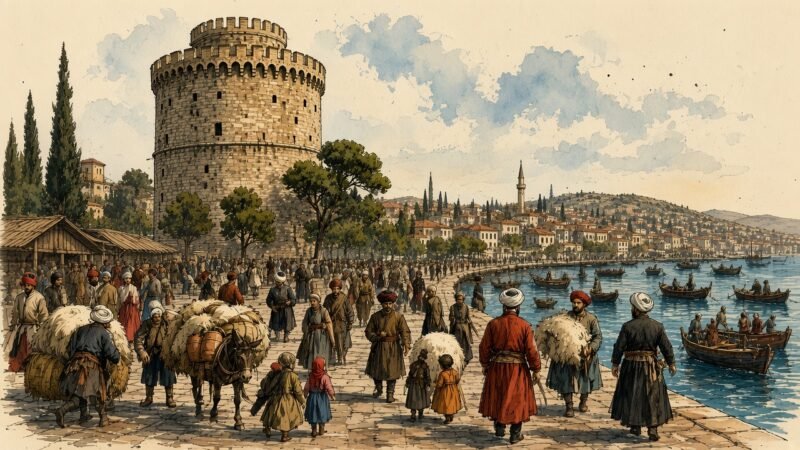
The Arabic Storyteller Who Gave the World a Chinese Boy
1. The boy in the cave
The most famous fictional Chinese boy in the European imagination was never actually Chinese. He was the invention of a Syrian Maronite candy merchant’s son from Aleppo, who dictated the story in accented French in the spring of 1709, in a series of afternoons with a French royal librarian who was running out of manuscripts to translate. The boy is Aladdin. The arabic storyteller is Hanna Diyab. The librarian is Antoine Galland. And the fact that the resulting tale — one of the most retold stories in the modern world — is set “in one of the cities of China” is the kind of detail that sounds, to anyone who has not gone looking, like the unremarkable exotic geography of an “Arabian Nights” story, and that turns out, on inspection, to be one of the most extraordinary pieces of cultural displacement in the European literary tradition.
The setup, on the surface, is straightforward. The original Arabic manuscript of the Thousand and One Nights, the enormous frame-narrative collection that medieval Arab and Persian writers built up over several centuries, did not contain a story of Aladdin. It did not contain a story of Ali Baba, either. It did not contain a story of Sinbad the Sailor. The first two of these stories were added to the Nights by Antoine Galland in volumes published between 1709 and 1717, drawn neither from a manuscript nor from any published Arabic source, but from oral storytelling sessions in Paris. The third — Sinbad — was more complicated, since several of the Sinbad voyages circulated in earlier Arabic and Persian sources, but Galland’s specific compilation of the seven voyages is, again, shaped by the oral input he was receiving in Paris, much of it from the same man. That man was Hanna Diyab, and the most striking thing about his contribution is not just that he supplied the tales, but that he had not been raised on them: at least one of the stories he is now credited with — Aladdin — appears to have been substantially his own invention, a confection that he had developed from his Aleppo childhood, his brief stay in a Maronite monastery in the Qadisha Valley, and his travels along the eastern Mediterranean, and that he had been telling, in some form, before he ever met Galland. Aladdin is, in the most literal sense, the work of a single man. That man was not Chinese. He was a Syrian Catholic who had never been to China, and who, when he wanted to set a story in the most distant land his audience could imagine, used the word the medieval Arab world used for distant lands: al-Sin, China.
2. Hanna Diyab of Aleppo
Almost nothing about Hanna Diyab’s life was known until the late twentieth century. Even the spelling of his name was uncertain. Galland, in his diary, called him only “Hanna” or “Monsieur Hanna” or “the Maronite from Aleppo.” His surname surfaced only in the autumn of 1709, when Galland noted, in passing, that the storyteller’s name was Diab. He disappears from the European record after that — there is a small entry suggesting he passed through Marseille on his way home — and for two and a half centuries nothing more was heard of him in Western scholarship. The Arabic manuscript tradition was no better: the Syrian Catholic manuscript collections of Aleppo, where Diyab lived most of his life, were long assumed to have been destroyed in the upheavals of the late nineteenth and early twentieth centuries. The eventual rediscovery of Diyab’s own autobiography is one of the more dramatic episodes in modern manuscript scholarship.
Diyab was born around 1688 in Aleppo, then the largest and most commercially sophisticated city of Ottoman Syria, and a place whose Maronite Christian community had been deeply entangled with French ecclesiastical and commercial interests for more than two centuries. His family was in the textile trade. He was the youngest of three brothers. His father died while he was still a teenager, and the family’s fortunes declined. Around 1706, when he was in his late teens, he entered the Maronite monastery of St. Elisha in the Qadisha Valley, the long gorge in northern Lebanon that had been, for centuries, the principal seat of the Maronite monastic order and a byword for austere seclusion. The novitiate did not take. Diyab left the monastery after a few months, found himself stranded without funds, and set out on the road back to Aleppo. He was, in his own telling, somewhat at a loss. The memoir that he wrote at the end of his life — at the age of about seventy-five, in 1763 — opens in this register: a young man walking south through the Lebanese mountains, with no clear plan, looking for the next thing to do.
The next thing was Paul Lucas. Lucas was a French antiquarian and adventurer in the service of Louis XIV, charged by the king with the task of collecting old coins, manuscripts, and pieces of ancient statuary from across the Ottoman Empire for the French royal collections. He had been travelling in the eastern Mediterranean for years and had the appropriate combination of pluck, royal protection, and utter indifference to the dangers of the journey. He met Diyab on the road in early 1707 and asked, in effect, what the young man was doing with himself. Diyab, in the autobiography, confesses that he was too embarrassed to admit the truth — that he had just walked out of a monastery and had nowhere in particular to go — and so he told Lucas that he was on a voyage to see the world. Lucas offered him a job: factotum, translator, dragoman. The two men set out together, almost immediately, on a year and a half of travel that would take them through Cyprus, Egypt, Tunisia, Italy, and at last to Marseille and Paris, where they arrived in January 1708. Diyab was received, with some excitement, at Versailles, where Louis XIV — that avid patron of exotic displays — had him appear in the Syrian costume he had brought from Aleppo and had him show off a pair of jerboas he had brought from Tunisia. The visit was a piece of imperial theatre. Diyab was a prop in a production the king was staging to demonstrate the reach of French power. He was also, almost in spite of himself, famous for fifteen minutes.
He could not find a job in Paris that paid what he wanted, and his patron Paul Lucas was, by all accounts, a difficult man to work for — Lucas eventually secured for himself the royal appointment he had once promised Diyab, and the breach between them was not repaired. Diyab decided to return to Aleppo. He left Paris in 1710, sailed from Marseille, and made his way home via Italy, Cyprus, and the Syrian coast. He had been away about three years. He settled in Aleppo, worked in his brothers’ cloth shop, married in 1717, became a grandfather, lived out his days as a small-scale merchant of reasonable prosperity and no further distinction, and died around 1765. He wrote his autobiography — the work now known as The Book of Travels — in the last years of his life, probably around 1763. The manuscript was unknown until the early twentieth century, when a Syrian priest named Paul Sbath, working in Aleppo and then in Paris, acquired and catalogued it as part of a much larger collection of Syrian Christian manuscripts that had been preserved in Aleppo’s Maronite community. The manuscript ended up, with the rest of the Sbath collection, in the Vatican Library, where it is now MS Sbath 254. The last page of the manuscript bears a note dated 1766, identifying the author as “Antun Yusuf Hanna Diyab.” A French translation of the memoirs was published in 2015; a complete English translation, by Elias Muhanna, was published by NYU Press in 2021 with an introduction by the editor Johannes Stephan, a foreword by the translator Yasmine Seale, and an afterword by Paulo Lemos Horta, the scholar who has done the most to argue for Diyab’s authorship of the most popular tales of the Nights.
3. Meeting “an old man” at the royal library
Antoine Galland was not, when Diyab met him in March 1709, a particularly striking figure. He was then sixty-three years old, an old man by the standards of the eighteenth century, with a long career as a French Orientalist behind him. He had been a pensionnaire of the French embassy in Istanbul, where he had spent five years in the 1670s copying Arabic manuscripts for the royal library. He had been elected to the Académie des Inscriptions et Belles-Lettres, France’s small learned society devoted to oriental and antiquarian topics. He had translated the Qur’an into French. He had produced a series of works on the antiquities of the Near East, including a study of the coins of the Abbasid caliphs, a translation of a thirteenth-century Syrian chronicle, and a partial translation of an Indian mystical poem. He was, in short, the kind of career academic that France’s royal library and Académie des Inscriptions produced in those decades: a man of wide learning, careful method, modest personal distinction, and useful access to the rare manuscript rooms where the period’s most important Oriental scholarship was being done.
Galland had begun his translation of the Thousand and One Nights in 1704, publishing the first four volumes that year. The text he was working from was an Arabic manuscript — now known as the Galland manuscript, after him — that had been brought to Paris from Syria in the 1690s. The manuscript was incomplete. It ended in the middle of a story, in the middle of a sentence, and Galland, by the time he had published volumes five through eight with various other Arabic sources, had run out of manuscript. He had been searching for more material. The search had not been productive. Then Diyab appeared.
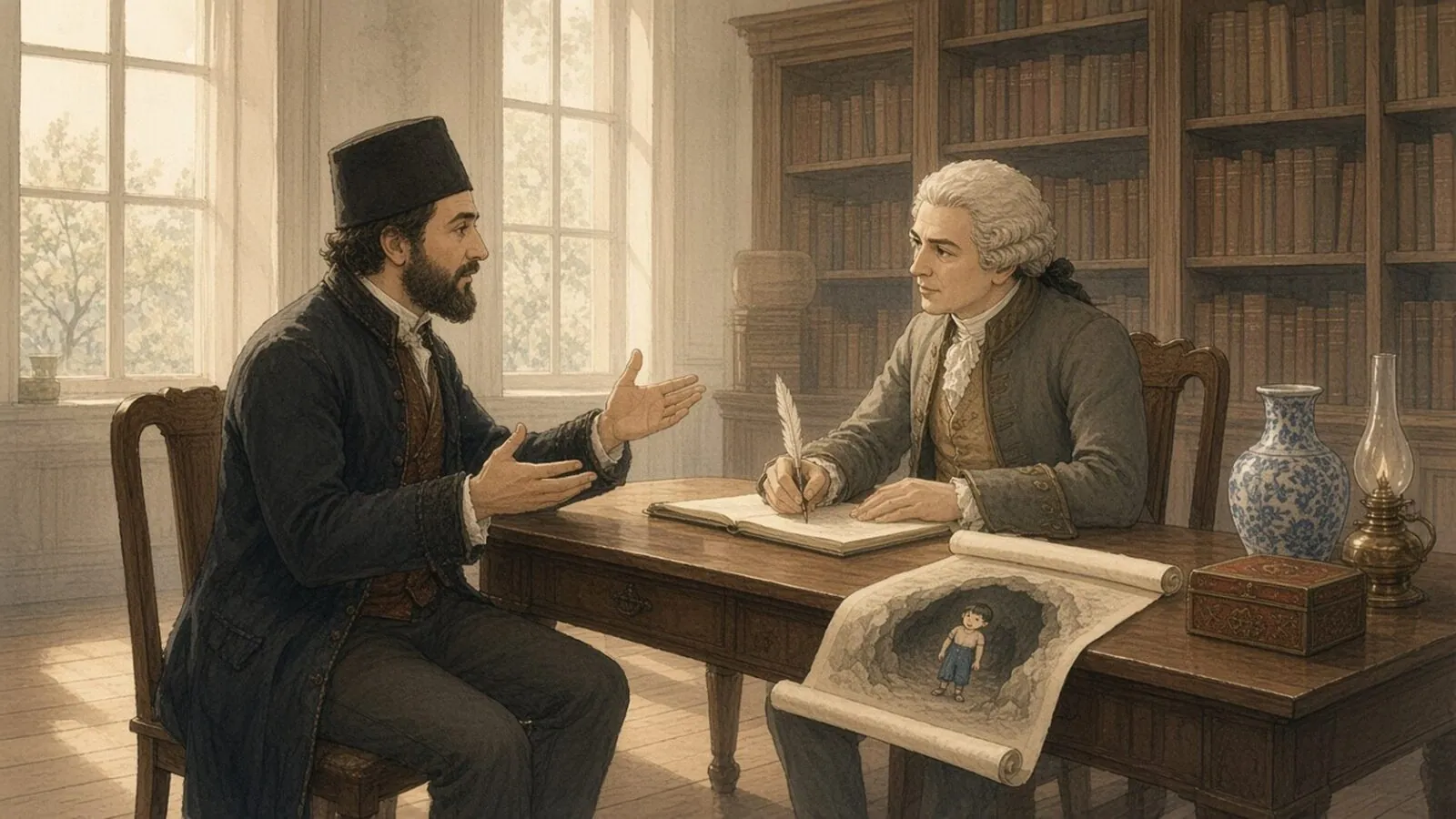
The two men met on Sunday, 17 March 1709. Galland noted the meeting in his diary. He noted that Hanna, the Maronite from Aleppo, spoke French, Provençal, and Turkish, in addition to his native Arabic. Galland met him again the following Monday, 25 March, and on that afternoon heard him tell “several very beautiful Arabic stories.” From that point through May and into June, the two men met regularly. Diyab would come to the royal library, or to Galland’s lodgings, and would dictate or tell stories. Galland would write them down. On 5 May 1709, Galland recorded that he had received “the Story of the Lamp” — that is, the tale of Aladdin. Over the course of the spring, Diyab supplied Galland with sixteen new stories. The most famous of them were Aladdin and Ali Baba and the Forty Thieves. Others included Sīdī Nuʿmān, the Three Apples, and several tales that have since drifted out of the popular imagination.
The formal status of the stories Galland was receiving has been debated ever since. In Galland’s lifetime, and through most of the history of the Nights in European scholarship, the source was concealed: the tales were presented as Galland’s translations from Arabic, and the storyteller was unnamed. The first Western identification of “Hanna” as the source came in 1887, when the Prussian scholar Hermann Zotenberg, working through Galland’s archived papers at the Bibliothèque nationale de France, found the diary entries naming him. Subsequent scholars — including, most prominently, the Finnish Arabist Jaakko Hämeen-Anttila and the American scholars Ruth B. Bottigheimer and Paulo Lemos Horta — argued for Diyab’s centrality to the corpus. The current scholarly position is that Diyab is the primary author of at least ten of the orphan tales, including Aladdin and Ali Baba, and that some of these tales — Aladdin most clearly — are largely his own invention rather than retellings of stories he had heard elsewhere.
The mechanism of the storytelling is itself unusual. The standard assumption, made by generations of scholars, was that Diyab told the tales in Arabic and Galland translated them. Ruth Bottigheimer’s close reading of Galland’s notes, however, suggests that Diyab dictated the tales directly in accented French, on Galland’s own terms, and that what Galland then published is less a translation than a transcription. This complicates the picture considerably. Diyab was not so much a folklore informant as a participant in a joint literary enterprise — and a self-conscious one. His memoir, written more than fifty years after the events, treats the storytelling with a studied casualness, as though it had not been that important, and refers to Galland only as “an old man” with a position in the royal library who was also translating the Nights. The studied casualness is, in itself, a strong signal. People do not write casually about the most consequential events of their lives. Diyab had evidently decided, in the long retrospective of his late-seventies vantage, that the storytelling was not what he had wanted to be remembered for. He wanted to be remembered as a cloth merchant, a father, a grandfather, a man who had been a colleague of Paul Lucas, and an Aleppo notable. The fairy-tale craze that would erupt in Europe after his death was, to him, someone else’s business.
4. Aladdin’s cave
The tale of Aladdin, as Galland published it, opens with an explicit statement of setting. There is, the text says, “a city of China.” The city has markets and a bazaar. Aladdin’s father, Mustafa, is a poor tailor. The mother is unnamed. The boy himself is unemployed and troublesome — he is described, in the opening pages, as an idle scamp who is uninterested in his father’s trade. The sorcerer — described in the first French edition as le magicien africain, and a Maghrebi — arrives one day, identifies Aladdin as the right instrument for his purposes, and lures him out to a secluded spot in the countryside with a promise of untold wealth. At the spot there is a cave with a stone that can be lifted by magic words. Inside the cave is treasure, a magic lamp, and a magic ring. The sorcerer goes in first to retrieve the lamp and a handful of trinkets, gives the trinkets to Aladdin, asks the boy to fetch the lamp, refuses to lift the boy back out of the cave when he refuses to hand it over, and seals him underground with the lamp. The boy is trapped. He rubs the lamp in despair. A jinn appears. The rest of the story — the lamp’s identification as a slave of the ring, the marriage to Badr al-Budur, the palace built by the lamp-jinn, the three attempts of the sorcerer to recover the lamp, the eventual death of the sorcerer — is the familiar modern version.
The “Chinese” framing is, on inspection, almost entirely cosmetic. There is no Chinese geography in the story. There is no Chinese language, no Chinese costume, no Chinese custom, no Chinese practice. The “city of China” is, at most, a market town with a bazaar, run by a Muslim commercial class with a Muslim judicial officer and a sultan. The religious vocabulary is entirely Middle Eastern Islamic: the jinn, the muezzin, the fast of Ramadan, the pilgrimage, the language of Sufi piety that suffuses the lamp-jinn’s declarations (“your slave between your hands”). The mother, when she first invokes the lamp, addresses her question to Solomon — a habit of folk religion in which Solomon is taken to be the patron of all jinn and the lord of the inanimate world. The “poor tailor” father is a stock character of Damascene and Aleppine comic tradition. The society described in the story is a Damascus society shifted east by a vague gesture, dressed up in a piece of exotic costume. It is, in short, an Arabic story told by an Arab, set in a place the storyteller called China because “China” meant “the most distant imaginable land” and not because he knew anything about the place.
Medieval Arabic literature used “China” in this loose way. Al-Sin, in classical Arabic writing, designated both the actual China — the country of the Tang and Song dynasties that Arab merchants reached by sea and by the overland Silk Road — and a generic Eastern Far East that sometimes conflated Japan, Korea, and the various polities of maritime Southeast Asia. The Chinese novel The Thousand and One Nights does not contain, in any of its medieval manuscripts, a setting in China. The added tales of Galland, however, inhabit a midway position: they are ostensibly “of the Nights” in literary form, but they were produced in conversation with a French Orientalist who was selling his work to a Parisian audience hungry for the exotic. The “Chinese” setting of Aladdin is one of the concessions to that audience. It tells the reader, at a glance, that this story is from far away. It also tells a modern reader, who knows enough about China to be confused by the mismatch, that the story has been put on. China is, in the original Arabian-Nights Aladdin, a piece of theatrical costume.
Paulo Lemos Horta has argued, in his essay “Aladdin: The Lonely ‘Orphan’ Tale” and in his 2021 afterword to Elias Muhanna’s translation of Diyab’s memoir, that the kernel of the story is recognisably autobiographical for Diyab. The opening of Aladdin is a poor boy, the son of a father in an unfashionable trade, who refuses to follow his father into the trade. The second half of the story is a poor boy, the son of an unfashionable family, who is brought into contact with a foreigner — a stranger of great wealth, dubious morality, and uncertain geography — who is interested in him for reasons he does not understand. Diyab’s own memoir opens with exactly this configuration: a poor boy from a textile family, who has refused to become a priest, who has attached himself to a stranger (Paul Lucas) of dubious reliability, and who has not quite understood why the stranger wants him around. The Magian sorcerer in the story is a wicked caricature of the patron who offered Diyab his first taste of travel. The cave is the monastic cell in the Qadisha Valley that Diyab had fled, transposed to the wrong side of the world. Aladdin’s eventual triumph — wealth, palace, marriage to a princess — is the rags-to-riches romance that Diyab’s own life only partly delivered on. Some of this is overreading. Diyab did not, himself, get rich. But the structural similarities are sufficiently close that Horta’s reading has been broadly accepted.
5. The “orphan tales”
Aladdin and Ali Baba are the most famous of what the German folklorist Enno Littmann called the “orphan tales” — the stories in Galland’s translation that have no known Arabic manuscript source. Other orphans include Sīdī Nuʿmān, the Three Apples, the City of Brass, the Ebony Horse, and a dozen smaller pieces. The reason these tales are “orphaned” is that no known medieval Arabic manuscript of the Nights contains them, and no other medieval or early modern Arabic source — chronicle, encyclopaedia, philological treatise — preserves them. They appear, in the historical record, only after Galland published them. Some of them — particularly Ali Baba — may have circulated in middle-class Aleppine oral tradition in forms that simply never made it into any manuscript we have, and that Diyab may have heard as a child. Others — and the principal case is Aladdin — appear to be substantially Diyab’s own composition.
The orphan-tale status of Aladdin was suspected for a long time, and confirmed only with the publication of Diyab’s memoir in the twenty-first century. The classic nineteenth-century Arabist Heinrich Leberecht Fleischer, in a famous lecture of 1831, treated Galland’s tales with suspicion, noting that the manuscript sources Galland cited were incomplete, and floated the hypothesis that Galland had been inventing “in the manner of the Orient.” Subsequent scholarship treated the tales as folkloric transmission that had simply failed to make it into any known manuscript. The discovery of Diyab’s autobiography brought the scholarly consensus around to a stronger version of Fleischer’s intuition: the tales were not folklore that the manuscripts had missed. They were, in some cases, the work of a specific person who was not a folklorist at all, but a Maronite shopkeeper with a particular gift for narrative and a particular acquaintance with European literary fashion.
The implications of this consensus are larger than they look. The most popular story in the modern Nights, told to children everywhere, is one that was, in its known form, written by a single identifiable person in 1709, in French, in Paris, with the intent of being sold as a translation from a manuscript tradition that did not contain it. The story was Diyab’s invention. The “China” of the setting was Diyab’s invention, or Galland’s, or something they worked out together. The sorcerer, the cave, the ring of the slave of the lamp, the princess Badr al-Budur, the palace raised from nothing, the wedding, the triumph over the sorcerer’s brothers — all of it. The story was new in 1709. The shape it has acquired since — through the French fairy-tale tradition, through the various European retellings of the eighteenth and nineteenth centuries, through the Disney animated film of 1992, through the Broadway musical of 2011 and the live-action film of 2019 — is the result of more than three centuries of commentary on this original.
6. Afterlife, the stripping of China
The trajectory of the “Chinese” element in the Aladdin tradition over three centuries is a small history of European exoticism in retreat. The 1709 setting is, on Galland’s first page, “a city of China.” The early French, English, and German translations of the eighteenth century preserved the Chinese framing. The eighteenth-century British pantomime tradition, in which Aladdin was a stage fixture and Joseph Grimaldi was the most famous Aladdin of his generation, kept at least some of the East-Asian styling. The 1868 pantomime at the Theatre Royal, Drury Lane — the canonical Victorian Aladdin — opened with a procession of “Chinese warriors” and the magician was sometimes coded as Chinese in the stage directions.
The slippage began in the late nineteenth century. The Hollywood of the early twentieth century first adapted Aladdin as a silent film in 1917, then again as the animated feature The Adventures of Aladdin in 1939, with the magician cast as a vaguely Egyptian figure. By the time the 1992 Disney animated Aladdin was being developed, the “Chinese” framing was, in popular imagination, no longer operative. Disney set the film in a fictional Arabian city called “Agrabah” — a name that appears nowhere in any of the older versions of the story — and cast the characters as Middle Eastern in costuming, soundtrack, and visual reference. The sorcerer Jafar was given a vaguely Persian-Ottoman look. The princess Jasmine’s palace had vaguely Mughal architecture. The film’s hit song “A Whole New World” was sung over Middle Eastern instruments. China was gone. The “Arabian Nights” framing had taken over.
The displacement is, in retrospect, easy to read as a normalisation of Aladdin into a mid-twentieth-century American idea of the “Middle East” — at the expense of a less familiar Far Eastern framing that no one in 1992 had the framework to maintain. But it is worth remembering that the Arabian framing is, from the standpoint of the original Diyabian story, also wrong. Diyab was not Arabian. He was Syrian. His city was Aleppo. The lingua franca of his storytelling was, in Paris, accented French. The “Arabian Nights” was a French marketing construct, and the “Arabian” of the title was already, by the early eighteenth century, a placeholder for the entire Eastern Mediterranean. The “Arabian” Aladdin of Disney is three removes from the actual story: it is an eighth-generation French imitation of a Syrian Maronite invention, retold for a mid-twentieth-century American audience in a setting that the original author and his audience would not have recognised as either Arabian or Chinese, but as their own Levantine world.
Some contemporary retellings have, however, begun to recover the “China” setting. The 2019 live-action Aladdin largely reproduces the 1992 framing. But other contemporary adaptations — including several young-adult novel retellings of the last decade, and a number of illustrated editions — return to the Galland text and preserve the “city of China” opening. The original Chinese of medieval Arabic literature, in other words, has begun to make a small comeback in popular retellings, three hundred and twenty years after a Syrian storyteller first invoked it.
7. What the lost Chineseness tells us
There are two readings of the Chinese Aladdin that the modern reader can fall back on, and neither of them is quite right. The first is the cynical one: that “China” is just a piece of exotic decoration, a costume the story wears to sell itself, and that we should not mistake a costume for a person. There is something to this. The medieval Arabic world did use “China” as a synonym for “the farthest east,” and Diyab, or Galland, or both of them together, used the word in precisely that sense. The “city of China” was not China. It was Europe as the east that was not the home of the storyteller. China was a rhetorical device, a way of saying “this story is far away from you.”
The second reading is the romantic one: that Aladdin is, in some sense, the earliest recoverable piece of Chinese cultural transmission to the West, a kind of secret channel by which the idea of China entered the European fairy tale. This is also too simple, but it is closer to the truth. The Arabian-Nights Aladdin does not bring us Chinese culture. It brings us an idea of China that European and Middle Eastern readers shared for nearly a thousand years before Diyab sat down with Galland in Paris. That idea was, by 1709, largely a fiction. It had been a partial truth in the time of Ibn Battuta, who reached Quanzhou in 1346 and saw a substantial Arab trading community. It had been a partial truth in the time of Marco Polo, who is one of the few European witnesses to a Yuan-dynasty China in 1275. But by 1709 the Mediterranean trade with China had been drastically reduced — the Portuguese had routed it around the Cape of Good Hope from 1498 onwards, and the old Indian Ocean trade that had brought Chinese goods to Aleppo through Aden and Hormuz had largely atrophied. The “China” of Diyab’s childhood storytelling was a historical memory. It was the land of porcelain, of silk, of strange paper money, of mandarins who drank tea, of magicians who knew things about the stars that European magicians did not. It was, in short, the medieval idea of an ancient civilisation at the far end of the Eurasian land mass, full of riches and full of magic. It is this idea, more than any specific Chinese detail, that the Arabian-Nights Aladdin preserves. Aladdin the “Chinese” boy is a piece of Eurasian medievalism preserved by a Syrian shopkeeper who had heard Marco Polo and Ibn Battuta and wanted a story that explained why a poor boy from a poor family had no business being rich. He set the story in the China of his imagination. The boy got rich anyway.
That we have now lost that Chineseness — that Disney’s Aladdin sings in an Arabic idiom, that the Broadway musical’s Aladdin wears vaguely Mughal costumes, that the Broadway Aladdin’s lamp is shaped like a mosque lamp rather than a Tang-dynasty oil burner — is itself an artefact of the modern history of the story. It is, in fact, the cleanest evidence we have that the original Chineseness of Aladdin was never meant to be literal. It was a piece of medieval mock-exoticism, and when the modern audience’s taste in mock-exoticism shifted from East Asia toward the Islamic Mediterranean, the story had no difficulty shifting with it. The story was, in a sense, ready for its costume change. The costume it had been wearing was, after all, always borrowed.
8. Timeline
-
It had been a partial truth in the time of Marco Polo, who is one of the few European witnesses to a Yuan-dynasty China in 1275.
-
It had been a partial truth in the time of Ibn Battuta, who reached Quanzhou in 1346 and saw a substantial Arab trading community.
-
Diyab was born around 1688 in Aleppo, then the largest and most commercially sophisticated city of Ottoman Syria, and a place whose Maronite Christian community had been deeply entangled with French ecclesiastical and commercial interests for more than two centuries.
-
Galland had begun his translation of the Thousand and One Nights in 1704, publishing the first four volumes that year.
-
Around 1706, when he was in his late teens, he entered the Maronite monastery of St.
-
He met Diyab on the road in early 1707 and asked, in effect, what the young man was doing with himself.
-
That idea was, by 1709, largely a fiction.
-
The first Western identification of “Hanna” as the source came in 1887, when the Prussian scholar Hermann Zotenberg, working through Galland’s archived papers at the Bibliothèque nationale de France, found the diary entries naming him.
-
The Hollywood of the early twentieth century first adapted Aladdin as a silent film in 1917, then again as the animated feature The Adventures of Aladdin in 1939, with the magician cast as a vaguely Egyptian figure.
-
By the time the 1992 Disney animated Aladdin was being developed, the “Chinese” framing was, in popular imagination, no longer operative.