The Voyager Probes
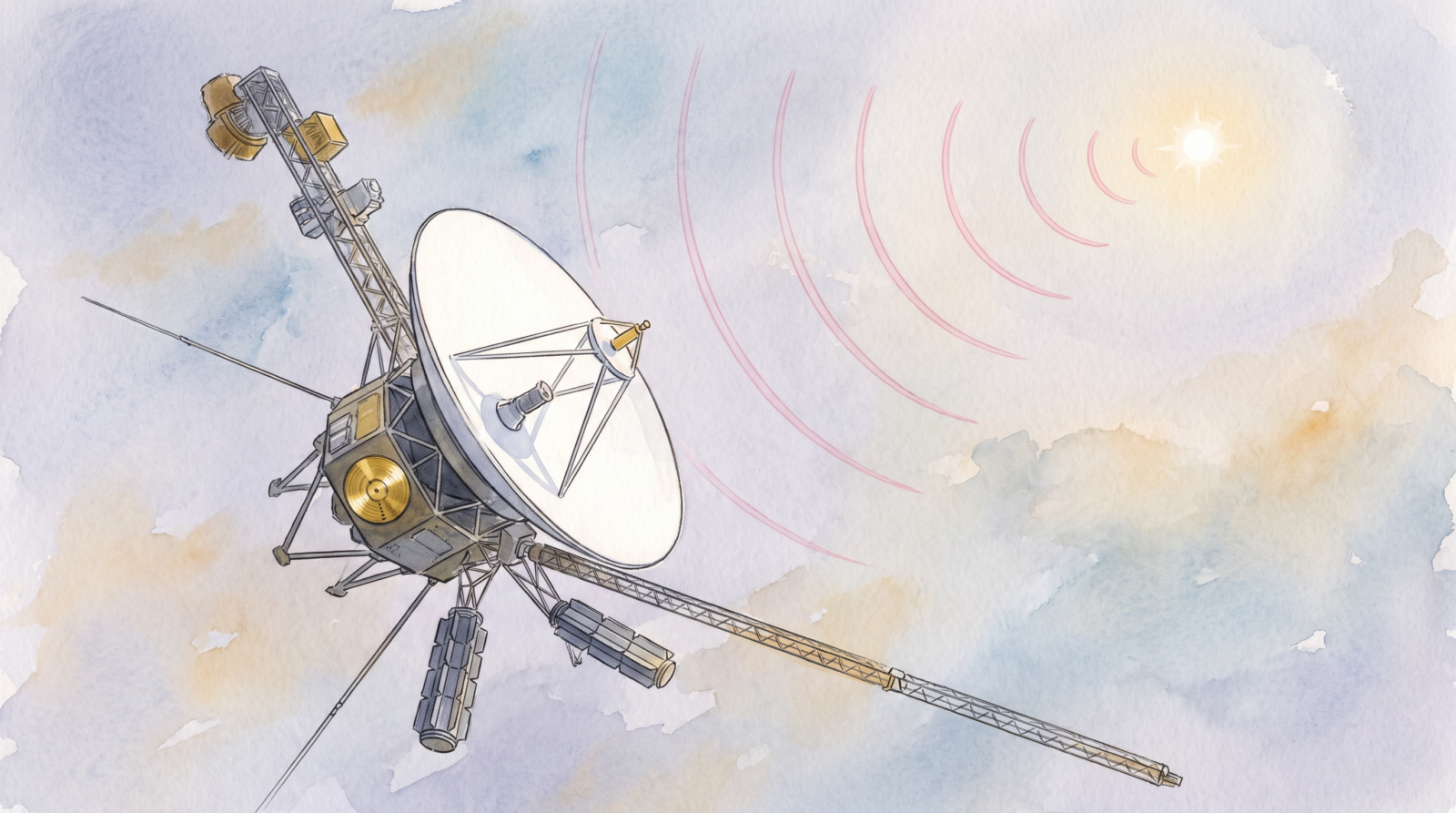
A spacecraft the size of a small car hangs against the deep black of interstellar space, the white parabolic high-gain antenna dish pointed back at the distant Sun which appears as a small bright point of light in the upper right of the frame. Two long booms extend out at angles from the spacecraft bus, one holding the radioisotope thermoelectric generator that has powered the mission since 1977, the other holding the magnetometer and plasma-wave antennas. A gold-anodised record cover is mounted on the side of the bus, its surface etched with the pulsar map and the binary-encoded playback instructions. The photograph is a 1977 picture of the Voyager spacecraft as it was being prepared for launch at the Kennedy Space Center, but the scene could equally well be a picture of the same spacecraft today, more than forty-eight years after launch, drifting through the Local Interstellar Cloud at a distance of more than fifteen billion miles from the Earth.
The two Voyager spacecraft, launched by NASA in August and September 1977, are the longest-operating and most distant missions in the history of space exploration. They are the only spacecraft ever to have crossed the heliopause and entered interstellar space, and they are the only spacecraft ever to have visited all four of the outer planets of the solar system. Voyager 2, in particular, is the only spacecraft ever to have visited Uranus and Neptune, and the data it returned from those two encounters in 1986 and 1989 remain, more than thirty-five years later, the principal source of information about the two ice giants. The Voyager programme is, by any standard, one of the most successful planetary science programmes ever conducted.
But the Voyager programme is also a story about the limits of human foresight. The two spacecraft were designed for a four-year primary mission to Jupiter and Saturn. The four-year mission was extended, first to include Uranus and Neptune, then to include the heliosphere and the heliopause, then to include the interstellar medium itself. The two spacecraft are still returning data in 2026, more than forty-eight years after launch, although their instrument complement is now reduced to the four instruments that consume the least power. The Voyager mission is the clearest demonstration in the history of space exploration of what a well-designed spacecraft can achieve when its operational lifetime is not constrained by the political and budgetary cycles that have shaped most other missions.
The Grand Tour and the alignment of the outer planets
The Voyager mission was the beneficiary of one of the most remarkable coincidences in the history of celestial mechanics. In the late 1960s, the graduate student Gary Flandro, working at the Jet Propulsion Laboratory in Pasadena, California, discovered that the four outer planets of the solar system would be aligned in such a way that a single spacecraft could use the gravitational slingshot effect to fly from Jupiter to Saturn to Uranus to Neptune in succession. The alignment, which occurs only once every 175 years, would take place in the late 1970s. The alignment would allow a single spacecraft to visit all four planets in a single mission, rather than requiring four separate missions. The implications for the cost of the mission were substantial; the cost of a single grand tour mission was estimated at roughly the cost of two separate missions to the outer planets.
Flandro’s discovery was first presented at a meeting of the American Astronautical Society in 1969, and it was incorporated into the planning for NASA’s outer planets programme within two years. The planning was complicated by the cancellation of the original grand tour mission in 1972, on the grounds that the budget for the programme was too large. The cancellation was followed by a redesign of the mission as two smaller spacecraft, originally designated Mariner Jupiter-Saturn A and Mariner Jupiter-Saturn B, which would visit only Jupiter and Saturn. The redesign was driven in part by budget pressure and in part by the desire to maintain the schedule that the planetary alignment required. The two spacecraft were eventually renamed Voyager 1 and Voyager 2 in 1977, on the eve of their launch.
The two spacecraft were nearly identical, weighing approximately 815 kilograms each at launch, including propellant. Each spacecraft carried eleven scientific instruments, including imaging cameras, infrared and ultraviolet spectrometers, a magnetometer, a plasma instrument, a cosmic-ray detector, and a planetary radio astronomy receiver. Each spacecraft was powered by three radioisotope thermoelectric generators, fueled by plutonium-238, which produced approximately 470 watts of electrical power at launch. The power output declined by approximately 3.2 watts per year as the plutonium-238 decayed, and the decline has been the principal limit on the operational lifetime of the spacecraft.
The launch window for the Voyager programme opened in August 1977. Voyager 2 was launched first, on 20 August 1977, aboard a Titan IIIE-Centaur rocket from the Kennedy Space Center in Florida. Voyager 1 was launched sixteen days later, on 5 September 1977, aboard an identical rocket. The two spacecraft followed different trajectories through the inner solar system. Voyager 1 was launched on a faster trajectory that would take it directly to Jupiter and then to Saturn; Voyager 2 was launched on a slower trajectory that would take it past Jupiter, then past Saturn, then on to Uranus and Neptune. The two trajectories were both calculated to take advantage of the planetary alignment that Flandro had identified, but the slower Voyager 2 trajectory was designed to reach Uranus and Neptune in 1986 and 1989, when the alignment would still be favourable for the slingshot manoeuvres required to reach the outer planets.
Jupiter, Saturn, and the Grand Tour encounters
Voyager 1 made its closest approach to Jupiter on 5 March 1979, after a flight of approximately eighteen months. Voyager 2 made its closest approach on 9 July 1979, four months later. The two encounters returned a wealth of data on the Jovian system, including the discovery of active volcanoes on the moon Io, the discovery of the faint Jovian ring system, the discovery of three additional moons of Jupiter (Metis, Adrastea, and Thebe), and detailed images of the Great Red Spot and the Jovian atmospheric circulation. The Io volcano discovery was particularly significant: the volcanoes, which were the first active volcanoes to be discovered beyond the Earth, were entirely unexpected and have been the subject of intensive study ever since.
Voyager 1 made its closest approach to Saturn on 12 November 1980, after a flight of more than three years. Voyager 2 made its closest approach on 25 August 1981, nine months later. The Saturn encounters returned data on the ring structure, the atmospheric composition, and the satellites of the planet, including the first detailed images of Titan, Saturn’s largest moon. The Titan data were particularly significant because Titan has a dense nitrogen-rich atmosphere that is similar in some respects to the Earth’s early atmosphere. The Voyager 1 spacecraft was deliberately targeted to fly close to Titan, in a manoeuvre that took it out of the plane of the ecliptic and prevented it from continuing on to Uranus and Neptune. The Voyager 2 spacecraft was targeted to fly past Saturn at a slightly different angle, in a manoeuvre that preserved its trajectory for the continuation of the grand tour to Uranus and Neptune.
Voyager 2 made its closest approach to Uranus on 24 January 1986, after a flight of more than eight years. The Uranus encounter returned the first close-up data on the planet, including detailed images of the atmosphere, the magnetic field, and the satellites of Uranus. The encounter discovered ten new moons of Uranus, including the moons Cordelia, Ophelia, Bianca, Cressida, Desdemona, Juliet, Portia, Rosalind, Perdita, and Mab. The encounter also returned the first data on the Uranian magnetic field, which turned out to be tilted at an unexpected angle of 59 degrees relative to the planet’s axis of rotation; the tilt has been interpreted as evidence that the magnetic field was captured from the planet’s primordial atmosphere rather than being generated by a dynamo in the planet’s core.
Voyager 2 made its closest approach to Neptune on 25 August 1989, after a flight of more than twelve years. The Neptune encounter returned the first close-up data on the planet, including the discovery of the Great Dark Spot, a large dark storm system in the planet’s atmosphere, the discovery of supersonic winds in the upper atmosphere, and the discovery of six new moons of Neptune, including the moon Triton, which was found to have a retrograde orbit and a thin atmosphere. The encounter with Triton was particularly significant because the retrograde orbit suggested that Triton was captured from the Kuiper Belt rather than forming in situ around Neptune. The Kuiper Belt has since become one of the most active areas of planetary science, and the Voyager 2 data from the Neptune encounter remain the principal basis for understanding Triton’s composition and atmospheric properties.
The Golden Record and the message to the stars
Each Voyager spacecraft carries a gold-anodised copper record mounted on the side of its bus, containing a selection of sounds, images, and greetings intended as a message from the Earth to any extraterrestrial civilisation that might find the spacecraft in the distant future. The records, which are 12 inches in diameter and gold-plated for protection against the harsh environment of interstellar space, were the idea of the Cornell astronomer Carl Sagan, who chaired the committee that selected the contents. The records are protected by an aluminium cover, on which are etched instructions for playing the record and for locating the Earth relative to fourteen nearby pulsars, whose periods of rotation are expected to remain stable over the billions of years that the record will be travelling through interstellar space.
The contents of the record were selected by a committee that included Sagan, the science writer Timothy Ferris, the anthropologist Ann Druyan, the artist Jon Lomberg, and several other scientists and writers. The committee worked under considerable time pressure; the records had to be prepared and assembled before the launch of the two spacecraft in 1977. The selection of the contents was the subject of considerable internal debate, in part because of the difficulty of predicting what an extraterrestrial civilisation might find intelligible, and in part because of the political sensitivities of the project. The contents were eventually chosen to represent the diversity of life and culture on Earth, rather than to represent any particular human community or political position.
The record contains 115 images, encoded in analog form, including scientific diagrams of the solar system and its planets, images of the flora and fauna of the Earth, images of human culture, and a series of images that demonstrate the structure of DNA and the organisation of the human brain. The images are accompanied by spoken greetings in 55 languages, including the major world languages of 1977 and a selection of smaller languages that were included on the recommendation of linguists. The greetings were recorded in 1976, at the Cornell University campus and at other locations around the world, and they include both formal greetings and informal messages. The longest greeting is in Mandarin Chinese, recorded by the dialectologist Janet Tsu-Ming Yang; the shortest is in Akkadian, recorded by the Assyriologist David Rauber.
The record also contains 90 minutes of music, including Western classical compositions by Bach, Beethoven, Mozart, and Stravinsky; traditional music from a variety of cultures; and contemporary popular music, including Chuck Berry’s “Johnny B. Goode”. The music selection was the most controversial element of the record; the committee received a number of letters protesting the inclusion of rock music and the exclusion of particular composers. The selection was eventually finalised in 1977, and the record was pressed and assembled at the Opryland Recording Studios in Nashville, Tennessee, where the gold plating was applied. The records were delivered to the Jet Propulsion Laboratory in 1977 and mounted on the two spacecraft in the final weeks before launch. The records have been travelling through the solar system ever since.
The heliopause and the entry into interstellar space
The Voyager mission’s primary planetary mission was completed when Voyager 2 flew past Neptune in August 1989. The two spacecraft were then retargeted for the Voyager Interstellar Mission, an extended mission to study the outer heliosphere and the boundary between the heliosphere and the interstellar medium. The heliosphere is the bubble of charged particles that surrounds the Sun and that is pushed outward by the solar wind. The boundary between the heliosphere and the interstellar medium, called the heliopause, is the place where the pressure of the solar wind is balanced by the pressure of the interstellar medium. The boundary is irregular in shape and is at a distance from the Sun that varies with the direction of measurement, but the average distance is approximately 18 billion kilometres, or about 120 times the distance from the Earth to the Sun.
Voyager 1 crossed the heliopause in August 2012, at a distance of approximately 18.2 billion kilometres from the Sun. The crossing was identified by a sudden drop in the flux of solar particles and a corresponding increase in the flux of galactic cosmic rays, observed by the cosmic ray instrument on board the spacecraft. The crossing was confirmed by a series of additional measurements in the following months, including the observation of the magnetic field direction outside the heliopause, which was found to be aligned with the local interstellar magnetic field rather than with the Sun’s magnetic field. The confirmation was announced by NASA in September 2013, with a paper in the journal Science describing the crossing and its implications for the structure of the heliosphere.
Voyager 2 crossed the heliopause in November 2018, at a distance of approximately 18.0 billion kilometres from the Sun. The Voyager 2 crossing was particularly significant because Voyager 2 is the only spacecraft ever to have crossed the heliopause with a working plasma instrument on board. The plasma instrument on Voyager 1 had been damaged in 1980 during the Saturn encounter, when it was used to study the Saturnian plasma torus; the instrument on Voyager 2 had remained operational. The Voyager 2 plasma instrument returned the first direct measurement of the plasma density and temperature outside the heliopause, and the measurement confirmed that the local interstellar medium is approximately 10 times hotter and 100 times less dense than the solar wind near the Earth.
The Voyager measurements of the interstellar medium have transformed our understanding of the boundary between the heliosphere and the galaxy. The measurements have shown that the heliopause is a relatively sharp boundary, with a transition region of only a few astronomical units, and that the local interstellar magnetic field is significantly stronger than had been predicted by earlier models. The measurements have also shown that the heliosphere is asymmetric in shape, with a longer tail in the direction opposite the Sun’s motion through the galaxy. The Voyager data have been the basis for several hundred scientific papers since 2012, and the two spacecraft continue to return data on the local interstellar medium in 2026.
The RTG power and the dwindling instruments
The two Voyager spacecraft are powered by three radioisotope thermoelectric generators (RTGs) each, fueled by plutonium-238. The RTGs produced approximately 470 watts of electrical power at launch in 1977. The power output has declined by approximately 3.2 watts per year as the plutonium-238 has decayed, and the power output in 2026 is approximately 235 watts per spacecraft. The declining power has required the gradual shutdown of the spacecraft’s scientific instruments, with each instrument shut down when its power consumption becomes too high relative to the available power. The shutdown sequence has been managed by the Voyager engineering team at the Jet Propulsion Laboratory, and the team has been able to extend the operational life of the spacecraft by careful management of the remaining power budget.
The Voyager 1 spacecraft currently operates four instruments: the cosmic ray subsystem, the low-energy charged particle instrument, the magnetometer, and the plasma wave subsystem. The Voyager 2 spacecraft currently operates five instruments: the cosmic ray subsystem, the low-energy charged particle instrument, the magnetometer, the plasma science instrument, and the plasma wave subsystem. The additional instrument on Voyager 2 is the plasma science instrument, which was the instrument that returned the first direct measurement of the plasma density and temperature outside the heliopause. The instruments that have been shut down include the imaging cameras, the infrared and ultraviolet spectrometers, the photopolarimeter, and the planetary radio astronomy receiver. The imaging cameras were shut down in the late 1980s, after the Neptune encounter, in order to conserve power for the extended mission.
The two spacecraft are expected to continue returning data until approximately 2030, when the power output of the RTGs will have declined to approximately 200 watts, which is the minimum required to operate the remaining instruments and to maintain communication with the Earth. The spacecraft will then continue to fly on their current trajectories through the interstellar medium, but they will no longer be able to return data. The two spacecraft will eventually pass through the Oort Cloud, a hypothetical cloud of comets that surrounds the solar system at a distance of approximately 2,000 to 200,000 astronomical units, and that is the source of the long-period comets. The crossing of the Oort Cloud is expected to take approximately 30,000 years for each spacecraft, and the spacecraft will exit the Oort Cloud at a distance of approximately 1.5 light years from the Sun.
Voyager 1 is currently the most distant human-made object in space, at a distance of approximately 25 billion kilometres from the Earth in 2026. The spacecraft is moving at a speed of approximately 17 kilometres per second relative to the Sun, and is in the constellation of Ophiuchus, in the direction of the constellation’s centre. Voyager 2 is at a distance of approximately 21 billion kilometres from the Earth in 2026, and is moving at a similar speed in the direction of the constellation of Telescopium. The two spacecraft are on trajectories that will eventually take them out of the solar system and into the interstellar medium, where they will continue to drift for billions of years. The two spacecraft are expected to pass within 1.6 light years of the star Gliese 445 in approximately 40,000 years, in the constellation of Camelopardalis.
The Voyager mission and the future of interstellar exploration
The Voyager mission is the only existing example of a spacecraft that has crossed the heliopause and entered interstellar space. The mission is also the only existing example of a spacecraft that has visited all four of the outer planets of the solar system. The success of the mission has been the basis for several subsequent mission proposals, including the proposed Interstellar Probe, a spacecraft designed to escape the solar system and travel to a distance of 1,000 astronomical units, where it would conduct a more detailed survey of the interstellar medium. The Interstellar Probe has been under study at NASA since the late 1990s, but it has not yet been approved for development.
The Voyager mission’s success has also been the basis for the development of the New Horizons mission, which was launched in 2006 and which conducted the first flyby of the dwarf planet Pluto in 2015. New Horizons is the fifth spacecraft to have crossed the orbit of Neptune, and it is the first spacecraft designed to explore the Kuiper Belt, the region of the solar system beyond Neptune that contains the small icy bodies from which the short-period comets originate. New Horizons conducted a flyby of the Kuiper Belt object Arrokoth in 2019, and the spacecraft is currently on a trajectory that will eventually take it out of the solar system, although it will not reach interstellar space for several decades.
The Voyager mission’s Golden Record has been the subject of considerable cultural and intellectual attention since its launch. The record has been the subject of several books, including Carl Sagan’s 1978 Murmurs of Earth, which describes the contents and the selection process in detail. The record has also been the subject of a 2010 documentary film, “The Farthest”, which describes the Voyager mission and its significance for human understanding of the solar system and the universe beyond. The record has been pressed in a number of commercial editions, including a 2017 edition released by Ozma Records to mark the fortieth anniversary of the launch.
The Voyager mission is, in the end, a story about the durability of human ingenuity. The two spacecraft have been operating for nearly fifty years, and they have been returning data for nearly forty-eight years, on a power budget that has been declining by approximately 3.2 watts per year. The two spacecraft were designed for a four-year mission to Jupiter and Saturn, and they have completed the grand tour of the outer planets, the crossing of the heliopause, and the entry into interstellar space. The two spacecraft are now in the Local Interstellar Cloud, where they will continue to drift for billions of years. The Voyager mission is the clearest example in the history of space exploration of what a well-designed and well-managed mission can achieve.
What Voyager tells us about the universe
The Voyager mission has contributed to the understanding of the solar system and the universe beyond in ways that were not anticipated when the two spacecraft were designed. The mission’s most important discoveries include the active volcanoes on Io, the faint ring system of Jupiter, the tilted magnetic field of Uranus, the retrograde orbit of Triton, the heliopause, and the local interstellar medium. The mission’s instruments have also returned data on the cosmic microwave background, the cosmic ray flux outside the heliopause, and the magnetic field of the galaxy. The mission’s data have been the basis for more than 10,000 scientific papers since 1979.
The Voyager mission’s data have also been the basis for the development of several new fields of research. The data on the magnetospheres of the outer planets have been the basis for the development of comparative magnetospheric physics, a field that compares the magnetic fields and plasma environments of the planets in the solar system. The data on the active volcanoes on Io have been the basis for the development of comparative volcanology, a field that compares the volcanic activity of different planetary bodies. The data on the Triton atmosphere have been the basis for the development of comparative atmospheric science, a field that compares the atmospheres of the planets and the satellites of the solar system.
The Voyager mission’s legacy will extend beyond the operational lifetime of the two spacecraft. The mission’s data will continue to be analysed for many years, and the data will be the basis for new scientific papers as new questions are asked. The mission’s engineering will be the basis for the design of new missions, including the proposed Interstellar Probe and the New Horizons spacecraft. The mission’s Golden Record will continue to drift through interstellar space for billions of years, a physical artefact of the human species and the Earth. The Voyager mission is, in the end, a story about the human species and its place in the universe.
The Voyager instruments, what they did, and what they did not
The Voyager spacecraft each carried an identical complement of eleven scientific instruments, designed for the four-year primary mission to Jupiter and Saturn and for the eventual extended mission to the outer planets and the heliosphere. The instruments were selected by a team of principal investigators led by the Jet Propulsion Laboratory, with significant contributions from outside institutions including the Cornell University Center for Radiophysics and Space Research, the Massachusetts Institute of Technology, the University of Iowa, the Los Alamos National Laboratory, and several European institutions. The instrument complement was designed to be redundant, so that no single instrument failure would compromise the scientific return of the mission; the redundancy has paid off in practice, with most of the instruments still operational at the time of the Neptune encounter in 1989.
The imaging system was the most publicly visible of the Voyager instruments. The imaging system consisted of two cameras, one wide-angle and one narrow-angle, each with a vidicon tube and a filter wheel for colour imaging. The wide-angle camera had a focal length of 200 millimetres and a field of view of 56 degrees; the narrow-angle camera had a focal length of 1500 millimetres and a field of view of 7.5 degrees. The imaging system returned approximately 67,000 images of Jupiter, Saturn, Uranus, Neptune, and their satellites during the planetary encounters. The images were the principal public-relations output of the mission, and they were released by NASA as soon as they were returned to Earth. The most famous of the images are the “Pale Blue Dot” photograph of Earth, taken by Voyager 1 in February 1990 from a distance of approximately 6 billion kilometres, and the family portrait of the solar system, taken by Voyager 1 at the same time.
The imaging system was shut down in the late 1980s, after the Neptune encounter, in order to conserve power for the extended mission. The cameras could not be operated again without significant power consumption, and the engineering team at JPL decided to allocate the available power to the four instruments that consume the least. The cameras are still on board the spacecraft, but they are no longer functional. The Voyager imaging system was, for its time, the most advanced imaging system ever flown on a planetary mission, and the images it returned remain the principal source of visual information about the outer planets. The imaging system was the basis for the development of subsequent imaging systems on the Galileo, Cassini, and New Horizons missions.
The infrared and ultraviolet spectrometers returned data on the atmospheric composition of the outer planets, the surface composition of their satellites, and the thermal emission of the rings and the moons. The infrared spectrometer was particularly important for the study of Titan, the largest satellite of Saturn, which has a dense atmosphere that obscures the surface in visible light but is transparent at certain infrared wavelengths. The infrared spectrometer on Voyager 1 detected the presence of methane and ethane in Titan’s atmosphere, and the detection was the basis for the subsequent design of the Cassini mission, which was launched in 1997 and which carried a more capable infrared spectrometer to Titan. The ultraviolet spectrometer returned data on the aurorae of Jupiter, Saturn, Uranus, and Neptune, and on the helium and hydrogen content of the outer planets’ upper atmospheres.
The magnetometer was the principal instrument for the study of the magnetic fields of the outer planets. The magnetometer was designed to measure the strength and direction of the magnetic field at the location of the spacecraft, with a resolution of approximately 0.1 nanotesla. The magnetometer returned the first measurements of the magnetic fields of Uranus and Neptune, both of which turned out to be unusual: the Uranian magnetic field is tilted at 59 degrees relative to the planet’s rotation axis, and the Neptunian magnetic field is offset from the centre of the planet by approximately 13,500 kilometres. The magnetometer has been continuously operational since the launch of the two spacecraft, and it is currently one of the four instruments that are still returning data on both spacecraft. The magnetometer is the only instrument that has been operational throughout the mission.
The Voyager data archive and its continuing use
The Voyager data archive is the most extensive planetary science archive in existence. The archive contains all of the data returned by the two spacecraft during the planetary encounters and the interstellar mission, including the imaging data, the spectrometer data, the magnetometer data, and the plasma and particle data. The archive is maintained by the Planetary Data System, a multi-node archive operated by NASA, and it is freely available to researchers worldwide. The archive has been the basis for more than 10,000 scientific papers, and it continues to be the source of new findings as new analytical techniques are developed and new questions are asked of the data.
The Voyager data have been reanalysed several times since the original mission, in light of new findings from subsequent missions. The Voyager imaging data have been re-processed using modern image-processing techniques, and the re-processed images are significantly sharper than the original images that were released during the planetary encounters. The re-processed images have been the basis for several new scientific papers, including papers on the atmospheric circulation of Jupiter and the ring structure of Neptune. The Voyager magnetometer data have been reanalysed in light of the magnetic field measurements returned by the Galileo and Cassini missions, and the re-analysis has shown that the magnetic fields of the outer planets are more complex than the original Voyager data suggested.
The Voyager data have also been the basis for the development of new analytical techniques. The Voyager radio science data, which include the measurements of the gravitational fields of the outer planets and the properties of their ring systems, have been the basis for the development of improved techniques for the analysis of radio occultation data. The Voyager plasma data have been the basis for the development of improved techniques for the analysis of plasma wave data. The Voyager cosmic ray data have been the basis for the development of improved techniques for the analysis of cosmic ray flux. The Voyager data archive is, in this sense, a resource that has not yet been fully exploited, and it will continue to be the source of new findings for many years.
The Voyager mission’s broader legacy is in the human imagination. The Pale Blue Dot photograph, taken by Voyager 1 in February 1990 from a distance of approximately 6 billion kilometres, has been reproduced in countless textbooks, magazines, and documentaries. Carl Sagan’s 1994 book Pale Blue Dot, which takes the photograph as its starting point, has been the basis for a generation of scientific thinking about the human place in the universe. The Golden Record has been the subject of several books, films, and exhibitions, and it has been the inspiration for a number of similar projects, including the 2008 Sounds of Earth record that was included on the Europa Clipper mission. The Voyager mission is, in the end, a story about the human species and its attempts to understand its place in the universe.
References
- Voyager program - Wikipedia overview of the programme, its history, and its findings.
- Voyager, NASA’s Longest-Lived Mission, Logs 45 Years in Space - NASA news article on the forty-fifth anniversary of the mission.
- Voyager Data - NASA Heliophysics Data Portal, with the current status of both spacecraft.
- The Voyager missions - The Planetary Society, on the programme’s findings and current status.
- The Golden Record - NASA Science, on the contents and the design of the Voyager Golden Record.
- The Golden Records tell the story of Earth. Will alien worlds ever find them? - National Geographic, on the cultural significance of the record.
- Voyager 1 and 2: The Interstellar Mission - NASA Space Place, a public-facing summary of the mission.
- Voyager 1 and 2 - NASA image gallery of both spacecraft, the planets they visited, and the Golden Record.
- Carl Sagan, F. D. Drake, Ann Druyan, Timothy Ferris, Jon Lomberg, and Linda Salzman Sagan, Murmurs of Earth: The Voyager Interstellar Record - Random House, 1978. WorldCat listing.
- William E. Burrows, The Survival Imperative: Using Space to Protect Earth - Forge, 1998. WorldCat listing.
- Stephen J. Pyne, Voyager: Exploration, Space, and the Third Great Age of Discovery - Viking, 2010. WorldCat listing.
- The Farthest (documentary film, dir. Emer Reynolds, 2017) - official site with details on the Voyager mission.