Xerox PARC and the Graphical User Interface
On the afternoon of 9 December 1968, in a hall at the Fall Joint Computer Conference in San Francisco, a man with a large head and an unfashionable beard demonstrated a device that most of the audience thought was a toy: a small wooden box with three buttons and a single cord, which he moved across his desk to move a pointer around a screen. He went on to show a machine in which text could be written, revised and linked, in which two people at different ends of a network could edit the same document at the same time, and in which a person in another city could appear on the screen and talk. It was recorded on film by a documentary maker, who cut it down into ninety minutes. The film is now known as the Mother of All Demos, and it contains almost everything we recognise about the personal computer. Douglas Engelbart, who gave it, had been working on the problem for a decade, and he knew at the time that nobody in the room had understood what they had just seen.
The Man Who Believed in the Mind
Douglas Engelbart was born in Portland, Oregon, in 1925, and grew up on a farm outside the city, the son of a Norwegian immigrant who ran a radio repair shop and insisted his son learn to build things. He read the wartime reports of the radar operators and the Air Force’s pilot-training programmes and became convinced that the real bottleneck in every military operation was not hardware but the mind. Then, in 1945, he read an essay by Vannevar Bush called “As We May Think”, in which Bush proposed a device, the memex, that would let an individual store all his documents and records and link them together into a navigable web. Bush was describing a machine that would be built using associative indexing, a device that would become, in Engelbart’s phrase, a personal repository of information for the individual, and the phrase that made Engelbart write his own first paper on the subject was this: “the important thing is not the technology, but the idea of augmenting human capability.”
He took a doctorate at the University of California, Berkeley, on the large-scale superimposition of electrical energy distributions, a subject with roughly the same relevance to the future as the study of horse-drawn transport has to the internal combustion engine, and in 1957 he joined Stanford Research Institute in Menlo Park, California. There, with money from the United States Advanced Research Projects Agency, he set up the Augmentation Research Center in 1962. His central document that year, “A Conceptual Framework for the Augmentation of Man’s Intellect”, is a strange and remarkable piece of writing, part engineering report and part sermon. It argues that the digital computer is not primarily a calculator but a medium, a way of representing and manipulating information that can be made to work with the human being using it. It proposes a hierarchy of needs, beginning at the bottom with training, discipline and motivation, then the need for devices to aid perception and expression, then the need for devices to aid cognition, that is memory, reasoning and computation, then the need for devices to aid the highest level of synthesis, where the individual formulates new ideas and translates them into action, and then the whole: an integrated system of all of the above, which Engelbart called the home computer. He argued that the way to build such a system was to concentrate on the human being and treat the machine as a tool for thinking, not the other way round. He also argued, in a paragraph that reads with hindsight like a prophecy, that the interactive use of a computer display and a pointing device would soon be the dominant way of working.
The pointing device came first. In 1963 Engelbart sketched a device with two wheels, one for horizontal and one for vertical movement, mounted in a wooden case with a single cord, and named it for the tail that trailed behind it. Bill English, an engineer at SRI, built the first working prototype in 1964, and the name stuck, which was unfortunate in the 1980s. The most important thing about the mouse was not the mouse. It was that the cursor, the arrow on the screen, was under the control of the hand, so that the hand and the pointer moved together, and the pointer could be used to reach out and touch things on the screen. Engelbart also insisted on a keyboard of five keys and a hand chord, rather than one key per character, because the point was to use the fingers of one hand on the mouse and the other on the keys without ever leaving the keyboard, and because a small keyboard left room for a large screen. Almost every workstation made since has that shape.
Engelbart built a machine to run the idea, the oN-Line System, or NLS, running on a time-shared mainframe with a high-resolution display built from a storage tube. The NLS had windows, hyperlinks, a mouse-driven cursor, and a text editor that could be shared between people on different machines. It also had, in Engelbart’s phrase, the first collaborative editing. And it was, for its day, a remarkably large and expensive system built with a great deal of custom hardware.
It is easy to read Engelbart’s 1962 memorandum as a list of features, and it is worth resisting that, because the features are the least of it. The argument he made was about the division of labour between a person and a machine. A computer, he wrote, can be made to serve as a medium in which the human being can express himself with vastly greater ease and effectiveness, and the value of the machine lies not in the arithmetic it performs but in the way it holds and manipulates the symbols with which a person thinks. He was explicit that this required the human to be in continuous conversation with the machine rather than issuing instructions and waiting, and that the machinery must therefore be fast enough to keep up with thought. Much of what follows in computing, from time-sharing to the graphical interface to the word processor, is an attempt to make that conversation feel immediate. It is an argument that people generally accept now without noticing that they are accepting it.
Ninety Minutes in San Francisco
The demonstration on 9 December 1968 was staged as a working session rather than a lecture, and Jack Goldman, a documentary filmmaker at Stanford, filmed it. Goldman cut the material into a film that ran to ninety minutes and has since become known as the Mother of All Demos. The title is not Engelbart’s, and not Goldman’s either; it is generally said to have been coined by a member of the conference staff, and it has stuck because it is accurate. Everything a personal computer turned out to be is in that film, including several things nobody had asked for and nobody has needed since.
Engelbart began with the mouse and the cursor, and showed a chunk of text on the screen that he could select, move, and copy. He then showed the mouse driving a selection of text that was linked to another document, and moving from there into a third, and so on: hypertext, with the pointer as the pointing hand. He showed a window, with a title bar and a border, opened and closed and resized. He made a video call to Bill English, who was at SRI in Menlo Park, so that the two of them appeared to be looking at the same screen from different places, and the audience could see English’s face appear in a window in the middle of a document. He showed two people editing the same text at the same time, each seeing the other’s changes as they were made, which is the ancestor of every shared document editor in use today. He demonstrated the five-key chord keyboard and the hypertext. And he demonstrated the thing that did more damage to the demonstration’s reception than anything else, which was that for a large part of the hour the screen showed nothing much happening, and the session ran long.
The reception was mixed, and it is worth being honest about that, because the demo has acquired a mythology that its first audience did not share. The engineers in the room understood what they were looking at. The wider world did not, and the demonstration did not make Engelbart famous: he was, by most contemporary accounts, an eccentric figure in a fringe field. The reason the demo is famous now is a matter of later history. In the 1990s the footage began circulating widely; in 2007 the Computer History Museum released the full ninety-minute film, and it has been watched several million times since. And in 1990 Engelbart received the Turing Award, the highest honour in computing, which was mostly a belated correction.
Two features of the demonstration are worth dwelling on, because they are the ones that were not for decades understood to be the important ones. The first is the collaborative editing. Engelbart did not merely show a document; he showed a document being edited by two people at once, in different places, with each person’s changes appearing instantly in the other’s copy. That was not a party trick. It was a claim about what a computer could be used for socially, and it took the better part of thirty years before the world accepted it in the form of shared documents, shared spreadsheets and, eventually, shared source code. The second is the video link, which was technically the least impressive part of the hour and conceptually the most important: a picture of another person, appearing inside a window, inside a document, on a machine that was otherwise a private workstation. Every later claim that the personal computer would become a communications device rests on the demonstration having shown that it could be done, even if nobody in the room could yet see the use.
What the demonstration did produce immediately was money, which is another way of saying that it produced research funding and therefore the next decade. ARPA increased its support for SRI’s Augmentation Research Center, NASA funded further work, and the Air Force did the same. Engelbart’s group at SRI became a magnet for the people who would build what he had described. Some of them, like Dustin Lindberg, stayed at SRI. Others left. And in 1970 a much larger organisation, with much deeper pockets, created a laboratory on the other side of the San Francisco Bay whose explicit purpose was to go further in the direction the demonstration had pointed.
A Corporate Park and a Book for Children
Xerox Palo Alto Research Center was chartered on 1 July 1970. The founder was Jacob E. Goldman, who had run research at the Advanced Research Projects Agency and later at NASA, and who first discussed the idea with George Pake, a physicist specialising in nuclear magnetic resonance and then provost of Washington University in St. Louis. Xerox’s motivation was straightforward. The company made its money from the 914 office copier, and it was keenly aware that the copying industry was about to be displaced by something else, and that the only way to know what was coming was to fund people who were not thinking about copiers. The laboratory was placed three thousand miles from Xerox’s headquarters in Rochester, New York, on purpose, so that the people in it would be too far away to be managed and would have the freedom to work on things whose value could not yet be demonstrated.
The freedom was real, and so was the isolation. PARC’s first manager of computer science was Bob Taylor, who had come from the ARPA’s Information Processing Techniques Office and who understood both what the laboratory could do and what the rest of the world would want. Taylor hired people who had been at SRI’s Augmentation Research Center, whose funding from ARPA, NASA and the United States Air Force had begun to shrink, and he leased land at Stanford Research Park so that graduate students could be drawn in. By the end of the decade PARC could claim four Turing laureates, and the ACM’s Software System Award would eventually be given to the Alto, to Smalltalk, to InterLisp and to the remote procedure call.
The most consequential person to walk into PARC in 1970 was Alan Kay. He had a bachelor’s from the University of Colorado and a doctorate from the University of Utah, earned in 1969 for a thesis on a flexible and extensible programming language. In 1968 he had met Seymour Papert and learned of Logo, and that encounter had turned his attention to children, to Jean Piaget, Jerome Bruner and Lev Vygotsky, and to the idea that learning is something a person constructs rather than something delivered. He had intended to take a professorship at Carnegie Mellon, but in 1969 he became a visiting researcher at the Stanford Artificial Intelligence Laboratory, and in 1970 he joined Xerox PARC, where he founded the Learning Research Group with Adele Goldberg.
Kay’s central idea was not a computer but a book. He had been reading about the pedagogical potential of portable, affordable machines, and in August 1972 he published a paper called “A Personal Computer for Children of All Ages”. The Dynabook, as he named it, was to be a machine the size of a bound notebook that folded open, with a flat screen, a keyboard and a stylus, powered by a battery, and costing a few hundred dollars. He set the target at roughly eight thousand words of memory, under four pounds in weight, and under five hundred dollars in 1972 money. There is a physical mockup of the Dynabook, which Kay has held and shown on stage, and looking at it is to understand that Kay was not describing a laptop. He was describing a paperback that happened to compute.
Kay was careful about the gap between the idea and the technology of his day, and in the paper he named three things that had to be hand-waved for the Dynabook to exist: a flat, bright, high-resolution display; a source of power small and light enough to go in a book; and memory cheap enough to buy by the thousand. None of the three was available in 1972. All three arrived, in the end, and the machine arrived with them. Kay’s later lectures have argued that the personal computer revolution, in the sense of a genuinely personal machine for a genuinely ordinary person, is still unfinished, and that his own field, the one he created, is the field of learning software and children’s machines, and that the machines we now take for granted are the early version of the book he described rather than the fulfilment of it.
It is worth following the thread of the idea, because it is one of the few cases in the history of computing where a specific document can be followed forward across four decades. Xerox built a machine very close to the Dynabook in 1978 and called it the NoteTaker. It was a working notebook, with a flat screen and a stylus, that a person carried and wrote on, and it was made from the same bill of materials as the Dynabook would have needed. In 1982 the GRID Compass, a machine of about the same size and weight, put a clamshell keyboard, a flat screen and a pen into the hands of travelling salesmen, at a price of a few thousand dollars. Kay himself used one and continued to insist that it was the right idea in the wrong decade. The Apple Newton of 1993 was the first attempt to make the Dynabook a consumer product, and it failed commercially in a way that seemed conclusive until it did not. The One Laptop per Child machine that Kay helped to found in 2005 was explicitly an attempt to put a personal computer into the hands of children, which is what the 1972 paper had asked for in the first place, and which in 1972 was priced at under five hundred dollars for exactly the reason that the parts were not there yet.
The Alto and the Metaphor of the Desktop
While Kay was describing the machine he wanted, Butler Lampson was describing the machine he could build. In a memorandum written in 1972, Lampson proposed a personal computer with a bitmap display, a reasonable amount of memory, and a disk. Chuck Thacker then built it, and the Alto was finished with startling speed. Its design was explicitly inspired by Engelbart’s NLS, and also by the PLATO system at the University of Illinois, which had already made a habit of small-screen teaching and had a strong idea of what a community of learners sharing a machine could do.
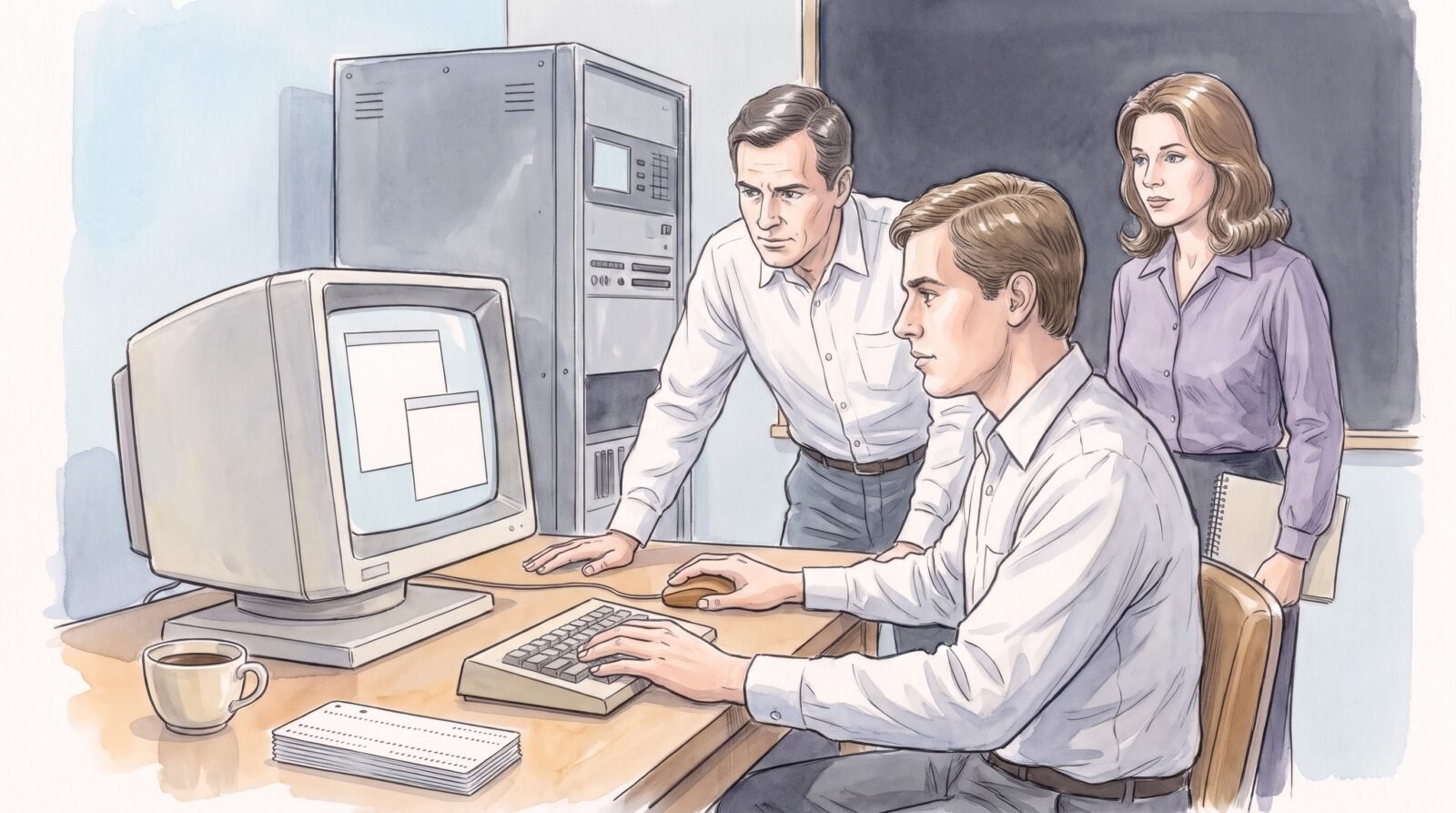
The Alto that emerged in 1973 was a remarkable object. It had a high-resolution black-and-white display of some six hundred by three hundred and forty pixels, mounted in portrait orientation on a swivel base, so that the screen stood like a sheet of paper rather than a cinema screen. It had about ninety-six thousand words of memory by the middle of the decade. It had a fast, custom-built, microcoded processor, an unusual design that gave it extraordinary graphics performance for its time at the cost of a very high engineering effort and, once built, no easy way to change it. It had a hard disk. And it had a mouse. The display was not a terminal attached to a distant mainframe; it was the whole point of the machine.
PARC made about a hundred and twenty of the first Alto, the Alto I, and then roughly two thousand of the Alto II, which was introduced in the middle of the decade. The machines were leased to other organisations, including Stanford University and several commercial firms, and the outside world could buy one for around thirty-two thousand dollars by the end of the 1970s. That was a great deal of money, and it bought a machine with ninety-six thousand words of memory, no protection between programs, and one user at a time.
What made the Alto matter was not the hardware. It was the software, and above all the environment that Kay’s group and others built on it: Smalltalk, which in its version of 1972 already had overlapping windows, a working environment composed of graphical objects, and the idea that a program was a thing you could point at. And it was the printer. Gary Starkweather’s laser printer, developed at PARC through the middle of the decade, meant that the Alto’s screen was not a separate thing from the paper in front of you. You could compose on the screen and print the identical page, which was the first time that the screen and the printed page were the same artefact. Without a laser printer that could render a bitmap faithfully and fast, the Alto would have been a very expensive terminal. With one, it was a new medium.
Smalltalk in particular was more than a programming language, though it was that too, and it was more than an operating system, though in Smalltalk the distinction between the two did not exist. Everything on the screen was an object with a shape, a behaviour and a picture, and any object could be made to respond to a mouse click by running a short piece of code attached to it. That was the mechanism by which the icons worked, and it was the reason a program could be represented by a picture of itself that you could pick up and use. It also meant that the boundary between the application and the operating system dissolved, which was a problem for a research language and a revolution for an operating system, and which is the reason every desktop since has been an object-oriented environment whether its designers would have used that word or not.
Out of that came the metaphor that has organised every desktop since. Not the commands, which had been typed at a prompt, but a surface: a sheet of paper on which things lie, which can be picked up, moved, opened and discarded. Windows overlaid one another and could be brought to the front. Icons stood for things, and the icon for a document looked like a document, in the sense that it was a little drawing of a document, and the icon for a folder looked like a folder, and the icon for a wastebasket looked like a wastebasket. That last one, the trash can, was drawn by Bill English. The pointer was the hand. Text appeared on the screen as it was going to appear on the printed page. All of it is now so familiar that it is hard to recall that it was ever a surprise, and harder still to recall that it was assembled in a research laboratory with no commercial aim and no product plan.
Some of the names have dates attached. Smalltalk-72 was the first version of the language to run on the Alto. The term WIMP, for window, icon, menu and pointer, came into general use in the early 1980s for the interaction style itself, and it outlived the machines, since it is still the standard term for the family of interfaces that descend from the Alto. The icons themselves came from David Canfield Smith, who wrote his thesis on the subject under Kay’s supervision, and who also worked on the desktop metaphor, in which the user sees a desk holding documents and folders rather than a command line. Bob Metcalfe wrote the Ethernet memorandum at PARC in 1973, and the Alto was the first machine with an Ethernet interface, which is another way of saying that PARC had a network before it had a product. The laboratory’s electronic mail system, built on that network, was among the first anywhere, and for a while PARC ran one of the busiest mail exchanges in the country.
It is worth being clear about what the Alto was not. It had no hard disk worth the name and no networking to speak of until Ethernet arrived, no memory protection, and no facility for more than one person at a time. Its processor was a remarkable piece of custom engineering that gave outstanding performance for graphics and could not be extended without redesigning the machine. Its user interface was enormously more sophisticated than anything a customer could buy in 1973 or 1974. In short, it was a machine built to explore an idea, which is exactly what it was, and it is a reminder that PARC was not trying to build a product but was trying to find out what a product should be. What it found out, it found out with a machine that cost several times what a person earned in a year.
Xerox did try to sell the idea. The Xerox Star 8010 Information System, introduced on 27 April 1981, was the first commercial personal computer to have a bitmap display, a window-based graphical interface, icons, folders and a mouse. A single workstation cost about sixteen thousand dollars in 1981, and a working office needed two or three of them plus a file server, a print server and a laser printer, which could take the total towards a hundred thousand dollars. Xerox sold something in the order of twenty-five thousand units, which was enough to make it a modest success and not enough to change the company’s fortunes. Meanwhile the Apple Lisa team saw the Star at the National Computer Conference in 1981, went back to Cupertino and converted their own desktop manager to an icon-based interface modelled on it. Charles Simonyi left Xerox for Microsoft in 1981 and produced the first WYSIWYG version of Microsoft Word.
It is also worth remembering that Xerox did make money out of the laboratory, just not out of the part of it that everybody now remembers. The laser printer that Starkweather developed became a product, and a very profitable one, and in doing so it did for the printed page what the Alto had done for the screen: it made a page of information cheap to reproduce in quantity, and it did so without a photographic intermediary. The same commercial instincts that failed to see a computer in the Alto saw a printer immediately. Xerox’s own account of the laboratory’s history is frank about the division: the copier and the printer were the business, the personal computer was the research, and for a decade the research was allowed to be expensive because the business could pay for it. It was only when the business itself came under pressure, in the middle 1980s, that the laboratory’s commercial possibilities were reconsidered, and by then the interface had already escaped.
The Borrowed Idea
In December 1979, Steve Jobs visited Xerox PARC. He was shown Smalltalk, he was shown networking, and above all he was shown the WYSIWYG, mouse-driven graphical interface of the Alto. According to the account in the Computer History Museum’s own history, he did not at first appreciate the significance of the first two and was excited by the third. The visit was arranged on the understanding that the Apple people would receive demonstrations of Xerox technology in exchange for Xerox being able to purchase options in Apple stock. Within five years Apple had put a mouse and a bitmap screen and overlapping windows and icons on a desk for a couple of thousand dollars, and the Macintosh had done more to change personal computing than any machine since the IBM PC.
And the argument about who took what from whom went on for a decade. Xerox sued Apple and Microsoft, and the case dragged through the courts. In 1989 the two claims were settled, and the terms were reported as including cash and Xerox share purchases. By then the argument had lost most of its interest, because the answer had been delivered commercially: the interface that Xerox’s research laboratory had invented, and that Xerox had then declined to sell, was on a hundred million desktops within a few years.
It is tempting to make Xerox the villain of this story, and that would be wrong. Xerox had not invented the mouse, or hypertext, or the laser printer, or the network, or the idea of a personal computer for children. It had taken the ideas of Engelbart, Kay, Lampson, Thacker, Smith, Metcalfe and Starkweather and put them together in a machine that was ten years ahead of the market. It had also, in the person of the corporate management in Rochester, declined to build a business out of them, because the copier business was the business, and the laboratory’s achievements were visible mainly as press coverage. It took the Macintosh to make the argument for the interface, and the Internet to make the argument for the network, and the notebook computer and the tablet to make the argument for the Dynabook.
There is one more twist to the story that ought to be mentioned, because it recurs. Xerox did not lose the mouse and the window in the sense of failing to invent them. It lost them in the sense of having them and not commercialising them. The same company, a few years earlier, had taken the same decision with the laser printer, and made a great deal of money, so the decision was not absurd; it was simply wrong about which future was worth preparing for. The Alto’s designers had a name for the machine that PARC built to run Smalltalk on the Alto’s own successors, and the name was used, in a laboratory that knew what it had, as a piece of self-deprecating prophecy. Everything about the Alto was a little ahead of its time. The interface was not, in the end. It was exactly on time, and it was somebody else’s.
The last thing worth saying about PARC is that it is still there, and that the argument it was founded to settle is still open. Xerox donated the laboratory to SRI in 2023, where it continues as the Future Concepts division. Kay has spent the decades since insisting that the computer revolution has not happened yet, and that what has happened is the arrival of a medium that is capable of being a book, a tutor and a companion, and that nobody has built those yet. The mother of all demos is ninety minutes long, and what is strange about it now is not how much we recognise, but how little of it we have done.
References
- A Conceptual Framework for the Augmentation of Man’s Intellect - Douglas C. Engelbart, Augmentation Research Center, Stanford Research Institute, 1962
- Mother of All Demos - Wikipedia, the 9 December 1968 demonstration and the making of the film
- The Mother of All Demos, Reel 1 - Douglas Engelbart’s demonstration, filmed by Jack Goldman, Internet Archive
- Douglas Engelbart - Wikipedia, biography and bibliography
- PARC (company) - Wikipedia, the founding of Xerox PARC, its people and its outputs
- PARC History - PARC, the laboratory’s own account of its founding and its work
- Alan Kay - Wikipedia, biography, the Dynabook and the ACM Turing Award
- Xerox Alto - Wikipedia, design, cost, production numbers and the December 1979 visit by Apple
- 50 Years Later, We’re Still Living in the Xerox Alto’s World - IEEE Spectrum
- How a 1970s Research Lab Helped Create the Future - IEEE Spectrum, the electronic mail and networking work at PARC
- Xerox Star - Wikipedia, the 8010 Information System of 1981, its price and its sales
- Smalltalk and Smalltalk-72 - Wikipedia, the language and the version that ran on the Alto
- Graphical user interface - Wikipedia, the history of the interface and the role of icons
- WIMP (computing) - Wikipedia, the window, icon, menu and pointer interaction style
- Mouse (computing) - Wikipedia, the history of the pointing device from Engelbart’s sketch onwards
- History of the graphical user interface - Wikipedia, a chronological account of the interface’s development