The Viking Landers on Mars
For two and a half centuries after the invention of the telescope, nobody knew how to get to Mars and stay alive there. The Soviet Union got there first and was destroyed on arrival. It took the United States two Viking spacecraft, launched four months apart in 1975, to put two working laboratories on the Martian surface in the summer of 1976, and one of them kept sending data for six more years. The Viking landers were the first robots to explore another planet, and they are still, by some distance, the machines that made the most alien measurements of anything that has ever come back from elsewhere. They found a soil chemistry nobody predicted, a pressure nobody expected, a weather station on a world with almost no air, and a positive result from a life-detection experiment that has never been fully explained. They also, almost accidentally, gave the world the Face on Mars.
The Programme That Almost Was Not
NASA’s Mars ambition in the middle 1960s was going nowhere. After Mariner 4 returned the first close photographs of Mars in 1965 and Mariner 6 and 7 mapped a small part of it in 1969, the agency studied a large orbiter-and-lander mission called Voyager, to be launched in 1973. It was cancelled, and the money went into the Apollo lunar programme instead. What replaced it was, in December 1968, the biggest research project NASA had ever mounted outside the manned programme: Viking, approved by the administrator Thomas Paine and eventually to cost something close to one billion dollars in 1970s money for a pair of orbiters and a pair of landers. NASA’s official history of the exploration of Mars, published in 1978, remains the standard account of how the programme was argued, cut and eventually rebuilt.
Viking inherited a national mood that was not encouraging. The budget for the project was cut, twice, and in 1974 a third orbiter and a third lander were cancelled outright for reasons of cost. Even the hardware that was built had a troubled time. The launch vehicle was the Titan IIIE with a Centaur upper stage, and the Centaur had a poor record; the Viking 1 launch was delayed more than once, and one of the delays came after a fault was found in the vehicle’s thrust vector control system. The Viking programme was delivered on a schedule that had slipped repeatedly, by a budget that had been cut repeatedly, by a team spread between the Jet Propulsion Laboratory in Pasadena and the Langley Research Center in Virginia. That division is worth noting, because it produced one of the programme’s most useful scientific results and one of its most awkward disputes.
There was also a memory that shaped everything. On 19 May 1971 the Soviet lander Mars 2 crashed on the surface of Mars, and on 2 December 1971 the Soviet lander Mars 3 achieved the first soft landing on the planet, transmitted for about twenty seconds, and was then crushed by the weight of its own descent engines pressing into the soil. The Americans had watched both attempts. The Soviet programme had won the race to land on Mars and had come away with nothing, and the Viking team knew exactly what it was trying to do better.
And there was Apollo. The first Moon landing had been on 20 July 1969. When the Viking 1 lander touched down on Mars on 20 July 1976, it was almost exactly seven years and one day later, and NASA chose the date with some care. The Mars landing was scheduled to be, in the words that circulated at the time, the first flight of a spacecraft to another planet, and the publicity apparatus of an agency that had just put men on the Moon was ready for it.
The people who ran the programme had pedigree. James S. Martin Jr., the Viking project manager, came from the Langley Research Center and had a reputation for insisting that hardware worked before it flew. Gerald Soffen, a planetary scientist from the University of Colorado, was the project scientist and would end up doing more to shape the public understanding of Viking than anyone else, for better and for worse. Henry Mason was in charge of the biology package. The lander itself was built by Martin Marietta at Denver, with the orbiters by JPL.
Seven Minutes of Terror
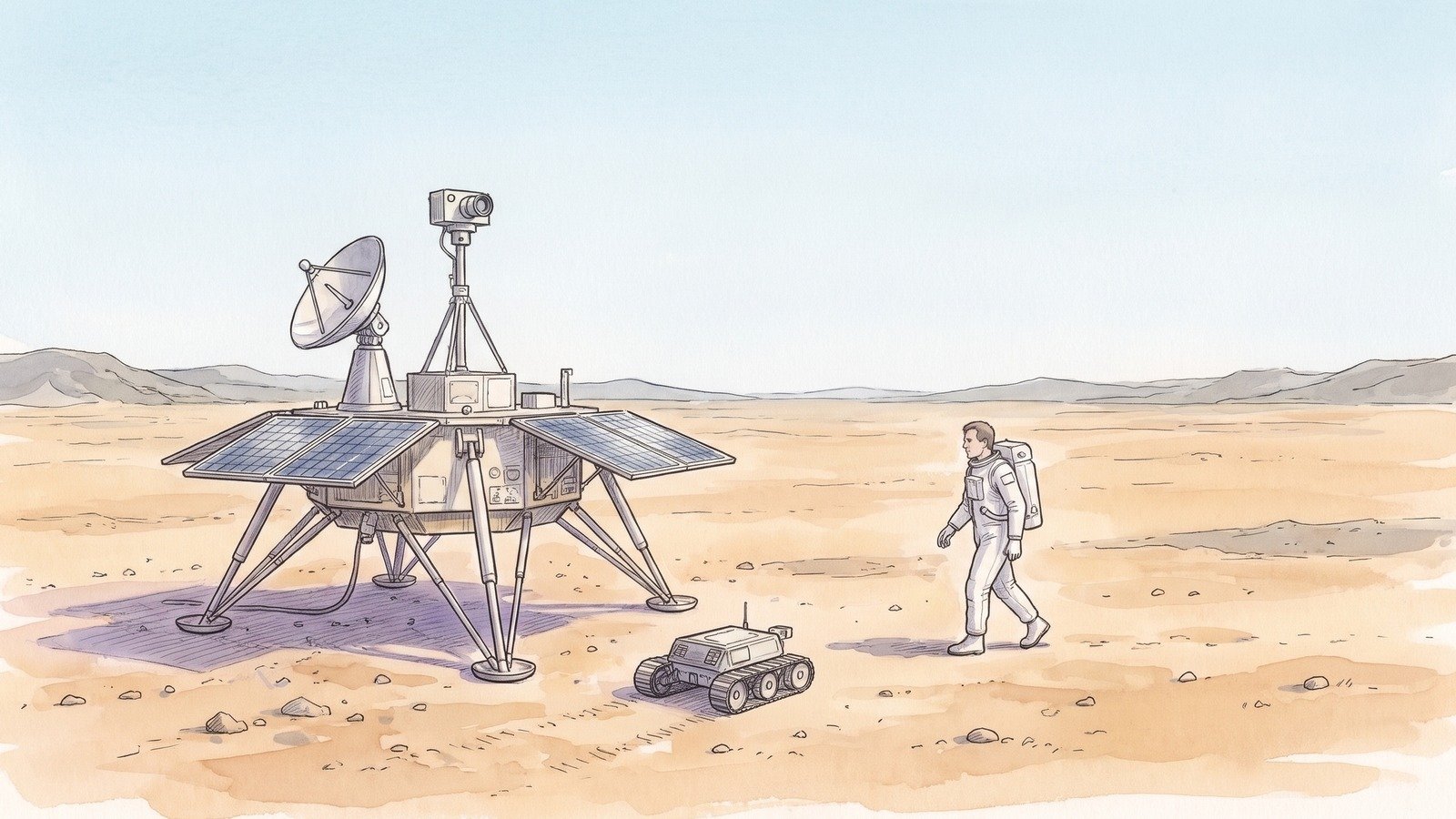
The Viking lander was a machine of about 595 kilograms, and it had been through more preparation than almost anything else that has ever flown. Because the programme’s central scientific purpose was to look for life, the whole lander was heat-sterilised before launch, heated to around 110 degrees Celsius and held there for some thirty hours, in a programme whose thoroughness was a source of pride to the engineers and an obsession to the scientists, who wanted to know whether every organism on Earth had really been killed. The lander was then sealed inside an aeroshell, and it was to be delivered to the surface of Mars at the end of a descent that became known, in NASA’s own phrase, as seven minutes of terror.
The entry vehicle was a cone. The heat shield and the back shell were fitted with ablative materials to carry away the enormous heat of atmospheric entry, and although Mars’s atmosphere is less than one per cent of the density of Earth’s, the lander was entering at some five kilometres a second, and there was enough of it to burn for. The parachute deployed at about six kilometres altitude with the lander still descending at some 900 kilometres an hour. Then, at roughly one and a half kilometres, three retrorockets fired and the parachute was cut away. From there the lander came down under its own guidance, using a radar altimeter, until the three legs touched the soil. The fuel margin on the Viking 1 descent was famously thin. Every one of those steps had been rehearsed in a laboratory with a giant air-bearing table and a mocked-up lander, and the rehearsals were run until the descent was, in the words of one of the engineers, about as interesting as a wedding.
The hardware underneath the aeroshell was remarkable for what it carried. Two facsimile cameras, each scanning the landscape with a moving slit and a row of photodiodes, building up a panorama three hundred degrees wide in a series of narrow horizontal strips. A gas chromatograph coupled to a mass spectrometer, which heated a soil sample, separated the gases that came off it by chemical properties and then weighed the individual molecules. An X-ray fluorescence spectrometer, which put a radioactive source against the soil and read the characteristic X-rays that came back, so that the chemistry of the Martian surface could be determined without any of the elaborate wet chemistry that Earth-bound instruments used to require. Three biology experiments. A meteorological instrument that measured pressure, temperature and wind. A sounder for the atmospheric structure. And on Viking 1 a seismometer, left on the surface after the lander stopped moving, in the hope that Mars would shake and the seismometer would hear it.
Power came from two radioisotope thermoelectric generators, squat canisters of plutonium-238 converting heat into current at a rate of about thirty watts each. They were chosen because they would last for years, and because the alternative, a chemical battery, would have run out. The onboard computer had a few thousand words of memory. The data were recorded on magnetic tape and then, once the lander was in radio contact with Earth, read back at a glacial rate; the tapes were also flown home on the next mission, which is how the raw data came to be preserved and re-analysed decades later. The whole arrangement is set out in NASA’s own Viking 75 spacecraft design and test summary, which remains the first place to look for the engineering detail.
Viking 1 touched down in Chryse Planitia, a low plain of ancient floodwater in the northern hemisphere, on 20 July 1976. It landed some six kilometres from the point where the orbiter’s tracking and imaging had predicted it would come down, a discrepancy that nobody could detect until the Mars Reconnaissance Orbiter photographed the site in 2006 and found the lander sitting there, cast a shadow, with its legs dug into the soil where it had settled. The first image from the surface arrived on Earth the same day and showed, famously, a bootpad, a piece of the lander’s own structure, and Martian soil in the background. The first picture anyone on Earth had ever seen from the surface of another planet was a picture of the machine that had taken it.
The descent itself was finished before the cameras saw anything, and the sequence was designed so that the last seconds would be the least forgiving. The aeroshell separated from the cruise stage, and the cruise stage’s solar panels were discarded so that the lander would hang correctly beneath its parachute. The heat shield was jettisoned after entry. The parachute deployed, the radar altimeter woke, and then the descent engine did the rest. The lander carried three fuel tanks feeding three engines that could be gimballed to control its attitude and its rate of descent, and the guidance software had to decide, in the last seconds, whether the engines were burning correctly, whether the lander was level, and when to cut off. It was given very little margin. NASA has never said publicly how close the first landing came to a failure, and the fact that it did not come closer is the only fact that matters.
Viking 2 landed three weeks later, on 3 September 1976, at Utopia Planitia, far to the north, where the site had been chosen for a different reason: to look at a region of ancient sea-bed deposits where water-bearing minerals might be preserved. It carried a smaller set of instruments, one of its two cameras failed early, and it would go on working until the spring of 1980, when its batteries gave out. Viking 1 would last until November 1982, six years and nearly four months after landing, and its final transmissions were received that November; the end of the mission is generally attributed to a fault in the lander’s power and communications system, though the accounts differ on whether it was a component failure or an error during a software update. NASA marked the fiftieth anniversary of the landing in 2021 with a short official account of the descent, which remains a good place to start.
What the landers found about the place itself was startling. The atmospheric pressure at the Viking 1 site was measured at about 6.1 millibars at the lowest point of the local topographic profile, and at most around 10.8 millibars at Viking 2. That is less than one per cent of the pressure at sea level on Earth, and it was lower than the models had predicted. The temperature swung through a Martian day of around minus sixty degrees Celsius. The surface was, as expected, red, and the sky was, as expected, butterscotch. The atmosphere was almost entirely carbon dioxide, and the X-ray spectrometer found chlorine in the soil at a level of a few tenths of one per cent, a datum that would look very different in 2008.
The weather was the surprise that nobody had budgeted for. The meteorology instruments recorded a daily cycle in which the pressure rose and fell as the atmosphere warmed and cooled, with a seasonal component superimposed, and the total pressure at the Viking 1 site varied by roughly a factor of two over the Martian year. That sounds trivial until it is compared with Earth, where the pressure varies by a few per cent over the course of a day. On Mars the air is so thin that a modest change in temperature produces a large change in the weight of the column above you. The Viking landers also gave the first measurement of how fast the Martian atmosphere moves, and the answer, at a few metres a second, was low enough that the lander was never in danger of being blown over and high enough that the dust it raised mattered.
The Experiments That Divided the World
The biology package was three experiments, and they were the reason the Viking programme existed. The idea, set out by George Pake and refined by Henry Mason and Gilbert Levin, was to give Mars a chance to prove itself. Each experiment put a Martian soil sample in contact with something a terrestrial organism would like, and then looked for the signature of metabolism.
The gas exchange experiment was the gentlest. It wetted a soil sample with a nutrient solution and measured the gases that appeared or disappeared, looking for the exchange of carbon dioxide and oxygen that respiration produces. The labelled release experiment was the most sensitive. It fed the soil with nutrients whose carbon was labelled with the radioactive isotope carbon-14, and then looked for carbon dioxide containing that label, which would mean that something alive in the sample had taken the carbon into itself and then given it back as gas. The pyrolytic release experiment was the most brutal: it heated the sample to several hundred degrees and analysed the gases that came off, looking for the breakdown products of organic molecules of the kind that metabolism on Earth would produce.
The results arrived on 30 July 1976, and they split the world in two. The gas exchange experiment was negative. The pyrolytic release experiment gave a small result that was judged inconclusive. The labelled release experiment was positive. The reaction in the Viking room at JPL, and in laboratories and newsrooms all over the world, was immediate and largely elated. It had taken a century and a half for anyone to detect life on another world, and it now looked as though it had been done by three American spacecraft in the space of two weeks. The formal paper describing the first Viking mission, by the project scientist Gerald Soffen and Carl Snyder, appeared in Science in 1976 and remains the primary account of what the landers returned.
It did not hold up, and the reasons are instructive. The gas chromatograph-mass spectrometer, running on the same samples, found no organic molecules at all at the level of its sensitivity, which was in the parts per billion range. That is an extraordinarily low threshold. If there were biology on Mars, it was either not carbon-based, or not using carbon in the way terrestrial life does, or it was present in quantities so small that the nutrient solution was a fatal environment for it. And then there was the chemical explanation. If the nutrient solution contained an oxidising agent, it would react directly with the nutrient chemicals and release carbon dioxide without any biology being involved at all. The labelled release experiment, in this reading, was measuring chemistry. The question was whether Mars had oxidants in its soil, and the answer would turn out to be yes.
The positive result sat in the literature for decades as a famous loose end. In 2008 the Phoenix lander found perchlorate in the Martian soil at concentrations of a few tenths of a per cent. Perchlorate is a powerful oxidiser, and the oxidising power of perchlorate in the Viking nutrient solutions is exactly what is needed to produce a false positive in the labelled release experiment. That is the standard explanation, and it is a good one. It does not, however, close the case, because perchlorate at the concentration Phoenix measured does not by itself account for the full Viking signal, and because the organic molecules the gas chromatograph did detect, at vanishingly small levels, are not what they would be if the soil were simply sterile. The case that the signal was chemical rather than biological was set out in detail by Alberto Navarro-Gonzalez and colleagues in 2010, who re-analysed the Viking gas chromatograph data in the light of the Phoenix result.
The re-analysis has continued. In 2012 a group led by Rocco Bianciardi published a paper in the International Journal of Astrobiology arguing that the full Viking results were more complex, and more like the results of biological metabolism, than the standard chemistry explanation could account for, and that the complexity was of a kind that deserved to be taken seriously rather than explained away. That claim has been contested, and the paper has been criticised both for the method and for the politics of what it implies.
In 2018 Isabel Guzman and colleagues published the most thorough modern re-analysis of the Viking gas chromatograph data, in the Journal of Geophysical Research: Planets. They reconstructed the instrument’s behaviour and found that the Viking instrument, running in the oven mode, would have destroyed any organics present, because perchlorate would have decomposed and released chlorine and oxygen at the temperatures used. They also reported a signal in the data consistent with chlorobenzene, a compound that has no known non-biological route of formation and, on Earth, is not produced by any known biology either. It is, in other words, a compound that points at neither hypothesis.
What none of this amounts to is a claim that NASA announced life on Mars. It did not. Gerald Soffen, the project scientist, was careful throughout, and the official position has remained that Viking detected no evidence of life and that the labelled release positive is most plausibly chemical. The honest summary is that the Viking biology package produced a result that has never been fully explained and has never been quietly buried, and that the instruments aboard the landers are still generating papers nearly half a century later, because they are the only instruments that have ever run on Martian soil.
A Face in Cydonia
Five days after the Viking 1 lander touched down, the Viking 1 orbiter, searching for a landing site for its sister spacecraft, took a picture of a mesa in the southern highlands of Mars called Cydonia. The image was released by JPL on 31 July 1976. It became one of the most widely reproduced pictures in the history of spaceflight, and the caption that accompanied it was, in its way, as remarkable as the image.
The photograph is frame 035A72, taken on 25 July 1976 by the second of the orbiter’s two cameras. It shows a mesa some one and a half kilometres across, lit from the side by a low sun, with a dark pattern of shadows on its face. NASA described it in terms that managed to be both frank and disarming: the huge rock formation in the centre, which resembles a human head, is formed by shadows giving the illusion of eyes, nose and mouth. The feature is 1.5 kilometres across, the sun is at a low angle, and the speckled appearance of the data is due to bit errors. Much of what looked like detail in the face, in other words, was corruption in the transmission.
The project scientist gave the phrase that has outlived the image. Gerald Soffen called it a trick of light and shadow. And the explanation, while dismissed by enthusiasts, is essentially correct: a mesa of layered sedimentary rock, eroded into a shape whose shadows, at that particular sun angle, fall across the features that a human face has, and whose proportions are a coincidence of geology and perception. Human beings evolved to find faces in ambiguous patterns. That is not a criticism of the brain; it is what the brain is for.
For several years the story had something of a stalemate about it, and then, around 1980, it was reopened in an unexpected way. A second Viking frame of the same feature, taken on 30 August 1976 with the sun at a quite different angle, had been sitting in the mission archive, and two engineers at NASA Goddard, Vincent DiPietro and Gregory Molenaar, went looking for it. Their conclusion was that the second image did not show a face, and they published their findings, together with a set of other odd-looking formations in the Viking imagery, in a book of their own in 1982 rather than through a journal. The argument was picked up in the peer-reviewed literature in 1988, when Mark Carlotto published a shape-from-shading analysis in Applied Optics, applying the same techniques used to reconstruct facial features from a single photograph of a person’s face. His conclusion was that the face could be accounted for as a pattern of illumination on a mesa, and that the illusion depended critically on the sun angle, which is exactly what the first caption had said.
The matter was settled empirically in the end, in the way that matters most. The Mars Global Surveyor reached Mars in 1997 and began imaging from orbit at a resolution no Viking camera could approach. The Mars Orbiter Camera photographed the Cydonia mesa in 1998 and 2001 at high resolution and from several angles, and NASA described what it found as a natural looking Martian hill whose illusory face-like appearance depends on the viewing angle and angle of illumination. Later imaging from the Mars Reconnaissance Orbiter’s HiRISE camera was to confirm it. The face is not there. The mesa is, and the resemblance is a fact about light and about us.
There is a footnote to the story that is worth keeping in mind. The Face was photographed by an orbiter, not by a lander. It belongs to the Viking programme, and to the same year and the same spacecraft, and it is part of the story of 1976. But it was not a picture from the surface, and the Viking 1 lander, sitting in Chryse Planitia some thousand kilometres to the north, never saw it.
The Third Lander, and What Four Decades Returned
The Viking programme was meant to be bigger than it was. A third orbiter had been built and tested, and in September 1974 NASA cancelled it for lack of funds; the proof-test orbiter was redesignated as a flight unit and put into storage at JPL, where it stayed. A third lander was cut at the same time, and a backup lander remained in storage at Martin Marietta’s Denver works. What was built and flown was two orbiters and two landers, and that is what the programme was. The budget history, and the sequence of cuts, has been reconstructed in detail by Howard McCurdy in his study of low-cost innovation in the American space programme, which remains the best single account of why the Viking programme was the size it was.
The names Viking 3 and Viking 4 entered the language in a way that is easy to get wrong. On the day of the first landing, President Ford telephoned JPL to congratulate the team, and asked the Viking project manager, James Martin, whether there were plans for a Viking 3. Martin replied that there were not, but that his team was, in the account recorded in NASA’s own chronology of the year, ready to take on Viking 3 plus Viking 4, 5 and 6. The remark was a joke about a team that had just succeeded spectacularly, and it was reported widely. It was not a description of two cancelled spacecraft, and no Viking 3 or Viking 4 was ever built, launched or lost. The genuine failures of the programme were the launch vehicle troubles, the cancelled third orbiter and third lander, the Soviet crashes that preceded it, and two landers that were asked to work far beyond any sensible design life and then stopped.
What the two landers returned is more substantial than any single headline. The cameras produced thousands of images of two sites, a panorama at a time, and those panoramas became the reference against which every later Mars mission was checked. The gas chromatograph and mass spectrometer gave the first chemical analysis of soil on another planet, and the X-ray spectrometer gave the first elemental analysis that did not depend on Earth-trained wet chemistry. The meteorological instruments made the first long record of pressure, temperature and wind on another world, and revealed the enormous and unexpected daily and seasonal swings in the Martian atmosphere. The seismometer left on the surface listened. And the images of the sky, taken at different times of day and season, gave the first real measurements of the way dust and ice move in the Martian atmosphere.
The images are the part that has aged best. Each Viking panorama is built from hundreds of narrow horizontal strips scanned a few lines at a time, and the result is a view of a landscape with a resolution that no eye can take in at once but that no human hand could have assembled without the machine that took it. It took years for anyone to work out how to assemble the strips into a single picture, and the process had to be redone for each new image. The panoramas showed the Viking 1 site as a boulder-strewn plain of volcanic sediment with drifts of wind-blown sand, cut by sinuous channels that had been interpreted, in the years immediately after 1976, as evidence of running water. The same picture that was once read as proof of a warm wet Mars was later read as evidence of a cold dry one, when it became clear that the channels had been carved by carbon dioxide frost and by the wind. That reversal was one of the most instructive episodes in the whole history of planetary science, and it happened because the data were good enough and the images were preserved.
Two of those datasets had consequences that nobody could have predicted in 1976. The X-ray spectrometer’s detection of chlorine in the soil at a few tenths of one per cent sat in the archive for thirty-two years and then became the key to explaining the biology experiment, because the same oxidant that a perchlorate interpretation required was there in the data all along. And the images of the sky, and the analysis of the surface minerals at the Utopia site, together with the later orbital and rover data, all of it eventually built into the modern picture of a Mars that once had stable liquid water and that still holds vast quantities of ice and, very probably, briny liquid at depth.
Between them, Viking 1 and Viking 2 did something that turned out to matter more than their own results, which was to define the question for the next generation. For a while after 1976 the received wisdom was that Mars had been warm and wet, that the channels in the Viking images were river beds, and that the Viking soil chemistry was a fossil of a vanished ocean. That view was wrong, and it took another two decades to establish that it was wrong, using instruments Viking had never had. But Viking supplied the data that the correction was made from, the images that were re-examined, and the chemical results that were reinterpreted. The programme also created the institutional pattern for everything that followed: a lander that returned a great deal of imperfect data, kept for decades, and then mined again by people who had better theories. The Mars Observer that followed in 1992 failed shortly after launch; the Mars Global Surveyor that reached orbit in 1997 began the long photographic record; Pathfinder landed in 1997; the rovers came in 2004; Phoenix found the perchlorate in 2008; and Curiosity and Perseverance have been returning the data that a generation of researchers is now arguing about in exactly the way that people still argue about Viking.
The two landers then stopped, one after the other, in a way that was entirely predictable and entirely sad. Viking 2’s batteries ran down in April 1980 and the lander went quiet. Viking 1 carried on until November 1982, its final transmissions arriving after six years and nearly four months of operation on the surface of another planet. The landers are still standing. The Mars Reconnaissance Orbiter found Viking 1 in 2006, and photographs taken since then show the lander sitting where it settled, with its shroud and its wind shield gone, slowly being covered by Martian dust.
The distance between what Viking promised and what it delivered is the distance between a laboratory that asked a question and a laboratory that answered it. Viking was not built to make the cover of a magazine. It was built with three biology experiments that could detect metabolism in Martian soil, and it found something in the soil, and that something has never been fully identified. For the two and a half centuries before 1976, nobody had got to Mars at all. In the decade that followed, a pair of laboratories on the ground did the first chemistry of another planet, the first weather, the first seismology, the first night-side photography, the first soil analysis by non-terrestrial means, and the first data that anyone would still be arguing about a half a century later. That is a very good return for a project that cost about a billion dollars and was, for much of its life, close to being cancelled.
References
- On Mars: Exploration of the Red Planet, 1958-1978 - NASA, Office of the History of Spaceflight, NASA SP-4212
- Astronautics and Aeronautics, 1976: Chronology - NASA, including the account of President Ford’s telephone call to JPL on the day of the Viking 1 landing
- Viking 1 - NASA Science, mission overview and spacecraft data
- Viking 2 - NASA Science, mission overview and spacecraft data
- Viking - NASA Science, the programme as a whole
- 45 Years Ago, Viking 1 Touches Down on Mars - NASA, anniversary feature, 20 July 2021
- Viking ’75 Spacecraft Design and Test Summary, Volume 1: Lander Design - NASA, NASA Reference Publication 1027
- The First Viking Mission to Mars - Gerald A. Soffen and Carl W. Snyder, Science, Vol. 193, No. 4255, August 1976, pp. 759-766
- The Face on Mars - NASA Jet Propulsion Laboratory, California Institute of Technology, image caption and release of 31 July 1976
- Mars Orbiter Camera Views the Face on Mars, Comparison with Viking - NASA Jet Propulsion Laboratory, California Institute of Technology, and Malin Space Science Systems
- Face on Mars - Wikipedia, the history of the image and of its re-analysis, including the 1988 Applied Optics shape-from-shading study
- Reanalysis of the Viking results suggests perchlorate and organics at midlatitudes on Mars - Alberto Navarro-Gonzalez et al., Journal of Geophysical Research: Planets, Vol. 115, 2010, E12010
- Reanalysis of the Viking Results Suggests Perchlorate and Organics at Midlatitudes on Mars - Isabel M. Guzman et al., Journal of Geophysical Research: Planets, Vol. 123, 2018, pp. 2641-2670
- Faster, Better, Cheaper: Low-Cost Innovation in the U.S. Space Program - Howard E. McCurdy, Johns Hopkins University Press, 2001, p. 68
- Viking program - Wikipedia, programme history, costs and mission timelines
- Mars 2 and Mars 3 - Wikipedia, the two Soviet Mars landers of 1971
- Cydonia (Mars) - Wikipedia, the region containing the mesa photographed in 1976
- Perchlorate - Wikipedia, the compound identified in Martian soil by Phoenix in 2008