The First Flight at Kitty Hawk
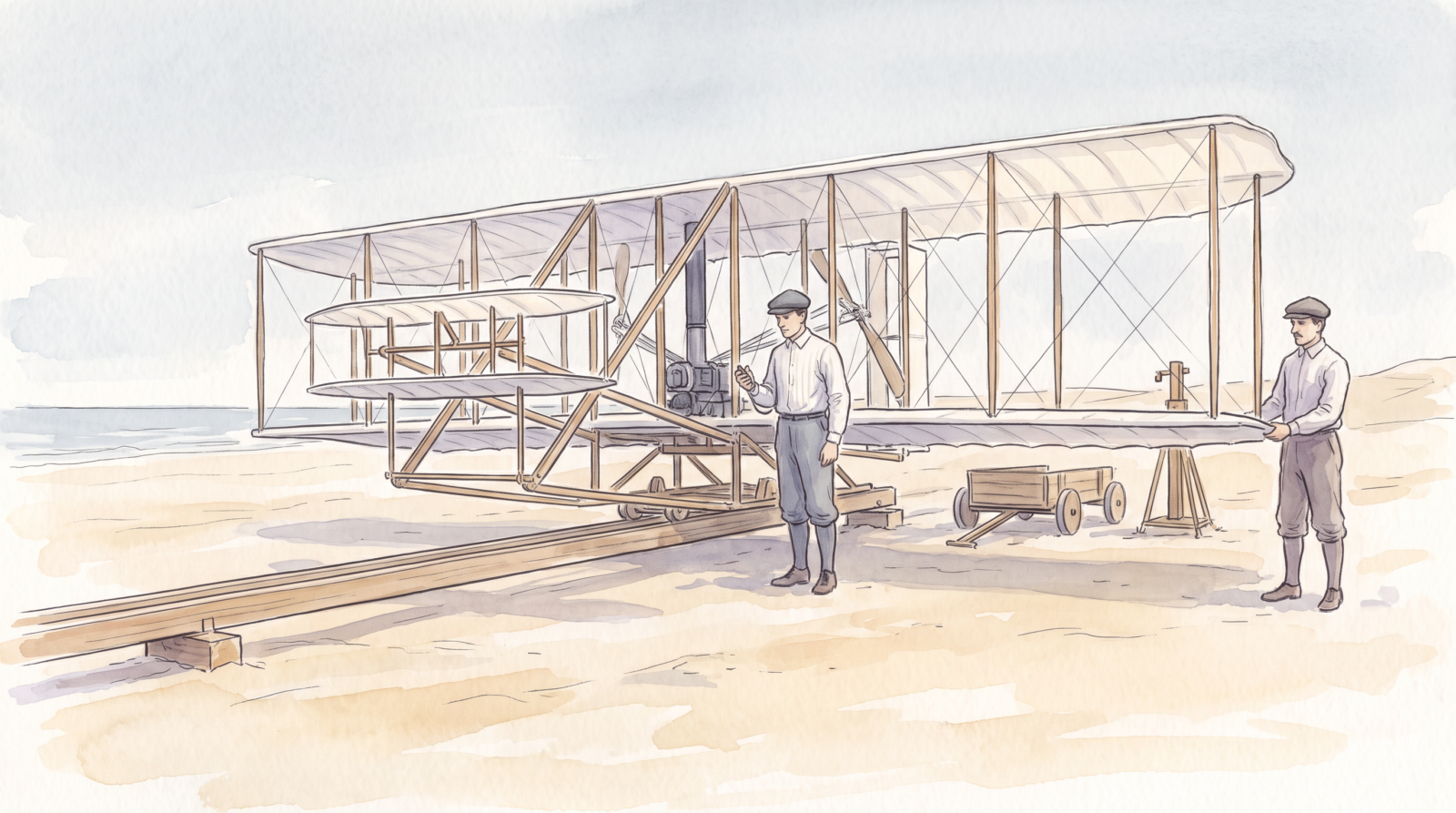
On the morning of Thursday, 17 December 1903, at a quarter past ten, on a stretch of soft sand at the base of the Kill Devil Hills, a few miles south of the village of Kitty Hawk on the Outer Banks of North Carolina, an aircraft rose from a wooden launching rail and flew, under the control of a single pilot, for twelve seconds over a distance of one hundred and twenty feet, less than the wingspan of a Boeing 747. The pilot was Orville Wright, twenty-eight years old, and the machine that carried him was the Wright Flyer, a strange-looking biplane with double-tiered wings braced by an elaborate scaffold of struts and wires, with a forward elevator mounted in front of the lower wing, with twin pusher propellers driven by a chain-and-sprocket transmission from a four-cylinder engine of the brothers’ own design, and with no wheeled landing gear, the lower wing resting on a small wooden dolly that ran along the launching rail. The machine was the product of a four-year programme of research and development that had begun, in 1899, with a small biplane kite flown in the back garden of the Wright cycle shop at 22 Hawthorn Street in Dayton, Ohio, and that had progressed through three full-sized gliders, flown at Kitty Hawk in 1900, 1901, and 1902, to the powered machine of 1903. The first flight of 17 December was, as the Smithsonian Institution would later formally acknowledge, “the first in the history of the world in which a machine carrying a man had raised itself by its own power into the air in full flight, had sailed forward without reduction of speed, and had finally landed at a point as high as that from which it started.” Three more flights were made that morning, with Wilbur at the controls of the fourth and final flight, which covered eight hundred and fifty-two feet in fifty-nine seconds, longer than the wingspan of a 747. The four flights were witnessed by five people: John T. Daniels and W. S. Dough of the Kill Devil Hills Life-Saving Station, Adam Etheridge and J. T. Moore of Nags Head, and W. C. Brinkley of Manteo, none of whom was a journalist. The four flights were recorded, by Daniels and by Orville Wright, by means of the brothers’ Graflex camera, and the resulting photograph of the first flight, with Orville prone on the lower wing of the Flyer at the moment of takeoff, is the single most iconic image in the history of flight. The Flyer, after the fourth flight, was caught by a gust of wind, rolled over and over on the sand, and was so badly damaged that it was never flown again. The Wright brothers, after a brief and almost offhand discussion with the witnesses, walked back to their camp, telegraphed their father back in Dayton to tell him that they had been successful, and spent the rest of the day packing the wreckage into a wooden crate for shipping back to Ohio. The age of the airplane, in other words, began on a chilly morning on a North Carolina beach, was over in less than two minutes of flight time, and was followed by a quiet conversation, a telegram, and the packing of a wooden box.
The bicycle mechanics who taught themselves to fly
\n
Wilbur Wright, the elder of the two brothers, was born in 1867, and Orville Wright, the younger, was born in 1871, in Millville, Indiana, and in Dayton, Ohio, the sons of a bishop of the Church of the United Brethren in Christ, Milton Wright, and of Susan Catherine Koerner Wright. The brothers, after leaving school without formal university education, opened a printing business in 1889 and a bicycle repair shop in 1892, and they operated the Wright Cycle Company in Dayton from 1892 to 1908. The bicycle business, in the 1890s, was a high-technology industry in which new developments in metal tube frames, ball bearings, chain drives, and pneumatic tyres were transforming a small craft into a mass-market consumer product, and the brothers were, by the standards of the 1890s, well-trained mechanical engineers. The brothers did not, however, come to the problem of flight as engineers in the formal sense, and they had no training in aerodynamics, in engine design, or in any of the other disciplines that, in the twentieth century, would constitute the curriculum of an aeronautical engineering school. The brothers came to the problem, as they themselves repeatedly insisted, as bicycle mechanics who had thought carefully about the problem and who had decided that the problem of flight was, in essence, a problem of balance and control rather than a problem of engine power or airframe construction.
\n
The decision of the brothers to focus on the problem of balance rather than on the problem of power was a strategic choice that set them apart from almost all of the other investigators of heavier-than-air flight in the 1890s and 1900s. The most prominent of the other investigators, Samuel Pierpont Langley, the Secretary of the Smithsonian Institution, had spent more than ten years and a substantial portion of the institution’s endowment on the development of a large, steam-driven, model aircraft, the Aerodrome, which Langley had tested over the Potomac River in 1903. The Aerodrome, in its two test flights of 7 October and 8 December 1903, had failed ignominiously, the aircraft being pitched nose-down into the river on both occasions, and the failure of the Aerodrome was one of the most public failures in the early history of American aviation. The failure was, in retrospect, attributable to the fact that Langley had focused on the engine, the airframe, and the thrust, and that Langley had neglected the question of balance and control. The Wright brothers, who had been following Langley’s work closely, concluded that the fundamental problem of flight was the problem of controlling an aircraft in three axes of rotation, the pitch, the roll, and the yaw, and the brothers set out to develop a method of three-axis control that would allow the pilot to maintain the aircraft in equilibrium in any attitude. The method that the brothers developed, the simultaneous warping of the wings to control roll, the use of a forward elevator to control pitch, and the use of a rear rudder to control yaw, is, in its basic form, the method that is still used in fixed-wing aircraft today, and the method is one of the most important single inventions in the history of aviation.
\n
The brothers began their experimental work in 1899, with a small biplane kite flown in the back garden of the bicycle shop at 22 Hawthorn Street. The kite was a five-foot-wingspan biplane, with wings that could be twisted to warp the wing tips, and the kite was designed to test the wing-warping idea. The kite was successful, and the brothers, on the basis of the kite’s success, applied to the United States Weather Bureau for a list of likely places to test a full-sized glider, and the brothers settled on the Kill Devil Hills on the Outer Banks of North Carolina as the most promising site, on the grounds that the Outer Banks had reliable strong winds, that the sand was soft for landings, and that the surrounding area was sparsely populated. The brothers made their first trip to the Outer Banks in September 1900, and they spent the season of 1900 flying a full-sized biplane glider, with the glider being flown as an unmanned kite for most of the season and being flown by Wilbur as a manned glider for a brief period at the end of the season. The 1900 glider was too small to generate useful lift, and the brothers returned to Dayton to build a larger glider for the 1901 season. The 1901 glider was larger and was flown extensively, but the glider produced much less lift than the brothers’ calculations predicted, and the brothers returned to Dayton to investigate the cause of the discrepancy. The cause of the discrepancy turned out to be the existing tables of air pressure on curved surfaces, the so-called Lilienthal data, which the brothers had been using for their calculations, and which turned out to be substantially incorrect. The brothers, in the winter of 1901 to 1902, built their own wind tunnel in the back room of the bicycle shop, and the brothers tested more than two hundred wing models in the wind tunnel, generating their own data on lift and drag. The wind tunnel tests, which the brothers published in 1901 in a paper read before the Western Society of Engineers in Chicago, were one of the first systematic experimental investigations of aerodynamic data, and the wind tunnel data, together with the Lilienthal data that the brothers had superseded, were the basis of the design of the 1902 glider.
\n\n
The 1902 glider and the solution to the control problem
\n
The 1902 glider, which the brothers flew at the Kill Devil Hills in the autumn of 1902, was the machine in which the brothers solved the fundamental problem of three-axis control. The 1902 glider was, in its basic configuration, similar to the 1901 glider, with a wingspan of thirty-two feet, a chord of five feet, and a total lifting surface of approximately three hundred and five square feet, but the 1902 glider was fitted with the now-complete three-axis control system. The system, in the form in which the brothers developed it in the 1902 season, consisted of a wing-warping mechanism for roll, a forward elevator for pitch, and a rear rudder for yaw, with the three systems linked by means of a hip cradle that the pilot used to operate the elevator with his hips and the rudder with his feet. The system, in its essential form, is the system that is still used in fixed-wing aircraft today, and the system is the invention that the Wright brothers are most often credited with in the history of aviation. The 1902 glider, in addition to the three-axis control system, was also the first glider in which the brothers were able to fly extended flights of several minutes, and the brothers made between seven hundred and one thousand flights in the 1902 glider over the course of the season, including flights in which they were able to bank, to turn, and to maintain a constant heading in the strong Outer Banks wind. The 1902 glider, in the cumulative effect, was the most successful of the brothers’ gliders, and the 1902 glider was the basis of the design of the powered machine of 1903.
\n
The solution to the problem of three-axis control was, in retrospect, the breakthrough that made powered flight possible. The solution was, however, by no means obvious to the brothers’ contemporaries, and the brothers’ first publication of the three-axis control system, in a brief paper delivered to the Western Society of Engineers in 1901 and in a longer paper in the Journal of the Western Society of Engineers in 1902, attracted almost no attention. The brothers, in the years after the 1902 season, attempted to interest the United States Army, the United States Navy, and a number of other potential sponsors in the development of a powered aircraft, and the brothers were uniformly unsuccessful in their attempts to secure sponsorship. The brothers’ frustration at the failure of the United States military and the United States government to take an interest in their work was one of the most striking features of the early Wright story, and the frustration was a recurring theme in the brothers’ letters to Octave Chanute, the Chicago engineer and aviation enthusiast who was one of the brothers’ most important correspondents. The brothers decided, in the spring of 1903, to design and build a powered aircraft on their own, without any external sponsorship, and the brothers set to work on the design of the engine, the propellers, and the airframe in the spring of 1903. The engine, which was designed by the brothers and built in the back room of the bicycle shop by their mechanic, Charlie Taylor, was a four-cylinder water-cooled engine of approximately twelve and a half horsepower, and the engine was, for its time, a remarkable piece of engineering. The propellers, which the brothers designed themselves on the basis of their own aerodynamic data, were the most efficient propellers that had been built to that date, and the propellers were one of the most important of the brothers’ contributions to the development of aviation. The airframe, which was built in the back room of the bicycle shop and shipped to the Kill Devil Hills in the autumn of 1903, was a biplane configuration similar to the 1902 glider but with a longer wingspan of forty feet, a higher aspect ratio, and the new four-cylinder engine mounted on the lower wing between the wings.
\n\n
The four flights of 17 December 1903
\n
The 1903 Flyer, when the brothers assembled it at their camp at the Kill Devil Hills in late November 1903, was, in its physical character, a strange and unwieldy machine. The Flyer was a biplane, with two wings of forty-foot span and six-foot chord, and the wings were braced by an elaborate network of vertical struts and diagonal wires. The wings were covered with a fine bleached muslin, and the wings were given a slight downward droop at the tips to give the aircraft the appearance of a soaring bird. The Flyer was driven by a four-cylinder engine of twelve and a half horsepower, and the engine drove two pusher propellers mounted behind the wings by means of a chain-and-sprocket transmission. The forward elevator, which was used to control the pitch of the aircraft, was mounted in front of the lower wing on a pair of long booms, and the rear rudder was mounted at the back of the aircraft. The Flyer was launched from a wooden rail sixty feet long, and the rail was mounted on a wooden dolly that ran along the rail. The Flyer, after the launch, slid along the rail on the dolly until the aircraft reached flying speed, and the dolly then dropped away and the aircraft lifted off the rail. The Flyer, in the present state of reconstruction, is one of the most distinctive and most recognisable aircraft in the history of aviation, and the Flyer, after its reconstruction by Orville Wright in 1928 and its transfer to the Smithsonian Institution in 1948, has been on display in the National Air and Space Museum in Washington, D.C., since 1948.
\n
The first attempt at powered flight took place on Monday, 14 December 1903, in the late afternoon, with Wilbur at the controls. The Flyer was placed on the launching rail, the engine was started, and the aircraft was released. The Flyer lifted off the rail, climbed to a height of approximately ten feet, stalled, and pitched forward onto the sand, breaking the front elevator. The accident, which was witnessed by John T. Daniels, Adam Etheridge, and W. S. Dough, the three members of the Kill Devil Hills Life-Saving Station who had been watching the attempts, was a discouraging but not disastrous failure, and the brothers returned to their camp to repair the damage. The repairs, which took three days, were completed by Wednesday, 16 December, and the brothers, with a strong wind blowing from the north, prepared for another attempt on the morning of Thursday, 17 December. The brothers tossed a coin to decide who would have the first chance, and Wilbur, who had won the toss on Monday, lost the toss on Thursday to Orville. Orville took his place on the lower wing of the Flyer, lying prone with his hips in the cradle and his hands on the hip elevator, and the engine was started. The Flyer moved down the launching rail, the dolly dropped away, and at 10:35 a.m. the aircraft lifted off the rail and flew, in a slightly crabbed line, for a distance of one hundred and twenty feet in twelve seconds, at a height of approximately ten feet above the sand, and landed smoothly on the sand beyond. The flight, as Orville later recalled, was the first in the history of the world in which a machine carrying a man had raised itself by its own power into the air in full flight, and the flight was the first sustained, powered, controlled flight of a heavier-than-air aircraft.
\n
The brothers, in the next hour, made three more flights. The second flight, with Wilbur at the controls, covered one hundred and seventy-five feet in twelve seconds. The third flight, with Orville at the controls, covered two hundred feet in fifteen seconds. The fourth and final flight, with Wilbur at the controls, covered eight hundred and fifty-two feet in fifty-nine seconds, and the flight was, as the contemporary press reports noted, the longest flight of the day and the most convincing demonstration that the brothers had solved the problem of sustained, powered, controlled flight. The fourth flight ended when the aircraft hit the sand, breaking the front elevator supports, and the brothers, after a brief discussion of the damage, were about to begin repairs when a sudden gust of wind caught the Flyer and tumbled it end over end across the sand, breaking the aircraft into a jumble of sticks and wires. The aircraft was so badly damaged that it was never flown again, and the brothers, after a brief conversation with the five witnesses, returned to their camp to telegraph their father in Dayton. The telegram, which has been preserved and which is one of the most famous telegrams in the history of technology, reads, in its entirety, “Success four flights thursday morning all against twenty one mile wind started from level with engine power alone average speed through air thirty one miles longest 57 seconds inform press home christmas.” The brothers, after the telegram, spent the rest of the day packing the wreckage of the Flyer into a wooden crate for shipping back to Dayton, and the brothers returned to Dayton themselves a few days later by train.
\n\n
The reception of the flights and the controversy with the Smithsonian
\n
The reception of the flights of 17 December 1903, in the American and European press, was remarkably muted. The first press account, a brief Associated Press dispatch, was published in the Washington Post and in a number of other regional newspapers on 18 December, and the dispatch was, in most papers, buried on an inside page. The dispatch was, in its first form, almost offhand in its description of the event, and the dispatch did not attract the attention that one might have expected. The brothers, in the weeks after the flights, attempted to interest the press in the achievement, and the brothers were particularly anxious to secure an interview with a major newspaper, but the brothers were unsuccessful. The brothers’ father, Milton Wright, who had received the telegram, travelled to Dayton in time to spend Christmas with the brothers, and the brothers, on Christmas Day, sent a longer press release to a number of newspapers, but the press release was, in most cases, ignored. The brothers’ explanation for the muted reception, in their later letters and in Orville’s later interviews, was that the brothers’ reticence in the years before the flights, in particular the brothers’ refusal to discuss their work in public, had resulted in a perception, in the press and in the public, that the brothers were not serious investigators of flight. The brothers’ explanation was, in retrospect, a substantial part of the truth, and the brothers’ reticence in the years before the flights was, in fact, one of the principal reasons for the muted reception.
\n
The controversy with the Smithsonian Institution, which would dominate the brothers’ later relations with the American press and the American government, began within a year of the flights. The Smithsonian, under the leadership of Charles Doolittle Walcott, who had become Secretary in 1907, refused to give the brothers credit for the first powered, controlled flight of a heavier-than-air aircraft, and the Smithsonian, in the official exhibits and in the official publications of the institution, gave the credit instead to Samuel Pierpont Langley, the former Secretary of the Smithsonian, whose Aerodrome had failed in 1903 but whose reputation as an aviation pioneer was, in the early twentieth century, widely established. The brothers, in 1910, offered the 1903 Flyer to the Smithsonian as a gift, and the Smithsonian declined the offer on the grounds that the institution was unwilling to display a “practical” aircraft in its galleries. The brothers, in 1928, sent the Flyer to the Science Museum in London for safekeeping, and the Flyer was displayed in the Science Museum for the next twenty years. The Smithsonian, in 1942, issued a formal statement acknowledging that the Wright brothers had been the first to fly, and the Smithsonian, in 1948, accepted the Flyer as a permanent gift from the Orville Wright estate. The Smithsonian, in 1948, also entered into a contractual agreement with the Orville Wright estate that, in the cumulative effect, required the Smithsonian to acknowledge the Wright brothers as the first to fly in any official exhibit or publication. The Smithsonian’s contractual obligation was, in the 1970s, the subject of a new controversy when the Smithsonian, in 1976, exhibited a model of Langley’s Aerodrome under a label that some readers interpreted as suggesting that the Aerodrome had been capable of flight, and Orville Wright’s estate, in 1948, had reserved the right to remove the Flyer from the Smithsonian if the institution ever published such a claim. The Smithsonian, in the controversy that followed, formally reaffirmed the Wrights’ priority, and the Flyer has remained on display at the National Air and Space Museum since 1976. The controversy, in the cumulative effect, was one of the most bitter and most public priority disputes in the history of American science, and the controversy was one of the most striking illustrations of the difficulty of establishing priority for a contested invention.
\n\n
The development of practical aviation, 1903 to 1914
\n
The Wright brothers, in the eleven years between the first flight of December 1903 and the death of Wilbur Wright of typhoid fever in 1912, developed the airplane from a contraption that could fly for twelve seconds into a practical aircraft that could fly for hours, that could carry a passenger, that could execute basic aerobatic manoeuvres, and that could be operated commercially. The brothers, in 1904, built a second Flyer, the Flyer II, and the brothers tested the Flyer II at a new site, Huffman Prairie, a tract of farmland a few miles east of Dayton that the brothers had leased from a local farmer. The Flyer II was similar to the 1903 Flyer but with a more powerful engine and with the launching rail replaced by a simple wooden derrick. The Flyer II made more than a hundred flights in 1904, with the longest flight of the season being just over five minutes, and the flights were the basis of the development of the techniques that the brothers would use in the years to come. The brothers, in 1905, built a third Flyer, the Flyer III, and the Flyer III, in the autumn of 1905, was the first practical airplane in the history of the world. The Flyer III, in the hands of Wilbur, made a flight of thirty-nine minutes on 5 October 1905, and the flight, as the brothers’ diary records, was the first flight in which the pilot was able to take his hands off the controls for any length of time without the aircraft deviating from its course. The Flyer III was, in the cumulative effect, the first practical airplane, and the Flyer III was the basis of the development of the airplane in the years that followed.
\n
The brothers, in the years between 1905 and 1908, were unable to secure any contracts for the sale of the airplane, and the brothers, in this period, devoted most of their time to the defence of their patents and to the development of the airplane as a practical vehicle. The brothers, in 1906, were granted a US patent for the three-axis control system, and the brothers, in 1907, began a campaign to interest the United States Army in the purchase of an airplane. The campaign, in 1908, was successful, and the United States Army, in February 1908, signed a contract for the purchase of a Wright military airplane for the sum of twenty-five thousand dollars. The brothers, in 1908, made a series of demonstration flights at Fort Myer, Virginia, and at Le Mans, France, and the demonstrations, in particular the demonstration at Le Mans, established the brothers as the leading aviators in the world. The demonstration at Le Mans, in August 1908, was attended by a large number of European officials and journalists, and the demonstration was, for the European public, the first clear evidence that the airplane was a practical vehicle. The European public, in the years between 1908 and 1914, took up the airplane with a speed and a passion that the American public did not match, and the European public was responsible for most of the development of the airplane in the period before the First World War. The brothers, in 1909, formed the Wright Company, and the Wright Company, in the years between 1909 and 1914, was the leading aircraft manufacturer in the United States.
\n
The development of practical aviation in the years between 1903 and 1914 was, in the cumulative effect, one of the most rapid and most consequential developments in the history of technology, and the development was the basis of the transformation of the modern world in the twentieth century. The development, in the military sphere, was the basis of the development of the military aviation of the First World War, in which the airplane was used for reconnaissance, for bombing, and for the air-to-air combat that would become one of the most distinctive features of the modern battlefield. The development, in the commercial sphere, was the basis of the development of the commercial aviation of the interwar period, in which the airplane was used for the transportation of mail, of passengers, and of freight, and in which the airline industry, as a major sector of the modern economy, was established. The development, in the social sphere, was the basis of the transformation of the modern world in which the airplane became one of the most distinctive features of the modern landscape, and in which the airplane became one of the most important means of communication between the different parts of the world. The development, in the cultural sphere, was the basis of the transformation of the modern imagination in which the airplane became one of the most powerful symbols of the modern world, and in which the airplane became one of the most important subjects of the modern art and the modern literature. The development, in the cumulative effect, was one of the most important and most consequential developments in the history of the world, and the development was, in the most direct possible sense, the consequence of the twelve seconds of flight of 17 December 1903.
\n\n
The afterlife of the 1903 Flyer
\n
The 1903 Flyer, in the years after the first flights, has had a remarkable afterlife as one of the most iconic objects in the history of American technology. The Flyer, after being shipped back to Dayton in 1903, was stored in a shed behind the Wright Cycle Company for several years, and the Flyer was occasionally taken out and exhibited at local events. The brothers, in 1908, lent the Flyer to the United States Army for display at the Army War College, and the Flyer was exhibited in Washington, D.C., for several years. The brothers, in 1910, offered the Flyer to the Smithsonian Institution as a gift, and the Smithsonian declined the offer on the grounds that the institution was not interested in displaying a “practical” aircraft. The brothers, in 1928, sent the Flyer to the Science Museum in London for safekeeping, and the Flyer was exhibited in the Science Museum for the next twenty years. The Flyer was, in the Science Museum, displayed in a place of honour, and the Flyer was one of the most popular exhibits in the museum. The Flyer, in 1948, was returned to the United States and was donated to the Smithsonian Institution, and the Flyer has been on display in the National Air and Space Museum in Washington, D.C., since 1948. The Flyer, in the present moment, is one of the most iconic and most recognisable objects in the history of American technology, and the Flyer is one of the most visited objects in the National Air and Space Museum.
\n
The Flyer, in the years after 1948, has been the subject of a continuous programme of conservation and study by the Smithsonian, and the Flyer has been the subject of a substantial body of scholarly literature. The most important of the conservation projects, in the 1990s, was a major restoration of the Flyer that was undertaken by the National Air and Space Museum, and the restoration, which was completed in 1998, returned the Flyer to as close to its original 1903 configuration as the evidence allowed. The restoration, in the cumulative effect, was one of the most thorough and most successful in the history of conservation, and the restoration has been the basis of a renewed programme of study of the Flyer. The Flyer, in the present moment, is one of the most studied and most photographed objects in the history of American technology, and the Flyer is one of the most important single objects in the history of the development of the airplane. The Flyer, in the long view of the history of the development of the airplane, is the most important single object in the history of the development, and the Flyer is the most important single object for the modern understanding of the development of the airplane.
\n
The 17 December 1903, in the long view of the history of the world, is one of the most important dates in the history of technology, and the four flights of the day are one of the most important events in the history of the world. The four flights, in the cumulative effect, were the first steps in the development of the airplane that would, in the course of the twentieth century, transform the world, and the four flights were, in the cumulative effect, the first steps in the development of the technology that would become one of the most distinctive features of the modern world. The four flights were made by two brothers from a bicycle shop in Dayton, Ohio, who had no formal training in engineering or in aerodynamics, who had no financial support from the United States government or from any of the established scientific institutions of the day, and who, in the most literal sense, taught themselves to fly. The four flights were, in this sense, one of the most extraordinary achievements in the history of the development of technology, and the four flights were, in the cumulative effect, one of the most powerful expressions of the ingenuity and the determination of the human spirit in the modern world. The Wright brothers, in the long view of the history of the world, are among the most important of the inventors of the modern world, and the four flights of 17 December 1903 are among the most important of the events of the modern world.
\n\n
References
\n
- \n
- In Search of the Real Wright Flyer - Smithsonian Air & Space Magazine, 2003 (last accessed 14 October 2026).
- 1903 Wright Flyer - Smithsonian National Air and Space Museum object record (last accessed 14 October 2026).
- To Fly! The Wright Brothers and the Great Race for Flight - Smithsonian Magazine, 2003 (last accessed 14 October 2026).
- Wright flyer of 1903 - Encyclopaedia Britannica, last updated 2026 (last accessed 14 October 2026).
- Wright Flyer - Wikipedia, the free encyclopedia (last accessed 14 October 2026).
- Wright Flyer - Wikipedia, the free encyclopedia (last accessed 14 October 2026).
- Crouch, Tom D. The Bishop’s Boys: A Life of Wilbur and Orville Wright - W. W. Norton, 1989 (WorldCat).
- Tobin, James. To Conquer the Air: The Wright Brothers and the Great Race for Flight - Free Press / Simon & Schuster, 2003 (WorldCat).
- McCullough, David. The Wright Brothers - Simon & Schuster, 2015 (WorldCat / Open Library).
- Jakab, Peter L. Vision of a Visionary: How the Wright Brothers Invented the Airplane - Houghton Mifflin, 1990 (WorldCat / Open Library).
- Howard, Fred. Wilbur and Orville Wright: A Bibliography of the Brothers and Their Contemporaries, 1882 to 1948 - McFarland, 1998 (WorldCat / Open Library).
- Wolko, Howard S., ed. The Wright Flyer: An Engineering Perspective - Smithsonian Institution Press, 1987 (WorldCat).
\n
\n
\n
\n
\n
\n
\n
\n
\n
\n
\n
\n
“,
“word_count”: 0
}