History
The Seven Voyages and the Sea Ban
Contents ▾
In the spring of 1405, a fleet of more than two hundred ships left the Yangtze River with twenty-eight thousand men aboard. Over the next twenty-eight years that fleet, and the six successors that followed it, would cross the Indian Ocean seven times, calling at Calicut, Hormuz, Mecca, Mogadishu, and Malindi. The commander was a Muslim eunuch from Yunnan, originally named Ma He, who had been captured as a child, castrated, and given the surname Zheng by the Prince of Yan. The Prince of Yan became the Yongle Emperor.
The seven voyages were the largest naval expeditions of the pre-modern world. They preceded Vasco da Gama by almost ninety years, preceded Columbus by eighty-five, and circumnavigated or touched most of the Indian Ocean basin at a moment when no European state had yet sent a ship around the Cape of Good Hope. They were the high-water mark of a Chinese maritime tradition that had been building for centuries. Then they stopped. The Ming court pulled the fleet home, burned the records, and imposed a sea ban that lasted, in various forms, until the dynasty fell.
1. Zheng He and the Yongle Emperor
Zheng He was born Ma He in 1371 in Kunyang, in Yunnan, into a Muslim family of Mongol or Hui origin that had been settled in southwest China for several generations. In 1381, when he was ten, the Ming armies under general Fu Youde swept into Yunnan to mop up the last Mongol loyalists. Ma He was one of tens of thousands of boys captured in the campaign. He was castrated, like most captured boys of military age, and sent north as a eunuch servant to the household of Zhu Di, the Prince of Yan, who held the fief of Beiping, the old Mongol capital, on the northern frontier.
Zhu Di’s household was the best finishing school a young eunuch could have asked for. The Prince of Yan was the most militarily serious of the late Hongwu Emperor’s sons, and his court was full of soldiers, scholars, and frontier officials. Ma He rose through the household service, picked up a working knowledge of Chinese, Persian, and Arabic from the cosmopolitan frontier, and earned his master’s trust on the long campaigns against the Mongols on the steppe. In 1390, when Zhu Di led a major expedition against the Mongol pretender Naghachu, Ma He was at his side, and he distinguished himself enough to be promoted to a senior eunuch rank and given the surname Zheng. The boy captured in 1381 had, by his early thirties, become one of the most senior eunuchs in the Ming court.
In 1402, the Prince of Yan rebelled against his nephew, the Jianwen Emperor, marched south with the northern armies, captured the Ming capital at Nanjing, and took the throne as the Yongle Emperor. The Yongle Emperor’s legitimacy was contested; the Confucian bureaucracy considered him a usurper. He needed a foreign-policy project that would project his authority across Asia without relying on the scholar-officials who had opposed him. The voyages were, among other things, a solution to that political problem. They were run by the eunuch faction, paid for out of the imperial household budget, and aimed at the foreign tributaries whose recognition of the new Ming emperor was the public evidence of his legitimacy. The Yongle Emperor was a usurper who needed a fleet.
He also needed a commander. Zheng He was the natural choice: a trusted servant from the Prince of Yan’s household, an experienced military officer, a Muslim who could engage credibly with the Muslim trading communities of the Indian Ocean, and a high-ranking eunuch who could command obedience from the other eunuchs who would make up much of the fleet’s officer corps. He was also, in his late thirties, the right age to lead a campaign that would last the better part of three decades.
2. The fleet itself
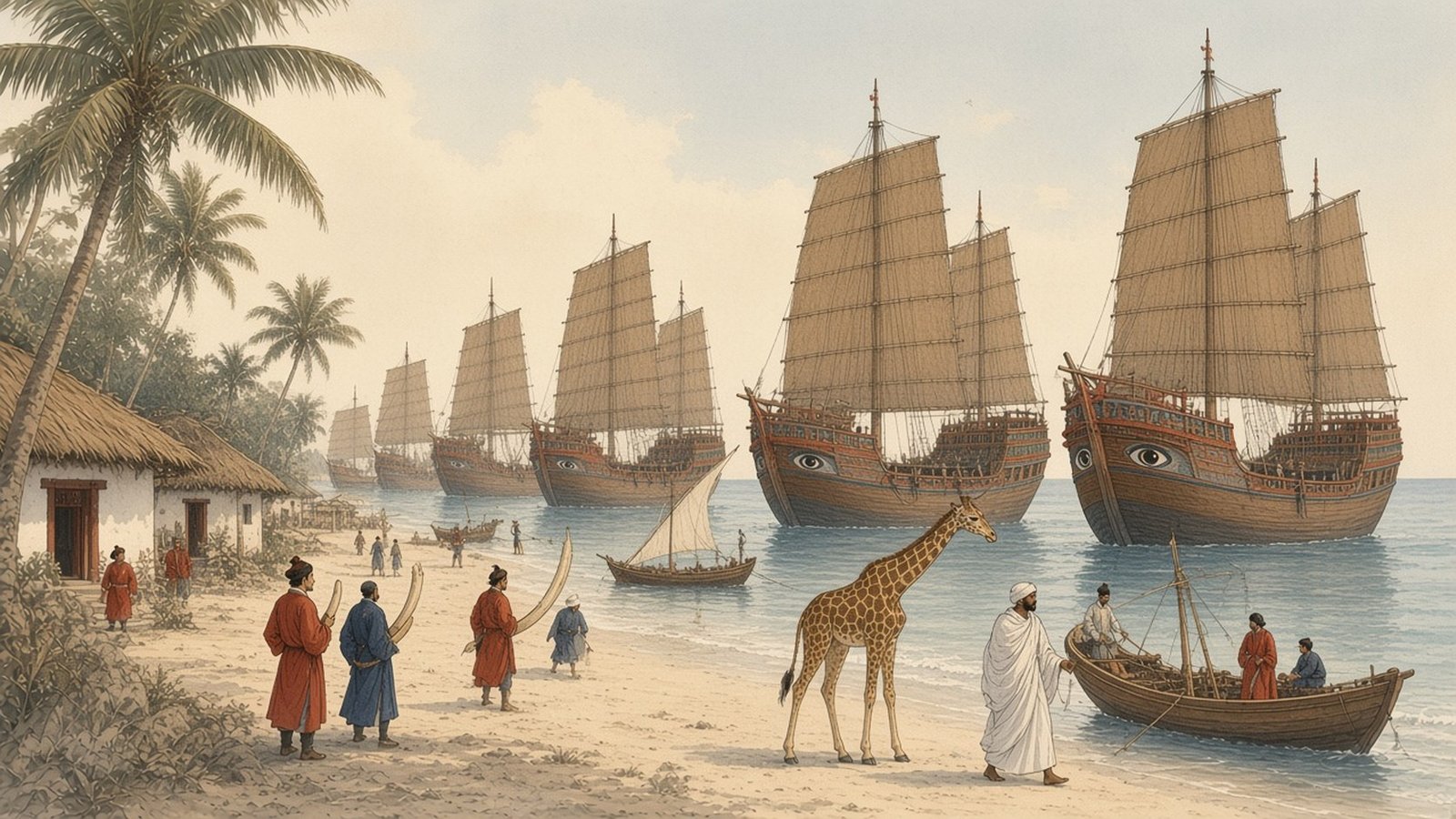
The flagship of the first fleet, in the Ming court chronicles, was a “treasure ship” of nine masts, four hundred chi long, and one hundred and sixty chi wide. By the most generous modern reading of the chi, that puts the ship at roughly 130 metres, longer than any wooden vessel ever built before the modern era. Most Western naval historians think the length is exaggerated, perhaps by half, but even a length of sixty or seventy metres would be considerably larger than any contemporary European ship, and the timber mathematics of a vessel that size are not trivial. Whatever the precise dimensions, the treasure ships were several times the size of the caravels and carracks that the Portuguese and Spanish were beginning to send down the African coast.
The fleet was not just the treasure ships. According to the Ming chronicler Ma Huan, who served as a translator on several of the voyages and wrote a detailed account after his retirement, the first fleet comprised 62 treasure ships and roughly 190 support vessels: horse transports, water tankers, troop carriers, supply ships, and patrol boats. The combined crew of about 28,000 included sailors, soldiers, carpenters, doctors, astrologers, and a substantial translation office. The translations were not an afterthought: the fleet carried Arabic, Persian, Tamil, and Malay speakers, and the diplomatic protocols of each port of call were carefully prepared in advance by the Ministry of Rites in Nanjing.
The crews themselves were a cross-section of Ming China. The sailors and soldiers were drawn from the southern coastal provinces, with a particular concentration from Fujian and Guangdong, where the maritime tradition was already old. The officers were disproportionately eunuchs of the imperial household, including several of Zheng He’s closest associates. The scholars and translators were recruited from the imperial bureaucracy. The ships were built at the Longjiang shipyards near Nanjing, using teak from the southwest and fir from the south, and they were provisioned for the round trip with months of grain, water, dried fish, and tea. The logistics of the voyages were considerable: each fleet represented roughly a tenth of the annual revenue of a single middling province.
3. The seven voyages
The first three voyages (1405 to 1409, 1407 to 1409, 1409 to 1411) established Calicut in Kerala as the main Indian Ocean port of call. Zheng He’s fleet brought silk, porcelain, gold thread, copper, and silver; it carried back pepper, cinnamon, gems, ivory, and exotic animals. The Chinese commodities were used both as diplomatic gifts to local rulers and as goods to sell in the bazaars. Calicut was a reasonable first choice: it was a major pepper port under a Hindu king, the local Muslim merchant community was large and well-connected, and the harbor was protected by the monsoon cycle that the Chinese navigators had learned to read over centuries of Indian Ocean trade. The third voyage in particular was, in effect, a punitive expedition: a Chinese diplomatic mission had been roughed up by the local Sinhala court in Ceylon, and the fleet raided the capital, captured the king, and took him back to Nanjing for a ceremonial humiliation before returning him home.
The fourth voyage reached Hormuz at the mouth of the Persian Gulf in 1415 and returned via Calicut. The fifth (1417 to 1419) and sixth (1421 to 1422) pushed further west, with the sixth voyage reportedly reaching the East African coast as far as Malindi and Mombasa, where a Chinese porcelain trade has been identified in the archaeology. The seventh and final voyage, after the Yongle Emperor’s death, was launched by the Xuande Emperor in 1431 and returned in 1433. Zheng He is recorded to have died on the return, or shortly after, and was buried at sea by tradition.
The most famous incident of the voyages happened in 1414. Among the gifts the Sultan of Malindi sent back to the Yongle Emperor was a giraffe, which the court astrologers read as the qilin of the classics, a beast whose appearance signalled a virtuous reign. The Yongle Emperor was pleased, the beast was paraded through the southern capital, and the conflation of an African giraffe with a Chinese mythical animal became one of the best-known images of the voyages. The giraffe episode is sometimes read as evidence that the voyages were a long-running diplomatic exercise in flattery and prestige. That is a fair reading. It is also a fair reading that the Yongle Emperor’s court simply did not know what a giraffe was, and that the court astrologers reached for the closest Chinese category they had.
4. The Indian Ocean world
The seven voyages did not take place in an empty sea. The Indian Ocean in the early fifteenth century was already a busy, multilingual trading system, and Zheng He’s fleets slotted into it. The Gujarati merchants of western India traded up and down the East African coast, in cotton, grains, and horses. The Malay sailors of the Straits of Malacca connected South China, Java, and the eastern Indian Ocean. The Persian and Arab merchants of Hormuz handled the long-haul trade in pepper, cloves, and nutmeg from the Spice Islands, and the slave trade from the East African coast. The Chinese, before the Ming voyages, were already a significant presence in the trade: Chinese ceramics from the Song and Yuan dynasties have been found in archaeological sites from Sri Lanka to Kenya.
What the Ming voyages added to this system was the projection of state power. The earlier Chinese maritime activity had been private and commercial, conducted by merchants out of ports like Quanzhou and Guangzhou. The Ming voyages were official, paid for by the imperial household, and backed by the kind of military force that no merchant fleet could match. The Indian Ocean trading world of the early fifteenth century was not surprised by the arrival of a Chinese fleet: it was surprised that the fleet was a state project rather than a merchant consortium. The Chinese came as a tributary-collecting imperial mission, not as a profit-seeking commercial one, and the difference mattered for what came next.
The diplomatic protocols of the voyages were elaborate. Ma Huan’s account and the surviving inscriptions describe formal exchanges of gifts, the reading of imperial letters, the establishment of a stone stele at Calicut marking the visits, and the use of Muslim diplomatic conventions when dealing with Muslim rulers. The fleet carried Muslim diplomatic staff for this reason, and the Chinese Muslim commanders and scholars could function as cultural translators. The voyages were, in a sense, the last major pre-modern exercise in long-distance Chinese diplomacy before the modern era.
The trading language of the Indian Ocean at the time was a pidginised form of Persian, with Malay and Arabic as secondary languages of commerce, and Tamil as a third in southern India. Ma Huan’s vocabulary in the Ying-yai Sheng-lan, his account of the voyages, draws on all three. The Chinese had been trading in the Indian Ocean in some form since the Tang dynasty, and by the Ming period Chinese-speaking merchants were a known presence in the bazaars of Hormuz and Calicut, even before the official voyages. The official voyages, with their Muslim commanders and their Muslim translators, were the formalisation of an informal Chinese commercial presence that had been building for several centuries. The same is true of the Southeast Asian trade, where the Chinese had been a presence in the Straits of Malacca and the ports of Java at least since the Song. The Ming voyages, like the European voyages that followed, were the political arm of an existing commercial relationship, not the beginning of one.
5. Why they stopped
The standard answer, repeated in Chinese school textbooks for half a century, is that the voyages were a private indulgence of the Yongle Emperor and that the Confucian bureaucracy, the eunuch faction, and the cost of the new capital at Beijing together ended them. The Hongxi Emperor (r. 1424 to 1425) cut the budget for the fleet and turned the page inward. The Xuande Emperor (r. 1425 to 1435) allowed the seventh voyage as a closing gesture but did not authorise another. The Ming followed with the haijin, the sea ban, which restricted private maritime activity and stayed in force in various forms until the dynasty fell in 1644.
The harder answer is that the voyages were not profitable on their own terms. The tributary system they served was a way of managing China’s prestige, not its trade. Chinese merchants handled the South China Sea and Indian Ocean commerce through private networks that did not need state fleets. The Grand Canal, rebuilt under the Yongle Emperor, brought southern grain to the northern capital more cheaply than any naval logistics could. The strategic logic of the voyages was political, and the political will evaporated when the Yongle Emperor died. The same argument has been made about the Apollo program, and the parallel is not a bad one: both were political projects with scientific and prestige payoffs, both were extremely expensive, and both were vulnerable to a successor administration that did not see the point.
A third answer, less often given, is that the voyages did not have a clear institutional constituency. The merchants who benefited from Indian Ocean trade were not the people who paid for the voyages. The Confucian scholar-officials, who paid for the voyages in taxes, did not benefit. The eunuch faction, which ran the voyages, was politically vulnerable whenever the emperor was not personally invested. The Yongle Emperor was personally invested; his successors were not. The voyages ended because the constituency that supported them was a single man.
6. The sea ban and after
The haijin, the sea ban, is usually dated to the Hongxi Emperor’s reign, with the first formal restrictions in 1421 and the most stringent versions imposed by the Xuande and later emperors. The ban took several forms: a prohibition on privately owned seagoing vessels, restrictions on the number of masts a merchant could have on his junk, requirements that coastal residents register with the authorities, and a total ban on the export of certain strategic goods. The ban was unevenly enforced: it was strictest in the early years, lax during periods when the imperial household needed foreign goods, and gradually abandoned as the Ming state weakened in the sixteenth century. But it was, for a century and a half, a clear policy. The Ming court had decided that the sea was not where Chinese wealth or attention should be.
The ban had several effects. It damaged the Chinese maritime economy in the South China Sea and Indian Ocean. It pushed Chinese merchants to operate under foreign flags, or out of foreign ports like Manila, where the Spanish welcomed them as trading partners. It left the coast vulnerable to the wokou pirates of the sixteenth century, who were sometimes Chinese and sometimes Japanese, and who ran smuggling networks that the ban itself had created. And it cleared the field for the Portuguese, the Spanish, and the Dutch, who arrived in the Indian Ocean in force in the sixteenth century with no significant Chinese state competitor to deal with. The European ascendancy in Asian maritime trade in the sixteenth and seventeenth centuries is partly an unintended consequence of the Ming sea ban.
The wokou crisis of the mid-sixteenth century is the clearest evidence of how badly the ban had worked. The pirates operated in organised fleets of several hundred junks, raiding coastal villages from Shandong to Guangdong, and at their peak in the 1550s they extracted tribute from the Ming court itself. The Ming response was a partial relaxation of the ban, combined with a long-running programme of naval rebuilding that produced a generation of professional admirals including the famous Qi Jiguang. The relaxation was grudging and never complete: the ban was not formally lifted until 1567, and even then coastal residents who wanted to trade had to apply for licences, post bonds, and limit their voyages to specific routes. The maritime culture that the ban had damaged did not recover in the Ming period. The Qing, who succeeded the Ming in 1644, were even more restrictive in their first century, banning all ocean-going voyages outright until 1683. The Chinese maritime economy of the eighteenth century, when it did recover, was a coasting trade, not an ocean trade.
7. The comparison with europe
Comparison with the Iberian voyages a generation later is misleading but irresistible. Zheng He’s fleets were larger, earlier, and reached further west than any European. They were not, however, exploratory. They knew where they were going. They did not establish colonies, did not seize territory, and did not begin the mercantile and plantation economies that the Portuguese and Spanish set in motion from the 1490s. The Chinese fleets carried tribute; the European fleets carried cargo. The world those two kinds of voyages made was different.
The deeper difference is institutional. The Iberian voyages were state-private partnerships, with the crown licensing merchants and the merchants sharing the profits with the crown. The Ming voyages were state projects, with the imperial household funding the fleet and keeping most of the diplomatic benefits. The Iberian model created a constituency for overseas expansion, because the merchants who financed it had a direct economic interest in continuing it. The Ming model created no such constituency, because the merchants were excluded and the political benefits did not survive the Yongle Emperor. The institutions mattered more than the size of the ships.
A related difference: the Ming court had access to the technologies and the knowledge of a great seafaring tradition. Chinese junks, Chinese navigation by compass and stars, Chinese shipbuilding, Chinese gunpowder weapons, all of these were at the leading edge of the pre-modern world. The Chinese did not lack the technical capacity to project power overseas. They lacked the political and economic reasons to do so. The European voyages of the same period were powered by a search for direct access to the spice trade, by a competitive state system in which no single European power could monopolise, by a religious missionary impulse, and by the simple fact that the Atlantic powers had a captive labour supply in West Africa. The Ming court had none of these forces, and so the voyages stopped.
8. The afterlife in evidence and memory
The physical traces of the voyages are sparse but real. Chinese porcelain from the early Ming period has been excavated in dozens of sites from the Swahili coast to the Red Sea, with concentrations on the Kenyan coast near Mombasa and Malindi. Chinese coins of the Yongle period have been found on Mafia Island off Tanzania. A Chinese stone inscription recording a visit by Zheng He to Galle, in Sri Lanka, was discovered in 1911 and is now in the Colombo National Museum. A series of Muslim gravestones with Chinese characters and Arabic inscriptions, found in the Swahili coastal towns, have been tentatively linked to the voyages, though the dating is uncertain. The picture from the archaeology is consistent with the written record: the fleet went where the chronicles said it went, and it left physical traces along the way.
The memory of the voyages has been put to work for several different purposes since the early twentieth century. The 1905 revolution in China looked back to the Ming maritime tradition for inspiration; the early Republican period produced a number of popular histories that treated Zheng He as a Chinese analogue to the European maritime explorers. The People’s Republic has used the voyages more deliberately: the 2005 anniversary of the first voyage was a major state event, and the official Chinese line since then has been that Zheng He’s voyages were peaceful, mutually beneficial, and a model for contemporary Chinese foreign policy, in contrast to the European voyages. The framing is partly true, partly convenient, and partly modern. The Ming court itself did not run the voyages as a foreign-policy ideal; it ran them as the Yongle Emperor’s prestige project. The contemporary use of the voyages is its own kind of rewriting.
For the rest of the world, the voyages sit oddly. They are too big to be ignored and too early to fit into the standard narrative of European maritime ascendancy. The first Chinese circumnavigation, if it can be called that, was eighty-five years before Magellan, and the first Chinese contact with the African continent was almost a century before the Portuguese. The voyages are a reminder that the early modern world was not, in fact, the first modern world. The technologies of global connection, the institutions of long-distance trade, the diplomatic and linguistic practices of the Indian Ocean, all of these were already there before the European voyages began. The European voyages were the next chapter, not the first.
The scholarly debate over the voyages has been particularly lively in the past half century. Some historians, particularly those in the older Western tradition, treated the voyages as a curiosity: an expensive project that did not produce the kind of overseas empire that the European voyages did, and therefore not central to the early modern world. Other historians, particularly those in the post-1970s generation influenced by the China-centred world-history school, treated the voyages as evidence of an early modern world system in which China was a centre of gravity, and in which European voyages were a later and secondary phenomenon. The Zheng He voyages, in this latter reading, are the high-water mark of a Chinese-led world system that the Ming sea ban interrupted and the European maritime expansion built on the foundations of. The debate is not settled, and is not likely to be: the evidence is partial, the political stakes are high, and the questions are partly about the present rather than the past. What is not in dispute is that the voyages happened, that they were large, and that they were real.
9. What Zheng He left behind
What Zheng He left behind was a Chinese maritime diaspora in Southeast Asia that traces its presence to the Yongle era, a handful of archaeological finds in Kenya and Sri Lanka that have been tentatively linked to his ships, and a memory. The voyages did not leave a permanent Chinese political presence outside China. They did not leave a chain of trading posts in the way the Portuguese and Dutch would do. They did not leave a tradition of Chinese oceanic empire, because the Ming court had no interest in maintaining one. What they left was a record, partial and contested, of a moment when the Chinese state tried, briefly, to be a global maritime power, and then decided not to.
The last fleet returned in 1433. The sea ban held. The Ming did not send another major naval mission until the sixteenth century, by which point the Portuguese, the Spanish, and the Dutch had begun to reshape the Indian Ocean and the South China Sea in their own image. The records of the voyages were preserved in the Ming archives, were partially transcribed in the eighteenth century, and have been the subject of intensive scholarly attention in the twentieth and twenty-first centuries. The voyages remain the most ambitious Chinese state maritime project before the modern era, and the most striking example of what a pre-modern state could do with the will and the resources to do it.
The seven voyages of the Ming treasure fleets, 1405 to 1433, were the largest naval expeditions of the pre-modern world. They were a Yongle Emperor’s prestige project, a eunuch faction’s institutional platform, a Chinese maritime tradition’s last great state-backed performance, and a closing gesture for a political vision of the world that the Ming court could not sustain. They were also, and this matters, the high-water mark of a kind of cross-cultural diplomatic projection that the world has not seen on the same scale since. The giraffe that arrived in Nanjing in 1414 was a beast of the Indian Ocean and a sign of the Chinese emperor’s virtue, both at the same time, and that double reading is the right one for the voyages as a whole.
10. Timeline
-
Zheng He was born Ma He in 1371 in Kunyang, in Yunnan, into a Muslim family of Mongol or Hui origin that had been settled in southwest China for several generations.
-
In 1381, when he was ten, the Ming armies under general Fu Youde swept into Yunnan to mop up the last Mongol loyalists.
-
In 1390, when Zhu Di led a major expedition against the Mongol pretender Naghachu, Ma He was at his side, and he distinguished himself enough to be promoted to a senior eunuch rank and given the surname Zheng.
-
The most famous incident of the voyages happened in 1414.
-
The fourth voyage reached Hormuz at the mouth of the Persian Gulf in 1415 and returned via Calicut.
-
The haijin, the sea ban, is usually dated to the Hongxi Emperor’s reign, with the first formal restrictions in 1421 and the most stringent versions imposed by the Xuande and later emperors.
-
The seventh and final voyage, after the Yongle Emperor’s death, was launched by the Xuande Emperor in 1431 and returned in 1433.
-
The relaxation was grudging and never complete: the ban was not formally lifted until 1567, and even then coastal residents who wanted to trade had to apply for licences, post bonds, and limit their voyages to specific routes.
-
The Ming followed with the haijin, the sea ban, which restricted private maritime activity and stayed in force in various forms until the dynasty fell in 1644.
-
A Chinese stone inscription recording a visit by Zheng He to Galle, in Sri Lanka, was discovered in 1911 and is now in the Colombo National Museum.
Share this article
Related reading

Minsk and the Book of Books
For four centuries Minsk was one of the great Jewish cities of Lithuania and the Russian Empire: a city of yeshivot and study houses, of Aryeh Leib Gunzberg and the Gadol of Minsk, of maskilim, Hebrew teachers and Zionists. This long read follows how its Jews studied the Hebrew Bible, from the first customs farmers to the ghetto, the Soviet silence and the small community of today.
Counting the Communities
How the religious make-up of Lebanon, Syria, Israel and the Palestinian territories changed between 1860 and 2026, through emigration, famine, mandates, war, flight and immigration, told through the censuses, registers and estimates that each state has used, avoided or contested.

Simon Schama and the Art of History
For more than half a century Simon Schama has bet that scholarship and storytelling are not rivals. This long read follows his work from the Dutch Republic, the French Revolution and Rembrandt to his lifelong engagement with Jewish history: Two Rothschilds, The Story of the Jews and his writing on antisemitism, weighed against what critics and admirers have said.