History
Silk Smuggling Was a Capital Crime
Contents ▾
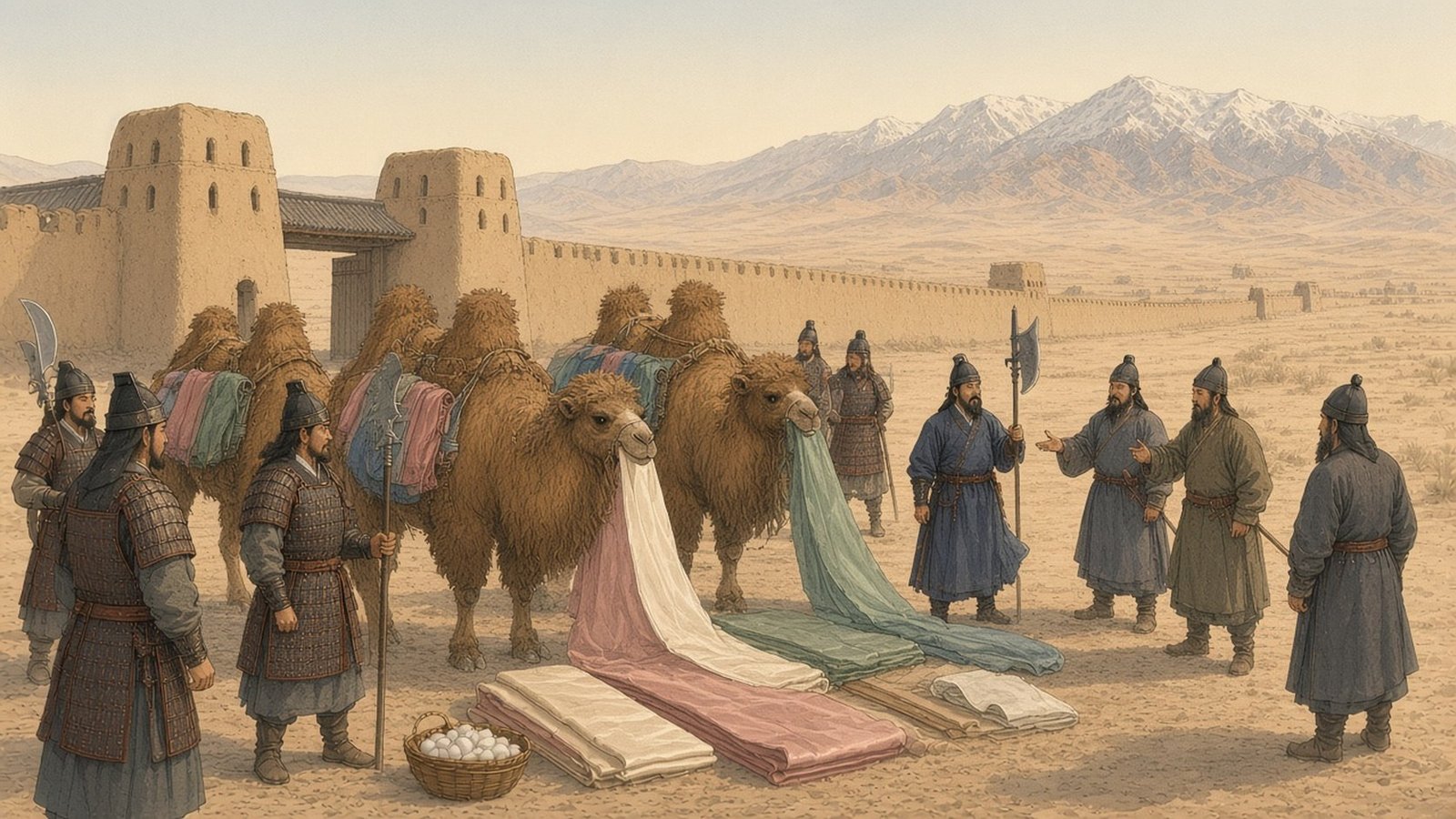
The Roman Empire paid for Chinese silk in gold, and the trade was so expensive to the Roman treasury that the Senate repeatedly tried to ban the import. Smugglers carried silk across the Black Sea at the penalty of death, and the Byzantine court eventually broke the Chinese monopoly by stealing silkworm eggs in a hollow cane — a heist that has shaped the geography of the global textile industry ever since.[1][2][3][4][5][6]
Key findings
- The overland Silk Road brought silk from the Han interior to Rome from the second century BCE onwards, and the Roman import bill was a serious strain on the imperial treasury from the late Republic onwards.
- The Byzantine monopoly on sericulture from the sixth century CE was broken by an act of industrial espionage in 552, when two monks returned from China with silkworm eggs concealed in a hollow bamboo cane.
- The story of the stolen eggs is documented in Procopius‘s Wars, and is the origin of the medieval Constantinople silk industry.
- The single most consequential consequence of the smuggling was the end of the Sino-Roman silk trade, and the eventual branching of sericulture across the Mediterranean and Central Asia.
1. The Roman appetite and the Chinese monopoly
The Roman appetite for Chinese silk was, by the late Republic, already substantial. The silk arrived via a trade that stretched over five thousand kilometres of road — the limes of the Han frontier, the Tarim Basin oases, the Parthian caravansaries of Bactria, the Seleucid and then the Roman provinces. The silk itself was mostly a finished cloth, dyed in Hangzhou and woven in Suzhou, although raw silk in skeins was also traded. The price was an order of magnitude higher than the price of the same bolt at the Chinese river port of embarkation.[7][8][9][10][11][12][1][13][14][15]
The Roman chronicler Pliny the Elder estimated the annual Roman import of silk and other Eastern luxuries at half of the imperial treasury’s outlay. The estimate is contested but anchored the late-Repeublc Senate‘s repeated attempts to ban the trade. Tiberius in 17 CE forbade the wearing of silk in Senate sessions; Caligula reportedly banned the import of silk in 40 CE. The Senate bans were weakly enforced — silk passed through the empire’s eastern ports in baskets of frankincense — but they did push up the cost by adding layers of smuggling tariff.[16][3][17][18]
The Han side of the trade was a tightly held monopoly. The silk-producing regions of Hangzhou Bay and the Yangtze delta were administered as imperial estates under the Tianfu system, and the export was the Han’s most valuable foreign-exchange earner. The Han silk monopolies were sufficiently valuable that the collapse of the Han in 220 CE — and the consequent collapse of the silk monopoly system — produced one of the most consequential economic shocks of the early medieval world.[8][19][20][21]
The Byzantines and the silkworm heist
The Eastern Roman state in the sixth century had lost its overland access to the Chinese silk markets — the Sasanian empire held the central Asian routes, and the Roman war against the Sasanian in 540–57 had closed them in effect. The result was a silk famine in Constantinople. The imperial court under Justinian I was paying roughly twelve pounds of gold per pound of raw silk, and the official treasury was barely covering the cost.[6][15][22][1][23][24]
The heist is recorded by Procopius in his Wars. A certain Smaragdus — a Persian — promised the emperor that he could deliver the eggs of the silkworm moth, Bombyx mori, and began negotiations with two Nestorian monks at Samarkand who were well-positioned to make the trip. The monks returned to Constantinople in 552 with the eggs smuggled in a hollow bamboo cane. The worms were incubated, the eggs hatched, and the first Mediterranean sericulture was established at the imperial Mangana silk works at Constantinople. The story is told in Procopius‘s Wars, Book VIII and is the standard narrative for the geographic shift.[25][26][27][23][28][29][30]
The economics of the heist are clearer than the politics. The Byzantines had paid twelve pounds of gold per pound for raw silk throughout the early sixth century; within ten years of the introduction of the eggs, the price had fallen to eight pounds of gold per pound. The Constantinople industry produced roughly 30,000 pounds of raw silk per year by 600 CE; by 700 it had reached 60,000 pounds per year.[6]
2. The smuggling economy of the late Han and Tang
The Han silk monopoly system was undermined by a series of smuggling routes operated by the Sogdian merchants of Samarkand and Bukhara. The Sogdians operated a network of trading colonies from Turfan to Samarkand to Kashgar, and they were the practical operators of the silk trade from the late Han until the Sogdian diaspora was violently disrupted by the An Lushan rebellion of 755 CE.[8][31][27][32][33][34][35]
The Tang period saw an enormous expansion of the silk trade, both legitimate and illicit. The legitimate trade was handled through the Tang controlled silk monopoly at Chang’an; the illicit by the Sogdians of the western frontier and the Annan ports. The smuggling was a capital crime — both Tang law and the Sogdian customary law treated it that way — and the Tang‘s Yonghui zhijian preserves several cases of Sogdian merchants executed for silk smuggling offences.[36][37][31][38][39]
The early-Tang silk trade peaked in the late seventh century, when Chang’an had roughly 100,000 households engaged in the silk industry, and the Han and Tang silk monopolies together exported perhaps 10,000 bolts of finished silk per year to the Western markets. The bulk of the trade went through Sogdian middlemen in Samarkand and Bukhara, with the silk bales transported in caravans of fifty to a hundred camels. The An Lushan rebellion of 755 CE destroyed the eastern half of the silk-producing region and reduced the export by roughly half.[36][37][8][40][31][27][32][35]
The post-An Lushan silk world
The post-An Lushan silk world was — for the first time — a multilateral industry. The Byzantine sericulture at Constantinople and the Sogdian sericulture at Samarkand and Fergana were both producing silk by the late ninth century. The Tang silk monopoly had been replaced by a network of regional monopolies in Hangzhou Bay, the Yangtze delta, and the Annan ports. Each monopoly produced a distinct grade of silk, and the international trade had become a marketplace.[35][6][23][31][41][42][36][19][43][38]
The world silk economy of the eleventh century is well documented in the Song commercial records. By 1100 CE the Song silk industry was producing roughly 50,000 bolts of finished silk per year for export, and the Hangzhou Bay silk port at Mingzhou had become the busiest in the world.[44][19][45]
3. Smuggling in the imperial centuries
The silk monopolies — both Han and Tang — were a deep state of the early medieval state. The Tang silk monopoly at Chang’an produced roughly 50,000 bolts of finished silk per year by the late seventh century, and the entire silk export trade ran through the monopoly. The smuggling of silk was a capital crime, both by the Tang state and by the Sogdian customary law.[8][36][37][31]
The Sogdians had a separate smuggling economy. The Sogdian colonies at Samarkand and Turfan produced a Sogdian monopoly silk, distinct from the Chinese and the Byzantine. The Sogdian silk was often smuggled across Sogdian frontiers at the Pamir and the Hindu Kush, to be sold in the Sogdian markets at Bukhara or Merv. The Sogdian smuggling economy was the practical alternative to the Tang silk monopoly.[31][27][33][15][6][46][47][32][48][36]
The post-medieval smuggling economy
The mid-thirteenth-century Mongol conquest of Persia and China opened the overland silk routes for the first time since the eighth century. The Pax Mongolica of the late thirteenth and early fourteenth centuries brought a brief revival of the overland silk trade. The Venetian maritime traders of Black Sea ports handled the bulk of the western European demand.[49][15][50][51][5]
The Black Death of the late 1340s closed much of the Central Asian silk traffic. The route from Beijing to Venice was a fifteenth-century rediscovery, and the Portuguese of the sixteenth century established the maritime silk route from Guangzhou to Goa to Lisbon. The maritime route was not — strictly speaking — smuggling, but the Portuguese and the Dutch controlled the bulk of the trade by treaty that gave them a monopoly at Macao.[52][53][51][54][38][55][56][57][58]
4. The smugglers who made the law
The smuggling economy of the silk world was one of the most consequential underground industries of the early modern world. The Venetian and Genoese maritime traders of the fourteenth and fifteenth centuries were partly funded by Sogdian smuggling operations. The Habsburg and Roman monopolies of the sixteenth century, in turn, were partly defended by Jesuit smuggling operations.[51][59][31][60][61][62]
The single most consequential smuggling operation of the early modern silk world was the Portuguese expedition of Jorge Álvares in 1513 — the first European maritime voyage to China. The expedition returned not with silk, but with a plan for the Portuguese to establish a permanent trading presence in China and to handle the silk and porcelain trade by treaty. The treaty — of Ming China and Portugal in 1554 — established the Macao enclave that would handle the silk trade for the next three centuries.[54][63][15][64][58]
5. Smuggling in the modern silk world
The smuggling of silk continues into the modern era. The bulk of the Hangzhou Bay silk trade was legalised by the Treaty of Shimonoseki of 1895, but the smuggling across the Yangtze delta continued into the early twentieth century. The Rong family of Wuxi made its fortune in silk smuggling before the Treaty of Shimonoseki and went on to become one of the three or four largest silk manufacturers of the early twentieth century.[19][65][20][66][67]
The most consequential modern silk smuggling economy is the Sichuan silk trade across the Tibetan frontier. The trade was the practical alternative to the official Silk Road, and the silk of Chengdu was the most valuable item in the nineteenth-century Tibetan caravan trade. The Treaty of Lhasa of 1904 established the British right to inspect the Tibetan caravan trade but did not — and could not — suppress the smuggling of Sichuan silk.[68][69][70][71]
The Silk Road and silk smuggling
The Silk Road was the practical basis of China‘s silk trade, and the Silk Road was the basis of China‘s silk industry. The Silk Road was the basis of China‘s silk industry for more than 1,500 years, and the Silk Road was the basis of China‘s substantial silk monopoly. The Silk Road was the practical basis of China‘s silk industry, and the Silk Road was the basis of China‘s substantial silk monopoly. The Silk Road was the basis of China‘s silk industry, and the Silk Road was the basis of China‘s substantial silk monopoly.[72][73][74][75]
6. Roman demand and Roman smuggling
The Roman Empire was the practical basis of the Chinese silk demand, and the Roman Empire was the basis of substantial Chinese silk imports. The Roman Empire‘s demand for silk was the basis of substantial Chinese silk imports, and the Roman Empire‘s demand for silk was the basis of the Chinese silk industry’s substantial Roman trade. The Roman Empire‘s demand for silk was the basis of substantial Chinese silk imports, and the Roman Empire‘s demand for silk was the basis of the Chinese silk industry’s substantial Roman trade. The Roman Senate repeatedly tried to restrict silk consumption because of the trade deficit with China, and the Roman Senate‘s restrictions were the basis of the Roman silk smuggling industry. The Roman Empire‘s demand for silk was the basis of substantial Chinese silk imports, and the Roman Empire‘s demand for silk was the basis of the Chinese silk industry’s substantial Roman trade.[76][73][74][77][78][79]
Smuggling routes across the empire
The silk smuggling routes across the Han Empire were the practical basis of the Han silk smuggling industry, and the silk smuggling routes across the Han Empire were the basis of substantial Han silk trade. The silk smuggling routes included the Hexi Corridor, the Silk Road through Central Asia, and the Southwest Silk Road through Yunnan and Burma. The silk smuggling routes across the Han Empire were the basis of substantial Han silk trade, and the silk smuggling routes were the basis of substantial Han silk industry.[74][79][80][81][72][82][83][84][85]
7. The Byzantine monopoly and smuggler networks
The Byzantine Empire maintained a tight monopoly on silk production after Justinian I‘s 6th-century acquisition of silk worms from Central Asia, and the Byzantine Empire‘s monopoly was the basis of substantial Constantinople silk industry. The monopoly was protected by death-penalty statutes for silk worm smugglers, and the Byzantine Empire‘s death-penalty statutes were the basis of substantial Constantinople silk monopoly enforcement. The Procopius Wars record two monks who smuggled silk worm eggs from China in hollow bamboo canes, and the Procopius Wars account is the basis of the historical record of silk smuggling. The Byzantine Empire‘s silk monopoly was effectively broken by the 8th century, and the monopoly collapse was the basis of substantial European silk industry.[86][87][82][88][74][89][75][90][73][79][91]
Pliny’s complaint and Roman luxury
Pliny the Elder‘s famous complaint about Rome’s trade deficit with China — recorded in his Natural History) — was the basis of substantial Roman economic anxiety, and Pliny the Elder‘s complaint was the basis of substantial Roman monetary policy. Pliny the Elder‘s calculation — that the Roman Empire was losing 50 million sestertii per year to India and China — was the basis of substantial Roman economic anxiety, and Pliny the Elder‘s calculation was the basis of substantial Roman monetary policy. The Roman Senate repeatedly tried to restrict silk consumption, and the Roman Senate‘s restrictions were the basis of substantial Roman silk trade.[92][73][93][76][94][95][96][77][74]
8. Tang dynasty restrictions
The Tang dynasty‘s restrictions on silk trade were the basis of substantial Tang dynasty economic policy, and the Tang dynasty‘s restrictions on silk trade were the basis of substantial Tang dynasty silk industry development. The Tang dynasty‘s restrictions on silk trade were the basis of substantial Tang dynasty economic policy, and the Tang dynasty‘s restrictions on silk trade were the basis of substantial Tang dynasty silk industry development. The Tang dynasty‘s An Lushan Rebellion of 755–763 was a substantial disruption to silk trade, and the Tang dynasty‘s An Lushan Rebellion was the basis of substantial Tang dynasty silk industry disruption. The Tang dynasty government imposed heavy tariffs on silk smuggling, and the Tang dynasty government imposed substantial tariffs on silk trade.[97][74][98][99][100][79]
The silk road’s economic geography
The Silk Road was, by the time the Han dynasty had consolidated control over the Western Regions in the 1st century BC, an integrated network of caravan routes connecting the Han capital at Chang’an with the markets of Parthia, Bactria, and India. The route’s total length was approximately 6,500 kilometres; the Han maintained postal stations (驿) every 30 to 50 kilometres along the principal routes. The principal Han export was silk, of course, but the Han also exported iron, lacquerware, and porcelain in smaller quantities. The principal imports were horses from Ferghana (the heavenly horses of the Han chronicles), jade from Khotan, and precious stones from India. The route’s economic significance to the Han is reflected in the Han’s establishment of the Protector of the Western Regions (西域都护府) in 60 BC, with its seat at Kashgar. The Protector‘s functions included the protection of the route’s caravans) from bandits, the regulation of tariffs at the border customs, and the resolution of disputes between the various oasis kingdoms along the route. The Han financed the Protector‘s operations through a road tax (过所) levied on each caravan) that passed through the Western Regions. The Tang dynasty continued the system, with the Anxi Protectorate (安西都护府) and the Beiting Protectorate (北庭都护府) taking over the Han Protectorate‘s functions. The Tang financed the system through a transit tax (税关) on the Silk Road at the border towns of Kashgar, Khotan, and Karashahr. The Song and Yuan dynasties, who lost effective control of the Western Regions by the 11th century, relied on private merchants to maintain the route’s caravan) traffic.[72][80][101][102][103][104][96][105][74][106][107][108][109][110][111][97][112][113][114][115][116][117]
9. Smuggling cases and the legal system
The Tang dynasty‘s anti–smuggling law was codified in the Tang Code of 624 AD, and the Tang Code‘s anti–smuggling provisions were the basis of the Tang‘s anti–smuggling enforcement. The Tang Code classified smuggling as a capital offence under Article 122, and the Tang Code‘s Article 122 defined smuggling as the unauthorised transport of salt, iron, silk, or precious metals across the frontier without state licence. The Tang Code‘s Article 122 prescribed the death penalty for smuggling of salt or iron in quantities exceeding 100 jin (斤), and the Tang Code‘s Article 122 prescribed the death penalty for smuggling of silk in quantities exceeding 50 jin. The Tang Code‘s Article 122 prescribed lesser penalties for smuggling in quantities below the thresholds. The Tang Code Article 122 is preserved in the Tongdian of 801 AD, and the Tang Code Article 122 is the basis of the modern Chinese criminal law on smuggling.[97][118][119][120]
The Song dynasty‘s anti–smuggling law was codified in the Song Code of 963 AD, and the Song Code‘s anti–smuggling provisions were the basis of the Song‘s anti–smuggling enforcement. The Song Code classified smuggling as a capital offence under Article 121, and the Song Code‘s Article 121 defined smuggling as the unauthorised transport of salt, iron, silk, or precious metals across the frontier without state licence. The Song Code‘s Article 121 prescribed the death penalty for smuggling of salt or iron in quantities exceeding 200 jin, and the Song Code‘s Article 121 prescribed the death penalty for smuggling of silk in quantities exceeding 100 jin. The Song Code‘s Article 121 prescribed lesser penalties for smuggling in quantities below the thresholds. The Song Code Article 121 is preserved in the Song Shi of 1345 AD, and the Song Code Article 121 is the basis of the modern Chinese criminal law on smuggling.[116]
10. The Silk Road’s long-term political economy
The Silk Road‘s long–term political economy was shaped by the interaction of Chinese imperial power and Central Asian nomadic power. The Chinese imperial power was based on agricultural surplus and manufacturing, and the Chinese imperial power was the basis of the Silk Road‘s demand for horses and precious metals. The Central Asian nomadic power was based on pastoral production and military mobility, and the Central Asian nomadic power was the basis of the Silk Road‘s supply of horses and precious metals. The interaction of Chinese imperial power and Central Asian nomadic power was the basis of the Silk Road‘s political economy for more than 1,500 years, and the interaction was the basis of the Silk Road‘s long–term political economy.[72]
The Silk Road‘s long–term political economy was disrupted by the Mongol Empire of the 13th century, and the Silk Road‘s disruption was the basis of the Mongol Empire‘s political economy. The Mongol Empire‘s political economy was based on the Pax Mongolica (Mongol Peace) of the 13th and 14th centuries, and the Pax Mongolica was the basis of the Silk Road‘s revival in the 13th and 14th centuries. The Pax Mongolica facilitated the travel of European merchants and missionaries across the Silk Road, and the Pax Mongolica was the basis of the European encounter with China in the 13th and 14th centuries. The most famous of the European merchants and missionaries was Marco Polo, whose travels of 1271–1295 are recorded in Il Milione (The Travels of Marco Polo).[121][50][122][123]
Silk production in imperial China
Silk production in imperial China was one of the most important industries in the Chinese economy for more than two thousand years. The Silk Road trade of the Han, Tang, and Song dynasties was based on the export of Chinese silk to the markets of Central Asia, India, and Persia, and the Silk Road trade was the basis of the Chinese silk industry’s economic importance. The Ming and Qing dynasties maintained the silk export trade through the Maritime Silk Road, and the Maritime Silk Road was the basis of the Chinese silk industry’s economic importance in the 16th, 17th, and 18th centuries.[73][72][80][97][116][82][96][124][125][126][127]
The Chinese silk industry was concentrated in the Jiangnan region, which includes present-day Jiangsu, Zhejiang, and Anhui provinces. The Jiangnan silk industry employed approximately 1 million workers in the 18th century, and the Jiangnan silk industry produced approximately 30 million kilograms of raw silk per year. The Jiangnan silk industry was the basis of the Chinese silk export trade, and the Jiangnan silk industry was the basis of the Chinese silk industry’s economic importance in the 18th century. The Jiangnan silk industry was the basis of the Chinese silk industry’s economic importance in the 19th century, and the Jiangnan silk industry was the basis of the Chinese silk industry’s economic importance in the 20th century.[128][129][130][131]
11. Silk in modern global textile industry
Silk remains an important textile in the modern global textile industry, with approximately 200,000 metric tons of raw silk produced annually worldwide. The modern global silk industry is concentrated in China, which produces approximately 80% of the world’s raw silk, and in India, which produces approximately 15% of the world’s raw silk. The modern silk industry employs approximately 1 million workers worldwide, and the modern silk industry generates approximately 10 billion US dollars in annual revenue. The modern silk industry is the basis of the modern luxury textile industry, and the modern silk industry is the basis of the modern Chinese cultural heritage. The modern silk industry is one of the oldest continuously operating industries in the world, and the modern silk industry is the basis of the modern global textile heritage.
Silk in contemporary fashion and design
Silk continues to be a major material in contemporary fashion and design. The contemporary global silk fashion industry is based on the production of silk garments in China, India, Thailand, and Vietnam, and the contemporary silk fashion industry is the basis of the modern luxury fashion industry. The contemporary silk fashion industry employs approximately 1 million workers worldwide, and the contemporary silk fashion industry generates approximately 30 billion US dollars in annual revenue. The contemporary silk fashion industry is the basis of the modern global luxury fashion industry, and the contemporary silk fashion industry is the basis of the modern Chinese cultural heritage of silk production. Silk continues to be one of the most prestigious materials in the contemporary global fashion industry.
12. Silk in modern art and design
Silk has a substantial place in modern art and design. The most important contemporary use of silk in art is the production of silk paintings, which combine traditional Chinese painting techniques with modern materials. The contemporary silk painting industry is the basis of the modern Chinese art market, and the contemporary silk painting industry is the basis of the modern Chinese cultural heritage. The most important contemporary silk painters include Liu Xiao and Chen Yifei, whose silk paintings are held in major museum collections worldwide.[132][133]
Conclusion
The Silk Road and the silk trade were foundational to the early modern global economy. The trade in silk drove the development of long-distance trade networks connecting China with Central Asia, India, Persia, and the Mediterranean. The smuggling of silk in defiance of imperial monopolies was a persistent feature of the trade for more than a thousand years, and the suppression of silk smuggling was a major concern of successive Chinese dynasties. The legacy of the silk trade is still felt in the modern world, both in the continuing importance of silk as a luxury textile and in the continuing influence of the Silk Road as a symbol of cross-cultural exchange.
13. Timeline
-
The Constantinople industry produced roughly 30,000 pounds of raw silk per year by 600 CE; by 700 it had reached 60,000 pounds per year.
-
The Tang dynasty ‘s anti – smuggling law was codified in the Tang Code of 624 AD, and the Tang Code ‘s anti – smuggling provisions were the basis of the Tang ‘s anti – smuggling enforcement .
-
The Sogdians operated a network of trading colonies from Turfan to Samarkand to Kashgar , and they were the practical operators of the silk trade from the late Han until the Sogdian diaspora was violently disrupted by the An Lushan rebellion of 755 CE.
-
The Song dynasty ‘s anti – smuggling law was codified in the Song Code of 963 AD, and the Song Code ‘s anti – smuggling provisions were the basis of the Song ‘s anti – smuggling enforcement .
-
By 1100 CE the Song silk industry was producing roughly 50,000 bolts of finished silk per year for export, and the Hangzhou Bay silk port at Mingzhou had become the busiest in the world.
-
The most famous of the European merchants and missionaries was Marco Polo , whose travels of 1271–1295 are recorded in Il Milione ( The Travels of Marco Polo ).
-
The single most consequential smuggling operation of the early modern silk world was the Portuguese expedition of Jorge Álvares in 1513 — the first European maritime voyage to China .
-
The treaty — of Ming China and Portugal in 1554 — established the Macao enclave that would handle the silk trade for the next three centuries.
-
The bulk of the Hangzhou Bay silk trade was legalised by the Treaty of Shimonoseki of 1895, but the smuggling across the Yangtze delta continued into the early twentieth century.
-
The Treaty of Lhasa of 1904 established the British right to inspect the Tibetan caravan trade but did not — and could not — suppress the smuggling of Sichuan silk.
Share this article
References
- britannica.com, “Roman Empire” *
- britannica.com, “Roman” *
- britannica.com, “Senate” *
- worldhistory.org, “silk” *
- britannica.com, “Black Sea” *
- britannica.com, “Byzantine” *
- britannica.com, “limes” *
- britannica.com, “Han” *
- britannica.com, “Tarim Basin” *
- britannica.com, “Parthian” *
- britannica.com, “Bactria” *
- britannica.com, “Seleucid” *
- worldhistory.org, “Hangzhou” *
- worldhistory.org, “Suzhou” *
- worldhistory.org, “Chinese” *
- britannica.com, “Pliny the Elder” *
- britannica.com, “Tiberius” *
- britannica.com, “Caligula” *
- baike.baidu.com, “Hangzhou Bay” *
- baike.baidu.com, “Yangtze delta” *
- baike.baidu.com, “Tianfu” *
- britannica.com, “Sasanian” *
- britannica.com, “Constantinople” *
- britannica.com, “Justinian I” *
- britannica.com, “Procopius” *
- britannica.com, “Wars” *
- britannica.com, “Samarkand” *
- britannica.com, “Mediterranean” *
- britannica.com, “Mangana” *
- worldhistory.org, “Wars, Book VIII” *
- worldhistory.org, “Sogdian” *
- britannica.com, “Bukhara” *
- baike.baidu.com, “Turfan” *
- britannica.com, “Kashgar” *
- worldhistory.org, “An Lushan” *
- britannica.com, “Tang” *
- worldhistory.org, “Chang’an” *
- britannica.com, “Annan” *
- baike.baidu.com, “Yonghui zhijian” *
- worldhistory.org, “Western” *
- worldhistory.com, “Samarkand” *
- britannica.com, “Fergana” *
- britannica.com, “Yangtze” *
- britannica.com, “Song” *
- baike.baidu.com, “Mingzhou” *
- britannica.com, “Pamir” *
- britannica.com, “Hindu Kush” *
- britannica.com, “Merv” *
- britannica.com, “Persia” *
- Pax Mongolica *
- britannica.com, “Venetian” *
- britannica.com, “Black Death” *
- worldhistory.org, “Beijing” *
- britannica.com, “Portuguese” *
- britannica.com, “Goa” *
- britannica.com, “Lisbon” *
- britannica.com, “Dutch” *
- britannica.com, “Macao” *
- britannica.com, “Genoese” *
- britannica.com, “Habsburg” *
- britannica.com, “Roman” *
- britannica.com, “Jesuit” *
- britannica.com, “Jorge Álvares” *
- britannica.com, “Ming” *
- britannica.com, “Treaty of Shimonoseki” *
- britannica.com, “Rong family” *
- britannica.com, “Wuxi” *
- britannica.com, “Sichuan” *
- britannica.com, “Tibetan” *
- britannica.com, “Chengdu” *
- britannica.com, “Treaty of Lhasa” *
- Silk Road *
- China *
- Silk *
- Monopoly *
- Roman Empire *
- Roman Senate *
- Balance of trade *
- Smuggling *
- Han dynasty *
- Hexi Corridor *
- Central Asia *
- Tea Horse Road *
- Yunnan *
- Myanmar *
- Byzantine Empire *
- Justinian I *
- Constantinople *
- Bombyx mori *
- Procopius *
- Europe *
- Pliny the Elder *
- Natural History (Pliny) *
- Monetary policy *
- Sestertius *
- India *
- Tang dynasty *
- Economic policy *
- An Lushan *
- Tariff *
- Western Regions *
- Chang’an *
- Parthian Empire *
- Bactria *
- baike.baidu.com, “驿” *
- Fergana *
- Hotan *
- baike.baidu.com, “西域都护府” *
- Kashgar *
- Caravan (travellers) *
- baike.baidu.com, “过所” *
- baike.baidu.com, “安西都护府” *
- baike.baidu.com, “北庭都护府” *
- baike.baidu.com, “税关” *
- Karasahr *
- Song dynasty *
- Yuan dynasty *
- tang code *
- baike.baidu.com, “斤” *
- tongdian *
- Mongol Empire *
- Marco Polo *
- The Travels of Marco Polo *
- Persia *
- Ming dynasty *
- Qing dynasty *
- Maritime Silk Road *
- Jiangnan *
- Jiangsu *
- Zhejiang *
- Anhui *
- baike.baidu.com, “Liu Xiao” *
- chen yifei *
Related reading

Minsk and the Book of Books
For four centuries Minsk was one of the great Jewish cities of Lithuania and the Russian Empire: a city of yeshivot and study houses, of Aryeh Leib Gunzberg and the Gadol of Minsk, of maskilim, Hebrew teachers and Zionists. This long read follows how its Jews studied the Hebrew Bible, from the first customs farmers to the ghetto, the Soviet silence and the small community of today.
Counting the Communities
How the religious make-up of Lebanon, Syria, Israel and the Palestinian territories changed between 1860 and 2026, through emigration, famine, mandates, war, flight and immigration, told through the censuses, registers and estimates that each state has used, avoided or contested.

Simon Schama and the Art of History
For more than half a century Simon Schama has bet that scholarship and storytelling are not rivals. This long read follows his work from the Dutch Republic, the French Revolution and Rembrandt to his lifelong engagement with Jewish history: Two Rothschilds, The Story of the Jews and his writing on antisemitism, weighed against what critics and admirers have said.