Solomon and Nepean Lodge
When Albert moved to London, the Bombay house of David Sassoon & Co. was left in the hands of one of his younger half-brothers. Solomon David Sassoon, whom the family letters call Suleiman, was a son of David’s second marriage. He was born in 1841, had spent many years running the family’s affairs in China and then returned to Bombay to manage the office there.[1][2] He was, by the account of the Jewish Women’s Archive, the most observant of the brothers, and he recited all 150 psalms every morning before he went to the office.[1]
In 1876 he married Farha Gabbai, a great-granddaughter of the founder. She had been born in Bombay in 1859, the eldest of the twelve children of Ezekiel Gabbai, a Baghdadi trader, and his wife Aziza, a granddaughter of David Sassoon.[1] Her parents gave her an unusual education. She went to a Catholic school, and rabbis brought from Baghdad taught her at home. By the age of seventeen, the Jewish Women’s Archive records, she knew Hebrew, Aramaic and Hindustani as well as English, French and German, and she was deeply read in Jewish texts.[1] The couple lived in a grand house in Bombay, Nepean Lodge, which had its own synagogue. Their parties kept strictly to the dietary laws and became famous.[1] They had three children. David Solomon, born in 1880, became the great collector of Hebrew manuscripts. Rachel later became Lady Ezra of Calcutta, and Mozelle was an invalid scholar who died young.[1]
Farha was involved in the business while her husband lived. The Times of Israel, summarising Joseph Sassoon’s book, describes her as “outgoing and assertive,” and says that she had been accompanying Solomon to the office for years before his death.[3] When he died in 1894 she saw no reason not to take his place.
The only woman to run a branch
What followed was, by the reckoning of Joseph Sassoon, without precedent. The catalogue of the Jewish Museum’s 2023 exhibition calls Farha “the only woman in the family to oversee a branch of the firm.”[1] Patel, reviewing Joseph Sassoon’s book, goes further: Farha “was likely the first woman to preside over a global business,” and she did it from colonial India, where British officials and Indian merchants now had to deal with a woman as the firm’s senior partner.[2] The Times of Israel records that Albert, though reluctant to have a woman in charge, saw that the company had no one else of her ability. She was thirty-eight.[3]
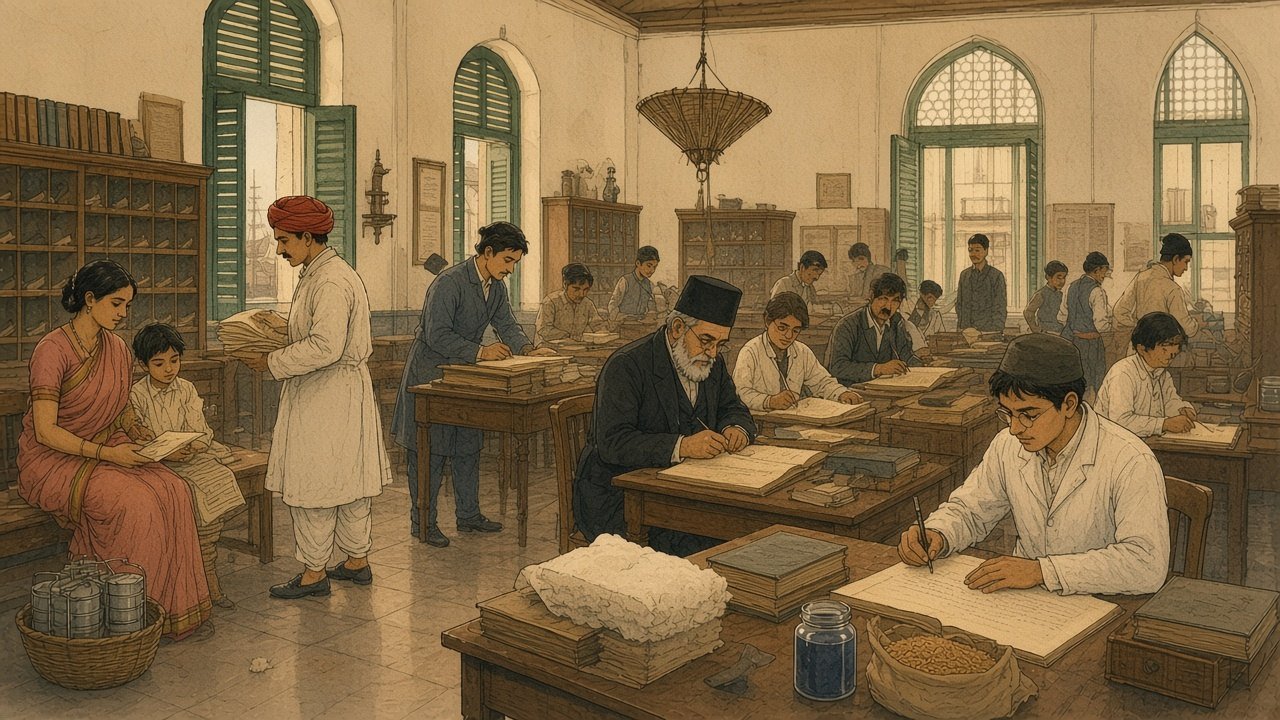
She proved an exceptional manager. Joseph Sassoon’s account, as the Jewish Women’s Archive summarises it, credits her with reorganising the Bombay office into nine separate departments. She set strict rules for borrowing and lending and introduced a uniform system of written business reports.[1] Patel says she brought “some semblance of order” to the firm’s “freewheeling chaos” and expanded its business beyond opium.[2] She also arranged a truce with the rival house of E. D. Sassoon, reducing the competition between the two firms.[1][3] “She was obviously a bulldozer in the sense that you can’t really stop her,” Joseph Sassoon told the Times of Israel, admiringly.[3]
She did not, however, question the trade on which the house rested. The Jewish Women’s Archive is explicit that the later quarrel was not about opium. Like the other partners, she “saw opium as simply a legal commodity, traded between India and China, subject to the laws of supply and demand, and not as a moral or religious issue.”[1]
Her years in charge were also the years of plague in Bombay. The Jewish Women’s Archive records that she backed Waldemar Haffkine, the Jewish bacteriologist who had developed a vaccine, in his campaign to inoculate a reluctant population. She was also active in the movement against purdah, the seclusion of women.[1] Bombay admired her. Patel quotes a Parsi admirer who, before she left the city, hailed her as “Her Majesty, the Queen of Bombay and Empress of Malabar Hill.”[2]
Forced out
Albert’s death in October 1896 removed Farha’s protector. The Jewish Women’s Archive suggests that she might then have run the whole business worldwide. The men of the firm, however, “especially because they were rooted in the world of the East and in the lands of Islam, found it impossible to accept Flora, a woman, as a leader.”[1] For a while their inattention protected her. Solomon’s brothers Reuben and Arthur in London, and Albert’s son Edward, were busier with the Prince of Wales and English society than with the business.[1]
Her chief opponent was Frederick Sassoon, the youngest of David’s sons. He had moved from Hong Kong to London in the early 1890s and was running the head office there. He led the move to push her out.[1] When the firm was incorporated as a limited company at the end of 1900, Farha was not made a director.[1] The Times of Israel calls it “an internal coup engineered by disgruntled family members in 1901.”[3] Joseph Sassoon’s judgement was blunt: “She was running the whole gamut of work from beginning to end and that’s what annoyed the men, they just couldn’t accept it.” The Jewish Women’s Archive concludes that it was “misogyny and not ideology” that turned her relatives against her.[1][3]
The coup did the firm no good. Joseph Sassoon notes that none of the plotters actually wanted to run the business. “Normally in a putsch someone desperately wants the job, but there was no one who wanted the job.” Within five years of her departure, one bank was describing David Sassoon & Co. as “a more or less declining firm.”[3] Patel calls her removal “another fatal crack” in the Sassoon empire.[2] When she died, one magazine, quoted by the Times of Israel, recorded that she had managed the company “entirely alone … for six years with great success.”[3]
Flora in London
In 1901 Farha left Bombay for England, partly in the hope of better medical care for Mozelle. She did not set up a rival firm or interfere in the business again.[1] In London she was known as Flora. She was one of the great hostesses of Edwardian society, with an open house at least once a week. Unlike the English Sassoons, she stayed loyal to the observance of the East. She travelled with her own minyan, the quorum of ten men for prayer, and with her own ritual slaughterer.[1] The historian Cecil Roth recorded what was said of her: that she “walked like a queen, talked like a sage and entertained like an Oriental potentate.”[1]
Her learning was real. The Jewish Women’s Archive notes that she could discuss Jewish texts with rabbis as an equal, and that she published scholarly work on Rashi.[1] On a visit to Baghdad she read from the Torah in synagogue from a scroll dedicated by the family patriarch, Sheikh Sason. In 1924 she presided over Speech Day at Jews’ College, the London rabbinical seminary, as its first woman chair. Her address, on the importance of religious education and full of Talmudic references, was printed that year by Oxford University Press for private circulation.[1] She answered appeals by hand on the day they arrived, as David Sassoon had done, and letters reached her addressed simply to “Flora Sassoon, England.” She supported the Balfour Declaration in 1917, visited Jerusalem with her son in 1925 and signed guarantees for refugees trying to reach Britain.[1]
She died at her home, 32 Bruton Street in Mayfair, on 14 January 1936. She was buried at first in the Sephardi cemetery in Golders Green, and in 1947 she was reburied on the Mount of Olives in Jerusalem.[1]
She is easy to confuse with another Flora Sassoon. Sassoon David Sassoon, the first of the family to settle in England, had married a cousin who was also called Farha in India and Flora in England. That Flora, a widow from 1867, lived in Hove until 1919. She was the mother of Rachel Beer and the grandmother of Siegfried Sassoon, and both appear in later chapters.[1]
References
OpenClose
- Jewish Women’s Archive, “Flora Sassoon,” Shalvi/Hyman Encyclopedia of Jewish Women *
- Dinyar Patel, “The Rise and Fall of the Sassoons,” The India Forum, 6 October 2022 *
- “The rise and fall of the opium-fueled Sassoon dynasty, the ‘Rothschilds of the East’,” The Times of Israel *
The family tree, timeline, places, glossary and select bibliography for the whole history are on the Sassoon index page.