A valley of two villages
The Surb is a small river that runs through the north of the canton of Aargau, in the hilly country between Zurich and the Rhine. Two villages stand a few kilometres apart along its valley, Endingen and Lengnau. For about two centuries they were, in a phrase Swiss writers still use, the homeland of the Jews in Switzerland, because they were the only places in the Confederation where Jews were allowed to settle.[1][2]
The Jews of medieval Switzerland had lived mostly in the towns, in Basel, Zurich, Bern and elsewhere, until a series of accusations and expulsions, culminating in the persecutions that followed the Black Death, drove most of them out. A few families are recorded in the Surb valley in the Middle Ages, but organised communities appear there only in the early seventeenth century, when the villages belonged to the county of Baden, a territory ruled jointly by the Swiss cantons through a bailiff. The number of Jewish households across the county grew slowly, from about twenty in 1634 to thirty-five in 1702 and ninety-four in 1761.[1]
Around 1650 the leader of the community was a man recorded as Marharam, or Meir, Guggenheim. The family name, which probably derives from a place name in south-west Germany, was already among the oldest in the valley when the American branch was born.[1][3] Gilberte Favre, who has written on the Swiss roots of the family, gives a striking figure from a census taken a few decades before Meyer’s birth: Lengnau then had 396 Jewish inhabitants, of whom twenty-eight were Guggenheims, living alongside 453 Christians.[2]
Letters of protection and double doors
The legal position of these families rested on a document called a letter of protection, a Schutzbrief, which the authorities granted for a fixed term and the community had to pay to renew. From 1696 the letters ran for sixteen years at a time; the last was issued in 1792. They allowed the Jews to trade across the county of Baden, but not in land, and to lend money only against movable goods. Jews could not own farms or work the land, and most crafts were closed to them. Many lived by peddling and, above all, by dealing in livestock. The letter of 1776 went further and confined Jewish residence in the county to Endingen and Lengnau alone.[1][4]
The restrictions reached into the houses themselves. The number of Jewish houses was limited, and a Jew and a Christian were forbidden to live under the same roof. Where a building was shared, it was given two front doors, one for each faith, and several of these double-doored houses still stand. They have become the emblem of a local heritage trail, opened in 2009, that links the two villages, their synagogues, schools, ritual baths and cemetery.[1][4] Favre adds a detail of daily life: after a day’s trading at the fair in Zurzach, about ten kilometres away, the Jewish dealers were obliged to return to their villages to sleep.[2]
Inside these limits the communities governed much of their own life. They had their own bakery, butcher, school and charitable funds, and their rabbis judged religious and civil disputes among them. In 1750, after floods had damaged the old burial ground on a small island in the Rhine, they were allowed to acquire a cemetery in the woods halfway between the two villages. It is the oldest Jewish cemetery in Switzerland and holds about 2,700 graves. In the same year Lengnau dedicated a permanent synagogue; Endingen followed in 1764.[1]
The arrangement suited everyone except the Jews themselves. The County of Baden was ruled jointly by several Swiss cantons, which took turns to send a bailiff to govern it, and the fees paid by the Jews for their letters of protection, renewed every sixteen years, were a welcome source of revenue for the bailiffs and the cantons alike.[2][1] Because Christians and Jews shared the two villages, the Jewish houses with their double doors stood beside Christian farmhouses, and the communities lived close together while remaining legally apart. Lengnau, according to the community’s historians, had a synagogue long before it had a church of its own, and the Jews of the two villages made up a large part of their population for most of the eighteenth and nineteenth centuries.[1][4]
Revolution, reaction and the marriage tax
The French invasion of 1798 brought the promise of emancipation, and with it a backlash. In 1802 Jews were attacked in both villages, and when the French withdrew in 1803 Christian neighbours plundered Jewish homes, as they had done in 1729 and would do again in 1861. The canton of Aargau, created in 1803, passed a Jews’ Law in 1809 that did more to regulate the communities than to free them, and later laws on organisation (1824) and schooling (1835) increased state interference. Full equality was not achieved until the 1870s; the Jewish Virtual Library, following the Encyclopaedia Judaica, gives 1878 as the date at which the struggle finally succeeded in Aargau.[1]
One of the most effective ways of keeping the Jewish population down was to tax marriage. A Jewish man who wished to marry had to show that he had the means to support a household and pay a substantial fee for the licence. For many young people the result was emigration, and the villages lost a steady stream of their children to France, Germany and, from the 1840s, America. Among those who left, the encyclopaedia notes, was Simon Guggenheim, who went to the United States in 1847, and later emigrants from the valley included the film director William Wyler and the composer Ernest Bloch.[1]
Schools, rabbis and a village language
The communities that the Guggenheims left were not cultural backwaters. By the early nineteenth century they had achieved the legal status of public corporations, with their own schools, poor relief and religious officials, and the cantonal laws of 1824 and 1835 brought them under closer state supervision but also into the modern school system.[1] The valley later attracted rabbis of real distinction. Julius Fürst served the communities from 1854 to 1858 and the historian Meyer Kayserling from 1861 to 1870, and the arguments over religious reform that divided Jews across central Europe divided the villages too, although the majority remained loyal to tradition.[1]
The speech of the valley has itself become an object of study. The linguist Florence Guggenheim-Grünberg devoted a series of works in the 1950s to the language and the oldest Jewish families of Endingen and Lengnau, and to the old cemetery on the island in the Rhine, recording a Western Yiddish dialect that was disappearing as its last speakers died.[1] Her work allows historians to hear something of the world in which Simon and Meyer grew up: a Yiddish full of Swiss German words, with Hebrew for prayer and study, spoken in villages that were Jewish in their institutions and Swiss in almost everything else.[1][2]
The tailor and his son
Simon Guggenheim was born in Lengnau in 1792 and worked as a tailor.[2][3] His first wife, Schäfeli Levinger, bore him six children. Favre, drawing on the village records, describes how in the 1830s she was taken to the cantonal asylum at Königsfelden suffering from what the doctors called nervous exhaustion, and what the commune’s register recorded more bluntly as being disturbed in the head. She died there after about two years. In her absence the children were placed with relatives, Simon himself was put under guardianship, and the community paid for the children’s clothes, shoes and doctors, a charity he is said to have found humiliating.[2] Other accounts give the mother’s name differently, and the family histories differ on details of the household; what they agree on is that Simon was poor and the family’s position precarious.[3][5]
Meyer, the only son, was born in Lengnau on 1 February 1828.[6][7] He grew up in a village where a third of the houses had double doors and where a Jewish boy learned early which trades, which fields and which marriages were closed to him. The language of the household was the Western Yiddish of the Surb valley, a dialect later studied by the Swiss linguist Florence Guggenheim-Grünberg, mixed with the Swiss German of the neighbours.[1]
In the 1840s Simon, by then a widower in his fifties, wished to marry again. The woman he chose, Rachel Weil Meyer, was a widow with children of her own; the family histories put their number at seven. The couple’s combined means fell short of what the authorities demanded, and permission to marry was not forthcoming. Unger and Unger, like Davis before them, see this as the decisive reason for the family’s departure: in America there was no marriage tax and no limit on the number of Jewish households.[3][5][7] Simon and Rachel sold what they could, gathered the thirteen children of their two families, and set out for the coast.[7]
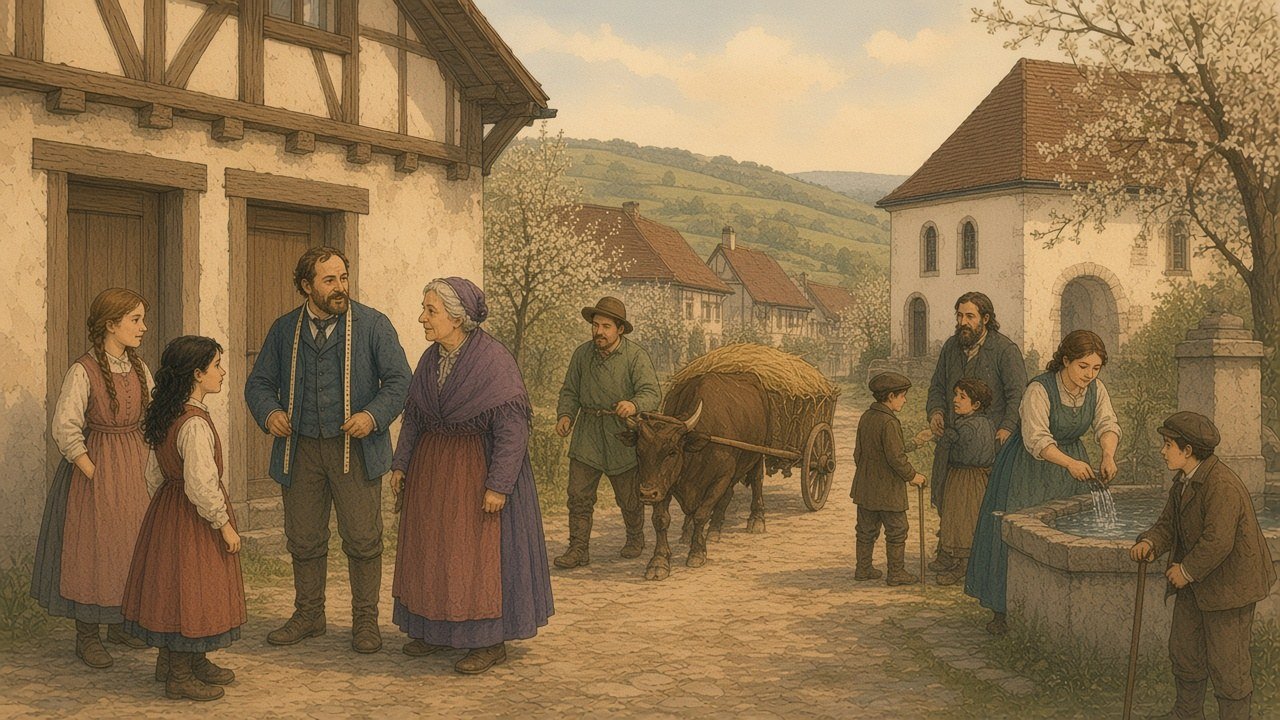
The village they left changed slowly. Jewish population in the two communities reached about 1,500 around 1850 and then fell away as families moved to the cities once settlement was free, and to the New World; by 1950 fewer than a hundred remained, and today only a handful of elderly Jews live there. A Swiss Jewish home for the aged opened in Lengnau in 1903, and services are still held occasionally in the synagogue at Endingen.[1] The Guggenheims who went to America never forgot the place. In the twentieth century members of the family visited and gave money to the community, and the name that had once been written in the bailiff’s tax rolls became, on the other side of the Atlantic, one of the most famous in the world.[3][2]
References
OpenClose
- “Endingen and Lengnau, Switzerland,” Jewish Virtual Library, after the Encyclopaedia Judaica *
- Gilberte Favre, “The Swiss origin of the Guggenheim family,” Sept *
- Irwin Unger and Debi Unger, The Guggenheims. A Family History (New York: HarperCollins, 2005), print *
- Doppeltür, “Historical background,” Jewish heritage project for Endingen and Lengnau *
- John H. Davis, The Guggenheims. An American Epic (New York: William Morrow, 1978), print *
- “Meyer Guggenheim,” Encyclopedia of World Biography, reprinted at Encyclopedia.com *
- Irwin Halfond, “Meyer Guggenheim,” EBSCO Research Starters, 2024 *
The family tree, timeline, places, glossary and select bibliography for the whole history are on the Guggenheim index page.