Leaving in 1847
Most accounts give 1847 as the year the Guggenheims left Switzerland. The Jewish Encyclopedia of 1904, published in Meyer’s lifetime, says that he went to America with his father in 1847 and that his father settled in Philadelphia; the Encyclopedia of World Biography and Irwin Halfond’s more recent entry agree.[1][2][3] A few sources give 1848, among them the Mining Foundation of the Southwest, and John H. Davis’s family history takes 1848 as its starting date.[4][5] The difference may reflect the length of the journey, which began in one year and ended in the next, or simply the uncertainty of family memory. This history follows the majority and the earliest printed source.
The party was large. Besides Simon and Meyer there were Meyer’s five sisters, Rachel Weil Meyer and her seven children, so that Simon was responsible for a combined family of thirteen children, as Halfond counts them.[3] They were part of a wider movement. In the 1840s tens of thousands of German-speaking Jews left Bavaria, Baden, Württemberg, Bohemia and Switzerland for the United States, driven by restrictions on marriage and settlement, by poor harvests and by the political turmoil that came to a head in the revolutions of 1848.[6][7]
The crossing
The emigrants from the Surb valley usually travelled overland to a French or German port and sailed in the steerage of a merchant ship. The family histories describe a crossing of several weeks in crowded and insanitary conditions, the usual experience of emigrants before the age of steam.[5][6] It is in this setting that Davis places one of the best-known stories of the family: that the young Meyer met his future wife, Barbara Myers, on board, where she was travelling with her mother.[5] Unger and Unger are sceptical; in their reconstruction Barbara’s family had already been in America for some time, and the couple met in Philadelphia.[6] No contemporary document settles the point, and both versions are given here as their authors tell them.
What is not in doubt is the scale of the gamble. Simon was in his mid-fifties, spoke no English and had no capital to speak of. The family’s resources would have been exhausted by the cost of passage for so many people. Halfond notes that Simon’s effectiveness as a salesman in America was limited by his inability to speak English, so that his customers came mainly from the German-speaking quarters of Philadelphia.[3]
A German-Jewish city
Philadelphia in the late 1840s was the second city of the United States, a manufacturing and commercial centre with a population of several hundred thousand and a long-established Jewish community. Its oldest congregation, Mikveh Israel, followed the Sephardi rite and dated from the colonial period; the Ashkenazi congregation Rodeph Shalom had been founded in the eighteenth century and was growing quickly with the new immigration from central Europe. German-speaking Jews were settling in large numbers in the northern districts of the city, and many of the newcomers began, as the Guggenheims would, as pedlars, carrying goods out to the towns and farms of Pennsylvania and selling them door to door.[6][7]
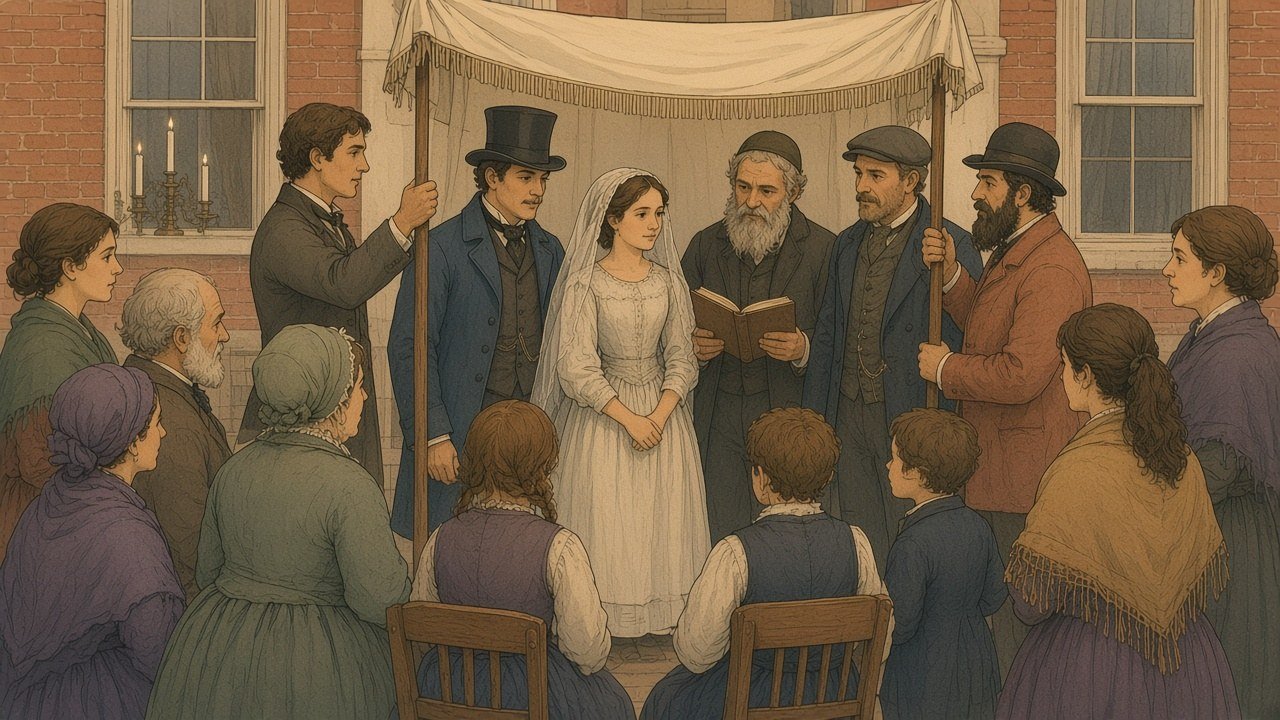
Shortly after their arrival Simon and Rachel were married, the ceremony that the authorities in Aargau had denied them.[6][5] The two families settled together. The older children went to work; the younger ones went to school and learned English, the first generation of the family to speak it. Meyer, who was nineteen when he arrived, took up a pedlar’s pack.[3][2]
Peddling was hard and often lonely work. A pedlar walked or drove a cart from village to village for days or weeks at a time, sleeping in barns or cheap inns, carrying a stock of small wares, needles, thread, buttons, ribbons, lace, spices and household goods, bought on credit from a wholesaler in the city. It required little capital and no English at the start, which is why it attracted so many immigrants, and it could lead, for those who saved, to a cart, a horse, a shop and eventually a wholesale business.[6][8] It is the path Meyer followed, and the next chapter describes how he left the road.
What the emigrants missed
The year after the Guggenheims left, Switzerland adopted its first federal constitution, which turned the old confederation of cantons into a modern federal state. It guaranteed freedom of settlement and the free exercise of religion, but only to Christians; the Jews of the Surb valley remained bound to their two villages.[9][10] Freedom of settlement for Jews came only in 1866, after foreign governments, France above all, had objected to the exclusion of their Jewish citizens from Swiss commercial treaties, and full freedom of religion followed in the revised constitution of 1874. In Aargau the struggle over local citizenship went on for several years more, and the Jewish Virtual Library gives 1878 as the year it was finally won.[9][10]
Had Simon waited, in other words, he would have been nearly eighty before his family enjoyed the rights of Swiss citizens. For a widower in his fifties, unable to marry and dependent on the charity of the community, the decision to go was not hard to understand. The departure of so many young families in these decades emptied the villages, and by the time emancipation came most of the energetic and ambitious had already gone, to Basel, Zurich and the other Swiss cities, to France and to the United States.[10][6]
The city they reached had one of the oldest Jewish communities in the United States. Mikveh Israel, its Sephardi congregation, dated from the colonial period, and by the 1840s the city was a centre of Jewish religious publishing and education whose influence reached Jews across the young republic.[7][6] The newcomers from Germany and Switzerland founded congregations of their own, in which the services followed the customs of the villages they had left, and benevolent societies that helped the sick, buried the dead and lent money to pedlars starting out on the roads.[6][5] For a family like the Guggenheims, who arrived with little money and less English, these networks of kinship and religion were the first source of credit, advice and goods, and the family histories agree that it was through other Jewish merchants of the city that Meyer found the wares he would carry into the countryside.[6][5][8]
Barbara Myers
In 1852, at the age of twenty-four, Meyer felt secure enough to marry. His bride, Barbara Myers, was born in 1834, the daughter of a family of German-Jewish origin.[3] The marriage was by every account a close and long one. Barbara was remembered by her children as gentle, devout and patient, a counterweight to a husband who was quick-tempered, sharp in business and a strict disciplinarian with his sons.[6][5][3]
The couple set up house in Roxborough, then a working-class district in north-west Philadelphia, on the bank of the Schuylkill. Between 1854 and 1873 Barbara gave birth to eleven children, eight sons and three or four daughters, depending on how one counts a daughter who died young; the sources differ on the number of daughters who survived. All but three of the children were born in Roxborough.[3][6] The names and order of the sons are better recorded than those of the daughters, because the sons went into the business. In order of birth they were Isaac (1854), Daniel (1856), Maurice, always called Murry (1858), Solomon (1861), Benjamin (1865), Robert, Simon (1867) and William (1868). Robert died young, killed in a riding accident in his teens, which left the seven sons who appear in every account of the family. The daughters included Jeannette, Rose and Cora.[6][5]
Over these years Simon and Rachel grew old in the same household. Simon lived to see his son prosperous; he died in Philadelphia in 1869.[6] The family had come to America with nothing, and the years in Philadelphia gave it a modest security, a house of its own and a place in a growing Jewish community. They also gave Meyer a training in the American market that would shape everything that followed: an instinct for what ordinary households needed, a willingness to take a partner when he lacked a skill, and a conviction that the profit lay not in selling goods but in making them.[6][2]
References
OpenClose
- Isidore Singer et al., “Guggenheim, Meyer,” Jewish Encyclopedia (New York: Funk and Wagnalls, 1901 to 1906) *
- “Meyer Guggenheim,” Encyclopedia of World Biography, reprinted at Encyclopedia.com *
- Irwin Halfond, “Meyer Guggenheim,” EBSCO Research Starters, 2024 *
- Mining Foundation of the Southwest, “Meyer Guggenheim,” American Mining Hall of Fame *
- John H. Davis, The Guggenheims. An American Epic (New York: William Morrow, 1978), print *
- Irwin Unger and Debi Unger, The Guggenheims. A Family History (New York: HarperCollins, 2005), print *
- Edwin P. Hoyt, The Guggenheims and the American Dream (New York: Funk and Wagnalls, 1967), print *
- Harvey O’Connor, The Guggenheims. The Making of an American Dynasty (New York: Covici, Friede, 1937), print *
- Doppeltür, “Historical background,” Jewish heritage project for Endingen and Lengnau *
- “Endingen and Lengnau, Switzerland,” Jewish Virtual Library, after the Encyclopaedia Judaica *
The family tree, timeline, places, glossary and select bibliography for the whole history are on the Guggenheim index page.