For more than thirty years the Duveens had shipped porcelain, tapestries, furniture and pictures across the Atlantic, and for most of that time the United States had charged heavy duties on imported works of art. The incentive to declare low values was strong, and the firm’s books were kept in a way that its accountants understood and customs officers did not. In the autumn of 1910 that arrangement came to a sudden end.
The arrests
On 14 October 1910 an agency report from New York, printed that afternoon in a newspaper in Eugene, Oregon, announced that customs officials were “actively engaged in examining the works of art displayed in the galleries of Duveen Brothers”. Two members of the firm, Henry J. Duveen and Benjamin Duveen, had been arrested the day before, on the charge of defrauding the government of customs duties by means of undervaluation, and warrants were said to be out for the remaining members of the firm in Europe.[1] District Attorney Henry A. Wise said that the fraudulent valuations had been carried on for many years.[1]
The New York Times later described the episode as a raid on the Fifth Avenue store by customs men on 14 October, in which art objects and antiques worth $1,000,000, brought in by undervaluation, were seized by the government.[2] The New Yorker profile of 1928 put it more dramatically: one day the customs people descended on the Duveen place in lower Fifth Avenue “and seized everything in it, charging systematic undervaluation”.[3] Criminal and civil proceedings were started against Joseph, his uncle Henry and two of his brothers, and Wise charged that what the magazine called “sophisticated bookkeeping” had cost the Treasury $5,000,000 in unpaid duties.[3]
The accounts differ on who was arrested. The contemporary report names only Henry and Benjamin.[1] Charlotte Vignon, curator of decorative arts at the Frick Collection, whose study of the firm draws on its own records, writes of the arrest of six Duveens, including Henry and Joseph, and of the seizure of the contents of their offices; the New Yorker says that proceedings were brought against four Duveens.[4][3] The likeliest explanation is that warrants were issued for several partners, some of whom were in Europe and surrendered or were charged later, but the surviving published accounts do not allow a precise list.
The informer
The government’s case rested on information from inside the firm. According to the New Yorker, the information came from J. L. Payne, a Duveen bookkeeper, to whom “a grateful republic” paid $35,000 once the case was settled; the magazine added drily that “Mr. Payne is no longer connected with the Duveens”.[3] Informers in customs cases were entitled to a share of what the government recovered, and Payne’s reward was a measure of how much the Treasury believed it had lost.
Vignon’s research shows how the system worked. In one case she cites, the firm declared that a writing desk had cost $2,550 when it had in fact paid $100,322, and she found that the firm was not above bribing government experts to accept false certificates and invoices.[4]
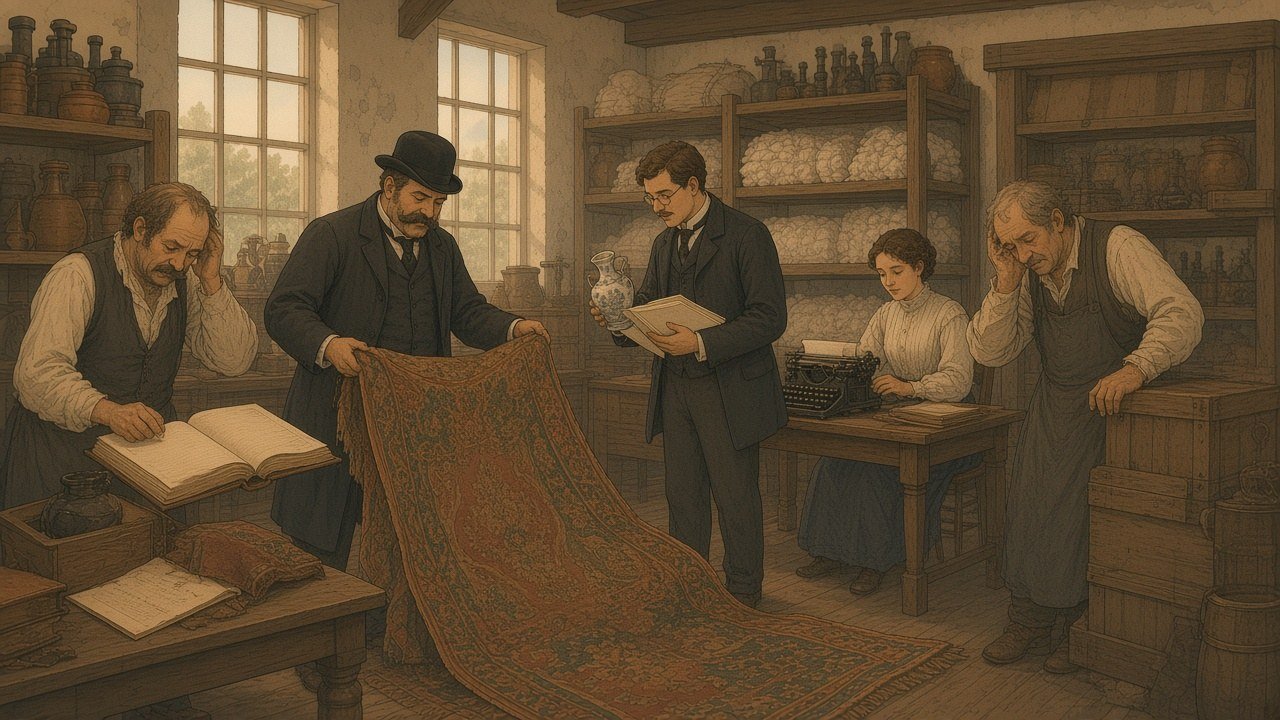
The case was a serious threat. Seized goods could be forfeited, the partners faced prison, and the reputation of a firm that asked its clients to trust its word on authenticity and value now depended on whether it could be trusted to tell the truth to the customs. There were reports that the officials might even go after the works already sold to the firm’s clients and hold them pending judgment.[1]
Dollars or pounds
Joseph’s response was to hire the best lawyers he could find. He engaged the New York firm of Stanchfield and Levy, and the New Yorker preserved the exchange that followed. Joseph asked what the retaining fee would be. “Ten thousand,” said Levy. “Dollars or pounds?” asked Joseph. “Pounds,” said Levy.[3] The story was told, the magazine said, to show how far the incident had thrown him off his poise.[3]
The settlement came the following spring. On 11 April 1911 the New York Times reported that the firm had paid $1,200,000 in settlement of the civil litigation, handing the money to George S. Terry, Assistant Treasurer of the United States, though the payment did not relieve the brothers of the criminal charges still pending.[2] The New Yorker gives the figure as $1,080,000, offered publicly by the Duveens as a compromise and accepted by the government, and describes it as the record price ever paid to settle a customs case.[3] The difference may reflect whether duties, penalties and costs were counted together, but the sources do not explain it.
The criminal charges were disposed of later. According to the New Yorker, each of the four Duveens charged pleaded guilty and was fined $10,000.[3] Vignon’s account, drawing on the government’s statement, says that Henry, then in fragile health, was personally fined only $15,000, and quotes the New York Times headline of 25 May 1911: “Judge Martin … Blames Customs Officials for Making it Easy to Cheat. Also Moved by Prisoner’s Health”.[4] Henry’s position in the firm never fully recovered. He remained a partner, but the conduct of the New York house had already passed to Joseph, and the case confirmed that it would stay with him.
Credit and survival
The settlement had to be paid in cash, and the firm needed to borrow. Schjeldahl writes that the Duveens “quickly swung a loan, arranged by J. P. Morgan, to pay the judgment of $1.2 million”; Brewer describes the firm’s exceptional access to bank credit and to the House of Morgan in particular.[5][6] Whatever the exact source of the money, the firm survived. The New Yorker remarked that “as usual, a tilt with the customs people did no harm socially or commercially”, and that business continued to expand enormously.[3]
A palace on Fifth Avenue
Even before the raid Joseph had decided that the firm needed a new building. One of his first changes as head of the New York house, according to the archive’s history, was to move it to a more visible site on Fifth Avenue and transform its showrooms, displaying art with dramatic lighting in lavish surroundings.[7] In May 1910 the firm acquired the lease of a site at Fifth Avenue and Fifty-Sixth Street, 720 Fifth Avenue, on the former home of the pharmaceutical magnate George Kemp, and in September 1911, with the customs settlement behind it, it turned to the French architect René Sergent, who had designed the firm’s Paris gallery in the Place Vendôme in 1907 and 1908.[8]
Work on site was overseen by Horace Trumbauer, the Philadelphia architect who had built houses for P. A. B. Widener, and by about 1909 the lead designer in Trumbauer’s office was Julian Francis Abele, an African American architect trained at the University of Pennsylvania and the Pennsylvania Academy of the Fine Arts, whom his biographer credits with the design of the Duveen gallery.[8] Secrest attributes the vision to Joseph himself, who asked Sergent to model the building “after the Ministry of Marine Building in the Place de la Concorde, designed by Louis XV’s architect, Jacques-Ange Gabriel”.[8]
The result, faced in creamy Illinois limestone and fitted with eighteenth-century French interiors by the decorator Lucien Alavoine, was meant to look like a stately private house rather than a shop. Edward Fowles recalled that “all the stone and woodwork, together with such elements as chandeliers and Savonnerie carpets, and so forth were shipped from Paris”.[8] The building opened a few days before the end of 1912, and word reached Paris that its impact had been sensational. “The Building was a tremendous advertisement for Duveen’s,” Fowles wrote; “we were both the source of beautiful objects, and proud creators of a building whose very ambience would serve to please and elevate both the casual observer and the dedicated collector”.[8]
The theatre of selling
The building was a stage, and Joseph was a showman who understood publicity as no dealer had before him. Brewer calls him “a news hound” who spoke to journalists constantly, cultivated a special relationship with the New York Times, and kept a vast archive of press cuttings about his firm, which he frequently tried to manipulate.[6] The archive’s history records the lengths to which he would go to win a commission, such as the elaborate plaster model of Senator William A. Clark’s Fifth Avenue mansion, built at a cost of $20,000, to persuade the senator to let Duveen Brothers furnish it.[7]
The gallery stood opposite the house of the financier Morton Plant, now the Cartier store, whose footprint and elevation it closely resembled, and it placed the firm among the mansions of the millionaires who were moving up the avenue.[8] It remained the firm’s New York home for nearly forty years, until 1951, when Duveen Brothers announced that it was moving to the former house of Mrs Stanley Grafton Mortimer at 18 East Seventy-Ninth Street because Fifth Avenue had grown “too commercial”.[8]
With the customs case settled and the new gallery under construction, Joseph was ready for the most important partnership of his career. It was not with a client but with a scholar.
References
OpenClose
- “Vast Frauds in Valuation of Imported Pictures and Works of Art”, Eugene Guard (Oregon), 14 October 1910, p. 1 (Library of Congress, Chronicling America) *
- “Duveen Bros. Pay $1,200,000. Reported Settlement of Civil Action Over Seizure of Art Objects”, The New York Times, 11 April 1911 *
- Alva Johnston, “Noble Merchandise”, The New Yorker, 21 April 1928 *
- Wendy Moonan, “The Family That Brought European Luxury to America’s Gilded Age Tycoons”, 1stDibs Introspective, 1 September 2019 *
- Peter Schjeldahl, “Masterpieces for Sale”, The New Yorker, 8 November 2004 *
- John Brewer, “The Art of the Deal”, The New York Review of Books, 7 October 2004 *
- Getty Research Institute, Finding aid for the Duveen Brothers records, 1876 to 1981 (accession no. 960015) *
- Anne Helmreich, Jill Sterrett and Jacqueline van Ginhoven, “Purpose-Built. Duveen and the Commercial Art Gallery”, Nineteenth-Century Art Worldwide 20, no. 2 (Summer 2021) *
The family tree, timeline, places, glossary and select bibliography for the whole history are on the Duveen index page.