Science
Built by Autistic Minds
The claim that autistic people “run” technology is usually made from rumour and resemblance. This record takes a stricter route, following only people who have spoken about their own diagnosis, the firms built to employ autistic technologists, and the work itself, in detail, sector by sector, with speculation labelled as speculation throughout.
Contents ▾
The modern world runs on systems that somebody had to imagine before they could exist. A protocol for moving a large file between thousands of computers that have never met. A curved chute that moves cattle calmly towards a point they cannot see around. A set of guitars that breathe fire on cue, night after night, without injuring the men holding them. A website built by a teenager who could not find anyone like himself, so he built the room where they could find each other. Each of these things was made by a person who has said, in public and in their own words, that they are autistic. That sentence, and the evidence that can stand behind it, is the subject of this article.
It is a narrower subject than the one usually discussed. The internet is full of lists of “famous autistic geniuses”, and most of those lists collapse on inspection. They include founders who have never said any such thing about themselves, historical figures who died before the diagnosis existed in its modern form, and at least one games designer whose supposed diagnosis was traced, in 2022, to a probably fake page on a defunct social network and was denied by his own company. A record built on those lists would be a record of what the internet wishes were true. This article tries to build the other record, the one that survives checking, and it turns out to be substantial enough without any help from invention. There are autistic people who designed widely used internet protocols. There are autistic people who redesigned an entire industry’s physical plant. There are firms, some of them two decades old, whose whole workforce model rests on autistic consultants doing client work in software testing, data and engineering, and there is a military programme that trains autistic analysts to read satellite photographs. None of that requires diagnosing anyone who has not spoken first.
1. The evidence rule used here
Every person in this article falls into one of three clearly marked groups, and the groups are never blurred. The first group is people who have publicly stated that they were diagnosed, or who have written at length about their own diagnosis in books published under their own names. Temple Grandin, diagnosed in childhood and the author of Thinking in Pictures (1995), belongs here, as does John Elder Robison, diagnosed at forty and the author of Look Me in the Eye (2007) [1][2]. The second group is people who have described a self-diagnosis and been reported on that basis. Bram Cohen, the author of the BitTorrent protocol, is the clearest technology example, and he is described throughout this article exactly as the reporting describes him, as self-diagnosed, which is a different evidentiary status from a clinical diagnosis and is not upgraded here [3]. The third group is historical figures about whom later writers have speculated. Alan Turing, Isaac Newton, Henry Cavendish, Paul Dirac, Albert Einstein and Nikola Tesla appear only in the chapter devoted to speculation, where the speculation is attributed to the named writers who made it, the counter-arguments are given alongside, and no conclusion is drawn, because none can be. A person who cannot be assessed cannot be diagnosed, and a biography, however detailed, is not an assessment.
One living figure sits deliberately on the boundary, and his treatment shows the rule working. In his 2025 memoir Source Code, Bill Gates wrote that “if I were growing up today, I probably would be diagnosed on the autism spectrum” [4]. That is a sentence about a hypothetical childhood under modern criteria, written by a man who was never assessed as a child. It is quoted in this article in full and in context, in its own section, and it is never shortened into “Gates is autistic”, because Gates did not write that, and the difference between the two sentences is the difference between reporting and invention.
The rule cuts the other way as well. Several of the most famous names in technology are excluded from the case studies entirely, not because anyone has proved anything about their neurology, but because they have made no public statement of a diagnosis, and resemblance is not evidence. Mark Zuckerberg, Steve Jobs, Vitalik Buterin, John Carmack and Shigeru Miyamoto are discussed only in the chapter on exclusions, which explains, case by case, where the claims about them come from and why they do not meet the standard used here. Satoshi Tajiri, the creator of Pokémon, receives fuller treatment in that chapter because his case is instructive, the claim about him was investigated in detail in 2022, traced to an unreliable source, and contradicted by a statement from Game Freak, the company he co-founded [5]. The exclusion chapter is not a concession. It is part of the record, because a literature that cannot say how it handles its weakest claims cannot be trusted with its strongest ones.
A final point of method concerns the word “run” in the commission itself. Autistic people do not run the technology industry in any literal, measurable sense, and this article does not pretend otherwise. There is no census of founders by diagnosis, no registry of protocol authors, no reliable prevalence figure for the industry as a whole, a gap examined in the companion literature and not repeated at length here. What can be documented is different, and in some ways more interesting. Specific named people made specific named things, and said specific things about the minds that made them. Specific firms employ autistic technologists as their stated business model, publish figures about it, and have survived long enough for those figures to be checked against accounts and anniversaries. Specific institutions, from a German software multinational to an Israeli intelligence unit, built programmes around autistic analysts and published their reasoning. The chapters that follow take those specifics one at a time, in depth, and let the cumulative picture form from evidence rather than from atmosphere.
2. Traits, work and the limits of the connection
Trait research is background in this article, kept brief by design, but it is the background that explains why the case studies are plausible subjects for study at all. Three bodies of peer-reviewed work matter most. The first is the systemising account developed by Simon Baron-Cohen and colleagues at Cambridge, which describes a drive to analyse and construct systems, to identify the rules by which an input produces an output, and which reports, on average across large samples, higher systemising scores among autistic people than among the general population, alongside wide overlap between groups [6]. The second is the detail-focused processing literature associated with Uta Frith and Francesca Happé. Frith proposed in 1989 that autistic cognition shows weak central coherence, a reduced tendency to pull information together into a global gist, with a corresponding strength in processing the parts. Happé and Frith’s 2006 review reframed the idea as a processing style or bias rather than a deficit, a superiority in local processing that could be set aside when a task explicitly demanded global processing [7]. The third is Laurent Mottron’s enhanced perceptual functioning model, set out with colleagues in 2006, which proposes that autistic perception is locally oriented by default and enhanced in low-level discrimination, accounting for superior performance on tasks such as embedded figures, block design, pattern recognition and visual search, while global processing remains available rather than absent [8].
Read together, and read at the level of averages at which they were written, these accounts describe capacities that map onto identifiable kinds of technical work without any romantic gloss. Finding the one inconsistent record in a large dataset is an embedded-figures problem conducted at industrial scale. Holding a protocol’s rules steady in the mind while varying its inputs is systemising in its textbook form. Reading aerial photographs pixel by pixel for the detail that has changed since the last pass is enhanced perceptual functioning given a uniform and a budget. Designing a physical system by running it mentally, part by part, before building it, is the working method Temple Grandin describes in her own books, in her own vocabulary of thinking in pictures [1]. The mapping is real, and the case studies in this article return to it repeatedly, because the individuals themselves return to it. Grandin attributes her design method to her visual thinking. Cohen’s reporting connects his concentration and his indifference to social friction with the long solitary construction of BitTorrent. Robison describes machines as the things that could be counted on when people could not.
Three cautions belong with the mapping, and they are stated once here rather than repeated in every chapter. First, a trait is not a diagnosis. Systemising, detail focus and perceptual discrimination are distributed across the whole population, autistic and non-autistic alike, and no score on any of them identifies an individual’s neurology. Second, an average is not a person. Every study cited above reports group differences with extensive overlap, which means that for any individual engineer, designer or founder, the research predicts almost nothing. Third, the direction of causation in a working life is rarely single. A person may choose work that suits their cognition, be shaped further by years of doing it, and describe the result afterwards in the vocabulary available to them. The case studies that follow are therefore presented as documented lives and documented work, with the person’s own account of the connection given in their own terms, and with no claim that the connection has been proved in the way a clinical trial proves a drug. That restraint is not a weakness of the record. It is what makes the record worth having.
Read in full rather than in abstract, the trait literature is more modest than its headlines, and this record uses it only at the strength it can bear. Ruzich and colleagues analysed 450,394 self-selected questionnaires completed through a television programme’s website and found mean Autism-Spectrum Quotient scores of 21.92 in people working in science, technology, engineering and mathematics against 18.92 outside those fields, inside standard deviations of about nine points — a real average difference, in a sample the authors themselves note is enriched with autistic respondents, measured by a questionnaire that records traits and diagnoses nobody [41]. The older engineering study points the same way and carries its own correction inside the literature. Baron-Cohen and colleagues reported in 1997, in the journal Autism, that 12.5 per cent of the fathers of autistic children were engineers, against about 5 per cent in comparison groups [42]. On re-analysis, Jarrold and Routh found the same fathers over-represented in medicine, science and accountancy too, and the original authors conceded that the difference shrank when professional bias was controlled, while stressing that the vast majority of engineers have no connection with autism [42].
The two 2006 accounts of autistic perception, published side by side, are similarly careful. Happé and Frith’s update of the weak central coherence account, reviewing more than fifty studies, found a robust bias towards local detail but only mixed evidence for weak global processing, and recast the coherence difference as a processing bias that explicit task demands can overcome [7]. Mottron and colleagues’ enhanced perceptual functioning model, in the same issue, pairs enhanced low-level discrimination with diminished perception of complex movement — an account of a different perceptual default, not of a uniformly superior one [8]. None of this identifies an individual, predicts an occupation, or diagnoses a founder. It describes averages, defaults and styles, which is all the case studies in this record have ever needed it to do.
3. Temple Grandin and the redesign of an industry
Temple Grandin is the strongest case in this entire record, for a simple reason, the evidence is hers. She was born in Boston in 1947, did not speak until she was three and a half, and was diagnosed with autism in childhood, at a time when the standard medical advice to parents of such children was institutionalisation [9]. Her parents refused it. She was educated in private schools, took a bachelor’s degree in psychology at Franklin Pierce College in 1970, a master’s degree in animal science at Arizona State University in 1975 and a doctorate in animal science at the University of Illinois in 1989, and from 1990 she taught at Colorado State University while running Grandin Livestock Handling Systems [9]. Alongside the academic career she wrote the books that make her case study possible without intermediaries. Emergence: Labeled Autistic appeared in 1986, Thinking in Pictures in 1995 and in an expanded edition in 2006, and The Autistic Brain in 2013. In them she describes her own cognition from the inside, in specific mechanical detail, and then describes the machines and buildings she designed with it. Few technology case studies in any field rest on a first-person technical literature of comparable length.
Her account of her thinking is precise enough to be treated as an engineering claim. She reports that she thinks in pictures, that words arrive as a kind of translation after the image, and that she can assemble a piece of equipment in her mind, rotate it, run it, watch where it fails, and correct the failure before any material is cut [1]. She also reports the corresponding costs with the same plainness. Algebra defeated her, she writes, because there was nothing in it to picture. Abstract concepts had to be given images before she could use them, doors and gates standing in for relationships and transitions. Her memory, on her account, works like a searchable library of images, specific and dated, rather than as a set of general rules. Whether or not a reader accepts every element of the self-description, the designs exist independently of it, they were built, adopted and measured by an industry that does not adopt equipment out of sympathy, and their logic can be inspected directly. That is what makes Grandin the correct first case study. The work can be checked without believing a word about the mind, and the mind’s own account can then be compared with the work.
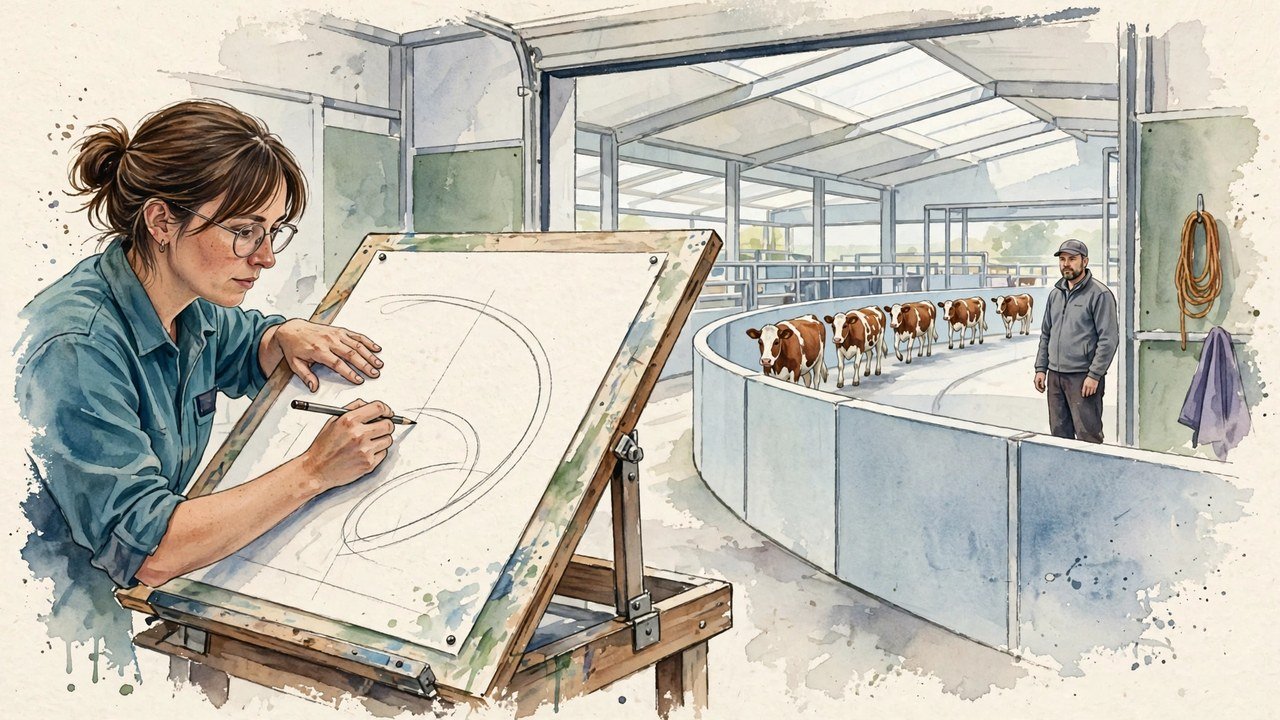
The squeeze machine
The first device came before the career, and it was assistive technology in the purest sense, built by an autistic person for her own nervous system. As a teenager visiting her aunt’s ranch in Arizona, Grandin noticed that cattle held firmly in a squeeze chute, a restraint used for veterinary treatment and branding, became visibly calmer under the pressure. She built herself a version, a padded device in which she could lie and control the pressure herself, and found that it relieved her own acute anxiety and sensory overload [9]. She has described the machine, usually called the hug machine or squeeze machine in the literature, throughout her writing life, refined its design, and discussed its use for other people, while also noting the limits of the evidence for it and the importance of the user controlling the pressure. The line of descent from that device to the weighted blankets and compression garments now sold widely for sensory regulation is a matter of design history rather than of any single patent, and it is presented here as influence, not invention. What can be said without qualification is narrower and sufficient. A teenager with a stated diagnosis, reasoning from close observation of animal behaviour to her own, built a working device to regulate her own sensory state, decades before sensory design was a commercial category. It is the earliest complete example in this record of the pattern the assistive technology chapter returns to, the user as designer, the need as specification.
Curved races, solid sides and the removal of distractions
The livestock work began in the 1970s in the feedlots and packing plants of the American Southwest, and its governing insight was observational before it was architectural. Grandin got down into the chutes and looked at the route from the animal’s height and the animal’s angle of view. What she found, and documented in paper after paper, was that cattle balk, turn back and panic at specific, removable features of their environment that human handlers, viewing the same route from above and from the side, routinely failed to register as significant at all. A shadow across the path. A dangling chain. A coat thrown over a fence rail. A high-pitched noise. A change in flooring, a drain grate, a reflection in a puddle, the sight of people up ahead, air blowing back into the animals’ faces. Each was small. Together they were the difference between an animal that walked and an animal that had to be forced, with the electric prods, injuries, bruising, lost weight and damaged meat that forcing produced.
Her mature designs, installed from the 1980s onwards in plants across North America and beyond, systematised the remedy. Single-file races were curved, so that an animal entering could not see the end of the route or the people and activity at it, and so that the curve worked with the animal’s natural tendency to circle back towards where it had come from. Sides were made solid, to remove the visual distractions outside the race. Lighting was made even, because animals move from dark towards light but balk at harsh contrast and shadow. Floors were made non-slip, with grooves cut for footing, because an animal that slips panics, and panic in a confined herd is contagious and dangerous. Restraint systems for slaughter were redesigned on the same principles, including centre-track conveyor restraints in which the animal is supported under the body and carried rather than dragged. Her dip vat redesign tells the method in miniature. At a feed yard in Arizona in the late 1970s, cattle were walked down a steep, slick slide into a deep pool of treated water that killed parasites, and some panicked and drowned. Grandin pictured the entry from the animal’s side, a slippery drop into water with no visible bottom, and replaced the slide with a concrete ramp with grooves cut into it, down which the cattle walked in calmly. When the yard’s staff later laid a sheet of metal over the ramp, restoring the slide, cattle drowned again on the first day, and the sheet was removed. The anecdote survives because it is a controlled experiment that nobody intended, the same animals, the same yard, the design present and then absent, with the outcome following the design.
The industry measure of her standing is adoption and audit rather than applause. Her designs and her handling guidelines were taken up by major meat companies, and her scoring systems, numerical audits of such measures as how many animals vocalise, fall, or are moved with an electric prod, gave plant managers and corporate buyers a way to measure handling rather than merely exhort it. In the 1990s she surveyed plants for McDonald’s, and audit regimes built on that kind of scoring became part of the supply-chain requirements of large buyers, which is how a design philosophy becomes an industry standard, not by manifesto but by procurement. She has commonly been reported as having designed the handling systems used in a large share of North American cattle plants. That share is usually given as a fraction originating in profiles of her rather than in an industry census, so it is reported here as a reported figure, not a measured one, and the firmer claim is the one the audit history supports. Her methods changed what large buyers required, and plants changed to keep their contracts.
Two features of the case matter for the argument of this article. The first is that the connection Grandin herself draws between her autism and her work is specific, not atmospheric. She argues that her visual thinking lets her run a facility before building it, and that her own sensory sensitivity, her acute awareness of noise, contrast, touch and sudden change, is what attuned her to the same sensitivities in animals who cannot report them. A designer who found a dangling chain merely untidy might remove it. A designer who experienced the environment as a field of intrusions noticed that the cattle stopped at it. The second feature is the limit she herself observes. She has written for decades that autistic people think in different ways from one another, distinguishing in her later work between visual thinkers, pattern thinkers strong in mathematics and music, and verbal-fact thinkers who accumulate detailed knowledge, and she has warned against assuming that one autistic person’s mind explains another’s. The strongest witness in the record is also the clearest against generalising from it, and this article follows her in both directions.
The designs repay reading at the level of specification, because the specification is where the thinking is. Grandin’s own handling paper states the curved race’s logic without metaphor. A curved race “works better than a straight chute because cattle think they are going back to where they came from”, and cattle “move more easily through the curved race system because they can not see people and other distractions ahead” [46]. The solid sides are not decoration on the curve but half of the mechanism: they “prevent the cattle from seeing people and other distractions outside the fence”, and in slaughter plants they are, in her word, “essential”, because they block the animal’s view of people and equipment [46]. Read together, the two sentences describe a single design decision — deny the animal a view of the destination, and let its own circling tendency supply the forward motion that a straight, open race has to extract by force.
The lighting rules in the same body of work are as specific as the carpentry. Cattle “have wide-angle vision and they can see behind themselves without turning their heads”, which “explains why they will often balk at shadows or puddles of water on the ground”; a sharp shadow “may be absent in the morning and then appear later in the day”, so a race that worked at nine could fail at noon for a reason no handler standing upright would think to look for [46]. Her remedy is photometric, not exhortatory: illuminate the whole chute area to eliminate patches of light and dark, move ceiling lamps off the centreline to kill sparkling reflections on the floor, and aim any attracting light ahead of the animal, since light should never glare directly into the eyes of approaching animals. Her summary of the target, from 1989, is one line — “the ideal illumination should resemble a bright cloudy day” [46].
The centre-track restrainer applies the same psychology at the point of greatest stress, and its specification reads like a list of refusals. The animal walks down a cleated, non-slip ramp at 25 degrees — never steeper — because “the animal will walk in quietly if it does not slip”; it straddles a moving double rail and is “supported under the brisket and belly”, so that “even large wild calves will ride quietly”; a solid false floor just below its feet hides the drop, because cattle “will balk and refuse to enter if they see a steep drop off below the conveyor”; and a solid hold-down rack, in her capitals, “MUST be long enough so that the animal entering the restrainer can NOT see out until it’s feet are completely off the entrance ramp” [46]. Grandin later told the US Patent and Trademark Office that she had put the design “into the public domain deliberately on purpose” in the mid-1980s, while completing her doctorate, and was “kicking myself” for not patenting it — a sentence that belongs in any honest account of how the design spread [46].
The dip vat, described in Thinking in Pictures, shows the same method arriving by failure. A conventional vat presented cattle with a steep drop into water they could not judge; animals baulked, and some drowned. Her redesign replaced the drop with a grooved concrete entrance ramp at 25 degrees, hiding the water’s edge so that the animal committed itself before it could see the drop-off, and she describes the result in the plainest sentence in the book — the cattle appear to be “walking on water” [1]. The design was then reversed by a plant that fitted a metal sheet where her specification required the concealed edge, restoring the visible drop and the baulking with it; the episode is in the book because it demonstrates the principle from the other side. A Grandin design is not a shape but a set of perceptual conditions, and removing one condition removes the effect.
The squeeze machine belongs in the same account, because its origin is the chute work seen from inside. As a teenager staying on her aunt’s Arizona ranch, Grandin watched cattle held in a squeeze chute for veterinary treatment and noticed that the pressure calmed them; she tried the chute herself and found the pressure calming to her own overloaded senses, and built her own version at school [1]. The machine — two padded boards that apply gentle, controlled pressure to the sides of the body — became her principal means of managing her own sensory anxiety through college and beyond, and she later studied its effects formally. It is the one device in this chapter designed by an autistic person, in the first instance, for an autistic person, and it predates her professional work: the insight that pressure and predictability calm a nervous system was learned on herself before it was applied, at industrial scale, to other people’s animals.
The scoring system’s authority comes from its crudity, and Grandin says so herself. “Instead of relying on a subjective assessment, the auditor counts the percentage of cattle that was correctly stunned with 1 shot, percentage moved with an electric prod, and percentage that vocalized (moo or bellow) during handling and stunning” [45]. Five measures, each scored per animal — an animal either vocalises or it is silent — and a plant had to pass all five to stay on McDonald’s approved supplier list after the programme began in 1999, with Wendy’s following in 2000 and Burger King in 2001 [45]. Her retrospective judgement was that she “developed the scoring system in 1996-97 and wrote it up for the American Meat Institute”, and that “the McDonald’s audit in 1999 was a huge tipping point” [45]. The limit of the equipment work is also hers to state: designs installed in plants were, in the 1990s, frequently operated incorrectly, which is why the mature Grandin intervention is not a better chute but a number a buyer can enforce. The familiar claim that her systems are used in a third — or, in other profiles, half — of North American plants rests on publisher and profile copy, not on any industry census, and the audit record is the firmer ground.
4. John Elder Robison, circuits and the cost of promotion
John Elder Robison’s evidence is, like Grandin’s, primarily a book of his own. Look Me in the Eye: My Life with Asperger’s was published in 2007, when he was fifty, and it records a diagnosis received at forty, in 1997, from a therapist friend who recognised the pattern and gave him the name for it [2]. Robison was born in 1957, grew up in Massachusetts in a household he describes as unstable, left high school without graduating, and taught himself electronics. The memoir’s subtitle in its full form is a life with Asperger’s, and the diagnosis in the book is not a framing device added by an editor. It is the event the narrative turns on, the explanation that arrived after the career it explains. That order matters for evidentiary purposes. Robison did not build a public identity and then find work to match it. He did the work for twenty years, in near-total obscurity outside his industries, and received the word for his difference at the end of that period.
The work itself began in rock and roll. In the 1970s, still in his teens and twenties, Robison designed and built electronic effects for touring bands, most famously for KISS, for whom he created the signature special-effects guitars, instruments that shot rockets, emitted smoke and appeared to breathe fire, reliably, on stage, in front of audiences, while being played [2][10]. The engineering problem deserves a moment’s attention, because it is easy to file under showmanship and miss. A pyrotechnic device inside a wooden guitar, triggered by a performer in motion, in a dark arena, surrounded by other performers, cables, amplifiers and a crowd, has to fire when commanded and never otherwise, and it has to do so on a touring schedule that punishes fragility. Robison’s accounts of the period describe a self-taught engineer visualising circuits, building by hand, and travelling with the show to keep the effects alive. He also worked in sound, with the logistics of large touring productions, where the governing virtue is the same as in any safety-critical system, the failure must not happen, and if it begins to happen it must be containable.
From music he moved into the electronics industry proper. At the Milton Bradley Company in the 1980s he designed electronic games, in the period when the company’s handheld and tabletop electronic products, and its early home computer and game hardware work, required engineers who could move between circuit design, cost constraint and manufacturability. He went on to roles at Simplex, in fire alarm and building control systems, and at ISOREG, in power conditioning equipment [10]. The sequence is worth pausing on, because it traces a path from entertainment effects through consumer products into systems whose failure hurts people, fire alarms and power conditioning, and it was travelled by a man with no degree and no diagnosis, hired and retained, on his account, because the circuits worked. His memoir is unsparing about the other half of the pattern. As he rose, the work became less about circuits and more about meetings, ambiguity and the performance of collegiality, and he describes the rising cost of pretending to be, in his word, normal, until the exchange was no longer worth it. He left corporate engineering, and eventually built a business of his own, J E Robison Service in Springfield, Massachusetts, specialising in the repair of high-end European cars, Land Rover, Rolls-Royce and Bentley among them, applying the same diagnostic method to machines whose electronic and mechanical systems reward systematic fault isolation and punish guesswork [10].
Robison’s later career adds a second kind of technology contribution, the translation layer between autistic people and the institutions that employ them. After the memoir he became a prominent writer and speaker on neurodiversity in employment, served in advisory roles connected with autism research, and took part, as a subject and collaborator, in research at Beth Israel Deaconess Medical Center and Harvard Medical School on transcranial magnetic stimulation and social cognition, an experience he chronicled in Switched On in 2016. That later work is not engineering, and it is not counted here as such. Its relevance is that the man who could not sustain a corporate career in the 1980s spent the 2010s explaining to corporations, in concrete operational terms, which parts of their working environment had made the career unsustainable, written instructions, explicit expectations, evaluation by output, and which parts were decoration mistaken for necessity. The case study thus contains its own control condition. The same engineer, with the same cognition, flourished where the task was the system and failed where the task was the performance, and he lived long enough, and wrote well enough, to file the report himself.
The order of Robison’s careers matters, and the published summaries put the music first. He worked for Britro sound, “later became a sound adviser for Pink Floyd and KISS, for whom he created their signature illuminated, fire-breathing, and rocket launching guitars”, and only “subsequently designed electronic games at toy maker Milton Bradley”, before moving to Simplex, ISOREG and Candela Laser [2]. No source in the record names a Milton Bradley product, and none should be supplied: the memoir’s claim is about a kind of work — self-taught circuit design, hired because the circuits worked — not about a famous title. The diagnosis that reframed all of it arrived at forty, from a therapist friend; the biography that names him gives T. R. Rosenberg, a therapist practising in Amherst, Massachusetts [2]. Look Me in the Eye is a memoir written a decade later, and it is cited in this record as one — as evidence of how Robison understands his life, corroborated at the level of employers and dates, not as a contemporaneous engineering log.
Be Different (2011) is a different kind of book from the memoir, and its publisher describes it in exactly those terms: stories from Robison’s childhood and young adult years, in each of which “he offers practical advice — for Aspergians and indeed for anyone who feels ‘different’” [47]. The advice is deliberately ordinary — why manners matter, how to deal with bullies, when to make an effort to fit in and when to embrace eccentricity, “how to harness your powers of concentration to master difficult skills” [47]. Its opening returns to the diagnosis at forty — “Asperger’s came into my life when I was forty years old” — and to the reassurance he says he was given: “You’re actually not sick at all; you’re just different” [47]. Where Look Me in the Eye files the report on a career, Be Different attempts the translation work of his later career, turning one man’s retrospective understanding into instructions other people might use.
5. Bram Cohen and the protocol that assumed strangers
Bram Cohen is the central software case in this record, and his evidentiary status must be stated before anything else, because it differs from Grandin’s and Robison’s. Cohen has described himself as having Asperger’s on the basis of a self-diagnosis reached in adulthood, at about twenty-seven, after reading about psychological conditions, and the serious reporting of his life, in Wired in 2005 and in BusinessWeek in 2008, reports it in exactly those terms [3][11]. He has spoken openly in interviews about the subject, including about its effect on his work, answering a 2005 interviewer’s question about how it affected him as a software author by saying that it made him less emotional when coding, that he did not take it personally when the computer did not work well [12]. No clinical assessment of Cohen has been published, and this article does not supply one. What it can do is what Cohen himself does, treat his self-understanding as his own stated account, examine the work in full technical detail, and note where the two illuminate each other without pretending the illumination is proof.
Cohen was born in 1975 and grew up on the Upper West Side of Manhattan. The profiles agree on the outline. A child absorbed in puzzles and programming while other children played outside, able to solve a Rubik’s Cube in minutes by junior high, unhappy at school, a student who left the University at Buffalo without a degree [11]. He worked at a succession of dot-com era firms, and his formative professional experience was at MojoNation, an early peer-to-peer project that attempted to build a distributed file storage and publishing system with an internal economy of digital tokens, called Mojo, intended to reward users for contributing resources. MojoNation’s difficulties were instructive. A peer-to-peer system lives or dies on the behaviour of strangers. If downloading is free and uploading costs bandwidth, rational users download and leave, and the system starves. MojoNation tried to solve the incentive problem with a currency. Cohen left, and in April 2001 began building, alone, the system that solved the same problem with a rule instead of a money [11].
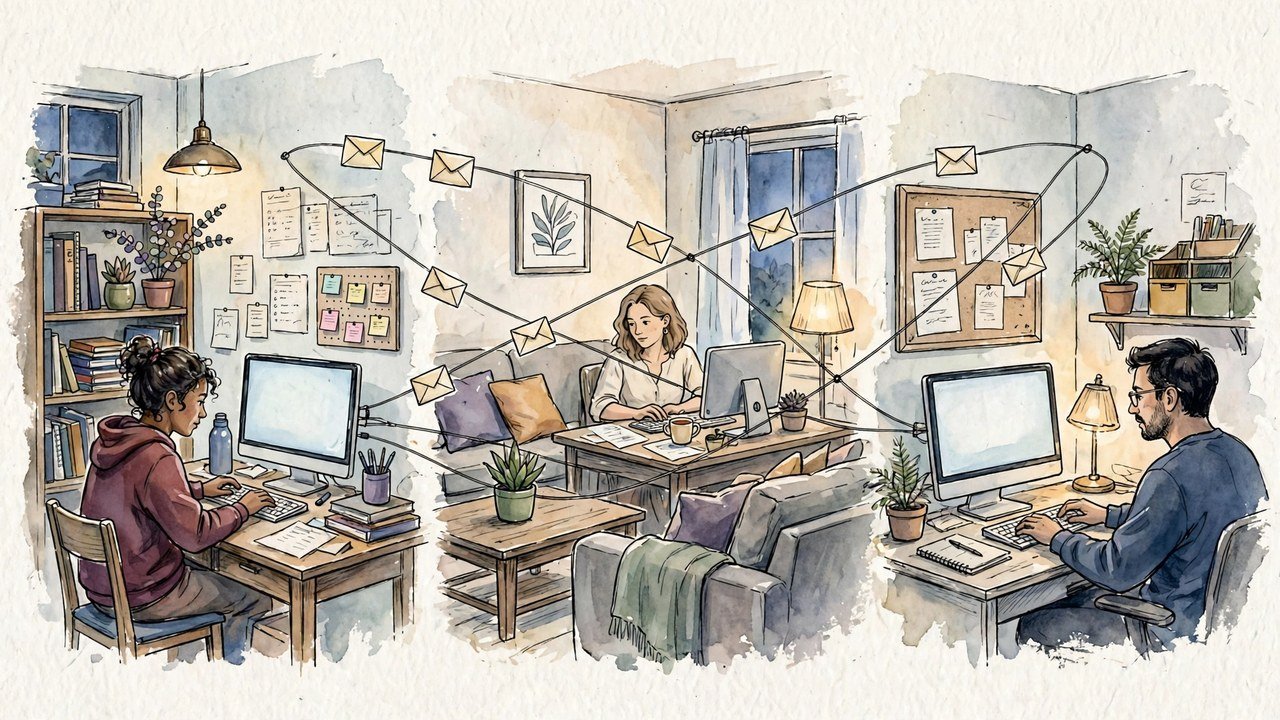
How BitTorrent works, and why the rule matters
BitTorrent, first released in July 2001 and presented publicly in 2002, is a protocol for distributing a large file among many downloaders by turning each of them into a supplier. A file is divided into pieces, typically a few hundred kilobytes each in the early design. A small metadata file, the torrent, contains the cryptographic hashes of the pieces and the address of a tracker, a lightweight coordinator that knows which peers hold which pieces but does not itself carry the file’s contents. A peer joining the swarm downloads pieces from many holders at once, verifies each piece against its hash, and, crucially, begins uploading the pieces it already holds to other peers while still downloading the rest. The result is that the distribution capacity of the system grows with its demand. A popular file does not collapse its source, as a popular download from a single server does. It recruits an army of temporary distributors, each of whom arrived wanting the file for themselves.
The incentive problem is handled by the protocol’s choking algorithm, a piece of applied game theory of unusual elegance. Peers keep a limited number of upload slots, typically four, and direct them preferentially to the peers who have recently uploaded to them in return, a strategy of tit-for-tat with an additional optimistic slot that periodically offers upload to a randomly chosen peer, giving newcomers a chance to obtain their first pieces and letting the system discover better partners. A peer that only downloads, contributing nothing, finds itself choked by the peers it leeches from, and its download rate falls. No currency, no accounts, no central enforcement. Cooperation is simply the fastest strategy available to a selfish participant, which is why the design survived contact with the real internet, where any system that depends on altruism at scale is dismantled within months. Cohen wrote the original implementation in Python, presented the protocol at the first CodeCon in 2002, a conference series he co-founded for working programmers to present functioning code, and initially demonstrated and distributed the system using legally available content, famously seeding a batch of free material calculated to attract beta testers to a protocol that needed a crowd to prove itself [11].
The scale the protocol reached is a matter of industry measurement rather than of Cohen’s own claims, and the figures vary by year and by measurement firm, so they are given here as reported ranges with their nature made plain. Through the mid and late 2000s, measurement companies repeatedly attributed a very large share of all internet traffic, in some reports between a third and over a half of upstream traffic in particular regions and years, to BitTorrent, and the protocol became the standard distribution mechanism for Linux distributions, game patches, scientific datasets and software updates, quite apart from the unauthorised film and music traffic that made it notorious. In 2004 Cohen co-founded BitTorrent, Inc. with Ashwin Navin and his brother Ross Cohen, to commercialise the technology, and the company pursued content distribution agreements and an entertainment network, with mixed commercial results across the following decade. Cohen’s own subsequent venture applies the same cast of mind to a different resource. Chia Network, which he founded in 2017, built a blockchain whose consensus mechanism, proof of space and time, replaces the energy-intensive calculation of proof of work with committed disk storage and verifiable delay functions, an attempt to redesign an incentive system’s physical costs, as BitTorrent had redesigned a distribution system’s social ones.
The connection Cohen and his reporters draw between the man and the protocol is unusually concrete, and it can be stated without exaggeration. The BusinessWeek profile described a condition that kept him “rooted in the world of objects and patterns, puzzles and computers”, while leaving him “disoriented in the everyday swirl of human interactions”, and described his working style in the same register, the long absorption, the lecturing at length without monitoring the listener, the Rubik’s Cube in the hands during conversation, the unwelcome candour when fatigued [3]. His co-founder Ashwin Navin described having to tell employees explicitly that they were permitted to interrupt Cohen and even to correct him, because the ordinary social signals by which a meeting steers itself were not doing that work. Read against the protocol, the pattern is not a diagnosis. It is a design sensibility. BitTorrent does not ask strangers to be generous, does not require them to signal goodwill, and does not depend on anyone reading anyone else. It specifies behaviour in rules, verifies claims with hashes rather than trust, and makes the cooperative outcome the selfish one. A man who found implicit social negotiation exhausting built, for the largest cooperative system of his era, a replacement for implicit social negotiation. That sentence is an interpretation, and it is labelled as one. The protocol, the dates and the stated self-diagnosis are the record.
Cohen’s 2003 paper, “Incentives Build Robustness in BitTorrent”, is unusually quotable because it states its social theory as engineering. “BitTorrent does no central resource allocation. Each peer is responsible for attempting to maximize its own download rate. Peers do this by downloading from whoever they can and deciding which peers to upload to via a variant of tit-for-tat” [43]. The file is cut “into pieces of fixed size, typically a quarter megabyte”, each verified against SHA1 hashes in the .torrent file before a peer may claim to hold it; new pieces are chosen “rarest first”, so that scarce pieces are replicated before the peers holding them leave; and one of the four unchoked slots is always an “optimistic unchoke”, rotated every thirty seconds, which “correspond[s] very strongly to always cooperating on the first move in prisoner’s dilemma” [43]. Nothing in the design asks a stranger to be generous, trustworthy or even identifiable. It asks only that cooperation be, as Cohen puts it, the route to “pareto efficiency” — the fastest selfish strategy available [43].
Cohen’s evidentiary status stays exactly where he and his biographers leave it: he “has described himself as self-diagnosed with what was formerly called Asperger syndrome” [3]. In a 2005 interview, asked how it had affected him as a software author, he answered: “It makes you less emotional when you’re coding. It’s like you don’t take it personally when the computer doesn’t work well” [12]. The later work extends the design pattern rather than the biography. Chia Network, co-founded in 2017 after he left BitTorrent, Inc., replaces proof of work’s electricity with proofs of time and storage, harnessing cheap and abundant unused storage space on hard drives to verify its blockchain — as BitTorrent had replaced a single host’s upload capacity with the upload capacity of everyone who wanted the file [3]. In both cases the scarce resource is socialised and the allocation is done by rule. That parallel is an interpretation, and it is labelled as one; the dates, the mechanisms and the self-diagnosis are the record.
6. Elon Musk, a stated diagnosis and an industrial empire built by teams
On 8 May 2021, hosting Saturday Night Live, Elon Musk said in his opening monologue, “I’m actually making history tonight as the first person with Asperger’s to host SNL, or at least the first to admit it”, adding that he would not make a lot of eye contact with the cast, and that he was “pretty good at running human in emulation mode” [13]. It was widely reported at the time, by the Associated Press and others, as the first occasion on which Musk had said publicly that he has Asperger’s syndrome, and it remains the primary public statement on which any inclusion of Musk in a record of this kind must rest. Two qualifications belong with it immediately. The claim of priority was wrong, and was corrected within hours, the comedian Dan Aykroyd, who has also spoken of an Asperger’s diagnosis, had hosted the programme in 2003 [13]. And a monologue written for a comedy programme is a public statement, not a medical record. It is what Musk chose to say about himself, in his own words, before a large audience, and under the evidence rule of this article that is sufficient to include him, described exactly in those terms, and not sufficient to say anything further about the clinical particulars, which he has not published.
Musk was born in Pretoria, South Africa, in 1971, taught himself programming as a child, and, by his own and his family’s account, sold his first program, a space game called Blastar written in BASIC, to a computer magazine at about the age of twelve for about 500 dollars. He emigrated to Canada in 1989, studied at Queen’s University and then at the University of Pennsylvania, where he took degrees in physics and economics, moved to California in 1995, and left a Stanford doctoral programme in applied physics after two days to found, with his brother Kimbal, the company that became Zip2, a provider of business directories and maps to newspapers, sold to Compaq in 1999. His share of that sale funded X.com, an online bank founded in 1999, which merged with a rival to become PayPal, sold to eBay in 2002. The two companies that define his industrial career followed immediately. SpaceX was founded in 2002 to reduce the cost of access to space, and Tesla, founded by Martin Eberhard and Marc Tarpenning in 2003, received Musk as its lead investor and chairman in 2004, and later as chief executive. He subsequently founded or co-founded Neuralink in 2016, for brain-computer interfaces, and The Boring Company in 2016, for tunnelling, acquired Twitter in 2022 and renamed it X, and co-founded the artificial intelligence company xAI in 2023. Any honest account of this career has to hold two things at once, and the failure to hold both is what makes most writing about Musk, admiring and hostile alike, unreliable as evidence. The companies are real, their engineering achievements are documented by regulators, customers and competitors, and they were achieved by workforces numbering in the tens of thousands, whose names are mostly not Musk’s.
The engineering record, at the level where it can be checked, is substantial. SpaceX’s Falcon 1 reached orbit in September 2008, on its fourth flight, weeks from the company’s insolvency, and won a NASA contract to resupply the International Space Station. Falcon 9, first flown in 2010, became the first orbital rocket whose first stage was recovered and reflown, with a booster landing at sea in April 2016 and a reflight of a recovered booster in March 2017, changing the cost structure of the whole launch industry, since an airframe that had previously been thrown into the ocean after one use could now be treated as capital equipment. Falcon Heavy flew in 2018. In May 2020, Crew Dragon carried NASA astronauts to the station, the first crewed orbital flight by a commercial company. Starship, the largest rocket ever flown, began integrated flight tests in 2023, and in October 2024 its booster was caught on return by the arms of its launch tower. Tesla, in parallel, moved from the low-volume Roadster of 2008 through the Model S of 2012 and the Model 3 of 2017 to become, by volume and by market capitalisation at its peak, the most consequential electric car company of its period, and built the charging network and battery factories that competitors now plan around. None of this is attributed here to a diagnosis. It is attributed to companies, dates and machines, which is where attribution belongs.
What, then, is Musk doing in this article at all, beyond the fact of the monologue? Two things, both documented, neither inflated. The first is that he has repeatedly described his own working method in terms that match the trait literature’s vocabulary without borrowing it, total absorption in engineering problems, a preference for first-principles reasoning over analogy, direct and sometimes abrasive written communication, and a stated difficulty with the social performance expected of a public figure, the “emulation mode” joke being a compressed version of the same self-description. Under the rules of this article, a subject’s account of his own mind is evidence about his self-understanding, and it is reported as such. The second is structural. Musk is the limiting case for the whole subject, because he is the person about whom the folk claim is made most often and most confidently, and the record shows how thin the documented part of that claim is, one monologue, no published assessment, and a vast industrial output produced by organisations. If the strongest popular example yields, on inspection, a single self-statement and a warning about attributing corporate work to one mind, the reader has learned something true about every weaker example. The case earns its place by the discipline it imposes, not by the mythology it decorates.
7. Bill Gates and the sentence that is not a diagnosis
Bill Gates requires a section of his own precisely because he does not meet the evidence rule for the case studies, and because his own words have been widely reported as if he did. In Source Code: My Beginnings, published in February 2025, the first volume of a planned trilogy of memoirs covering his life to the founding of Microsoft, Gates wrote of his childhood self, “If I were growing up today, I probably would be diagnosed on the autism spectrum”, adding that during his childhood “the fact that some people’s brains process information differently from others wasn’t widely understood”, and that he would not trade the brain he was given [4]. The sentence was excerpted in The Wall Street Journal before publication and reported internationally. In interviews around the book he discussed the same material in the same conditional terms, describing a hyper-focused child who would forget to eat, who rocked when concentrating, and observing that nobody in the 1960s ever used the word autistic to him, because the term was not in circulation in that sense. Every part of that is retrospective and conditional. He was not diagnosed as a child. He does not report having been diagnosed as an adult. The memoir’s verb is “would”, its adverb is “probably”, and its condition is “if I were growing up today”.
The distinction matters beyond pedantry, for two reasons. The first is that Gates’s childhood, as he tells it, is a genuinely interesting document in the history of computing, and it does not need a label to be evidence. The memoir describes a boy in Seattle, born in 1955, who encountered a computer at thirteen in 1968, when his school, Lakeside, obtained terminal access to a General Electric timesharing system, an almost absurd privilege for the period, and who proceeded to spend thousands of hours on it with his friend Paul Allen, exploiting a bug in a timesharing company’s accounting system to obtain free time, being banned, being rehired to find bugs, writing a timetabling program for the school and a traffic-counting system that became the company Traf-O-Data. He describes reading obsessively, competing ferociously, and being, by his own account, a difficult child for his accomplished parents to guide. In 1975, at nineteen, he and Allen founded Microsoft in Albuquerque, New Mexico, to supply a BASIC interpreter for the Altair 8800 microcomputer, the business that became, within a decade, the supplier of the operating system of the personal computer industry. A reader who wants to understand how a certain kind of mind met a certain historical moment, early access, tolerant institutions, a friend of equal obsession, a market being born, has the whole story in the memoir itself. Adding a diagnosis the author did not claim adds nothing but error.
The second reason is the general one this article exists to demonstrate. Gates is the most respectable version of the retrospective move, because he made it about himself, in print, with the conditionals intact, and it was still flattened within days, in headlines and in at least one widely shared family anecdote, into the flat claim that he “has” a condition he had described only as a probability about an alternative childhood. If that flattening happens to the most carefully hedged self-speculation by the most documented living technologist, the reader can estimate for themselves what happens to claims about people who never wrote a memoir, never used the word, and died before it existed. Gates therefore appears in this record in a category of one, stated self-speculation, reported exactly, and his section stands as the working demonstration of why the historical chapter that follows is written the way it is.
8. Building the room, Alex Plank, Stuart Duncan and technology made for its own community
Some of the clearest cases in this record are not famous founders but people who built technology for autistic people themselves, and whose diagnoses are documented on their own sites and in their own statements. They matter disproportionately to the argument, because their work answers a question the celebrity cases cannot. What does technology look like when the specification is written from inside the experience it serves?
Alex Plank was diagnosed with Asperger’s syndrome at the age of nine, a fact stated on his own website, which adds that he runs, owns and develops the community he founded [14]. Born in 1986, bullied and isolated at school, he discovered his diagnosis, on the account given in Steve Silberman’s NeuroTribes, by finding papers in his parents’ drawers. As a teenager he searched the young web for other autistic people and found almost nothing addressed to autistic people themselves, as distinct from sites for parents and professionals. He was already a Linux developer in high school and an early contributor to online encyclopaedia projects, and in 2004, at seventeen, with Dan Grover, he launched Wrong Planet, wrongplanet.net, a forum community for autistic people and others with neurological differences [14]. The site grew from hundreds of members to tens of thousands, and for a generation of autistic teenagers and adults it was the first place where the default assumption of the room was that the reader was autistic too. Its technical significance is easy to underrate because forums are unglamorous technology. But the design decision at its centre was a genuine insight about a medium. Text-based, asynchronous, pseudonymous communication removes, at a stroke, the channels that make face-to-face interaction costly for many autistic people, eye contact, tone of voice, real-time decoding of expression, the demand for an immediate reply, while preserving and even rewarding the channels many are strongest in, written precision, accumulated knowledge of a subject, the considered answer posted at 2 a.m. Plank has made exactly this argument himself in presentations on autistic social networking, describing the internet as a communication environment autistic people could shape rather than merely endure. Wrong Planet was not assistive technology in the clinical sense. It was something the clinical sense had not thought to build, a social space whose rules were written by its users, and it predates the mainstream social platforms that later made the same discovery commercially.
Stuart Duncan’s Autcraft makes the same point inside somebody else’s game. Duncan, a web developer, has stated publicly and repeatedly that he has Asperger’s himself and that his eldest son is autistic, giving that as his reason for acting when, in 2013, he saw parents reporting that their autistic children were being bullied on public Minecraft servers, targeted because they behaved differently and reacted strongly [15]. He set up a private, whitelisted server, Autcraft, with rules written for the population it served, no bullying, no griefing of other players’ constructions, active adult moderation, and a membership process that made the space defensible. He expected, by his own account, perhaps a dozen children. More than 750 signed up within two days, and the server grew over the following years into a community reported in the thousands and then the tens of thousands of registered players, with its own volunteer staff, many of them autistic adults and older players who had grown up in it [15]. The technical content of the achievement is moderation architecture, whitelisting, rule design, the patient administration of a shared world, and it should not be mistaken for a minor thing. Minecraft itself is a systemising environment of unusual purity, blocks, rules, redstone circuitry that behaves like logic made visible, an effectively infinite space in which a creation persists and can be revisited, improved and shown. That autistic children congregated there in large numbers is a datum about the game. That one of them, grown up and a father, built the version of it where they would be safe, and ran it for over a decade, is a datum about who builds the infrastructure of a community when the community builds it for itself.
A third example belongs in this chapter because its founder has described her own position in the same first-person terms. Vanessa Gill, a neuroscience researcher, founded Social Cipher, a games company whose role-playing game Ava was built by and for autistic young people, and she has described starting the company from her own experience as an autistic person who had used music, film and games to build her own understanding of social situations [16]. The design stance she articulates is the sharpest statement of the chapter’s theme in commercial form. Most products in what she calls the autism industry, she argues, are built for parents, to train desired behaviours in children, and autistic players can tell when a product was not made for them, a formulation her team renders as “chocolate-covered broccoli”, a lesson disguised as a game. Ava was instead designed as a game first, in which an autistic protagonist navigates a fantasy world and the player practises self-advocacy, asking for what they need, as a mechanic of play rather than as a curriculum. Whether any individual title succeeds commercially is a separate question from the structural one, and it is the structural one that belongs in this record. In each of these three cases, a person with a stated diagnosis identified a failure of the existing technology that was invisible, or merely tolerable, to its existing makers, and the failure was the same in each case. The space had been designed around a user who did not exist in it. The correction, when it came, came from a user who did.
The scholarly record on Autcraft is more interesting than the celebratory coverage, because it names the cost of the design as well as the benefit. Kathryn Ringland’s ethnographic study of the server found that members “search for, practice, and define sociality through a variety of communication channels”, and argued for “an expansion in how sociality has traditionally been conceptualized for individuals with autism” — the children were not failing to be social; they were being social in ways the standard measures did not count [44]. Her later study adds the tension the profiles omit: “the walls of the community work to keep community members safe, but also set them apart from others on the internet”, and the community “goes beyond being a support group for victims of targeted violence, to one that redefines and helps community members embrace their own autistic identities” [44]. The safeguarding itself is mundane and therefore credible — a whitelist, plot protection so that only a player and named friends can build on a plot, preventive rather than punitive moderation — and the membership figure that can be dated is over 17,000 whitelisted players as of December 2023, against roughly 750 sign-ups in the first two days of June 2013 [44]. Ringland’s work is ethnography, not a trial: it shows what the community does and what it means to its members, not a measured clinical outcome.
9. The engineers who said so later, Plummer, Nagel and Belsky
Three further creators belong in this record’s first group, and they share a shape the earlier chapters have not shown: in each case the diagnosis arrived after, or alongside, work that was already in the world, and in each case the statement is the man’s own, made in his own venue, in terms that can be checked. They are placed together not because their work is similar — an operating-system component, a focus application, a hiring platform — but because their evidence is of the same kind, and because two of them correct this article itself. Dave Plummer’s route to a diagnosis began with a joke he made about himself. Lecturing, he remarked that “I might be on the spectrum, but it’s a non-visible portion”, and a friend, a former Microsoft manager, suggested that rather than making a joke of it he should take some tests. “Several months and 12 hours of in-depth testing later, I was diagnosed with autism (what would have been Asperger’s in years past),” he told an interviewer in 2021. “More accurately, I was officially diagnosed with ‘Autism Spectrum Disorder’” [26]. The work the diagnosis arrived after was already familiar to hundreds of millions of people who had never heard his name. Plummer joined Microsoft as an intern, worked on MS-DOS in its final years — CD-ROM support in the SmartDrive cache, a single-pass DiskCopy, a new Setup for MS-DOS 6.2 — and, programming at home, wrote the Task Manager he had meant to sell as shareware. A supervisor he showed it to liked it, and Microsoft shipped it, in Windows NT 4.0 and in the Windows versions that followed [26][27]. His own account of the diagnosis is notably unsentimental, and it is quoted here rather than paraphrased because the register is the evidence. “I used to be ‘gifted’, but now I had a ‘diagnosis’, and it had a better and worse. But the last thing I wanted was to be labelled in such a way as to be limiting” [26]. His response was to do, deliberately, the things his temperament avoided. “I held big open shop parties, I gave lectures, I wrote a book, and started a YouTube channel,” he said. “When you’re an introverted programmer who prefers to be alone, there’s not much that’s more foreign than sticking your face on the internet in 4K and saying a big Hello to the world, so that’s what I did” [26]. The book was Secrets of the Autistic Millionaire, published in 2021, and the channel, Dave’s Garage, begun in 2018, turned the retired engineer into a public explainer of the systems he had helped to build; in November 2021 he told his viewers directly that he was autistic, having dropped hints on the channel before then [27]. Plummer therefore belongs near the front of this record’s first group. The statement is his, the testing he describes is specific, and the technology is not a start-up that might have been. It is a component of the world’s most widely used operating system, written by a man who made it, in the first instance, for himself: “I made it for myself because I wanted it, and that is often a great way to start” [27]. Jeremy Nagel’s early career is the part of his story that his diagnosis later explained, and he tells it without softening. He graduated with first-class honours and was, in RMIT University’s summary of his account, fired from his first five jobs. “I struggled with emotional regulation and executive dysfunction which made it difficult to plan and pay attention to detail — so my early career was challenging,” he said [29]. The explanation arrived late: “It wasn’t until he received his diagnoses — autism first in 2017 and ADHD in 2022 — that Jeremy was able to harness a newfound self-understanding to build a successful career in software development” [29]. The tool he then built was, like Plummer’s Task Manager, built first for its author. On Focus Bear’s own site, in a founder’s note signed with his name, he writes: “I’m a late diagnosed AuDHDer (autistic+ADHD) and productivity and healthy habits felt impossible to achieve consistently” [28]. He had tried, he says, everything from parental-control apps to hiding his laptop in a cupboard. “Focus Bear was my way of building the tool I couldn’t find anywhere else” [28]. Focus Bear is an anti-distraction and anti-burnout application aimed at people with ADHD and autism, organised around a four-step method the company calls “B.E.A.R” — tasks made bite-sized and enjoyable, distraction-blocking, and structured recharging against burnout. RMIT reports that the app had attracted more than 7,000 users and a 4.9-star app-store rating at the time of its profile, figures given here as the university reported them, not as independently audited numbers [29]. Nagel has since become a PhD candidate at RMIT, researching the question his product poses in commercial form: “I’m researching how we can build tech that actually works for ADHD and autistic brains — rather than frustrating them” [29]. His case also carries a warning this record has cause to print about itself. In an earlier podcast appearance Nagel described only a counsellor’s preliminary view — in his words, a “pre diagnosis”, “more of you might have autism” — and research done at that stage recorded him, honestly on the material then available, as unconfirmed [29]. He later described going “to get my autism diagnosis confirmed, and big tick on the autism side”, and now introduces himself, in his own speaker biography, as a founder who has “been diagnosed with ADHD and autism myself” [29]. The record changed because the man’s own public account changed. That is not a contradiction in the evidence. It is what a record built on self-statement has to be able to absorb, and this chapter exists partly to absorb it in print. Shea Belsky’s statement is the earliest-diagnosed in this record, and he makes it on the first page of his own website. “Diagnosed with autism at age two, I was nonverbal until I was four years old,” he writes. “Growing up with an Individualized Education Program (IEP), I frequently struggled to understand and make sense of the world around me” [30]. In a fuller biographical statement he adds what the doctors of the time expected: “I was diagnosed with autism at two years old, at which point my doctors were not convinced that I would ever be able to live independently of my parents” [30]. What followed was an engineering education and an engineering career. Belsky attended Cornell University, taking both a bachelor’s degree and a Master of Professional Studies in Information Science, held internships at IBM and Google, and worked as a software engineer at Wayfair, where, he writes, five different managers in his first year taught him how to explain autism and neurodiversity to each new team in turn [30]. In 2022 he became, in his own words, “the Chief Technology Officer and Technical Founder at Mentra in 2022, shaping not just the company’s engineering culture but also its product direction and making critical business decisions” [30]. Mentra is a hiring platform for neurodivergent jobseekers — founded as a company by others, a distinction this record keeps, because Belsky’s claim is to its technology and not to its founding — and he led a team of four software engineers and, he writes, “built out a job talent platform used by AWS, Microsoft, Pratt & Whitney, among many others”, an employer list given here as his own statement rather than as independently verified adoption [30]. His own summary of why he did the work is on his homepage: “My early experiences navigating these educational and social systems ultimately drove me to join Mentra, allowing me to apply my engineering background to directly bridge the hiring gap for neurodivergent jobseekers across the country” [30]. Belsky now manages software engineers at HubSpot, serves on the board of AANE, the Association for Autism and Neurodiversity, and hosts a podcast whose title states his position without adornment — Autistic Techie, “a space dedicated to the lived experiences of neurodivergent individuals navigating the technology sector” [30]. He is the limiting case, in the other direction, of the pattern this record keeps finding. The technology is employment infrastructure, unglamorous and specific, and it was built by a man whose qualification for building it began, by his own account, at the age of two.
10. The dead cannot be assessed, Turing, Newton, Cavendish, Dirac, Einstein and Tesla
This chapter exists because the names in its heading appear at the top of almost every popular list on this subject, and because leaving them out without explanation would look like an oversight rather than a decision. None of them can be diagnosed. Autism as a clinical concept dates from the 1940s, in the work of Leo Kanner in Baltimore and Hans Asperger in Vienna. Of the six men in the heading, only Dirac and Einstein lived substantially into the era of the modern diagnosis, neither was assessed for it, and the others died in 1954, 1727, 1810 and 1943 respectively. What exists for each of them is a three-layer construction, a documented life, a later writer’s selection from that life of traits that resemble a modern checklist, and a conclusion the evidence cannot carry. This chapter takes each in turn, gives the speculation with its author named, gives the counter-argument with the same prominence, and draws no conclusion, because the honest conclusion in every case is the same. It cannot be known.
Alan Turing, 1912 to 1954, is the case where the speculation is most understandable and must still be refused. The documented life is extraordinary without decoration. The 1936 paper on computable numbers that defined the universal machine, the wartime work at Bletchley Park on the German Enigma cipher, including the Bombe machines and the statistical method known as Banburismus, the post-war design work on the ACE computer, the 1950 paper that proposed the imitation game, and the final work on mathematical biology, pattern formation in nature, published in 1952. He was prosecuted in 1952 for gross indecency, for a homosexual relationship, subjected to chemical castration by hormone treatment, and died in 1954 of cyanide poisoning, in circumstances an inquest ruled suicide and later writers have continued to dispute. Andrew Hodges’s 1983 biography, Alan Turing: The Enigma, documented in detail a man who was literal-minded, solitary in his working habits, indifferent to convention and occasionally baffling to colleagues, and later writers, including clinicians writing in the retrospective-diagnosis genre, have assembled those details into a proposed Asperger’s profile. Simon Baron-Cohen’s The Pattern Seekers in 2020 placed Turing within a broad argument that hyper-systemising minds, autistic and otherwise, drive human invention, an argument about a cognitive style across history rather than a set of individual diagnoses. The counter-arguments are not pedantic. Turing’s surviving correspondence and the testimony of friends show humour, warmth, close friendship and acute social perception in the domains he cared about. The traits selected for the checklist are also the traits a culture expects of a mathematical genius working in total secrecy, which makes them close to worthless as discriminating evidence. And the actor who played him in the 2014 film The Imitation Game, Benedict Cumberbatch, said publicly that he did not think Turing was on the spectrum and that it was “a really dangerous thing to toy with”, a layman’s objection that happens to state the methodological one exactly [17]. Recent scholarly treatment of Turing’s death and possible neurodivergence makes the same point in academic form, that a neurodivergent framing may illuminate his treatment by the state while the evidence does not establish that he was autistic [17]. Turing’s work changed the century. Nothing about that requires, or survives, a diagnosis he never received.
Isaac Newton, 1642 to 1727, is the furthest reach of the genre. The speculation rests on the documented facts of a solitary, obsessive working life, years of near-total absorption in alchemy, theology and the mathematics of the Principia, published in 1687, furious and long-held disputes over priority, notably with Leibniz over the calculus, a breakdown in 1693, and few recorded intimate friendships. A widely reported 2003 discussion associated with Cambridge autism researchers proposed Newton as a retrospective Asperger’s case, and the claim has been repeated in popular lists ever since, usually without its provenance. The counter-argument is a matter of arithmetic and of archives. The surviving evidence about Newton’s inner life consists largely of his vast, strange written output and the reports of a small number of contemporaries, filtered through three centuries of hero-making. Almost any intense, solitary, argumentative scholar of the seventeenth century would satisfy the same selection of traits, which means the selection identifies the scholar, not the syndrome. Henry Cavendish, 1731 to 1810, presents the strongest surface case of the eighteenth-century group and the same underlying problem. Cavendish, who weighed the Earth in the experiment reported in 1798, who isolated hydrogen and determined the composition of water, was documented by contemporaries as pathologically shy, speaking rarely and reluctantly, dressing in old-fashioned clothes, communicating with his household servants by notes, and building a separate entrance to his house to avoid encounters. The neurologist Oliver Sacks was among the modern writers who suggested, in an essay on Cavendish, that his profile resembled Asperger’s syndrome. It may. It also resembles the profile of an immensely wealthy aristocrat of the period whose wealth removed every ordinary pressure to accommodate other people, a confound no retrospective method can remove. A man who never has to learn small talk because no one can make him is not evidence about neurology. He is evidence about money.
Paul Dirac, 1902 to 1984, is the physicists’ case, and the one where the testimony is best, because Dirac lived among colleagues who wrote about him with precision and affection. The author of the 1928 equation that bears his name, which united quantum mechanics with special relativity and predicted antimatter, confirmed with the discovery of the positron in 1932, Dirac was famous in his own profession for silence so complete that colleagues jokingly defined a unit, one dirac, as one word per hour. Graham Farmelo’s biography, The Strangest Man, in 2009, examined the retrospective Asperger’s suggestion directly and at length, drawing on family history, including a domineering father who imposed French-only conversation at the family table and forbade it elsewhere, effectively engineering his son’s silence as a child. Farmelo’s treatment is the model this chapter recommends, the speculation aired, the alternative explanations given their full weight, the verdict left open. A boy trained into silence by a household rule, who then enters a profession that rewards the man who speaks only when the equation requires it, may have been autistic. He may also have been a man whose childhood taught him that speech was dangerous and whose genius made the lesson affordable. The record supports both readings, which is another way of saying it decides neither.
Albert Einstein, 1879 to 1955, attracts the claim for a different reason, because he is the most famous scientist in the world and any popular list needs him. The material offered is his late speech as a small child, reported by family, his absorption in a compass as a boy of four or five, his indifference to school discipline, and his adult self-description as a solitary traveller. Against it stands the largest documentary record of any figure in this chapter, thousands of letters full of humour, political engagement, romantic entanglement, friendship, wit and acute reading of other people, a record that makes the checklist selection look especially arbitrary, since the same archive can be mined, with equal ease, for a sociable and emotionally fluent man. The 2003 speculation that paired Einstein with Newton in the retrospective literature was reported at the time as a hypothesis about traits, and its afterlife as a settled fact in list articles is a case study in how a hedge evaporates. Nikola Tesla, 1856 to 1943, completes the set, the inventor of the alternating current induction motor and polyphase system, whose documented life offers the list-makers unusually rich material, reported sensory sensitivities, an aversion to certain textures and round objects, a compulsion concerning the number three, celibacy, pigeon-feeding, and a visual imagination he himself described in his 1919 autobiographical articles as so vivid that he could build, run and wear-test a machine entirely in his mind before touching material. That last faculty is the reason Tesla belongs in any serious discussion of engineering cognition, and Grandin’s readers will recognise the description. It is still not a diagnosis. Tesla’s own accounts are self-mythologising documents by a man fighting priority battles for his legacy and his income, his reported compulsions are consistent with several modern categories and with none, and he died, impoverished and alone in a New York hotel, in 1943, the year Kanner’s paper appeared in Baltimore. The six cases teach one lesson between them, and it is the lesson the whole article is built on. Resemblance across centuries is a property of the checklist, not of the dead.
11. The names deliberately left out, and the Pokémon case in full
An exclusion list is evidence about a method, so this chapter gives the reasoning for the names most often demanded. Mark Zuckerberg has never stated that he is autistic or that he has been diagnosed. The belief that he is rests on his public manner, on a fictionalised film portrayal in The Social Network in 2010, in which a screen character written for dramatic effect displays traits audiences read as autistic-coded, and on the general atmosphere of the folk theory. A film performance is not a source about its subject’s neurology, and demeanour is not a source either. Steve Jobs, who died in 2011, made no such statement in his lifetime. The claims about him are assembled retrospectively from biography, his intensity, his dietary regimes, his management cruelty and his genius, a combination that says a great deal about what audiences want genius to look like and nothing verifiable about Jobs. Vitalik Buterin, the co-founder of Ethereum, has never stated a diagnosis, and the claims about him rest entirely on presentation and on community folklore within cryptocurrency culture, which has its own reasons for romanticising its founders. John Carmack, the programmer behind Doom and Quake, has never stated a diagnosis, and his case is instructive precisely because his working method, decades of publicly documented, monomaniacal programming productivity, is the strongest trait-based case an advocate could construct. It is still trait-based, and under the rule used here it still fails, which is the rule working as intended. Shigeru Miyamoto, the creator of Mario and Zelda, has never stated a diagnosis, and claims about him circulate almost entirely within list articles citing one another. In every one of these cases the correct sentence is the same, and it is not a euphemism or a hedge. There is no statement, so there is no case.
Satoshi Tajiri deserves the full treatment because his case, uniquely, has been investigated to a conclusion. Tajiri, born in 1965, founded the magazine Game Freak as a teenager, turned it into a games company, and created Pokémon, first released in Japan in 1996 as Pokémon Red and Green for the Game Boy, a game built, on his own repeated account, from his childhood passion for collecting insects and from seeing two Game Boys connected by a link cable and imagining a creature travelling down the wire. For well over a decade, a claim that Tajiri had Asperger’s syndrome circulated as settled fact, repeated by major outlets including a 2019 BBC article, and used to explain the games’ collecting mechanics as the expression of an autistic mind. In March 2022 the channel DidYouKnowGaming published a detailed investigation of the claim’s provenance [5]. It found that essentially every version of the claim was either unsourced or traced back to a single 2009 children’s biography, Satoshi Tajiri, Pokémon Creator by Lori Mortensen, whose author told the investigators that her source had been a page on the social network MySpace purporting to be Tajiri’s, which mentioned an “Aspie” community, that the reference had not survived into the published book, and that, looking back, the page could well have been created by someone pretending to be him [5]. Still more decisively, the investigation surfaced a statement from Game Freak itself. The company’s information coordinator, Yuri Sakurai, had written to a website that propagated the claim to correct it, in terms transcribed in the reporting as, “This is not the truth. Tajiri has not Autism and Asperger syndrome” [5]. There is no record of Tajiri ever saying he is autistic. The position, therefore, is not the usual agnostic one. The specific claim was investigated, its source collapsed, and the subject’s own company denied it. Tajiri is accordingly not merely excluded from this record’s case studies. He is retained in this chapter as the standing warning of what the other lists are made of, a globally repeated “fact” about the most successful media franchise in history, sourced, at the end of the chain, to a probably fake page on a dead social network.
The chapter closes with the principle the Pokémon case proves. In this field, repetition is not corroboration. A claim repeated by fifty outlets that all copied the forty-ninth is one claim, and if the one claim is a fan page, the fifty outlets are a rumour with a distribution network. Every case study in this article was therefore traced, as far as time allowed, to the person’s own statement or book, and every case that could not be so traced was moved here or dropped altogether. The dropped cases are listed in the accompanying notes, with the reasons, so that the reader can audit the boundary rather than take it on trust.
12. How a diagnosis claim is manufactured
The Pokémon case in the previous chapter is not an accident of one franchise’s fame. It is an instance of a process that can be documented step by step, because the same process has run, in public, on the most famous scientists in history, and the stages are visible in the record each time. Understanding the process matters to this article’s subject for a practical reason: every stage of it is a place where a careful record can refuse to take the next step, and the refusals are what separate the case studies in this article from the lists it declines to copy. The first stage is a hedged scholarly suggestion. In 2003 the Oxford mathematician Ioan James wrote, in the Journal of the Royal Society of Medicine, that Newton looked by standard criteria like an Asperger case, and Simon Baron-Cohen agreed publicly that Newton and Einstein seemed to fit the profile — while saying, in the same breath, that a definite diagnosis of someone long dead is impossible [48]. The second stage is the headline: press coverage in 2003 turned a hedged suggestion into headlines of the form “Einstein and Newton had autism”, in which the hedge, being unquotable at headline length, disappeared. The third stage is the listicle, in which the headline, detached from the article beneath it, becomes an entry in a list of “famous people with autism”, cited to the coverage rather than to the suggestion. The fourth stage is circularity: later lists cite earlier lists, and the claim acquires the appearance of multiple independent sources while remaining, underneath, one hedged paragraph from 2003. The scholarly pushback is also on the record, and it is methodological rather than merely indignant. Galina Weinstein’s 2023 paper on the Einstein case opens with the objection in its plainest form: “In 2003, Simon Baron-Cohen, a world expert on autism, diagnosed Einstein posthumously with Asperger’s syndrome. I think we cannot diagnose a dead person” [48]. Her method point is the one that generalises: “Baron-Cohen did not base his retrospective diagnosis on historical medical records written by physicians. He instead diagnosed Einstein based on fragments of evidence mainly found in biographies” [48]. Biographies are written to explain a life, not to record symptoms; they select for the striking anecdote, and a diagnosis assembled from striking anecdotes inherits the selection. The psychiatrist Glen Elliott made the companion point about the trait logic itself, in words quoted in summaries of the 2003 debate: “One can imagine geniuses who are socially inept and yet not remotely autistic. Impatience with the intellectual slowness of others, narcissism and passion for one’s mission in life might combine to make such an individuals isolative and difficult” [48]. Oliver Sacks’s verdict on the Einstein claims, collected in the same literature, was that they “seem very thin at best” [48]. Weinstein adds the twist that keeps the myth alive: the debunkers, she argues, rely on a counter-myth of a uniformly sociable Einstein, so that each side’s selective biography discredits the other’s and neither settles anything. A claim that cannot be settled cannot be killed either, which is why it is still on the lists twenty years later. The same upgrade — from cognitive style to diagnosis — can be watched happening to a living literature. Baron-Cohen’s The Pattern Seekers (2020) argues that a systemising mechanism, if-and-then pattern reasoning, is particularly strong both in innovators and in autistic people, two groups he believes have overlapped throughout history, and it discusses Thomas Edison at length as an elite case of the style [6]. Reviewing the book for the specialist press, The Transmitter noted that the argument is supported by “a fair degree of conjecture and evidence marshalled from a range of fields”, and that specialists in the fields crossed “may well take issue” with parts of it [50]. None of that is a diagnosis of Edison, and the book does not perform one. But a cognitive-style exemplar in a respected book is precisely the raw material from which the lists manufacture one: “discussed as a hyper-systemiser” becomes “identified as autistic” in a single step of paraphrase, performed by the secondary literature, not by any assessment [50]. The step is small enough to take by accident, which is why this record treats it as a step that must be refused on purpose. The cleanest documented refusal comes from a man the lists would most like to have. Richard Stallman, founder of the GNU project, was described in a 2000 profile, reported in Sam Williams’s biography Free as in Freedom (2002), as “borderline autistic”. When Computerworld put that description to him in 2008, Stallman corrected it on the record: the assessment was “exaggerated”, he said; “I wonder about it, but that’s as far as it goes. Now, it’s clear I do not have [Asperger’s] — I don’t have most of the characteristics of that. For instance, one of those characteristics is having trouble with rhythm. I love the most complicated, fascinating rhythms” [49]. He allowed only that he has “a few of the characteristics” and “might have what some people call a ‘shadow’ version of it” [49]. A subject who considered the label in print and concluded against it cannot be listed as a self-diagnosed case; “borderline”, retracted by its subject as exaggerated, is speculation that its own source withdrew. Stallman therefore appears in this record not as a case study and not as an unsolved mystery, but as the standing example of the rule working in the subject’s favour: the person most entitled to settle the question settled it, and the settlement was no. Set the four documented cases side by side — Tajiri, whose claim collapsed into a probably fake page and a company denial [5]; Einstein and Newton, whose claim survives because it was built to be unkillable [48]; Edison, whose claim is manufactured by paraphrase from a book that made a different claim [50]; Stallman, whose claim was withdrawn by the subject himself [49] — and the manufacturing process has a single common feature. At no stage does anyone new examine the person. Each stage examines only the previous stage’s text. That is the whole of the method this article has refused, and it is why the refusal has to be procedural rather than intuitive: a record that admits only the person’s own statement, or a documented clinical diagnosis the person has acknowledged, is not being fastidious. It is declining to take part in a process whose output, as the documented cases show, does not depend on the person at all.
13. Firms built on autistic technologists, Specialisterne, auticon, Aspiritech and Ultranauts
The individual record, however carefully kept, leaves the largest question untouched. Individual cases can always be dismissed as exceptions, gifted outliers whose success says nothing about autistic people generally, most of whom, in every country that measures it, face unemployment and underemployment rates that shame the technology industry’s self-image. The firms in this chapter answer that dismissal in the only way that counts, commercially and at scale. They employ autistic technologists not as inspiration but as their workforce, sell their work to clients who can buy it elsewhere, and have done so, in the oldest case, for more than twenty years. Their published figures are largely self-reported, and are labelled as such throughout this chapter, in line with the rule that a company’s account of itself is evidence of what it claims, to be weighed accordingly. But their survival, their client lists and their filings are not self-reported. They are the record.

Specialisterne, Danish for “the specialists”, is the founding case. It was established in Denmark in 2004 by Thorkil Sonne, a former technology manager whose youngest son, Lars, had been diagnosed with autism at the age of three. Sonne’s founding observation, repeated across two decades of interviews, was a mismatch he could see from both sides of the table. His son and people like him showed, in his account, extraordinary concentration, memory for detail, pattern recognition and persistence with tasks others found unbearably repetitive, while the labour market screened them out at the first interview for exactly the social performance the work itself did not require. He mortgaged his house to start the company, a detail that has survived every retelling because it is the kind of fact Companies House filings and Danish reporting corroborate in substance, a founder with his own capital at risk on a workforce the market had discarded. Specialisterne’s original model was consultancy in the tasks where the mismatch was most expensive for clients, software testing, quality assurance, data conversion, digitisation and record verification, work in which an error rate is measurable and a missed defect has a price. Its consultants, most of them autistic, were placed with clients with support from the company, and the company developed the assessment and management methods, task clarity, structured environments, explicit communication, that later programmes worldwide adopted, often through formal partnership with Specialisterne itself. At its twentieth anniversary in 2024 the organisation reported more than 600 employees, offices in 13 countries, and more than 10,000 neurodivergent people helped into jobs across its operations and partnerships [18]. Those are the organisation’s own figures, given here as such. Its recent history also belongs in an honest record. By 2026 its own reporting showed a smaller organisation, over 500 staff in 11 countries, and its Australian operation closed its workforce in late 2025 [18]. A social enterprise is still an enterprise, exposed to the same contract cycles as any consultancy, and the contraction does not erase the two decades. It disciplines what may be claimed from them, which is that the model worked repeatedly, in many labour markets, for a long time, not that it is invulnerable.
auticon is the German counterpart and the largest pure consultancy of the group. Founded in Berlin in 2011 by Dirk Müller-Remus, whose son is autistic, it employs autistic consultants as its core delivery workforce on client projects in software development, software testing, data analytics, quality assurance, compliance and process automation, supported by job coaches and project managers who form the interface with client organisations [19]. Its clients, as listed by the company over the years, include major German and international firms in finance, insurance, manufacturing and technology. In June 2023 auticon merged with Unicus, the Norwegian consultancy founded in 2008 on a similar model, employing consultants with Asperger’s diagnoses for testing, development and data work, and the combined company reported 575 employees, 81 per cent of them autistic, across 14 countries, with an ambition to pass 600 staff by the end of that year [19]. The company’s later self-reported figures show the same cooling visible at Specialisterne, 552 employees in 2024 and 494 in 2025, with 287 clients and 81 per cent neurodivergent staff, and with two-thirds of its consultants reported as having been unemployed or underemployed before joining [19]. Unicus’s Norwegian public accounts, which are filings rather than publicity, show a much smaller national operation within the group, with revenue of about 29 million Norwegian kroner in 2025 and a small pre-tax profit [19]. The composite picture is neither the triumph of the brochures nor a failure. It is a real, mid-sized international IT consultancy, staffed overwhelmingly by people the ordinary hiring process rejects, trading through the same downturns as its competitors, neither exempt from economics nor dependent on charity. For the purposes of this article that ordinariness is the finding. The experiment has run long enough to stop being one.
Aspiritech, based in the Chicago area and founded in 2008 by Moshe and Brenda Weitzberg, whose son Oran is autistic, built the American version of the model as a non-profit, employing autistic adults in software testing and quality assurance for corporate clients, financial and technology firms among them. Its significance in the record is partly its longevity and partly a single reported result that illustrates what these firms sell. In work reported by the company and repeated in coverage of the sector, its testers’ defect detection on client projects was the product, clients were not purchasing goodwill, they were purchasing the found bug, the inconsistent record, the edge case a hurried conventional team had scrolled past. Ultranauts, founded in New York in 2013 by Rajesh Anandan and Art Shectman, originally as Ultra Testing, took the model furthest in organisational design. It is a fully remote software testing and data quality company in which, by the company’s own reporting, about 75 per cent of the staff are neurodivergent, most of them autistic [20]. Its founders’ argument, made in Anandan’s writing and talks, is that the accommodations usually bolted onto a conventional workplace for a minority, no reliance on interviews, skills demonstrated in paid trial work assessed against explicit criteria, remote-first working, communication in writing by default, meetings with agendas circulated in advance, flexible total hours, a technical career ladder that does not require promotion into management as the only route to seniority, are not accommodations at all when examined closely. They are simply better operating procedure, which the majority-neurotypical firm had never needed badly enough to adopt. Ultranauts is the firm in this chapter that most directly supports the strongest version of the article’s underlying claim, not that autistic people run the technology industry, but that a technology company designed around autistic working patterns can compete in the open market on quality, and that the design, once built, turns out to suit a much wider range of people than the ones it was built for. That is a pattern the reader has met before in this record. It is Grandin’s audit, Plank’s forum and Duncan’s server, restated as a company.
Sonne’s own framing of the model, in the account he co-authored with Robert Austin for MIT Sloan Management Review, is worth quoting because it forecloses the charitable reading in advance: Specialisterne “has maintained that it competes based on the talent of its people, not by drawing on the good intentions of others” [31]. The “dandelion principle” of that account’s title is a claim about context rather than about people: a dandelion is a weed in a lawn and a valued plant in a kitchen garden, and the firm’s task was to build the context in which its consultants’ abilities counted. The client work named in the same account was unglamorous and specific — software testing, quality control and security monitoring for clients including Microsoft, Cisco and SAP — and about 75 per cent of its skilled employees were reported as having an autism spectrum diagnosis, a figure the company itself reported, not one an auditor counted [31].
Aspiritech’s client record can be followed furthest because one of its clients described the work itself. Medline, the medical supplies company, reports that Aspiritech has tested its MedPack app — the application clinicians use to order custom surgical packs — since 2018, work the client credits with helping to deliver a product that won its own 2021 Innovation Award [37]. The same client account reports Aspiritech running “60 or 70 projects” for roughly 30 clients, among them Abbott, AbbVie, Bose, Goldman Sachs and the Transportation Security Administration, while the American Medical Association had about a dozen Aspiritech staff a year testing its CPT SmartApp and AMA Guides Digital products [37]. Aspiritech’s own account of why clients first chose it cuts against the charitable reading in the same way Sonne’s does — in the company’s client study, “number one was quality, number two was price”, and the social mission came third, a ranking the company reported itself and which no outside body has verified [37].
auticon’s reporting is the most detailed in this sector, which makes its limits easiest to see. In 2023 the combined auticon and Unicus company reported delivering 402 technology consulting projects for 266 client companies, figures it reported itself [33]. Its 2025 report, again self-reported, counts 494 employees, of whom 373 were autistic technologists working in artificial intelligence, data, software development and software testing, across 287 client organisations [32]. One project can be described concretely because the buyer described it: a partner firm engaged auticon in 2025 to migrate procurement data and documents to a new system for a client in The Hague, after earlier work for the Municipality of Utrecht, and reported that auticon “delivered on their commitments and ensured high quality” [32]. The outcome percentages that headline auticon’s reports — 95 per cent of clients saying its technologists added value in 2025 — come from the company’s own surveys, and the 2025 figures rest on replies from 59 people at 50 companies, a basis the company states in its own methodology note and which any honest use of the numbers must state with them [32].
Ultranauts, founded in New York in 2013 by Rajesh Anandan and Art Shectman as ULTRA Testing, rebuilt the employment process itself rather than only the support around it — no curriculum vitae and no conventional interview, assessment by ability tests ending in a week of paid simulated work, a fully remote workplace, and a self-authored “user manual” for every employee stating how they prefer to communicate and receive feedback [38]. Its workforce figures are self-reported throughout — more than 75 per cent of 60 employees on the autism spectrum in 2019, by self-disclosed data, and staff in 30 states by 2024 — and its one published client result is a founder’s account of a single engagement for an unnamed financial services company, in which the firm replaced an incumbent testing team, redid a cycle of work and, in Anandan’s words, “apples to apples — we improved the quality of the platform by 56%” [38]. That is evidence that a client kept and praised the work; it is not a benchmark, and no independently measured comparison was published alongside it.
14. Institutions that reorganised themselves, Ro’im Rachok, SAP, Microsoft and the banks
Alongside the specialist firms stand the large institutions that changed their own machinery to employ autistic technologists inside it. Their evidence is different in kind. A specialist firm proves a workforce can be sold. A multinational or an army proves that an existing hierarchy, with everything to lose from novelty, examined its own procedures and found them, not its applicants, to be the obstacle.
Ro’im Rachok, Hebrew for “seeing far” or “looking ahead”, is the most striking case, because the institution is an army and the work is intelligence. The programme was founded in 2013 by two Israeli intelligence veterans, one of them the mother of an autistic young adult, on the observation that a specific and chronic military need, the analysis of aerial and satellite reconnaissance photographs, matched a specific profile, the analyst who can spend long hours on visual detail, detect minute changes between images, and persist at a task from which other soldiers rotated away as fast as promotion allowed [21]. In Israel, military service is near-universal and socially decisive, and autistic young people were routinely exempted, a exemption that marked them for civilian life as well. Ro’im Rachok recruited volunteers from that exempted population, trained them in a three-month course run with Ono Academic College, covering the technical skill, image analysis first, later also software quality assurance, information sorting, electro-optics and electronics, and, with equal weight, the unwritten curriculum of service life, schedules, orders, teamwork and public transport [21]. Graduates served, initially and most famously, in Unit 9900, the Israel Defense Forces’ visual intelligence formation, which collects and interprets satellite and aerial imagery for operational planning, and later across more than ten units in the intelligence community and the air force [21]. The Israel Defense Forces’ own published accounts describe the soldiers as among its most valued specialists, describe commanders’ attitudes changing through working with them, and note the high rate at which the volunteers, who may enlist in one-year increments rather than the standard term, choose to extend their service, nine of one reported group of eleven doing so [22]. The programme’s numbers in its early years were modest, roughly fifty participants by 2016 on contemporary reporting [21], and its significance was never numerical. An intelligence service, the least sentimental employer imaginable, concluded that its exemption system was discarding analysts it needed, built a training pipeline to recover them, and published the conclusion. That is institutional evidence of a kind no list article can manufacture.
SAP, the German enterprise software company, was the first major technology multinational to make the equivalent move in civilian industry, launching Autism at Work in 2013, working with Specialisterne on assessment and support, and setting the widely reported ambition that autistic employees should in time form about 1 per cent of its workforce, a figure chosen to mirror population prevalence rather than to set a quota of genius [23]. The programme expanded across countries including India, Brazil, Canada, Ireland and the United States, placing employees in software testing and development but also, as the company has been at pains to report, in product management, human resources and customer-facing roles, a detail that matters because it contradicts the assumption that such programmes are a way of warehousing autistic staff in a single quiet function. By 2024 SAP reported 215 colleagues diagnosed with autism across 15 countries, and a retention rate for the programme of about 90 per cent [23]. Both figures are the company’s own, and are given as such. Microsoft followed in 2015 with an Autism Hiring Program, later folded into a broader Neurodiversity Hiring Program, whose central reform was to the interview itself, replacing the conventional single-day interview loop, a test of rapid social performance under artificial pressure, with an extended process built around demonstrated work, preparation, workplace familiarisation and built-in adjustments such as extra time and breaks, and which by its tenth anniversary in 2025 covered roles from engineering to finance, customer support, marketing and, from 2024, data centres [24]. The financial sector produced the most quoted productivity claim of the whole field, from JPMorgan Chase’s Autism at Work programme, launched in 2015, whose internal comparisons were reported in Harvard Business Review coverage as finding participants in some roles substantially more productive than peers, figures of 90 to 140 per cent greater productivity in specific technology and operations tasks being the ones most often repeated. Those figures are internal, role-specific and reported at second hand, and they are presented here in exactly those terms, as the bank’s own reported finding about particular teams, not as a property of autistic employees generally. Goldman Sachs launched a paid Neurodiversity Hiring Initiative internship in 2019, working with Specialisterne, and set a public aim of raising neurodivergent representation towards 1 per cent of its workforce [18].
Read as a group, the institutional programmes converge on a finding more robust than any of their individual statistics, because it does not depend on believing any single one of them. In every case, the intervention that unlocked the workforce was procedural, not inspirational. Change the interview from a conversation to a demonstration. Write the instructions down. Give the agenda before the meeting. Assess the work, in paid trial, against criteria published in advance. Provide a named coach or buddy for the unwritten rules. Adjust the sensory environment. None of these requires an employer to believe anything about autism as a gift, a superpower or a brand. All of them require an employer to admit that its previous procedures were measuring something other than ability to do the job, and were discarding measurable ability in the process. The autistic technologists in these programmes did not change when the procedures changed. The yield did. That is as close to a controlled demonstration as employment practice ever produces, and it is the strongest single piece of evidence in this entire record for the proposition that the technology industry’s relationship with autistic people has been limited less by their capacities than by its own machinery for detecting them.
SAP’s programme can be measured against its own words, because its head of the programme put them on the congressional record. José Velasco, testifying to a US House committee on 24 July 2014, stated the launch — 21 May 2013, with Specialisterne — and the objective in terms that left no room for later redefinition: “by the year 2020, 1% of its workforce will be represented by people in the autism spectrum, roughly 650 positions” [34]. The roles he named were real and ordinary — software developers and testers, business analysts, technical writers, IT support staff, a project manager, customer support associates — and by May 2014 the programme had made twelve hires in the United States [34]. Set against that testimony, SAP’s own figure of March 2024 — 215 colleagues with autism across 15 countries, with a retention rate of about 90 per cent that the company reported itself [23] — records a programme that survived, spread and retained people at a rate worth taking seriously, and also fell well short of the target its own witness announced. Both halves of that sentence are the record, and neither should be printed without the other.
Microsoft’s published account is similarly specific about method and similarly its own source for results. The programme began as an autism hiring pilot in April 2015, replacing the conventional interview with a four-day skills evaluation and ninety days of supported onboarding; in April 2021 the company reported — its own figure — that it had hired more than 100 neurodivergent employees into full-time roles supporting 95 organisations, among them Azure, Windows, Xbox, HoloLens and customer support [35]. Google Cloud’s Autism Career Program, launched in July 2021 with the Stanford Neurodiversity Project, published a careful design — up to 500 managers to be trained, interview questions in advance, interviews in writing if wanted — and, in the primary material available, no outcome figures at all [36]. That silence is itself part of the record: a programme can be documented at launch in complete detail and remain, years later, undocumented in everything that would show whether it worked.
JPMorgan Chase supplies the cautionary tale for every number in this chapter. Its Autism at Work programme began in 2015, and the figures attached to it — a first cohort 48 per cent more productive within six months than colleagues who had done the job for years, and a second group “90 to 140 percent more productive, with zero errors” — are the bank’s own internal measurements, for specific roles, reaching print second-hand through a 2019 playbook and press coverage rather than in any primary report that can be opened and checked [51]. They may be true of those teams in those roles; nothing in the published record lets a reader test them, and they have nonetheless hardened, in retelling, into a general claim about autistic employees that the underlying evidence never made. The firms in the previous chapter deserve better than that kind of help, because their checkable record — contracts kept, apps shipped, images read, tools built, soldiers who chose to stay — is strong enough without it.
The military programme’s retention evidence is smaller and, for that reason, more believable. The Israel Defense Forces’ own account from 2015 gives Ro’im Rachok’s most concrete figure, and it is deliberately small: of the most recent group of 11 soldiers, “9 out of these 11 have decided to extend their service”, one of them explaining, “They value me and they depend on me” [21]. The programme’s own later counts, reported by Ono Academic College, are of about 150 soldiers serving at any one time and more than 300 recruited in total across 27 units by 2023 [21]. The often-retold claim that its analysts completed eighteen months’ photo comparison in three months before a 2014 operation comes from a book account, not from the IDF’s pages, and belongs in print only with that attribution attached.
15. The other side of the record, three in ten
No honest version of this article can end with the firms and the founders, because the population they are drawn from is, by the official statistics of the country in which this article is published, the least employed disabled group in the labour market. The Office for National Statistics, counting disabled people aged 16 to 64 who name autism as their main health condition, reported an employment rate of 21.7 per cent in the six months to June 2020, rising to about 29 per cent a year later, against roughly half of all disabled people and eight in ten non-disabled people [25]. Later Annual Population Survey figures put the rate at 30.2 per cent for 2023 to 2024, still the lowest or near the lowest of any impairment group [25]. The Buckland Review of Autism Employment, commissioned by the Secretary of State for Work and Pensions and published in February 2024, took the figure as its starting point, about three in ten autistic people in any kind of employment, and documented the accompanying pattern, autistic graduates twice as likely to be unemployed fifteen months after graduation as non-disabled graduates, only 36 per cent in full-time work at that point, and the largest pay gap of any disability group, median pay about a third below that of non-disabled employees in 2021 [25]. Professor Anna Remington of University College London, giving evidence to Parliament, added the necessary caution about the statistics themselves, that they are likely to understate the population, because they cannot count the undisclosed and the undiagnosed [25]. Even with that caution, the direction of the evidence is not in doubt, and it is the opposite of the folk theory’s atmosphere. Whatever is happening between autism and technology, it is not, for most autistic people, a story of an industry eager for their minds.
The gap is not explained by a lack of desire to work, a point every serious review records. Surveys of autistic adults repeatedly find large majorities of those without work saying they want it. The Buckland Review’s account of the barriers is procedural in a way that will by now be familiar, negative experiences of conventional interviews, group exercises and psychometric tests that measure social performance rather than job capability, workplaces whose sensory and communication environment is unmanaged, disclosure that leads to no adjustment or to worse treatment, and adjustments that, in one Birkbeck study conducted with Neurodiversity in Business, fewer than a third of neurodivergent workers reported having formally in place at all [25]. Set beside chapter 14, the picture completes itself. The same labour market contains firms reporting 90 per cent retention of autistic staff and a national employment rate of three in ten, and the variable that separates the two outcomes is not the employees. It is whether the employer changed the procedure. This is why the specialist firms and the corporate programmes matter out of proportion to their headcounts, which remain, in total, a small fraction of the autistic population. They are existence proofs. They demonstrate, in audited companies and in a national army, that the three-in-ten figure is not a measurement of autistic capacity. It is a measurement of everyone else’s hiring machinery, and machinery can be rebuilt.
There is a further consequence that belongs in this chapter because it disciplines the whole article’s tone. The genius narrative, the story this article was commissioned from, is not merely inaccurate at the population level. It is, for the majority it does not describe, an active burden. An autistic person who is not a programmer, who does not experience their cognition as a gift, who needs substantial support to work at all, encounters a culture that has decided in advance what autistic people are for, and finds that the decision has no place in it for them. Employers who believe the narrative hire towards it, funding the celebrated testing team while leaving the ordinary adjustments, the written instructions, the quiet room, the predictable rota, unfunded in the rest of the building. Grandin’s insistence that autistic minds differ radically from one another, and Robison’s account of a career that failed at the point of promotion rather than of competence, are both, read carefully, arguments against the narrative their own success stories are used to support. This article has tried to keep faith with that. The cases are the cases. They are not a promise made to, or a standard set for, anyone else.
The prevalence figures that frame this chapter need the same discipline, applied in the other direction. The US Centers for Disease Control and Prevention’s latest ADDM Network report, published in April 2025 on records from 2022, identified autism in 32.2 per 1,000 eight-year-olds — “one in 31” — across 16 surveillance communities in the United States [40]. The same report gives site figures running from 9.7 per 1,000 in Laredo, Texas to 53.1 per 1,000 in California, and states explicitly that the surveillance areas “are not nationally representative and do not generate nationally representative ASD prevalence estimates” [40]. The method — active review of health and education records, not a door-to-door count — means the figure tracks identification at least as much as incidence, a distinction the report itself maintains and most reporting of it drops. Read beside the ONS employment measure above, whose 21.7 per cent rests on Annual Population Survey respondents naming autism as their main impairment in the first six months the survey counted it at all [39], the two official sources describe the same underlying situation from opposite ends: a large and growing identified population, and a severe, persistent gap between that population and ordinary employment.
16. Games, play and the worlds autistic people built inside other people’s
Games are the sector where the folk theory is most confident and the documented record is most interestingly mixed, and the mixture is itself instructive. The most famous claim in the sector, about Satoshi Tajiri, was investigated and collapsed, as chapter 11 records in full. No major commercial games studio is publicly led by a founder with a stated autism diagnosis meeting this article’s standard. And yet the documented record in games is not empty. It is concentrated, as in the wider record, at the points where autistic people built for their own community, and where the design knowledge came from inside the experience being designed for.
Autcraft, Stuart Duncan’s Minecraft server, was treated briefly in chapter 8 as community infrastructure, and it deserves a second, more technical look here, because its longevity makes it one of the longest-running pieces of autistic-built technology in this entire record. Founded in 2013, it has operated continuously for over a decade, which in the life of online worlds is an era. Its design decisions repay enumeration, because each is an answer to a documented failure of the open servers it replaced. Membership is by application and whitelist, which converts the moderation problem from reactive punishment of strangers to maintenance of a known population. The rules are explicit, published and few, centred on the protection of other players’ constructions and persons, which matters because Minecraft griefing, the destruction of another player’s work, is for a child who has spent weeks on a build not a prank but the loss of the work itself, in a medium where the work is the point. Staffing is by volunteers drawn substantially from within the community, including autistic adults, which means the unwritten rules are enforced by people who can read the population’s behaviour from inside. And the game underneath the governance is itself part of the design. Minecraft is a deterministic system of blocks and rules, its redstone component is quite literally a logic-circuit construction kit, its worlds persist, can be revisited and extended indefinitely, and its social layer can be engaged in text, at the player’s chosen pace, or set aside for solitary building without penalty. Duncan, who has stated that he has Asperger’s and that his eldest son is autistic, did not design the game [15]. He designed the jurisdiction, and the distinction is the contribution. A decade of children played there who, on their parents’ reporting to him and to the press that covered the server, were being driven out of the public version of the same game.
Social Cipher’s Ava, introduced in chapter 8, represents the complementary case, a game designed from the ground up. Its founder Vanessa Gill’s stated position, that she started the company from her own experience as an autistic person and that autistic players can detect products not made for them, produced a design brief inverted from the sector’s norm [16]. The conventional autism game of the period was a training instrument commissioned by adults, in which social behaviour was rehearsed and scored. Ava was built as a role-playing game with an autistic protagonist in a fantasy setting, in which the mechanic being practised is self-advocacy, the player character asking for what she needs, setting boundaries, recruiting allies, inside a story whose appeal is meant to stand on its own. The commercial fate of any single independent title is contingent on funding rounds and platform economics that have nothing to do with its design philosophy, and this article makes no claim for the title’s market performance. Its place in the record is as a documented instance of a general principle that the assistive technology field has since adopted as orthodoxy, that the specification improves when the person with the condition holds the pen. The games chapter therefore ends where the evidence does. The sector’s giants cannot be claimed. Its community infrastructure and its independent design can, and they show the same signature as the rest of the record, autistic technologists building, inside other people’s platforms and their own, the version of the thing that was missing.
17. Hardware, hands and the physical world
The folk image of the autistic technologist is a person at a screen, and the record assembled here corrects it in a way worth drawing together, because three of its strongest cases are physical. Grandin’s life’s work is concrete, steel, hydraulics and animal bodies, designed by a mind that reports thinking in pictures and tested by whether cattle walk calmly or panic. Robison’s career runs through pyrotechnic guitars, fire alarm systems and the diagnostic bay of a workshop full of elderly British motor cars, work in which a wrong inference is not a failed test suite but a fire, a dead engine or a burned hand. Ro’im Rachok’s analysts work on images, but in the service of physical operations planned on real terrain. The pattern is not a coincidence to be marvelled at. It follows from the trait literature of chapter 2 more directly than the software cases do. A physical system has the property that its rules do not change when it is observed, that its failures are legible and located, and that mastery of it accumulates, a bolt, a circuit, a behaviour, into a model the practitioner can run in the mind. Grandin’s phrase for her own process, running the equipment in her head before it is built, and Tesla’s self-description of doing the same a century earlier, whatever the difference in their evidentiary status, describe a real engineering method that predates both of them and will outlast the vocabulary used to explain it. Simulation before construction is now the industry’s own orthodoxy, performed by software. The people in this record who did it natively, in their heads, at a time when the software could not, were not performing a metaphor for engineering. They were doing the thing itself, early, and in Grandin’s case leaving the designs in concrete across a continent for anyone to inspect.
The physical cases also carry the record’s most useful corrective about cost. Software mythology prefers its geniuses frictionless, but a livestock plant at full operation, a touring rock production and a military intelligence floor are environments of noise, smell, urgency and other people, exactly the conditions the trait literature predicts will be hardest. Grandin’s designs are, among other things, sensory management for animals that incidentally produced sensory order for the humans working in them, solid sides, even light, no dangling distractions, a route that explains itself. Robison left the environments he could not manage and built one he could, a workshop organised around the machine on the lift and the problem in front of him. The analysts of Unit 9900 work in a service that redesigned its intake so that the environment, a screen, a dataset, a defined task, a commander briefed in advance, fits the analyst. In each case the physical world was not escaped. It was re-engineered, by the person it was hurting or by an institution that had learned to listen to her, until it could be worked in. That is a less romantic sentence than the ones usually written about these people. It is also, unlike most of them, true in every particular that can be checked.
18. Assistive technology, open source and the AI era
The final sector of the record is the one now forming, and it must be written more cautiously than the others, because its history is short, its claims are current, and its most famous names are exactly the ones this article’s evidence rule excludes. No founder of a major artificial intelligence company has made a public statement of an autism diagnosis that meets the standard used here. That sentence is worth printing plainly, because the AI era attracts the folk theory more strongly than any previous one, the solitary researcher, the obsessive trainer of models, the founder who speaks in systems, and because the honest record for the sector is therefore not a list of names. It is an account of where autistic people demonstrably are in the AI economy, in the workforces of the previous chapter’s programmes now applied to data and model evaluation, in the design of assistive products, and in the open-source culture that built the era’s foundations and whose working methods were, from the beginning, unusually compatible with the minds this article is about.

Assistive technology is the sector where the user-as-designer pattern is most developed, and Grandin’s squeeze machine is its ancestor in this record. The modern field includes augmentative and alternative communication, the software and devices by which non-speaking autistic people and others communicate, text-to-speech systems, visual scheduling and prediction tools, sensory regulation products, and a large penumbra of mainstream features, captions, text communication, customisable interfaces, notification control, that function as access technology whether or not they were designed as such. The documented contribution of autistic people to this field runs through design and advocacy more than through any single attributable invention, and it is important not to invent founders to fill the gap. What can be documented is a change in who specifies the products. Autistic consultants, testers and co-designers are now routinely employed in the development of autism-related technology, Social Cipher’s Ava in the previous sector chapters being one commercial example, and research programmes in human-computer interaction increasingly build with autistic participants as collaborators rather than subjects, Vanderbilt University’s work on collaborative platforms designed with autistic people, informed by Damian Milton’s double empathy framework, being a documented academic instance. Milton, an autistic academic, proposed the double empathy problem in 2012, the argument that the mutual difficulty of understanding between autistic and non-autistic people is a two-way failure of fit rather than a one-way deficit in the autistic party. It is a piece of theory rather than of technology, but it has become load-bearing in technology design, because it relocates the fault from the user to the interface, which is where engineers know how to fix things. A communication breakdown reframed as an interface problem is a specification. Much of the best current design work in this area is that specification being implemented.
Open source requires no speculation about individuals at all, because its significance here is cultural and procedural, and it can be documented from its own institutions. The free and open-source software movement built the infrastructure of the modern internet, its servers, languages, protocols and tools, through a mode of collaboration that was, decades before the term existed in human resources departments, a neurodiversity accommodation of genius. Work is proposed, reviewed and accepted in writing, asynchronously, across time zones, by people who may never meet or speak. Reputation accrues to the work itself, in public commit histories and mailing list archives, rather than to interview performance or social presence. Disagreement is conducted, at its best, about code, in text, with the artefact on the table. Bram Cohen’s CodeCon, founded to present working code rather than business plans, and the BitTorrent protocol itself, which replaced social trust with cryptographic verification, are both artefacts of this culture as much as of one man. It would be exactly the error this article exists to correct to claim that open source was built by autistic people as a class. The claim the record supports is the converse and the more useful one. Open source built an environment in which the traits discussed in chapter 2 conferred advantage and the usual social tolls were unusually low, and autistic programmers, including named individuals in this record, have described recognising it as habitable for precisely those reasons. Environments select. That was the argument about the early technology industry generally, made in the companion literature. In open source the mechanism is visible in the archive, which is why the sector earns its place in a record of evidence rather than of atmosphere.
The AI economy’s documented autistic workforce, finally, is at present concentrated where the previous chapter left it, in the quality, data and evaluation layers of the industry, which are neither marginal nor unskilled. Machine learning systems are built on labelled data, and their deployment depends on testing, edge-case detection, consistency checking and the patient identification of the anomalous output, work for which the specialist firms and corporate programmes recruit explicitly, and which companies in the sector, from data services firms supplying technology clients to the internal programmes at SAP and Microsoft, have reported assigning to autistic employees as a matter of capability rather than of placement. auticon’s service lines, as the company lists them, now include data analytics and work connected with artificial intelligence projects, and Aspiritech and Ultranauts both sell data quality services into the same market. There is a temptation, which this article resists, to decorate this with a narrative about pattern minds meeting pattern machines. The sober version is sufficient and is also the compliment the workforce is actually owed. The AI industry, like the software industry before it, discovered a class of work that is critical, badly done by the hurried and the bored, and well done by people it had previously been unable to hire. It is hiring them through the front door this time, with the procedures rewritten, which is the entire difference between this era and the era of the lone unrecognised engineer that Robison’s memoir records.
19. What the record shows, and what it does not
A record assembled under strict rules should end by stating its own limits as plainly as its findings, so this closing chapter does both, without summarising the chapters above, which the reader has just read and does not need read back.
The record shows, first, that a small number of identifiable autistic people, speaking for themselves, made identifiable things of large consequence, a livestock industry’s physical plant, a foundational internet protocol, an enduring online community, a safe world inside a game played by millions, and that in each case the maker’s own account connects the mind to the work in specific, checkable detail rather than in slogans. It shows, second, that the connection scales beyond the exceptional individual. Firms employing mostly autistic consultants have traded for up to two decades, an army built a training pipeline for autistic analysts, and the largest technology and finance companies in the world rewrote their hiring machinery and reported, in their own figures, retention and output they were willing to attach their names to. It shows, third, that the mechanism in the institutional cases is not mysterious. Wherever the yield changed, the procedure had changed first, the interview, the instructions, the agenda, the environment, and the people who had been failing the procedure turned out, in substantial numbers, to have been able to do the work all along.
The record does not show that autistic people run the technology industry, found a disproportionate share of its great companies, or are responsible, as a class, for the digital revolution. No evidence assembled here, or known to this article, establishes any of those propositions, and the one attempt in the record to test a version of the folk theory at full strength, the case of the Pokémon claim, collapsed into a fake web page and a company denial. It does not show that autism is an advantage in technology. For every case in these chapters there are autistic people, the large majority, whose lives include no protocol, no company and no memoir, whose support needs are high, whose employment prospects remain poor in the very industry this article examines, and for whom the genius narrative is not a compliment but an additional standard they are measured against and found wanting. Grandin has made this point herself for years, in her insistence on the diversity of autistic minds and on building a working life on whatever a particular mind actually does. It does not show, finally, anything at all about the famous names it excluded, in either direction. Exclusion under an evidence rule is not a finding about a person. It is a finding about the evidence.
What remains, when the rumour is removed and the record is kept, is not a smaller story. A teenager built a machine to calm her own mind and grew up to rebuild the handling systems of an industry. A school dropout who could not look people in the eye built guitars that breathed fire and alarms that guard buildings. A programmer who found the social world disorienting wrote the rules by which strangers’ computers learned to cooperate without trusting each other. A seventeen-year-old who could not find his people built the room where they found each other, and a father did the same inside a children’s game. Companies staffed by the people the interview was designed to reject sell their accuracy to the world’s largest firms, and an army reads its satellite photographs through autistic eyes. None of them runs the world. Together, on the evidence, they built more of its working parts than the world, until recently, was willing to notice, and they did it, in case after documented case, not in spite of the way their minds are organised but in transactions with it, specific, dated and sourced, that this article has tried to record at the length they deserve.
Timeline
-
Leo Kanner in Baltimore and Hans Asperger in Vienna publish the first modern clinical descriptions of autism.
-
Temple Grandin is born in Boston. She is diagnosed with autism in childhood.
-
Grandin begins redesigning livestock handling systems in the American Southwest. John Elder Robison builds special-effects guitars for KISS.
-
Grandin’s Emergence: Labeled Autistic is published.
-
Grandin’s Thinking in Pictures is published.
-
John Elder Robison is diagnosed with Asperger’s syndrome at the age of forty.
-
Bram Cohen creates the BitTorrent protocol and releases its first implementation.
-
Thorkil Sonne founds Specialisterne in Denmark. Alex Plank, diagnosed at nine, co-founds Wrong Planet at seventeen.
-
Robison’s Look Me in the Eye is published.
-
Aspiritech is founded in the Chicago area. Unicus is founded in Norway.
-
auticon is founded in Berlin.
-
SAP launches Autism at Work. Ro’im Rachok trains its first autistic analysts in Israel. Stuart Duncan launches Autcraft. Ultranauts is founded in New York.
-
Microsoft launches its Autism Hiring Program. JPMorgan Chase launches Autism at Work.
-
Elon Musk states on Saturday Night Live that he has Asperger’s.
-
An investigation traces the claim that Satoshi Tajiri is autistic to an unreliable source, and reports Game Freak’s denial.
-
auticon and Unicus merge, reporting 575 employees, 81 per cent of them autistic.
-
Jeremy Nagel is diagnosed autistic; he later founds Focus Bear.
-
Dave Plummer publishes Secrets of the Autistic Millionaire and tells his YouTube viewers directly that he is autistic.
-
Shea Belsky becomes chief technology officer and technical founder of Mentra.
-
auticon reports 494 employees, 373 of them autistic technologists. The CDC’s ADDM Network reports autism identified in one in 31 eight-year-olds across its 2022 surveillance sites.
-
Bill Gates publishes Source Code, writing that he probably would be diagnosed on the autism spectrum if growing up today.
- Grandin, Temple, Thinking in Pictures, Doubleday, 1995, expanded edition, Vintage, 2006. *
- Robison, John Elder, Look Me in the Eye: My Life with Asperger’s, Crown, 2007. *
- “Bram Cohen”, Research Starters biography, EBSCO, reporting Cohen’s self-diagnosis and its reporting in BusinessWeek, 2008. Source *
- “Bill Gates Suggests He Would Be Diagnosed With Autism If He Were A Child Now”, Disability Scoop, 28 January 2025, reporting the excerpt from Source Code in The Wall Street Journal. Source *
- “A popular claim about Pokémon’s creator has been debunked”, Video Games Chronicle, March 2022, reporting the DidYouKnowGaming investigation and Game Freak’s statement. Source *
- Baron-Cohen, Simon, The Pattern Seekers: How Autism Drives Human Invention, Basic Books, 2020. *
- Happé, Francesca, and Uta Frith, “The weak coherence account: detail-focused cognitive style in autism spectrum disorders”, Journal of Autism and Developmental Disorders, 2006. *
- Mottron, Laurent, and colleagues, “Enhanced perceptual functioning in autism: an update, and eight principles of autistic perception”, Journal of Autism and Developmental Disorders, 2006. *
- “Temple Grandin”, Encyclopaedia Britannica biography. Source *
- “Look Me in the Eye”, publisher’s book page, Penguin Random House Higher Education. Source *
- Thompson, Clive, “The BitTorrent Effect”, Wired, January 2005, archived copy. Source *
- “BitTorrent 2005 part 4, Bram Talking”, TorrentFreak, 2008, republishing a 2005 interview with Bram Cohen. Source *
- Boyle, Alan, “While hosting ‘SNL,’ Elon Musk acknowledges having Asperger’s”, GeekWire, 8 May 2021. Source *
- Plank, Alex, personal website, biography and Wrong Planet. Source *
- “How This Dad Created A Safe Minecraft Server For People On The Autism Spectrum”, Scary Mommy, 2019, reporting Stuart Duncan’s own account of Autcraft. Source *
- “This Group of Changemakers is Making the World More Inclusive Through Video Games”, Her Campus, reporting Social Cipher and Vanessa Gill’s own account. Source *
- Willson, S., “A Psychological Autopsy of Alan Turing’s Death”, research article, concluding that the available evidence does not establish that Turing was autistic. Source *
- “Inclusion ventures”, profiles of Specialisterne, auticon and Unicus, with figures labelled by source and year, InkludX. Source *
- “Inclusion ventures”, auticon and Unicus profiles, including the 2023 merger figures and later self-reported headcounts, InkludX. Source *
- “What is it like when 75% of your employees are autistic”, account of Ultranauts, its staffing and its hiring method. Source *
- “Leading the Battle Against the Stigma of Autism”, Israel Defense Forces, on the Ro’im Rachok programme. Source *
- “One of the IDF’s Most Unique Intelligence Teams: The Group Within Unit 9900”, Israel Defense Forces. Source *
- “10 Companies Leading the Way in Disability Inclusion (2025)”, SAP Autism at Work figures, InkludX. Source *
- “10 Companies Leading the Way in Disability Inclusion (2025)”, Microsoft Neurodiversity Hiring Program, InkludX. Source *
- “Supporting neurodivergent people into employment”, House of Commons Library research briefing, reporting Office for National Statistics employment and pay figures and the Buckland Review, 2024. Source *
- Speed, Richard, “Assembly language, arcade games, and YouTube: The Reg speaks to former Microsoft engineer Dave Plummer”, The Register, 6 January 2021. Source *
- Armstrong, Bill, “Life on the spectrum”, Degrees Magazine, University of Regina, updated 10 June 2022. Source *
- Nagel, Jeremy, “Founder’s Note”, About Focus Bear, Focus Bear. Source *
- “Triumph over challenge: Turning neurodiversity into a strength”, RMIT University, May 2025. Source *
- Belsky, Shea, personal website and biographical statement. Source *
- Austin, Robert D., and Thorkil Sonne, “The Dandelion Principle: Redesigning Work for the Innovation Economy”, MIT Sloan Management Review, Summer 2014. Source *
- auticon, “The Edge Effect”, Impact Report 2025, launch report. Source *
- auticon, joint auticon and Unicus impact reporting, 2023. Source *
- Velasco, José, written testimony to a subcommittee of the US House Committee on Foreign Affairs, 24 July 2014. Source *
- “Celebrating World Autism Awareness Day and Autism Acceptance Month”, Microsoft blog, 2 April 2021. Source *
- “Google Cloud launches a career program for people with autism”, Google Cloud blog, 26 July 2021. Source *
- “Tapping into the power of autism to advance software testing”, Medline newsroom. Source *
- “A neurodiverse workforce”, MIT Technology Review, 24 October 2019. Source *
- “Outcomes for disabled people in the UK: 2020”, Office for National Statistics, 18 February 2021. Source *
- Shaw, Kelly A., and colleagues, “Prevalence and Early Identification of Autism Spectrum Disorder Among Children Aged 4 and 8 Years”, Autism and Developmental Disabilities Monitoring Network, 16 sites, United States, 2022, MMWR Surveillance Summaries, 2025. Source *
- Ruzich, Emily, and colleagues, “Sex and STEM Occupation Predict Autism-Spectrum Quotient (AQ) Scores in Half a Million People”, PLOS ONE, 2015. Source *
- Baron-Cohen, Simon, and colleagues, “Is There a Link between Engineering and Autism?”, Autism, 1997; and Wheelwright, Sally, and Simon Baron-Cohen, reply, Autism, 2001. *
- Cohen, Bram, “Incentives Build Robustness in BitTorrent”, workshop paper, 22 May 2003. Source *
- Ringland, Kathryn E., and colleagues, “‘Will I Always Be Not Social?’”, CHI ’16, ACM, 2016; and Ringland, Kathryn E., “Autsome”, iConference 2019. Source *
- Grandin, Temple, “Developing Measures to Audit Welfare of Cattle and Pigs at Slaughter Facilities”, Animal Welfare, 2012. *
- Grandin, Temple, “Improving the Movement of Cattle, Pigs, and Sheep” and “Center Track Conveyor Restrainer for Beef Cattle”, Grandin.com, updated 2022 to 2025. Source *
- Robison, John Elder, Be Different: Adventures of a Free-Range Aspergian, Crown, 2011. *
- Weinstein, Galina, “Retrospectively Diagnosing Einstein with Asperger’s Syndrome and the Dismal Failure of Debunking Myths”, arXiv:2305.01308, 2023. *
- Tennant, Don, “Asperger’s Oxymoron”, Computerworld, 6 October 2008. Source *
- “‘The Pattern Seekers’ links human invention — past, present and future — to autism traits”, book review, The Transmitter, 2020. Source *
- Autism @ Work Playbook, Disability:IN with JPMorgan Chase, Microsoft and SAP, 2019, reporting JPMorgan Chase’s internal programme figures. *
Share this article
References
Select bibliography
- Grandin, Temple, Thinking in Pictures, 1995, expanded edition 2006.
- Grandin, Temple, and Richard Panek, The Autistic Brain, 2013.
- Robison, John Elder, Look Me in the Eye: My Life with Asperger’s, 2007.
- Robison, John Elder, Switched On, 2016.
- Gates, Bill, Source Code: My Beginnings, 2025.
- Baron-Cohen, Simon, The Pattern Seekers, 2020.
- Plummer, Dave, Secrets of the Autistic Millionaire, 2021.
- Robison, John Elder, Be Different, 2011.
- Silberman, Steve, NeuroTribes, 2015.
- Farmelo, Graham, The Strangest Man: The Hidden Life of Paul Dirac, 2009.
- Hodges, Andrew, Alan Turing: The Enigma, 1983.
Related reading

Trained Not Programmed
On Piers Morgan Uncensored on 25 November 2026, Daniel Kokotajlo made a point that sounds like a slogan and is in fact a literal description. Modern AI systems are not programmed line by line. They are…

Geometry and the Möbius Twist
A strip of paper, given a half-twist and joined end to end, has one side and one edge. August Ferdinand Möbius and Johann Benedict Listing found that surface independently in 1858, and it has since become…

Will Super Intelligence Ever Pay
The companies building super intelligence have committed sums larger than most national budgets, much of it paid to each other — a chip maker investing in its own customer, a software giant buying its own cloud…