Culture
Geometry and the Möbius Twist
A strip of paper, given a half-twist and joined end to end, has one side and one edge. August Ferdinand Möbius and Johann Benedict Listing found that surface independently in 1858, and it has since become a test case for geometry itself — for orientability, for the classification of surfaces, and for the shape paper actually takes — and a working form in belts, circuits, molecules and buildings. This long read follows the twist through all of them.
Contents ▾
Take a long strip of paper, give one end a half-twist, and join the two ends together. The result is formed from a rectangular strip joined after a half-twist, and it is the simplest object in geometry that refuses to behave as a flat ring behaves.[1] A plain ring, joined without the twist, has an inside and an outside, and two separate edges, one along each rim. The twisted band has neither arrangement. A line drawn along its centre does not return to its starting point after one circuit; it arrives back on what would have been the other face, and only a second circuit brings it home. A finger run along its edge travels the whole length of the band and returns from the opposite direction, because the edge is a single continuous curve. The construction takes less than a minute, needs nothing beyond paper, tape or glue, and a pair of scissors for the experiments that follow, yet the object it produces was not described in print until the nineteenth century, and the questions it raises — about sides, edges, shape and space — are still being worked on in papers dated within the last twenty years.[2] The mathematics records the same doubling that the pencil and the finger find: the parameter describing the band’s boundary has to run through two full turns, to 4π, before the edge curve closes, although the band itself is swept out in a single circuit of 2π — the edge is one curve, but it is a curve of double length, wrapped twice round the ring it bounds.[2]
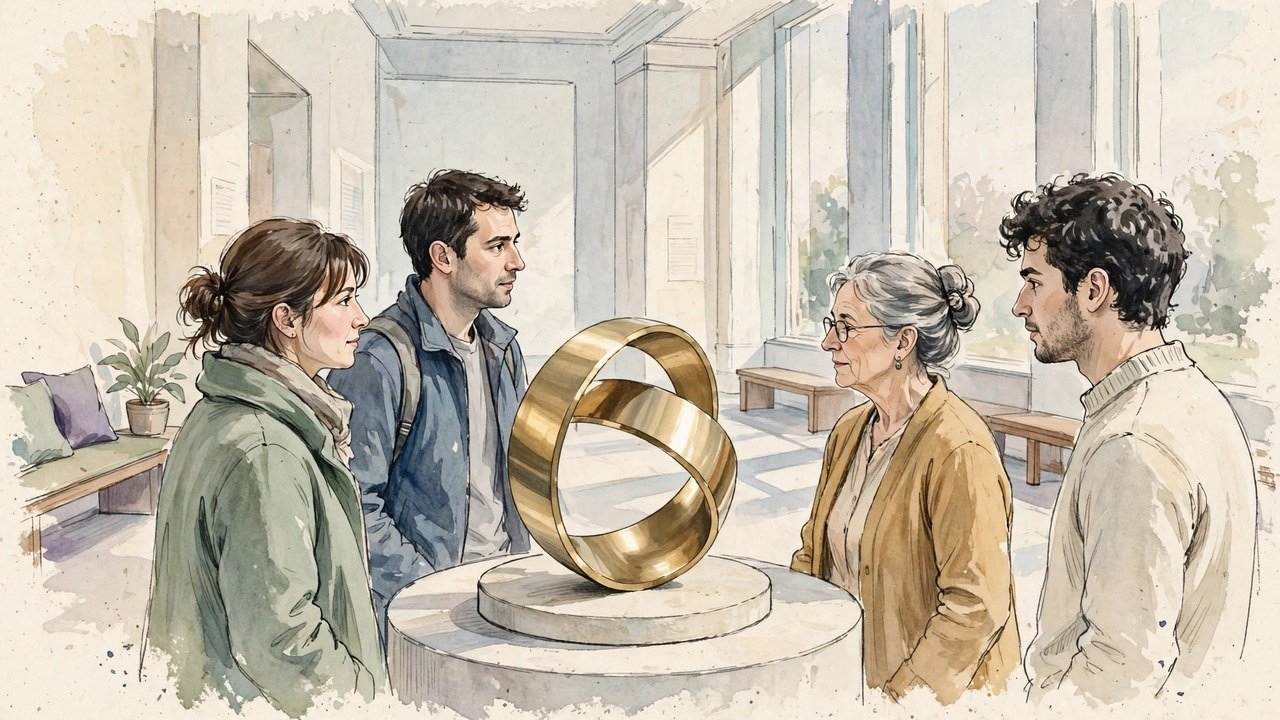
The same object now stands in metal. A polished brass loop with a Möbius twist, set on a low stone plinth in a modern gallery, is the paper band translated into a permanent material: the half-twist is fixed in the casting, the surface is continuous, and a visitor who walks round it and follows the bright curve with one eye is repeating, at walking pace, the journey a pencil makes on paper. Nothing about the sculpture adds a second side. Brass has thickness, as paper does, but the form the metal follows is the form of the twisted strip, and it is that form — not the paper, and not the brass — that this post is about. The band serves here as an occasion and a test object at once. It can be made on a table, stated in equations, cut apart with scissors, built into electrical components and molecules, and set up as sculpture, and at each stage it keeps the same defining property, that a journey along it reverses the traveller’s sense of which face is which before the journey is complete.[1][2]
What follows works through the band in that order. It begins with the construction itself and with what “one side” does and does not mean, then turns to the two men who found the surface independently in 1858, August Ferdinand Möbius and Johann Benedict Listing, and to the memoir of 1865 in which Möbius discussed the properties of one-sided surfaces.[1][3] From the demonstrations — painting the band, drawing its centre line, walking its edge, cutting it along the middle and watching it stay in one piece — the post moves to the ideas the band forced into the open: orientability, the Euler characteristic, the shape a real paper band actually settles into, and the band’s place among the other surfaces of topology, the annulus, the Klein bottle and the projective plane.[2] It ends where the band has ended up in the world: in pulley belts and a patented electrical resistor, in aromatic molecules and carbon nanobelts, in woodcuts, sculpture and the design for a national library — a long career for an object made by twisting a strip of paper once and joining the ends.[1]

1. A surface with one side
The band begins as an ordinary rectangle. The Complete Dictionary of Scientific Biography entry on Möbius describes the one-sided surface as formed from a rectangular strip joined after a half-twist, and that short description contains the whole construction.[1] The description itself can be found at pages 484–485 of the second volume of Möbius’s collected works, the Werke, which is where the printed account of the surface stands in that edition.[1] Take a strip of paper several times as long as it is wide. Hold one end still, turn the other end through half a turn — 180°, so that the face that was uppermost now faces down — and bring the two ends together and fix them. Joined straight, the same strip would make a cylinder band, a plain ring with an inner face, an outer face and two edges. Joined after the half-twist, it makes something else, and the difference is not visible at a glance: the finished band looks like a ring that has been given a single kink, and its strangeness only appears when it is travelled over, painted or cut.[1][2]
Two terms need to be fixed before the travelling starts, because the rest of this post depends on them and will not define them again. A surface, in the sense used here, is a two-dimensional object: at any small patch of it, movement is possible in two independent directions, along the patch and across it, and a sufficiently small neighbourhood of any point looks like a small piece of a plane. The paper band is a surface in this sense even though it sits in three-dimensional space and curves through it; its length and its width are its two dimensions, and its thickness as a sheet of paper is a property of the material, not of the surface being modelled. The boundary of a surface is its edge — the curve, or set of curves, at which the surface stops. A disc has one boundary curve, its circumference. A plain ring of paper has two, one along each rim. How many boundary curves the twisted band has is one of the questions the construction answers, and the answer is not the obvious one.[2]
The sweep that makes it
The construction can be stated without paper, as a moving line segment. MathWorld’s account gives the standard parametrisation in equations, and the equations describe a mechanical process.[2] Picture a circle, the centre circle of the finished band, of radius R. At each point of that circle stands a straight segment of length 2w, centred on the circle and lying across the band, so that w is the band’s half-width and the segment runs from one edge of the strip to the other. Now let that segment travel once round the circle. As it travels, it also rotates, and the rate of rotation is fixed by the construction: the segment turns through half the angle of its travel, t/2 when it has travelled through an angle t. When the travel is complete, at t = 2π, the segment has therefore rotated through exactly π — one half-turn, the same half-twist given to the paper strip by hand.[2]
The closing of the surface follows from that rate. A segment that had not rotated at all would return to its starting position exactly as it left it, and the surface it swept would be the plain ring, its two edges and two faces separate throughout. A segment that has rotated through a half-turn returns to the same position in space but with its two ends interchanged: the end that set out pointing in one direction across the band comes back pointing in the opposite direction, occupying the place the other end started from. The surface closes at t = 2π with the segment’s ends interchanged, an identification MathWorld writes as (0, t) ~ (1, −t).[2] That single interchange is the whole difference between the ring and the band, stated formally. Every test in this chapter — paint, centre line and edge — is a way of detecting the interchange by travelling, and when R is greater than w the parametrisation places the surface in three-dimensional space without self-intersection, so the paper model and the equations describe the same object rather than two approximations of it.[2]
The paint test
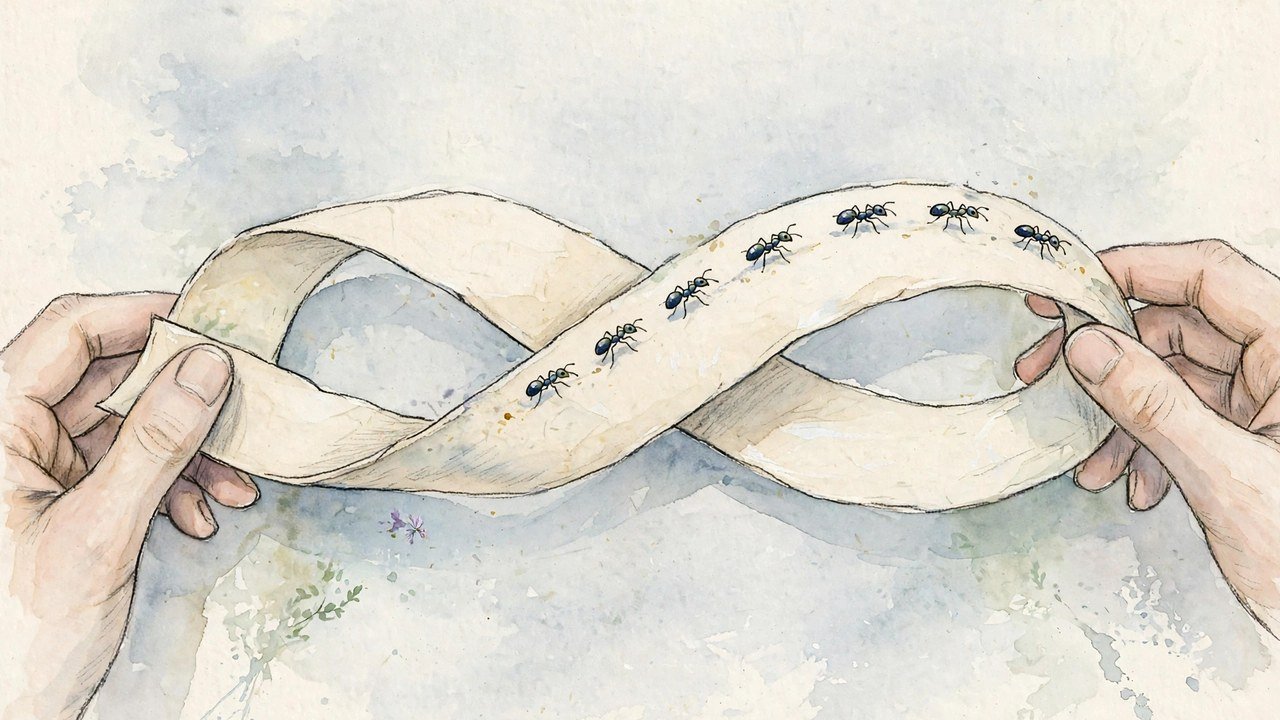
Möbius himself characterised the surface, in Heinz Klaus Strick’s account for MacTutor, as one that “requires twice as much paint to colour as one might have thought”.[4] The remark is a practical test. Begin painting the band on what appears to be its outer face, working the brush steadily along the strip, and do not lift it or turn the band over. On a plain ring the brush would cover the outer face and stop, the inner face still bare, because the two faces are separate and no path on the surface leads from one to the other. On the twisted band the brush keeps going, passes the join, and arrives at regions that, judged by their position in space, lie on the inside of the ring — and it covers them too, without the brush ever having crossed an edge. One continuous stroke colours the whole of the band. That is the operational meaning of “one side”: not that the band is thin, and not that it lacks extent, but that its apparent two faces belong to a single connected surface, so that a traveller confined to the surface can reach any part of it from any other part without leaving the surface or crossing its boundary.[1][2]
Run slowly, the test has distinct stages. Mark the place where the brush first touches the band, and choose a direction along the strip. In the first part of the circuit nothing unusual happens: the brush lays colour on the face it started on. The join is then crossed without incident — it is a join in the paper, not a barrier on the surface, and the stroke passes over the seam as it passes over any other part of the strip. What changes is the relation of the painted region to the room. Continuing in the same direction, on the same unbroken stroke, the brush reaches stretches of strip whose position in space faces inward, toward the axis of the ring, where the starting stretch faced outward. The brush has not been lifted, yet the stroke is now colouring what a static inspection would call the other face. Completing the circuit brings the brush back to its starting mark with both apparent faces coloured by the one stroke, which is the outcome Möbius’s remark about the quantity of paint records: the area to be coloured is the area of both faces of the original strip, because the surface presents them as one.[4][2]
The qualification matters, because “one side” is easily misread. It does not mean that at any given point the band presents only one face to the room. Stand the band on a table and a point on it plainly faces one way in space; a fly standing on it stands on something, with the paper beneath its feet and air above. What the band lacks is a consistent global division of its surface into two faces. Locally, at each small patch, there are two directions away from the surface, as there are on any sheet. The twist prevents those local choices from being carried round the whole band and joined up consistently: carry the notion of “this face” steadily along the centre of the band, and after one circuit it has become the opposite face. One-sidedness is a property of the whole circuit, not of any single point, and every demonstration of it — paint, line or edge — is a journey round the band rather than an inspection of one place on it.[2]
The centre line
Draw the journey instead of painting it. Set a pencil at the middle of the strip’s width and draw a line along the band, keeping to the centre. After one full circuit the line does not close. It returns to the starting point’s position in space, but on the other face of the paper, offset from where the pencil began by exactly the reversal the twist produces; the drawn line and its starting point face each other through the sheet. Continue for a second circuit and the line meets its own beginning and closes. The centre line of the band is therefore a single closed curve that wraps twice round the ring’s axis before it shuts, and a traveller following it visits both apparent faces in the course of one continuous path. MathWorld’s account of the strip records the same doubling in the mathematics of the boundary: the parameter that describes the band’s edge has to run to 4π, through two full turns, before the edge curve closes, where the circuit of the band itself takes 2π.[2]
The failure to close after one circuit follows from the sweep described above. The pencil starts at the centre of the moving segment, the one point of the segment that the half-turn leaves in place, so its starting position in space is the same after one circuit as before it. What has changed is everything around that point. The segment through the starting point has been turned end for end, so the direction across the band has been reversed, and the face of the paper that was beneath the pencil point is now above it. The line therefore arrives at the starting position drawn on the reversed face. Only the second circuit, which applies the interchange a second time and so undoes it, brings the pencil back onto its own first stroke. Two circuits are the interchange of the segment’s ends, counted twice.[2]
The edge walk
The boundary gives the third demonstration. Put a fingertip on the edge of the band at any point and run it along the rim. On a plain ring the finger would complete the circuit on one rim while the other rim remained untouched, a separate boundary curve of the same length. On the twisted band the finger, after one circuit, finds itself on the rim that looked like the other one — because there is only one rim. The boundary of the Möbius band is a single closed curve, not two, and it is twice as long, measured along the curve, as the centre circle of the ring: the walk takes two laps of the axis to come back to its start with its original orientation. The surface has one side and the band has one edge, and the two facts are companions rather than the same fact restated — the first is about the faces of the sheet, the second about where the sheet stops.[2][1]
The walk, too, divides into stages. Mark the starting point on the edge with a spot of ink. The finger sets off along one rim, with the surface of the band on a consistent side of its path — say, always to the left of the direction of travel. After one lap of the axis the finger is back at the marked position in space, but it has arrived along the rim that the static band presents as the opposite edge, and the surface now lies to the other side of its path. The ink spot is reached, but the walk has not closed in the sense that matters, because the finger’s relation to the band has been reversed by the lap. A second lap restores that relation: the finger returns to the spot travelling along the original rim with the surface on its original side, and only then has the whole boundary been traversed. In the parametrisation this is the statement that the boundary is given by the two settings s = w and s = −w together — the two edges of the untwisted strip — yet forms a single curve, which needs the parameter to run through [0, 4π) before it closes.[2] The two rims of the rectangle are one curve on the band, just as its two faces are one surface, and for the same reason: the closing of the strip interchanged the ends of the segment that sweeps it out.[2]
The tests have a limit that should be marked now: they show, by handling, that no consistent division into two faces is possible, but they do not yet explain why, which is the work of the orientability chapter later in this post. The handling also came late in the history of geometry. Von Staudt’s geometry text had asserted that every surface has two sides, an assumption stated as if it were part of what a surface is.[4] The twisted strip of paper is the counterexample that can be made on a desk, and it was made, independently and within a few months, by two mathematicians in 1858.[1]
2. Two discoveries in 1858
The band was found twice in one year, by two men working independently, and the record of who found it first, who published first, and whose name it carries does not align neatly. The Dictionary of Scientific Biography entry on Möbius, hosted by MacTutor, is explicit about the independence: Johann Benedict Listing discovered the same surface in July 1858, Möbius discovered it around September of that year, and the two worked independently and “should thus share the credit”.[1] Britannica’s biography gives the same shape to the story in shorter form: Möbius discovered the surface in 1858, and Listing had discovered it a few months earlier but did not publish his discovery until 1861.[3] On the dates as both sources give them, priority of discovery belongs to Listing by about two months, priority of print belongs to Listing as well, and the name by which the object is universally known belongs to Möbius. Each of those three facts has its own evidence, and the chapter takes them in turn.
The evidence is of three different kinds, and keeping the kinds apart is what makes the chronology intelligible. A discovery date, in Möbius’s case, rests on private notebooks examined by a later scholar. A submission date rests on the record of a paper sent to an academy and not accepted. A publication date rests on a printed memoir that any reader could consult. The three kinds of record were made at different times, for different audiences, and they survive in different places — the notebooks and the printed description of the surface in the second volume of Möbius’s collected Werke, the submission in the accounts of his polyhedron work, and the publications in the journals and academy volumes of the early 1860s.[1][4] A single question — who was first? — therefore has a different answer depending on which kind of record is being asked about, and the sources for this post give the material for all three answers without forcing them into one.
Möbius and the Paris prize
Möbius came to the surface from a problem about solid bodies rather than from paper models. The Paris Academy had offered a prize on the geometrical theory of polyhedra, and that prize prompted his essay work of 1858 on the subject.[1] A polyhedron is a solid bounded by flat polygonal faces, and the Academy’s question concerned the geometrical theory of such solids — among other things, what it means to determine the volume, the “content”, of a polyhedron from its faces. Work of that kind forces attention onto the faces themselves: onto how a face is bounded, how it joins its neighbours, and which way it faces, since a signed volume calculation depends on the faces being taken with a consistent orientation. The one-sided surface appears in Möbius’s work as the limiting case that breaks the assumption such calculations rest on — a surface for which a consistent choice of facing direction cannot be made at all.
The sequence of Möbius’s work can be followed through its stages. The prize question came first: the geometrical theory of polyhedra was set by the Paris Academy, and Möbius’s essay work of 1858 was his response to it.[1] The surface was found in the course of that work, around September 1858, which places the discovery inside the polyhedron investigation rather than as a separate amusement with paper.[1] The work then had a further, unsuccessful stage before it reached print in the form that survives: Strick’s MacTutor account records that Möbius submitted his polyhedron paper to the French Academy in 1861, and that the submission was unsuccessful.[4] Only after that, in 1865, did the article “Ueber die Bestimmung des Inhaltes eines Polyëders” appear in print, carrying the discussion of one-sided surfaces with it.[1][3] Prize question in 1858, discovery in September of that year, academy submission in 1861, publication in 1865 — the four dates belong to four different documents, and the seven-year span between the first and the last is the span the chronology has to account for.
The evidence for the September date is documentary rather than published. Curt Reinhardt showed from Möbius’s notebooks that he discovered the surface around September 1858, and the notebook material is printed in the second volume of Möbius’s collected works, at pages 517–521 of Werke II.[1] The printed description of the surface itself stands earlier in the same volume, at pages 484–485, where the one-sided surface is described as formed from a rectangular strip joined after a half-twist.[1] The two page ranges are worth distinguishing, because they carry two different kinds of evidence side by side: pages 484–485 give what Möbius wrote about the surface for readers, and pages 517–521 give the notebook material from which Reinhardt dated the discovery to around September 1858.[1] A notebook discovery has a different standing from a publication: it fixes, for historians who accept Reinhardt’s reading of the manuscripts, when Möbius himself had the object, but it put nothing before the mathematical public. What Möbius did put before an academy came later. Strick’s MacTutor account records that Möbius submitted his polyhedron paper to the French Academy in 1861, and that the submission was unsuccessful.[4] The paper then appeared in print in another form: the article “Ueber die Bestimmung des Inhaltes eines Polyëders” — on determining the content of a polyhedron — was published in 1865, and it is in that memoir that the strip appears in print in Möbius’s work, in a discussion of the properties of one-sided surfaces.[1][3]
One point about the 1865 memoir needs stating plainly, because it is often got wrong. The memoir was published in Möbius’s lifetime. He died at Leipzig on 26 September 1868, three years after it appeared.[1][3] It is not a posthumous paper. The posthumous item in this story is different: the memoir connected with the Paris Academy prize, which reached print only after his death. Keeping the two apart matters for the chronology, because the 1865 paper is the public, dated evidence of Möbius’s work on one-sided surfaces, published while he was alive to stand behind it, whereas the prize memoir belongs to the record assembled by his editors after 1868.[1]
Listing, July 1858
Listing’s path to the surface was his own. He discovered it in July 1858, two months before the date Reinhardt established for Möbius’s notebooks.[1] Where Möbius approached through polyhedra and their volumes, Listing was building a general study of spatial forms and the ways they connect — the field he had already named. In 1847, in his Vorstudien zur Topologie, Listing had introduced the German word Topologie for the study of such properties; he had used the word in correspondence for about ten years before the book appeared, and the English form “topology” is first found in Nature in 1883.[5] The word’s own chronology therefore runs well ahead of the band’s: used in letters for about a decade before 1847 — which places Listing’s private use of it in the later 1830s, on the “about ten years” the source gives — printed in German in 1847, and not recorded in its English form until 1883, thirty-six years after the Vorstudien and twenty-five years after the discovery of the surface itself.[5] The band therefore surfaced, in Listing’s hands, inside the discipline that would eventually take it as a standard example, and under a name its co-discoverer had coined eleven years earlier.
Listing was also first in print. He published the discovery in 1861, four years before Möbius’s 1865 memoir.[1][3] The publication was his paper Der Census räumlicher Complexe, in which, in Strick’s account, Listing publicised the figure’s properties — one edge, one face — in the mathematical community.[4] The two properties Strick names are the two the handling tests of the previous chapter establish: the single boundary curve and the single connected face. Listing’s paper is recorded as the vehicle that put those properties before the mathematical community, which is a claim about circulation as well as about print — the Census did not merely contain the figure, it publicised what the figure was.[4] The paper’s date is not given uniformly by the sources used for this post, and the disagreement is stated here rather than resolved silently: the Dictionary of Scientific Biography and Britannica date Listing’s publication to 1861, while Strick’s MacTutor account gives the Census paper as 1862.[1][3][4] Presentation versus publication is the likely explanation of the two dates — a paper presented in one year and published in the next would carry both years in different records — but the sources themselves simply differ, and a reader checking either account will find the year that account gives. What is not in dispute is the order of events: Listing in print in the early 1860s, Möbius in print in 1865.
Whose name, and why
The two versions of the credit question can now be set side by side. The first, given by the Dictionary of Scientific Biography and reflected in Britannica, is a shared-credit account: the two men discovered the surface independently in 1858, Listing first by a matter of months and first into print in 1861, Möbius publishing in 1865, and they “should thus share the credit” for it.[1][3] On that account the name “Möbius strip” records one of two independent discoveries and is not, by itself, a claim that Möbius was first. The second version is Strick’s, and it is a question rather than a settlement: it is, Strick writes, “difficult to figure out today why the strip was named after Möbius and not after Listing”, given that Listing publicised its properties — one edge, one face — in the mathematical community.[4] The question is a fair one on the dates alone. Listing was earlier in the notebooks’ terms by two months, earlier in print by roughly four years, and active in spreading the figure’s properties; Möbius’s claim rests on an independent discovery, on the depth of the polyhedron work in which the surface was embedded, and on the 1865 memoir’s discussion of one-sided surfaces as a class, of which the strip is the leading example.[1][3]
The prize as it was actually posed
Chapter 2 has so far called the Paris question “the geometrical theory of polyhedra”, which is the Academy’s subject in summary but not in its own words. A contemporary note, circulated in 1861 with an abstract in the Proceedings of the Royal Society, quotes the question in French: “Perfectionner dans quelque point important la Théorie Géométrique des Polyèdres” — improve, in some important point, the geometric theory of polyhedra.[6] The wording matters because of its deliberate openness. The Academy did not ask for a named theorem, a construction or a measurement; it asked competitors to improve the theory at any important point of their own choosing, which is why work as different in kind as a volume criterion and a classification of surfaces could both present themselves as answers. The note also fixes the competition’s formal shape. The subject had been proposed by the Imperial Institute of France in 1858 as its Grand Prix de Mathématiques for 1861, announced with three years’ notice to “the men of science of all nations”, so the three-year interval between the prize’s announcement and its judgement is built into the chronology of Möbius’s essay work rather than being an unexplained delay.[6]
The same note records how the competition ended, and the ending was not a verdict on one entry but a failure of the competition as a whole. When the report on the 1861 competition tardily appeared, it informed the world, in the note-writer’s words, that “some eight or nine competitors had accomplished nothing”; the medal was resuspended for a second competition, and only after four or five years did the Academy dispose of the two medals of 1858.[6] A second Grand Prix, hung up at the same time and to be awarded in 1860, had drawn three competitors who were all commended, yet the Academy neither awarded that medal nor allowed a second competition for it.[6] Against that background, the judgement on Möbius’s own entry can be stated more precisely than chapter 2’s “unsuccessful”. Kolmogorov and Yushkevich, in their history of nineteenth-century geometry, describe Möbius’s paper as written in bad French, containing many new ideas, and not understood by the jury; like the other papers submitted, it was not awarded the prize, and its content was later published by Möbius in the articles of 1863 and 1865.[7] The failure, on this account, was shared by the whole field of entrants and was in Möbius’s case compounded by the language the memoir was written in — a German professor, working in Leipzig, submitting new geometry to Paris in French that the jury could not follow.[7]
Listing did not come by the Paris road
It is natural to assume that Listing reached the band by the same road as Möbius, since both finds fall in 1858, but the sources read for this insert do not support the assumption, and the chapter should not imply it. Listing’s path ran through Göttingen and through Gauss. He had entered Göttingen in 1830, been spotted by Gauss, joined his circle, collaborated with him on terrestrial magnetism and taken his doctorate under him in 1834; the topological ideas he pursued for the rest of his career were, in MacTutor’s account, first suggested by Gauss, and he was already summarising them in a letter to his old schoolteacher Müller during the Sicily journey of the mid-1830s.[8] The programme those ideas formed is the one set out in the Vorstudien of 1847, and it already contained the band in embryo. Tait’s obituary summary of the Vorstudien traces the route inside the book: from double-threaded screws and twisted bundles of fibres Listing passed to the general theory of paradromic winding, and from that to the slitting experiment — give a strip of paper one half-twist before pasting the ends together, slit it up the middle, and it remains a continuous ring; give it three half-twists and the slit band “cannot be opened into a ring, it is in fact a trefoil knot”.[9] The half-twist band was therefore an example inside Listing’s published system eleven years before 1858, as a winding phenomenon; what 1858 added, in the Census, was its place in a general theory of complexes and of Euler’s formula. Tait explains that generalisation directly: the “mysterious 2” in Euler’s formula belongs to the two regions of space, the one enclosed by the polyhedron and the rest of infinite space, which Listing called the Amplexum.[9] Where Möbius met the band while trying to say when a polyhedron has a content at all, Listing met it while counting — extending Euler’s relation beyond the solids Euler had considered.[8][9] Two roads, one object; only one of them passed through Paris.
Tait, Maxwell and the British afterlife
The band’s passage into British mathematics ran through Listing’s books, and it was slow. Tait, writing Listing’s obituary in Nature in 1883, remarks that the Vorstudien and the Census “seem scarcely to have been noticed in this country, until attention was called to their contents by Clerk-Maxwell”.[9] MacTutor’s note to the obituary gives the dates of that awakening: Maxwell discovered Listing’s work on knots in 1868, when it was already twenty years old, showed the book to Tait, and lectured on it to the London Mathematical Society in February 1869; Tait himself did not begin his work classifying knots until 1876.[9] Tait’s obituary is itself part of the transmission it describes — a Scottish physicist explaining, for Nature’s readers, a Göttingen professor’s qualitative geometry, and regretting that Listing’s knot methods, “the first really successful attempt” at the subject’s preliminary difficulties, occupied so brief a part of his paper.[9]
What Tait did with the inheritance, from 1876, was tabulation. Menasco’s account of alternating knots records that Tait was motivated by Lord Kelvin’s programme of understanding the chemical elements as knotted vortices in the ether, and that, without the aid of any theorems from topology, he published in 1876 a first knot table containing the fifteen knot types through seven crossings, enumerating all possible diagrams up to seven crossings and grouping those that represented the same knot.[10] His grouping of the fifteen types agrees with modern tables, although, lacking the notion of prime and composite knots, he also listed some composite sums alongside them.[10] Out of the tabulated data came the three conjectures that carry his name — that a reduced alternating diagram has minimal crossing number, that any two such diagrams of one knot have the same writhe, and that any two are connected by flypes — none of which was settled until after Vaughan Jones’s knot polynomial of 1984.[10] The line from the band to the knot tables is direct in one specific sense: the trefoil that Tait’s tables begin from is the very object Listing had produced in the Vorstudien by slitting a band given three half-twists, and Tait’s obituary preserves Listing’s remark as the seed of the subject Tait then spent years enumerating.[9][10]
Klein — systematiser, editor, and one unreliable story
No source read for this insert states that Felix Klein coined the name “Möbius band”, and the claim should not be made. What the record does show is Klein doing the three things that fix a name in place: systematising the idea, editing the canonical text, and teaching the picture. The systematising came first. In 1873, discussing with Schläfli which type of connectivity non-orientable surfaces realise, Klein introduced his notion of Einseitigkeit, one-sidedness, and understood that closed surfaces fall into two classes, orientable and non-orientable — applying to closed surfaces a concept that, as the Manifold Atlas history puts it, had been known since Listing and Möbius discovered the strip but that nobody had yet applied to them.[11] In 1882 came his own contribution to the family: a one-sided surface that is closed, with no boundary at all, now called the Klein bottle, which Britannica’s history of topology pairs with Möbius’s 1858 example as the two published works on one-sided surfaces around which the classification of surfaces grew.[12] The editing followed: when the Gesammelte Werke appeared, volumes II and III — the volumes carrying the band’s description and its notebook record — were edited by Klein, as was the supplement to volume IV.[13] And the teaching lasted longest: Klein’s model of the projective plane as a sphere whose hole is closed by a Möbius strip was delivered in his Göttingen lectures of 1889–90 and reached print in his Vorlesungen über nicht-euklidische Geometrie of 1927, while his pupil Walther von Dyck’s 1888 classification gave the first complete list of closed surfaces and a picture of the projective plane that became standard.[11]
One counterweight belongs beside this. Klein was also a maker of Möbius lore, and not always a reliable one. Fritsch’s Neue Deutsche Biographie article records that the widespread claim that Möbius had treated something like the four-colour theorem in his lectures around 1840 is a fairy tale, probably put into the world by Klein, on Baltzer’s authority; what Möbius actually lectured on was the simpler problem of five regions each bordering the other four, to which his friend Weiske had drawn his attention.[14] The distinction is worth keeping in a chapter about naming. Klein’s documented role is that of the man who classified one-sidedness, edited the volumes in which the band’s record stands, and carried its picture into the lecture room — work that made “Möbius” the name a student met. The stronger claim, that he bestowed the name itself, is not in the sources, and one of the stories he did bestow on Möbius’s memory turns out to be false.[14][11]
No document in the sources for this post settles the naming, and the honest position is the one the two versions share underneath their difference: the discovery was double, the independence is not doubted by any of the accounts, and the name settled on one of the two men for reasons the record does not fully explain.[1][4] MacTutor’s chronology of the period lists the year without adjudicating it — 1858, Möbius describes a strip of paper with only one side and only one edge, Listing makes the same discovery in the same year, and the band remains in one piece when cut down the middle.[15] The chronology’s three clauses correspond to the three strands of the record: a description by Möbius, a parallel discovery by Listing in the same year, and a property of the band — its behaviour under a centre cut — stated as part of what the year 1858 established.[15] The surface entered mathematics, in other words, already attached to two names and one date, and the strip’s later career in topology, physics and art has been conducted almost entirely under Möbius’s. The next chapter turns to the man himself — what else his name is attached to, and why a Leipzig astronomer was writing about the volumes of polyhedra in the first place.[1]
3. The man behind the band
August Ferdinand Möbius was born at Schulpforta on 17 November 1790 and died at Leipzig on 26 September 1868.[1][3] Britannica describes him as a mathematician and theoretical astronomer, and the double description is the shape of his career: Leipzig was his base, astronomy his profession, and geometry the field in which his most durable work was done.[3] He was seventy-seven when he died, and the one-sided surface that carries his name belongs to the last decade of his life — the notebooks date to September 1858, when he was sixty-seven, and the memoir that printed the strip appeared in 1865, three years before his death.[1] The band, in other words, is late work, the product of a mathematician whose principal methods had been set out forty years earlier.
The dates of the work itself mark out that span. The barycentric book appeared in 1827, when Möbius was in his thirties. The paper that introduced the Möbius function was written in 1831 and published in 1832, four to five years after the book.[4][16] The polyhedron work prompted by the Paris Academy’s prize, in the course of which the one-sided surface was found, belongs to 1858 — thirty-one years after the barycentric book and twenty-six years after the function paper appeared in print.[1] Between the first of those dates and the last, the same name attaches to a method of geometry, a function in the theory of series, and a surface; the chapters of a single career, not the coincidences of several men sharing a surname. The collected edition that eventually gathered the work was not published until 1885–1887, seventeen to nineteen years after his death, so during his lifetime the record of that career existed only as the separate books, papers and notebooks in which it had originally appeared.[1]
The barycentric calculus
That earlier work is Der barycentrische Calcul, published in 1827. Britannica records that Möbius developed the methods of the barycentric calculus in that book, and Strick’s MacTutor account names it as his most important mathematical work.[3][4] The standing Strick gives the book is worth holding onto while the band is discussed, because it reverses the order a modern reader naturally assumes. The strip is the work by which Möbius’s name is most widely known; the barycentric calculus is the work Strick identifies as his most important within mathematics.[4] For this post its importance is biographical rather than technical: it establishes that Möbius’s reputation within mathematics did not rest on the strip. The band was found by a geometer whose main contribution was already three decades old, in the course of the polyhedron work prompted by the Paris Academy’s prize on the geometrical theory of polyhedra.[1]
The other things that carry his name
Strick lists the legacies together: Möbius geometry, the Möbius function and Möbius transformations all bear his name.[4] The three are named here as a list because that is how the source gives them — three distinct attachments of one name, in three parts of mathematics. Möbius geometry and Möbius transformations are named in this post without exposition, since they are not its subject and the research behind it does not develop them; their presence in the list establishes only that the band is one of several bearers of the name, not the sole one. The function needs one paragraph, because its dating is part of the record. The Möbius function, written μ(n), was introduced by Möbius in studying the coefficients of a series-inversion problem, in the paper “Über eine besondere Art von Umkehrung der Reihen” — on a special type of inversion of series.[16] Its dating carries the same kind of small disagreement met in the previous chapter, and it is given here in both forms: Strick dates the writing of the article to 1831, and the paper is cited from its publication in Crelle’s Journal für die reine und angewandte Mathematik in 1832 — written in 1831, published in 1832.[4][16] In that paper Möbius set up a series-inversion problem and, in studying its coefficients, introduced the function now written μ(n), which also matters in number theory and combinatorics.[16]
The route by which the function arrived can be stated in the order the source gives it, without supplying the formulae the research does not record. Möbius set up a problem of a specific kind: a special type of inversion of series, in which a series is to be reversed — the given quantities and the sought quantities exchanging their roles.[16] Studying that problem meant studying its coefficients, the numbers that govern how the terms of one series are built from the terms of the other. It was in the course of that study of the coefficients that the function now written μ(n) was introduced.[16] The function’s later importance lies outside the paper’s immediate setting: the source records that μ(n) also matters in number theory and combinatorics, two fields distinct from the series problem in which it first appeared.[16] A result obtained by examining the coefficients of an inversion problem in 1831–1832 thus carried its author’s name into subjects the paper itself was not about, in the same way that a surface found during work on polyhedra in 1858 carried it into topology.
The collected works
A Leipzig career that advanced slowly
The bare appointments of chapter 3 conceal how uneven the career was. Möbius was appointed to the chair of astronomy and higher mechanics at Leipzig in 1816, at twenty-five, but the appointment was as Extraordinary Professor, and promotion then stalled for twenty-eight years.[17] MacTutor’s biography gives a practical reason alongside the institutional ones: he was not a particularly good lecturer, fee-paying students stayed away, and he was reduced to advertising his lecture courses as free of charge before students thought them worth taking.[17] The offers that might have moved him were refused. An astronomy post at Greifswald in 1816 and a mathematics post at Dorpat in 1819 were both declined, partly, MacTutor says, through his belief in the high quality of Leipzig and partly through loyalty to Saxony.[17] Cantor’s older biography in the Allgemeine Deutsche Biographie puts figures to the Dorpat refusal: the call, which arrived at Christmas 1819, offered 1,450 silver roubles a year, while his fixed income at Leipzig was not yet 500 Thaler, and he declined it outright, without even attempting to use it to improve his position at home; only twenty-five years later did he use a call in that way.[14] When Mollweide died in 1825, Möbius hoped to follow the route his teacher had taken and move to the chair of mathematics; another mathematician was preferred.[17] Fritsch’s Neue Deutsche Biographie article adds the faculty’s reasoning, as he reports it: the faculty was so certain of Möbius’s staying that it passed him over and appointed the now largely forgotten Moritz Drobisch instead.[14]
Fritsch names three qualities behind the slow rise — personal modesty, a scientific integrity that allowed him to publish only completely matured work, and rootedness in his Saxon homeland — and Cantor names two causes in similar terms: a shyness-accompanied modesty that kept him from petitioning, and the high demands he placed on scientific work.[14] The stall ended by an outside call: in 1844 Jena invited him — as successor to the philosopher Jakob Friedrich Fries, Fritsch specifies — and Leipzig responded with the full professorship, specified later as professor of higher mechanics and astronomy, held until his death; Cantor dates it to Easter 1844 and notes it carried only a small increase in salary.[17][14] The pattern is the reverse of the usual one: the chair came early, the rank came late, and both decisive interventions — 1825 and 1844 — turned on what other universities, or other candidates, did rather than on any application of his own.
The observer on the Pleißenburg
The observatory half of the career has its own topography, which the sources allow to be stated concretely. The Leipzig university observatory of Möbius’s time stood in the tower of the Pleißenburg castle, converted in 1787–1790 and inaugurated on 3 February 1794, and it remained there until 1861.[18] Möbius held the observer’s post from his first appointment: he visited several other German observatories before making his recommendations, and from 1818 to 1821 he supervised the observatory’s rebuilding.[17] The institution he ran was small. Until 1848 it was headed by an observer assisted by a single assistant (the second assistant’s post had lapsed in 1815), with a warden — from 1842 styled Castellan — in addition; its instruments included a six-foot parallactically mounted Fraunhofer refractor.[18] In 1848 the staffing was rearranged: the assistant’s position became that of a second observatory director, and the former head was then appointed director of the observatory.[18] The UNESCO portal’s list of the Leipzig observatories’ heads accordingly runs “1816 to 1848: August Ferdinand Möbius; 1848 to 1861: Director of the observatory”, with Heinrich Louis d’Arrest — who would marry Möbius’s daughter Emilie — serving from 1848 to 1857.[18]
One date in this sequence is given differently by the German national biography, and the disagreement should be recorded rather than smoothed over. Fritsch writes that Möbius’s refusals of Greifswald and Dorpat were “only rewarded with the appointment as director of the observatory (1820)”.[14] MacTutor and the UNESCO portal both give 1848 for the directorship, after an observer’s tenure beginning in 1816.[17][18] The UNESCO page supplies the likely mechanism of the confusion: before 1848 the observatory’s head bore the title of observer, and the 1848 rearrangement is precisely the moment at which the head’s title became director, so a source that treats the headship as a directorship from its first reward will date it to the early promotion Fritsch mentions, while sources that follow the titles will date it to 1848.[18] What is not in dispute is the end of the tenure. The Pleißenburg observatory closed in 1861, its usefulness destroyed by the dense building development around it, and its replacement in Johannisthal opened on 8 November 1861 under his successor Karl Christian Bruhns; Möbius’s name closes in the portal’s list at 1861, seven years before his death.[18] His astronomical writing ran in parallel with the observing throughout: the occultation treatise of 1815, Die Hauptsätze der Astronomie in 1836, and Die Elemente der Mechanik des Himmels in 1843, the last of which, Fritsch notes, was widely spread and read by laypeople as well as astronomers.[17][14]
How the barycentric book was received
Chapter 3 records that Der barycentrische Calcul is named Möbius’s most important mathematical work; the new sources describe its reception, and the reception was slower and stranger than that standing suggests. The book was nearly ten years in the making, was dedicated to Bernhard von Lindenau — the Gotha observatory director Möbius had met on his inaugural tour, who became a Saxon minister and whom Fritsch calls his friend and patron — and was received with interest by the mathematical public, in France, Fritsch says, even more than in Germany.[14] Cantor’s account agrees on the geography and explains it: scholarly attention stirred earlier in France than in Germany because Dupin, Gergonne, Poncelet and others had reached similar results there by quite different routes, so a French reader met the Calcul as a contribution to a live discussion while a German reader met it largely alone.[14] On its long-term effect the two German biographies are measured in the same direction. Fritsch judges that Möbius’s immediate influence on the mathematics of his time is not to be rated too high, while identifying what endured: the book opened the use of homogeneous coordinates in projective geometry that has since become standard, and Felix Klein saw in Möbius a precursor of the Erlangen Programme of 1872.[14] MacTutor’s assessment matches that division: the Calcul became a classic and introduced the Möbius net, which played an important role in the development of projective geometry.[17]
Cantor, writing in 1885, is blunter about the method’s fate, and his verdict is the sharpest reception evidence the new sources contain. Möbius’s own barycentric method, he writes, strikingly failed to gain a foothold with any successor — unless one chose to see its basic idea glimmering through much later work — and the Lehrbuch der Statik of 1837, though it became a starting point for the graphical statics taken up by Culmann, could not escape the fate of being pulped in almost its entire edition: “So little was Möbius appreciated ten years after the appearance of the barycentric calculus!”[14] The two judgements are compatible, and together they describe the book’s actual career: a classic whose coordinates everyone eventually used and whose calculus, as a working method, almost nobody used — honoured earliest abroad, and absorbed into the subject in a form its author would have had to look for to recognise.[17][14]
Working habits, and the limits they set
The working method behind that pattern is described by the man who later edited the first volume of the Werke. Richard Baltzer’s characterisation, quoted in MacTutor’s biography, runs: the inspirations for his research Möbius found mostly in the rich well of his own mind; he worked without hurrying, quietly on his own; his work remained almost locked away until everything had been put into its proper place; and only after such a wait, without pomposity and without arrogance, did he publish his perfected works.[17] The habit explains both the ten-year gestation Fritsch records for the Calcul and the notebook form in which the band’s discovery survives.[17][14] It also had a cost, and the cost has a name. In 1844 Hermann Grassmann visited Möbius and asked him to review Die lineale Ausdehnungslehre, a work containing many results similar to Möbius’s own; Möbius did not understand its significance and did not review it, though he persuaded Grassmann to submit work for a prize and, after Grassmann won it, reviewed the winning entry in 1847.[17] A mathematician who worked from his own well, and published almost everything in Crelle’s Journal, was not well placed to recognise a kindred system arriving from outside it.[17]
The smaller habits are recorded too, in Cantor’s biography. Möbius was a keen walker, and so as to be sure of having forgotten nothing he might need, he never failed to apply a mnemonic, “3 S und Gut” — for Schlüssel, Schirm, Sacktuch, Geld, Uhr, Taschenbuch: key, umbrella, handkerchief, money, watch, notebook.[14] His health was otherwise sound, apart from an eye ailment that impaired his sight in his last decades, and toothaches severe enough to prompt his joke that his gravestone should read “Dem thut kein Zahn mehr weh” — “His teeth don’t hurt any more”.[14] The correspondence of a less solitary worker would have survived scattered in other men’s archives; Möbius’s was gathered centrally, and then lost centrally: the Saxon Society of Sciences had established a Möbius Archive containing his rich correspondence with other mathematicians and astronomers, and it burned in 1943 through the effects of war.[14] What is known of his working life is therefore known disproportionately from the printed works and from Baltzer’s and Cantor’s recollections, because the letters that would have corrected them no longer exist.[14]
Family — a blind wife, an astronomer son-in-law, a neurologist grandson
The family record can now be filled in from the national biography’s genealogy. Möbius married in 1820 Dorothea Rothe, a surgeon’s daughter from Gera; Cantor gives her full name as Dorothea Christiane Johanna Rothe, born 26 July 1790, and the wedding date as 6 April 1820, quietly celebrated.[14] His mother, who had moved to Leipzig in 1816 and kept his house, died unexpectedly on 4 March 1820, aged sixty-four, a month before the wedding she had pressed for, and could not attend it.[14] The couple had two sons and a daughter: Theodor; Paul (1825–1889), a pedagogue and writer; and Emilie (1823–1897).[14] Dorothea suffered with her eyes from 1821 and was completely blind by 1825, yet remained, in Cantor’s words, the cheerful centre of the household until her death on 9 September 1859.[14] The observatory and the family were not separate worlds: Emilie married Heinrich Louis d’Arrest, who had come to the Leipzig observatory in 1848 as its second director under her father and served there until 1857, before becoming professor of astronomy at Copenhagen.[14][18]
The grandson sometimes confused with Möbius’s son Paul can be placed exactly. Fritsch’s genealogy lists among the grandchildren (“E” for Enkel) Paul Julius (1853–1907), nerve doctor and Privatdozent at Leipzig — Paul Julius Möbius, the neurologist, son of the pedagogue Paul and grandson of the astronomer.[14] The distinction matters because the family reuses its names, and the genealogy is what keeps a Paul born in 1825 and a Paul Julius born in 1853 from being collapsed into one man.[14] Möbius outlived his wife by nine years, holding the full professorship until his death in 1868; Cantor’s biography, published in 1885, closes by noting that the Saxon Society was then newly organising a collected edition of his works — the edition the next section describes volume by volume.[14]
What the collected edition actually preserved
Chapter 3 states the Gesammelte Werke’s dates and its three editors together; the edition’s own catalogue record distributes the work more informatively. Volume I was edited by Baltzer; volumes II and III were edited by Felix Klein; volume IV was edited by Wilhelm Scheibner, with a supplement edited by Klein and a report on Möbius’s Nachlass — his papers and estate — by Curt Reinhardt.[13] The distribution is not a bibliographical nicety. It was Klein, the systematiser of one-sidedness discussed in chapter 2, who edited the two middle volumes in which the band’s printed description and the notebook material stand, and Reinhardt, whose report on the estate accompanied the fourth volume, who established the September 1858 dating on which the discovery chronology rests.[13] Fritsch’s works list adds what the edition carried at its front: a preface by Baltzer, and a contribution by Reinhardt “on the date of origin and the connection of Möbius’s most important writings and treatises” — that is, the edition did not merely reprint the works but argued, in print, for how they were dated and how they hung together.[14] Set against that loss, the edition’s preservative role is plain: the archive that might have documented the career independently burned in 1943, while the four volumes of 1885–87 remain the form in which Möbius’s work — including work left unpublished at his death — is still read.[14][13]
Möbius published no collected edition of his own. After his death his writings were gathered as the Gesammelte Werke, four volumes edited by Baltzer, Klein and Scheibner and published at Leipzig in 1885–1887, seventeen to nineteen years after he died.[1] Britannica gives the same dates for the collected works, 1885–87.[3] The edition was a substantial undertaking on the scale the dates imply: four volumes, three named editors — Baltzer, Klein and Scheibner — and a publication run spread across three years, from 1885 to 1887, at Leipzig, the city where Möbius had died in 1868.[1][3] The edition matters to the history of the band for a specific reason: it is in the second volume of the Werke that the strip’s early record is printed — the one-sided surface described at pages 484–485, and the notebook material from which Curt Reinhardt established the September 1858 date of discovery, at pages 517–521.[1] The two page ranges stand for the two halves of the evidence. Pages 484–485 carry the description Möbius himself prepared — the surface formed from a rectangular strip joined after a half-twist. Pages 517–521 carry notebook material that Möbius did not publish in that form, from which Reinhardt, reading the manuscripts, established when the discovery was made.[1] Much of what is known about when Möbius found the band is therefore known through a posthumous edition assembled by other hands, while the claim itself — the 1865 memoir on the content of a polyhedron, with its discussion of one-sided surfaces — had been in print, under his own hand, since three years before his death.[1][3]
4. One side and one edge
The claims made for the band in chapter 1 — that it has one side and one edge — are not definitions. They are results, and each of them can be tested on a paper model with nothing more elaborate than a pot of paint, a pencil and a finger run along the rim. The tests matter because ordinary language is a poor guide here. A sheet of paper plainly has two faces, front and back, and a rectangular strip cut from it has four edges, two long and two short. Joining the short ends together does not remove any of the paper, and it does not remove any of its rim. What the half-twist changes is not how much surface or how much edge there is, but how the parts are connected to one another. One side means one connected face, not half the usual amount of surface. One edge means one connected rim, not a rim of half the usual length. The demonstrations in this chapter separate those two ideas, connectedness and amount, which the short phrases “one side” and “one edge” otherwise blur together.
The distinction is easiest to see against the untwisted comparison. Join a strip end to end without a twist and the result is a short open cylinder, an annulus in band form. Its outside face can be painted from any starting point without the brush ever reaching the inside face, because to get from outside to inside the brush would have to cross the rim or pass through the paper. The two faces are separate regions of the surface, even though they are the two faces of the same thin sheet. Its rim likewise falls into two separate closed curves, the circle at the top and the circle at the bottom, and a finger that sets out along one of them will return to its starting point without ever having travelled on the other. Two sides and two edges, in this usage, are statements about how many separate pieces the face and the rim fall into when they are followed, not statements about the area of paper or the length of card from which the band was made.
The paint test
Möbius’s own characterisation of the surface turned on exactly this point about area and connection. Strick’s MacTutor account records that he described it as a surface that “requires twice as much paint to colour as one might have thought”.[4] The remark is sometimes quoted as a curiosity, but it is a precise description of the paint test done carefully. Begin painting the band at any point, on what looks, locally, like its outer face. Work the brush steadily along the length of the strip, keeping it on the surface and never lifting it across the rim and never letting it pass through the paper. On the untwisted cylinder this procedure colours one face and stops, in effect, at a completed circuit: after one lap the painted region has closed on itself, and the other face remains untouched. On the twisted band the painted region does not close after one lap. The brush comes back to the place where it started, but it arrives there on the face that, at the start, was facing the other way. Painting can therefore continue, without any crossing of the rim, into the region that a first inspection would have called the back of the strip. Only after a second lap does the painted region meet itself in the same orientation in which it set out, and by then the whole of the paper — both of the faces with which the flat strip began — carries colour.
That is the sense of “twice as much paint”.[4] The band does not have a larger area than the strip it was made from. It has the area of both faces of that strip, as any band does, and the untwisted cylinder has exactly the same total area divided between its two faces. The difference is that on the cylinder the total is divided between two disconnected painting jobs, each of which can be finished without beginning the other, while on the Möbius band there is only one painting job, because the surface is a single connected face. Paint reaches everywhere not because the twist creates new surface, and not because the brush has found a way through the paper, but because the route along the surface joins what the flat strip kept apart. The half-twist is a connection made at the seam, and the paint test reads that connection off over the whole length of the band.
It is worth stating what the test does not show. It does not show that the band has no thickness, or that a real strip of paper ceases to be a thin solid with two faces in the physical sense. A paper model has thickness, and its two broad faces are distinct sheets of fibres at any small place the eye examines. The mathematical surface represented by the model is the idealised sheet without thickness, and “side” for that surface means a face of the sheet as a route along it, not a layer in the material. Locally, at any one point, the band still presents two directions in which a brush could approach it, from one side of the paper or from the other. Globally, over the whole circuit, those two local directions belong to one connected face. The failure is in carrying the local picture — here is a front, here is a back, and never the twain shall meet — unchanged around the entire object. The paint test is a global test, and its result is a global property.
The same caution explains why the test must be done by travelling along the surface rather than by looking at the finished object from outside. From a single viewpoint the band presents an outer-looking part and an inner-looking part at every moment, because it sits in ordinary three-dimensional space as a loop. Those appearances change from place to place around the loop. A point on the centre line that is on the outside of the loop at one station is carried, by the gradual half-turn of the strip, to a position facing into the loop half a circuit later, without the surface ever having been broken. Appearance from a fixed viewpoint therefore sorts the surface by where its parts happen to lie in space. Painting sorts it by how its parts are joined to one another, and for the question of sidedness it is the second sorting that counts.
The centre line
The pencil version of the same test is cleaner, because a line leaves a visible record of the route taken. Draw a line along the middle of the strip, midway between its two long edges, and follow it round the band. On the untwisted cylinder the middle line of the outer face is a closed circle. One circuit brings the pencil back to its starting point travelling in its starting direction, and the line is complete. The middle line of the inner face is a second, separate circle, and it has to be drawn as a separate job. On the Möbius band there is no second job waiting. The line begun at any point of the centre continues for one full circuit and arrives back at the starting point of the strip, but on the opposite face of the paper at that station, so that as a line drawn on the surface it has not yet closed. The pencil is at the right place with the wrong side up, and the line it has drawn occupies only half of the centre of the surface — the half corresponding to one of the flat strip’s two faces at each station. A second circuit is needed, laid along the other face at each station, before the pencil returns to its starting point in its starting attitude and the line joins up with itself.
The standard parametrisation records this doubling in algebraic form. In MathWorld’s presentation a segment of length 2w is swept round a circle of radius R, the segment turning by half the angle through which it has travelled, so that after one complete circuit, at an angle of 2π, it has made exactly a half-turn and its two ends have been interchanged.[2] A point at the centre of the segment, the point that traces the centre line, is back where it began after that circuit. A point off centre, or a mark that distinguishes one face of the segment from the other, is not back in its original state: the interchange of the ends is the algebraic form of the pencil arriving with the wrong side up. The surface itself closes after one circuit — the band is a finished object, with no loose end — but a journey that keeps track of which face it is on needs two circuits to close. Confusing those two closures, the closure of the surface and the closure of a sided journey along it, is the source of most of the apparent paradox in informal accounts.
The centre line itself, considered simply as a curve drawn on the surface and forgetting which face the pencil was on, is a single closed curve, and it sits at the heart of the band in a sense later chapters will make precise. Every point of the band lies on the short straight segment that crosses the width at its station, and the centre of that segment lies on the centre line. The line is not an edge and it is not a seam; the seam where the ends were joined can be placed anywhere, and on a well-made model it cannot be told from any other cross-line of the strip. Nor does the centre line divide the surface into two halves in the way a line down the middle of a flat strip divides it. Cutting along it is a separate operation, with its own surprising result, and it belongs to chapter 7. Drawing along it divides nothing. It traces, instead, the spine of the object, the one curve along which the doubling behaviour of the faces is most plainly read off: one lap for position, two laps for position together with face.
Walking the edge
The rim submits to the same treatment, with a finger in place of the brush. A rectangular strip has two long edges, and on the untwisted cylinder those edges survive as the two separate rims already described. On the Möbius band they do not survive as two. Set a finger on the rim at any point and walk it steadily along the edge, never lifting it and never stepping across to another part of the rim at a crossing of the loop in space. After one circuit of the loop the finger is back at the station where it began, but it is travelling along what was, in the flat strip, the other long edge. The two long edges of the rectangle have been joined by the twisted seam into a single route, exactly as the two faces were joined into a single route for the brush. A second circuit brings the finger back to its starting point on its starting edge, and only then has the whole rim been traversed. Han, Pal, Liu and Yan state the result in the compressed form used in the research literature: the band has one side and one boundary component.[19]
The phrase “boundary component” needs unpacking, because it is the precise term of which “one edge” is the informal version. The boundary of a surface with edge is the whole of its rim, considered as a curve or collection of curves in its own right. A boundary component is one connected piece of that rim: a piece that can be traversed completely without lifting the finger, and that is not joined to any other piece. Counting boundary components is therefore an exercise of the same kind as counting sides by painting. Follow each piece until it closes, and count how many separate closures there are. A disc has one boundary component, its single circular rim. The annulus or open cylinder has two, its two end circles, and no journey along the rim passes from one to the other. The Möbius band, despite having been made from a strip whose two long edges look as separate as the annulus’s two rims, has one, because the seam joins the end of each long edge to the end of the other.[19] The short edges of the original rectangle do not add further components. They disappear into the seam, becoming an interior cross-line of the finished surface, which is why the count concerns the long edges alone.
The contrast becomes sharper if the uncut band is set against what the centre cut, treated in full in chapter 7, does to its boundary. Before any cut is made, the finger’s walk has the form already described: one component, traversed in a double circuit, with no second rim anywhere on the object for the finger to stray onto. The centre cut changes the object, and Han, Pal, Liu and Yan’s statement of its result includes the boundary change explicitly: the cut does not split the band, which remains one band, twice as long and two-sided, and the cut creates a second edge.[19] The uncut band has one boundary component; the band produced by cutting it along its centre line has the original rim and, in addition, the new edge opened along the line of the cut. One connected rim has become two.
The finger test, repeated on the cut band, registers the change in the same elementary way as it registered the original count. Set the finger on the rim that the uncut band already had, and walk: the walk closes on that rim without ever meeting the cut edge, because the two are separate components now, and a journey along one component of a boundary does not pass onto another — that was the definition by which components were counted in the first place. Set the finger instead on the edge the scissors made, and a second, independent walk appears, closing on the new edge alone. Where the uncut band offered a single walk that took two laps to finish, the cut band offers two walks, each finishing on its own rim. The paint test moves in step: the cut band is two-sided, so a brush started on one of its faces stays on that face, as it does on a cylinder.[19] Cutting along a line that was not an edge has manufactured an edge, and the manufacture shows in both counts at once — boundary components from one to two, sides from one to two — while the paper itself has neither gained nor lost area. What changed, once again, is not amount but connection: the counts return to the pair of twos that the flat strip seemed to promise, because the cut has opened, along the centre line, a separation that the uncut band nowhere possesses.
Length, once again, must be kept separate from connectedness. The single boundary curve of the band is not short. In the parametrisation, the boundary is given by taking the segment at either of its ends, and it requires the angle to run not to 2π but to 4π before it closes: the boundary curve needs the full double circuit.[2] Set against the centre circle of radius R, whose length is fixed by one circuit, the rim accordingly has twice the centre circle’s length. That figure should be read as the parametrisation states it, for the ideal band whose width segments sweep round a circular centre line. It is not the claim that a crumpled paper model’s rim will measure exactly twice its middle line with a tape, since a real model does not keep a perfectly circular centre line. It is the claim that the rim is one curve of double-circuit length: the finger’s two laps are not two traversals of the same circle, as they would be if someone simply walked twice round one rim of a cylinder, but one traversal of a single curve that passes through each station of the loop twice, once on each of the strip’s original long edges.
This also settles a confusion that pictures of the band often cause. In a drawing, the rim appears to cross the surface and to meet itself where the loop passes in front of and behind itself in space. Those crossings are artefacts of the drawing, and of the embedding of the band in space, not junctions in the rim. At a crossing in the picture, the two parts of the rim that seem to meet lie on different parts of the surface, at different stations round the loop, separated by the paper that passes between them. The finger walking the edge does not arrive at a junction and does not face a choice of direction. It passes each apparent crossing on its own level, so to speak, and continues. The boundary is a simple closed curve in the sense that matters for the count of components: one loop, traversed once in the double circuit, with no branching and no second loop hidden in the drawing.
The parametrisation adds one further condition that a careful statement should keep. For a band of half-width w whose centre circle has radius R, the standard model sits in three-dimensional space without self-intersection when R is greater than w.[2] In other words, the familiar object — the one the paint, pencil and finger tests describe — is the band wide enough to show its twist plainly but not so wide that its inner parts collide with one another across the middle of the loop. The tests themselves do not depend on that condition, because they follow connections along the surface rather than positions in space, but the clean paper model does. A strip joined with too great a width for its loop cannot lie flat against itself as the standard model does, and its behaviour in the hand becomes a mixture of the surface’s connections and the paper’s attempts to avoid occupying the same space twice — a mixture that later chapters, on the shape a paper band actually takes, will have to disentangle.
None of the three results depends on a special choice of starting point, and none depends on where the seam happens to sit. Begin the painting, the drawing or the walk at any station of the loop, and the same doubling appears after the same distances: the brush needs two laps, the pencil needs two laps, the finger needs two laps. Move the seam to another station — remake the model joining the ends at a different place along the strip — and nothing in any of the tests changes, because the seam is not a feature of the surface but only the place where its maker happened to close it. What the tests are measuring is therefore not an accident of construction. It is a property the finished object has at every point and from every start, and a property of that kind needs an explanation in terms of the surface itself rather than in terms of the order in which its parts were assembled. The explanation begins with a question the paint test raises but cannot answer: if the face is one, why can it not simply be named, once and for all, by a direction pointing out of it — and that question needs a new term, defined in the chapter that follows.
5. Orientability, the idea the band forced
The paint test of chapter 4 shows that the band’s two apparent faces belong to one connected surface. It does not, by itself, say what goes wrong when someone tries to keep the two faces apart by a rule. The natural rule is to choose, at each point of a surface, which way is out: to mark one of the two faces at that point as the front, consistently, all over the surface, so that neighbouring choices agree and the marking can be followed continuously from any point to any other. On an ordinary sheet, a cylinder or a sphere such a rule exists and is so familiar that it is rarely stated. The band is the object that made the rule worth stating, because on the band the rule cannot be carried out. Following the marking faithfully around the centre line brings it back reversed, and the attempt to maintain it produces a contradiction not at any one troublesome point but at the end of a completely smooth journey.
Normals carried round
The marking is usually made with a normal vector. At a point of a surface in ordinary space, a normal is a short arrow standing perpendicular to the surface at that point. There are exactly two such arrows of a given length, pointing in opposite directions, one toward each face of the surface at that point. Choosing a side at that point is the same thing as choosing one of the two arrows. A single choice at a single point is always possible and means very little. The content of a choice of side lies in making the choices at all points together, so that as the point moves a little, the chosen arrow moves a little with it, tilting as the surface tilts and never jumping suddenly to its opposite. Mathematicians describe such a family of arrows as continuous: no tears, no flips inserted by hand at a seam, no place where the arrow is left undefined while its neighbours are defined.
On the band, begin with any normal arrow at any point of the centre line, pointing, say, toward the face that the paint test started on. Carry the arrow round the centre line, keeping it perpendicular to the surface and letting it turn only as the surface itself turns beneath it. The journey is smooth throughout. The surface twists gradually — in the standard parametrisation the cross-segment turns by half the angle travelled, making its half-turn over the whole circuit — and the arrow, faithful to the surface, turns with it.[2] At the end of one complete circuit the arrow is back at its starting point, still perpendicular to the surface there, but pointing in the opposite direction from the arrow that set out. It points toward the other face. A second circuit turns it once more and restores it. The arithmetic is the same doubling met in chapter 4, now applied to a direction instead of to a journey of paint: position closes after one lap, direction only after two.
The contradiction follows at once. Suppose a continuous choice of normal over the whole band existed. Restrict that choice to the centre line. It would assign to the starting point one definite arrow. Carrying that assignment continuously round the circuit, as the supposition requires, it would have to agree at every stage with the carried arrow, since a continuous family is determined by its starting value along a path: at each step there is only one nearby perpendicular arrow on the chosen side, and the assignment may not jump to the opposite one. But the carried arrow returns reversed. The assignment would therefore have to assign to the starting point both the original arrow and its opposite, depending on whether the point is regarded as the start of the journey or as its end. One point cannot carry both choices in a single well-defined family. Hence no such family exists, and the failure is not a matter of ingenuity in choosing. Any choice, followed honestly, defeats itself after one circuit.
It is important that the argument uses nothing but the geometry already in hand. No point of the band is singular. The surface does not tear, crease or pass through itself at the place where the contradiction appears; indeed the contradiction appears at an ordinary point, the arbitrary starting point, and it would appear at every point if the journey were begun there instead. Nor is the seam to blame, except as the place where the twist is concentrated in a handmade model. Spread the twist evenly round the loop, as the parametrisation does, and the same reversal accumulates gradually, a small turning at each station adding to the half-turn that reverses the arrow.[2] The band is not a good surface with one bad join in it. Its non-compliance is distributed through its whole construction, which is why moving the seam, remaking the model or choosing a different starting arrow leaves the result untouched.
Orientability defined
The property at stake can now be defined, once, in the form used for the rest of this article. A surface is orientable if a unit normal — an arrow of length one perpendicular to the surface — can be chosen at every point of the surface in such a way that the choice varies continuously over the whole surface. A surface for which no such continuous choice exists is non-orientable. The Möbius band is non-orientable, by the carrying argument above. The cylinder and the sphere are orientable: on the cylinder the outward arrows form such a family, and on the sphere likewise. The definition says nothing about a surface having two faces as a piece of material, and nothing about how the surface sits in space. It is a statement about the consistency of a direction carried over the surface itself, tested by journeys along the surface and by nothing else.
An equivalent formulation, recorded alongside the first in the research base for this article, replaces the arrow by a local sense of rotation. To choose a normal at a point is also to settle which small circular journeys around that point count as clockwise when viewed from the tip of the arrow. A continuous choice of normal is therefore the same thing as a continuous choice, over the whole surface, of what clockwise means locally. On an orientable surface that local convention can be made global: clockwise means the same, in a continuously connected sense, everywhere. On the band it cannot, because the convention carried round the centre line returns as its mirror image, anticlockwise where clockwise was meant. The two formulations are not two properties but one, read through the arrow and through the rotation the arrow defines, and the second is the more useful of the two when the question concerns handedness, as it will shortly.
The equivalence can be unpacked in stages. Stand at the tip of the chosen arrow and look back along it toward the surface. A small circle drawn round the point, with its direction of travel marked, appears to run clockwise or anticlockwise from that vantage point, and the appearance is settled by which side of the surface the viewer is on: the same marked circle, viewed from the tip of the opposite arrow, runs the other way. Choosing the arrow therefore does not merely accompany a sense of rotation; it determines one, and reversing the arrow reverses it. Continuity matches on the two sides of the equivalence as well. If the arrow varies continuously, the vantage point from which rotation is judged moves continuously with it, so neighbouring points judge their small circles in senses that agree where the points meet; and if a sense of clockwise is assigned continuously, the arrow that has that sense on its own side is picked out at each point and varies continuously with the assignment. Neither formulation has content the other lacks. On the band the shared content is the reversal: the arrow carried round returns pointing the other way, so the viewer who stayed faithful to it is, at the journey’s end, judging rotation from the opposite side of the surface from the viewer who set out, and clockwise has become anticlockwise without any local step at which the change could be pointed to.
Before the band, the need for the definition was not apparent, because the surfaces geometry ordinarily dealt with all passed the test without anyone noticing that a test was being applied. Strick’s MacTutor biography records the point in its sharpest historical form: von Staudt’s geometry text had asserted that every surface has two sides.[4] Stated as an assertion about surfaces in general, that is the assumption the band broke. It was not an idle remark but the expression of universal experience with sheets, shells and solids, and nothing in the experience was wrong locally. Every small piece of the band does have two sides, and an observer confined to a small piece can name them, paint one of them and keep the names consistent for as long as the observer stays within the piece. The assertion fails only as a claim about the whole surface at once. Von Staudt’s two sides exist everywhere locally and cannot be assembled into two sides globally, and the distance between those two statements is exactly the distance the new definition had to measure.[4]
Listing’s role in publicising the figure belongs to the same moment. Strick records that Listing made the figure’s properties — one edge, one face — known in the mathematical community, in the work dated 1861 by some accounts and 1862 by his.[4] Properties of that kind, stated as curiosities of a paper model, could have remained curiosities. What turned them into a permanent part of geometry was the recognition that they recorded the failure of a general assumption, and that the failure could be defined, tested for and found in other surfaces besides the band itself. A definition converts a surprise into an instrument. Once orientability is defined by the continuous choice of a normal, any surface can be submitted to the test, and the band becomes the standard exhibit against which the test is calibrated.
The band inside a surface
The calibration takes a particularly usable form. The Open University’s course text on surfaces states the criterion in the direction that does the most work: a surface is non-orientable if it contains a Möbius band.[20] The same text applies it at once to the projective plane, which is non-orientable because it contains a Möbius band.[20] The force of the criterion is that the search for an obstruction can be localised. To show that a large or complicated surface admits no continuous choice of normal, it is not necessary to carry an arrow over the whole of it and exhibit the contradiction on some grand tour. It is enough to find, somewhere inside it, a strip of the surface that closes on itself with a half-twist — a band, embedded in the larger surface, whose centre journey already reverses a normal. The reversal inside the part makes a consistent choice over the whole impossible, since any choice over the whole would restrict to a choice over the part, and the part admits none.
The converse use of the criterion is the one the classification of surfaces relies on, and chapter 11 will take it up: surfaces are analysed by the bands and other standard pieces they contain, and the presence of a single Möbius band settles the orientability question for the whole. For the present chapter the point is simpler. The band is not merely an example of a non-orientable surface, standing alongside others that happen to share the property. It is the mechanism of non-orientability, the smallest and plainest configuration in which the reversal occurs, and other surfaces are non-orientable, in the cases the criterion covers, by containing that configuration. Long’s teaching account of the parity of twists makes the same point from the model-maker’s side: bands with an odd number of half-twists are one-sided, while the even cases are not.[21] One half-twist suffices, and each further pair of half-twists adds turning without changing the verdict on the normal, which is reversed by an odd count of half-turns and restored by an even count.
The parity can be worked through case by case, and the cases show that only the oddness or evenness of the count matters to the normal. With one half-twist, the ordinary band, the arrow carried round the centre line turns through a half-turn and returns reversed. With two half-twists — one full twist in the strip — the arrow turns through a whole turn over the circuit and returns pointing the way it set out, so the centre journey no longer defeats a choice of normal, and the band is two-sided in the manner of the cylinder, however twisted its embedding in space may look. With three half-twists the arrow turns through a turn and a half: the whole turn restores it and the remaining half-turn reverses it again, and the band is one-sided, as Long’s parity statement records for every odd count.[21] With four half-twists the arrow makes two whole turns and is restored a second time. Each additional pair of half-twists adds a full turn to the arrow’s journey and leaves the verdict unchanged, while each single additional half-twist flips it. Sidedness, for bands of this family, is therefore a parity property: it reads off whether the number of half-turns is odd or even, and it is indifferent to everything else about the count — to how large the count is, and to how much total turning the surface performs, beyond the half-turn by which an odd count exceeds the even count below it.
Handedness carried round
The rotation form of the definition gives the band’s best-known parlour consequence, and it deserves a careful statement, because it is easily overstated. Take a small flat object that lies against the surface and has a handedness: a clock face, say, with its hands moving clockwise as seen from the face’s front, or a flat spiral drawn winding outward in a left-handed sense. Attach the object to the surface — imagine it painted on a small patch of the band, or carried in a frame that stays flat against the surface and turns only as the surface turns, as the normal arrow did. Carry it once round the centre line and bring it back to its starting station. It returns as its own mirror image. The clock’s hands now run, relative to the carried frame’s original convention, in the opposite sense; the spiral that wound one way winds the other. A left-handed figure comes back right-handed, and a right-handed figure comes back left-handed.
The careful part is what has not happened. The object has not been turned over by anyone’s hand, and it has not passed through the surface or through itself. At no stage of the journey was it detached, flipped and reattached. Its reversal is the accumulated effect of the surface’s own half-turn, registered in the frame that stayed faithful to the surface throughout — the same accumulation that reversed the normal arrow, of which the clock’s clockwise is merely the visible expression. Nor has the object been changed in its own internal construction. A transported clock is still the same mechanism with the same gearing; what has reversed is the relation between its sense of rotation and the convention of clockwise established at the starting point before the journey. Handedness, on a non-orientable surface, is not a property a figure can carry with it intact around every closed journey. It is a property relative to a place and a path, and a closed path exists on the band along which the property comes back negated.
That is also the limit of what should be claimed. The sources for this article support the statement through the equivalence between a choice of normal and a local sense of clockwise, and through the reversal of the normal after one circuit; they do not present the transported clock as a separate experiment with its own literature, and it should not be dressed up as one. It is a consequence, drawn in plain terms, of the carrying argument — a way of seeing what the reversal of an arrow means for the figures drawn on the surface whose directions the arrow governs. Stated at that weight, it is exact. A traveller confined to the surface, who set out with a standard of handedness agreed at home and carried the standard faithfully, would on returning home find the standard at odds with the one left behind, and no local inspection at any stage of the journey would have shown a moment at which the standard was abandoned. The disagreement is created by the journey as a whole, on a surface that offers no continuous choice by which the two standards could have been reconciled in advance.
The cylinder shows the same transport succeeding, step by step, where the band’s fails. Carry a normal arrow round the centre circle of a cylinder, keeping it perpendicular and outward. The surface does not turn the arrow over as it goes: the outward direction at the end of the circuit is the outward direction at the start, because the strip from which the cylinder was made was joined without the interchange of ends that the parametrisation records for the band.[2] A clock face carried round the cylinder in a frame flat against its surface comes home with its handedness intact, agreeing with the standard left behind, and it does so for every circuit, not only for the centre circle. The sphere behaves likewise under its outward normals. These are not two kinds of luck. They are the two outcomes the definition distinguishes, and they can be told apart by a single closed journey on a single surface, with no reference to any other object, any embedding or any observer standing outside.
It is worth noticing how little the argument asks of the surface away from the journey. The centre circle is one closed path among many on the band, and the reversal was exhibited on that path because it is the path the construction puts nearest to hand. Any path that winds once round the loop in the same sense will do as well, and a path that stays within a small region of the band will not do at all: carried round a small loop that does not encircle the band’s circuit, a normal returns unreversed, exactly as it would on a flat sheet. Non-orientability is therefore not a defect spread evenly through every journey, like a roughness in the material. It is carried by the journeys that go round the whole object, and a surface can be locally indistinguishable from an orientable one at every point while differing from all of them globally. That is why no inspection of a fragment of the band — no microscope, no measurement of a patch — can detect the property, and why the definition had to be framed in terms of choices over the whole surface rather than in terms of anything a single neighbourhood can show.
The contrast with an orientable surface is the definition working in reverse. On a cylinder, the same transport returns every figure in its original handedness, because the normal returns unreversed and the convention of clockwise returns with it. The difference between the two surfaces is therefore not visible in any single patch, where both behave identically, nor in the material, nor in the thickness, nor in the embedding. It is visible only in the outcome of closed journeys, and it is total: on one surface every closed journey preserves handedness, and on the other some closed journeys reverse it. Orientability, defined by the continuous normal, is the property that decides which of those two regimes a surface lives under, and the band is the object that forced geometry to admit that there were two regimes at all.[4]
6. Counting what does not change
The band resists several of the descriptions that work for ordinary surfaces. Its faces will not separate, its normals will not align, and its rim will not divide into the expected pair of circles. Faced with objects of this kind, topology proceeds by a different route. Instead of asking what a surface looks like, it asks what can be counted about it that stays the same however the surface is stretched, bent or otherwise continuously deformed, short of tearing it or gluing it. A quantity with that stability is called an invariant, and the working method of the subject is to compute invariants, compare them between surfaces, and use agreement or disagreement between the values to settle what deformation can and cannot achieve. If two surfaces have different values of a genuine invariant, no continuous deformation turns one into the other, and the matter is closed without any need to attempt the deformation and fail. If they agree, the question stays open, and another invariant must be found. This chapter introduces the oldest and most used of these counts, defines it once, computes it for the band by an argument that shows the method at its most economical, and then shows, just as carefully, what the computation does not settle.
The Euler characteristic defined
The Euler characteristic of a surface, written χ, is defined as follows. Divide the surface into finitely many pieces by drawing a network on it: vertices, where lines of the network meet or end; edges, the stretches of line between vertices; and faces, the regions into which the lines divide the surface. Then χ is the number of vertices, minus the number of edges, plus the number of faces — in symbols, χ = V − E + F. The definition carries a condition without which it would be useless, namely that the result does not depend on the network chosen. Draw the division coarsely or finely, add a vertex in the middle of an edge, split a face with a new line: each such change alters V, E and F together in a way that leaves V − E + F untouched, and the theorem behind the definition is that every admissible division of the same surface gives the same total. The number therefore belongs to the surface and not to the drawing, which is what entitles it to be called an invariant of the surface at all. Maxim’s lecture notes in algebraic topology treat the Euler characteristic alongside the classification of surfaces, as one of the organising counts by which surfaces are sorted.[22]
Two features of the definition deserve emphasis before it is used. The first is that χ is an integer, positive, negative or zero, got by counting finite things. It is not a length, an area or an angle, and it does not change when a surface is scaled up or smoothed out, because the network can be carried along with any such change and the count repeated on the deformed surface with the same result. The second is that χ is coarse. A single integer cannot encode the shape of a surface, and it is not meant to. Its power lies in the opposite direction: because it is so coarse, it can be computed in whatever way is easiest — from a convenient division, from a standard model, or, as the next section shows, without a division at all, by borrowing the value from a simpler object to which the surface can be deformed.
Retracting the band onto its centre circle
The borrowing rests on a deformation of the band that chapter 4 has already prepared. Every point of the band lies on the short segment that crosses the width of the strip at its station, and the centre of that segment lies on the centre circle. Slide each point along its own segment toward the centre, all points sliding together, each stopping when it reaches the centre line, points already on the centre line staying where they are. Performed gradually, this is a continuous shrinking of the band in the width direction only: the loop does not contract, the twist is not undone, nothing is torn and nothing is glued. At the end of the process the whole band has been pressed onto its centre circle, and the original surface is recovered, in the sense relevant here, by thickening the circle back out along the same segments. A deformation of this reversible, structure-preserving kind is called a deformation retraction: the band retracts onto the circle, and the circle sits inside the band as the band’s spine. Surfaces and spaces related by such deformations — more generally, by continuous deformations in either direction of the kind called homotopy equivalences — are said to have the same homotopy type, and the Euler characteristic is a homotopy invariant: spaces of the same homotopy type have the same χ. The retract argument for the band is the standard one, catalogued in the references MathWorld draws on for the value χ = 0.[2]
The computation is now short, and its shortness is the point. The circle’s Euler characteristic is zero, and this can be seen from the definition directly with the smallest possible network: place one vertex on the circle and let the rest of the circle form a single edge running from that vertex round to itself, with no faces, since a bare curve encloses no region of surface. Then V − E + F is 1 − 1 + 0, which is 0. Since the band retracts onto the circle, χ of the band equals χ of the circle. The Möbius band therefore has Euler characteristic 0 — the same value that MathWorld states directly for it, citing Dodson and Parker’s A User’s Guide to Algebraic Topology (1997).[2] Two routes to the number agree: the direct statement in the reference literature, and the argument that obtains it from the centre circle without ever dividing the twisted surface into vertices, edges and faces, a division that would be perfectly possible but fiddly, and whose fiddliness the retraction exists to avoid.
The argument also shows why the centre line mattered in chapter 4 beyond the pencil test. The centre circle is not merely a convenient curve drawn on the band. It is a complete record of the band’s homotopy type: everything in the band that a homotopy invariant can detect is already present in the circle, because the width of the band, which is all that the retraction removes, contributes nothing that such an invariant registers. The twist, notably, is not removed by the retraction and is not recorded by χ either — a point that will matter in a moment. What the retraction preserves and what χ measures are both blind to the difference between the twisted band and its untwisted counterpart, and recognising the limits of a tool is part of learning the method, not an objection to it.
A direct count, as a check
The retraction argument can be checked against the definition by counting a network on the band itself, and the rectangle from which the band is made supplies the network. MathWorld’s account of the construction gives the identification in the form in which the ends of the strip are identified with their order reversed.[2] Take the rectangle as a single face. Its left and right edges become, after the joining, one edge of the network, the seam. Its two corners at one end are carried by the reversed joining onto the two corners at the other end, crosswise, so the four corners of the rectangle give not four vertices but two. The top and bottom edges of the rectangle each run from one of those two vertices to the other, and they are not identified with each other — together they form the single boundary curve of chapter 4, in two stretches — so they count as two edges. The tally is therefore V = 2, E = 3, F = 1, and χ = 2 − 3 + 1 = 0. The direct count and the retraction agree, as the theorem behind the definition requires them to, and the exercise shows where the twist enters a counting argument: not in the face, which is one either way, but in the identification of the corners, which the reversed joining pairs crosswise where the straight joining of the annulus pairs them directly. Performed for the annulus, whose corners are paired directly rather than crosswise, the same style of count arrives at the same total by a different arrangement of the same pieces — an early warning, in arithmetic, of the point the next section makes.
What the value does not settle
The untwisted counterpart is the annulus: the cylinder in band form, got by joining the strip’s ends without the half-turn. Séquin’s gluing table sets the two constructions side by side in exactly these terms — a rectangle with one pair of edges joined straight gives the cylinder, with two rims and two sides, while the same rectangle with that pair joined flipped gives the Möbius band, with one rim and one side.[23] The annulus, like the band, retracts onto its centre circle by the same sliding of width segments toward their centres; nothing in that argument used the twist. It follows by the same computation that the annulus also has χ = 0. The research base for this article states the consequence plainly: χ = 0 does not distinguish the band from the annulus, which also has χ = 0.[2] Here, then, are two surfaces that no amount of continuous deformation will turn into one another — chapter 4’s counts of faces and rims already forbid it — carrying exactly the same value of the invariant that this chapter has just defined. The invariant is genuine, the computation is correct, and the question “band or annulus?” is one it cannot answer.
Séquin’s gluing table can be read as a panel of such dossiers, worked row by row from the same rectangle.[23] Join one pair of edges straight and the result is the cylinder: the unjoined pair stays free as two rims, the surface is two-sided, and its χ is the 0 computed above for the annulus. Join that pair flipped instead and the result is the band: the free pair is sewn into one rim, the surface is one-sided, and χ is again 0, by the count already made. Join both pairs straight and no edge is left free at all, so the surface has no boundary: this is the torus, two-sided, and the table records χ = 0 for it.[23] Join one pair straight and the other flipped and again nothing is left free: this is the Klein bottle, closed like the torus and with the same χ = 0, but one-sided where the torus is two-sided.[23] Join both pairs flipped and the panel ends with the cross-cap, Séquin’s model of the projective plane, for which the table records χ = 1.[23] Read down the panel, the pattern of agreements and disagreements is the method in miniature. The cylinder and the band agree in χ and differ in rims and sidedness. The torus and the Klein bottle agree in χ, and in having no boundary at all, and differ only in sidedness. The projective plane differs from every other row at the first entry consulted, its χ of 1 separating it before any question about sides or rims arises.
What answers it is the property defined in chapter 5. The annulus is orientable and the band is not, by the non-orientability of chapter 5: the annulus admits the continuous choice of normals that the band refuses. The two invariants together — χ and orientability — separate the pair at once, and the pattern generalises into the working routine of the subject. No single count is expected to do everything. Surfaces are identified by a panel of invariants, each cheap to compute and each blind to something, whose combined values narrow the possibilities until, in favourable cases such as the classification of surfaces treated in Maxim’s notes, the list is exhausted and the surface is pinned down.[22] Séquin’s table is a compact display of the routine at work on the simplest gluings: the torus and the Klein bottle both have χ = 0, as the table records, while differing in sidedness, the torus being the two-sided case and the Klein bottle one-sided.[23] The cross-cap or projective plane in the same table has χ = 1, a value that separates it from both at the first step of the routine, before sidedness even needs to be consulted.[23] Each row of the table is a small dossier of counts and properties, and it is the dossier, never a single entry in it, that identifies the surface.
There is a discipline in this that the band teaches particularly well, because the temptation it corrects is a natural one. A number computed by an elegant argument feels like a verdict on the object, and χ = 0 for the band is sometimes presented as though it were the band’s mathematical essence in one figure. The annulus refutes that presentation by sharing the figure and differing in almost everything else that matters about the pair — faces, rims, normals, handedness. The correct conclusion is not that the Euler characteristic is weak and should be discarded. It is that invariants answer the questions they answer, and the craft lies in knowing which question each one settles and in assembling enough of them to settle the question actually asked. The band and the annulus agree in χ and disagree in orientability; the torus and the Klein bottle agree in χ and disagree in the same second property; the projective plane disagrees with all of them in χ itself. A method that can state those agreements and disagreements exactly, and prove the ones it states, does not need any single number to be an essence.
The count also behaves predictably when surfaces are assembled from pieces, and one assembly in the research base shows the arithmetic working. Maxim’s notes give the figure of a Möbius band obtained by removing a disc from the projective plane.[22] Run the figure backwards: the projective plane is the band with a disc glued on along the boundary circle. Gluing along a circle, whose own χ is 0, adds the counts of the two pieces without correction, and a disc — one vertex on its rim, one rim edge and one face, on the smallest network — has χ = 1. The assembled total is therefore 0 + 1, which is 1, and Séquin’s table independently records χ = 1 for the cross-cap or projective plane, its model of the same surface.[23] Two sources and two routes, a gluing table and a figure in a set of lecture notes, meet at the same integer. Agreement of that kind is what makes a count usable as evidence: it can be reached from the construction, from a retraction and from the pieces, and a mistake in any one route shows up as a disagreement with the others.
The panel’s closed rows are also the first examples of a general statement of classification recorded in the Open University’s surfaces text: surfaces without boundary are made from a sphere by adjoining tori or projective planes.[20] The two kinds of adjoining correspond to the two regimes of chapter 5. Adjoining tori keeps a surface orientable, and the torus row of the panel is the first step of that route; adjoining projective planes produces non-orientable surfaces, and the Klein bottle belongs to that side of the ledger, being the connected sum of two projective planes.[22] Maxim’s notes treat the classification and the Euler characteristic together, as counts of exactly this assembling kind.[22] The classification therefore does not compete with the panel of invariants; it is what the panel is for. If every closed surface is assembled from a sphere by those adjoinings, then computing χ and orientability for the assembled pieces, as this chapter has done for the rows of the gluing table, is a way of identifying any closed surface by the recipe that built it.
The gluing table points to the next use of the counts. If surfaces can be built by joining the edges of a rectangle in prescribed ways — straight or flipped, pair by pair — then their invariants can be computed from the joining instructions, and the catalogue of possible surfaces becomes a catalogue of instruction sets, each with its dossier.[23] Chapter 11 will work through that catalogue: the annulus and the band as the two one-pair gluings, the Klein bottle as two Möbius bands joined along their single boundary circles, and the projective plane as a disc joined to a band. The counts of this chapter and the orientability of the last are the instruments that catalogue is read with, and the cutting experiments that come next, in chapter 7, will give the hands their own version of the same lesson — that what a band becomes when it is cut depends, exactly and predictably, on the connections this part of the article has been counting.
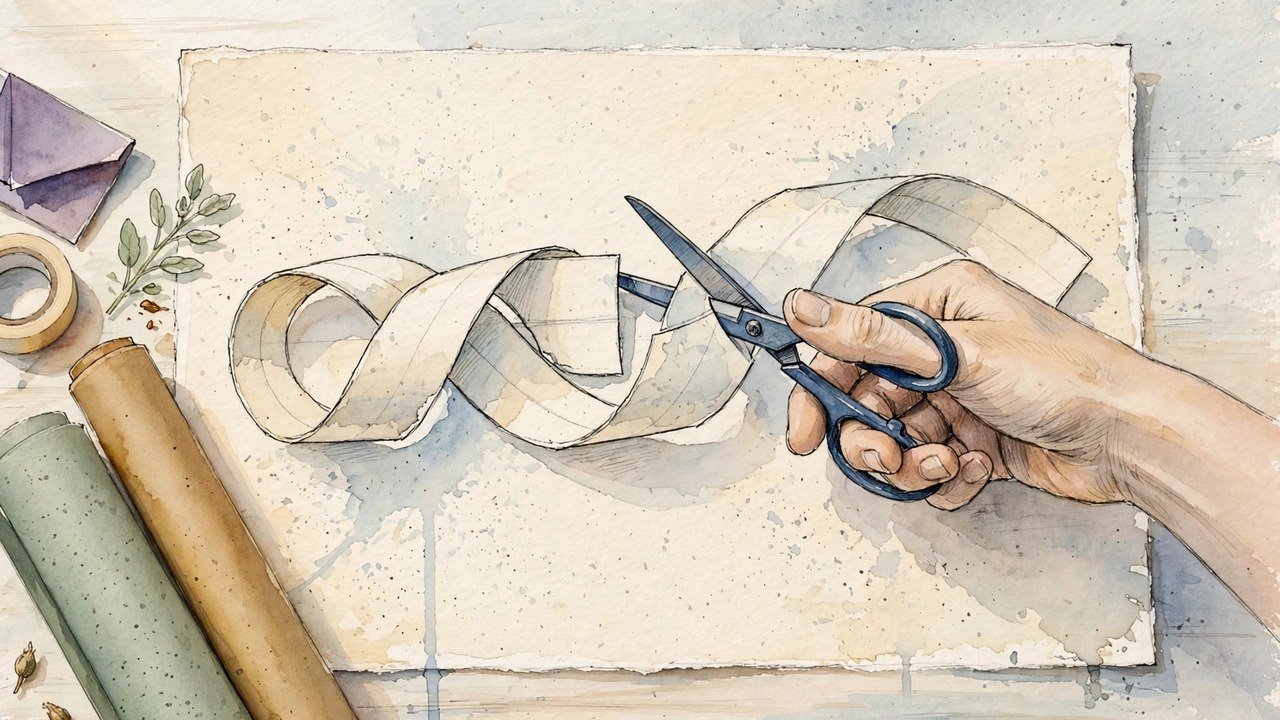
7. Cutting the band
The properties established in the earlier chapters — one side, one edge, the centre line that closes only after two laps — are all properties of the intact band. Cutting changes the object, and it changes it in ways that can be stated exactly, because a cut along a line drawn on the band is governed by the same identification that made the band one-sided in the first place. The strip was joined with its ends reversed, so a line that runs along the band does not necessarily return to its starting point after one circuit: it may return on what would, on an ordinary strip, be the other half of the width. Every cutting experiment on the band is a working out of that single fact, and the cleanest statement of the results comes not from paper models but from a peer-reviewed paper that performed the cuts twice over, once at the scale of paper and once at the scale of molecules. Dongran Han, Suchetan Pal, Yan Liu and Hao Yan published the experiments in Nature Nanotechnology in 2010, in a paper on folding and cutting DNA into reconfigurable topological nanostructures.[19] Their starting point is the familiar one: the band has one side and one boundary component.[19]
The centre cut
Take a paper band, half-twisted and joined, and draw a line along its middle, following the centre of the width all the way round until the line meets itself. On an ordinary untwisted loop — a cylinder band — that line divides the surface into two equal halves, and cutting along it produces two separate loops, each half as wide as the original and the same length. Anyone who has cut a paper chain ring in half has done it. The expectation the Möbius band creates, by looking so similar, is that the same thing will happen. It does not.[19]
Cut a Möbius band along its centre line and the result does not split. What comes off the scissors is a single band: one piece, twice as long as the original, and half as wide.[19] The reason lies in the path the scissors are forced to follow. The centre line of the band is a single closed curve, but the material on either side of that line is not two separate margins, as it is on a cylinder. Because the band is one-sided, the strip of material to the left of the centre line, followed far enough round, is continuous with the strip of material to the right of it. The cut therefore does not separate the band into an inside piece and an outside piece. It opens the band out, unrolling the single surface into a longer, narrower one, and the two apparent margins of the original turn out to be two stretches of one margin.
Worked as a procedure, the centre cut has three stages, and the surprise arrives only at the last of them. First, the blade is started on the centre line and kept on that line: the line is a single closed curve, so after one circuit of the band the blade returns to the point where it entered, and the cut is complete. There is no second circuit to make, because the centre of the width is the one line the reversed join sends to itself — the identification (0, t) ~ (1, −t) of chapter 9 fixes t = 0, since −0 is 0.[2] Second, the band is lifted and the cut edges are drawn gently apart: instead of two loops falling away from each other, the material stays in the hand as one piece. Third, the piece is measured. If the original band had length L and width W, the piece in the hand has length 2L and width W/2.[19] The width figure follows from what the cut has done across the strip: the distance from the centre line to the single edge of the original was W/2, and in the opened band that distance is the whole width, bounded on one side by the original edge and on the other by the newly cut edge. The length figure follows along the strip: the opened band’s centre line runs through the material of both halves of the original width in succession, so one circuit of the new band traverses the original’s circuit twice over.[19]
The twist count of the result is the point on which accounts differ, and it is worth stating the verified figure plainly. The centre-cut band carries four half-twists — two full twists, 720° of rotation accumulated along its length.[19] A popular account of the same experiment gives the result as one full twist, 360°, and the two figures disagree; the figure used here is the one in Han and his colleagues’ paper, where the count is made on the band actually produced by the cut.[19] The likely source of the confusion, as the research base for this article notes, is a slide between two different things that can be counted on the finished band: the twist in the band itself, and the way its edges are linked around one another. Those are not the same number, and quoting one where the other is meant produces exactly the 360°-against-720° discrepancy found between popular and technical accounts.
The other change is in the sidedness. The original band was one-sided; the centre-cut band is two-sided.[19] A line drawn down its middle, or an insect walking its surface, now stays on one face and never reaches the other without crossing an edge. The cut has also created a second edge: where the original had a single boundary component, the longer band has two distinct edges, one on each side of its width, and the cut edge is the new one — the boundary that did not exist until the scissors made it.[19] So a single cut has changed every headline property of the object at once. Length has doubled, width has halved, the twist has multiplied from one half-twist to four, one side has become two, and one edge has become two. Nothing has been added and nothing taken away; the paper is the same paper, rearranged by one continuous cut.
It is worth pausing on why the twist comes out at four half-twists rather than at some smaller number, because the arithmetic is visible in the object. The original band’s single half-twist is still present in the material. But opening the band out along its centre doubles its length, and the surface that was traversed once in a circuit of the original is now traversed as part of a band whose own circuit runs through the original’s circuit twice over. The half-twist is encountered, in effect, on both passes, and the geometry of the opened band — its edges winding around each other as they go — adds up to the four half-twists that Han and his colleagues report.[19] Counting twists on a finished band is a matter of fixing one cross-section and counting the rotation of the width direction over one full circuit of the centre line, and on that count the centre-cut band gives 720°, not 360°.[19]

The one-third cut
The second standard cut is made not along the centre but along a line one-third of the way across the width. Here the behaviour of the scissors is itself part of the result: the scissors travel twice round the band before the cut closes.[19] The line at one-third of the width, followed round one circuit, does not come back to its starting point. Because the ends of the original strip were joined reversed, a point one-third of the way across the width arrives, after one circuit, at the position two-thirds of the way across — the mirror position in the width. Only on the second circuit does it return to where it began, and so the blade has to make both circuits before the cut is complete.[19] This is the same phenomenon as the centre line that needs two laps to close, displaced from the middle of the width to the one-third line, where instead of retracing itself it pairs with the two-thirds line and the two form a single cutting path of double length.
When the cut is finished, the band does come apart — but not into two copies of anything. The result is two interlocked bands, of different kinds.[19] The first is a thinner Möbius band: one-third of the original width, the same length as the original, and still one-sided, with its half-twist intact.[19] This is the middle third of the original strip, in effect — the portion around the centre line — and it keeps the original’s topology because it keeps the original’s circuit and the original’s reversed join. The second band is the outer portion, the two outer thirds of the original width joined into a single piece by the double circuit the scissors travelled: it is one-third of the original width, twice the original’s length, two-sided, and carries two full twists.[19] The two bands are interlocked — the longer two-sided band passes through the thinner Möbius band, and the two cannot be pulled apart without cutting one of them.[19]
The width accounting of the one-third cut is exact, and it explains why the longer band is narrow rather than broad. Divide the original width W into thirds. The middle third becomes the thinner Möbius band: width W/3, length L, and the original’s single half-twist, since it contains the centre line and the original circuit unchanged.[19] The two outer thirds do not sit side by side in the result. Because the cutting path joins them end to end — the blade leaves one outer third at the end of its first circuit and continues in the other outer third throughout its second — they form one band whose length is 2L and whose width is the width of a single third, W/3, not the sum of two thirds.[19] That longer band carries two full twists and is two-sided.[19] The complete inventory after the cut is therefore: two bands, each W/3 wide; one of length L with a half-twist, the other of length 2L with two full twists; and the pair interlocked, so that the inventory describes one object in the hand even though it lists two pieces.[19]
The asymmetry of the result repays attention, because it shows the cut sorting the original band into its two natures at once. The central third behaves as the band itself in miniature: same length, same one-sidedness, reduced only in width. The outer thirds, which on an untwisted strip would simply be two separate ribbons, are on the Möbius band a single ribbon, because the reversed join connects the top outer third of one end to the bottom outer third of the other. Their union is longer, two-sided and doubly twisted — the same kind of object, in miniature, that the centre cut produced from the whole band. One cut has therefore yielded both possible outcomes side by side: a band that retains the Möbius character, and a band from which that character has been cut away, linked through each other so that the pair has to be handled as one object even though it is now two.
Cutting again, and the paradromic rings
The centre-cut band — twice as long, half as wide, two-sided, with four half-twists — can itself be cut along its centre line, and at this point the behaviour changes character, because the object being cut is no longer one-sided. On a two-sided band the two margins of the centre line are genuinely distinct: the material on one side of the line belongs to one edge, the material on the other side to the other edge, and no circuit of the band exchanges them. A centre cut on such a band therefore does what the same cut does on a cylinder — it separates the band into two narrower bands, which the twisting of the parent band leaves linked through one another rather than free. The dramatic refusal to separate was a property of the one-sided original, and it does not survive the first cut.
Results of this kind — bands cut along lines at various fractions of the width, and the linked rings that successive cuts produce — were already being tabulated in the nineteenth century. The linked rings obtained by cutting twisted bands were given the name paradromic rings, and MathWorld’s account of the band reproduces a paradromic-ring cutting table drawn from the tradition that runs back to Listing and to Tait, as set out in Ball and Coxeter’s Mathematical Recreations and Essays of 1987.[2] The table is the natural completion of the two experiments above: for each choice of band and each choice of cutting line, it records how many pieces result, of what lengths, and with what twists. Listing’s presence at the head of that tradition is fitting. The man who shared the discovery of the surface in 1858 also stands behind the systematic record of what happens when the surface is taken apart, and the cutting table in the modern reference literature is credited to that Listing-and-Tait line of work.[2]
What the table formalises, the two cuts of Han and his colleagues already show in outline. A cut along a line that closes after one circuit separates a two-sided band and merely opens a one-sided one; a cut along a line that needs two circuits to close binds distant parts of the width into a single piece. Length, width, twist, sidedness and number of edges all change together, and they change by amounts fixed entirely by the original reversed join. There is no freedom in the outcomes and no approximation in them: given the width fraction, the result is determined, which is why a table of results could be compiled at all, and why the same table can be checked, more than a century later, by performing the cuts on an object built to a completely different scale and from a completely different material.[2][19]
The same cuts in DNA
That check is the second half of Han, Pal, Liu and Yan’s 2010 paper. Alongside the topology, the paper reports the construction of Möbius and related topological nanostructures from DNA, built from DNA by the folding technique known as DNA origami.[19] The bands so built are not metaphors for Möbius bands; they are ribbons with the band’s own structure — one side, one boundary component — realised at molecular scale.[19]
The order of operations in the DNA work matters to what it demonstrates. The folding comes first: DNA is folded into a structure that already has the band’s topology before any cut is made — a Möbius nanostructure, not a flat precursor waiting to be given its twist by the cutting step.[19] The cutting comes second, applied to the finished structure, and it is a transformation rather than a destruction: the cut structure reconfigures into the topology the cutting results predict for a Möbius band, which is why the paper’s title describes its products as reconfigurable topological nanostructures.[19] Folding and cutting are therefore doing different work in the experiment. Folding shows that the topology can be constructed in DNA at all; cutting shows that the constructed object obeys the same transformation rules as the paper original, changing its sidedness, its length and its twist in the amounts the macroscopic experiments record.[19]
The cutting experiments of the paper were performed on these DNA structures as well as on the macroscopic models.[19] A DNA Möbius band cut along its centre line behaves as the paper band does: it does not fall into two pieces, but reconfigures into the single longer, two-sided band — the outcome the paper’s title describes as a reconfigurable topological nanostructure.[19] The one-third cut likewise yields its two interlocked bands at the molecular scale.[19] Topology is indifferent to scale and to material, and the DNA work is the experimental demonstration of that indifference: the twist counts, the lengths and the interlocking are properties of the identification that defines the band, not of paper, and they survive translation into a folded molecule unchanged. Where the paper band is cut with scissors, the DNA band is cut by the molecular means the technique provides, but the line being followed is the same line, and it closes, or refuses to close, in the same places.[19]
At the molecular scale the double circuit of the one-third cut carries a particular force, because there is no hand guiding a blade and no possibility that the second circuit is an artefact of how a strip is held or fed through scissors. The cutting path is fixed by the folded structure’s own geometry: a line begun at one-third of the width is not closed after one circuit of the DNA band, and the operation has to follow the structure through its second circuit before the two interlocked products — the thinner Möbius band of the original length and the longer two-sided band at twice the length — are the outcome.[19] The result is therefore a property read off the molecule’s identification of its own parts, not a consequence of the cutting instrument. That is the same conclusion the paper band suggests, arrived at independently, in a material whose parts are held together by molecular folding rather than by the fibres of paper.[19]
The DNA results also close off a possible misunderstanding of the paper experiments. It might be thought that the centre-cut band stays in one piece because of some accident of paper — its stiffness, say, or the way a real strip resists being pulled apart along a cut. The molecular structures share none of paper’s mechanical properties — not its stiffness, not its scale, not the way it is held together — and still the centre cut opens the band out instead of dividing it, and still the one-third cut travels twice round before it closes.[19] The outcomes belong to the geometry. That is the point at which the cutting experiments stop being parlour demonstrations and become measurements: two materials, two scales, one table of results, and no discrepancy between them.[19]
8. More twists, and the parity rule
Nothing in the construction of the band fixes the twist at a single half-turn. A strip of paper can be given one half-twist before its ends are joined, or two, or three, or any whole number, and each choice produces a band of the same length and width but of different character. Write k for the number of half-twists — so that the ordinary Möbius band is the case k = 1, a band given one full twist before joining is the case k = 2, and a band given a twist and a half is the case k = 3. The family of bands so obtained is governed by a single rule, and the rule is not about the size of k but about its parity: whether k is odd or even decides the sidedness of the band, the number of its boundary components, and the nature of its edge.[21][2]
Odd and even
For odd k, the band is one-sided, as the ordinary Möbius band is: a path drawn along its surface reaches both apparent faces without crossing an edge, and its boundary is a single component — one closed curve, not two.[21][2] For even k, the band is two-sided: its two faces are genuinely distinct, and its boundary falls into two separate components, one along each side of the width.[21] The untwisted case, k = 0, is the limiting member of the even family and the most familiar object of all: a rectangle with one pair of edges joined straight, without any flip, gives a cylinder — two rims, and two-sided.[23] The band with k = 2, one full twist, belongs to the same family in everything except appearance. It is a twisted annulus: an annulus — the flat ring between two concentric circles, the two-sided band of which the cylinder is the curved form — that has been given a complete turn before being joined. Topologically it is the annulus, with two sides and two edges; geometrically it is contorted, and the contortion is what the eye notices, while the topology registers only the parity.
The reason parity is what matters can be seen in the join itself. Each half-twist exchanges the two faces of the strip at the join: the face that was uppermost at one end meets the face that was lowermost at the other. Apply that exchange once, and the two faces are identified into one — the band is one-sided. Apply it twice, and the faces are exchanged and exchanged back: upper meets upper again, lower meets lower, and the band keeps the two distinct faces it started with. A third half-twist exchanges them once more, a fourth restores them, and so on indefinitely. Sidedness therefore alternates with k and depends on nothing else — not on the length of the strip, not on its width, and not on how tightly the twists are distributed along it.[21] The same alternation governs the boundary. Where the faces are identified, the two long edges of the original strip are identified into a single closed curve, wound twice round the band’s centre; where the faces are kept distinct, the two long edges stay apart as the two boundary components of an annulus.[21][23]
The rule can also be read off the gluing description of the rectangle, which is where the family starts. A rectangle has two pairs of edges. Join one pair straight, end to end without reversal, and the result is the cylinder: two rims, two sides.[23] Join the same pair flipped — one end turned over before the join — and the result is the Möbius band: one rim, one side.[23] Every band in the k family is the flipped-or-straight join repeated in effect: the total reversal at the join is the sum of the half-twists, and the sum is reversing exactly when k is odd. Séquin’s gluing table, from his Berkeley lecture notes, sets the two basic cases side by side in just these terms — the straight join giving two rims and two sides, the flipped join giving one rim and one side — and the k family is what results when the flip is compounded with further half-turns before the ends meet.[23]
Applied band by band, Séquin’s vocabulary of rims makes the parity rule a statement about the join alone. An even number of half-twists has, in its net effect on the ends, the character of the straight join: whatever turning the strip undergoes along its length, its ends meet unreversed, and the finished band has the cylinder’s two rims, one along each long edge of the original rectangle.[23] An odd number has the character of the flipped join: the ends meet reversed, the two long edges of the rectangle are sewn into each other, and the finished band has the Möbius band’s single rim.[23] The rim count can therefore be read off before any band is made. Write down k, ask whether the compounded join is straight or flipped in effect, and the table gives the answer — two rims for the straight case, one rim for the flipped case — with the sidedness following the rim count in both of Séquin’s entries.[23]
The rest of Séquin’s table shows what the same two joins produce when a rectangle is glued along both pairs of edges, and it is worth setting out entry by entry, because the band is the one-pair case of a general scheme. Both pairs joined straight give the torus, with Euler characteristic χ = 0.[23] One pair straight and one pair flipped give the Klein bottle, χ = 0 and one-sided.[23] Both pairs flipped give the cross-cap, the projective plane, with χ = 1.[23] The Möbius band sits in this table as the entry where only one pair has been joined at all: flipped, it leaves its single rim free as a boundary, and that free rim is what the closed entries no longer have. The parity rule for bands and the gluing table for closed surfaces are one piece of bookkeeping at two levels — a flip either identifies the two edges of a pair into one rim, or, when both pairs are joined, contributes to closing the surface altogether.[23]
One entry in the table carries a warning against reading too much into a single number. The band’s Euler characteristic is χ = 0, as chapter 6 established.[2] But χ = 0 is also the value Séquin’s table gives for the torus and for the Klein bottle, two surfaces the band resembles in neither sidedness nor boundary.[23] The characteristic counts something real, but it does not record the flip; the rim count and the sidedness, which the parity rule governs, are the entries that separate the band from the other χ = 0 surfaces in the table.[23][2]
Worked through in sequence, the family runs as follows. At k = 0 there is no twist at all: the cylinder, two-sided, with two boundary components, the two rims of Séquin’s table.[23] At k = 1 there is the Möbius band itself: one-sided, one boundary component, the case every other member of the family is compared against.[2][21] At k = 2 the full twist restores what the half-twist removed: the band is two-sided again, an annulus in topology however twisted in appearance, with its boundary in two components.[21] At k = 3 the alternation turns again — one-sided, one boundary component — but the boundary, as the next section shows, is no longer the plain curve it was at k = 1.[21] At k = 4 the band is two-sided once more, and this is not an abstraction: the centre-cut band of chapter 7 is a k = 4 band produced by experiment, and its two sides and two edges are the parity rule’s prediction for that value, arrived at by scissors rather than by construction.[19][21] Beyond k = 4 the alternation simply continues, odd members one-sided with a single boundary, even members two-sided with two, for any number of half-twists the strip can physically be given.[21]
One consequence of the rule is that the amount of twist and the kind of band are different questions, and confusing them produces wrong expectations. A band with three half-twists looks far more contorted than the ordinary band, and a band with two half-twists looks, to most eyes, more Möbius-like than either, because a full twist is plainly visible where a half-twist can be missed. The topology reverses the visual ordering. The three-half-twist band shares the ordinary band’s defining properties — one side, one edge — while the two-half-twist band shares neither, being an annulus for all its twisting.[21][23] What the surface is depends on the parity of the count; how it looks depends on the count itself, on the proportions of the strip, and on how the twists settle along its length, none of which the parity rule speaks to at all.[21]
This is why the cutting results of the previous chapter take the form they do. The centre-cut band of chapter 7 emerged with four half-twists — an even number — and it was two-sided with two edges, exactly as the parity rule requires of a k = 4 band.[19][21] The thinner band produced by the one-third cut kept a single half-twist, k = 1, and kept its one-sidedness with it.[19] The rule also predicts, without any experiment, the character of bands nobody has yet bothered to make: a band with five half-twists will be one-sided with a single boundary, and a band with six will be two-sided with two, and the alternation will continue for as long as strips and patience hold out.[21]
The edge as a string
The boundary of a twisted band can be studied on its own, detached from the surface it bounds, by an argument that teaching accounts of the subject present in a deliberately physical form. Imagine the edge of the band as a string, or a loop of wire, following the boundary curve exactly as the band holds it in space. Now pull the string tight — let it slip free of the band and contract, under tension, into the simplest closed curve it can form without being cut. What it settles into reveals the knot type of the boundary, if it has one. This is the edge-string argument, and the results it gives are these. For the ordinary Möbius band, with one half-twist, the pulled-tight edge string is unknotted: for all the winding the boundary does around the band, the string contracts to a plain loop, a circle with no crossings that cannot be removed.[21] The boundary of the ordinary band is twice as long as its centre line and winds twice around it, but it is not knotted.
The force of the edge-string test is that the same procedure is applied to each band in turn, so the outcomes are comparable. The string is taken in the position the band’s boundary actually occupies — for the ordinary band, a curve that runs twice round the centre line before closing, passing on its second circuit along what a drawing of the band presents as the opposite edge. Nothing is untied by hand and nothing is cut. The string is simply allowed to contract, and the question is what remains when every slack loop and removable crossing has been taken up. For the ordinary band nothing remains: the contraction ends at a plain loop.[21] That is the contrast case for everything that follows. A boundary can be long, doubled and wound twice round its surface, and still be the unknot; length and winding alone do not make a knot. What the three-half-twist band adds, on the same test, is not more winding of the same kind but a residue that contraction cannot remove.[21]
For the band with three half-twists, the same argument gives a different answer. Its boundary is again a single component, as the parity rule requires for odd k, but this time the edge string, pulled tight, does not reduce to a plain loop. It forms a trefoil knot — the simplest of the true knots, the overhand knot with its ends joined, whose curve crosses itself three times in its standard form and cannot be undone without cutting.[21] The boundary of the three-half-twist band is therefore not merely a long curve but a knotted one: the surface’s single edge is a trefoil, tied in space by the three half-twists that the strip was given before joining. A surface with one side and one edge has, in this case, an edge that is a knot, and the knot is there whether or not anyone pulls the string — the pulling only makes visible what the boundary curve already was.
The weight of this last claim should be stated as plainly as the claim itself. The source for it in the research behind this article is a university teaching page — Cliff Long’s Recycling Topology, written at Bowling Green State University and hosted by Northern Kentucky University — not a primary topology text or a peer-reviewed paper.[21] It is presented here on that footing: as the edge-string argument given in teaching accounts of the subject, which is how the trefoil boundary is standardly introduced, and not as a theorem quoted from a primary source. The parity rule itself stands on the same page and on MathWorld’s account of the band together.[21][2] A reader who wants the trefoil result with the full apparatus of knot theory behind it will need to go beyond both; what the teaching account establishes, and what is claimed here, is the argument and its conclusion at the level at which they are usually taught.
The contrast between the two edge strings is the sharpest form of the parity rule’s limit. Parity settles sidedness and the number of boundary components completely: odd k, one side and one edge; even k, two sides and two edges.[21] But within the odd family, the bands are not all alike, and the boundary records the difference that parity cannot see. One half-twist leaves the boundary unknotted; three half-twists tie it into a trefoil.[21] The surface-level properties repeat with period two as k increases, while the boundary’s entanglement grows with k itself. A classification by parity alone is therefore exact as far as it goes — and the edge string shows precisely where it stops going, at the point where counting twists has to give way to the theory of knots.[21]
9. The band in equations
Everything said about the band so far has been said about an object made of paper. The same object can be specified without paper, in two standard ways: by a gluing instruction, which says how a flat rectangle is to be assembled, and by a parametrisation, which gives a formula placing every point of the band in three-dimensional space. The two descriptions are given in MathWorld’s account of the strip, and between them they contain the whole of the earlier chapters in compressed form — the one-sidedness, the single boundary, and the reason the boundary needs two circuits where the surface needs one.[2]
The quotient description
Begin with a rectangle. Let one coordinate, running along the rectangle’s length, go from 0 at the left-hand edge to 1 at the right-hand edge, and let the other coordinate, running across the width, be t, with the centre of the width at t = 0 and the two long edges at the extremes of t. To make a cylinder, the two short edges are glued straight: the point (0, t) on the left edge is identified with the point (1, t) on the right, at the same height t. To make the Möbius band, the glueing is reversed: the point (0, t) is identified with the point (1, −t), at the opposite height.[2] In symbols, (0, t) ~ (1, −t), where the sign ~ reads ‘is identified with’. That single minus sign is the half-twist, expressed as an instruction. The top corner of one end meets the bottom corner of the other; a point a little above the centre line on one end meets a point the same distance below the centre line on the other; only the centre point itself, t = 0, meets its own counterpart, since −0 is 0.[2]
The identification repays being worked slowly, point by point. Scale the width so that t runs from −1 at one long edge to +1 at the other, with 0 at the centre. The corner (0, +1), at the top of the left-hand edge, is identified with (1, −1), the bottom corner of the right-hand edge: the two corners that a straight gluing would keep apart — top to top — are here paired across the diagonal.[2] The other corner pair follows at once: (0, −1) is identified with (1, +1). A point halfway up the width, (0, +1/2), meets (1, −1/2), halfway down the other end; a point just above the centre, at small positive t, meets a point just below the centre at the far end, at the corresponding small negative value. No point except the centre point is paired with a point on its own side of the centre line, and the pairing is exact at every height: the distance from the centre is preserved, and only the sign — which side of the centre — is changed.[2]
A path drawn on the rectangle shows what the pairing does in motion. Draw a horizontal line at height t = +1/2, starting at the left-hand edge and running toward the right. At the right-hand edge the line reaches the point (1, +1/2), which is not a point of the band in its own right: by the identification it is the point (0, −1/2), at the left-hand edge but below the centre. So the path does not stop or jump; it continues from (0, −1/2) along the lower half of the width, and only when it reaches the right-hand edge a second time — at (1, −1/2), identified with (0, +1/2) — does it arrive back at its starting point.[2] One crossing of the seam exchanges the halves of the width; two crossings restore them. That exchange, stated for the single height t = +1/2, holds at every height except the centre, and it is the whole mechanism behind the doubled circuits that recur throughout this article: the boundary needing two laps, the one-third cutting line needing two circuits, the drawn line on the paper band emerging on the apparent other face.[2]
The description is called a quotient description because the band is obtained as a quotient of the rectangle: the rectangle’s points are partitioned into pairs — the identified edge points — and singletons everywhere else, and the band is the set of those classes, with the shape the identifications impose. Nothing in the description mentions three-dimensional space at all. The band exists, as an abstract surface, as soon as the rectangle and the identification are given, and its one-sidedness can be read straight off the minus sign: a path crossing the join at height t continues at height −t, on what the rectangle presented as the other half of the width, which is precisely the behaviour the paper model shows when a drawn line or a walking insect crosses the seam.[2] The quotient description is also the form in which the band connects to the gluing tables of the other surfaces: change the identification and the same rectangle becomes a cylinder, and rectangles glued along both pairs of edges give the torus, the Klein bottle and the projective plane, according to which identifications carry the minus sign.[23]
The parametrisation, term by term
The second description puts the band into ordinary three-dimensional space. MathWorld gives the standard parametrisation for a band whose centre line is a circle of radius R and whose half-width — the distance from the centre line to either edge — is w.[2] The surface is swept out by a straight segment of length 2w, centred on the circle, which travels once round the circle while rotating about the direction of travel; the rotation is geared to the travel so that the segment turns by exactly half a revolution in one complete circuit.[2][24] Kirby A. Baker’s UCLA handout on parametric surfaces gives the construction in the same verbal form: the Möbius strip is made by sweeping a segment round a circle with a half-twist, the rotation being t/2 where t is the angle of travel.[24]
The formula has two parameters. The first, t, is the angle of travel around the centre circle, running from 0 to 2π — one full circuit, measured in radians. The second, s, is position along the sweeping segment, running from −w at one end of the segment, through 0 at its centre, to +w at the other end. Every pair (s, t) gives one point of the band, and the three coordinates of that point are: x = [R + s·cos(t/2)]·cos t; y = [R + s·cos(t/2)]·sin t; z = s·sin(t/2).[2] Read in words, the parts are these. The factors cos t and sin t, applied to the quantity in brackets, place a point at angle t on a circle — that is the travel around the centre line. The quantity in brackets, R + s·cos(t/2), is the point’s distance from the central axis: it is R, the radius of the centre circle, adjusted by the component of the segment’s offset that currently points radially outward. The term cos(t/2) is that component’s share: at the start of the circuit, t = 0, cos(t/2) is 1, and the segment lies flat in the plane of the circle, pointing radially, so that moving along s moves straight toward or away from the axis. The third coordinate, z = s·sin(t/2), is the point’s height above or below that plane, and sin(t/2) is the complementary share of the segment’s offset: as t grows, the segment tilts, trading radial extent for height, at half the rate of the travel — which is what the t/2 in every term records.[2]
Halfway round the circuit, at t = π, the shares have exchanged completely in kind if not yet in sign: cos(t/2) is cos(π/2), which is 0, and sin(t/2) is 1. The segment there is perpendicular to the plane of the circle — standing upright, pointing in the z direction — and moving along s changes only the height, not the distance from the axis.[2] At the end of the circuit, at t = 2π, cos(t/2) is cos π, which is −1, and sin(t/2) is 0. The segment is flat in the plane again, but reversed: the end that pointed outward at the start now points inward, and the point of the band at parameter s is exactly where the point at parameter −s was at the start. The surface closes at t = 2π with the segment’s ends interchanged.[2] That closing is the parametrisation’s version of the quotient’s minus sign. The formula does not need to be told to twist; the t/2 gearing builds the interchange in, and at 2π the surface meets itself in the reversed alignment and stops, complete, with no seam left over. One further condition is recorded with the parametrisation: for R > w — the centre circle’s radius greater than the half-width, so that the segment never reaches across the axis — the parametrisation embeds the band in three-dimensional space without self-intersection.[2]
The condition can be read directly out of the formula, as a consequence of the bracketed quantity R + s·cos(t/2). That quantity is the point’s distance from the central axis, and s ranges only between −w and +w, while cos(t/2) ranges between −1 and +1, so the quantity never falls below R − w.[2] When R > w, that lower bound is positive: every point of every segment stays a positive distance from the axis, the segment never reaches the centre of the circle it travels round, and successive segments, set at successive angles t, occupy successive positions around the axis without being driven into one another at the middle. The clearance R − w is, in effect, the width of the empty hole in the middle of the band, measured from the axis to the band’s inner reach.[2]
What fails outside the condition follows from the same bracket. At R = w the clearance is exhausted: the lower bound R − w is 0, and the end of the segment at the start of the circuit, where s = −w and cos(t/2) = 1, reaches the axis itself, so the margin that kept the band clear of its own centre is gone. For R < w the bracket takes negative values for part of the segment’s travel — at t = 0, every point with s < −R gives R + s < 0 — and a negative value in that bracket places the point on the far side of the axis, in the region that segments at other angles are already sweeping. The parametrisation then no longer keeps distinct points of the surface at distinct points of space: the surface is driven across the axis and into itself, and the placement fails as an embedding, whatever it remains as a formula.[2] The condition R > w is therefore not a technicality attached to the equations. It is the equations’ statement of how wide a band a given centre circle can carry — half-width strictly less than radius — before the geometry of the sweeping segment makes self-intersection unavoidable.
Why the boundary needs 4π
The boundary of the band is the set of points where the segment’s ends fall: the points with s = +w and the points with s = −w. On a cylinder those two sets would be two separate closed curves, each traced completely as t runs from 0 to 2π. On the band they are one curve, and the parametrisation shows why, in the interchange at the end of the circuit. Follow the boundary point at s = +w as t increases from 0. At t = 2π that point has arrived, by the interchange, at the position where s = −w began: it is now on the other apparent edge, having traced only half of the boundary — one pass round the centre circle along one side of the width.[2] To complete the boundary curve, t must run on from 2π to 4π, a second full circuit, during which the point traces the remaining half and returns, at t = 4π, to its starting position with its starting alignment restored.[2] MathWorld states the consequence directly: the boundary is a single curve, and it needs the parameter to run to 4π, twice the range the surface itself needs.[2]
This is the equations’ restatement of facts the paper model already gave. The boundary is one component, not two, as the parity rule of chapter 8 requires for a band with an odd number of half-twists.[21][2] It is twice as long as the centre line, in the sense that it makes two circuits of the centre circle in one traversal of itself. And the centre line, by contrast, closes within the surface’s own range: at s = 0 the coordinates reduce to the centre circle itself, R·cos t and R·sin t with height 0, traced once as t runs to 2π — while a line drawn on the surface at any fixed s other than 0, like the boundary at s = ±w, is carried by the interchange into the line at −s and needs the doubled range to close.[2] The asymmetry between the centre, which closes in one circuit, and everything off-centre, which closes in two, is the whole content of the one-third cut of chapter 7, where the cutting line at one-third of the width paired with the line at two-thirds and the scissors travelled twice round.[19]
Embedding and immersion
Two terms are needed to say precisely how a surface given abstractly, by a quotient or a parametrisation, can sit in three-dimensional space, and they are defined here, once. An embedding of a surface in space is a placement of it in which distinct points of the surface remain distinct points of space: the surface may bend and twist, but it never passes through itself, and no two of its points occupy the same place. An immersion is the weaker placement: the surface is laid into space smoothly, with a well-defined tangent plane at every point, but it is allowed to pass through itself, so that a single point of space may belong to two or more different points of the surface. Every embedding is an immersion; not every immersion is an embedding. The standard parametrisation above, under its condition R > w, is an embedding of the Möbius band: the paper band’s own way of sitting in space, with no self-intersection anywhere.[2] The distinction matters beyond this chapter because some of the surfaces and shapes in later chapters exist in space only as immersions — the projective plane’s models among them, which cross themselves necessarily — and the word for what the band manages, and they do not, is embedding.[2]
A ruled surface, with a warning
One more property is visible in the formula. Fix t, and let s vary: the coordinates each change in direct proportion to s, since s appears in each of them to the first power only, multiplied by quantities that depend on t alone.[2] The set of points so obtained is a straight line segment — the sweeping segment itself, at its position and tilt for that value of t. The whole surface is therefore the union of straight line segments, one for each t: it is a ruled surface, a surface generated by a moving straight line, and the moving line is the segment of Baker’s verbal construction, travelling round the circle and rotating at half the rate of its travel.[24][2] In this model the band has no curved cross-sections anywhere across its width; across, it is straight at every station round the circuit, and all of its curvature is in the way successive straight segments are angled against one another.
That is a property of the model, and it must not be mistaken for a property of paper. The ruled surface of the parametrisation is the band as the equations most simply present it; a band actually made by bending a paper strip does not take this shape, and why paper refuses the ruled shape is the subject of chapter 10.
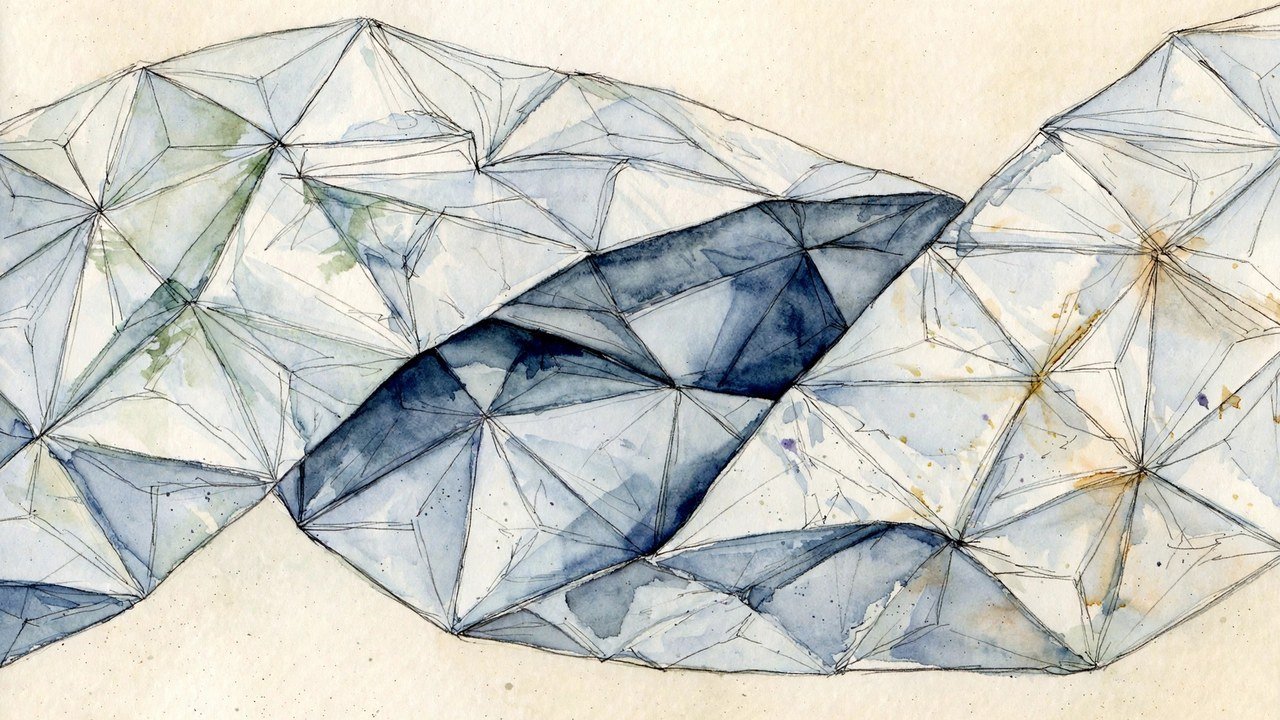
10. The shape of a paper band
Cut a strip from a sheet of paper, give one end a half-turn, and tape the ends together. The object in the hand looks simple, and the model of chapter 9, in which a straight segment sweeps round a circle while turning at half the rate, looks simple too. The two are not the same surface. That difference — between the band as an abstract surface, described by equations, and the band as a physical sheet that has to settle into a shape — is the subject of this chapter. It turns on a single property, and the property needs defining once, carefully, before anything else can be said.
A surface is developable if it can be mapped isometrically to a plane strip.[25] Each word in that sentence carries weight. A map is isometric when it preserves lengths measured along the surface, so that a curve drawn on the surface has exactly the same length after the map as before it. To say that a surface can be mapped isometrically to a plane strip is therefore to say that it can be unrolled, flattened, or — reading the map in the other direction — formed from a flat sheet, without stretching, compressing or tearing anything in the process. A surface is developable, on the statement of the definition used by Starostin and van der Heijden, when its Gaussian curvature is zero everywhere.[25] Curvature here is not a vague measure of how bent a thing looks. A sheet can look strongly curved, rolled into a tube or bent along a fold, and still have Gaussian curvature zero at every point, because bending of that kind changes no length measured within the sheet itself. What the condition excludes is the kind of curving that can only be achieved by stretching the material in some places and compressing it in others.
Paper sits close to the developable ideal because of how it behaves as a material. Paper, in the phrase used in the 2007 paper, ‘barely stretches’.[25] A sheet can be bent readily, and it can be bent in different directions at different places, but it resists being lengthened or shortened within its own plane to a degree that ordinary handling never overcomes. Any shape that a paper band actually takes must therefore be a shape that a flat strip can reach without appreciable stretching. If a proposed mathematical model of the band demands stretching somewhere, then whatever that model describes, it does not describe the object made at a desk. The model may still be correct as an abstract surface. It simply cannot be the shape of the paper one.
The ruled model, and why paper refuses it
The standard model of chapter 9 is a ruled surface, generated by a moving straight segment. In that model the segment of length 2w sweeps round the centre circle, rotating by half the angle of travel, and the surface it traces is exactly the surface given by the parametrisation. As a piece of geometry the construction is clean, and it gets the topology right: one side, one boundary curve, the ends of the segment interchanged after one circuit. The difficulty appears only when the model is asked to double as a description of a sheet of paper. In the ruled parametrisation, the curvature is non-zero away from the centre line.[25] That single fact is decisive. Non-zero Gaussian curvature away from the centre line means that points off the centre line would have to change their distances from one another, measured along the surface, if the surface were flattened back into the plane — or, equivalently, that a flat strip would have to stretch in order to take the ruled shape in the first place.
Starostin and van der Heijden put the consequence plainly: ‘a common paper Möbius strip is not well described by [the ruled] model because the surface generated in the model need not be developable’.[25] The wording matters. The claim is not that the ruled surface fails to be a Möbius band. It does not fail at that; topologically, and as an immersed or embedded abstract surface, it is the band. The claim is that it is the wrong answer to a different question — not ‘what is the band, as a surface?’ but ‘what shape does a band made from a nearly unstretchable sheet actually take?’ A common error, repeated in popular accounts and embedded in the way the band is usually drawn, is to treat those two questions as one. Correction of that error is the spine of the modern work on the band’s shape: a paper Möbius band can be developable, and the ruled model is what paper cannot take, because its curvature is non-zero away from the centre line.[25]
Once the two questions are separated, the second one becomes a problem in its own right, and a hard one. Given that the band must be developable — Gaussian curvature zero everywhere, no stretching — and given that it must close on itself after a half-twist, what shape does it settle into? The answer is not obtained by bending the ruled model slightly until the curvature goes away. A developable band has a structure of its own, different in kind from the ruled model’s. A developable Möbius band is a rectifying developable, and it is completely determined by its centreline.[25] Where the ruled model is built by prescribing a centre circle and sweeping a segment round it, the developable band is built the other way about: the centreline comes first, the surface is generated from it, and the centreline that results is not the circle that intuition, and every desk model at a glance, suggests.
A centreline that is not a circle
The centreline of a developable band must be a geodesic of the surface.[25] A geodesic, in the sense needed here, is a curve that is as straight as a curve on a surface can be — the path that, measured within the surface itself, does not turn aside to either side, even though in three-dimensional space it may rise and fall. The centreline of the ruled model, an ordinary circle, does not satisfy the conditions that developability imposes once the half-twist has to be accommodated as well. The centreline of a real band, Starostin and van der Heijden found, is not a circle: ‘a real band settles into a characteristic non-circular shape’.[25] Anyone who has made a wide paper band and set it down on a table has seen the effect without necessarily registering it. The band does not sit as a neat ring. It leans, it opens out on one side and draws in on another, and it rests in a lopsided attitude that no amount of coaxing will persuade into circular symmetry, because circular symmetry is not available to it. The asymmetry is not a defect of the making. It is the geometry asserting itself: a developable band with a half-twist cannot have a circular centreline, so the sheet finds the non-circular curve that the conditions do allow.
This is also why the width of the band matters so much, and why the history of the problem divides into a narrow-band theory and a wide-band theory. For a very narrow strip, the behaviour across the width is a small correction to the behaviour along the length, and the problem can be reduced, approximately, to a problem about a single curve. As the strip widens, what happens across its width stops being a correction and becomes part of the problem itself. The triangular facets described later in this chapter belong to the wide band. They have no counterpart in the narrow theory, and they could not have been predicted from it.
Sadowsky and the problem stated, 1930
The problem of the equilibrium shape of a Möbius strip was first formulated by M. Sadowsky in 1930.[26] The date deserves emphasis, because it places the question well after the band itself had become a standard object of topology. The band had been known since 1858, its one-sidedness analysed, its cutting behaviour catalogued, its place among surfaces understood — and for more than seventy years, on the record assembled here, nobody had put into precise form the elementary physical question of what shape an elastic band of this topology, left to itself, actually adopts. John Maddocks, commenting on the 2007 work, described the shape problem as ‘an abstract mathematical question, dating back to at least 1930’.[27] The phrase ‘at least’ is doing quiet work in that sentence: 1930 is the date of the first formulation that the literature carries, not a claim that nobody had wondered about the matter earlier.
Sadowsky’s 1930 paper carries the title ‘Ein elementarer Beweis für die Existenz eines abwickelbaren Möbiusschen Bandes’ — an elementary proof of the existence of a developable Möbius band — and it appeared in the Sitzungsberichte der Preussischen Akademie der Wissenschaften 22 (1930), 412–415.[28] The existence claim is the point that later retellings most often lose. Before any question of equilibrium shape can arise, it has to be settled that a developable Möbius band exists at all: that a flat strip, bent without stretching, can be closed on itself with a half-twist in a smooth developable surface. Given that the familiar ruled model is not developable, a sceptical reader in 1930 could reasonably have suspected that the half-twist itself forced stretching somewhere — that paper bands only appear to work because paper gives a little, or because the taped join hides a small region of strain. Sadowsky’s elementary proof closed that possibility off. A developable Möbius band exists, as a matter of geometry, not as an approximation tolerated by a forgiving material.[28]
Sadowsky did more than prove existence. He turned the equilibrium problem for a narrow strip into a one-dimensional variational problem, invariant under Euclidean motions.[26] A variational problem, in this setting, is a problem of the following shape: among all the configurations a system could take, find the one at which a given quantity — here, elastic energy — is stationary, neither increased nor decreased by any sufficiently small change of configuration. Equilibrium shapes are the configurations of that kind. To reduce the problem to one dimension is to replace the whole surface by its centreline, so that the unknown is a single curve in space rather than a sheet, and the energy is written as an integral along that curve. The invariance condition is a requirement of physical honesty: the energy of a strip cannot depend on where in space the strip happens to be, or on which way it is facing, so the formulation must give the same value when the whole configuration is moved or turned as a rigid body — that is, under the Euclidean motions.[26]
The energy density that Sadowsky’s reduction produced has a specific form, recorded in the later literature that translated and extended his work: for a narrow band, the energy density is proportional to (κ² + τ²)²/κ².[28] The symbols are those of curve geometry: κ is the curvature of the centreline, measuring how fast the curve turns away from its own tangent direction, and τ is its torsion, measuring how fast the curve twists out of the plane in which it is instantaneously bending. The form of the expression repays a moment’s attention, even without any calculation. The energy grows with the square of a quantity that itself combines curvature and torsion, so a centreline that is both strongly bent and strongly twisted is penalised heavily. And the division by κ² has a consequence that shapes the whole theory: as the curvature falls towards zero, the density rises without bound, which means that an equilibrium centreline cannot pass through a point of zero curvature. A developable band, on Sadowsky’s theory, has no straight point and no flat spot along its centreline. The band is bent everywhere along its length, all the way round, with no resting place.
Wunderlich and finite width, 1962
Sadowsky’s formulation was a narrow-band formulation. Its one-dimensional reduction treats the strip through its centreline, and that treatment is an approximation whose accuracy depends on the width being small. W. Wunderlich generalised the formulation to finite width.[28] His paper, ‘Über ein abwickelbares Möbiusband’, appeared in Monatshefte für Mathematik 66 (1962), 276–289.[28] Finite width means exactly what it says: the strip is allowed to have a width that is not negligible, and the theory has to account for the surface as a surface, across its whole breadth, rather than collapsing it onto a single curve from the outset. Wunderlich’s work also supplied a proof of Sadowsky’s formula, placing the narrow-band energy density on a firmer footing than its original derivation had given it.[28]
The sequence — existence proved and the narrow problem formulated in 1930, the formulation generalised to finite width in 1962 — might suggest a theory steadily completing itself. It did not complete itself. What Sadowsky and Wunderlich supplied was the variational framework: the statement of what has to be minimised, and for the narrow band the form of the energy. What neither supplied was the solution of the equilibrium problem for a wide band — the actual equations whose solutions are the shapes, solved for the Möbius case. That gap stood for decades. The work of L. Mahadevan and J. B. Keller of 1993 belongs in this history only in the form in which the research base carries it, as a paper cited by Starostin and van der Heijden in their own reference list.[25] It is recorded here in that form, and in no stronger form.
The wide band solved, 2007
In 2007 E. L. Starostin and G. H. M. van der Heijden published ‘The shape of a Möbius strip’ in Nature Materials 6 (2007), 563–567.[25] The journal name is Nature Materials. The paper is persistently misattributed to a sister journal in secondary accounts, and the correction is worth making in the text rather than in a footnote, because citations copied from one secondary account to another have carried the wrong name a long way. What the paper did, in the authors’ own summary of its place in the subject, was to derive the first equilibrium equations for a wide developable strip.[25] ‘Wide’ is the operative word. Sadowsky’s problem, and Wunderlich’s generalisation of its formulation, had set up the variational machinery; the 2007 paper produced equilibrium equations that treat the strip at finite width directly, and then solved the Möbius boundary-value problem numerically.[25] A boundary-value problem, here, is the problem of finding a configuration that satisfies the equilibrium equations throughout the strip while also meeting the conditions imposed at its join — the condition, in this case, that after one circuit the strip comes back to its starting cross-section reversed, which is the half-twist expressed as a condition on the solution.
Numerical solution, rather than a formula, is what a problem of this complexity generally yields, and the shapes that came out of the computation could be checked against real bands. The computed centreline is not a circle, in agreement with the theoretical requirement already described: the centreline of the developable band is a geodesic of the surface, the band is completely determined by that centreline, and the shape it settles into is the characteristic non-circular one.[25] Theory and computation meet at that point from opposite directions. The geodesic condition says the centreline cannot be a circle; the numerical solutions exhibit the specific non-circular curve that a band of given proportions adopts.
The most visible prediction of the wide-band theory concerns what happens as the band is made wider relative to its length. As the width-to-length ratio grows, the developable surface develops creases bounding nearly flat triangular regions.[25] The picture is of a band that organises itself into facets: regions that are, to a good approximation, flat triangles, separated by lines along which the bending is concentrated. Flatness, here, is developability showing itself in its most literal form. A nearly flat triangular region is a piece of the original plane strip that has travelled into the finished shape almost undeformed, while the curvature the shape requires is gathered into the creases at its edges. A narrow band cannot do this; there is not enough width for a facet to form across it, and its bending is spread smoothly along its length in the manner Sadowsky’s one-dimensional energy describes. A wide band partitions itself. The wider it gets, the more pronounced the partitioning becomes, and a reader who makes a band from a strip that is short and broad — a strip whose width is a substantial fraction of its length — can see the triangles with the naked eye, as patches of the surface that catch the light uniformly, like the facets of a cut stone, while the turns of the band happen at their boundaries.
Maddocks’s commentary on the paper, published alongside it as a News and Views piece under the title ‘Around the Möbius band’, treated the result as the resolution of the abstract question that had stood since 1930.[27] The interval is worth stating flatly: 1930 to 2007 is seventy-seven years between the first formulation of the equilibrium problem for a narrow strip and the first equilibrium equations for a wide one. Nothing in that interval suggests neglect of an easy problem. The narrow theory’s energy density, with its division by κ² and its prohibition on points of zero curvature, already indicates how constrained the configurations are; the wide problem adds the full two-dimensional behaviour of the sheet to those constraints, and it resisted formulation as a solvable system until the 2007 paper.
Stress at a point, 2015
The sequel came from the same authors. In 2015 Starostin and van der Heijden published ‘Equilibrium shapes with stress localisation for inextensible elastic Möbius and other strips’ in the Journal of Elasticity 119 (2015), 67–112.[29] The title states the finding. In the equilibrium shapes studied there, stress does not spread itself evenly through the material, and it does not spread itself smoothly either: stress localises at a singular point on the band’s edge.[29] Localisation, in mechanics, is the concentration of a quantity that a simpler theory would distribute — the gathering of stress into a small region, here into a single point of the boundary in the idealised theory, rather than its diffusion across the surface. A singular point is a point at which the smooth description breaks down: quantities that vary continuously elsewhere do something abrupt there, and the mathematics has to treat the point separately from the rest of the edge.
The location of the concentration is as striking as its existence. The edge of a Möbius band is its single boundary curve, the curve of chapter 4 that runs twice round the centre circle before closing. That the equilibrium theory of 2015 places a singular point of stress on that edge connects the physical theory back to the one feature of the band that has no counterpart in an ordinary ring.[29] An ordinary elastic ring — the annulus of the next chapter, two-sided, with two separate boundary circles — presents its own equilibrium problems, but a singular point on ‘the’ edge is a statement that can only be made in this form about a surface that has just one edge to be on. The paper’s scope, as its title records, extends beyond the Möbius case to ‘other strips’, with the Möbius band as the leading example.[29]
The narrow band, corrected
The 2015 stress-localisation paper was not the end of the paper band’s theory, and the first of its sequels reaches back to the oldest part of the subject: Sadowsky’s energy itself. The narrow-band density of chapter 10, proportional to (κ² + τ²)²/κ², was obtained by Sadowsky by a formal passage to the limit as the width tends to zero, and Wunderlich’s justification of it rested on an assumption that is easy to miss because the classical texts do not advertise it — that the curvature of the centreline never vanishes.[30] In 2016 Lorenzo Freddi, Peter Hornung, Maria Giovanna Mora and Roberto Paroni re-derived the limit by Γ-convergence, a method that tracks minimisers as well as energies, and made no such assumption.[30] Their result both confirms and corrects the classical one. The rigorously derived functional agrees with Sadowsky’s only for “large” curvature of the centreline — precisely, only where the curvature exceeds the absolute value of the torsion.[30] Where the curvature is small against the torsion, and in particular where it vanishes, the corrected density takes a different form, finite where Sadowsky’s density, with its division by κ², blows up.[30] The singularity that chapter 10 read as a prohibition — an equilibrium centreline cannot pass through a point of zero curvature — is therefore, in part, an artefact of the derivation rather than a property of the band. A narrow ribbon may pass through flat points; what it may not do is be costed for them by Sadowsky’s formula. The distinction matters beyond the Möbius case, because the corrected functional is a statement about inextensible ribbons in general, but the Möbius band is where the question came from: Freddi and his co-authors open their paper, as Sadowsky opened his, with the developable Möbius strip of 1930.[30]
The finite-width theory received the same treatment four years later. Wunderlich had reduced the bending energy of a developable band from a surface integral to a line integral without assuming the width small, and for half a century the equilibrium shapes of closed unstretchable ribbons were sought almost exclusively by numerical minimisation of his functional, although its derivation had substantial gaps.[31] In 2020 Brian Seguin, Yi-Chao Chen and Eliot Fried supplied a rigorous justification of the Wunderlich integral and a complete formulation of the minimisation problem behind it: the function space for minimisers, the isometry constraint encoding unstretchability, the local injectivity forbidding self-penetration, the connecting conditions at the joined edges, and the Euler–Lagrange equations with their matching and jump conditions.[31] Their formulation covers closed bands, orientable and non-orientable, with arbitrary numbers of twists, and records one permission the classical picture did not state: the straight rulings of a developable band may meet at isolated points on the band’s edge, though not in its interior.[31] The creases bounding the flat triangular regions of the 2007 solutions meet the edge in exactly that permitted way.
Stretch a little, crease less
Every result so far in this chapter assumes the idealisation that paper barely stretches. In 2016 David Kleiman, Denis Hinz, Yoichi Takato and Eliot Fried asked what changes when the idealisation is relaxed, using a two-dimensional discrete lattice model in which stretching is allowed and costed.[32] The answer is quantitative, and it connects the equilibrium theory to the tearing that the 2007 paper had hoped its energy-localisation results might one day predict. Bands made of stretchable material are less likely to crease or tear than unstretchable ones, and the mechanism is named: allowing stretching delocalises the twisting strain.[32] At every aspect ratio studied, the total energy of the band decreases monotonically as stretchability increases, so a stretchable band is easier to form; the mean and Gaussian curvatures, the latter non-zero only once stretching is permitted, distribute themselves more evenly; and bending is progressively transferred into stretching, eliminating the localised zones of concentrated bending-energy density that, in the unstretchable theory, mark the onset of failure.[32] In the opposite limit the model recovers the paper theory: at large values of the Föppl–von Kármán number, which measures resistance to stretching against resistance to bending, the equilibrium shapes are essentially the developable shapes of Starostin and van der Heijden, while as the number falls the centrelines become more circular and less out of plane.[32] The authors are careful about the bearing on real paper, which is not the unstretchable limit but a material that stretches “by a percent or two” in the direction of loading without creasing or tearing — enough, on their results, for a slight degree of stretchability to alleviate the worst concentrations.[32] Their stated application is not paper at all: the low-energy configurations are offered as strategic target shapes for the guided assembly of Möbius bands at nanometre and micron scales, where the material’s stretchability is a design parameter rather than a defect.[32]
The same authors’ introduction preserves, at second hand, the one assessment of Mahadevan and Keller’s 1993 paper that this chapter is entitled to use, the original not having been read for this post. Kleiman and his co-authors record that the problem of constructing developable equilibrium configurations was first considered by Mahadevan and Keller, whose numerically determined solutions gave a tighter upper bound on the bending energy — and that those solutions are inconsistent with a result of Randrup and Røgen, that the midline of a Möbius band must have an odd number of switching points at which its curvature and torsion both vanish.[32] That is the 1993 paper’s standing in the later literature: first on the developable problem, and superseded where its solutions conflict with a necessary condition on the centreline.
Spheres, memory and solitary waves
Starostin and van der Heijden themselves returned to the narrow band in 2018, with a result about the Sadowsky functional rather than about the Möbius boundary-value problem.[33] A forceless solution is an equilibrium that needs no distributed external force to hold it in place. They showed that forceless energy-minimising configurations of the Sadowsky functional lie on a sphere: a narrow developable ribbon, left to itself, has a propensity to form spherical shapes, and on a sphere it needs to sustain no tensile or compressive stress.[33] The contrast they draw is with the classical filament models — the wormlike chain and the rodlike chain both require a reaction force from a spherical surface, and their forceless solutions are rings and helices.[33] The Sadowsky functional is the simplest member of a wider family whose forceless minimisers are all spherical, and the authors’ stated moral is that ribbon-like objects in biopolymer physics and nanoscience, which behave as thin sheets rather than chains, cannot be described by the wormlike chain model.[33]
A different sequel abandons developability altogether and asks what non-orientability alone does to elasticity. Denis Bartolo and David Carpentier, in 2019, modelled a soft Möbius strip — a three-dimensionally printed ribbon of width 1 cm is their figure — and established that the elastic response of a non-orientable surface is non-additive, non-reciprocal and contingent on stress history.[34] The elementary fact drives everything. The surface normal, carried once round the strip, returns reversed, so the shear angle measured against it satisfies θ(0) = −θ(L) and must vanish at least once along the ribbon: no stress distribution whatever can produce homogeneous shear over a Möbius strip.[34] Bartolo and Carpentier formalise this as a ℤ₂ gauge theory, with orientability itself as a charge, −1 for the band and +1 for the cylinder. The consequences they derive are not the ones linear elasticity would suggest. The response to a point shear vanishes at a single point at maximal distance from the source; the responses to two shears do not add, because their sum would be a shear that nowhere vanishes, which the topology forbids — the response is intrinsically non-linear although the local stress–strain relation is linear; and because the zero-shear point can sit anywhere, the strip’s static deformations encode the history of the stresses applied to it, a mechanical memory.[34] Twist, by contrast, is insensitive to orientability and obeys ordinary harmonic elasticity.[34] Their second result concerns instability: the buckling patterns of a non-orientable ribbon do not stay where they are excited but propagate through the bulk as solitary waves, and those waves are quantitatively equivalent to the edge modes found at the interface between two inequivalent topological insulators — a connection the authors present as a challenge to the usual bulk–boundary correspondence of topological phases.[34]
How short can a paper band be?
The last sequel is not about energy at all, but about length. Chapter 10’s wide band grows triangular facets as its width-to-length ratio grows; the limiting question is how far that ratio can be pushed — how short a strip, relative to its width, can be made into a Möbius band at all. Richard Evan Schwartz settled the question in 2023.[35] A paper band is defined formally as a smooth isometric map of the flat band obtained from a rectangle of width 1 and length λ, the ratio λ being the aspect ratio, and the band is embedded when the map never lets the surface pass through itself. Schwartz proved that a smooth embedded paper Möbius band must have aspect ratio greater than √3, about 1.73.[35] He proved further that the bound is sharp in the strongest available sense: any sequence of smooth embedded bands whose aspect ratios converge to √3 converges, up to isometry, to the triangular Möbius band — the flat, three-fold construction, known since Sadowsky’s 1930 paper, in which the strip is folded into an equilateral triangle.[35] The triangular band itself does not count as a smooth embedded band, since its map is neither smooth nor injective; it is the limit of such bands, and now provably the unique limit. The result resolves the conjecture stated by Benjamin Halpern and Charles Weaver in 1977, on a minimum-aspect-ratio question that Wunderlich had already discussed in 1962.[35] The older bound in the literature marks the difference between embedding and immersion: Halpern and Weaver had shown that a smooth *immersed* band need only satisfy λ > π/2, and that immersed examples exist at π/2 + ε for every ε > 0 — shorter bands exist, but only by passing through themselves.[35] Schwartz’s proof turns on a configuration he calls a T-pattern, a pair of perpendicular straight bends across the band, whose existence in every smooth embedded band he proves using the Borsuk–Ulam theorem; cutting the band open along one bend of the pattern leaves a bilaterally symmetric trapezoid, and the √3 bound is the solution of the resulting optimisation problem.[35] The smoothness in the definition is load-bearing: without it, a square could be accordion-folded into a thin strip, twisted and taped, and no minimum would exist — such “origami monsters”, Schwartz notes, are not limits of smooth bands, while the triangular band is.[35]
The three-twist case, the subject of chapter 8, was taken up in the same year by Brienne Elisabeth Brown and Schwartz, and there the picture is stranger.[36] Pulling a loose three-twist band tight, Brown found not one limiting shape but two, which they call the crisscross and the cup: both are immersed three-twist polygonal paper bands of aspect ratio exactly 3, both are limits of smooth embedded bands whose boundaries are knotted, the crisscross is planar and the cup is not.[36] Their existence shows that the infimal aspect ratio for a three-twist band is at most 3 — far below the 3√3 that wrapping three times round the triangular band would give — and the authors conjecture that every smooth embedded band with knotted boundary has aspect ratio greater than 3, which would make 3 the exact infimum.[36] Unlike the one-twist case, there can be no unique-limit theorem: two distinct limits, one of them non-planar, already exist at the conjectured optimum.[36] The width-to-length question that the 2007 paper raised as a matter of creases and facets thus ends, for one twist, in a theorem with a single extremal shape, and, for three twists, in a conjecture with two.
Between Sadowsky’s proof of 1930 and the stress-localisation results of 2015, the paper band acquired a complete physical theory of a kind that the abstract band of the topologists never needed. The abstract band is specified by its gluing: a rectangle, one pair of edges joined with a flip. The paper band is specified by that gluing plus a material condition — no stretching — and the material condition, which looks like a practical footnote, turns out to determine a non-circular centreline, a surface of flat triangular facets at large widths, and an equilibrium in which stress gathers at a singular point of the single edge. The desk object and the topological object are the same band. They are not the same problem.
11. The band among surfaces
So far the band has mostly been considered on its own: made, painted, cut, written in equations, and, in the last chapter, allowed to settle into the shape its material imposes. This chapter places it in company. Topology classifies surfaces — it sorts them into families, states the invariants that distinguish the families, and describes how complicated surfaces are assembled from simpler ones. In that sorting the Möbius band occupies a peculiar position. It is not itself one of the closed surfaces that the classification principally concerns, since it has a boundary. It is, instead, a building block: a piece that appears inside larger surfaces, whose presence settles the character of the whole, and from which, combined with the simplest pieces of all, surfaces can be constructed that cannot be placed in ordinary space without passing through themselves.
The rectangle and its gluings
The most economical way to see the company the band keeps is to start, as chapter 9 did, with a rectangle, and to enumerate what its edges can do. Carlo Séquin’s gluing table, from a 1998 lecture at Berkeley, sets the possibilities out in a row.[23] Take a rectangle and join one pair of opposite edges. Joined straight — the left edge to the right edge with the direction preserved — the rectangle becomes a cylinder: two rims, and two-sided.[23] Joined flipped — the same pair of edges, but with one of them reversed before the join — the rectangle becomes a Möbius band: one rim, and one-sided.[23] The two constructions differ in nothing but the flip. The material is the same, the pair of edges joined is the same, and the pair left free is the same. Everything that distinguishes the annulus — for the cylinder of the table, considered as a surface with its two circular boundaries, is the annulus — from the Möbius band is carried by that single reversal.
Chapter 6 defined the Euler characteristic and computed it for the band by deformation-retracting the band onto its centre circle, giving χ = 0. The annulus has χ = 0 as well, and the point was made there, and is cross-referred rather than re-derived here, that the Euler characteristic does not distinguish the band from the annulus: the same count, χ = 0, is returned for both.[23] The gluing table shows what does distinguish them, at the level of construction. It is the flip, and its consequences — one rim instead of two, one side instead of two — are exactly the orientability difference of chapter 5. Two surfaces can agree in one invariant and differ in another, and the pair formed by the annulus and the band is the standard first example of that phenomenon: χ = 0 for both, gluing different, orientability different.[23] A classification that counted only the Euler characteristic would file them together and miss the twist entirely.
Continue the table, and the rest of this chapter’s cast appears. Join both pairs of edges of the rectangle, both of them straight, and the result is a torus, with χ = 0.[23] Join one pair straight and the other pair flipped, and the result is a Klein bottle: χ = 0, and one-sided.[23] Join both pairs flipped, and the result is the cross-cap, or projective plane, with χ = 1.[23] Five surfaces from one rectangle, generated by nothing more than the choice, for each pair of edges, of joining it straight or reversed. The band is the second entry in that list, and the third and fifth entries — the Klein bottle and the projective plane — are both, as the next sections show, made of bands.
The Klein bottle
The Klein bottle was first described by Felix Klein in 1882.[22] It is a closed surface: it has no boundary at all, no rim, no edge on which a finger could come to the end of the surface.[23] It is non-orientable, and its Euler characteristic is χ = 0.[23] In the gluing table it appears as the rectangle with one pair of edges joined straight and the other flipped.[23] Each of those facts is unremarkable separately — the torus is also closed, with χ = 0 — but the combination of closed and non-orientable is one that no surface placed without self-intersection in three-dimensional space can realise, and the reason runs through the Möbius band.
The construction that explains the Klein bottle best does not start from the rectangle. It starts from two Möbius bands. The Klein bottle is equivalently two Möbius bands glued along their single boundary circles.[23] Recall what a single band contributes: a surface with exactly one boundary component, a single closed curve. Take two bands, and join them to each other along those curves, boundary circle to boundary circle, so that the two rims are identified and cease to be rims at all. The resulting surface has no boundary left — each band’s only edge has been consumed by the join — and it is closed.[23] Its non-orientability is inherited, twice over: each half of it is a band, and a surface containing a Möbius band is non-orientable, on the criterion of chapter 5. The Euler characteristic behaves as the construction leads one to expect: χ = 0 for the Klein bottle, the value already recorded for a single band and for the annulus, reached here by a closed surface with no boundary at all.[23]
The lecture notes of Laurenţiu Maxim on algebraic topology treat the Klein bottle alongside the classification of surfaces and the Euler characteristic, in the chapters where those invariants are developed.[22] That placement reflects the bottle’s role in the theory: a closed surface, with no boundary, that is nevertheless one-sided, standing in the classification next to the torus, which shares its Euler characteristic and differs from it in orientability. The Klein bottle cannot be embedded in three-dimensional space; it can only be immersed there, with self-intersection. The distinction between embedding and immersion was defined in chapter 9, and it is cross-referred here rather than re-stated.
The two constructions of the Klein bottle — from the rectangle, and from two bands — are not rivals. They are connected by the construction of the next section, and the connection is worth drawing out because it shows the band doing the same work in two apparently different recipes. The Klein bottle is also the connected sum of two projective planes: two projective planes, joined into a single surface.[22] A connected sum, in the usage of the classification theory, is formed by removing a disc from each of two surfaces and gluing the two resulting boundary circles to each other. Apply that operation to two projective planes, using the disc-and-band construction of the projective plane set out below. Removing a disc from a projective plane leaves a Möbius band, on Maxim’s figure.[22] Do it to both, and the two pieces awaiting gluing are two Möbius bands, each with its single boundary circle exposed by the removal. Glue those boundary circles together — the connected sum’s own gluing step — and the result is two Möbius bands glued along their single boundary circles, which is the Klein bottle of the preceding paragraphs.[23] The rectangle construction, the two-band construction and the connected-sum construction are three descriptions of one surface, and the band is the piece that the second and third of them share.
Reconciled in sequence, the connected-sum description runs as follows. First surface: a projective plane, closed, with no boundary. Remove a disc from it, and the closed surface acquires exactly one boundary circle, the edge of the removed disc; the piece that remains is a Möbius band.[22] Second surface: another projective plane, treated in exactly the same way. Remove a disc from it, and again exactly one boundary circle appears, and again the piece that remains is a Möbius band.[22] At this stage the two pieces are separate, and each carries the one boundary circle that the removal created. The connected sum is completed by a single gluing: the two boundary circles are identified, point for point, so that neither circle survives as a boundary of the combined surface. What the gluing produces, read directly, is two Möbius bands glued along their single boundary circles.[23] Read the other way, it is the connected sum of two projective planes.[22] The two readings describe the same sequence of operations at different stages: the projective planes are what the sequence starts from, the bands are what the middle stage consists of, and the Klein bottle is what the final gluing leaves, closed because both of its boundary circles have been consumed by that gluing.
The projective plane, from a disc and a band
The second construction is the mirror image of the first. Where the Klein bottle is two bands joined to each other, the real projective plane — written RP² — is one band joined to the simplest bounded surface there is. The projective plane is obtained by gluing a disc to a Möbius band along their boundary circles.[20] The statement is a theorem in the Open University’s course text on surfaces, stated there as Theorem 6: the projective plane is obtained by gluing a disc to a Möbius band along their boundary circles.[20] Susan Sierra’s account for the University of Edinburgh gives the same construction in the same terms: the projective plane is a disc glued to a Möbius strip.[37] MathWorld records the construction identically, listing the disc glued to a Möbius band among the ways the projective plane is formed.[2]
Read the construction slowly, because it is the single most informative fact about where the band sits among surfaces. A disc has one boundary circle. A Möbius band has one boundary circle. Glue the two boundary circles together, point for point, and both boundaries disappear into the join. What remains is a closed surface, with no boundary anywhere. That closed surface is the projective plane.[20] Its non-orientability requires no separate argument: the projective plane is non-orientable because it contains a Möbius band.[20] Half of it, in the construction, is a Möbius band, and the non-orientability of the part settles the character of the whole. The converse construction is equally standard, and Maxim’s notes use it as a figure: removing a disc from the projective plane leaves a Möbius band.[22] Disc and band are complementary pieces of the projective plane; take either piece away, and the other is what remains.
The removal construction can be worked in the opposite direction, step by step, and doing so shows why the two statements — gluing a disc to a band, and removing a disc from the projective plane — are not two facts but one fact read forwards and backwards. Start with the projective plane as a closed surface, with no boundary anywhere. Choose a disc lying in it, a small round patch whose edge is a single circle in the surface. Remove that disc. The removal does two things at once: it opens a hole where the patch was, and it creates a boundary where there was none, namely the circle that was the disc’s edge. What remains after the removal is, on Maxim’s figure, a Möbius band.[22] Its boundary is exactly that circle — not a new curve introduced by the cutting, but the disc’s own edge, now exposed as the edge of the remaining surface. The step can then be reversed without any further choice. Take the disc that was removed and glue it back along the circle, point for point, and the boundary disappears into the join again. The closed surface recovered by that gluing is the projective plane, which is Theorem 6’s statement arrived at from the other end: the projective plane is obtained by gluing a disc to a Möbius band along their boundary circles.[20] Disc and band are therefore complementary in a precise sense. Each is what the other leaves behind in the projective plane, and the single circle is the common seam at which the exchange is made.
The projective plane cannot be embedded in three-dimensional space without self-intersection.[37] This is a stronger statement than it may appear. It does not say that nobody has yet found a tidy model, or that models are awkward. It says that any attempt to realise the projective plane as a surface sitting in ordinary space — every point of the surface given a position, distinct points given distinct positions, the surface nowhere passing through itself — must fail. Something has to give, and what gives, in every physical or drawn model, is the prohibition on self-intersection: the model is an immersion, in the terminology defined in chapter 9, not an embedding. The reason is not remote from the constructions already given. The projective plane contains a Möbius band as half of itself, its boundary circle bounds a disc within the same surface, and the interplay of those two facts cannot be accommodated by the geometry of three-dimensional space. Sierra’s account, addressed to exactly the question of what RP² looks like, gives the construction and the impossibility together: a disc glued to a Möbius strip, and no embedding in three-dimensional space without self-intersection.[37]
Cross-cap, Boy surface, Roman surface
Since the projective plane cannot be embedded, every concrete model of it in three-dimensional space is a self-intersecting model — an immersion in which distinct points of the abstract surface are allowed to occupy the same point of space, so that the surface appears to pass through itself. MathWorld lists the standard models in one breath: the cross-cap, the Boy surface and the Roman surface are self-intersecting models of the projective plane.[2] The cross-cap is also the model that the gluing table produces directly: it is the fifth entry in Séquin’s table, the rectangle with both pairs of edges joined flipped, recorded there under both names, cross-cap and projective plane, with χ = 1.[23] What the three models share is the thing that matters for this chapter: each is the projective plane, the same abstract closed surface built above from a disc and a band, presented in space at the unavoidable price of self-intersection.[2]
The Euler characteristic of the projective plane, χ = 1, from the gluing table, is worth setting beside the values collected so far.[23] The band has χ = 0, the annulus χ = 0, the Klein bottle χ = 0, the torus χ = 0 — and the projective plane χ = 1, the odd value in the list, belonging to the one closed surface in the chapter that is built from a single band rather than from two, or from none. The table’s value, χ = 1, is the recorded result, and it separates the projective plane from every other surface named in this chapter by count alone, as the flip separated the band from the annulus by gluing.[23]
The classification, at the level of the pieces
Behind these individual constructions stands a general theorem, the classification of surfaces, which the sources used here state at an explanatory level rather than in its full technical form. The Open University text states the classification in these terms: surfaces without boundary are made from a sphere by adjoining tori or projective planes.[20] Unpacked, the statement says that every closed surface — every surface without boundary — is accounted for by a single recipe, starting from a sphere and adjoining tori or projective planes.[20] Maxim’s lecture notes develop the classification of surfaces and the Euler characteristic together, as the central results of the part of algebraic topology they cover.[22]
Stated in full, the classification has three parts, and each part is carried by the Open University wording. The objects classified are surfaces without boundary — closed surfaces, in the sense used for the Klein bottle and the projective plane above, surfaces with no rim or edge at all.[20] The starting point is a single surface, the sphere. And the building operations are two in number: adjoining tori, or adjoining projective planes.[20] Every closed surface is made from a sphere by adjoining tori or projective planes — that is the statement, and it leaves no closed surface outside the recipe.[20] The two kinds of addition correspond to the two characters a closed surface can have. A torus, on the gluing table, is two-sided, made by joining both pairs of the rectangle’s edges straight.[23] A projective plane, on the construction of this chapter, contains a Möbius band and is non-orientable because it contains one.[20] A closed surface assembled with projective planes among its additions therefore carries a band inside it, in the half of each projective plane that the disc is not, while a closed surface assembled from the sphere and tori alone has no such piece in its construction.
The band’s place in that scheme is indirect and essential at once. The classification is stated for surfaces without boundary, and the band has a boundary, so the band is not itself an entry in the list of closed surfaces.[20] But the non-orientable side of the classification is built from projective planes, and a projective plane, on the construction of this chapter, is a disc with a Möbius band as its other half.[20] The two pieces determine each other: gluing a disc to a band gives the projective plane, and removing a disc from the projective plane leaves a band.[22] The criterion of chapter 5 — a surface is non-orientable if it contains a Möbius band — and the projective plane’s own non-orientability, which the Open University text grounds in exactly that containment, are therefore statements that travel together through the classification.[20] Wherever a projective plane enters the construction of a closed surface, a band is present inside the result, as the half of that projective plane that the disc is not.
That reciprocity is the band’s real position among surfaces. It is too small to be a world of its own — bounded, with an edge, an object that can be held — and it is the operative part of every closed non-orientable surface: the piece whose presence makes two sides impossible, whose boundary circle is the seam along which discs are exchanged for twists, and whose gluing to a second copy of itself produces, in the Klein bottle of 1882, the first closed surface in which the twist is the whole story.[22]
12. Bundles over a circle
Every chapter so far has read the band along its length: round the centre circle, along the boundary, through the cut. This chapter reads it across its width. At any point of the band, a short line runs from one side of the strip to the other — the segment of chapter 9, caught at one instant of its sweep. The band is the totality of those segments, one standing over each point of the centre circle, and that way of seeing it is not a metaphor or a convenient picture. It is a precise mathematical structure, called a bundle, and the Möbius band is the standard first example of the structure in its non-trivial form. The terms of bundle theory are defined in this chapter, once, and the band supplies the example for each of them in turn.
Fibres over a base
A bundle, for the purposes of this chapter, consists of three things. The first is a space called the base, over which the bundle sits. The second is a space called the fibre, one copy of which sits over each point of the base. The third is the total space, formed by all the fibres together, arranged over the base in a way that may vary from place to place in how the fibres are joined to their neighbours, even though each fibre, considered on its own, is the same space throughout. John Hunton and Andrew Lobb, in the Durham University project description ‘Fiber bundles’, state the band’s case in exactly these terms: each point of the circle is orthogonal to an interval, and the union of the intervals covers the Möbius band.[38] The base is the circle — the centre circle of the band, written S¹. The fibre is an interval: the segment across the width, from one edge of the strip to the other, sitting at right angles to the circle at the point where it is attached, in the orthogonality of the Durham description.[38] The total space is the band itself, recovered as the union of all the intervals at once.[38] Nothing has been added to the band and nothing taken away. The bundle description is a way of organising what is already there: a two-dimensional surface resolved into a one-dimensional base and a one-dimensional fibre, the width laid over the length.
The picture can be built up point by point, following the Durham statement literally. Take one point of the circle. Standing at that point, at right angles to the circle, is one interval — a single straight segment, with the point of the circle at its middle and its two ends free.[38] Move to a neighbouring point of the circle, and a second interval stands there, again orthogonal to the circle at its own point of attachment, parallel to the first except for the slight turning that following the circle imposes.[38] Continue round the circle, point by point, and an interval is erected at every point, with no point of the circle left without one and no interval serving for two points. The union of all those intervals — every point of every interval taken together — is the whole band, and the Durham statement records the covering in exactly those terms: the union of the intervals covers the Möbius band.[38] Nothing in the band lies outside some interval, because every point of the band lies across the width from some point of the centre circle; and nothing in the union lies outside the band, because each interval is, by construction, the segment across the width at its point. Base, fibre and total space are all visible in the one picture: the circle running through the middles of the intervals, the interval itself as the fibre over its point, and the surface the intervals sweep out together as the total space.[38] What the picture does not yet show is how the intervals are joined to one another — whether the end of an interval that starts on one side of the centre circle is still on that side when the circuit is completed. That is the information the transition functions of the next section supply.
The same description, with the same base and the same fibre, also fits the annulus. The annulus is the simplest case of the construction: it is the product of the circle with the interval.[38] A product, here, means that the total space is formed in the most straightforward way possible — the fibre over each point of the base is placed identically, with no variation and no twist as one travels round the base, so that the whole is exactly ‘circle times interval’, S¹ × interval, with the two factors independent of each other. A bundle whose total space is a product of its base and its fibre in this direct way is called a trivial bundle. The annulus, as the product of the circle with the interval, is the trivial interval bundle over the circle.[38] The word ‘trivial’ is a technical term, not a judgement: it records that the joining of the fibres involves no global complication, that the bundle is a product all the way round.
The band and the annulus therefore present a question in its sharpest possible form. Same base, the circle. Same fibre, the interval. Fibres of the same length, attached at the same spacing, covering surfaces that chapter 6 showed agree even in their Euler characteristic. And yet the total spaces are different surfaces — one two-sided with two boundary components, the other one-sided with one. If the base and the fibre do not determine the bundle, what does? The answer is the joining: the information about how the fibre over one point is connected to the fibre over the next, and in particular about what has happened to the fibre after it has been carried all the way round the base and brought back to its starting point. That joining information is recorded in objects called transition functions, and the band’s transition functions are the content of the Stony Brook notes on which the rest of this chapter rests.
Two overlaps and a sign
The Stony Brook lecture notes for MAT 531, Topology/Geometry II, present the Möbius strip as a one-dimensional bundle over the circle S¹ — one-dimensional because the fibre, an interval or a line, has dimension one, whatever the dimension of the total space may be.[39] Their construction covers the circle with two overlapping pieces. The device is a standard one, and worth following in detail, because the whole difference between the band and the annulus is located inside it. No single interval of the circle, taken alone, exhibits any twist: over any short arc of the base, the band looks like a product, a rectangle, fibre laid beside fibre with nothing reversed. The twist is a global phenomenon, visible only when the whole circuit has been made. A construction that hopes to capture it must therefore work with at least two pieces — each piece internally untwisted — and must record, separately, how the pieces are glued to each other where they overlap. What is recorded at an overlap is a transition function: the rule that translates the description of a fibre in the terms of one piece into its description in the terms of the other.
Two overlapping arcs on a circle meet each other in two places: the overlap of the two pieces has two components, one at each end of the arcs. In the Stony Brook construction, the Möbius strip is covered by two overlapping intervals with transition function +1 on one overlap component and −1 on the other.[39] The values need interpreting, and the interpretation is elementary. The fibre is an interval, and a point of the fibre can be located by a coordinate running across the width, from a negative value at one edge, through zero at the centre, to the corresponding positive value at the other edge. A transition function of +1 at an overlap says that the coordinate is carried across the join unchanged: what one piece calls +0.3 across the width, the other piece calls +0.3, on the same side of the centre line. A transition function of −1 says that the coordinate is reversed at the join: what one piece calls +0.3, the other calls −0.3. The fibre has been flipped end for end. Lengths across the width are preserved — the interval is the same interval — but its two ends have been exchanged.
For the annulus, the transition function is +1 on both overlap components: at neither join is the fibre flipped, the coordinate crosses each overlap unchanged, and the bundle closes up as the product it locally appears to be. For the band, the values differ: +1 on one component, −1 on the other.[39] That single minus sign is the half-twist, expressed in the language of bundles. It is not located at any particular point of the band — the construction deliberately spreads the description over two pieces, each of them twist-free, and the reversal lives in the relation between the pieces, in the gluing, exactly as the flip in chapter 11’s gluing table lived in the joining of the rectangle’s edges and not in the rectangle itself. The Stony Brook notes draw the conclusion in one sentence: the transition functions +1 and −1, differing between the two components of the overlap, give a non-trivial bundle.[39] Non-trivial is again a technical term: the Möbius bundle is not a product, cannot be rearranged into S¹ × interval by any relabelling of the fibres, and the obstruction is precisely the disagreement between the two transition values. Had both values been +1, the bundle would be the annulus. The band is what the −1 makes of it.
Not the cylinder
The notes set, as an exercise, the corresponding statement about the total spaces: the Möbius strip is not homeomorphic to the cylinder S¹ × R.[39] A homeomorphism is a correspondence between two spaces that matches their points one to one and preserves their topology in both directions — the relation that chapter 6’s invariants exist to test, since spaces that are homeomorphic must agree in every topological invariant. The cylinder of the exercise, S¹ × R, is the annulus’s unbounded relative: the trivial bundle with a whole line, rather than a bounded interval, as its fibre, extending indefinitely in both directions across what was the width. The exercise’s point is that the difference established by the transition functions is not a superficial feature of one particular construction, which a cleverer construction might remove. It is a difference between the total spaces themselves. No homeomorphism between the Möbius strip and the cylinder exists, and the bundle argument — the +1 that meets a −1 after one circuit — is the mechanism that any proof of that non-existence has, in one form or another, to engage with.[39] A traveller carried round the base of the trivial bundle returns with the fibre’s orientation as it was; a traveller carried round the base of the Möbius bundle returns with it reversed, and a product space has no way to reproduce that behaviour.
Presented as the notes present it — as an exercise — the statement is one the reader is now in a position to see through, using only the transition data already recorded.[39] The exercise is to show that the Möbius strip is not homeomorphic to the cylinder S¹ × R.[39] Work it from the bundle descriptions of the two spaces. The cylinder is the product bundle: its fibres are placed identically all the way round the base, so in a two-piece cover of the circle its transition function is +1 on one overlap component and +1 on the other, the coordinate across the fibre crossing each join unchanged. The Möbius strip, in the Stony Brook construction, is covered by two overlapping intervals with transition function +1 on one overlap component and −1 on the other.[39] Now suppose, for the sake of the exercise, that a homeomorphism between the two total spaces existed. The transition data are part of what a homeomorphism would have to carry across: the way the fibres are joined over the overlaps is a property of the bundle, not of the labels chosen for the fibre coordinates, and changing the labels can at most reverse a coordinate consistently, which leaves the agreement or disagreement between the two overlap values untouched. On one space the two values agree, both +1; on the other they disagree, +1 against −1. A correspondence preserving the topology in both directions cannot turn agreement into disagreement, so the supposed homeomorphism cannot exist — which is the exercise’s conclusion, reached from the sign at the overlap and from nothing else.[39]
The same fact can be stated from the fibre’s point of view, using the non-orientability of chapter 5, cross-referred rather than re-derived. A coordinate across the width of the band is a local choice: it can be made consistently over any short arc, which is why each piece of the two-piece cover is a product. The transition function −1 records that the local choices cannot be extended to a single consistent choice over the whole circle. After one circuit, the choice has been negated. That is the bundle-theoretic form of the statement that a normal vector carried round the band returns reversed: in both formulations, something that can be chosen locally, in two ways, with complete consistency on any small piece, refuses to be chosen globally, and the refusal is measured by a sign.
Sections, stated carefully
One further term belongs to this chapter, and it is the term over which care is most needed. A section of a bundle is a choice, made continuously, of one point in the fibre over each point of the base — a rule that assigns to every point of the circle a point of the interval standing over it, with the assignment varying without jumps as the base point moves. For the trivial bundle, the annulus, sections are easy to exhibit: choose the midpoint of every interval, and the chosen points trace the centre circle of the annulus, a copy of the base sitting inside the total space. Choose any other fixed coordinate across the width instead — a quarter of the way across, say — and a parallel circle results. The product structure makes every such choice available, because the fibres are all placed identically and a coordinate chosen in one fibre means the same in every other.[38]
For the Möbius bundle, a coordinate chosen across the width has to survive the circuit of the base, and the transition function of −1 governs what survival means.[39] A point at coordinate +0.3 in one piece of the cover is the point at coordinate −0.3 in the other piece, at the overlap where the sign changes.[39] A section defined by holding a non-zero coordinate fixed therefore cannot be written in the same terms on both pieces: the value that one piece records for the section, the other piece records with its sign reversed. The midpoint is the exception that proves the mechanism, since zero is the one coordinate that the sign change leaves alone, and the midpoints of the fibres trace the band’s centre circle just as they trace the annulus’s. Beyond that observation, this chapter states nothing about sections of the Möbius bundle. The Stony Brook notes support the transition-function data and the non-triviality that follows from it, and the argument of this chapter rests on exactly that data and nothing stronger.[39]
The canonical line bundle
The Stony Brook notes close the construction with an identification that places the band in a wider theory. The Möbius strip is identified there with the canonical line bundle over the projective line RP¹, and the projective line RP¹ is the circle S¹.[39] Each term extends a term already defined. A line bundle is a bundle whose fibre is a line — a one-dimensional fibre without the interval’s endpoints, extending in both directions — where an interval bundle has the bounded segment for its fibre. The band, with its bounded width, is the interval version; strip the endpoints away, let each fibre run to a full line, and the same +1/−1 transition data define the line bundle of which the band is the bounded core. The base of that bundle is named the projective line, RP¹: the one-dimensional member of the family to which RP², the projective plane of chapter 11, belongs, and in dimension one the projective line is no exotic object — RP¹ = S¹, the ordinary circle.[39] ‘Canonical’ records that this bundle is not one choice among many but the bundle that the projective line carries by its own construction, the standard line bundle over it. The Möbius band, on this identification, is not merely an example of a non-trivial bundle that happens to be easy to draw. It is the canonical line bundle over the circle, the object that the general theory itself supplies when it is asked for the line bundle over RP¹.[39]
That identification also fixes the band’s position relative to the projective plane of the last chapter, without repeating that chapter’s constructions. Chapter 11 built RP² from a disc and a band, glued along a circle. This chapter has built the band itself over a circle, out of intervals, with a sign change in its transition functions, and found it to be the canonical bundle over RP¹ — the projective object one dimension down. The circle S¹ is the common element in both accounts: the base over which the band is bundled, the boundary along which the band is glued to a disc to make the projective plane, and the centre line onto which chapter 6 retracted the band to compute its Euler characteristic. Three descriptions, from three parts of the subject, keep returning to the same circle, with the band arranged around it — as its neighbourhood, as its bundle, as the surface that retracts onto it.
Every section vanishes somewhere
The section headed “Sections, stated carefully” stopped short of one statement, because the sources then in hand supported the transition data and nothing stronger. The statement can now be made, and the source for it is a university course text: the homework for Math 262 at Duke University, Fall 2008, whose first problem is set on exactly the objects of this chapter.[40] The problem has two parts, and the claim is what the two parts give when they are put together. The first part is general. For a line bundle E over a manifold M, E is trivial — isomorphic to the product bundle M × R — if and only if there is a section s : M → E that is nowhere zero, meaning s(x) ≠ 0 in the fibre over x for every x.[40] The second part is the band’s case. Let E be the “Möbius line bundle” over S¹, defined there by covering the circle with two open sets whose overlap has two components, with transition function 1 on one component of the overlap and −1 on the other.[40] That is, word for word in mathematical content, the Stony Brook construction on which this chapter rests: the same two pieces, the same two overlap components, the same pair of values.[39] The homework’s second task is to prove that this E is not isomorphic, as a vector bundle, to the trivial line bundle over S¹.[40]
The conclusion follows by chaining the two parts, and the chaining is the whole argument. Suppose, for contradiction, that the Möbius line bundle had a section that was nowhere zero. By the first part, a line bundle with a nowhere-zero section is trivial, so the Möbius bundle would be isomorphic to the product bundle over the circle. By the second part, it is not. The supposition is therefore false: the Möbius line bundle has no nowhere-zero section.[40] Stated without the bundle vocabulary, that is the flagged claim in its equivalent form — every continuous section of the Möbius line bundle vanishes somewhere. A choice of one point in every fibre, made continuously all the way round the circle, is forced to pass through the zero of some fibre: through the centre circle of the band, at least once. The zero section itself — the centre circle, the choice of the midpoint of every fibre — is not a counterexample but the limiting case, the section that vanishes everywhere; what the result excludes is a section that vanishes nowhere.
The mechanism is the sign of this chapter, seen from inside the fibre rather than from the gluing. A section is recorded, over each of the two pieces of the cover, by a coordinate across the fibre, and at the overlap where the transition function is −1 the two records differ by a sign, while at the other overlap, where it is +1, they agree.[40][39] Carry a section that starts at a non-zero coordinate round the full circuit and the records force its final value to be the negative of its initial one; a continuous quantity that ends at the negative of where it began has passed through zero on the way. That is the same reversal that returns a carried normal vector pointing backwards in chapter 5, and that returns the shear angle of a soft Möbius strip to the negative of its starting value in the work of Bartolo and Carpentier, who conclude from it that the shear on such a strip must vanish at least once along the ribbon whatever stress is applied.[34] In each setting the object that cannot be chosen — a consistent normal, a nowhere-zero section, a nowhere-vanishing shear — fails to exist for the same reason: the −1 at one overlap.
One further precision belongs with the statement, about where the sign sits. The construction of this chapter spreads the −1 over one overlap component, but nothing in the bundle fixes it there. Bartolo and Carpentier, discretising a ribbon into links between neighbouring cross-sections, show the same freedom in their setting: by changing sign conventions link by link, the sign can be cleared from every link but one, and the remaining link then carries the whole charge, −1 for a non-orientable strip and +1 for an orientable one, with the product of the signs round the circuit invariant under every such rearrangement.[34] The bundle-theoretic statement is the same in substance. What is intrinsic is not the location of the reversal but its parity — that the signs round the circle multiply to −1 rather than +1 — and a section’s forced zero inherits the freedom: the vanishing is necessary, its place is not. A section may be arranged to vanish where one likes, once, or an odd number of times if it is made to cross the centre circle cleanly; what it cannot do is vanish not at all. The Duke problem’s formulation respects exactly this division, since its second part asks only for non-isomorphism with the product bundle — a statement about the bundle as a whole, proved from the transition data as a whole — and not for any property of a particular overlap or a particular point of the circle.[40]
The result also sharpens the contrast with the trivial bundle that has run through this chapter. The annulus, as the product of the circle with the interval, carries nowhere-zero sections in abundance: hold any fixed non-zero coordinate across the width and the choices close up consistently after one circuit, because both of its transition values are +1.[38] The existence of such a section is not an incidental convenience of the product; by the Duke problem’s first part it is equivalent to triviality itself, for line bundles in general.[40] Non-triviality and the forced vanishing of sections are therefore two statements of one fact, and the Möbius bundle is the standard example of both at once — which is why a course on bundles sets the two parts as a single problem, the general equivalence first and the band’s transition data second.[40]
Vanishing points in physical dress
The same forced vanishing has appeared, since this chapter’s sources were first assembled, as a statement about materials rather than about bundles. In 2023 Xiaofei Guo, Marcelo Guzmán, David Carpentier, Denis Bartolo and Corentin Coulais generalised the theory of elasticity to what they call non-orientable order, in which the order parameter — the quantity describing the local state of a frustrated material — is itself a section-like object living in a non-orientable bundle.[41] Their central observation is that equilibria of such a system are necessarily heterogeneous and extensively degenerate, because of the arbitrary location of topologically protected nodes and lines where the order parameter must vanish.[41] The parallel with the section theorem is exact, and the authors draw it themselves: the theory, they state, applies directly to objects that are non-orientable in their own right, “such as buckled Möbius strips and Klein bottles”, and the deformations of a soft Möbius strip and of their frustrated metarings belong to the same topological class, through equivalent line bundles.[41] Where the bundle argument says that a section’s zero is forced but does not say where it falls, the physical theory makes a feature of the same freedom: the zero can be placed anywhere, every placement is an equilibrium, and the degeneracy is extensive. Perturbing such a system in time produces topologically protected mechanical memories and responses that do not commute — the order in which two loads are applied changes the outcome — carrying, in the authors’ phrase, an imprint of the braiding of the loads’ trajectories.[41] The −1 recorded at an overlap in a Stony Brook lecture and set as homework at Duke is, in this later work, a design principle for materials whose behaviour is required to remember.
The twist, in this encoding, is a piece of data rather than a manipulation: a −1 recorded at one of two overlaps between two untwisted pieces, in the Stony Brook construction.[39] It can be carried into any calculation that the bundle enters, compared with the +1 of the corresponding overlap in a trivial bundle, and checked — a sign, doing the work that the half-turn of the paper construction does by hand.[39][38]
13. Soap films and minimal surfaces
A soap film stretched on a wire frame settles, under surface tension, into the shape of least area that the frame allows. A minimal surface is the mathematical form of that idea: a surface whose area is stationary under small deformations, so that no small push inwards or outwards, made while its edge — if it has one — is held fixed, can reduce its area to first order. The qualification matters. A minimal surface need not be the absolute least-area surface spanning a given boundary, and many of the surfaces studied under the name have no boundary at all. What they share is the local condition, not a wire, a frame or a film of soap. The distinction will matter throughout this chapter, because the Möbius example at its centre is a minimal surface in the mathematical sense and is not, in any literal sense, a soap film.
The name is nevertheless earned by the physics. A film on a frame is the readymade experiment of the theory, and the experiments return at the end of the chapter, where a film formed in the shape of a Möbius band proves unstable and jumps to another shape altogether.[42] Between the experiment and the theorem, however, lies a change of object. The film is bounded by its wire and exists only while the wire holds it. The surfaces of the classification theorems are complete — a term used here in its technical sense, for a surface that extends indefinitely without reaching an edge or a missing point at finite distance — and completeness, not a boundary curve, is what allows a surface to be classified by quantities such as its total curvature.
The curvature total
Total curvature is, in the usage of the sources for this chapter, a single number obtained from the curvature of the whole surface, and for the complete surfaces at issue it can be finite even though the surface itself is unbounded. Francisco Martín’s survey of complete non-orientable minimal surfaces in three-dimensional space puts the central result of the chapter in one sentence. “In 1981, William Meeks constructed the first example of a nonorientable minimal surface with critical total curvature”, and the value attached to that example is C(M) = −6π.[43] The word “critical” is part of the statement, not decoration. The value −6π is the threshold case in the classification that Meeks’s work established, and the surface that attains it has the topological type of a Möbius strip.[43]
Martín’s formulation gives the topology in a second, equivalent form. The surface M is homeomorphic to RP² minus a point, “which has the topological type of a Möbius strip”.[43] That equivalence is the one established in the earlier chapters of this post: a disc glued to a Möbius band along their boundary circles gives the real projective plane, so removing a disc — in the limiting form used here, a point — from the projective plane leaves the band.[2] Stated that way, the result can be read without any picture of a strip of paper. Meeks had produced a complete minimal surface whose underlying topology is that of the projective plane with a point removed, and that topology is the band’s.[43]
The original paper is William H. Meeks III, “The classification of complete minimal surfaces in R³ with total curvature greater than −8π”, published in the Duke Mathematical Journal in 1981.[44] The title itself fixes the setting. This is a classification paper, concerned with complete minimal surfaces in three-dimensional space whose total curvature lies above −8π, and the Möbius example sits inside that range at −6π.[44] MathWorld’s entry on the Möbius strip records the same example in the same terms, citing the Duke Mathematical Journal paper and giving the total curvature as −6π.[2] The date is 1981 in both the survey and the journal record, and the result belongs to that year.[43][2]
Construction and uniqueness
Meeks’s result has two parts, and they should not be run together. The first is construction: an example exists. Before 1981 there was, on Martín’s account, no example of a non-orientable minimal surface with the critical total curvature, and Meeks constructed the first one.[43] The second part is characterisation. Martín states that Meeks characterised the surface as the unique minimal surface with total curvature −6π, up to homotheties and rigid motions.[43] A homothety is a uniform scaling — the surface may be enlarged or shrunk as a whole — and a rigid motion is a translation or rotation in space. Uniqueness up to those operations means that any complete minimal surface with that total curvature and that topology is the Meeks surface moved, turned or rescaled, and nothing else.
Meeks and Joaquín Pérez state the result in their survey of classical minimal surface theory in a form that adds one further precision. Theirs is “the unique complete, minimally immersed surface in R³ of finite total curvature −6π”.[45] Every adjective in that sentence does work. The surface is complete, so it has no edge at which a film could be held. Its total curvature is finite, and equal to the critical value. And it is immersed, a word defined in chapter 9 and carrying its full weight here: an immersion may pass through itself, where an embedding may not.[45]
The same survey records how such a surface is handled in the theory.
The survey’s statement can be put in its shortest form: the Weierstrass data double-cover a complete immersed minimal surface topologically a Möbius strip.[45] Read literally, that sentence assigns the double cover to the data, not to the surface. The surface itself remains a single object of Möbius topology, complete and immersed; what is doubled is the analytic apparatus placed on it.[45] It follows that a point of the surface does not carry its Weierstrass data in the direct way an orientable surface allows. The data live on the covering surface, where the orientation problem that blocks them on the band itself does not arise, and the surface below is recovered from data defined above it.[45] The distinction is not a technicality about notation. It is the precise point at which the topology of chapter 5 enters the existence theory of chapter 13: the same reversal that returns a carried normal pointing the opposite way also prevents the classical data from being assigned consistently over the band in one pass.[45]
In the treatment given by Meeks and Pérez, the Weierstrass data — the complex-analytic data from which a minimal surface is built in the classical theory — are placed on a double cover of the surface.[45] The reason lies in the non-orientability of chapter 5. The ordinary machinery of minimal surface theory is set up for orientable surfaces, on which a continuous choice of normal, and with it the associated analytic data, can be made over the whole surface. On a Möbius-topology surface it cannot, and passing to the double cover — the orientable surface that wraps twice round the original — is the device that lets the machinery run.[45] The band’s one-sidedness, first met as a property of a paper strip, is here an obstruction that the proofs have to be redesigned to accommodate.
The range in Meeks’s title also locates the example among its neighbours. A classification for total curvature greater than −8π is a classification of the least-curved complete minimal surfaces, the cases nearest to flatness that the theory admits, and within that range the non-orientable case appears at −6π rather than at the bottom of the range.[44] Martín’s survey is devoted to exactly this territory — its subject is complete non-orientable minimal surfaces in R³ — and within it the Meeks surface is the founding example, the first such surface at the critical value and the standard against which the survey’s later examples are organised.[43] That is the sense in which the result is a classification result and not only a construction. Meeks did not merely exhibit one surface; the 1981 paper determined which surfaces, in its curvature range, exist, and the Möbius surface is the non-orientable entry in that determination.[44][43]
Uniqueness, stated carefully, is a strong claim and the sources state it in the strong form. Martín gives it as a characterisation: Meeks characterised the surface as the unique minimal surface with total curvature −6π, up to homotheties and rigid motions.[43] Meeks and Pérez give it with the completeness and immersion conditions made explicit: “the unique complete, minimally immersed surface in R³ of finite total curvature −6π”.[45] The two statements are the same theorem at two levels of precision. The second makes clear that the uniqueness is asserted among complete immersed surfaces, not among bounded films, paper models or embedded surfaces — classes in which, as the caveats below show, no such surface exists at all.[45]
The position of −6π inside the classification can also be read off the title’s bound. The 1981 paper classifies complete minimal surfaces with total curvature greater than −8π, and −6π lies inside that range, 2π above its lower edge.[44] The Möbius example is therefore not the limiting case of the whole classification but a case strictly inside it, at the value Martín calls critical for the non-orientable problem.[43][44] That placement matters for how the uniqueness claim should be understood. Meeks did not find a surface at the boundary of what the methods could reach and leave its status open beyond that boundary; within the stated range, the surface at −6π is characterised, and characterised as unique up to the stated operations.[43]
The caveats, stated plainly
Three caveats belong to the statement of the theorem, not to a footnote after it. The first is that the Meeks surface is immersed and self-intersecting, not embedded.[42] A paper Möbius band, and the standard parametrisation of chapter 9 with radius greater than half-width, sit in space without passing through themselves.[2] The Meeks surface does pass through itself. It is a legitimate surface in the sense of the theory — the immersion is smooth, and the self-intersection is a property of how it lies in space, not a tear or a crease in the surface itself — but no sheet of paper, and no film, occupies space in that way.
The second caveat is that the surface is open and boundaryless.[42] It is complete and unbounded, a band that continues indefinitely rather than a band cut to a length and held at its rim. There is therefore no wire for a film to span and no edge at which the surface stops. The topological description says the same thing from the other side: RP² minus a point has no boundary circle of the kind a paper band has, because the point removed from the projective plane is not an edge held in a frame but an end at infinity.[43]
The third caveat follows from the first two. The Meeks Möbius strip is not a soap film on a wire frame, and should not be pictured as one.[42] The chapter’s title joins soap films and minimal surfaces because the film is where the area condition comes from and because films supply the experiment described below. The theorem’s object is different: complete, immersed, self-intersecting and without boundary.[42] Holding both halves of that sentence at once — that the surface is genuinely a minimal surface of Möbius topology, and that it is not a film — is the accurate way to hold the result.
Instability
The bounded relatives of the Meeks surface behave differently from the complete surface itself, and their behaviour is the subject of work published more than three decades later. In 2015 Adriana I. Pesci, Raymond E. Goldstein, Gareth P. Alexander and H. Keith Moffatt published “Instability of a Möbius strip minimal surface and a link with systolic geometry” in Physical Review Letters.[42] Their paper takes the Meeks surface, with its total curvature of −6π, as its starting point and considers a one-parameter family of incomplete — that is, bounded — Meeks surfaces.[42] A bounded surface of this kind is the closer analogue of a film, because it stops at a boundary rather than continuing indefinitely.
For that family, the 2015 paper finds an instability threshold.[42] On one side of the threshold the bounded Möbius minimal surface can persist; beyond it, it cannot hold its shape. The work was motivated by soap-film experiments, and the experiments show what the instability looks like in practice. A Möbius film, formed as a film rather than constructed as a complete surface, does not settle permanently in the band’s shape: it jumps to a two-sided disc.[42] The film abandons the one-sided topology altogether and takes the topology of an ordinary disc, with two sides and a single boundary, in place of the band it was formed as.
A one-parameter family, in the paper’s usage, is a set of surfaces generated by varying a single quantity, so that the bounded Meeks surfaces can be followed continuously from one case to the next and the point at which stability is lost can be located within the family rather than merely observed in an experiment.[42] The threshold the authors identify is that point. Its existence converts the film’s behaviour from an anecdote about soap into a statement about the surfaces themselves: bounded Möbius minimal surfaces of this family are not uniformly stable, and the film’s jump is the experimental sign of the instability the analysis finds.[42] The paper’s title adds a further connection, to systolic geometry, which the authors name as the instability’s link; the research base for this post carries the title and the instability result, and the systolic connection is recorded here at that level.[42]
The threshold also fixes what kind of statement the instability is. Because the bounded surfaces form a one-parameter family, stability is not being assessed for one isolated shape, chosen by hand, but across a continuously varying set of them, and the threshold is the point within that set at which the behaviour changes.[42] A single soap-film trial could show only that one film, on one occasion, failed to hold the band’s shape. A threshold in a family says more: that the failure has a location, that bounded Meeks surfaces on one side of it and on the other are in different stability situations, and that the film’s jump is the visible case of a division that exists in the family whether or not any film is formed.[42] The complete surface stands outside this assessment altogether, because it is not a member of the bounded family — it is the unbounded surface from which the family’s members are the incomplete counterparts.[42]
The systolic geometry named in the 2015 paper’s title should be recorded at exactly the weight the record carries. The authors present the instability as having a link with systolic geometry, and that link is part of their paper’s stated framing of the result.[42] The research base for this post carries the title, the Meeks surface’s total curvature, the family and its threshold, and the soap-film motivation; it does not carry an account of the systolic argument itself.[42] The link is therefore named here, as the authors name it, and not expounded — an instance of the same discipline applied to the belt patents in the next chapter, where a claim is given at the strength of its source and no further.
Why −6π, and not a multiple of −4π
Meeks and Pérez’s survey, read in full for the finite-total-curvature sections, places the Meeks surface inside a theorem that at first sight seems to exclude it. Their Theorem 2.3.1, due to Huber and to Osserman, concerns complete, oriented, immersed minimal surfaces of finite total curvature.[46] For such a surface, the survey states, the surface is conformally a compact Riemann surface with finitely many points removed — the removed points are its ends — the Weierstrass data extend meromorphically to the compactification, and the total curvature is a multiple of −4π, namely −4π times the degree of the Gauss map.[46] The familiar examples obey the rule: the plane has total curvature 0, the catenoid and Enneper’s surface −4π, and the survey’s genus-one Costa surface −12π.[46] The Meeks surface, at −6π, does not. −6π is not a multiple of −4π, and no manipulation of the degree, which is a whole number, can make it one. The resolution is in the theorem’s first adjective. The Huber–Osserman statement is a theorem about *oriented* surfaces, and the Möbius surface is not one. Its total curvature is not a counterexample to the theorem but a measurement of what lies outside it: the non-orientable case attains a value that the oriented theory proves unattainable, at exactly half the step — 6π rather than a multiple of 4π — because the Gauss map and its degree are defined not on the surface itself but on the orientable double cover that the earlier part of this chapter described.[46][45] That is also why the survey’s treatment of finite total curvature is headed “oriented” in the theorem and why the Möbius example is carried not in that section but among the examples, where the double cover can be stated as part of the example’s data.[46]
The same section of the survey adds a completeness precision that this chapter’s caveats can use. For immersed minimal surfaces of finite total curvature, the survey records, the equivalence between completeness and properness still holds — a complete example does not merely trail off towards a missing point at finite distance but goes properly to infinity — established by elementary analysis of the asymptotic behaviour of the ends.[46] The Meeks surface’s boundarylessness is therefore of the strong kind: it has an end, in the compactification sense of one removed point, and that end is at infinity in space, not an edge at which the surface was cut.
The example as the survey gives it
The survey’s own entry for the surface, headed “The Meeks minimal Möbius strip”, is short, and its details go beyond the uniqueness statement quoted earlier in this chapter.[46] The domain of the Weierstrass data is M = ℂ − {0}, the complex plane with the origin removed — an annulus-type domain whose two ends correspond, under the double cover, to the single end of the surface below.[46] The data, the survey states, “double cover a complete, immersed minimal surface M₁ ⊂ R³ which is topologically a Möbius strip”, and the entry repeats the characterisation in its full form: “This is the unique complete, minimally immersed surface in R³ of finite total curvature −6π.”[46] Two geometric contents are then recorded, and they are the only picture of the surface’s internal geometry that the survey offers. The surface contains a unique closed geodesic, and that geodesic is a planar circle.[46] It also contains a straight line bisecting the circle.[46] A closed geodesic is the minimal-surface analogue of the band’s centre circle — a curve that is straight as measured within the surface — and the Meeks surface, for all its self-intersection, carries exactly one, lying in a plane, with a line of the surface passing through it as a diameter. The paper band’s centreline, which the developable theory of chapter 10 proved cannot be a circle, and the minimal surface’s geodesic, which the survey states is one, mark the difference between the two theories’ objects as sharply as any caveat about films and frames: the constraints are different, so the central curves are different, and neither result touches the other.
Meeks and Pérez are also explicit about the place of this material in their book, and the explicitness is a useful check on how the result should be described. Finite total curvature, they write, is treated only briefly — the examples and the Huber–Osserman theory are two “short incursions”, after which the survey does not develop the theory extensively, referring the reader to treatises by Hoffman and Karcher, by López and Martín, and by Pérez and Ros for the deeper treatment.[46] The Möbius surface accordingly appears in the survey as an example with a uniqueness characterisation, not as the subject of a classification chapter, and no later classification of complete minimal surfaces of Möbius topology is stated there. Any account that presented the 1981 result as the first case of a subsequently completed Möbius classification would be going beyond the survey that one of its authors wrote; the accurate statement is the narrower one this chapter has used — construction in 1981, uniqueness at −6π, and no successor classification in the source.
The embedded classifications around it
What the survey does classify, in the chapter following the examples, is the embedded side of the finite-total-curvature theory, and the contrast fixes the Meeks surface’s position from the other direction.[46] The Jorge–Meeks formula relates total curvature, genus and number of ends for a complete embedded minimal surface of finite total curvature, and the classification results the survey states are obtained by fixing those numbers. Schoen proved in 1983, by the Alexandrov reflection technique, that the catenoid is the unique complete immersed minimal surface with finite total curvature and two embedded ends.[46] López and Ros classified the embedded genus-zero case completely: the plane and the catenoid are the only complete, embedded minimal surfaces in R³ with genus zero and finite total curvature.[46] Costa’s work, as the survey reports it, describes the genus-one, three-ended embedded case, in which every example is the Costa surface or lies in its Hoffman–Meeks deformation family.[46] Every surface in these theorems is orientable, as every embedded surface in the survey’s finite-total-curvature chapters is treated through its genus and ends in the oriented sense; a surface of Möbius topology cannot appear in the lists, not because it was overlooked but because the hypotheses — embedded, and in the Huber–Osserman background oriented — exclude it twice over.[46] The Meeks surface is the entry that the theory admits only when both hypotheses are relaxed at once: immersed rather than embedded, non-orientable rather than oriented, its data on a double cover, its total curvature a half-step outside the oriented sequence. Chapter 13’s caveats are sometimes read as qualifications apologising for the example. Read against the survey’s classifications, they are the example’s coordinates: −6π is where a complete minimal surface of Möbius topology can exist, and the classifications show that it can exist nowhere else in the theory — not among the embedded surfaces of any genus the survey classifies, and not at any total curvature the oriented theorem permits.
One consequence is worth stating separately, because it is purely arithmetical. The oriented values form a sequence — 0, −4π, −8π, −12π — indexed by the degree of the Gauss map, and the non-orientable value −6π falls between the second and third terms of that sequence, at a place no oriented surface can occupy.[46]
That jump is the physical counterpart of the caveats above. A film is bounded, held and subject to the instability the 2015 analysis identifies in the bounded family; the complete Meeks surface is none of those things, and its existence as a theorem is untouched by the film’s behaviour.[42] What the experiment removes is a picture, not a result. There is no stable soap film in the shape of a Möbius band waiting to be exhibited as the Meeks surface made visible, because the film, pushed past its threshold, becomes a disc.[42] The minimal Möbius strip of 1981 remains where Meeks put it: in the classification of complete immersed surfaces, unique at total curvature −6π, self-intersecting, without an edge, and not realisable as the film its chapter title begins with.[43][42]

14. The twist at work
The half-twist has two working uses in this chapter, and they rest on different kinds of evidence. The first is a practice recorded in a research paper on the shape of the band itself. The second is a single patented device, documented in the patent’s own text, with the inventor, the dates and the test figures all on the record. Keeping those two evidential levels separate is part of describing the uses accurately: a practice widely enough established to be cited as background in Nature Materials is one thing, and a named invention with a patent number is another.
Belts that wear on both faces
Eugene Starostin and Gert van der Heijden, in “The shape of a Möbius strip” in Nature Materials in 2007, record the engineering use in a single clause. Pulley belts, they write, are often used in the form of Möbius strips to wear “both” sides equally.[25] The point of the arrangement follows from the one-sidedness established in the earlier chapters. A flat drive belt looped in the ordinary way presents the same face to the pulleys at every circuit, and that face takes the wear of contact while the outer face does not. Give the belt a half-twist before joining its ends, and the joined belt has the topology of the band: what were two faces are one continuous surface, so a given part of the belt presents first one face and then the other to the pulleys as it circulates, and the wear is shared between them.[25]
The sentence deserves to be seen in its own setting. It appears not in a belt manufacturer’s catalogue or a history of power transmission but in a paper whose subject is the equilibrium shape of a developable band — a paper deriving the equations that shape must satisfy and solving the Möbius boundary-value problem numerically.[25] The belt is mentioned because the authors are recording where the object they are analysing already occurs in practice: “pulley belts are often used in the form of Möbius strips to wear ‘both’ sides equally”.[25] The quotation marks the authors place round “both” do quiet work in that sentence. A Möbius belt does not, strictly, have both sides as separate possessions; it has one continuous side, and the marks register that the ordinary two-sided language is being used loosely for a surface to which it does not quite apply.[25] The engineering sentence and the paper’s mathematics are thus about the same fact from two directions — the practice exploits the one-sidedness, and the shape theory describes the form the exploiting strip actually takes.[25]
That is the whole of the verified claim, and it is worth noticing how much it does not contain. It names no manufacturer, no date and no patent. The research base for this post records the position plainly: the half-twist belt practice is verified, on the authority of Starostin and van der Heijden’s paper, and the specific early belt patents often quoted in popular accounts were not verified from the patent pages themselves.[25] A frequently repeated story about a 1957 conveyor-belt patent could not be traced to a patent or company source, and it is therefore not stated here as fact. The belt use stands on the 2007 paper’s testimony that the practice exists and on the reason the paper gives for it — equal wear of both faces — and on nothing further.[25]
The belt is also, in one respect, the band of chapter 10 put to work. A drive belt is a wide strip that cannot stretch appreciably in use, and its working shape is the shape such a strip takes when its ends are joined with a half-twist, not the ruled model of chapter 9. Starostin and van der Heijden’s paper is the source for both observations — the equilibrium shape of a developable band and the pulley-belt practice — which is why the practice appears in the literature of the band’s geometry rather than only in engineering accounts.[25]
The wear argument can be followed round the loop. In an untwisted belt, a mark painted on the pulley-side face stays on the pulley side for as long as the belt runs: that face is in contact at every pass, and the unmarked outer face is in contact at none. In a belt joined with a half-twist, the same mark is on the pulley side at one pass and on the outer side at the next, because one circuit of the loop carries a point of the belt through the half-twist and exchanges the faces — the exchange performed by hand in chapter 1, when a finger following one face of a paper band arrives, after one circuit, on what began as the other face. Two circuits restore the mark to its starting face, and over the belt’s working life each face spends half its circuits in contact. That is the mechanical content of wearing “both” sides equally.[25]
It is also the limit of what this post can responsibly say about belts as engineering history. No named belt patent is carried in the research base, no date for the first use of the practice is verified, and no manufacturer is named in the source that attests the practice.[25] The contrast with the resistor, taken up next, is instructive. For the resistor there is a patent, an inventor, an assignee and a test table, all read directly. For the belt there is an attested practice and a reason for it. A history that supplied the belt with inventors and dates would be inventing them, and the honest form of the claim is the one Starostin and van der Heijden themselves use — a practice, recorded in passing, in a paper whose subject is the band’s shape.[25]
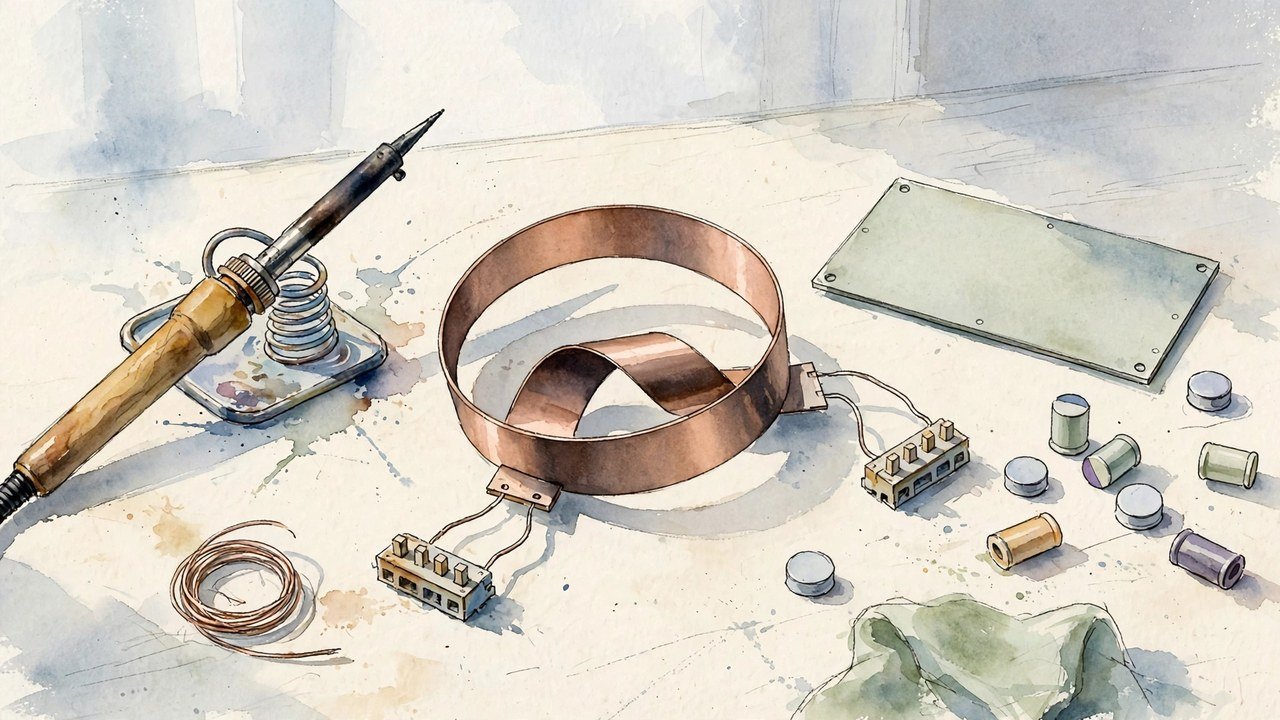
A resistor with no inductance
The second use is documented to the day. Richard L. Davis’s “Non-inductive electrical resistor” is United States Patent 3,267,406, filed on 1 May 1964 and granted on 16 August 1966.[47] Davis was of Albuquerque, New Mexico, and the patent was assigned, by mesne assignments, to the United States of America as represented by the United States Atomic Energy Commission.[47] Albuquerque is the home of Sandia, and the assignment places the invention in the atomic-energy establishment rather than in a commercial components firm, on the face of the patent itself.[47] Some secondary sources misprint the patent number as 3,267,405; the patent’s own first page gives 3,267,406, and that is the number used here.[47]
One phrase in that record carries more than it first seems to. An assignment “by mesne assignments” is an assignment through intermediate hands: the rights in the invention reached the United States, as represented by the Atomic Energy Commission, by a chain of assignments rather than by a single direct transfer from the inventor named on the patent.[47] What the patent’s first page therefore establishes is a chain with three distinct elements — Davis as inventor, of Albuquerque, New Mexico; the intermediate assignments the phrase records; and the United States, acting through its Atomic Energy Commission, as the holder at the end of the chain.[47] The invention’s institutional home, on the document’s own showing, is the atomic-energy establishment, and its ownership is governmental. That is the complete assignee record the patent gives, and it is given here complete rather than shortened to a company name the patent does not contain.[47]
The device answers a specific electrical problem. An ordinary resistor wound as a coil behaves partly as an inductor: the current in the winding generates a magnetic field, and that field opposes rapid changes in the current, so the component’s response to a fast pulse is not the clean resistance its rating suggests. For a resistor intended to be used with fast pulses, that inductive behaviour is a defect. Davis’s invention removes it by geometry rather than by compensation. The patent uses insulated resistive material “in the form of a mobius surface”, with the electrical leads attached at points diametrically opposite each other.[47]
The mechanism is stated in the patent in terms of the currents. With the leads so placed, the current travels in opposite directions through the two resistive ribbons — the two runs of the Möbius-formed material that lie alongside each other.[47] Currents in opposite directions generate electromagnetic fields that oppose each other, and the patent’s conclusion follows directly: “the electromagnetic fields generated by these currents cancel each other resulting in an essentially non-inductive, non-reactive resistor”.[47] The half-twist is what makes the arrangement a single continuous ribbon rather than two separate conductors joined at their ends. The resistive material is insulated, formed as a Möbius surface, and connected so that the cancelling pair of runs is one piece of material traversed by one current.[47]
The placement of the leads is part of the mechanism, not a wiring detail added afterwards. They are attached diametrically opposite each other — at opposite ends of a diameter of the Möbius-formed material.[47] It follows from that placement that the material between the two attachment points is divided into two runs, one along each side of the arrangement, and it is through those two runs that the patent’s opposing currents travel.[47] Move the leads, and the division into the paired runs on which the cancellation argument rests is no longer the division the patent describes. The geometry of the connection and the geometry of the twisted material are a single arrangement: the half-twist makes the ribbon continuous, and the diametrically opposite leads make the continuous ribbon carry its current in opposite directions through its two runs.[47]
The patent’s own wording keeps a qualification that summaries of the device usually drop. The resistor is “essentially” non-inductive and non-reactive, not perfectly so.[47] Cancellation between the two runs is a matter of geometry, and geometry in a manufactured component is approximate: the claim the patent makes, and the claim its test figures support, is that the fields cancel to the extent that the component behaves as a pure resistance at the pulse speeds for which it was built. The Möbius form is the means of holding the two opposing runs in the required relation along the whole length of the resistive material, rather than at a single crossing or junction.[47]
The patent supports the mechanism with figures from its own tests, and those figures are the measure of what “fast” meant for the device. The Möbius resistor in the patent’s Table I was pulsed at 1,000 volts, with a measured rise time of 0.1 microsecond.[47] A rise time of a tenth of a microsecond is the regime in which stray inductance ordinarily dominates a component’s behaviour, and it is precisely the regime the cancelling geometry was designed for. The figures are the patent’s own, reported here as the patent reports them: 1,000 volts, and 0.1 microsecond.[47]
Table I’s figures also need their context within the patent. They are not a general specification for resistors of this type, offered in the abstract; they are the recorded test of the Möbius resistor itself, the device the patent describes, pulsed at 1,000 volts with a measured rise time of 0.1 microsecond.[47] The table is therefore the patent’s evidence for its own conclusion. The claim that the fields cancel, “resulting in an essentially non-inductive, non-reactive resistor”, is a claim about behaviour under pulses, and a pulse test — a stated voltage, a stated rise time — is the form of evidence that claim requires.[47] A test at a slow rise time would not have addressed the defect the invention exists to remove, since it is at fast changes of current that an ordinary component’s inductive behaviour appears. The figures’ place in Table I, as measurements of this device under a pulse of that speed, is what makes them support the patent’s conclusion rather than merely accompany it.[47]
It also follows that the cancellation in Davis’s device is distributed, not local. Because the leads are diametrically opposite, the two opposing runs extend over the whole Möbius-formed ribbon between them, so the fields are opposed along the length of the resistive material rather than at one point where two wires happen to cross.[47] That is the difference the Möbius form makes to the invention: a pair of separate conductors could be laid against each other by hand, but the patent’s arrangement obtains the opposed pair from the form of a single insulated ribbon, held in that relation by its own continuity.[47]
The belt patents
The practice recorded in passing by Starostin and van der Heijden has a patent literature of its own, and it can now be set out from the patents themselves. The earliest of the belt patents in that literature does not use Möbius’s name at all. Owen H. Harris of Milwaukee filed his “Abrasive belt” on 19 March 1949, and it was patented as US 2,479,929 on 23 August 1949, with no assignee named on the patent.[48] Harris’s belt is a coated abrasive: a backing of paper, cloth or a combination of both, coated on both sides with abrasive grit — flint, garnet, corundum, emery, artificially fused aluminium oxide or silicon carbide — held in a binder such as glue, the second side being coated by running the roll through the coating machine a second time.[48] The invention itself is stated in one sentence: the belt is one “in which an abrasive strip one end of which has been given a half twist before the ends are Joined”.[48] The twist is specified as a 180-degree turn, given to one end before joining or splicing, and the splice shown in the drawings is a diagonal one, with abutting, overlapping and interlocking joints named as alternatives.[48]
What the twist does, in Harris’s own terms, is reversal. The belt “is so constructed that it will reverse itself once every revolution so that the coated face of the belt is uniformly presented to the working piece”, and as it revolves round its pulleys “alternate sides of the belt are presented to the work piece on alternate revolutions of the belt”.[48] His fourth claim carries the wear consequence into the legal text: the belt is “adapted to provide a continuous abrasive surface when rotated, and subjecting both sides of said belt to uniform wear”.[48] The commercial point is arithmetic. Because both coated faces work, the abrading area is doubled without lengthening the belt; a belt of half the length will serve where a given abrading area is needed, and a belt of ordinary length lasts longer before the machine must stop to have it replaced.[48] Harris also notes, in a closing sentence, that the construction is not confined to abrasives: any belt “wherein it is desired to present alternate sides on alternate revolutions of the belt without changing it” can be made in the same manner.[48]
It was a later patent that attached the Möbius name to Harris’s device. Norman Poe’s “Power transmission belt”, US 3,995,506, was filed on 26 June 1975 and patented on 7 December 1976, with no company assignee — Google Patents lists the original assignee as the individual inventor.[49] Poe’s background section states that “a Mobius power transmission belt was developed, as shown in U.S. Pat. No. 2,479,929 issued to Harris on Aug. 23, 1949”, and he is careful about the language he then uses: “Theoretically, a Mobius belt has only one side, but for purposes of explanation and description of the present invention, any reference to the two different [surfaces]… should be correctly understood as meaning the opposed surfaces”.[49] Poe’s own contribution is not the twist but the construction. His belt is laminated, built from a single strip of flexible material with an adhesive surface on one side and a friction surface on the other, the friction surface optionally carrying teeth, grooves or holes to engage the pulleys.[49] An open loop is formed from one end portion of the strip, that end is twisted 180 degrees about its longitudinal axis, and its adhesive surface is pressed to the adhesive surface of the remainder of the strip to close the loop; the remainder is then pressed congruently over the loop, building the lamination, with two laminae preferred because they give the belt an even thickness throughout its length.[49]
The contrast Poe draws is with laminated belts that lack the Möbius form. Such belts, he writes, contain “a connective joint-like structure within the belt loop which renders it susceptible to failures and uneven wear”, whereas the advantage of his structure “resides in continuity and superior mechanical integrity of the assembled structure which renders longer life, greater wear resistance and higher tensil strength”.[49] In operation, the patent adds a detail the wear argument alone does not supply: “the half twist 40 in the Mobius belt remains in a substantially stationary position” as the pulleys turn, while both opposed surfaces of the belt come into contact with the pulleys in turn, “providing means for even wear on both opposed sides of the strip resulting in more efficient use of the material from which the belt is made, and less frequent intervals between replacing the belts”.[49] The claims are drawn more widely than the preferred form: claim 1 covers a laminated belt “having an odd number of half-twists”, claim 4 narrows that to a single half-twist, and claim 5 claims the method of making it.[49] The odd number is the operative condition — an even number of half-twists would restore the two surfaces as separate circuits, and with them the one-sided wear.[49]
Between Poe’s filing and his grant, the splice problem was attacked from the opposite direction, by weaving the belt endless in the first place. J. Lehman Kapp’s “Woven endless belt of a spliceless and Mobius strip construction”, US 3,991,631, was filed on 4 September 1975 and patented on 16 November 1976.[50] Kapp’s background separates the two defects a belt can suffer: concentrated wear “on their outside surfaces or along either a righthand or lefthand edge”, and “unusual wear and failure at the splice or joint of the ends of the belt”.[50] Spliceless woven belts already existed and had removed the second defect, but they “were still subjected to the surface and edge wear”.[50] Kapp’s belt is therefore spliceless and Möbius at once, its 180-degree turn “providing in effect one spliceless continuous surface and one spliceless continuous edge of twice the predetermined length of the belt during rotation thereof by the inside surface reversing and becoming the outside surface and the lefthand edge reversing and becoming the righthand edge during each complete revolution of the belt”.[50] The edge reversal is Kapp’s addition to the wear argument: not only the faces but the two edges exchange roles each revolution, so a wear pattern concentrated on one edge is shared with the other.[50] His construction is a warp of at least one continuous yarn wrapped in a helix of the belt’s length and width, with a 180-degree turn at one location, interwoven with a filling; and the warp is to have an even end count at any cross-section, “inasmuch as the Mobius strip orientation requires an even number of complete revolutions of the belt for the belt to return to its original surface and edge orientation”.[50]
The fullest belt patent of the series is the latest. Joseph P. Miranti Jr.’s “Mobius belt and method of making the same”, US 4,253,836, was filed on 14 September 1979 and patented on 3 March 1981, assigned to the Dayco Corporation, and it carries 58 claims.[51] Miranti opens by defining his terms — the strip is “a surface with only one side and one edge, made by placing a twist of 180 degrees in a long rectangular strip and then securing the ends of the strip together” — and then surveys the earlier Möbius belts, Harris’s among them, and states their common defect in terms that frame his whole invention: they “were of the type that were spliced to make the belt endless and, therefore, retained the undesirable characteristic of having a splice or point of joinder in the endless belt which is subject to surface and edge wear”.[51] Kapp’s woven belt is acknowledged and set aside on cost: “woven construction is generally considered to be too expensive to be practical”.[51] Miranti’s stated object is “an improved endless power transmission belt having an increased surface and edge wear potential, and which eliminates the splice therein and overcomes wear at the splice of the belt”.[51]
His solution is to make the belt’s strength member, rather than its body, the continuous element. An elongate strip of elastomeric material is wrapped round two spaced building supports, one end is turned through 180 degrees and the ends are joined, forming the Möbius strip; a continuous strength cord is then wound in a helix round that strip and across its entire width; at least one further layer of elastomeric material is wound over the cord; and heat and pressure are applied so that the elastomer flows and embeds the cord.[51] The description pauses on the point where the topology does practical work. As the cord is wound across the width, it appears in cross-section on opposite sides of the strip, yet “the Mobius strip has but a single side or surface and… the cord cross-sections are all disposed on that one surface” — a single helical winding therefore lays cord along both working faces of the finished belt, where an untwisted loop would need the winding carried round twice to cover them.[51] The turn likewise gives the belt, “in effect, one spliceless continuous edge of twice the predetermined length of the belt during rotation thereof”.[51] The word “spliceless” needs its patent sense. The building strip’s own ends are butt spliced at the forming stage, but that splice is buried: in vulcanising, the elastomeric layers “coalesce, i.e., flow together”, into a single body surrounding the cord, and neither the continuous cord nor the working surface of the finished belt contains a joint.[51]
Miranti’s remaining claims widen the belt from a flat strip into a family of drive belts. The cord may be wound across half the width and squeezed into approximately a single plane before the covering layer is applied; a calendered cord fabric at least twice the finished belt’s length may be used instead of a wound cord; the cross-section may be ground or moulded into a double-V, a multi-rib form, a double V-ribbed form or a toothed double-V; the cords may be cotton, rayon, nylon, polyester or aramid, the preferred rubber is neoprene, and polyurethanes and EPDM are named among suitable thermoplastics.[51] Read in sequence, the four patents divide the problem between them. Harris establishes the reversal and the doubled working surface, without the Möbius name; Poe names the form and gives it a laminated construction whose continuity is set against the jointed belt; Kapp removes the splice by weaving and extends the sharing of wear from faces to edges; Miranti removes the splice from the finished belt by burying it, and makes a single helical cord serve both faces because, topologically, there is only one face to serve.[48][49][51][50]
The resistor in circuit terms
Davis’s patent, re-read in full, states the electrical problem more sharply than its title suggests. It is set in “high voltage, high frequency electronic circuits, especially in pulse applications such as radar”, where, the patent says, design “is greatly affected by unknown reactance in the circuit components themselves or in unwanted coupling between components”.[52] The ideal is stated as a division of labour: “a resistor should essentially provide only resistance to the circuit, a capacitor only capacitance and an inductor only inductance”.[52] Low resistance values were the hard case — “previously known low resistance resistors have displayed in high frequency and pulse applications some form of deleterious reactance or coupling with other components” — and the patent’s objects are correspondingly exact: a resistor with “no residual self inductance or mutual inductance”, and one that is “nonreactive at high frequencies”.[52] Self-inductance and mutual inductance are named separately because they are separate defects: the first corrupts the resistor’s own response to a changing current, the second couples it to its neighbours.[52]
The construction that answers those objects is more specific than a twisted ribbon alone. The resistor is built on a non-conductive ribbon of Mylar — polyethylene terephthalate — with a resistive ribbon applied to each of its two sides, the resistive material being Tophet A, an alloy of 80 per cent nickel and 20 per cent chromium, or aluminium where very low resistances are wanted.[52] The combined ribbons are twisted, and the resistive ribbon on one side is connected to the resistive ribbon on the other, by soldering, “so as to form a mobius strip”; connected so, the two ribbons “form a single mobius surface”, and the leads are then soldered at diametrically opposite points of that surface.[52] Davis also gives the wire form of the same idea: the ribbons may be replaced by bifilar wire of Manganin — 84 per cent copper, 12 per cent manganese, 4 per cent nickel — the wire’s own insulation taking the place of the Mylar ribbon, provided “the spacing between the wires provided by the insulation should be maintained when the respective wires are connected together to form the mobius strip so as to have minimum reactance in the resistor”.[52] The spacing condition matters because the cancellation is geometrical: the opposing currents must run close together and parallel along the whole path if their fields are to oppose each other along the whole path, and a construction that let the pair separate would leave the separated portion’s field uncancelled.[52]
Davis’s arrangement belongs to a recognised family, and the general account of that family explains why a resistor for measurement is built this way at all. In a non-inductive bifilar winding, two insulated conductors are wound together and joined electrically at one end, so that current flows one way round in the first conductor and back the opposite way in the second; the magnetic fields of the two “cancel out to a great extent and the total parasitic inductance is minimised”.[53] The typical application named for such a winding is the wire-wound shunt resistor, used for current-to-voltage conversion, in which the voltage drop across the resistor is directly proportional to the current through it.[53] That proportionality is what parasitic reactance destroys: an ideal shunt “should introduce only pure electrical resistance, without any parasitic inductance or parasitic capacitance because they affect the linearity of voltage drop with respect to frequency and harmonics”, and a resistive element long enough to give the required value, wound on a former in the ordinary way, is coil-shaped and can carry a non-negligible inductance.[53] The Möbius form is Davis’s way of obtaining the bifilar condition — paired, opposed runs of one continuous conductor — from the topology of a single ribbon rather than from a winding procedure: the half-twist is what joins the two runs into one surface, so the opposed pair cannot be misassembled as two separate pieces.[53][52] The same reference records the family’s limit, which is worth keeping alongside Davis’s “essentially”: conductors brought close together gain parasitic capacitance, which “can become problematic at high frequency, do to self-resonance effect” — cancelling inductance does not by itself cancel capacitance.[53]
The patent’s evidence extends beyond the single pulse figure quoted earlier in this chapter. Table I reports resistance and reactance, the reactance measured at 200 kilocycles per second, for resistors built by the method: among its entries is a Tophet A ribbon resistor of 12.7 ohms with a reactance figure of 0.0305 microhenries.[52] A reactance quoted at a stated frequency is the right form of evidence for the patent’s claim, since inductive reactance grows with frequency and a figure without a frequency would say nothing about behaviour in a fast circuit.[52] Davis then reports two properties that follow from the cancellation being a property of the connected form rather than of the shape the ribbon happens to be held in. First, “the reactance and/or resistance of a resistor embodying this invention was unaffected by handling or changes in form”: once connected as a Möbius strip, the resistor “need not be maintained in any particular form” but “can be wound around a cylindrical core or a card or for that matter rolled in a ball”, provided the ribbons remain insulated from each other, and a resistor wound on a cylindrical core worked unchanged, “thereby enabling compact packaging of the resistor”.[52] Second, the devices compose. Two Möbius resistors formed side by side on a single non-conductive ribbon, about an inch apart, were found not to affect each other’s operation — the mutual-inductance object, tested rather than merely claimed — and, connected successively in series and in parallel, their resultant resistance “changed in accordance with the usual series-parallel effect without changing the time constant from that of a single resistor”, so that a group can be arranged “for most any resistance value either by series connection or parallel connection and still maintain the time constant”.[52] A resistor whose time constant survived combination in series and parallel could be treated, in a pulse circuit, as a pure resistance of whatever value the combination gave; that, in the patent’s own showing, is the circuit behaviour the half-twist was bought for.[52]
Resonators — the twist as a boundary condition
A ring resonator stores a wave by sending it round a closed circuit until it reinforces itself. Reinforcement requires the wave to return to its starting point in its starting state, so a plain ring admits only whole numbers of wavelengths round its circumference: one, two, three. The Möbius version changes the condition at the join. A wave that travels once round a twisted circuit returns to its starting point with its two faces exchanged, and it is restored to its starting state only after a second circuit. Wavelengths that fit the doubled journey but not the single one — the half-integer wavelengths, one and a half, two and a half, three and a half — are therefore admitted by the twisted ring and forbidden by the plain one. That single sentence is the whole subject of the three papers that follow, which establish it at three different levels: as a symmetry of classical resonators, as a computed absorption spectrum, and as a measured spectrum in an optical fibre.
The symmetry was stated first. Douglas J. Ballon and Henning U. Voss, in Physical Review Letters in 2008, demonstrated that classical one- and two-dimensional radio-frequency resonators constrained to a Möbius topology are “the formal partners of cylindrical ring resonators”, and that they “give rise to half-integral harmonic excitations that are orthogonal to the integral excitations of a ring”.[54] Orthogonal, here, is a separation claim: the half-integral excitations are not a perturbation of the ring’s ordinary harmonics but a distinct set, at right angles to them in the mathematical sense, existing because the boundary condition at the join is different. Ballon and Voss add the analogy that gives their paper its title. The half-integral harmonics “are formally invariant under rotations at a minimum of 4pi rather than 2pi rad, in analogy to the rotational symmetry of fermions in quantum mechanics”.[54] A fermion must be turned through two full rotations, 4π, to return to its original state; an ordinary object needs one, 2π. A wave on the Möbius circuit is in the fermion’s position, for the geometric reason of the first paragraph: one circuit exchanges its faces, and only the second restores it. The authors present the result as offering “a pathway for discovery in other physical systems as well as the design of novel materials and electronic instrumentation”, which is the claim the later papers in this section take up.[54]
Working devices, of a simpler kind, predate the symmetry paper, and the record of them is preserved inside the next paper’s introduction. Joshua Hamilton, Ian Hooper and Christopher Lawrence, writing in 2021, state that most earlier electromagnetic work on Möbius-like structures was that of Pond and his collaborators, who made Möbius resonators by twisting a conducting wire into a structure “with twice the path length when compared with a standard ring of the same radius”, so that “the resonant frequency of the Möbius strip is half that of the standard ring. This could be used to reduce the size of resonators”.[55] The references they cite for that work are Pond’s “Mobius dual-mode resonators and bandpass filters”, in the IEEE Transactions on Microwave Theory and Techniques in 2000, and a United States patent of 2002, number 6,445,264.[55] A halved resonant frequency at a fixed radius is the resonator form of the belt’s argument in this chapter: the twist does work. A ring of a given size, twisted, resonates where an untwisted ring twice the journey would, and a component built to a frequency can accordingly be built smaller. Hamilton and his co-authors also record a printed-antenna version of the same economy, by Kim and others, in which a pseudo-Möbius geometry reduced the average radius by one-third against a classic ring while keeping the resonance frequency the same.[55]
Absorption modes, computed at Exeter and Farnborough
Hamilton, Hooper and Lawrence’s own paper — “Absorption modes of Möbius strip resonators”, Scientific Reports, volume 11, article 9045, received on 3 February 2021, accepted on 8 April 2021 and published on 27 April 2021 — must be described at its correct evidential level, because its title invites a stronger one.[55] Its authors are at the University of Exeter and at QinetiQ Ltd, at Farnborough, and the work is computational. The two resonators were designed in Autodesk AutoCAD, imported into COMSOL Multiphysics and solved by the finite-element method; nothing in the paper is a fabricated or bench-measured device, and the abstract says what the study is for: it gives “an understanding of the electromagnetic response of these structures, paving the way for future experiments on Möbius strip resonators”.[55] The conclusion repeats the direction of travel — the results “will help any future experimental investigations focusing on such structures”.[55] What the paper establishes is therefore a prediction, made precisely enough to be tested, and the precision is in its dimensions and frequencies.
The two structures are twins except for the twist. Each is a central lossy dielectric layer bounded by perfectly conducting layers — the conducting layer lies on the inner and outer surfaces of the ring, which, as the authors note in a parenthesis that carries the whole topology, are “the same surface for the Möbius strip”.[55] Both were designed with a centreline radius of 20 mm, a width of 10 mm and a thickness of 7 mm, the dielectric volume given the constant of a lossy glass-reinforced epoxy laminate, FR4, and both were designed to have a fundamental resonance at 2.5 GHz.[55] At gigahertz frequencies, the authors note, the absorptive losses occur overwhelmingly in the dielectric spacer, because the electric fields are highly localised there, which is what makes the perfectly-conducting boundary a tractable model of a metal coating.[55] The comparison is then exact. Whatever differs between the two spectra differs because one circuit is twisted and the other is not.
The ring’s spectrum behaves as the opening paragraph predicts. Its large fundamental mode stands at 2.5 GHz, its dielectric mode — dipoles across the thickness of the layer — at 1.4 GHz, sharp because those small dipoles couple poorly to the radiation, and its higher absorption modes at 2.6, 4.0 and 5.4 GHz correspond to integer quantisations of two, three and four wavelengths round the dielectric.[55] The Möbius spectrum keeps the fundamental and moves everything else. The fundamental mode is “unchanged at 2.5 GHz”; the dielectric mode shifts from 1.4 to 2.1 GHz; and illuminated edge-on, where the ring’s fundamental cannot be excited at all, the Möbius resonator shows four relatively equally spaced resonances, at 0.7, 2.1, 3.5 and 5 GHz.[55] The authors give the mechanism in one sentence. “When a twist is present, there is a switch between inner to outer charge distributions. As a result, when traversing around the ring and summing over the dipole moments, previously forbidden modes are present and coupling is allowed. These modes correspond to half-integer wavelength quantisations around the dielectric rings — for example, 0.5λ, 1.5λ, 2.5λ, and 3.5λ”.[55] The four edge-on frequencies are those four quantisations, in order.
The consequence the authors draw is stated in their abstract, in terms of the quantity their sponsoring field measures. The additional modes “result in increased absorption, and a corresponding reduction in the radar cross section”.[55] Radar cross section is the power an object scatters back when illuminated, against the power incident on it; a structure that absorbs at frequencies where a plain ring only weakly couples is, at those frequencies, less visible to radar. The second consequence is angular, and it is the more distinctive one. Rotated about one axis, the Möbius resonator’s lowest-order mode, the 0.5λ mode, “is excited over the full angle range”; rotated about the other, “the dielectric modes supported by the Möbius resonator are completely angle independent”, in a geometry where the ring’s modes are not excited at all.[55] The authors’ explanation is again geometric. A rotated Möbius resonator always presents dielectric material in the plane of the excitation, because the twist carries the layer through every orientation in the course of one circuit; the ring, turned edge-on, presents only conductor in that plane, and coupling to its modes is then impossible.[55] A plain ring has an orientation in which it goes quiet. The twisted ring, in the computed range, does not.
Möbius symmetry without a strip, and a measured fibre ring
The metamaterial work removes the strip altogether and keeps only its symmetry. Chih-Wei Chang, Xiang Zhang and their co-authors reported in Physical Review Letters in 2010 that they had “experimentally observed a new topological symmetry in optical composites, namely, metamaterials”, an electromagnetic Möbius symmetry “equivalent to the structural symmetry of a Möbius strip, with the number of twists controlled by the sign change of the electromagnetic coupling between the meta-atoms”.[56] Nothing in the device is twisted. The Berkeley Lab release on the paper describes the construction: metallic resonant meta-atoms, configured as coupled split-ring resonators, assembled three at a time into trimers, the couplings between them designed so that the trimers “displayed Möbius C3 symmetry — meaning Möbius cyclic symmetry through three rotations of 120 degrees”, the twists resulting from a change in the signs of the coupling constants.[57] The test of whether the symmetry is genuinely topological is the paper’s second result. Metamaterials with different coupling signs “exhibit resonance frequencies that depend only on the number but not the locations of the ‘twists,’ thus confirming its topological nature”.[56] A property that survives moving the twist from place to place is a property of the circuit as a whole, not of any joint in it — the same distinction chapter 6 draws between an invariant and a measurement. Zhang’s comment, in the release, states the freedom the construction buys: because coupling constants “can be arbitrarily varied from positive to negative without any constraints, the number of Möbius twists we can introduce are unlimited”, and in systems of six meta-atoms the group demonstrated up to three.[57] The symmetry, he states, is “a new symmetry not found in naturally occurring materials or molecules”.[57]
The measured counterpart of Hamilton’s computed spectrum arrived two years after it. Yao Chen, Jiankun Hou, Guolin Zhao, Xianfeng Chen and Wenjie Wan, in Communications Physics in 2023, experimentally demonstrated a Möbius ring resonator built from a twisted polarisation-maintaining fibre ring, the twist placed at the splice point.[58] The fibre carries two polarisation modes, along its fast and slow axes; a twist at the splice couples them, and at a 90° twisting angle the splice ideally converts the slow mode wholly into the fast one, and vice versa, so that a wave, like Escher’s ants, has to travel twice the resonator’s length to complete one resonance cycle.[58] Their hybridisation produces an additional geometrical phase — the Berry phase — during propagation, and that phase does the arithmetic of this section in a new notation: the resonance condition gains the Berry phase as an extra term, and “their mode numbers fractional as opposed to the integer ones in the traditional ring resonators”.[58] The measurements are specific. The untwisted ring shows its slow and fast modes close together, both with a free spectral range of about 60 MHz; in the 90° Möbius ring the two families shift to opposite sides of the spectrum and stand about 30 MHz apart, keeping their original spacing, and, fed with left- or right-circularly polarised light, they separate distinguishably, because the topological modes resonate only with polarised modes of a given circular chirality.[58] At higher twisting angles the authors further observe enhanced mode splitting and mode flipping.[58]
Chen and his co-authors frame their experiment against exactly the gap Hamilton’s paper left open. Half-integer modes between the traditional integer whispering-gallery modes had been theoretically predicted — Ballon and Voss’s 2008 result is among the work they cite — “but few experimental realizations have been implemented up to this work”.[58] The three papers therefore stand in a dated sequence that this chapter can state without exaggeration. In 2008 the half-integral excitations of a Möbius resonator were demonstrated as a symmetry of classical resonators, with the 4π analogy attached.[54] In 2021 they were computed, mode by mode and gigahertz by gigahertz, for a specified 20-millimetre structure that had not been built, with increased absorption, a reduced radar cross section and an angle-independent response as the predicted rewards.[55] In 2023 fractional mode numbers were measured in a fibre ring whose twist is a splice angle, and the authors name the uses they are aiming at: topological signal processing and quantum information.[58] In each case the working element is the same one this chapter began with, in the belt and in Davis’s resistor. The half-twist is not decoration on a ring. It is a change in the condition a wave must satisfy to come home — and a wave that must travel twice as far to come home admits frequencies that a wave on a plain ring cannot sound at all.
The two uses in this chapter exploit different properties of the same object. The belt uses the band’s topology directly: one continuous face, so that wear is distributed over what would otherwise be two separate faces.[25] The resistor uses the band’s geometry of traversal: a single ribbon whose two runs carry current in opposite directions, so that their fields cancel.[47] In neither case is the half-twist ornamental. Remove it from the belt and one face wears while the other does not; remove it from the resistor and the paired, opposing runs that the patent’s argument depends on are no longer given by the form of the material itself.[47][25]
15. Möbius molecules
A molecule cannot be cut from paper, but a ring of atoms can be twisted, and a twisted ring raises a question that paper cannot: what happens to the electrons in the ring when the framework carrying them is given a half-twist? The chemistry in this chapter turns on that question. It begins with a prediction made in 1964, reaches a claimed synthesis in 2003, is disputed in print in 2005, and ends with two later constructions — a triply twisted ring system and a carbon nanobelt — in which the Möbius topology is built into molecules by design. A second, separate construction, in which the band is folded from DNA, closes the chapter.
Heilbronner’s reversal, 1964
The background rule is Hückel’s. For an ordinary, untwisted ring of atoms with overlapping p orbitals — the orbitals whose overlap forms the π-electron system of such a ring — aromatic stability follows the 4n+2 rule: rings with 2, 6, 10 and so on π-electrons, for integer n, have the closed, delocalised electron arrangement associated with aromaticity, while 4n rings do not. In 1964 Edgar Heilbronner applied Hückel molecular orbital theory to rings in a Möbius conformation and obtained the reverse.[59] Annulenes — ring-shaped hydrocarbons of the kind at issue here — twisted into a Möbius conformation would, on Heilbronner’s calculation, be aromatic with 4n π-electrons.[59][60]
The reversal has a geometric cause that the paper-strip chapters make intelligible. In an untwisted ring, the p orbitals return to themselves after one circuit, in the same orientation in which they started. In a Möbius-conformation ring, the framework’s half-twist reverses the orientation after one circuit, in the same way that carrying a normal once round the band of chapter 5 returns it reversed. The electron-counting rule reverses with the orientation. Heilbronner’s prediction, published in Tetrahedron Letters in 1964 as “Hückel molecular orbitals of Möbius-type conformations of annulenes”, is that the 4n count, antiaromatic for a flat ring, becomes the aromatic count for a twisted one.[59][60] The Herges group’s own summary records both the prediction and its fate: Heilbronner predicted in 1964, using Hückel theory, that Möbius-conformation annulenes would be aromatic with 4n π-electrons, the reverse of the Hückel 4n+2 rule for untwisted rings.[59]
A prediction of that kind is a standing invitation to synthesis, and for nearly forty years the invitation went unanswered. The Herges group records that many attempts failed, and that the first Möbius annulene was obtained by that group in 2003.[59] The reasons for the failures are given in the 2003 paper itself, and they are structural rather than incidental.[60]
The 2003 synthesis
D. Ajami, O. Oeckler, A. Simon and R. Herges published “Synthesis of a Möbius aromatic hydrocarbon” in Nature in 2003.[60] The compound was a [16]annulene system — a sixteen-membered ring framework — with 16 π-electrons.[60] Sixteen is a 4n number, with n = 4, so the compound sits exactly on Heilbronner’s count: if the ring genuinely has a Möbius conformation and its π-electrons are delocalised round it, the 1964 prediction says it should be aromatic where a flat 16 π-electron ring would not be.[60] The paper presented the compound as the first Möbius aromatic hydrocarbon, and the Herges group’s summary describes the 2003 result as experimentally confirming Heilbronner’s prediction.[59]
The difficulty the synthesis had to overcome is stated in the paper’s abstract record. Twisted cyclic molecules are destabilised by ring strain and by suppressed p-orbital overlap.[60] Both obstacles follow from the twist itself. Forcing a ring of atoms into a Möbius conformation bends the framework away from the geometry its bonds prefer, and that bending is ring strain. At the same time, the twist turns the p orbitals progressively out of the alignment in which they overlap most effectively, and weakened overlap weakens the delocalisation on which the predicted aromaticity depends. A Möbius aromatic system therefore has to be twisted enough for the reversed rule to apply, but not so distorted that the π-system stops overlapping — and, on the record of the failed attempts, that balance had not previously been struck in a stable compound.[59][60]
The abstract’s reasoning sets out why the combination was necessary, and the reasoning runs in two steps. The first step is negative: a twisted cyclic molecule is destabilised twice over, by ring strain in its framework and by the suppressed overlap of its p orbitals, so the straightforward object — a plain annulene ring forced into a Möbius conformation — carries both penalties at once.[60] The second step follows from the first. If the twist itself imposes the penalties, then a stable example cannot be obtained by twisting harder or by holding a plain ring more rigidly in the twisted shape; the penalties have to be offset by stabilisation built into the molecule from another source.[60] That is the role the combined structure plays in the paper’s argument. The synthesis did not merely find a ring that happened to survive being twisted; it constructed a compound in which stabilising arrangements were present alongside the twist, to set against the destabilisation the abstract identifies.[60]
The 2003 synthesis struck it by combination. The synthesis combined a “normal” aromatic structure, in which the p orbitals are orthogonal to the ring plane, with a “belt-like” structure, in which the p orbitals lie in the ring plane, in order to stabilise the Möbius compound.[60] The resulting molecule is thus not a plain [16]annulene ring twisted by force. It is a constructed system in which parts of the framework with the two different orbital arrangements are joined so that the whole adopts the Möbius conformation and holds it. That construction is what the next paper in the story fastened on, because a stabilising framework of that kind raises a question about the ring at the centre of the molecule: how much of the claimed aromaticity belongs to the [16]annulene core itself?
The 2005 rebuttal
The second version of the 2003 result was published two years later, and it must be given in full, because on its account the first Möbius aromatic hydrocarbon is not aromatic. Claire Castro, Zhongfang Chen, Chaitanya S. Wannere, Haijun Jiao, William L. Karney, Michael Mauksch, Ralph Puchta, Nico J. R. van Eikema Hommes and Paul von Ragué Schleyer published “Investigation of a Putative Möbius Aromatic Hydrocarbon. The Effect of Benzannelation on Möbius [4n]Annulene Aromaticity” in the Journal of the American Chemical Society in 2005, volume 127, pages 2425–2432.[61] The word “putative” in the title states the paper’s position before its argument begins.
The rebuttal’s first ground is geometric, and it rests on a critical reanalysis of the 2003 paper’s crystallographic data.[61] A delocalised aromatic ring tends towards equalised bond lengths, because the π-electrons are shared round the ring rather than assigned to alternating single and double bonds. Castro and her co-authors found the opposite in the [16]annulene core: large bond-length alternation, with Δr — the spread between the longer and shorter bonds — reaching up to 0.157 Å.[61] Alternation of that size is the signature of localised alternating bonds, not of a π-system smoothed out by delocalisation, and the authors drew that conclusion from the original group’s own crystal structure rather than from a new synthesis of their own.[61]
The second ground is the agreement of the standard aromaticity criteria. The 2005 paper applied geometric and magnetic criteria — HOMA, a bond-length-based geometric index; NICS, a magnetic criterion based on chemical shifts computed at or near the ring centre; and susceptibility exaltation, a magnetic measure of the response associated with a ring current — and found them pointing away from delocalisation.[61] The point of using several criteria is that aromaticity is not a single observable. A compound can satisfy one test and fail another, and a claim resting on one criterion alone is weaker than a claim the criteria jointly support. In the 2005 analysis they jointly pointed the other way: away from the delocalised picture the 2003 claim required.[61]
The criteria should be listed in full, because the rebuttal’s force lies in their number and independence. The 2005 paper’s list runs: Δr and Δrm, the bond-length alternation measures, of which Δr reaching up to 0.157 Å in the [16]annulene core is the figure quoted above; Julg A and HOMA among the geometric criteria; and NICS and susceptibility exaltation among the magnetic criteria.[61] These are not six restatements of one test. The geometric criteria are computed from the arrangement of the bonds, and the magnetic criteria from the response associated with a ring current, so a compound could in principle pass on one family of measures and fail on the other.[61] On the 2005 analysis it did not pass on either: the geometric and magnetic criteria pointed, together, away from delocalisation.[61] That convergence across independent kinds of measurement — structure on one side, magnetic response on the other — is what the paper puts against the 2003 reading, and a single-criterion reply would not answer it on its own terms.[61]
The third ground is energetic. Correcting the estimate of the compound’s aromatic stabilisation energy — the energy attributed to the aromatic delocalisation itself — Castro and her co-authors arrived at a corrected value of about 0.6 kcal/mol.[61] Against the 2003 paper’s reading of the compound as moderately aromatic, a stabilisation of about six-tenths of a kilocalorie per mole is, in the rebuttal’s terms, negligible as evidence of aromatic stabilisation. The paper’s conclusion follows from the three grounds together: the compound is non-aromatic, or only weakly so.[61]
The size of the energetic correction can be stated exactly, because both figures are on the record. The stabilisation estimate under correction — the ISEII value — stood at 4.0 kcal/mol; the corrected value is 0.6 kcal/mol.[61] The correction therefore removes 3.4 kcal/mol, leaving roughly one-seventh of the original figure. A dispute over a small adjustment to a stabilisation energy could leave the 2003 conclusion standing in weakened form; a correction of this proportion does not.[61] On the corrected figure, the aromatic stabilisation attributable to the Möbius [16]annulene core is close to the level at which, in the rebuttal’s conclusion, the compound is described as non-aromatic or only weakly so.[61] The number and the conclusion belong together: 0.6 kcal/mol is not presented by Castro and her co-authors as a refinement of the 2003 estimate but as the value that remains when the estimate is done as they argue it should be, and it is too small to carry the claim it was originally used to support.[61]
The two versions therefore stand as follows, and neither is suppressed here. In 2003, Ajami, Oeckler, Simon and Herges reported the synthesis of a Möbius aromatic hydrocarbon, a [16]annulene with 16 π-electrons, stabilised by combining normal and belt-like structures, and presented it as the realisation of Heilbronner’s 1964 prediction.[60] In 2005, Castro and nine co-authors, reanalysing the crystallographic data and applying the geometric, magnetic and energetic criteria, concluded that the [16]annulene core shows bond-length alternation up to 0.157 Å, that the criteria point away from delocalisation, that the corrected stabilisation energy is about 0.6 kcal/mol, and that the compound is non-aromatic or only weakly so.[61] What is not in dispute between the two papers is the synthesis itself: a molecule with the Möbius conformation was made in 2003. What is in dispute is whether its π-electrons behave as Heilbronner’s aromaticity prediction requires.
The benzannelation in the rebuttal’s subtitle is part of its argument, not a side topic. The paper’s full title announces an investigation of “the effect of benzannelation on Möbius [4n]annulene aromaticity” — that is, of the effect of the fused benzene rings built into the 2003 compound’s stabilising framework on the aromaticity attributed to its [16]annulene core.[61] The question matters because the 2003 synthesis achieved its Möbius conformation by combining a normal aromatic structure with a belt-like one.[60] If the framework that holds the twist itself contains aromatic units, then measurements made on the whole molecule have to be separated into what the framework contributes and what the twisted core contributes, and the 2005 paper’s corrected stabilisation energy of about 0.6 kcal/mol is the result of attempting exactly that separation for the core.[61] On the rebuttal’s account, once the framework’s contribution is accounted for, very little aromatic stabilisation is left for the Möbius ring itself.[61]
Three twists, and a belt of carbon
The chemistry did not stop with the dispute. Later work from the Herges group itself extended Möbius annulene chemistry to triply twisted systems, with Schaller and co-authors’ “Design and synthesis of the first triply twisted Möbius annulene” published in Nature Chemistry in 2014.[59] Three half-twists keep the parity of chapter 8: an odd number of half-twists gives a one-sided band, so a triply twisted ring is still a Möbius-topology object, with the additional twists taken up in its conformation. The 2014 paper is recorded on the Herges group’s page as the first triply twisted Möbius annulene, a decade after the singly twisted system of 2003.[59]
A different construction followed in 2022, in which the Möbius object is not an annulene ring with a stabilising framework but a belt made entirely of fused carbon. Yasutomo Segawa, Tsugunori Watanabe, Kotono Yamanoue, Motonobu Kuwayama, Kosuke Watanabe, Jenny Pirillo, Yuh Hijikata and Kenichiro Itami published “Synthesis of a Möbius carbon nanobelt” in Nature Synthesis in 2022.[62] The paper reports the first belt-shaped molecular nanocarbon with Möbius topology: a fully fused carbon nanobelt with a single twist.[62] The target molecule is identified in the research record as the (25,25) Möbius carbon nanobelt.[62]
The synthesis took 14 steps, carried out by way of Z-selective Wittig reactions and a nickel-mediated intramolecular homocoupling.[62] As in 2003, strain was the central obstacle: a fully fused belt of carbon rings resists being twisted into a closed Möbius form, and the route had to build the belt so that the strain of the final, twisted closure could be borne.[62] The timescale is part of the record. The same research programme had made its first untwisted carbon nanobelt in 2017, and the Möbius version followed five years later, in 2022.[62]
The route’s prehistory explains why the belt, rather than a simpler ring, was the group’s Möbius target. The programme’s first carbon nanobelt, made in 2017, was untwisted: a closed belt of fused carbon with no twist in it.[62] The Möbius nanobelt of 2022 is that object’s twisted counterpart, and the five years between the two results measure the additional problem the single twist posed for a framework of this kind.[62] The 2022 route is recorded by its two named methods — Z-selective Wittig reactions and nickel-mediated intramolecular homocoupling — deployed across a synthesis of 14 steps.[62] Fourteen steps is itself part of the result’s character. The belt was not closed by a single reaction applied to a ready-made strip; it was assembled through a sequence long enough that the twist and the strain it carries had to be planned into the route from its earlier stages, since a fully fused carbon framework offers no point at which a twist can simply be inserted at the end.[62]
The evidence for the travelling twist is also of two kinds, and the two kinds agree. Nuclear magnetic resonance measurements on the belt in solution, and calculations, both show the twist moving quickly round the molecule.[62] The NMR evidence is evidence about the molecule as it exists in solution, not about a single frozen conformation, and the calculations are what connect that solution behaviour to the motion of the twist itself rather than to some other rearrangement of the belt.[62] Taken together they describe a Möbius object whose defining feature — the location of its one twist — is not a fixed structural detail but a moving one, while the total topology, one twist in a closed fused belt, stays exactly as synthesised.[62]
Two properties of the finished nanobelt are recorded, and both belong specifically to its topology. The first is motion. Nuclear magnetic resonance measurements and calculations show that the twist moves quickly around the molecule in solution.[62] The half-twist is not fixed at the point where the belt was closed; it travels, so that over time every part of the belt takes its turn as the twisted part, while the molecule’s Möbius topology — one twist in total — is unchanged. The second property is chirality. The Möbius structure gives the nanobelt topological chirality, a handedness arising from the topology of the fused, twisted belt rather than from a single stereogenic atom, and that chirality was confirmed by chiral HPLC separation and by circular dichroism spectroscopy.[62] A left-twisted and a right-twisted form of the belt are distinct objects, separable by the chiral chromatography and distinguishable by their opposite responses in the circular dichroism measurement.[62]
The band folded from DNA
Why the count reverses — the phase inversion in full
Chapter 15 has so far stated Heilbronner’s reversal as a result. Herges’s 2006 review, “Topology in Chemistry. Designing Möbius Molecules” in Chemical Reviews, sets out the machinery behind it.[63] In a Möbius π system the one-sided surface is defined by the nodal plane of the π system itself. In a normal Hückel annulene, all the p orbitals can be chosen in such a way that there are only bonding interactions in the lowest π molecular orbital. In the Möbius system there is at least one sign inversion, as a consequence of the 180° twist.[63] The reversal of the electron count is that sign inversion, carried through the arithmetic of the orbital energies.
Heilbronner’s 1964 calculation, as Herges reconstructs it, assumed an equally distributed twist round an equilateral Möbius ring, and the twist entered in two distinct places.[63] First, the overlap of neighbouring p orbitals is reduced by the twisting, so the resonance integral β — the quantity measuring the interaction between adjacent orbitals — should be replaced by β·cos(π/N), where N is the number of ring atoms. Secondly, and separately, there is a sign inversion, an antibonding orbital overlap, at some point round the ring, accounted for by writing −β for one of the resonance integrals in the secular equation. Heilbronner included both boundary conditions and obtained a closed analytical solution.[63] Reduced overlap by itself would merely weaken a π system; it is the single negative entry, where the phases meet head-to-tail instead of head-to-head, that reorders the levels and reverses the count. Heilbronner’s own conclusion, quoted by Herges, is precise about the cost: “a planar perimeter of 4n AO’s, which would yield an open shell configuration when occupied by 4n electrons, can be twisted into a closed shell Möbius strip perimeter without loss in π electron energy”.[63] The prediction also carried a size condition, cautiously stated: larger annulenes, with ring size above 20, should tolerate a twist without any apparent strain.[63]
The level pattern behind the two counts was given a picture two years later. Zimmerman in 1966 introduced a mnemonic for Möbius annulenes analogous to the Frost–Musulin diagram for Hückel systems: inscribe the ring as a polygon in a circle and read the orbital energies from the vertices’ vertical positions.[63] For a Hückel annulene a vertex of the polygon is the lowest point of the circle; for a Möbius annulene the lowest edge must be horizontal. That half-step rotation is the whole reversal in graphical form. In the Hückel diagram the lowest π orbital is non-degenerate and those above it come in degenerate pairs, so 4n+2 electrons exactly fill the bonding orbitals, while 4n electrons leave an open shell and are antiaromatic. In the Möbius diagram all the orbitals are degenerate in pairs, except the highest in odd-membered systems, so 4n electrons exactly fill the bonding orbitals and it is the 4n+2 systems that are diradicals and antiaromatic.[63]
Two cautions belong with the picture, and both are Herges’s. The Hückel approximation is, in his words, extremely crude: in a symmetrical Möbius system the π molecular orbitals cannot in fact be degenerate, because C2 is an Abelian point group.[63] And in Möbius annulenes, unlike planar annulenes, the σ and π systems are not strictly orthogonal, and in small rings there is considerable σ–π mixing, so considerations based on σ–π separation are crude approximations.[63] The 4n rule is therefore a statement about an idealised, evenly twisted ring of pure p orbitals; real molecules depart from that idealisation in both respects.
One departure was mapped by Rzepa, whose 2005 Chemical Reviews review “Möbius Aromaticity and Delocalization” Herges cites for systems in which the sign inversion is produced electronically rather than by twisting the framework.[63][64] As Herges summarises the proposals, Rzepa set out three such ways: a d orbital, on Craig’s proposal of 1958–59 that a d orbital should induce a phase inversion in a π system with the same effect as a 180° twist; an allene, C=C=C, unit, which induces a 90° twist and would shut off conjugation in an unstrained ring, but in strained medium-sized rings, where the orthogonality is already broken — the dihedral angle in cycloheptatetraene is about 50° — can be used to induce a twist; and a coarctation in spiroaromatic systems, where the spiro atom provides two p orbitals for delocalisation.[63]
Designing round the strain — why the synthesis took thirty-nine years
The forty years between prediction and synthesis are sometimes told as a delay. On the record assembled in Herges’s review they are better understood as a result: the straightforward objects were calculated, repeatedly, to be the wrong objects.[63] Ab initio and density functional calculations, in agreement with experimental data, predict that the most stable isomer of each [4n]annulene up to n = 5 has Hückel topology. The crystal structures available for the [n]annulenes with n = 6, 8, 14, 16 and 18, and all the structures identified by NMR or by NMR combined with calculation, exhibit Hückel topology, and Herges’s summary is blunt: there is no experimental data available for any neutral, parent Möbius annulene.[63] Any stabilisation by Möbius aromaticity, he concludes, cannot overcome the destabilisation induced by strain or by the reduced overlap of neighbouring p orbitals.[63]
The [16]annulene case shows both sides of that verdict in numbers. The calculated Möbius [16]annulene is, by the magnetic criterion, strongly aromatic: its NICS value of −14.5 is of similar size to benzene’s −11.5, and its carbon–carbon bond lengths do not systematically alternate, the longest being 1.411 Å and the shortest 1.392 Å, close to the value in benzene; the largest deviation from planarity is 29.1°, small enough that conjugation is not interrupted.[63] Yet the isomer with the strongest predicted Möbius aromaticity is 15.8 kcal/mol higher in energy than the global minimum of [16]annulene, and number 137 in the list of its most stable isomers, so that, in Herges’s words, there is probably no chance to prepare such a species even at low temperatures.[63] Of the 153 most stable [16]annulene isomers examined in the group’s systematic study, the energies are dominated by strain and not by any aromaticity stabilisation.[63] A ring that twists far enough to satisfy Heilbronner’s geometry tends either to pay for the twist in strain or to escape by turning a dihedral angle towards 90°, at which point the conjugation, and with it the aromaticity in question, is switched off.
The design strategy of 2003 follows from that diagnosis, and Herges states its premise in one sentence: to obtain a stable Möbius annulene, the twist has to be stabilised by proper substitution or by incorporation into a rigid molecular frame.[63] His analysis divides a Möbius annulene into two kinds of conjugation. One part is “normal”, its p orbitals perpendicular to the ring plane, its sp² atoms keeping their preferred trigonal planar configuration. The other part is “in-plane”, belt-like, its sp² centres pyramidalised, with partial sp³ character; the strain arises mainly from that pyramidalised part, so stabilising the in-plane part should also stabilise the twist.[63] The building block chosen was a cyclic bianthraquinodimethane, whose central double bond cannot be planar because of the steric hindrance of its inner ortho hydrogen atoms — a unit already pyramidalised for reasons of its own, so the ring does not have to pay the full cost of pyramidalising it.[63] The strategy was tested in calculation before the laboratory, and the contrast is the sharpest statement of what the block does. Among the 20 most stable isomers of the parent [16]annulene there are five Möbius rings, all at higher energies than the Hückel leaders; among the 20 most stable isomers of the modified [16]annulene there are seventeen Möbius structures, and the seven most stable isomers are all Möbius rings.[63] The laboratory route still had to be changed once. Every attempt to react cyclooctatetraene directly with tetradehydrodianthracene — on heating, under Grubbs catalysis, and on irradiation — failed to give addition products, bianthryl being isolated instead, because on irradiation the cyclooctatetraene transferred triplet energy to its partner, which then underwent electrocyclic ring opening to a diradical.[63] The group therefore used syn-tricyclooctadiene as a masked cyclooctatetraene, which does not absorb ultraviolet light above 250 nm; irradiation of the pair then gave, among other products, five ring-opened [16]annulene structures, of which two were characterised by X-ray analysis as Möbius and one as Hückel.[63]
That is also where the later assessment of the 2003–05 dispute can be stated more exactly than either paper stated it alone. Castro and her co-authors’ abstract adds a mechanism to their geometric ground: delocalisation in the [16]annulene core is inhibited by large dihedral angles, which hinder effective π overlap, and their computations on less benzannelated derivatives, and on benzannelated derivatives of other Möbius aromatic species, present benzannelation-driven bond localisation as a general property of such systems rather than an accident of this one compound.[65] Their energetic analysis also locates what stabilisation there is: evaluation of the uncorrected values for just the polyene bridge portion suggests that the compound’s stabilisation relative to its Hückel isomer is confined to the polyene bridge and is not due to a delocalised π circuit.[65] Herges, writing the year after, cites that same theoretical work for a differently weighted conclusion — that the four benzene rings reduce the Möbius aromaticity of his compounds “albeit not to zero” — and adds the general admission that most of the measures taken to stabilise the twist reduce the conjugation.[63] The two positions are therefore not claim and simple denial. Both sides accept that benzannelation localises the bonds of the core and reduces whatever Möbius aromaticity the system has; they differ on whether the residue, after correction, is a small aromatic stabilisation or, at about 0.6 kcal/mol, none that deserves the name.[63][65]
After 2022 — three and four twists, a writhed belt, and a proton switch
The 2022 Möbius carbon nanobelt of chapter 15 was singly twisted, and for a year it stood alone: Fan, Isobe, Wu and their co-authors, reporting the next step in 2023, record that only one singly twisted Möbius carbon nanobelt had been reported and that belts with more than two twists were unknown, the obstacle being the same one as in 2003 — atomically precise synthesis requires careful control of both twist and strain.[66] Their paper in Nature Synthesis in 2023 reported the first triply twisted Möbius carbon nanobelt, made by Suzuki coupling-mediated macrocyclisation, Bi(OTf)3-catalysed cyclisation of vinyl ethers and oxidative dehydrogenation.[66] Three half-twists keep the odd parity of chapter 8, so the object is still one-sided. Its structure was unambiguously confirmed by X-ray crystallography, which also revealed the co-existence of the (P,P,P)- and (M,M,M)-enantiomers — the three twists all of one handedness, or all of the other. The racemate was resolved by chiral HPLC, and the isolated enantiomers showed a large absorption dissymmetry factor, |gabs| = 0.019, by circular dichroism spectroscopy, explained by the fully conjugated structure and the desirable orientation of the electric and magnetic transition moments.[66]
In the same issue of the same journal, Nogami, Hashizume, Tanaka and their co-authors reported a catalytic route to twisted belts in a series: doubly, triply and quadruply twisted aromatic belts, made with enantiomeric ratios up to 98:2 by rhodium(I)-catalysed asymmetric [2 + 2 + 2] cycloadditions of cyclic polyynes built from linear paraphenylene and curved metaphenylene units.[67] The hybrid substrate design answers the two failure modes of earlier methods, large twist strain and the unravelling of twists during belt formation, and allows multiple P- and M-twists to co-exist in a single belt molecule.[67] Precision about parity is needed here, and the paper’s own language observes it: only the triply twisted belt, with an odd number of half-twists, is a Möbius belt; the doubly and quadruply twisted belts are even-twist, two-sided objects. For the triply twisted Möbius belt, decomposition of the linking number gives a twisting number Tw = 2.45, among the highest found for twisted conjugated macrocycles, and analysis of the electron density of delocalised bonds gives electronic structures whose topologies depend on the linking number, among them a catenane and a trefoil knot.[67]
A 2025 paper then used that vocabulary to separate two things the earlier literature had run together. Ye, Miao and their co-authors, in the Journal of the American Chemical Society, begin from the Călugăreanu theorem for a closed ribbon: the linking number Lk is the sum of twist, Tw, the number of 180° rotations along the ribbon axis, and writhe, Wr, the sum of the ribbon’s self-crossings.[68] A Möbius strip has Lk = 1, but that unit can be supplied in either currency: Tw = 1 and Wr = 0, which they propose to call the twisted Möbius strip, or Tw = 0 and Wr = 1, the writhed Möbius strip, formed by joining the ends of a strip through a full-turn helix instead of through a half-twist.[68] The distinction reaches back to 2003. Herges’s [16]annulene derivative, the first reported stable Möbius aromatic molecule, was designed as a writhed Möbius strip, although careful topological analysis of its crystal structure later revealed Tw = 0.46 and Wr = 0.54 for it: its single unit of linking is split almost evenly between twist proper and writhe.[68] The 2025 group’s own molecule is a writhed Möbius nanobelt by design, made by fusing a [7]helicene, which provides a full-turn helix, with a fragment of an O,N-heterocyclacene whose p orbitals are radially arranged and in-plane, the junction of the two parts creating the p-orbital phase inversion.[68] A helical building block derived from the [7]helicene and a C-shaped building block derived from pyrene were connected by nucleophilic aromatic substitution to form an oxanorbornene-containing macrocycle, converted to the nanobelt by reductive aromatisation and subsequent oxidation, and the structure was confirmed by X-ray crystallography.[68]
The writhed belt also sharpens a distinction chapter 15 drew only in passing. A Möbius annulene or nanoring, the 2025 authors note, has only one conjugation pathway in circular form, Möbius or Hückel according to whether p-orbital phase inversion occurs; a conjugated Möbius nanobelt fully resembles a Möbius strip in having both a one-sided surface and a one-edge conjugation pathway.[68] Yet its calculations suggest no global ring current, only localised aromatic ring currents — Möbius topology, crystallographically confirmed, without a Möbius ring current.[68]
The last of the new systems is not a belt at all, and its twist is switched rather than built in. Dash, Chandrashekar and their co-authors reported in the European Journal of Organic Chemistry in 2023 a core-modified 28π non-fused hexaphyrin — 28 π-electrons, a 4n count with n = 7, in an expanded porphyrin macrocycle.[69] In its free-base form the macrocycle is non-aromatic at 298 K, and its non-aromatic character is unaltered on lowering the temperature.[69] Protonation on the imino pyrrolic nitrogens changes the framework’s shape, and single-crystal X-ray structures of the protonated macrocycle show the distortion needed for effective π-electron delocalisation, attaining Möbius aromaticity. The numbers move with the structure: the NICS value goes from −2.0 ppm for the free base to −5.6 ppm for the protonated form, and the anisotropy of the induced current density shows clockwise delocalisation of the current-density vectors in the protonated macrocycle.[69] Where the annulene work sought a molecule twisted permanently enough to be isolated, and the belt work sought frameworks rigid enough to hold three twists or a writhe, the hexaphyrin holds its Möbius state only on condition — a proton added, a framework distorted into the twisted form, an aromaticity present in one state of the molecule and absent in the other.
The last molecular construction in this chapter is not a ring of carbon atoms at all. In 2010 Dongran Han, Suchetan Pal, Yan Liu and Hao Yan, in “Folding and cutting DNA into reconfigurable topological nanostructures” in Nature Nanotechnology, constructed Möbius and related topological nanostructures from DNA, using the folding method known as DNA origami.[19] Their Möbius bands are the same objects, at nanometre scale, as the paper band of the opening chapters: one side and one boundary component.[19] The cutting results of chapter 7 were performed on these DNA constructions as well as stated for paper, so the DNA band is not merely shaped like the Möbius strip but behaves under cutting as the topology requires — a centre cut leaves a single longer band rather than two separate ones.[19] The DNA work is the verified connection between the Möbius band and molecular self-assembly carried in this post, and it is a construction: a band designed, folded and cut by experimenters, with the topology chosen in advance.[19]
16. The band in art and building
The band left mathematics twice in the twentieth century: once into sculpture and print, where artists took up its endless, one-sided circuit as a form, and once into a symbol placed in the public domain for anyone to print, whose designer intended it as a Möbius strip and whose printed form, examined topologically, is not quite one. A third departure, into architecture, exists as a competition-winning design. Each case is given here with the evidence as it stands, including the two places — the sculpture and the symbol — where the record carries two versions rather than one.
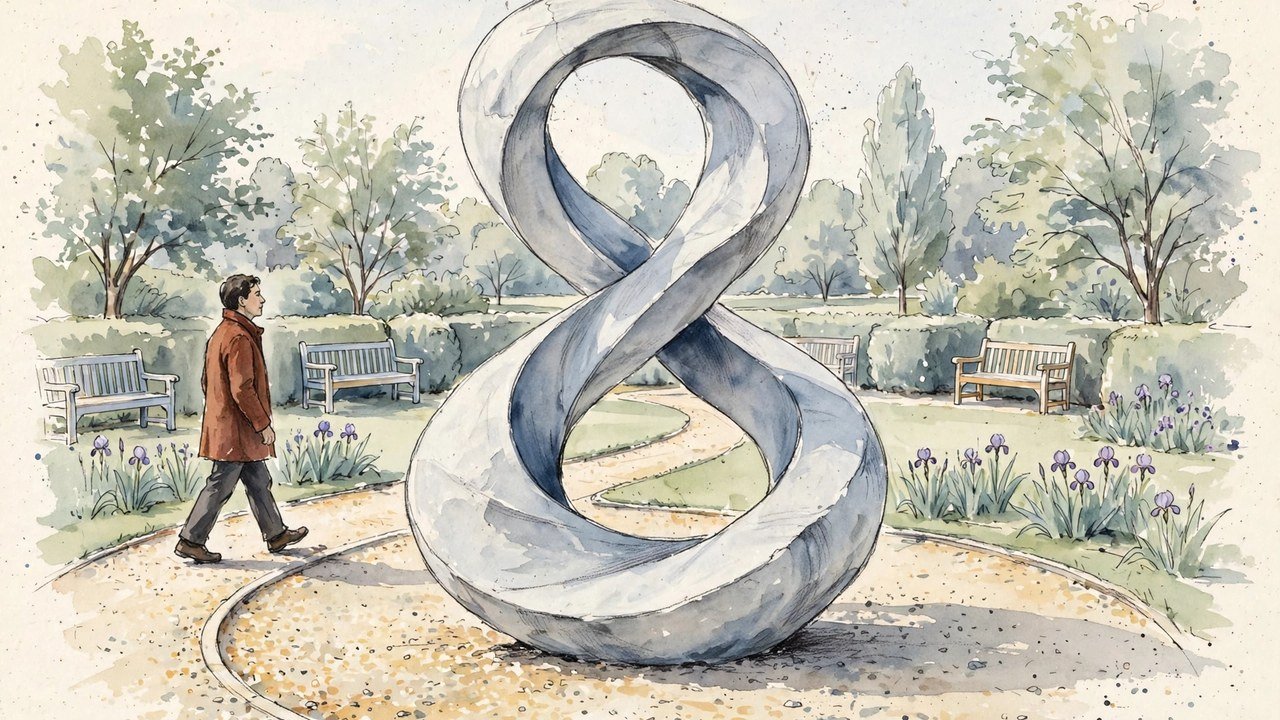
Max Bill’s Endless Ribbon
The Swiss artist Max Bill made his first Endless Ribbon sculpture in 1935.[70] The Praemium Imperiale’s official biography dates it so in its chronology — “1935 — First Endless Ribbon sculpture” — and some accounts place the first ribbon more precisely in the winter of 1935–36.[70] In 1936 Bill exhibited a “concrete” sculpture realising the single-sided figure known as the Möbius strip in the Swiss pavilion at the Milan Triennale.[70] The Endless Ribbon series continued, on the Centre Pompidou-Metz’s account, from 1935 to 1953, executed in hard stones, mechanically polished.[71]
How Bill arrived at the form is told in two versions, and both are given here. In the first, the biography’s version, the sculpture is a realisation of a known figure: Bill made a concrete sculpture of the single-sided surface already known to mathematics as the Möbius strip, and exhibited it as such at Milan in 1936.[70] In the second version, Bill found the form himself and the name afterwards. The Centre Pompidou-Metz brochure states that in 1934, searching for an endless movement, Bill “intuitively rediscovered the Möbius strip by folding on itself a strip of paper, to which he added a half-twist”.[71] The Art Story’s account of Concrete Art agrees in substance: the 1935 ribbon was designed to hang above an electric fireplace and turn in the rising hot air, and Bill learned of the Möbius connection from viewers afterwards.[71] On that telling, the sequence of 1858 repeated itself in a studio — the form first, arrived at independently, and its mathematical identity supplied later by others. The two versions differ over intention, not over the object: a ribbon with a half-twist, made from 1935, is common to both.[70][71]
The fireplace detail, recorded by The Art Story and carried in the Centre Pompidou-Metz account’s version of the story, gives the 1934 search its intended outcome.[71] Bill was searching for an endless movement, and the 1935 ribbon was designed to hang above an electric fireplace and turn in the rising hot air.[71] The movement sought was therefore not depicted movement, of the kind a drawing can suggest, but actual continuous turning, driven by the warm air rising from the fire below the hanging ribbon. A form that turns endlessly needs a circuit without a point at which the motion must reverse or restart, and the folded strip with its half-twist supplied a closed form equal to that requirement before Bill, on this version, knew its mathematical name.[71] The sequence in this telling is complete in itself: a search begun in 1934, a paper strip folded and twisted in the course of it, a ribbon made in 1935 to hang and turn, and the identification with Möbius’s surface supplied afterwards by viewers.[71]
The series that followed that first ribbon ran, on the Centre Pompidou-Metz account, from 1935 to 1953 — eighteen years of production.[71] Its material is specified as plainly as its dates: the ribbons were made in hard stones, mechanically polished.[71] Both details separate the sculptures from the paper strip of the discovery story. Hard stone holds the twisted form permanently, where the folded paper held it only while it was handled, and mechanical polishing gives the stone ribbons the finished, uniform surface of objects made to be exhibited rather than of models made to demonstrate a theorem.[71] The Endless Ribbon is thus, across its eighteen years, a single form repeatedly realised at exhibition standard in a durable material — the same half-twisted circuit, carried from a strip of paper above a fireplace to polished stone.[71]
The Milan exhibition fixes the series’ public starting point. Bill’s first ribbon dates to 1935, and by 1936 the form was being exhibited, in the Swiss pavilion at the Milan Triennale, as a “concrete” sculpture realising the single-sided figure.[70] Whatever version of the discovery is preferred, the interval between the first ribbon and its exhibition under that description is a single year: the object moved quickly from the studio circumstances the second version describes — a paper strip, a fireplace, viewers supplying the name — into an international exhibition as a work of concrete art.[70][71]
Escher’s ants
M. C. Escher came to the band through printmaking, and his exploration of it can be dated print by print. He had explored the idea earlier in Horseman in 1946 and Swans in 1956.[72] Möbius Strip I, in 1961, was his first print to focus on the concept itself.[72] Möbius Strip II followed in February 1963.[72]
Möbius Strip II, also known as Red Ants, is a woodcut in red, black and grey-green, printed from three blocks — one block for each colour — and measures 45.3 × 20.5 cm.[72] Nine ants walk the strip, in the museum’s phrase, “as if on an endless treadmill”.[72] The description is left at that. The print itself is in copyright, and what matters for this post is the fact it demonstrates rather than its appearance: a single file of nine ants on a one-sided band never reaches an end, a far side or a point at which the circuit has to be restarted, because the surface they walk on has none. Escher in Het Paleis, the museum in The Hague that holds and presents his work, records the print’s date, medium, dimensions and its place after Möbius Strip I in his sequence of treatments of the subject.[72]
The earlier explorations should be given their full spacing, because the intervals are part of the record. Horseman dates to 1946 and Swans to 1956, ten years later; in both, on the museum’s account, Escher was exploring the idea that the two later prints would take as their whole subject.[72] Möbius Strip I followed in 1961, five years after Swans, as his first print to focus on the concept, and Möbius Strip II came two years after that, in February 1963.[72] The gaps narrow as the subject becomes direct — ten years, then five, then two — and the sequence ends with two prints, in 1961 and 1963, in which the band is no longer an idea explored within another image but the image itself.[72]
The three Escher works before Möbius Strip II mark a progression in how directly the band is the subject. Horseman in 1946 and Swans in 1956 explored the idea earlier, in the museum’s account, before the band itself became the focus of a print.[72] Möbius Strip I in 1961 was the first print to focus on the concept, and Strip II followed it two years later with the band and its nine ants as the subject.[72] The museum’s sequence — 1946, 1956, 1961, 1963 — is the record of an artist approaching the same surface four times over seventeen years, the last two times with the surface itself as the whole subject of the print.[72]
The recycling symbol
The most widely reproduced Möbius form of the century was designed in 1970, for a competition. Gary Anderson, then a student of architecture at the University of Southern California who was finishing a master’s degree there, entered a design contest run by the Container Corporation of America.[73] Inspired by Escher’s Möbius strip, he produced the three folded chasing arrows in a couple of days.[73] The simplest of his designs won, the prize was a $2,500 scholarship, and the Container Corporation placed the symbol in the public domain.[73] Placed in the public domain, it was free for anyone to print, and it became the recycling symbol: three arrows chasing each other in a triangular circuit, each arrow folded as if it were a strip given a twist.
Anderson’s own account of what he designed is on record, and it is the first of the two versions this symbol requires. In an interview in Resource Recycling in May 1999, quoted by Cliff Long in “Recycling Topology”, Anderson said: “The figure was designed as a Mobius strip to symbolize continuity within a finite entity.”[21] The intention, on the designer’s own testimony, was the band itself, chosen for exactly the property this post has followed from chapter 1: continuity — a circuit that continues — contained within a finite figure.[21]
The second version is the topological qualification, and it qualifies the printed symbol, not the intention. As printed, the symbol is three separate arrows, not one continuous band.[21] It is a Möbius band only if the three arrows are joined into a single ribbon; joined that way, the standard symbol’s arrows form a Möbius band with one half-twist.[21] Some common variants, joined the same way, would give a band with three half-twists instead — still one-sided, by the parity rule of chapter 8, but a different band from the one the standard symbol implies.[21] Both statements are therefore true at once, of different things: the figure was designed as a Möbius strip, on its designer’s account, and the figure as printed is three arrows that become a Möbius band only when a reader joins them.[21][73]
Anderson’s route to the symbol runs through the preceding section. He was inspired by Escher’s Möbius strip, and he produced the design in a couple of days.[73] The symbol that resulted is therefore a second-hand Möbius form in a precise sense: not taken from a mathematics text, but from an artist’s print of the band, by a designer who then stated, in his own 1999 account, that the figure was designed as a Möbius strip.[21][73] The speed of the work belongs in the record alongside its later reach. A couple of days’ designing, by a student then finishing a master’s degree, produced the figure that the Container Corporation of America placed in the public domain and that printers have reproduced since.[73] Nothing in the contest record suggests a long development: the simplest of Anderson’s designs won, and it is that simplest design — three folded chasing arrows — whose topological status the qualification above examines.[73]
The competition figures for the library state the scale of the selection the design won. Nineteen entrants took part in the international competition, and BIG’s design took first prize.[74] The building as designed was about 33,000 m² and was named for President Nursultan Nazarbayev.[74] Those three figures — the field of nineteen, the first prize, and a national library of that size carrying the president’s name — are the standing of the design as it was published in 2009. They are also the limit of its standing in this post: a design selected over eighteen other entrants is a competition result, recorded at the time, and it is as a competition result, not as a finished building, that the Astana library enters the history of the band in architecture.[74]

A library in the form of a band
In 2009 the Danish practice BIG, Bjarke Ingels Group, won the international competition for a new National Library in Astana, Kazakhstan.[74] The competition drew 19 entrants, BIG took first prize, and the building as designed was about 33,000 m², named for President Nursultan Nazarbayev.[74] The design’s governing idea was stated by Bjarke Ingels in terms of the forms it merges: “the circle, the rotunda, the arch and the yurt are merged into the form of a Moebius strip”.[74]
The Möbius element in the design is the skin. The library as designed is a continuous skin in which the façade moves from inside to outside and back again — an “infinite loop”, in the project’s own description.[74] A reader inside such a building would be on a surface that becomes, by continuation, the building’s exterior, in the same way that a point travelling on the band finds the other face by going far enough along this one. That is the design as BIG published it and as it was reported in August 2009.[74] Its status must be stated exactly: this is a competition-winning design of 2009, reported and published as a design, and it is described here as a design and not as a built library.[74]
Escher’s first strip, in his own words
For Möbius Strip I there is something chapter 16 has not yet used: the artist’s own published account of what the print shows. Escher in Het Paleis, in a separate page on the print, calls it his “first fully developed one” and gives its making exactly: a wood engraving and woodcut in red, green, gold and black, printed from four blocks, in March 1961.[75] Four blocks for four colours is a material fact of a different kind from the three blocks of Strip II, and it belongs to a print whose subject is not a procession on the band but an operation performed on it. The band in Strip I has been cut.
Escher states the operation and its paradox himself, in The Graphic Work of M. C. Escher, in words the museum quotes in full. “An endless band has been cut through, down its whole length. The two sections have been drawn apart from each other a little, so that a clear space divides them all the way round. Thus the band ought to fall apart into two unattached rings. And yet apparently it consists of one single strip, made up of three fish, each biting the tail of the one in front. They go round twice before reaching their point of departure”.[75] Every clause of that is the centre-line cut of chapter 7, stated by a printmaker rather than a topologist. A band cut down its whole length ought, on the ordinary expectation Escher names, to fall apart into two unattached rings. It does not. It remains one strip, and the proof he builds into the image is a count of circuits: the fish go round twice before reaching their point of departure, which is exactly the doubled circuit a point must make on a one-sided band before it returns to its starting place in its starting orientation. The cut, the refusal to separate, and the double circuit are the whole argument, and Escher makes all three in one paragraph.[75]
The figures carrying that argument are described by the museum with a correction attached. The print “features three snake-like figures biting each other’s tails”, and Escher states, in the book the museum quotes, that “they are, in fact, fish”.[75] The ambiguity is the museum’s observation: the animal forms have “a rather ambiguous appearance”, ambiguous enough that the artist had to settle their species in print.[75] What the tail-biting means, on the museum’s reading, reaches further back than Möbius. A creature biting its own tail is the ouroboros, from the ancient Greek οὐροβόρος, “tail-eater”, a symbol from alchemy and “one of the oldest mythical symbols in the world”, standing for eternal cyclic renewal.[75] One ouroboros closes a circle on itself. Escher’s device is to multiply it: by putting three ouroboroi biting each other’s tails in a Möbius band, the museum concludes, he “is reinforcing this sense of eternity”.[75] The reinforcement is structural. The tail-biting already says that the end joins the beginning; the band adds that the joined circuit must be travelled twice, and that the surface travelled has no second side on which the cycle could be escaped.
The museum’s general description of the strip, on the same page, places Escher’s subject precisely among his impossible figures — and outside them. A Möbius strip, it states, is “a spatial form which appears impossible but can exist in reality”.[75] Those prints depict structures that could not be built; the band only appears to belong with them. It can be made from paper in seconds, and Strip I records an operation — cutting it down its length — that anyone can repeat on the made object and check against Escher’s paragraph, clause by clause.[75]
An impression of the print has a collection record of its own. The National Gallery of Canada, in Ottawa, holds Möbius Strip I, dated March 1961, as accession number 28463, in the same four colours, on japan paper, the sheet at 31.4 × 32.1 cm and the image itself at 23.9 × 25.9 cm.[76] The impression came as the “Gift of George Escher, Mahone Bay, Nova Scotia, 1983” — a gift from the artist’s family, twenty-two years after the print was made — and the record carries the rights line “© Cordon Art B.V. — Baarn — Netherlands”, the collection-level form of the caution this post has observed throughout: the print is described and measured here, not reproduced.[76]
Bill’s ribbon, measured and handed on
The Endless Ribbon can be treated with the same exactness as a surface in chapter 11, because a mathematician has done so. Carlo Séquin, of the University of California, Berkeley, analysed Bill’s sculpture in “2-Manifold Sculptures”, published in the proceedings of the Bridges conference on mathematics and art in 2015, and his verdict on the Endless Ribbon is the shortest in his paper: it “is just a Möbius band cut from stone”.[77] The classification he applies captures a thin surface with borders by three parameters — orientability, genus and number of borders — and members of the same family that agree in all three are homeomorphic, interchangeable by a smooth transformation that tears nothing.[77] For Bill’s ribbon the parameters are the band’s own. It is single-sided and non-orientable; it has one border, b = 1; its Euler characteristic is χ = 0, the value established for the band in chapter 6; and its genus, in the non-orientable sense Séquin uses, is g = 1, with one independent cutting line.[77] Sculpture and theorem therefore coincide without remainder. What Bill polished in stone is, parameter for parameter, the object whose invariants the middle chapters of this post computed for paper, and Séquin’s analysis is the point in the literature where the two descriptions are set side by side and found to be one description.[77]
A later Bill loop, under its own title, is held in Toronto. The Art Gallery of Ontario’s collection record lists Unendliche Schleife aus einem Kreisring II — Endless Loop from a Circular Ring II — dated 1947–1948, in gilded brass, measuring 38.7 × 53.3 × 13.3 cm overall.[78] Its shortness is its use: a specific, dated, measured Bill loop of the late 1940s, in metal rather than stone, at a scale a person can hold in two hands, held under a title that is not Endless Ribbon and should not be reported as if it were.[78] A journal caption fixes a second specific version at a second museum: Mediati, in disegno in 2021, illustrates “M. Bill, Endless ribbon, granite, 1953 (original version 1935)” and locates that granite version at the Baltimore Museum of Art.[79] Between the Toronto brass and the Baltimore granite, the single form of 1935 is documented in two materials, two countries and two collection records, each attached to its own object rather than to the series in general.[78][79]
Bill’s own reason for valuing such forms is also on record, and it is not an aesthetic reason. Mediati quotes him, from 1977, at length. “If non-oriented topological structures existed only by virtue of their aesthetics, then, despite their exactness, I could not have been satisfied with them. I am convinced that the foundation of their effectiveness lies partly in their symbolic value. They are models for reflection and contemplation”.[79] The statement is a condition placed on his own work. Exactness alone — the parameters Séquin would later verify — would not have satisfied him; the non-orientable structure had to carry symbolic value, and its effectiveness is founded, in his account, partly on that value.[79] Mediati’s framing of the same point is that Bill’s interest in topology was “not only linked to its aesthetic qualities but above all to the expressive-symbolic potential it offered”, with the analogy to the symbol of infinity doing the suggestive work.[79] Read against the fireplace story of the preceding sections, the 1977 statement completes it. The form found in a search for endless movement is retained, across forty years, not because it moves but because it means: a model, in Bill’s own chosen noun, for reflection and contemplation.[79]
The form was also handed on, and the handing-on is documented as an influence with a named recipient. The Museum Haus Konstruktiv in Zurich, in its exhibition on Concrete Art and the Brazilian Neoconcretismo movement, records that Bill’s first large solo exhibition at the Museu de Arte de São Paulo, and his participation in the first São Paulo Biennale, both in 1951, stirred the Brazilian art scene, and that Lygia Clark — a leading representative of the Neoconcretismo movement initiated in 1959 — referred directly to Bill in some of her works.[80] The museum’s summary of the exhibition text specifies the reference: Clark directly referenced Bill’s Unendliche Schleife in some of her works, a surface twisting into itself, its inside and outside indistinguishable, while Bill’s endless loops reflect a mathematically analytical approach and Clark’s Möbius works are participatory, actively involving the audience in the concept of the work.[80] The contrast the museum draws is the precise measure of what changed in the transmission. Bill’s loop is an object to be contemplated, on his own 1977 account; Clark’s, derived from it, is an object to be handled, its one-sidedness experienced by the person manipulating it rather than inferred by a viewer walking round it.[80][79] The museum is careful, finally, about the size of the claim. How strong Bill’s influence on the beginnings of Concrete Art in Brazil actually was “remains a subject of art-historical debate”, and the exhibition takes that debate up rather than settling it.[80] The direct reference by Clark is documented; the general influence is debated; the insert keeps the two at those separate strengths, as the museum does.[80]
A bridge that was built
Architecture’s second Möbius case differs from its first in the one respect that matters most. The Astana library of the preceding section remains a competition-winning design of 2009, described there as a design. The Lucky Knot, in Changsha, China, was completed. NEXT architects, the Amsterdam and Beijing practice that designed it, gives the completion date on its own project page in a single line: “Completion — 2016”.[81] The same page fixes the object the date attaches to: a pedestrian bridge over the Dragon King Harbor River, in the Changsha Meixi Lake District, of 185 metre span, built for the client Changsha Meixi Lake Industrial Co. Ltd.[81] Dezeen, reporting on 26 October 2016, a few weeks after the opening, states the completion as news — NEXT Architects “has completed an undulating red footbridge in Changsha” — and adds the dimensions the architects’ page does not: at 185 metres long the bridge is 24 metres high, and it is steel.[82] A Möbius form in architecture is therefore no longer only a rendering. Since 2016 one has stood over a river, at full size, open to pedestrians.[81][82]
What the architects claim for the form must be quoted as they state it, because they state it as a principle, not as a topology. NEXT’s project page says, twice over, that “[t]he shape is inspired by the principle of the infinite Möbius ring and refers to the Chinese knot art”, and that “[t]he flowy shape of the Lucky Knot was inspired by the principle of the Mobius ring, as well as the Chinese knotting art”.[81] Partner John van de Water, in Dezeen’s report, uses the same words: “The shape of the Lucky Knot was inspired by the principle of the Möbius ring, as well as by the Chinese knotting art”.[82] Neither source claims that a walking surface of the bridge is one-sided, and no such claim is made here. The Möbius element, on the architects’ own account, is a principle of endless, returning form, taken as the generating idea for a shape whose other generating idea is a knot — in the ancient decorative Chinese folk art van de Water cites, the knot “symbolises luck and prosperity”, and, NEXT adds, so does the colour red in which the bridge is built.[81][82]
The knotting is not a metaphor applied after the fact; it is a description of the route problem the bridge had to solve. The bridge “connects multiple levels at different heights; such as the river banks, the road, the higher-placed park as well as the interconnections between them”, and “[t]he final shape of the bridge is the result of tying all these routes together”.[81] Van de Water’s version of the same sentence makes the double sense explicit: “The final shape of the bridge is the result of — literally and metaphorically — knotting all these routes together”.[82] A single crossing at one level would have served one route. The site required several, at several heights, with the interconnections between them, and the continuous, rising-and-falling form is what those requirements produce when they are tied into one structure: the walkways connect river banks, the road and a park, all located at different heights, and the bridge rises and falls across its course to permit views of the river, Meixi Lake, the city and the surrounding mountain range.[81][82] The design had been public since 2013, when the firm first unveiled it, three years before the completed bridge opened.[82]
The commission itself was a joint production. For this commission “the teams in Amsterdam and Beijing joined forces to come up with the unique, winning design: the Lucky Knot”, combining the Dutch team’s expertise in infrastructure and water management with the Chinese team’s knowledge of the local context; the team is named in full on the page, and the design was a nominee for the WAF Awards 2017, with CNN selecting the bridge as one of the “most spectacular bridges that breaks the mold”.[81] Partner Michel Schreinemachers, in Dezeen’s report, gives the urban reason for a gesture of this scale: “The city is growing and changing rapidly. This context called for a unique gesture to inspire passers-by”.[82]
The bridge’s purpose, as its architects describe it, extends past crossing. It makes “an important contribution to the renewal of the city’s public space with its recreational, ecological and tourist program”, and gives the emerging New Lake District a new identity.[81] In the practice’s summary phrase, “[t]he Lucky Knot connects, illuminates, and entertains”: it offers a view of the river, Meixi Lake, the city and the surrounding mountain range, and, thanks to its “remarkable LED light show”, takes its place in the light route along the Dragon King Harbour River.[81] The district is itself new — Dezeen gives the Meixi Lake development as 6.5 million square metres, masterplanned by Kohn Pedersen Fox — so the bridge was built as the landmark of a district being built around it.[82] That is the completed architectural history of the band to set beside Astana’s unbuilt one: a 185-metre steel footbridge, designed from 2013, completed in 2016, whose architects took the principle of the Möbius ring and the art of the Chinese knot as their two stated sources.[81][82]
The brass loop with which this post began is a smaller object than a national library and a plainer one than Bill’s polished stone or Escher’s printed band, but it is the same figure as all of them: a strip of material, given a half-twist and joined, standing in a gallery for no purpose beyond being walked round and looked at. The mathematics of the preceding chapters was done on paper, in equations and in molecules; the loop returns it to the scale at which Möbius and Listing first met it, a single object whose one side a visitor can follow with one finger, all the way round, back to the place the finger started — on the face it had never left.
Timeline
-
Johann Benedict Listing introduces the word Topologie in German in Vorstudien zur Topologie, published at Göttingen, having already used the word for about ten years in correspondence.[5]
-
Curt Reinhardt showed from Möbius’s notebooks that he discovered the surface around September 1858, prompted by work connected with the Paris Academy prize on the geometrical theory of polyhedra.[1]
-
Max Bill makes his first Endless Ribbon sculpture, dated 1935 in his official biography’s chronology and placed in the winter of 1935–36 in some accounts.[70]
-
Escher completes Möbius Strip II in February 1963, a woodcut in red, black and grey-green from three blocks, 45.3 × 20.5 cm, with nine ants walking the strip.[72]
-
Richard L. Davis’s non-inductive resistor patent, US 3,267,406, filed on 1 May 1964, is granted on 16 August 1966, assigned to the US Atomic Energy Commission.[47]
-
Gary Anderson, a University of Southern California architecture student, wins the Container Corporation of America’s 1970 contest with the three chasing arrows, receives a $2,500 scholarship, and the symbol is placed in the public domain.[73]
-
Ajami, Oeckler, Simon and Herges report in Nature the synthesis of a Möbius aromatic hydrocarbon, a [16]annulene with 16 π-electrons.[60]
-
Castro and co-authors conclude in the Journal of the American Chemical Society that the 2003 compound is non-aromatic or only weakly so, citing bond-length alternation up to 0.157 Å and a corrected stabilisation energy of about 0.6 kcal/mol.[61]
-
Starostin and van der Heijden publish the first equilibrium equations for a wide developable Möbius strip in Nature Materials.[25]
-
Han, Pal, Liu and Yan fold and cut DNA into reconfigurable topological nanostructures, including Möbius bands, in Nature Nanotechnology.[19]
-
Pesci, Goldstein, Alexander and Moffatt identify an instability threshold for bounded Meeks surfaces, motivated by soap-film experiments in which a Möbius film jumps to a two-sided disc.[42]
-
Segawa, Itami and co-authors synthesise the first fully fused Möbius carbon nanobelt in 14 steps, showing that its twist travels in solution and confirming its topological chirality by chiral HPLC and circular dichroism.[62]
Share this article
References
- “August Ferdinand Möbius”, Complete Dictionary of Scientific Biography (Charles Scribner’s Sons, 2008), hosted by MacTutor, University of St Andrews. MacTutor *
- Eric W. Weisstein, “Möbius Strip”, MathWorld (Wolfram). MathWorld *
- “August Ferdinand Möbius”, Encyclopaedia Britannica. Britannica *
- Heinz Klaus Strick, “August Möbius”, MacTutor, University of St Andrews. MacTutor *
- “Earliest Known Uses of Some of the Words of Mathematics (T)”, MacTutor, University of St Andrews. MacTutor *
- Contemporary note circulated with an abstract in the Proceedings of the Royal Society (May 1861), Center for Research Libraries digital collections. Center for Research Libraries *
- Andrei N. Kolmogorov and Adolf-Andrei P. Yushkevich, Mathematics in the 19th Century: Geometry, Analytic Function Theory, vol. 2 (1996), p. 101, as quoted by Manhattan Rare Book Company. Manhattan Rare Book Company *
- J. J. O’Connor and E. F. Robertson, “Johann Benedict Listing (1808–1882)”, MacTutor History of Mathematics, University of St Andrews. MacTutor *
- Peter Guthrie Tait, “Johann Benedict Listing” (obituary), Nature, 1 February 1883, reproduced by MacTutor, University of St Andrews. MacTutor *
- William W. Menasco, “Alternating Knots”, Concise Encyclopedia of Knot Theory (arXiv:1901.00582). arXiv *
- Klaus Volkert, “Projective plane: a history”, Manifold Atlas, Max Planck Institute for Mathematics, Bonn. Manifold Atlas *
- “History of topology”, in “Topology”, Encyclopaedia Britannica. Britannica *
- August Ferdinand Möbius, Gesammelte Werke, 4 vols (S. Hirzel, 1885–1887), catalogue record, Internet Archive. Internet Archive *
- Rudolf Fritsch, “Möbius, August Ferdinand”, Neue Deutsche Biographie 17 (1994), 600–603, Deutsche Biographie; with Moritz Cantor, “Möbius, August Ferdinand”, Allgemeine Deutsche Biographie 22 (1885), appended in the same file. Deutsche Biographie *
- “Chronology 1850–1860”, MacTutor, University of St Andrews. MacTutor *
- Carl Lienert, “The Möbius Function and Möbius Inversion”, TRIUMPHS primary-source project, Ursinus College (2021). Ursinus College Digital Commons *
- J. J. O’Connor and E. F. Robertson, “August Möbius (1790–1868)”, MacTutor History of Mathematics, University of St Andrews. MacTutor *
- “New Leipzig Observatory”, UNESCO Portal to the Heritage of Astronomy. UNESCO Portal to the Heritage of Astronomy *
- Dongran Han, Suchetan Pal, Yan Liu and Hao Yan, “Folding and cutting DNA into reconfigurable topological nanostructures”, Nature Nanotechnology 5 (2010), 712–717. PMC *
- “Surfaces”, OpenLearn, The Open University, §3.3. Open University *
- Cliff Long, “Recycling Topology”, Bowling Green State University, hosted by Northern Kentucky University. Northern Kentucky University *
- Laurenţiu Maxim, Lecture Notes in Algebraic Topology, University of Wisconsin–Madison. University of Wisconsin–Madison *
- Carlo Séquin, “CS284 Lecture 17” (1998), UC Berkeley. UC Berkeley *
- Kirby A. Baker, “Parametric surfaces”, course handout, UCLA Mathematics. UCLA *
- E. L. Starostin and G. H. M. van der Heijden, “The shape of a Möbius strip”, Nature Materials 6 (2007), 563–567. Nature *
- G. H. M. van der Heijden, “The shape of a Möbius strip” (abstract page), University College London. UCL *
- John H. Maddocks, “Around the Möbius band”, commentary, EPFL. EPFL *
- Russell E. Todres, “Translation of W. Wunderlich’s ‘On a Developable Möbius Band’”, Journal of Elasticity 119 (2015), 23–34; and “Existence of optimal flat ribbons”, arXiv:2307.07311. arXiv *
- E. L. Starostin and G. H. M. van der Heijden, “Equilibrium shapes with stress localisation for inextensible elastic Möbius and other strips”, Journal of Elasticity 119 (2015), 67–112. Springer *
- Lorenzo Freddi, Peter Hornung, Maria Giovanna Mora and Roberto Paroni, “A corrected Sadowsky functional for inextensible elastic ribbons”, Journal of Elasticity 123 (2016), 125–136. Scuola Normale Superiore *
- Brian Seguin, Yi-Chao Chen and Eliot Fried, “Closed Unstretchable Knotless Ribbons and the Wunderlich Functional”, Journal of Nonlinear Science 30(6) (2020), 2577–2611. Springer *
- David M. Kleiman, Denis F. Hinz, Yoichi Takato and Eliot Fried, “Influence of material stretchability on the equilibrium shape of a Möbius band”, Soft Matter 12(16) (2016), 3750–3759. Royal Society of Chemistry *
- E. L. Starostin and G. H. M. van der Heijden, “Forceless Sadowsky strips are spherical”, arXiv:1802.02472 (2018). arXiv *
- Denis Bartolo and David Carpentier, “Topological Elasticity of Nonorientable Ribbons”, Physical Review X 9, 041058 (2019). arXiv *
- Richard Evan Schwartz, “The Optimal Paper Moebius Band”, arXiv:2308.12641 (2023). arXiv *
- Brienne Elisabeth Brown and Richard Evan Schwartz, “The Crisscross and the Cup — Two Short 3-Twist Paper Moebius Bands”, arXiv:2310.10000 (2023). arXiv *
- Susan J. Sierra, “What does RP² look like?”, University of Edinburgh. University of Edinburgh *
- John Hunton and Andrew Lobb, “Project IV: Fiber bundles”, Durham University. Durham University *
- “MAT 531 Topology/Geometry II, Week 4 notes”, Stony Brook University. Stony Brook University *
- “Math 262 Homework 4”, Duke University (Fall 2008). Duke University *
- Xiaofei Guo, Marcelo Guzmán, David Carpentier, Denis Bartolo and Corentin Coulais, “Non-orientable order and noncommutative response in frustrated metamaterials”, Nature 618 (2023), 506–512. Nature *
- Adriana I. Pesci, Raymond E. Goldstein, Gareth P. Alexander and H. Keith Moffatt, “Instability of a Möbius strip minimal surface and a link with systolic geometry”, Physical Review Letters 114, 127801 (2015). University of Cambridge *
- Francisco Martín, “Complete nonorientable minimal surfaces in R³”, University of Granada (2001). University of Granada *
- William H. Meeks III, “The classification of complete minimal surfaces in R³ with total curvature greater than −8π”, Duke Mathematical Journal 48 (1981), 523–535. *
- William H. Meeks III and Joaquín Pérez, A Survey on Classical Minimal Surface Theory, American Mathematical Society. University of Granada *
- William H. Meeks III and Joaquín Pérez, A Survey on Classical Minimal Surface Theory, American Mathematical Society, §§2.3, 2.5 and 3.1. University of Granada *
- Richard L. Davis, “Non-inductive electrical resistor”, US Patent 3,267,406, filed 1 May 1964, patented 16 August 1966. Google Patents *
- Owen H. Harris, “Abrasive belt”, US Patent 2,479,929, filed 19 March 1949, patented 23 August 1949. Google Patents *
- Norman Poe, “Power transmission belt”, US Patent 3,995,506, filed 26 June 1975, patented 7 December 1976. Google Patents *
- J. Lehman Kapp, “Woven endless belt of a spliceless and Mobius strip construction”, US Patent 3,991,631, filed 4 September 1975, patented 16 November 1976. Google Patents *
- Joseph P. Miranti Jr., “Mobius belt and method of making the same”, US Patent 4,253,836, filed 14 September 1979, patented 3 March 1981, assigned to Dayco Corporation. Google Patents *
- Richard L. Davis, “Non-inductive electrical resistor”, US Patent 3,267,406, filed 1 May 1964, patented 16 August 1966. Google Patents *
- “Bifilar winding”, Encyclopedia Magnetica. Encyclopedia Magnetica *
- Douglas J. Ballon and Henning U. Voss, “Classical Möbius-ring resonators exhibit fermion-boson rotational symmetry”, Physical Review Letters 101, 247701 (2008). PubMed, *
- Joshua K. Hamilton, Ian R. Hooper and Christopher R. Lawrence, “Absorption modes of Möbius strip resonators”, Scientific Reports 11, 9045 (2021). PMC, *
- Chih-Wei Chang, Ming Liu, Sunghyun Nam, Shuang Zhang, Yongmin Liu, Guy Bartal and Xiang Zhang, “Optical Möbius symmetry in metamaterials”, Physical Review Letters 105, 235501 (2010). HKU Scholars Hub, *
- “Strange new twist: Berkeley researchers discover Möbius symmetry in metamaterials”, Lawrence Berkeley National Laboratory news release, 20 December 2010. EurekAlert, *
- Yao Chen, Jiankun Hou, Guolin Zhao, Xianfeng Chen and Wenjie Wan, “Topological resonances in a Möbius ring resonator”, Communications Physics 6, 84 (2023). Nature, *
- Edgar Heilbronner, “Hückel molecular orbitals of Möbius-type conformations of annulenes”, Tetrahedron Letters 5 (1964), 1923–1928; and “Möbius aromaticity” project page, Herges group, University of Kiel. University of Kiel *
- D. Ajami, O. Oeckler, A. Simon and R. Herges, “Synthesis of a Möbius aromatic hydrocarbon”, Nature 426 (2003), 819–821. Nature *
- Claire Castro, Zhongfang Chen, Chaitanya S. Wannere, Haijun Jiao, William L. Karney, Michael Mauksch, Ralph Puchta, Nico J. R. van Eikema Hommes and Paul von Ragué Schleyer, “Investigation of a Putative Möbius Aromatic Hydrocarbon. The Effect of Benzannelation on Möbius [4n]Annulene Aromaticity”, Journal of the American Chemical Society 127(8) (2005), 2425–2432. PubMed *
- Yasutomo Segawa, Tsugunori Watanabe, Kotono Yamanoue, Motonobu Kuwayama, Kosuke Watanabe, Jenny Pirillo, Yuh Hijikata and Kenichiro Itami, “Synthesis of a Möbius carbon nanobelt”, Nature Synthesis 1 (2022), 535–541. Hokkaido University *
- Rainer Herges, “Topology in Chemistry. Designing Möbius Molecules”, Chemical Reviews 106 (2006), 4820–4842. Chemical Reviews *
- Henry S. Rzepa, “Möbius Aromaticity and Delocalization”, Chemical Reviews 105 (2005), 3697–3715. PubMed *
- Claire Castro, Zhongfang Chen, Chaitanya S. Wannere, Haijun Jiao, William L. Karney, Michael Mauksch, Ralph Puchta, Nico J. R. van Eikema Hommes and Paul von Ragué Schleyer, “Investigation of a Putative Möbius Aromatic Hydrocarbon. The Effect of Benzannelation on Möbius [4n]Annulene Aromaticity”, Journal of the American Chemical Society 127 (2005), 2425–2432 (abstract). PubMed *
- Wei Fan, Toshiya M. Fukunaga, Shaofei Wu, Yi Han, Qifeng Zhou, Jinyi Wang, Zhengtao Li, Xudong Hou, Haipeng Wei, Yong Ni, Hiroyuki Isobe and Jishan Wu, “Synthesis and chiral resolution of a triply twisted Möbius carbon nanobelt”, Nature Synthesis 2 (2023), 880–887. Nature Synthesis *
- Juntaro Nogami, Daisuke Hashizume, Yuki Nagashima, Kazunori Miyamoto, Masanobu Uchiyama and Ken Tanaka, “Catalytic stereoselective synthesis of doubly, triply and quadruply twisted aromatic belts”, Nature Synthesis 2 (2023), 888–897. Nature Synthesis *
- Liping Ye, Chenyu Hu, Daiyue Yang, Li Zhang, Xiao Chen, Lulin Qiao, Zhifeng Huang, Jun Yang and Qian Miao, “A Writhed Möbius Nanobelt Derived from [7]Helicene”, Journal of the American Chemical Society 147 (2025), 17795–17803. Journal of the American Chemical Society *
- Syamasrit Dash, Arindam Ghosh, Suritra Bandyopadhyay, Pankaj Kalita, Rampal Vishwakarma, Alagar Srinivasan, Cherumuttathu H. Suresh and Tavarekere K. Chandrashekar, “28π Non-Fused Hexaphyrin — Synthesis, Protonation Triggered Möbius Aromaticity and Structural Properties”, European Journal of Organic Chemistry 2023, 26(46), e202300870. HAL *
- “Max Bill”, laureate biography, Praemium Imperiale, Japan Art Association. Praemium Imperiale *
- “Forms of contemporary art” exhibition guide, Centre Pompidou-Metz. Centre Pompidou-Metz *
- “Möbius Strip II”, Escher in Het Paleis, The Hague. Escher in Het Paleis *
- “How the recycling symbol got America addicted to plastic”, Grist. Grist *
- “Astana National Library by BIG”, Dezeen, 25 August 2009; and project page, Bjarke Ingels Group. Dezeen *
- “Möbius Strip I”, Escher in Het Paleis, The Hague. Escher in Het Paleis, *
- “Möbius Strip I”, M. C. Escher (March 1961), collection record, accession number 28463, National Gallery of Canada, Ottawa. National Gallery of Canada, *
- Carlo H. Séquin, “2-Manifold Sculptures”, Proceedings of Bridges 2015: Mathematics, Music, Art, Architecture, Culture, 17–24. Bridges Archive, *
- Max Bill, Unendliche Schleife aus einem Kreisring II (1947–1948), collection detail report, Art Gallery of Ontario, Toronto. Art Gallery of Ontario, *
- Domenico Mediati, “The Masters of Vision. From Visionary Science to Visual Suggestions”, disegno 9 (2021). disegno, *
- “Konkrete Kunst / Neoconcretismo” (Concrete Art / Neoconcretismo), exhibition page, Museum Haus Konstruktiv, Zurich. Museum Haus Konstruktiv, *
- “Changsha Bridge — The Lucky Knot”, project page, NEXT architects. NEXT architects, *
- “Wavy red ribbons form Lucky Knot bridge in Changsha by NEXT Architects”, Dezeen, 26 October 2016. Dezeen, *
Select bibliography
- August Ferdinand Möbius, Gesammelte Werke, 4 vols, eds Baltzer, Klein and Scheibner (Leipzig, 1885–1887).
- C. T. J. Dodson and Phillip E. Parker, A User’s Guide to Algebraic Topology (1997).
- William H. Meeks III and Joaquín Pérez, A Survey on Classical Minimal Surface Theory (American Mathematical Society).
- Rainer Herges, “Topology in Chemistry. Designing Möbius Molecules”, Chemical Reviews 106 (2006), 4820–4842.
Related reading

Minsk and the Book of Books
For four centuries Minsk was one of the great Jewish cities of Lithuania and the Russian Empire: a city of yeshivot and study houses, of Aryeh Leib Gunzberg and the Gadol of Minsk, of maskilim, Hebrew…

Simon Schama and the Art of History
For more than half a century Simon Schama has bet that scholarship and storytelling are not rivals. This long read follows his work from the Dutch Republic, the French Revolution and Rembrandt to his lifelong engagement…

The Heights of Safed
After the expulsion from Spain and the Ottoman conquest of 1516, a hill town in Upper Galilee became, for a few decades, one of the most productive Jewish centres in the world: a town of looms,…