Scholarship Map
Safed
CITY STUDY · COMMUNITY HISTORY
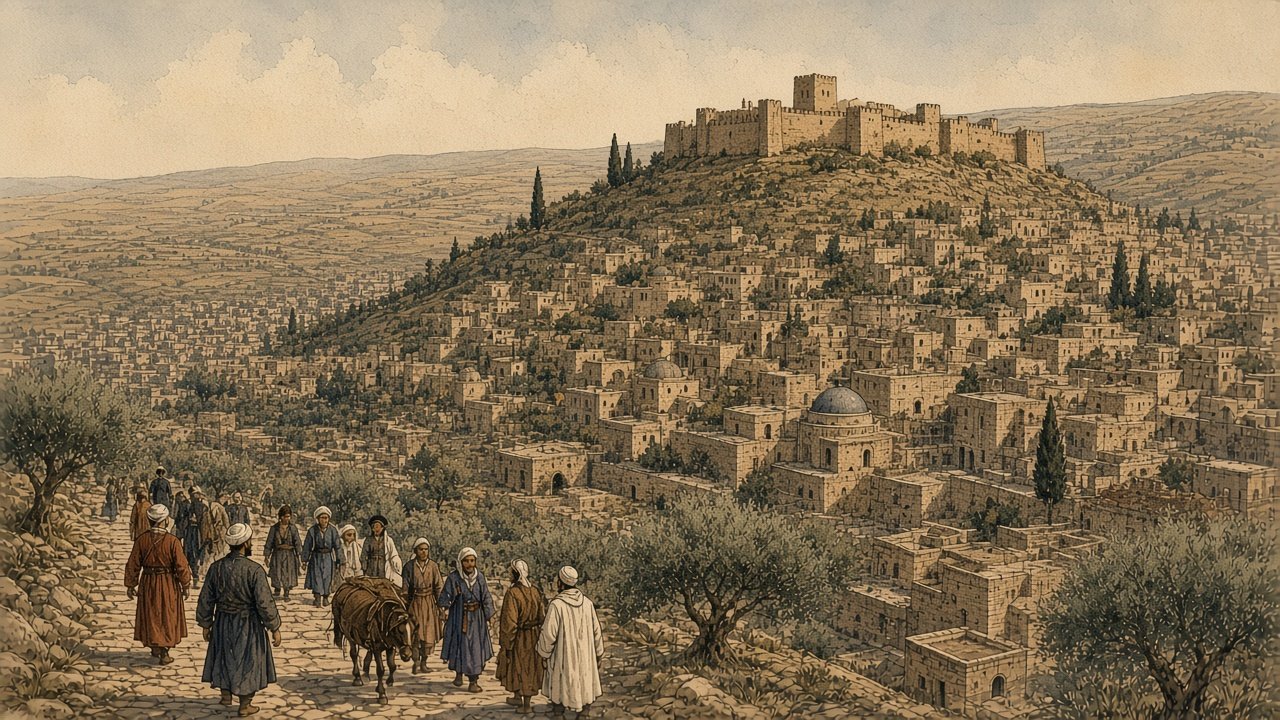
Safed (צְפַת, Tzefat; Arabic صفد, Ṣafad), a mountain town in Upper Galilee, became in the sixteenth century one of the most productive centres of Jewish law, mysticism and printing, and later one of the Four Sacred Cities of the Old Yishuv: a town of looms, of Joseph Karo’s Shulchan Arukh, of the fellowship around Isaac Luria, and, in 1577, of the first Hebrew books printed in the Land of Israel.
 Explore Safed on the interactive scholarship map.
צְפַת (Tzefat)
With Jerusalem, Hebron and Tiberias
Karo, Luria, and the first Hebrew press in the land
Earthquakes of 1759 and 1837; 1929; 1948
I. Prologue
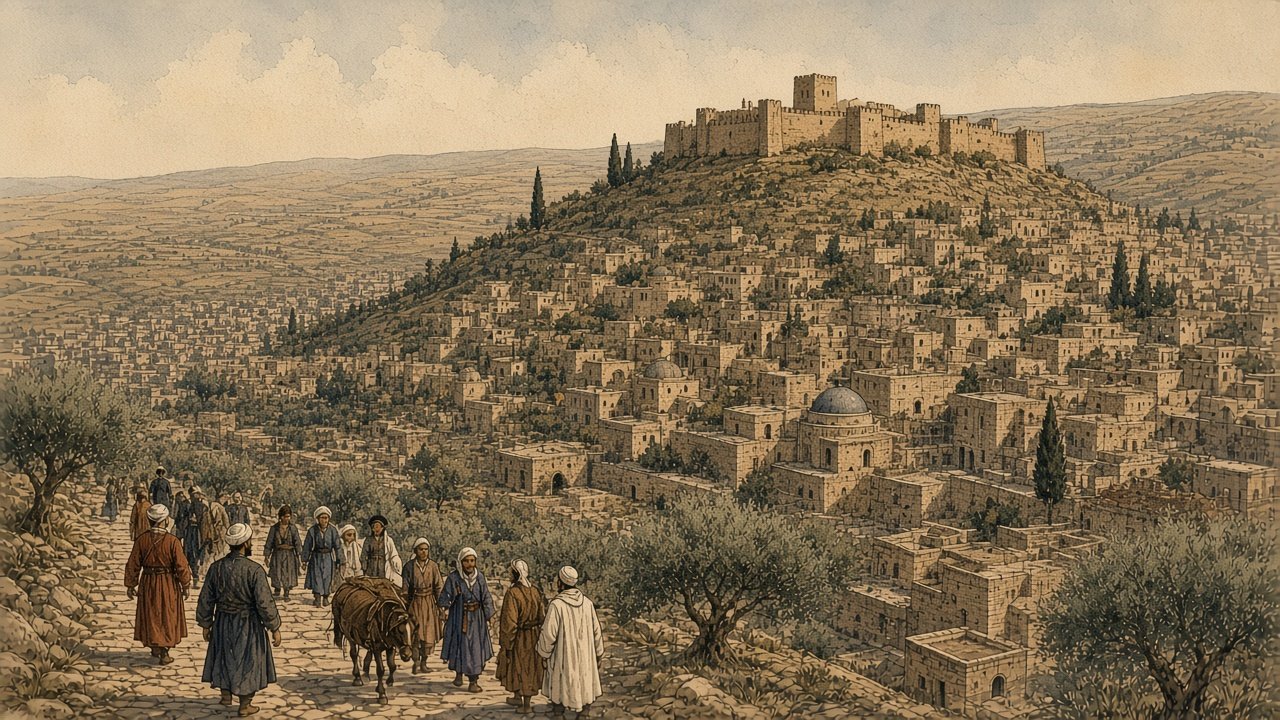
Safed stands on a mountain in Upper Galilee, some 850 metres above the sea, looking west towards the coast and east towards the lake. The Jews who settled there after the expulsion from Spain wrote its name as צְפַת (Tzefat). In Hebrew the root suggests watching or looking out; in Arabic the town is صفد (Ṣafad). It is not named in the Bible. Later tradition numbered it among the Four Sacred Cities of the Land of Israel, with Jerusalem, Hebron and Tiberias.[1]
The heart of this study is a few decades in the sixteenth century, when that hill town became, for a time, one of the most productive Jewish centres in the world. After the expulsion from Spain in 1492, and after the Ottoman conquest of Syria, Palestine and Egypt in 1516, exiles and their children gathered in Safed. They built looms whose cloth was sold as far as Venice. They tried to restore the ancient rite of rabbinic ordination. Joseph Karo completed there the code of law that would travel the Jewish world as the Shulchan Arukh, the Prepared Table. Solomon Alkabetz wrote the Sabbath hymn Lekha Dodi in the same streets. Moses Cordovero and, later, Isaac Luria taught a new kabbalah to a living fellowship of students. In 1577 a wandering printer from Prague issued, in Safed, the first Hebrew book printed in the Land of Israel.[1][2][4][13][14]
The story belongs with the other city studies on this site. The Iberian world those settlers had left is the subject of The Golden Age of Sefarad; their arrival in an Ottoman port is followed in From Sefarad to Salonica, and in the essays on Istanbul and Smyrna. The same sixteenth-century history appears as a long read, The Heights of Safed. What happened on the mountain was shorter than those histories. This page follows that century in full, and then the later earthquakes, the Old Yishuv, the crisis of 1929, the war of 1948, and the artists’ quarter and pilgrimages of the present.
II. The mountain before the boom
The site is old, even if the Jewish town of the sixteenth century was new. The Jerusalem Talmud names Safed as one of the mountaintop points from which fire signals were given, in the late Second Temple period, to announce the New Moon and the festivals. Two liturgical poems for the Ninth of Av, attributed to Eleazar Kallir, mention Safed as a place where priestly families settled after the destruction of the Temple. Josephus, describing the preparations for war with Rome in 66 CE, lists a fortress in Upper Galilee called Sepph; later writers have sometimes identified it with Safed, but the identification is not certain.[1]
Between the talmudic period and the Crusades the history of the town is obscure. It reappears in 1140, under the name Saphet, as a fortress of “very great strength” between Acre and the Sea of Galilee, built by King Fulk of Anjou. Amalric I of Jerusalem handed it to the Knights Templar in 1168. Saladin took it in December 1188; the Ayyubids ordered the dismantling of the fortress in 1220; the Templars recaptured and rebuilt it in 1240. In 1266 it passed to the Mamluk sultan Baybars, who continued to strengthen it. Under the Mamluks Safed became the headquarters of a province that extended over Galilee and the Lebanon. In the sixteenth century the town was still a district capital, the centre of a wide hinterland, not merely a shrine on a hill.[1]
Jewish settlement is attested by Cairo Genizah documents from the first half of the eleventh century. When Benjamin of Tudela visited in 1170 or 1171, however, he stated that no Jews lived there. The community was later revived under Mamluk protection. A scholar named R. Zadok, described as head of an academy of the gaon Jacob, was its most prominent member; genizah documents confirm a community in the thirteenth century, and it is mentioned by Estori ha-Parhi in the early fourteenth. In 1481 the Jews of Safed and of the villages around it were said to number some 300 families. They traded, towards the end of Mamluk rule, in spices, cheese, oil, vegetables and fruit. Refugees from the Spanish expulsion of 1492 strengthened the community even before the change of empire.[1]
The Ottoman conquest of 1516 is the hinge of the story. The new regime, unlike its Mamluk predecessor, encouraged economic development and settlement in the newly conquered provinces of Syria, Palestine and Egypt. For Iberian Jews, still absorbing the shock of expulsion from Spain and the forced conversions in Portugal, that openness offered a place to go. Many came by way of the larger Ottoman ports, above all Salonica and Istanbul, and some by way of Italy. Within a few years Jews of Spanish extraction, many of them clustered in the towns, came to dominate the Jewish communities of the Land of Israel. Safed, which became a centre of the Galilean textile trade, was the most striking case. The mountain had water, a market, and roads towards Damascus and the coast. Those ordinary advantages, as much as any reputation for holiness, help to explain why the boom happened here, and not only in Jerusalem.[4][1]
III. A working town
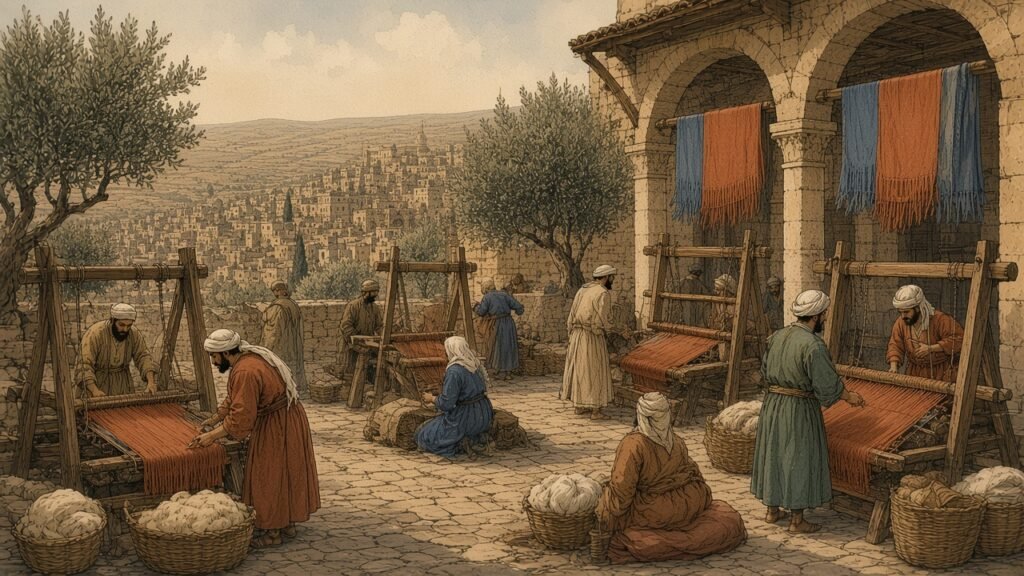
The spiritual reputation of sixteenth-century Safed can hide the fact that it was a place of work. The newcomers established looms, whose products competed with those of Venice. The Jews of the town also traded in the local produce of Galilee: oil, honey, silk and spices. They received Jewish and gentile pilgrims in their homes. The mountain was not a hermitage. It was a market town with a citadel, a district centre, and a community that paid taxes.[1]
The best early description of that working town is the travel diary of Moses Basola, an Italian rabbi who visited the Land of Israel between 1521 and 1523 and wrote a practical guide for later pilgrims and settlers. On Tuesday, 21 Marheshvan 5282 (1522), he was in Safed. He found the bulk of the city on the mountain, with four neighbouring hills: two occupied by Muslims, and two whose slopes were settled by Jews. There were, he wrote, more than three hundred Jewish householders, and three synagogues: one of Sephardim, one of Moriscos, and one of “Westerners,” called the synagogue of Elijah because it was held to be ancient and because a tradition said that Elijah had prayed there. The town was full of grain, grape juice and olive oil, cheap in season, and of fruit, some of it brought from Damascus. If so much oil and produce had not been taken to Damascus and elsewhere, he added, the prices would have been lower still.[11]
Basola was just as interested in trade as in food. The merchandise of the region, as he listed it, included shops for woollen clothing, dry goods and perfumes, and many of those enterprises were in Jewish hands. Dry goods and perfumes were brought from Damascus and sold in the town. When Venetian galleys put in at Beirut to buy clothing and other goods, Jews were regularly out in the villages selling dry goods and other commodities, and they filled their houses with stock. There was profit, he noted, in buying cotton, woven materials, wax and scammony when they were cheap and selling them at the right time. Jews also sold fruit and vegetables, oil and cheese in the market. A man who wished to could trade in grain, grape juice and olive oil all year. In general, Basola thought the region more commercially lucrative than Italy, because Muslims were more willing to buy from Jews than others were. He also visited Ein Zeitim, a village a mile from the town. The picture is of a mountain market tied to Damascus and to the Lebanese coast, not of a closed college of mystics.[11]
The Ottoman tax registers, the defters, allow us to watch that community grow, provided they are read for what they are. They count taxable households and, sometimes, bachelors; they are not a census of souls. Amnon Cohen and Bernard Lewis, working from the registers in Istanbul, found 233 Jewish households in Safed in 1525/26, very close to Basola’s “more than three hundred” householders a few years earlier. Of those 233, 131 were musta‘riba, the older Arabic-speaking Jews of the country; 48 were listed as “Frankish,” a term that in these registers covers European, largely Iberian, Jews; 33 were Maghrebi; and 21 were Portuguese. The native community was still, at that date, the largest single group. The newcomers were already numerous, and they were not all of one kind: Maghrebis, Portuguese former Conversos, and other Western Jews sat in the same town as the musta‘riba congregations Basola had already named.[12][11]
The later registers show how quickly the balance changed. Turkish statistics of 1548, as reported in the Encyclopaedia Judaica, show Safed as the centre of a district of 282 villages. In the town itself there were about 1,900 families of taxpayers, 716 of them Jewish, and 251 single taxpayers, 56 of them Jewish. Cohen and Lewis, reading a register of 1555/56, give 719 Jewish households; by 1567/68 the figure had risen to 945, and a register of 1596/97 still lists 976. By the middle of the century, on any of these counts, Jews formed a large and taxable part of a busy district capital. Safed was by then the largest Jewish centre in the land, larger than Jerusalem in the same registers. The community had eight synagogues, and numbered the town among the Four Sacred Cities, sometimes calling it also Beth-El. Samaritans also lived there in the sixteenth century. The later household totals, still high at the end of the century, will matter when the story of decline is told. A tax register is not the same thing as a description of prosperity.[1][12]
Later in the century the town’s Jews were often distinguished as Sephardim, Ashkenazim and Italians, but the registers and the rabbinic sources are more precise. There were Portuguese as well as Spanish congregations; Maghrebis kept their own identity for a time; musta‘riba Jews remained part of the town even as Judeo-Spanish and other Sephardi usages spread among them, a change encouraged by the demographic and intellectual weight of the Iberian arrivals and by their ties with other Ottoman communities. In the early 1570s a Provençal yeshivah, sponsored by Joseph Karo, is attested in Safed. Many of its members are thought to have come from the region of Avignon after the expulsion of the Jews from there in April 1569. Moses Galante, a Roman-born scholar of whom more will be said below, is recorded as its appointed head. The congregation was still in existence in 1637. A town that could absorb a Provençal house of study, alongside Spanish, Portuguese, Maghrebi, Italian and musta‘riba congregations, was a node in a Mediterranean network, not a provincial backwater.[1][25][18][12]
Those networks ran through people as well as through cloth. Scholars and merchants came from Salonica, Istanbul, Damascus, Cairo, Rome and the ports of Italy. Karo and Moses Alshekh had both studied in the Ottoman Balkans before they settled on the mountain. Eliezer ben Isaac, the printer of 1577, reached Safed by way of Lublin and Constantinople. The Shulchan Arukh would be printed in Venice; Cordovero’s systematic kabbalah would later be printed in Kraków and abridged in Venice. Venetian galleys at Beirut, already visible in Basola’s diary, and the competition of Safed cloth with Venetian cloth, kept the town in a commercial conversation with the same city that printed its law. The mountain looked out on Galilee, but its books, its wool and its people travelled much further.[11][4][2][6][15][17]
The human mixture mattered for what was written and taught. Iberian exiles brought legal learning, mercantile skills and a memory of catastrophe. Maghrebi and Italian Jews added their own rites and connections. Ashkenazim were already present. The result was not a single “Safed rite” imposed from above, but a town in which different congregations lived within walking distance of one another, under Ottoman rule, and in which a scholar could be a spice dealer as well as a contemplative. That combination — a working economy, a gathering of exiles, and a sense that the land itself might be on the edge of redemption — is the setting for everything that follows.[1][3][4]
The prosperity did not last into the next century on the same terms. The tax registers, as we have seen, still show a large Jewish household count at the end of the sixteenth century. The schools, at the beginning of the seventeenth, were still full. But the textile trade that had underwritten the boom did not remain the mainstay it had been, and the quality of Ottoman administration, in the standard account, declined. The later part of that story belongs with the press and the long silence after it, in the last section of this essay. The point for the mid-sixteenth century is simpler. The learning of Safed was paid for, in the first instance, by cloth, oil and the trade of a mountain market.[1][4]
IV. The attempt to restore ordination
The most ambitious institutional project of the Safed scholars was the attempt, in 1538, to restore סְמִיכָה (semikhah), the ancient form of rabbinic ordination that had lapsed centuries before. The driving figure was Jacob Berab (also written Beirav), a halakhic authority and communal leader in Palestine, Egypt and Syria in the first half of the sixteenth century. He was born around 1474 at Maqueda, near Toledo, and went to Morocco after the expulsion of 1492. By his own account he was only eighteen when he was appointed rabbi of Fez. Business then took him to Egypt, to Jerusalem and Safed, and to Aleppo and Damascus. He taught as he travelled, gathered pupils, and was not shy of asserting his authority over scholars who would not submit to it.[7]
Berab was also caught up in the messianic current of the early sixteenth century, which drew in part on intensive study of the Kabbalah. He gave that anticipation a practical form. Maimonides had ruled that if all the sages of the Land of Israel unanimously agreed to appoint and ordain judges, the new ordinands would possess the authority of the original ordained judges, and that a great court would be established before the coming of the Messiah. Berab conceived the idea of renewing semikhah while still in Egypt. As the Palestinian settlement strengthened and the number of scholars grew, Safed became the seat of the project. He had been living in the town periodically from at least 1524. In 1538 he won over the scholars there, including Joseph Karo and Moses di Trani (Moses of Trani). According to the account in the Encyclopaedia Judaica, some twenty-five rabbis convened and designated Berab as the first samukh, the first newly ordained rabbi.[7][8]
The stakes were practical as well as symbolic. Berab hoped that a restored semikhah might unify scattered communities and, in time, re-establish a Sanhedrin. An ordained court, on the view he adopted from Maimonides, would again be competent to judge cases involving fines, and to order the flagellation that the law required as atonement for certain sins — a point of particular importance for former Conversos seeking a recognised path back into Jewish life. Those hopes help to explain why the project mattered so much in a town full of Iberian exiles, and why its failure was more than a technical dispute about a medieval ruling. They also help to explain why the opposition, when it came, was so determined. To restore ordination was to claim a kind of jurisdiction that Jerusalem, as well as Safed, might think it had a right to share, or to refuse.[8][7]
The principal opponent was Levi ibn Habib, known by the acronym Ralbah, rabbi in Jerusalem and, by then, a scholar of established reputation. He was born in Zamora, in Spain, around 1483, and in 1492 was taken to Portugal by his father, Jacob ibn Habib, the author of the Ein Ya‘akov. There he was forcibly baptised. Father and son escaped to Salonica, where Levi received his education and later succeeded his father as teacher of the congregation of Spanish exiles known as Gerush Sefarad. He became known as a talmudist who preferred the plain sense of the sources to casuistry. In order, as the sources put it, to atone for his baptism as a youth, he went to the Land of Israel, travelling by way of Asia Minor, Aleppo and Damascus. He first settled in Safed and later moved to Jerusalem, where he officiated as rabbi for fifteen years.[20]
A messenger was then sent to Ibn Habib in Jerusalem, asking him to consent to the renewal and to accept ordination from Berab. He refused. He and Berab already had a history of disputes. He opposed the decision of the Safed rabbis on halakhic grounds, and argued that Maimonides’ statement was an opinion, later retracted, rather than a binding ruling. He also accused Berab of disgracing the honour of Jerusalem. The point was not only legal. As the Encyclopaedia Judaica notes, the act was of great significance because, in a common view, the ordination was to be re-established only in messianic times, and because it also marked the supremacy of the Safed rabbis. A town that had grown rich on wool was now claiming an authority that the older holy city would not concede.[20][7][8]
The protests delayed the project. Discussions between the rabbis of the two towns had been under way for three months when Berab was forced by the Ottoman authorities to leave Palestine. The immediate cause appears to have been a private affair in which his enemies denounced him in Safed. Because, under the law as he understood it, semikhah could not be given outside the land, he feared that the whole plan would collapse if he could not return. Before leaving he ordained four rabbis of Safed, among them Karo and Moses di Trani. Ibn Habib, taking this as a disregard of his protests, then opposed the ordination in public. He set out his legal case in a treatise, the Kunteres ha-Semikhah (“Pamphlet Concerning Ordination”), later printed as an appendix, under the title Semikhat Zekenim o Kunteres ha-Semikhah, at the end of his responsa, issued in Venice in 1565. The dispute, in other words, entered print in the same Venetian world that would soon print Karo’s code.[7][8][6][20]
From Damascus, Berab conducted the argument vigorously, and the dispute became personal on both sides. Later historians have read Ibn Habib’s opposition in more than one way: as a strictly halakhic objection, as a fear that Berab’s project might encourage messianic speculation, and as a reluctance to “hasten” redemption by human institution rather than wait for divine initiative. Jacob Katz, in a study published in 1950–51, treated the controversy as a window onto the religious and communal politics of the generation after the expulsion. The sources do not require us to choose a single motive. What is clear is that Jerusalem did not consent, and that without that consent the Safed ordination could not become the institution Berab had imagined.[8][20]
After Berab’s departure, about three months after the renewal of semikhah, Karo was regarded as the leader of the scholars of Safed. He was one of the four ordained in 1538, but he did not treat the ordination as fully authoritative. In his legal works he laid it down that “nowadays we have no ordained dayyanim.” The bet din of Safed which he headed based its authority on the fact that it was “recognized by the public and was great in wisdom and numbers,” not on the restored chain of ordination. A later chain is recorded — Karo ordained Moses Alshekh, who later ordained Hayyim Vital — but the institution itself gradually languished. The Sanhedrin was not re-established. What remained was a memory of the attempt, a bitter correspondence, and a town whose leading jurist had chosen to ground his court in public recognition rather than in a disputed revival.[6][7][8][17]
V. A prepared table
Joseph ben Ephraim Karo (also written Caro) was born in Spain in 1488. His family left after the expulsion of 1492 and settled in the Ottoman Empire. For a time he headed a rabbinical academy in Nicopolis. He began his great work, the Beit Yosef (House of Joseph), in 1522, at the age of thirty-four, in Adrianople, and worked on it for twenty years, completing it in Safed in 1542. He had settled in the town in 1536, after time in Turkey and, it seems, a stay in Egypt. Whether he studied under Berab in Egypt or in Safed is uncertain; that he was among Berab’s ordinands in 1538 is not. Before he reached the mountain he had already been in contact, at Nicopolis and Adrianople, with the kabbalist and poet Solomon Alkabetz. Alkabetz records that, while the two of them were studying the Torah on the night of Shavuot, a maggid appeared to Karo, and that they therefore established the custom of staying awake that night to study. The custom, later widespread, is known as Tikkun Leil Shavuot. The lawyer who would write the Prepared Table was already, in the Ottoman Balkans, a man who listened for a heavenly voice.[6][13][21]
The problem Karo set himself was practical. By the early sixteenth century a Jew who wanted to know the law faced a bewildering variety of codes and local customs. Different communities relied on different authorities, and many codes gave rulings without a thorough investigation of the sources or of opposing views. In the introduction to the Beit Yosef Karo described his aim: to follow every law from its source in the Talmud, to trace its development, to set out the divergent views, and only then to arrive at a ruling. The first volume was not published until 1555. The work is enormous, and it was not meant to be read quickly.[6]
The Beit Yosef is a book of sources as well as of decisions. Karo’s method was to begin with the Talmud, to follow each law through the medieval codes and the later authorities, and to record disagreement before he ruled. It was a response to the disorder of a people now living under many skies, in many customs, after the rupture of 1492. The first volume appeared in print in 1555, more than a decade after the manuscript was finished. In Safed itself Karo’s authority was not uncontested: the sources record many halakhic differences between him and Moses di Trani, his fellow ordinand and contemporary. A town that could house two such jurists was not a court with a single voice. It was a place of argument, which is one reason it could produce a code meant to be used everywhere.[6]
The book that travelled was the abridgement. The Shulchan Arukh (Prepared Table), printed in Venice in 1565, reduced the Beit Yosef to a clear statement of the law, without the full apparatus of argument. It met opposition on principle, notably from Solomon Luria, and it was not accepted overnight. What made it usable across the Jewish world was the work of a scholar who never lived in Safed. Moses Isserles of Kraków, who admired Karo, first wrote his Darkhei Moshe to adjust the Beit Yosef to the halakhah of Ashkenazi Jewry. He then added to the “table” a set of glosses which he called the Mappah, the Tablecloth. Where Karo’s ruling differed from Ashkenazi practice, Isserles recorded the law or custom of those communities, often with the words “our minhag is” or “thus is the minhag.” As a result, the Shulchan Arukh as supplemented by Isserles could be used by Ashkenazim, while Karo’s text remained acceptable to Sephardim. The prepared table, made in Safed and spread by the presses of Italy and Poland, became the standard code of Jewish law.[6][10]
Karo was not only a codifier. After Berab left Safed he was the leading scholar of the town, his name appearing first on documents of the bet din and on rulings issued by its sages. He also kept a mystical diary. Of the larger Sefer ha-Maggid only a fragment has survived, published under the title Maggid Mesharim (or Maggid Meisharim). In it a heavenly mentor, a maggid Karo took to be the Shekhinah in the form of the Mishnah personified, spoke to him. To bring about the appearance of the voice he would study mishnayot. The maggid spoke while he was awake, often just as he awoke; it guided him in his wanderings in Turkey and towards the Land of Israel, and it stimulated him to write his legal works. The revelations do not present a new kabbalistic system. They are a major source for the state of the Kabbalah after the expulsion from Spain and before the teachings associated with Isaac Luria, and they show that the author of the Prepared Table was also a mystic of the Safed school. The standard modern study of that double life is R. J. Zwi Werblowsky’s Joseph Karo: Lawyer and Mystic (Oxford, 1962).[6][21][9]
Around Karo there gathered a court and a circle of teachers whose names would outlive the decade. Moses Alshekh, born in Adrianople, had studied in Salonica under Joseph Taitazak and under Karo himself, and then settled in Safed, where he became known as a halakhic authority, a teacher in two talmudic academies, and a preacher. He sat on Karo’s rabbinical court and received from him the full ordination that Berab had reintroduced. In 1590, in his turn, Alshekh ordained Hayyim Vital, who had been his disciple in exoteric study. His principal field was law, but, asked to preach on Sabbaths, he turned his sermons into commentaries on most of the books of the Bible. Several appeared in his lifetime, beginning with Havatzalet ha-Sharon on Daniel, printed in Constantinople in 1563 and later in Venice. After his death his son Hayyim issued in Venice the remaining commentaries, on the Pentateuch, the Five Scrolls, Job, the Prophets and the Psalms, together with a volume of responsa. The commentaries, which proceed by raising difficulties and then answering them, and which weave rabbinic aggadah with kabbalistic elaborations, became widely popular and were often reprinted. Alshekh also studied Kabbalah. According to one tradition, Luria sought to dissuade him from pursuing those studies. About 1590 he visited Jewish communities in Syria and Turkey, and perhaps also in Persia, in the interests of Safed Jewry, and he sent an appeal on the community’s behalf to Italy and other countries. The last notice of him is from Damascus, where he sat on a rabbinical court in the spring of 1593 and died soon after, at a great age. His career is a reminder that Safed’s learning was not only a matter of codes and fellowships. It was also a matter of sermons, of emissaries, and of books printed in Constantinople and Venice for readers who would never see the mountain.[17]
The Galante brothers, Moses and Abraham ben Mordecai, belonged to the same generation, and to the same traffic between Italy and Galilee. They were born in Rome and settled in Safed. Moses was ordained by Karo at the age of twenty-two and studied Kabbalah under Moses Cordovero. From 1580 he served as av bet din in Safed, in succession to Moses di Trani. He lived to be more than ninety and appears to have died after 1612. His published work includes responsa issued in part at Venice in 1608; an index to biblical passages in the Zohar, printed incomplete at Venice in 1566; and Kohelet Ya‘akov, a commentary on Ecclesiastes, printed at the Safed press in 1578. Abraham, a pupil of his brother and of Cordovero, was known as a modest hasid and received the title ha-kadosh, “the saint.” He was the first to cite Karo’s Maggid Mesharim. His own works include a commentary on the Zohar later abridged by Abraham Azulai, and Kinat Setarim on Lamentations, published at Venice in 1589. H. J. D. Azulai relates that Abraham built the courtyard at Meron around the graves of Simeon bar Yohai and his son Eleazar. The brothers typify something characteristic of the town: Italian origin, legal and kabbalistic study in the same household, a book issued by the local press, and other books sent out to be printed in Venice.[18][19][21]
Karo died in Safed in 1575. By then the code was already in print, and the court he had headed was already a school for men such as Alshekh and Galante. The town that had given the Prepared Table a home would soon give it a press as well, though not in Karo’s lifetime, and not for the code itself, which had already found its printers in Italy. The Shulchan Arukh did not stay on the mountain. It went out, with Isserles’ tablecloth, to become the reference of a scattered people.[6][10]
VI. The fellowship of the Ari
Before Isaac Luria arrived, Safed already had a kabbalistic life of unusual density. The central figure of that earlier generation was Solomon ben Moses ha-Levi Alkabetz (also written Alkabez), a kabbalist and mystical poet born around 1505, and the composer of the Sabbath hymn Lekha Dodi. In 1529 he decided to settle in the Land of Israel. On the way he stayed in Adrianople, where a group of kabbalist ascetics asked him to instruct them, and at Nicopolis he was probably in contact with Karo, who valued his knowledge of Kabbalah. The Shavuot night already mentioned, and the custom of Tikkun Leil Shavuot that followed it, belong to that journey. Alkabetz probably arrived in Safed in 1535. Very little is known of his life there. His signature on rulings and documents is rarer than that of any other important Safed scholar, and nothing is known of his attitude to Luria. He seems to have headed a yeshivah at Meron and almost certainly officiated as a rabbi in the town. He was a prolific author of biblical and kabbalistic works; many of his manuscripts were stolen after his death, and none of his purely kabbalistic books was printed or preserved in manuscript. Samuel de Uceda, Eleazar Azikri, Abraham Galante and others heard him preach and quoted from his sermons.[13][14]
Alkabetz, in order to understand the secrets of the Zohar, used to go out with his students to pray and meditate at the graves of the righteous. The practice was called gerushin, “banishment.” During those peregrinations the group sought to rouse their contemplative powers spontaneously, without previous preparation. It was a piety of the Galilean landscape, and it left a mark on the later fellowship of the Ari, which also made communion with the dead a part of its work. Alkabetz’s best-known disciple was Moses Cordovero, who married Alkabetz’s sister. In time, it seems, the teacher became the student. That reversal is visible in Alkabetz’s surviving introduction to the doctrine of Kabbalah, a work whose structure resembles Cordovero’s Pardes Rimonim and whose opinions are generally the same, though Alkabetz took a more extreme view of the Sefirot as the essence of God and moved towards a stronger sense of divine immanence.[13][15]
The hymn by which Alkabetz is now most widely known is later than those journeys and earlier than most of the printed liturgy in which it appears. Lekha Dodi, “Come, my friend,” consists of nine stanzas; the initial letters of the first eight form the acrostic of the author’s name, Solomon ha-Levi. The opening line, which is also the refrain, is: “Come, my friend, to meet the bride; let us welcome the presence of the Sabbath.” The poem was inspired by talmudic accounts of scholars who went out to honour and welcome the Sabbath, likened to a princess or a bride, and it reflects the practice of the Safed kabbalists, who on Friday afternoons went into the fields to meet “Queen Sabbath” in meditation and song. It also reflects the kabbalistic identification of the Sabbath with the Shekhinah, and it carries messianic motives that echo the older association of redemption with Sabbath observance. Among the latest piyyutim to be taken into the prayer book, it became one of the best loved hymns in both the Ashkenazi and the Sephardi rites. It is sung after the psalms with which the Sabbath eve service begins in Ashkenazi synagogues; at the last stanza the congregation turns to face the entrance and bows, welcoming the Sabbath bride. The hymn has been translated into most European languages; among the best-known versions are those of J. G. Herder and Heinrich Heine, who in “Prinzessin Sabbat” mistakenly ascribed it to Judah Halevi. A contemporary of Alkabetz, Moses ibn Machir, head of the yeshivah at Ein Zeitun near Safed, composed another version, printed in his Seder ha-Yom at Venice in 1599. The hymn grew out of a local practice, and it travelled because that practice could be replayed, in a more modest form, in any synagogue.[14]
Moses ben Jacob Cordovero (1522–1570) was the outstanding kabbalist in Safed before Luria, and Luria’s teacher. His birthplace is unknown; his name points to a family of Spanish origin. He was a disciple of Karo as well as of Alkabetz. His first large systematic work, Pardes Rimonim (The Pomegranate Orchard), was completed by the time he was twenty-seven, so by about 1548 or 1549. Ten years later he finished his second systematic book, the Elimah Rabbati, and he also wrote a long commentary on the Zohar, preserved in manuscript in Modena. Pardes Rimonim summarises and develops earlier trends in Kabbalah and constructs a speculative system. Cordovero tried to hold together the idea of a transcendent God, drawn in part from medieval philosophy, with the personal God of the Sefirot. The Sefirot, in his compromise, are at once substance and vessels: instruments with which God acts in the world, and vessels containing the divine substance that permeates them. The book was printed in Kraków in 1592. Two abridgements followed in Venice, in 1600 and 1601. Cordovero also wrote Tomer Devorah (The Palm Tree of Deborah), printed in Venice in 1589, which laid foundations for a kabbalistic ethical literature that proliferated in the following two centuries. In short chapters it instructed every Jew in the way to come close, and to identify spiritually, with each of the ten Sefirot. The systematic kabbalah of Safed, like its legal code, was already on the road to the European presses before Luria’s disciples had finished writing down what they had heard.[15]
Isaac Luria is the name around which later memory of Safed most often gathers. He was born in 1534 and died in 1572, and he is known in Hebrew as the Ari, a title later read as “the Lion” and also as an acronym. For all his later influence, he spent only a short time in the town, arriving from Egypt towards the end of his life and teaching there until his death in the summer of 1572. Lawrence Fine’s Physician of the Soul, Healer of the Cosmos, the first scholarly monograph on Luria in English, begins with that earlier life in Egypt, where he was a rabbinical scholar, a spice dealer and a contemplative ascetic, and only then turns to the Safed years. The book’s premise is that Lurianic Kabbalah was first of all a lived practice in a particular social world: a teacher and a group of disciples, not only a set of doctrines.[3][1]
Fine then follows, in turn, the myth Luria taught; the idea of the teacher as a physician of souls; the work of tiqqun, or repair, through the performance of the commandments and through devotional prayer; the practice of yiḥudim, acts of communion with the “very special dead”; and the place of metempsychosis, fellowship and messianic redemption in the life of the group. The chapter titles are a map of a practice, not only of a theology. To study Luria only as a system of symbols is, on this reading, to miss the streets in which the system was lived. Fine’s chapter on pre-Lurianic Safed describes a community that was already lamenting exile and striving for redemption, and that already had a language of saintliness, heavenly communication and contemplative practice. Luria inherited that world; he did not invent it. His distinctive teaching, as later recorded by disciples, concerned the repair of a broken cosmos through the commandments, through prayer, and through practices of communion with the dead. The details of that myth and those rites are a subject in their own right. What matters here is that they were taught in a small fellowship, in a town of looms and courts, to men who also lived under Ottoman law and prayed from the same printed and manuscript books as other Jews.[3][1]
The man who did most to write that teaching down was Hayyim Vital (1542–1620), one of the greatest kabbalists of the following generation and Luria’s principal disciple. He was born in the Land of Israel, apparently in Safed. His father, Joseph Vital Calabrese, was a well-known scribe in the town; the surname points to an origin in Calabria. Vital studied in the yeshivot of Safed, especially under Moses Alshekh, his teacher in exoteric subjects. In 1564 he began to study Kabbalah, at first according to Cordovero’s system, though he did not call Cordovero his teacher. He also spent two years, from 1563 to 1565, in the practice of alchemy, which he later regretted. After Luria’s arrival he studied under him for nearly two years, until Luria’s death. He then began to arrange Luria’s teachings in writing and to elaborate them according to his own understanding. He tried to prevent Luria’s other disciples from presenting their versions in writing, and he gathered around him several who accepted his spiritual authority, but he did not entirely succeed in becoming the sole heir and interpreter of the legacy. In 1575 twelve of Luria’s disciples signed a pledge to study Luria’s theory only from Vital, not to induce him to reveal more than he wished, and to keep the mysteries secret from others. The group ceased to function when Vital moved to Jerusalem, where he served as rabbi and head of a yeshivah from late 1577 to late 1585, and where he wrote the last version of his presentation of the Lurianic system. He returned to Safed early in 1586 and stayed until 1592. According to a tradition recorded in a letter of Shlomel Dreznitz written in 1606, he fell seriously ill in Safed around 1587; during a long period of unconsciousness the scholars of the town are said to have obtained some 600 pages of his writings, which were then circulated among a select group.[16][17]
Vital later settled in Damascus. There, mainly between 1609 and 1612, he assembled autobiographical notes which he called Sefer ha-Hezyonot, a mixture of testimonies, dreams and stories, preserved in his own handwriting and now an important source for his life. He was married at least three times; his youngest son, Samuel, inherited his writings. He died in 1620. According to Samuel, Vital assembled his major writings into two vast works, Etz Hayyim and Etz ha-Da‘at. The former is the inclusive name for the writings in which he elaborated Luria’s teaching. He began to arrange what he had heard immediately after Luria’s death and, according to Meir Poppers, remained absorbed in the task for more than twenty years. The first edition of Etz Hayyim was organised into eight “gates,” covering Luria’s own surviving writings, the doctrine of emanation, commentaries on the Zohar, the Bible and the commandments, meditations on prayer, acts of “unification” (yiḥudim), and the transmigration of souls. That first version remained in Damascus with Samuel, who for many years did not permit it to be copied. He himself re-edited the Shemonah She‘arim, the Eight Gates, and this version was widely circulated from around 1660. Middle Eastern kabbalists, especially in Palestine, considered it the most authoritative form of Lurianic Kabbalah. For two centuries it circulated in manuscript only; it was finally printed, in seven volumes, in Jerusalem between 1863 and 1898.[16]
Other recensions travelled sooner. Copies that had circulated among kabbalists in Palestine during Vital’s lifetime were assembled around 1620 into a three-volume edition, and it was in this form that the writings first reached other countries. Meir Poppers later produced a comprehensive edition, said to have been completed in 1653. The book that came to be called Etz Hayyim in print was issued at Korets in 1782. Lurianic teaching also reached Italy in the middle of the seventeenth century in more than one recension, including writings associated with Israel Sarug, some of which were later erroneously attributed to Vital. The later printed corpus is a literary afterlife of conversations held in Safed in the early 1570s, filtered through Vital’s writing, his son’s editorial work, manuscript circulation, and later printers. Vital also wrote ethical tracts, of which the most important, Sha‘arei Kedushah, was first published in Constantinople in 1734.[16][3]
Luria’s time in the town was short, and his teaching was not at first a public curriculum. It was handed on in a circle, and then in writing, above all by Vital. Schechter, writing a century ago, already treated the jurists and the mystics as a single historical phenomenon. Fine’s study gave that insight a social history: who sat with whom, what authority looked like in practice, and how a teacher and his students understood their work together. The teachings later travelled far beyond Galilee and would shape much of later Jewish mysticism, including currents that fed both later Kabbalah and Hasidism. That afterlife is not the same thing as the few years of the fellowship itself. The Ari of later legend is a cosmic teacher. The Luria of 1570s Safed was a man among students, in a town that was already famous for its lawyers and its mystics.[3][5]
Solomon Schechter, in a long essay of 1908, already saw the two sides together. He called sixteenth-century Safed “a city of legists and mystics.” The phrase still holds. Karo and Luria, the Prepared Table and the fellowship of the Ari, were not two towns. They were neighbours. Some of the same men moved in both worlds. Alkabetz’s hymn, Cordovero’s orchard of pomegranates, Vital’s eight gates, and the court of Joseph Karo belonged to a single generation on a single mountain. The peculiar intensity of Safed in these decades comes from that proximity: a market town on a hill, full of exiles, which produced in the same generation a code that organised daily law, a hymn that welcomed the Sabbath in almost every rite, and a teaching that sought to mend the universe.[5][14][15]
VII. Type in the Holy Land, and after
Hebrew printing had been established in the Ottoman Empire since the 1490s, in Istanbul and later in other cities; the story of those first presses is told in the essays on Kushta and Smyrna, and, over a longer span, in Five Centuries of Jewish Printing and Publishing. Safed came late, and only briefly, to that history. The man who brought the press was Eliezer ben Isaac Ashkenazi, a printer born in Prague, who had worked in Lublin from 1557 to 1573, issuing among other books talmudic tractates with the approval of the Councils of the Lands. An epidemic forced him, for a time, to move the press to Końska Wola, near Lublin. In the 1570s he sold his materials and set out, with typographic equipment, for Constantinople. There, apparently in 1574, he formed a partnership with David ben Elijah Kashti. They printed a volume of geonic responsa and began a Romaniot festival prayer book; the partnership broke up before the prayer book was finished. Eliezer alone then issued Baruch ibn Ya‘ish’s Mekor Barukh in 1576. The same year, or early the next, he went on to Safed.[2][1][22]
There he entered into partnership with Abraham ben Isaac Ashkenazi, a resident of the town who provided the funds. Eliezer had already met him, it seems, in Constantinople. Between them they established the first printing press in the Land of Israel, and, as the Encyclopaedia Judaica notes, the first in the Orient. They felt sure, later writers have said, that Jews the world over would want holy books printed in the Holy Land. What they produced was more modest, and more local, than that hope. Six books, all by authors connected with Safed, appeared in two short campaigns, three in 1577–79 and three in 1587.[2][22][23]
The first book, completed on the fourth day of Tishri 5338 (1577), was Lekah Tov, a commentary on the Book of Esther by Yom Tov Zahalon (1559–after 1638), a young Safed scholar who later served as an emissary of the community to Italy, Holland, Egypt and Turkey. In his introduction Zahalon expressed his delight that a press had been founded in the Holy City of the Holy Land, and urged authors to have their works printed there. The final page of the volume, in the copy held by the Library of Congress, bears a woodcut of the Temple, copied from the printer’s mark used by Marco Giustiniani in Venice between 1545 and 1552, with the legend from Haggai, “Great will be the glory of this house.” Even the first book printed in the land carried, in its ornament, a memory of the Venetian press. The second book, issued in 1578, was Moses Galante’s Kohelet Ya‘akov, already mentioned, a commentary on Ecclesiastes. The third, issued in 1579, was Sar Shalom, a commentary on the Song of Songs by Samuel Aripul (also written Aripol), a preacher who worked between Safed and Salonica. After the third book, Abraham Ashkenazi may have been the man of that name who became an emissary of the Tiberias yeshivah to Yemen, selling books as he went, and the shop suspended operations. Eliezer returned to Constantinople, where, once more with Kashti, he printed Samuel Aripul’s Lev Hakham, a commentary on Ecclesiastes, in 1586.[2][22][23][18]
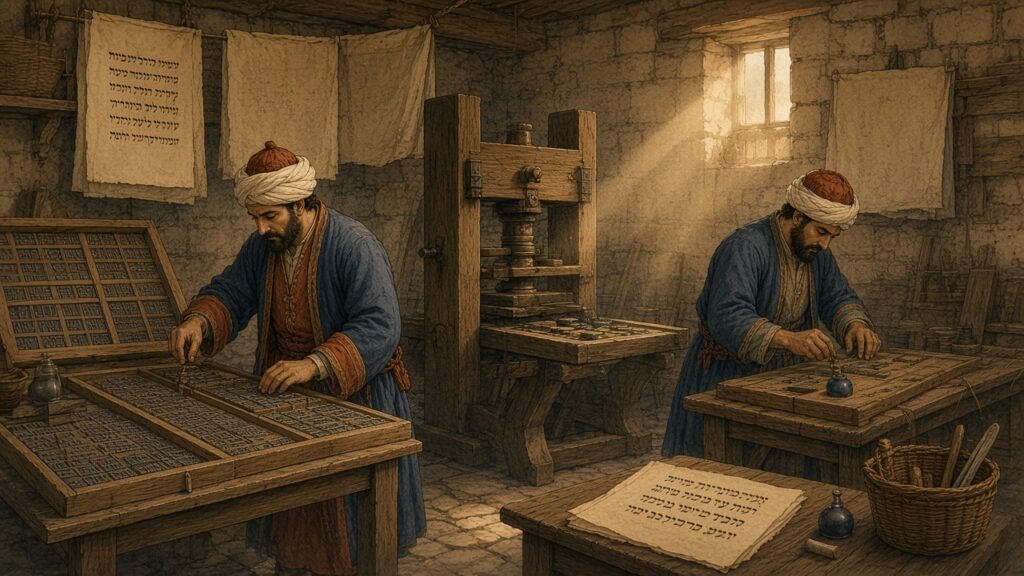
In 1587 Eliezer was in Safed again, once more with Abraham Ashkenazi, and printed three further books. Two were by Israel Najara (c. 1555–1625?), the Hebrew poet, born apparently in Damascus, where he had served as secretary of the community in which his father was rabbi. Zemirot Yisrael, issued in Safed that year, contained 109 poems; later editions at Salonica in 1594 and, much enlarged, at Venice in 1599–1600 carried the collection far beyond Galilee. Some of Najara’s hymns entered the liturgy; Ashkenazi communities adopted his Aramaic Sabbath song Yah Ribbon Olam ve-Alemayya. The second Safed volume, Mesaheket ba-Tevel, was a work of moral instruction. Not all of his contemporaries admired him: Hayyim Vital and Menahem Lonzano spoke disparagingly of his unconventional conduct and of his imitation of foreign poetic styles and melodies. The third book of 1587 was the Baraita de-Rabbi Eliezer, issued together with Midrash Agur and prepared for the press by Lonzano. Eliezer appears to have died soon after, possibly in an epidemic around 1587 or 1588. Six books, in two short campaigns, were the whole of the first Hebrew press in the land.[24][22][2]
Zahalon’s hope that authors would bring their works to the new press was not fulfilled. Many of the most prominent writers then living in Safed chose to publish abroad, perhaps in order to ensure that their books would be distributed throughout the Jewish world. After 1587 there was a long silence. No Hebrew book was published in the Land of Israel for some two and a half centuries, until Israel Bak of Berdichev settled in Safed in 1832 and issued a handful of works before, and briefly after, the earthquake of 1837, then transferred his press to Jerusalem. Later nineteenth- and early-twentieth-century presses in Safed belong to that later history. The sixteenth-century workshop remains a first: a few books, set in type brought from Lublin and Constantinople, paid for by a local partner, written by men of the town, and ornamented, in at least one case, with a mark borrowed from Venice.[1][2][22][23]
By then the great generation was already thinning. Cordovero had died in 1570, Luria in 1572, Karo in 1575. Alshekh was still travelling on the community’s behalf around 1590. Vital was writing in Jerusalem and then again in Safed. The looms and the courts continued for a time, and, as the registers show, the number of Jewish households recorded in 1596/97 was still very high. The conditions that had made the town a magnet — a relatively open Ottoman regime, a wave of Iberian settlement, a prosperous textile trade — were not, however, permanent. Abraham David and others have related the later deterioration of the community’s economic situation to the decline of the local textile industry. As the quality of Ottoman administration declined in the seventeenth century, so, in the standard account, did the material condition of the Jewish community. The decline was not immediate in the schools: at the beginning of the seventeenth century the same account records 300 rabbinical scholars, 18 schools, 21 synagogues and a large yeshivah, even as taxes were high and 1,200 poor lived on charity. By 1695/96 only 20 Jews paid the poll tax. The later earthquakes, immigrations and modern history of the town are told in the sections that follow. The boom of the mid-sixteenth century was real, and it ended not in a single catastrophe but in a long loss of economic and demographic weight, through which the schools shone for a time after the looms had begun to fail.[1][4][12]
What Safed sent out lasted longer than the boom itself. The Shulchan Arukh, with Isserles’ glosses, organised Jewish legal life from Fez to Kraków and beyond. Lekha Dodi entered almost every rite and was translated by European poets. Cordovero’s Tomer Devorah helped to shape a kabbalistic ethics that later moralists could teach to readers who would never open Pardes Rimonim. Lurianic teaching, written down by Vital and copied for decades before it was printed, entered the bloodstream of later mysticism and, in the eighteenth century, was one of the sources on which Hasidism drew. The idea of the town as a holy city, one of four, remained part of the map of the Old Yishuv. Even the failed semikhah left a record of how seriously the scholars of 1538 took the possibility of restoring a court for a people in exile. The hymn, the code, the ethical tract and the eight gates outlived the tax registers that once counted the households on the hill.[10][14][15][3][16][8]
Something of that century is still pointed out in the town’s fabric, though later disasters have intervened. Safed still contains six old synagogues, among them the Ari synagogue associated with Isaac Luria, which belongs to the Sephardi community and consists of two vaulted rooms with a courtyard, and is dated to the sixteenth century; another synagogue of Luria, belonging to the Ashkenazim, was renewed after the earthquake of 1837. Other well-known synagogues bear the names of Yose ha-Bannai, Joseph Karo and Isaac Aboab. The stones have been repaired, and in some cases rebuilt. They are not an untouched sixteenth-century street. They are what a later town chose to keep of the names of that generation.[1]
The mountain is still there, and the town is still called Safed. The sixteenth century is only one of its ages, and not the last. The earthquakes of 1759 and 1837, the Hasidic and Perushim immigrations, the riots of 1929, the war of 1948, and the artists’ quarter and pilgrimages of more recent times, are taken up in the sections that follow. The height that matters in this essay is not only the altitude. It is the brief period in which a working town on a Galilee hill became, for the Jewish world, a prepared table and a workshop of repair.
VIII. Decline, earthquake, and the Old Yishuv
As Ottoman administration weakened in the seventeenth century, the material condition of the Jewish community declined. The schools did not empty at once: at the beginning of the century there were still hundreds of scholars, many synagogues and a large yeshivah, even as taxes were high and a large poor population lived on charity. The community was then divided among Ashkenazim, Portuguese, Provençal and Italian congregations. Toward the end of the century the fall was steep. In 1695/96 only 20 Jews paid the poll tax. An epidemic in 1747 decimated the community. The earthquake of 1759 killed 2,000 people, among them 190 Jews. Survivors began to leave; by 1764 only 50 Sephardi families remained.[1]
A more stable government in Galilee towards the end of the eighteenth century, first under Sheikh Dhāhir al-ʿUmar and then under Jazzār Pasha, improved the town’s position, and immigration resumed from Eastern Europe. In 1778 more than 300 Hasidim, disciples of Israel ben Eliezer, the Baʿal Shem Tov, settled in Safed under the leadership of Menahem Mendel of Vitebsk. In 1810 disciples of Elijah, the Gaon of Vilna, opponents of the Hasidim, arrived under Israel ben Samuel of Shklov. Renewed Bedouin warfare, and epidemics in 1812–14, caused many Jews to leave, mainly for Jerusalem and the villages of Galilee. Safed was already, by then, one of the Four Sacred Cities of the Old Yishuv, a traditional community living by study, charity networks and pilgrimage, alongside Jerusalem, Hebron and Tiberias.[1]
IX. The earthquake of 1837 and the nineteenth-century recovery
Under the rule of Ibrahim Pasha (1831–40) Safed at first progressed and became Galilee’s commercial centre, but towards the end of that rule it suffered from local strife and from the Arab revolt against him. In 1834 Arab villagers pillaged the community. Israel Bak of Berdichev, who had settled in the town in 1832 and issued a handful of Hebrew books, saw his work interrupted; printing was briefly resumed in 1836 with Israel of Shklov’s Peʾat ha-Shulchan.[1]
The earthquake of 1837 destroyed most of the town’s houses. It was reported to have killed 5,000 people, 4,000 of them Jews; the figures are contemporary reports, not a census. Many of the surviving scholars went to Hebron. Bak transferred his press, after a stay at Kefar Jarmaq (Mount Meron), to Jerusalem. The Jewish community, which in 1839 had dwindled to 1,500 people, fell to only 400 in 1845.[1]
Under the reformed administration of Sultan Abdülmecid the situation improved. Former inhabitants returned and new immigrants arrived. The community numbered 2,100 in 1856, and 6,620 in 1895 (4,500 Ashkenazim and 2,120 Sephardim), then the majority of a total population of 12,820. It rose further to 8,000 in 1908 and to 11,000, out of 25,000, in 1913. Late in the century Rabbi M. Taubenhaus founded a weaving shop and a soup kitchen; a kindergarten opened in 1906 and became a modern elementary school in 1910. Groups from Safed attempted agricultural settlement at Gei Oni, later Rosh Pinnah, and at Benei Yehudah on the Golan. Most of the community, however, remained dependent on ḥalukkah, charitable support from abroad. In the First World War that support was cut off, and the Jewish population was reduced by hunger and disease. British forces under Allenby occupied the town on 28 September 1918.[1]
X. The Mandate, 1929, and 1948
The British census of 1922 recorded a population of 8,760 in Safed: 5,431 Muslims, 2,986 Jews, and 343 Christians. Relations between Arabs and Jews had generally been good. In the disturbances of August 1929 that pattern broke. On 29 August, at about 5.15 in the afternoon, Arab crowds attacked the Jewish quarter. The Shaw Commission, appointed by the British government and reporting to Parliament in March 1930, found that in the course of the attack “some 45 Jews were killed or wounded,” that Jewish houses and shops were set on fire, and that the destruction resembled, in its wantonness, the attack at Hebron.[26] British troops dispatched to the town arrived about two hours after the assault. The Parliamentary commission later visited the damaged quarter.[27] The Encyclopaedia Judaica notes simply that several inhabitants were killed.[1] After 1929 the Jewish population continued to fall: to 2,475 in 1935, some 27 per cent of the town, and further in the 1930s and 1940s, as educational and economic opportunities for the community’s youth remained limited.[1]
In the war of 1948, fewer than 2,000 of Safed’s 12,000 inhabitants were Jews, living in a narrow quarter on the northern and northwestern slope of the hill. When the British evacuated the town they permitted Arab forces — estimated at 4,000–4,500 men, including detachments of the Iraqi and Lebanese armies — to occupy two large police buildings in key positions, sealing off the Jewish quarter. On 1 May 1948 a Palmach force advanced from Mount Canaan and Biriyyah, occupied the Arab villages of Biriyyah and Ein Zeitun, and entered the Jewish quarter by hidden paths, raising the number of its defenders from about 60 to 222. On 10–11 May the defenders attacked and captured the Arab positions and the citadel (the Meẓudah) on the hill. The Arab population and armed forces left the town. Safed became a Jewish town. The account here follows the Encyclopaedia Judaica; it is a summary of military events, not a verdict on the wider war.[1]
XI. Artists, pilgrims, and the town today
After 1948 new immigrants from many countries settled in Safed. The population numbered 7,900 in 1953 and 13,100 in 1970; in 2002 it was 26,400. The local economy came to rest on tourism, recreation and industry, helped by dry summer air long thought beneficial for respiratory ailments, and by hotels in the town and on Mount Canaan. A regional hospital was built in 1970.[1]
The picturesque artists’ quarter, in which painters and sculptors have lived permanently or seasonally, became a lasting tourist attraction, with individual galleries and a communal exhibition. The town has also housed Bible and Kabbalah museums, a community of baʿalei teshuvah (Jews returning to religious practice), and, in later decades, thousands of immigrants from the former Soviet Union and from Ethiopia. Every summer it hosts a klezmer festival. Pilgrims visit the graves of Jewish saints near the town, the most famous being the grave of Rabbi Simeon bar Yochai at Meron, on the outskirts of Safed, where tens of thousands gather on Lag ba-Omer. Six old synagogues remain, including the Sephardi Ari synagogue, dated to the sixteenth century, and an Ashkenazi Ari synagogue renewed after the earthquake of 1837, as well as synagogues named after Yose ha-Bannai, Joseph Karo and Isaac Aboab.[1]
The town’s role in Jewish life has therefore never been only that of 1570s memory. It was a fortress and a market, a workshop of law and mysticism, a holy city of the Old Yishuv, a community twice broken by earthquake and once by riot, a battlefield in 1948, and, in the last three-quarters of a century, a place of immigration, art and pilgrimage. For the concentrated history of the sixteenth-century generation — Berab, Karo, Luria and the first Hebrew press in the land — see The Heights of Safed.[1]
XII. Timeline
| Year | Event | Note |
|---|---|---|
| c.66 CE | Josephus’s Sepph | Josephus lists a fortress called Sepph in Upper Galilee among the places fortified in 66 CE. Later writers have sometimes identified it with Safed; the identification is not certain. |
| Talmudic period | Fire signals and priestly memory | The Jerusalem Talmud names Safed as a mountaintop from which fire signals announced the New Moon. Liturgical poems attributed to Eleazar Kallir mention priestly families settling there after the destruction of the Temple. |
| 11th–13th centuries | A community in the Genizah | Cairo Genizah documents attest Jewish settlement from the first half of the eleventh century, and again in the thirteenth. Benjamin of Tudela, visiting in 1170 or 1171, found no Jews in the town. |
| 1140–1266 | Fortress and Mamluk capital | King Fulk of Anjou builds the Crusader fortress of Saphet. It passes to the Templars, to Saladin, back to the Templars, and in 1266 to the Mamluk sultan Baybars, who makes Safed a provincial headquarters. |
| 1481–1492 | Three hundred families, then exiles | The Jews of Safed and its villages are said to number some 300 families. Refugees from the Spanish expulsion begin to arrive before the Ottoman conquest. |
| 1516 | Ottoman conquest | The Ottomans take Syria, Palestine and Egypt. The new regime is more open to settlement than the Mamluks had been, and Iberian Jews gather in the towns of the land, above all in Safed. |
| 1522–1526 | Basola and the first register | Moses Basola finds more than 300 Jewish householders in Safed, with three synagogues and a lively trade in wool, oil and goods from Damascus. An Ottoman register of 1525/26 records 233 Jewish households: 131 musta‘riba, 48 “Frankish,” 33 Maghrebi and 21 Portuguese. In Adrianople, Joseph Karo begins the Beit Yosef. |
| 1529–1535 | Alkabetz on the road | Solomon Alkabetz decides to settle in the Land of Israel. At Adrianople, during a night of Shavuot study with Karo, a maggid appears; the custom of Tikkun Leil Shavuot is later traced to that night. Alkabetz probably reaches Safed in 1535. |
| 1536–1538 | Karo settles; the semikhah | Karo settles in Safed in 1536. In 1538 Jacob Berab and the scholars of the town attempt to restore rabbinic ordination. Levi ibn Habib of Jerusalem opposes it. Berab is forced to leave and, before going, ordains four rabbis, including Karo and Moses di Trani. |
| 1542–1556 | A completed code, a larger town | Karo completes the Beit Yosef in 1542; the first volume is printed in 1555. Turkish statistics of 1548 record 716 Jewish taxpayer families in a district of 282 villages. A register of 1555/56, as read by Cohen and Lewis, gives 719 Jewish households. Cordovero has by then completed Pardes Rimonim. |
| 1565–1568 | The Prepared Table in print | The Shulchan Arukh is printed in Venice in 1565. Moses Isserles of Kraków later adds his Mappah, the “tablecloth” of Ashkenazi custom. A register of 1567/68 records 945 Jewish households in Safed. |
| 1569–1575 | A Provençal yeshivah; Luria and Karo | After the expulsion of the Jews from Avignon in 1569, a Provençal yeshivah sponsored by Karo is attested in Safed in the early 1570s. Cordovero dies in 1570. Isaac Luria, after years in Egypt, teaches a close circle of disciples and dies in the summer of 1572. In 1575 twelve of those disciples pledge to study Luria’s teaching only from Hayyim Vital. Karo dies in the town the same year. |
| 1577–1587 | The first Hebrew press in the land | Eliezer ben Isaac Ashkenazi, with Abraham ben Isaac Ashkenazi as his partner, issues Lekah Tov in 1577, then Kohelet Ya‘akov (1578) and Sar Shalom (1579). After an interval, and a return via Constantinople, he prints Zemirot Yisrael, Mesaheket ba-Tevel and the Baraita de-Rabbi Eliezer with Midrash Agur in 1587. Six books in all; then the press falls silent for some two and a half centuries. |
| 1586–1620 | Vital’s writings; Alshekh’s last years | Vital, after years in Jerusalem, is again in Safed from 1586 to 1592, then later in Damascus, where he compiles Sefer ha-Hezyonot. Alshekh ordains him in 1590, travels on the community’s behalf, and is last recorded in Damascus in 1593. A register of 1596/97 still lists 976 Jewish households. Vital dies in 1620. His Eight Gates circulate in manuscript from around 1660; Etz Hayyim is printed at Korets in 1782. |
| 17th century | Decline | The textile trade that underwrote the boom weakens, and as Ottoman administration declines the material condition of the community worsens. At the beginning of the century the schools are still full; by 1695/96 only 20 Jews pay the poll tax. The later history of the town is taken up in the sections that follow. |
Share this page
Sources & Further Reading
The same sixteenth-century history appears as a long read on the main blog, The Heights of Safed. The numbered notes below correspond to the bracketed references in the text. The later centuries follow the Encyclopaedia Judaica entry “Safed”, with the 1929 assault also taken from the British Shaw Commission report and a contemporary Jewish Telegraphic Agency dispatch.
- Encyclopaedia Judaica, “Safed” (Encyclopedia.com) *
- Encyclopaedia Judaica, “Eliezer ben Isaac” (Encyclopedia.com) *
- Lawrence Fine, Physician of the Soul, Healer of the Cosmos: Isaac Luria and his Kabbalistic Fellowship (Stanford: Stanford University Press, 2003); https://www.sup.org/books/jewish-studies/physician-soul-healer-cosmos *
- Abraham David, To Come to the Land: Immigration and Settlement in 16th-Century Eretz-Israel, trans. Dena Ordan (Tuscaloosa: University of Alabama Press, 2010); https://www.uapress.ua.edu/9780817356439/to-come-to-the-land/ *
- Solomon Schechter, “Safed in the Sixteenth Century: A City of Legists and Mystics”, in Studies in Judaism, Second Series (Philadelphia: Jewish Publication Society of America, 1908), pp. 202–306; https://archive.org/details/studiesinjuda00sche *
- Encyclopaedia Judaica, “Caro, Joseph ben Ephraim” (Encyclopedia.com) *
- Encyclopaedia Judaica, “Berab (Beirav), Jacob” (Encyclopedia.com) *
- Encyclopaedia Judaica, “Semikhah” (Encyclopedia.com) *
- R. J. Zwi Werblowsky, Joseph Karo: Lawyer and Mystic (Oxford: Oxford University Press, 1962). Contemporary review: Georges Vajda, Revue des études juives 121 (1962), pp. 452–456; https://www.persee.fr/doc/rjuiv_0484-8616_1962_num_121_3_1430_t1_0452_0000_2 *
- Encyclopaedia Judaica, “Shulhan Arukh” (Encyclopedia.com) *
- Moses Basola, Masa‘ot Erets Yisrael (1521–1523), extract in The Posen Library of Jewish Culture and Civilization, vol. 5, from the edition of Itzhak Ben-Zvi (Jerusalem, 1938), pp. 42–47; https://www.posenlibrary.com/entry/masaot-erets-yisrael-travels-land-israel. English edition: Abraham David (ed.), In Zion and Jerusalem: The Itinerary of Rabbi Moses Basola (1521–1523) (Jerusalem: Bar-Ilan University, 1999) *
- Amnon Cohen and Bernard Lewis, Population and Revenue in the Towns of Palestine in the Sixteenth Century (Princeton: Princeton University Press, 1978), p. 161; publisher’s page. Household figures in the text follow Cohen and Lewis as summarised, with that page reference, by Alexander Beider, “Surnames of Jewish People in the Land of Israel…”, Genealogy 7 (2023), 49; https://doi.org/10.3390/genealogy7030049 *
- Encyclopaedia Judaica, “Alkabez, Solomon ben Moses Ha-Levi” (Encyclopedia.com) *
- Encyclopaedia Judaica, “Lekhah Dodi” (Encyclopedia.com) *
- Encyclopaedia Judaica, “Cordovero, Moses ben Jacob” (Encyclopedia.com) *
- Encyclopaedia Judaica, “Vital, Ḥayyim ben Joseph” (Encyclopedia.com) *
- Encyclopaedia Judaica, “Alshekh, Moses” (Encyclopedia.com) *
- Encyclopaedia Judaica, “Galante, Moses ben Mordecai (I)” (Encyclopedia.com) *
- Encyclopaedia Judaica, “Galante, Abraham ben Mordecai” (Encyclopedia.com) *
- Encyclopaedia Judaica, “Levi ben Ḥabib” (Encyclopedia.com). See also Jacob Katz, “The Dispute between Jacob Berab and Levi ibn Habib over Renewing Ordination” [Hebrew], Zion 16 (1950/51), pp. 28–45 *
- Encyclopaedia Judaica, “Maggid” (Encyclopedia.com), section “In Kabbalah”, on Karo’s diary and the published fragment Maggid Meisharim *
- Zeev Gries, “Eli‘ezer ben Yitsḥak”, YIVO Encyclopedia of Jews in Eastern Europe; https://encyclopedia.yivo.org/article.aspx/Eliezer_ben_Yitshak. Gries lists the six Safed imprints; the author of Lekah Tov is given here, as in the Library of Congress account, as Yom Tov Zahalon *
- Abraham J. Karp, “First Book in the Holy Land”, in From the Ends of the Earth: Judaic Treasures of the Library of Congress (Washington, DC: Library of Congress, 1991); https://jewishvirtuallibrary.org/first-book-in-the-holy-land-judaic-treasures *
- Encyclopaedia Judaica, “Najara, Israel ben Moses” (Encyclopedia.com) *
- Simon Schwarzfuchs, “Joseph Caro et la Yechiva provençale de Safed”, Revue des études juives 150 (1991), pp. 151–159 *
- Report of the Commission on the Palestine Disturbances of August, 1929 (Cmd. 3530; Shaw Commission), March 1930; the Safed passage is at Wikisource *
- Jewish Telegraphic Agency, “Inquiry Commission Visits Safed, Scene of Massacre; Inspects Jewish Quarters”, 5 November 1929, https://www.jta.org/archive/inquiry-commission-visits-safed-scene-of-massacre-inspects-jewish-quarters *
Select bibliography
- Lawrence Fine, Physician of the Soul, Healer of the Cosmos: Isaac Luria and his Kabbalistic Fellowship (Stanford: Stanford University Press, 2003)
- Abraham David, To Come to the Land: Immigration and Settlement in 16th-Century Eretz-Israel, trans. Dena Ordan (Tuscaloosa: University of Alabama Press, 2010)
- Abraham David (ed.), In Zion and Jerusalem: The Itinerary of Rabbi Moses Basola (1521–1523) (Jerusalem: C. G. Foundation Jerusalem Project / Bar-Ilan University, 1999)
- Amnon Cohen and Bernard Lewis, Population and Revenue in the Towns of Palestine in the Sixteenth Century (Princeton: Princeton University Press, 1978)
- Solomon Schechter, “Safed in the Sixteenth Century: A City of Legists and Mystics”, in Studies in Judaism, Second Series (Philadelphia: Jewish Publication Society of America, 1908)
- R. J. Zwi Werblowsky, Joseph Karo: Lawyer and Mystic (Oxford: Oxford University Press, 1962)
- Jacob Katz, “The Dispute between Jacob Berab and Levi ibn Habib over Renewing Ordination” [Hebrew], Zion 16 (1950/51), pp. 28–45
- I. Ben-Zvi and M. Benayahu (eds.), Sefer Ẓefat, 2 vols (= Sefunot, vols. 6–7, 1962–63)
- A. M. Habermann, Toledot ha-Defus ha-Ivri bi-Ẓefat (Jerusalem, 1962)
- Avraham Ya‘ari, Ha-Defus ha-Ivri be-Artsot ha-Mizrah, vol. 1 (Jerusalem, 1937)
- Marvin J. Heller, “Early Hebrew Printing from Lublin to Safed: The Journeys of Eliezer ben Isaac Ashkenazi”, Jewish Culture and History 4 (2001), pp. 81–96, reprinted in his Studies in the Making of the Early Hebrew Book (Leiden: Brill, 2007)
- The relevant articles in Encyclopaedia Judaica, 2nd edn (Macmillan Reference USA, 2007), listed in the numbered references above
- Report of the Commission on the Palestine Disturbances of August, 1929 (Cmd. 3530; Shaw Commission), March 1930
- Jewish Telegraphic Agency, “Inquiry Commission Visits Safed, Scene of Massacre; Inspects Jewish Quarters”, 5 November 1929