Oxford’s missing graduates
By the middle of the twentieth century the University of Oxford had been teaching undergraduates for about nine hundred years, but it was poorly equipped to train researchers. Wolfson College’s own history describes the problem. In the years after the Second World War universities were expected to become centres of research, and the Robbins Report of 1963 argued that highly trained postgraduates were needed to meet “the enormous extensions of knowledge in all fields of study” and “the scientific and technological revolution that we are living through”. Yet in 1963 Oxford had almost no housing, courses or staff for graduate students.[1]
The university’s own inquiry, the Franks Commission, reported in 1964, and its findings led to the creation of two new graduate colleges, St Cross and Iffley, paid for at first by grants from twelve existing colleges. They were meant both to provide for graduate students and to give college fellowships to the many university teachers and researchers who had none.[1][2] Iffley College began life in September 1965 at Court Place, in the south of the city, across the river from Iffley Meadows and a long way from the science laboratories in which many of its members worked.[1]
Isaiah Berlin’s condition
The new college had no president, and after much discussion its fellows approached Sir Isaiah Berlin, the philosopher and historian of ideas, then Chichele Professor of Social and Political Theory and one of the best-known public intellectuals in Britain.[1][3] Berlin, born in Riga in 1909 into a wealthy Jewish timber merchant’s family that had settled in Britain in 1921, had his doubts. “Without money and without graduates,” he wrote to Sir Maurice Bowra, “the college does not seem genuine to me.” He agreed in the end, on the condition that he could secure “funds to build and endow a true college, with generous accommodation for graduate students”.[3]
Doubtful of his own talent for fundraising, Berlin set to work early in 1966. He wrote to the Wolfson Foundation in March that without an expansion of graduate education Britain faced “intellectual and technological stagnation”. To his friend Joseph Alsop he wrote, in a letter of 13 March, “I have been Wolfsoning. If Wolfson produces the building & Mac [McGeorge Bundy] the endowment, I shall be fatally committed. I am still thought pretty mad (though less so) but burn with faith.”[3] The Ford Foundation in New York was then led by McGeorge Bundy, Berlin’s friend.[3]
£1.5 million
Isaac Wolfson, the college’s history says, had been considering a substantial gift to the university, and in late June 1966 he agreed to give £1.5 million, to be matched by the Ford Foundation.[3] The college records the combined endowment as £3.1 million, about £49 million in the money of 2024, announced in 1966; at the same time the university bought Cherwell House in north Oxford with its land and gave it to the college as a permanent site.[1] Nature reported in 1966 that the two foundations had between them given more than £4 million to support graduate colleges at Oxford, including roughly £3 million, shared equally, for the new Wolfson College, which would absorb Iffley College and in which about two-thirds of the fellows were expected to be scientists or doctors. It quoted Bundy’s hope that such endowments would counteract “the drift of people from Europe to the United States”.[4] The Royal Society’s archive records that the Wolfson grant was later raised to £2 million, again matched by Ford.[5]
The decision was not uncontested. The Foundation’s sixtieth-anniversary history notes that Berlin’s published letters show he was aware of significant divisions within the board of trustees over the gift, and in particular of strong opposition from Solly Zuckerman, the scientist and government adviser who was one of the most influential trustees. With an endowment coming from the Ford Foundation, the Wolfson money was put into the buildings, and Iffley College took its benefactor’s name.[6] Berlin called the gift “this noble and indispensable act”.[5] The college was renamed in honour of its benefactor. It officially came into being on 26 July 1966, when the university’s Congregation passed a decree for its creation.[2][5] Isaac Wolfson was elected its Founder Fellow.[7] The boy who had left Queen’s Park School at fourteen had given his name to a college of the University of Oxford.
Banbury Road
The new college still had no buildings. It was housed first at 15 Banbury Road and then in two nineteenth-century houses, 47 and 60 Banbury Road, where 60 provided a dining room and a small library. There the first cohort of graduate students was admitted in October 1968.[1][2] The Banbury Road years saw the creation of the college’s committees and its general meeting, the founding of the boat club and the beginnings of an art collection; the college colours, Wolfson red and gold, were chosen at this time.[1]
Haldane’s house
The permanent site lay ten minutes’ walk away, on the banks of the Cherwell at the end of Linton Road. Cherwell House, built at the beginning of the twentieth century on what had been marshy flood plain, had been the home and laboratory of the physiologist J. S. Haldane, whose work produced the first gas masks and who studied breathing by shutting his subjects, often including his son, the future biologist J. B. S. Haldane, into sealed metal chambers.[1][2] The college at first hoped to keep the Edwardian house and its laboratory, but that proved impractical for a college meant for hundreds of graduates, and the house was demolished in 1967.[1]
Powell and Moya
The architects were Philip Powell and Hidalgo Moya, designers of the Skylon at the Festival of Britain in 1951.[5] They were asked to create buildings that would keep the mature trees and the view across the river to Marston and that would not rise above the surrounding houses.[1] For Berlin they produced what the Royal Society’s account calls “democratic features”, among them a single common room for fellows and students together and a punting harbour on the river.[5] Parts of the buildings were inspired by Berlin’s love of the harbour at Portofino, from which he sent postcards to the architects, and a curved wall that he championed became known in the college as the Berlin Wall.[5][3]
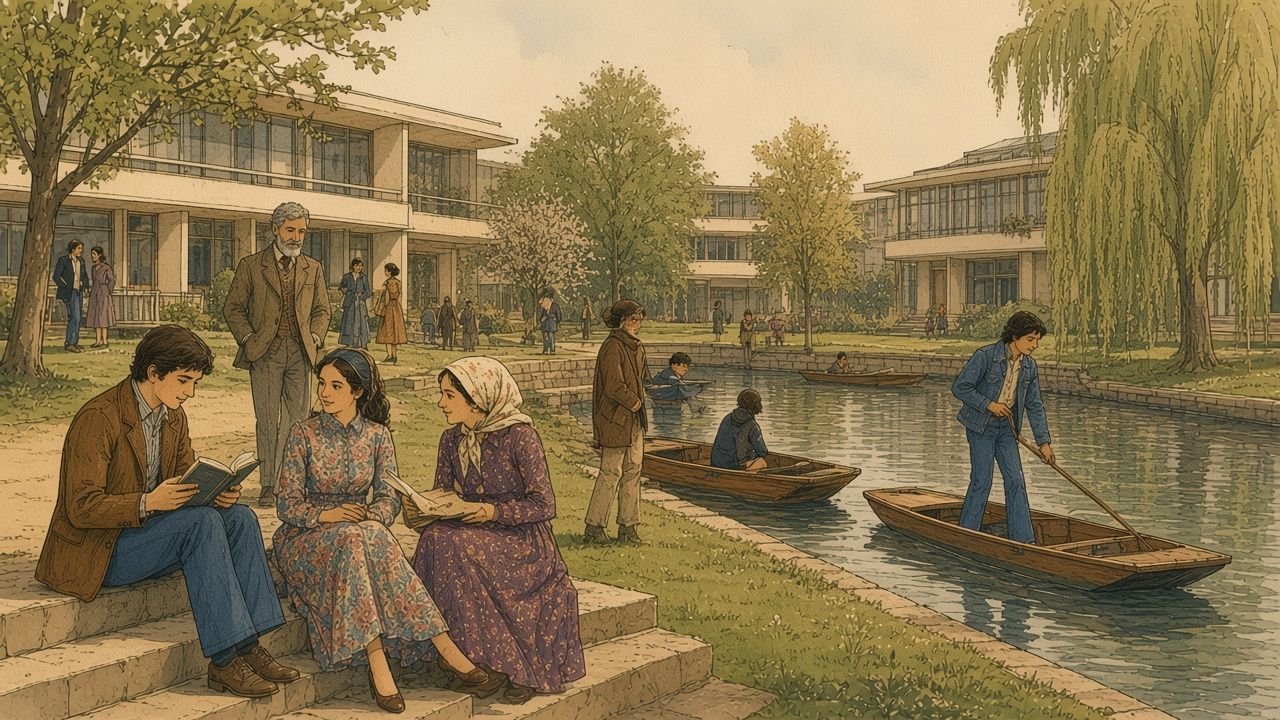
The Queen laid the foundation stone in 1968, and the work was completed six years later.[1] The college moved into its new home in 1974. The buildings, now listed at Grade II, include a hall seating two hundred, a library, a buttery and a cellar bar, seminar rooms and five storeys of accommodation for graduate students, both single and married, and for fellows, in what the college calls a modern twist on the quads and cloisters of older Oxford. A day nursery and family accommodation were added later.[1][2]
Two accounts of an opening
The sources describe the opening differently. The college archive says that the new buildings were formally opened in 1974 by the Chancellor of the university, Harold Macmillan.[2] The Wolfson Foundation’s record of highlights includes a photograph of Sir Isaac shaking hands with the Queen “at the opening of Wolfson College, Oxford in November 1974”, with Lady Wolfson and Sir Isaiah and Lady Berlin.[8] Both may be right, if a formal opening by the Chancellor was accompanied by a royal visit, but the sources consulted here do not settle the question.
Untrammelled and unpyramided
Berlin finished his term as president in 1975 and was succeeded by Sir Henry Fisher.[3] He left behind, the college says, an “egalitarian, democratic and unpretentious” community, and a phrase of his, “new, untrammelled and unpyramided”, that still describes its ethos.[3] One admirer quoted by the college remarked that he was “the only philosopher to leave behind him an institution in the image of his own ideals”.[3]
The college has continued to carry the family’s name and to receive its support. In June 2013 it opened the Leonard Wolfson Auditorium, named for Isaac’s son, and it has since added a new academic wing with a large extension to its library.[2] For the Wolfsons, Oxford was the first of two university colleges. The second, at Cambridge, had a longer and stranger path to its name.
References
OpenClose
- Wolfson College, Oxford, “Our Origins” *
- Oxford College Archives, “Wolfson College” *
- Wolfson College, Oxford, “Sir Isaiah Berlin” *
- “More Oxford Colleges,” Nature 211 (1966), 111 *
- Royal Society, “Wolfson College Oxford. The Riviera College” *
- The Wolfson Foundation, The Wolfson Foundation 1955–2015. Sixty Years of Philanthropy (London, 2015) *
- Raymond Hoffenberg, “Sir Isaac Wolfson,” Lives of the Fellows (Munk’s Roll), vol. IX (London: Royal College of Physicians, 1994), p. 601 *
- The Wolfson Foundation, “Highlights from history” *
The family tree, timeline, places, glossary and select bibliography for the whole history are on the Wolfson index page.