A town above the Wetterau
Friedberg stands on a ridge of high ground above the fertile plain of the Wetterau, some thirty kilometres north of Frankfurt am Main. Its main street, the Kaiserstrasse, runs north from the walled castle that gave the town its importance in the Middle Ages, when the Burggraf of Friedberg governed one of the free imperial towns of the region. Jews had lived there since at least the middle of the thirteenth century. They appear in an imperial tax list of 1241 and 1242, in which the Jews of the town and of the whole Wetterau were assessed together at the considerable sum of 150 marks. In 1275, on the instruction of Rudolf of Habsburg, the Burggraf received the right to admit Jews to the town, and four years later the Friedberg Jews alone paid 130 marks in imperial tax. Most of them lived by lending money. They owned several houses and courtyards, and they had a synagogue, a cemetery and a ritual bath.[1]
That bath survives. It is one of the most remarkable monuments of medieval Jewish life in Germany: a deep stone shaft descending some twenty-five metres to the groundwater, with a stair turning down its walls to the pool at the bottom. Local tradition and modern scholarship date it to 1260, and in 2010 the town marked its seven hundred and fiftieth anniversary with a symposium on the monumental mikveh as a building type. The community that built it did not survive the fourteenth century unscathed. The Armleder persecution of 1338 and the massacres that followed the Black Death in 1349 left no Jews in the town at all. On 13 September 1350 Ulrich of Hanau, the imperial bailiff of the Wetterau, sold the synagogue, the bath, the houses and the courtyards of the Jews to the citizens and the town. Only from about 1360 did a few Jewish families return.[1]
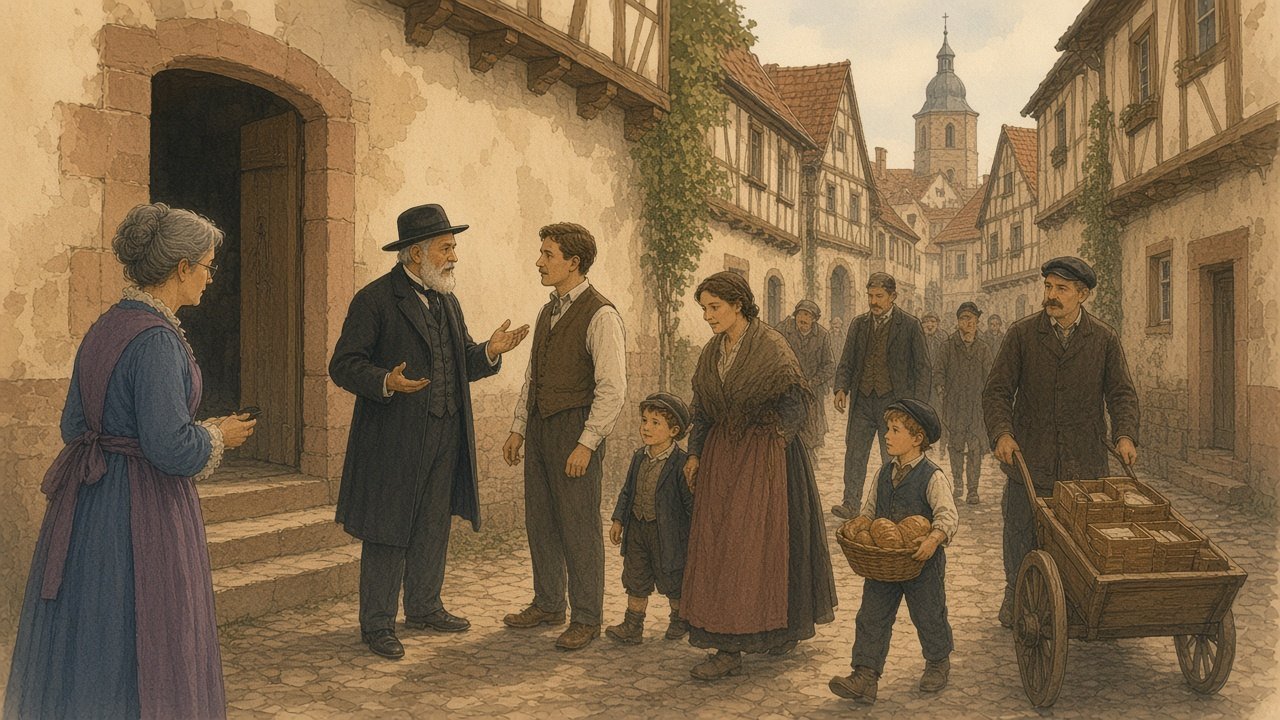
The Judengasse and the rabbinical court
From then on the Jews of Friedberg were confined more and more closely to a single street, the Judengasse, which ran parallel to the main street and is named in documents from the end of the fifteenth century. Within those narrow limits the community grew into one of the most important in Germany. In 1603 Friedberg was chosen as the seat of one of the five rabbinical courts of appeal of the Holy Roman Empire, and its yeshiva and rabbinate were spoken of in the same breath as those of Frankfurt, Worms and Prague. Among the rabbis of the town in the sixteenth century was Hayyim ben Bezalel of Poznań, the brother of the famous Rabbi Judah Loew of Prague, who served in Friedberg from 1569 until his death in 1588. In 1625 the community counted eighty-nine families, and for a short time after the Thirty Years’ War there were more Jews in Friedberg than Christians.[1]
The town’s importance declined from the late seventeenth century, but it remained a rabbinical seat for the whole region well into the nineteenth century, and the Jewish community stayed large relative to the town. When the Oppenheimer brothers were children, Friedberg was a market and garrison town of about five thousand inhabitants in the Grand Duchy of Hesse. In 1880, the year of Ernst’s birth, 438 of them, about nine in every hundred, were Jews. The community had its own synagogue, its own denominational school, a ritual bath and a cemetery. It belonged, after its own rabbinate lapsed in the middle of the century, to the liberal provincial rabbinate of Upper Hesse based in Giessen. By 1910 the town had nearly doubled in size, while the number of Jews had grown only slowly, to 491, about one in twenty of the population.[1]
Eduard and Nanette
The Oppenheimer name is among the commonest of German Jewish surnames. It derives from the town of Oppenheim on the Rhine, and many unrelated families bore it, among them the Habsburg court financier Samuel Oppenheimer of Vienna, the bankers of Cologne and the physicist of Los Alamos. The Friedberg Oppenheimers were not grand. Ernst’s father, Eduard, sold cigars, and his mother was Nanette, born Hirschhorn. Accounts of the family describe a household that was comfortable rather than rich, with a large brood of children. The sources do not agree on its exact size. A German reference work describes Ernst as the fifth son, while the American magazine Time, in its obituary of 1957, called him one of six sons of a German Jewish cigar merchant. There were daughters as well. Harry Oppenheimer, writing of his father’s youth, was careful to say that the family in Germany, though anything but rich, was certainly not destitute.[2][3][4]
Where exactly the family lived is also a matter of local disagreement. The Frankfurter Rundschau, reporting on the town’s plans for an Oppenheimer house, places the family’s home at Usagasse 26, a modest building on a lane leading down towards the little river Usa, where they lived until late in the nineteenth century. A jeweller’s workshop in the Kaiserstrasse, on the other hand, presents its own historic building as the house in which the future diamond king was born in 1880. Both claims may be true at different moments, since families of modest means moved often, and neither has yet been settled by a published study. What is clear is that the Oppenheimers belonged to the world of small Jewish traders who lived along the main street and its lanes, within sight of the castle, a world that had changed little in its outward forms since the legal emancipation of the Jews in the nineteenth century.[5][6]
The road to London
That world offered little to ambitious sons. Hesse was prosperous enough, but the great opportunities of the late nineteenth century lay in the cities and overseas, and the diamond trade in particular had become a family business for a network of German Jewish houses in London. According to one account the father encouraged his sons to leave Germany to make their fortunes elsewhere. The eldest of the brothers who matter to this story, Bernhard, born in 1866, went out to the diamond fields of South Africa and made his first career there. Louis, ten years older than Ernst, was already established in London in the office of A. Dunkelsbuhler and Company, one of the smaller firms of the diamond syndicate. Otto, too, would make his career in the London trade.[7][4][8][9]
Ernst followed Louis in 1896, at the age of sixteen. He was set to work in the Dunkelsbuhler office in the Hatton Garden quarter, where young men learned the trade by sorting rough stones, separating the flawed from the fine.[7] His son later gave his starting wage, on his father’s own telling, as seventeen shillings and sixpence a week, and observed with some irony that his father had enjoyed enlarging on his humble start in business. Le Monde, in its obituary, gave a slightly different version: the boy lodged in Camden Town at eighteen shillings and sixpence a week and earned a pound a week as an errand boy in Hatton Garden. Such small discrepancies are the ordinary residue of a story told many times over a long life. They agree on the essential point, which is that the boy arrived with nothing but his family connections and his wits, and that within a few years his employers trusted his eye for a stone.[4][10]
What Friedberg kept
Ernst became Ernest in England, and Friedberg receded into the background of the family story. He was naturalised as a British subject in November 1901, shortly before he sailed for the Cape, and later in life he was received into the Church of England.[11] Yet the town did not forget him. When he died in 1957, the Paris newspaper that recorded his career reminded its readers that the king of diamonds, knighted by the British crown after the First World War, had been born a German, in Friedberg in the province of Hesse.[7][10]
The Jewish community he left behind met a terrible end. In 1933 there were still 305 Jews living in Friedberg. In the following years many of them moved away or emigrated under the pressure of persecution. On 10 November 1938, in the middle of the day, members of the SA, local tradesmen, teenagers and children from the Hitler Youth beat Jews in the streets, stormed and plundered their homes and shops, and wrecked and set fire to the synagogue. By 1942 only sixty-three Jewish residents remained. On 16 September of that year they were assembled overnight in the gymnasium of the Augustinerschule and deported. The town’s memorial book lists by name the men, women and children born in Friedberg or long resident there who were murdered. A plaque on the site of the synagogue, first placed in 1979, asks that the place be kept as a thoughtful remembrance and an instructive warning for future generations.[1]
The Oppenheimers who prospered in London and Kimberley were long gone by then, and none of the sources suggests that close relatives of Eduard and Nanette remained in Friedberg in the 1930s. But the medieval bath in the Judengasse, which the Nazis did not destroy, still descends into the rock beneath the town, and the house in the Usagasse has become the object of a modest effort of local remembrance. The town has given money towards restoring the building as an Oppenheimer house, a small sign that Friedberg now counts among its citizens a family who left it to make their fortune at the other end of the world.[1][5]
References
OpenClose
- Alemannia Judaica, “Friedberg (Wetteraukreis, Hessen). Jüdische Geschichte, Synagoge, Mikwe” *
- South African History Online, “Sir Ernest Oppenheimer,” biography record B-0008856, updated 20 July 2026 *
- “South Africa. The Diamond King,” Time, 9 December 1957 *
- Harry F. Oppenheimer, “Sir Ernest Oppenheimer, 1880–1957. A Portrait by his Son,” Optima 17, no. 3 (September 1967), reprinted by The Brenthurst Library *
- Frankfurter Rundschau, “Kleiner Beitrag, große Wirkung” (on the Oppenheimer house in the Usagasse, Friedberg) *
- Schmuckatelier Friedberg, “Über uns. Ein Haus mit Geschichte” *
- “Oppenheimer, Ernest,” biographical reference entry, Encyclopedia.com *
- Historical Association, “Bernard Oppenheimer,” Students’ local history stories *
- “Philip Oppenheimer, Chairman of Diamond Cartel, Dies at 83,” The New York Times, 20 October 1995 *
- “Sir Ernest Oppenheimer avait conquis en Afrique du Sud le « royaume du diamant »,” Le Monde, 27 November 1957 *
- David Pallister, “Harry Oppenheimer,” obituary, The Guardian, 21 August 2000 *
The family tree, timeline, places, glossary and select bibliography for the whole history are on the Oppenheimer index page.