A portrait commission
In 1927 a German painter recently arrived in New York held her first American exhibition at the gallery of Marie Sterner. Hilla Rebay was thirty-seven. She had been born in Strasbourg, then part of the German Empire, in 1890, the daughter of an army officer, and had studied art in Cologne, Paris, Munich and Berlin. She was drawn to the theosophy of Rudolf Steiner, and through her friends in the Berlin circle of Der Sturm, the November Group and the Dada artists of Zurich, among them Jean Arp, she had become a passionate advocate of what she called non-objective art.[1][2] Her exhibition caught the attention of Irene Guggenheim, Solomon’s wife, and through Irene she met Solomon, who commissioned her to paint his portrait.[1][3]
Solomon was then in his late sixties. He and Irene had collected Old Masters, American landscapes and paintings of the Barbizon school since the 1890s, conventional choices for a rich New York couple of their generation.[1] Rebay persuaded him to abandon them. In the words of the Landmarks Preservation Commission, Solomon gave up his interest in representational movements for the twentieth-century world of European non-representational, or non-objective, art, and the shift in his taste grew out of his association with Rebay.[1] She became the couple’s artistic adviser, and their friendship lasted until Solomon’s death.[1][2]
The gospel of non-objectivity
For Rebay non-objective painting, the art of pure colour and form with no reference to the visible world, was not simply a modern style. It was a spiritual discipline, the art of the future, which could lead its viewers to higher states of perception. Her chief prophet was Vasily Kandinsky, whose treatise On the Spiritual in Art had argued that painting could act on the soul as music does, and her chief protégé was the German painter Rudolf Bauer, a follower of Kandinsky’s whose work she ranked above his.[2][1]
From 1929 Rebay escorted the Guggenheims on buying trips to Europe. They bought works by Kandinsky, Piet Mondrian, László Moholy-Nagy, Robert Delaunay, Fernand Léger, Marc Chagall and many others.[1][3] In 1930 Solomon and Rebay visited Kandinsky at the Bauhaus in Dessau, and Solomon bought paintings directly from his studio; the collection would eventually hold more than 150 of his works.[3][2] During the Depression, the Commission observes, Rebay used Solomon’s wealth to buy many paintings, supporting struggling artists, most of them her friends, while greatly enlarging his collection.[1] In 1931 the Guggenheims’ suite at the Plaza Hotel was redecorated to hold the growing collection.[1] Bauer was the greatest beneficiary. Solomon bought his paintings in large numbers and supported him with a contract and a house in New Jersey, an arrangement that ended in bitterness on all sides.[2]
Foundation and museum
Solomon was influenced, the Landmarks Commission suggests, by the precedents of men such as Henry Clay Frick, Henry Huntington and Andrew Mellon, who had built or were building museums as monuments to themselves.[1] In 1933 the architect Wallace K. Harrison’s plans for Rockefeller Center included a Museum of Modern Art, a Metropolitan Opera and a Guggenheim Museum, but the scheme died in 1936 when the Rockefellers abandoned their plan for a cultural plaza. Meanwhile the collection was shown in Charleston, South Carolina, in 1936 and in Philadelphia in 1937.[1]
In the spring of 1937 Solomon established the Solomon R. Guggenheim Foundation for, in the words of its charter, the promotion and encouragement of art and education in art and the enlightenment of the public. Rebay was named a trustee and the curator of the collection that was to form the core of a museum.[1][3] She had already consulted European architects about a building, among them Walter Gropius, Erich Mendelsohn and Le Corbusier, and she proposed a circular pavilion for the New York World’s Fair of 1939 that was never built.[1]
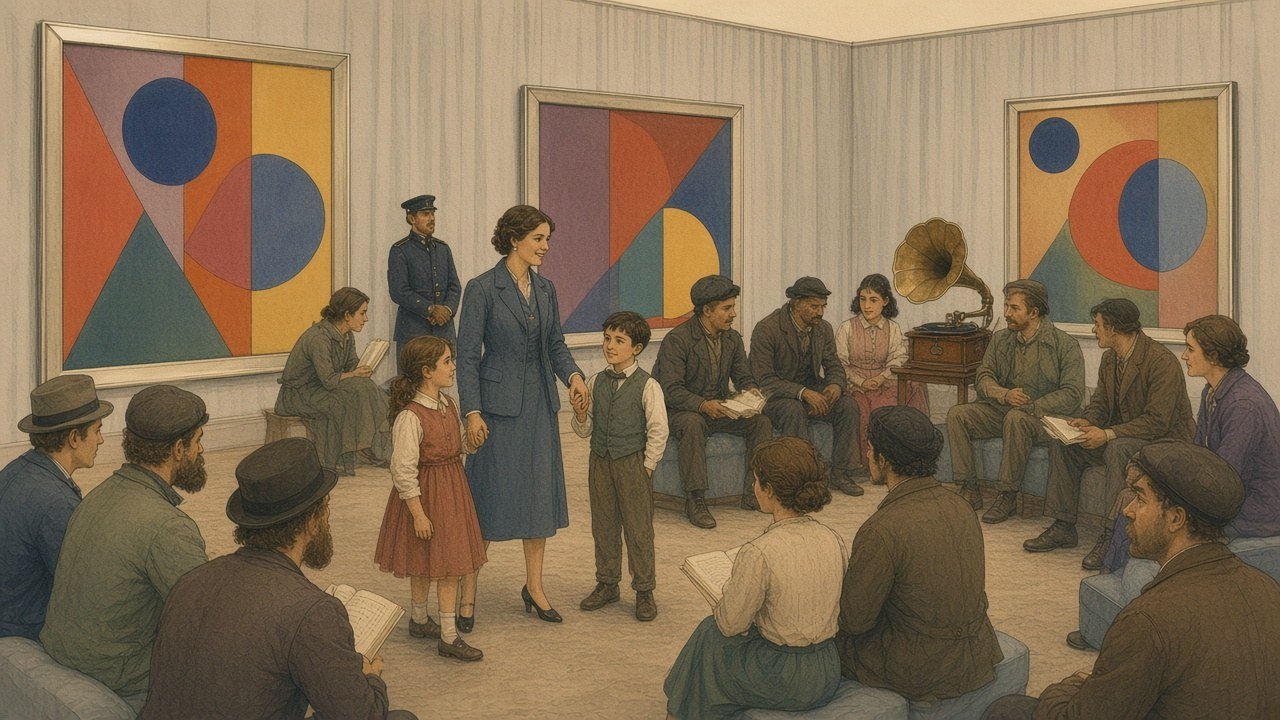
Instead, assisted by the architect William Muschenheim, she converted a former car showroom at 24 East 54th Street into a temporary home for the collection. The Museum of Non-Objective Painting opened there on 31 May 1939 with an exhibition called “Art of Tomorrow”.[1] The galleries had grey fabric on the walls and carpet on the floor, the paintings hung low in heavy silver frames, and recordings of Bach and Chopin played in the background to encourage contemplation.[2][3] The museum was free, and it gave stipends to young artists, among them Jackson Pollock, who worked there for a time as a carpenter and handyman.[2] In 1948 Rebay and Muschenheim remodelled a six-storey house at 1071 Fifth Avenue, on the site that had been bought for a permanent museum, and the collection moved there.[1]
The collection Rebay built
The collection formed in these years was, and is, the core of the Guggenheim’s holdings. Its strength lay in the art Rebay most admired: Kandinsky above all, from his early improvisations to the geometric paintings of his years at the Bauhaus, but also the Orphist paintings of Robert Delaunay, the abstractions of Moholy-Nagy, Albert Gleizes and Fernand Léger, and works by Marc Chagall, Franz Marc and Paul Klee.[1][3] Rebay’s own non-objective paintings and collages were exhibited alongside them, and so, in great number, were Bauer’s.[2] The museum’s first catalogues set out her theory in passionate prose, describing non-objective painting as an art of the future that would educate the spirit, and they read today as manifestos as much as catalogues.[2]
Not everyone was persuaded. Critics in New York mocked the museum’s reverent atmosphere and Rebay’s insistence on the spiritual superiority of abstraction, and the Museum of Modern Art, a few blocks away, presented a broader and more historical account of modern art that included the figurative and Surrealist work Rebay despised.[2][3] Yet the young American painters who visited the Museum of Non-Objective Painting in the 1940s saw there more abstract art, and especially more Kandinsky, than anywhere else in the country, and some of them, among them Pollock, worked for it.[2]
Rebay’s relations with the artists she championed were complicated by her love and admiration for Rudolf Bauer. She persuaded Solomon to buy his paintings in great numbers, arranged for him to come to the United States, and helped him to buy a house in New Jersey, and the museum showed his work more prominently than that of almost any other living artist.[2] Bauer’s later quarrels with Rebay, and a contract with the foundation that he believed exploited him, became an embarrassment to all concerned, and after his death his reputation declined sharply; the museum’s later directors gave his paintings little space.[2][3] Rebay’s own reputation suffered in the same way for many years, and only in recent decades have historians, led by her biographer Joan Lukach, given her credit for the vision and energy that founded the museum and commissioned its building.[2]
Rebay’s fall
Rebay was brilliant, generous, autocratic and impossible. She quarrelled with artists, with dealers, with the museum’s staff and with members of the Guggenheim family, several of whom regarded her influence over Solomon with alarm.[2][4] She also made enemies by her contempt for any art that was not non-objective, including the Surrealism that Solomon’s niece Peggy was showing a few blocks away. Peggy, for her part, mocked her uncle’s taste and his adviser.[5][2] During the war Rebay, a German citizen, was briefly detained by the authorities in 1942 in connection with an accusation of hoarding food and of sympathy for Germany, accusations that her biographer attributes in part to the malice of Bauer and of others she had offended.[2]
Solomon died on 3 November 1949, at the age of eighty-eight, without seeing his museum built.[1][3] He was succeeded as president of the foundation by his nephew Harry F. Guggenheim, whose turbulent relationship with Rebay, the Landmarks Commission says, caused her to resign as director and give up her other positions. She was considered eccentric because of her theosophical interpretation of non-objective art and was disliked as authoritarian.[1] She resigned in 1952, and in the same year the museum was renamed the Solomon R. Guggenheim Museum.[3][1]
Her successor was James Johnson Sweeney, a former director of painting and sculpture at the Museum of Modern Art, who broadened the collection to include figurative and Surrealist art and acquired sculpture, and whose ideas about how a museum should be built did not coincide with those of the architect Rebay had chosen.[1] Rebay retired to Connecticut, where she continued to paint and collect. She did not attend the opening of the museum she had conceived.[1] She died in 1967.[1][2] Joan Lukach, her biographer, argues that without her there would have been no Guggenheim collection and no Guggenheim Museum, and that her role was minimised for decades by those who found her embarrassing.[2] Her choice of architect, made in 1943, is the subject of the next chapter.
References
OpenClose
- New York City Landmarks Preservation Commission, “Solomon R. Guggenheim Museum,” designation report LP-1774, 14 August 1990 *
- Joan M. Lukach, Hilla Rebay. In Search of the Spirit in Art (New York: George Braziller, 1983), print *
- Solomon R. Guggenheim Foundation, “History” *
- Irwin Unger and Debi Unger, The Guggenheims. A Family History (New York: HarperCollins, 2005), print *
- Francine Prose, Peggy Guggenheim. The Shock of the Modern (New Haven: Yale University Press, 2015), print *
The family tree, timeline, places, glossary and select bibliography for the whole history are on the Guggenheim index page.