The poor Guggenheim
Marguerite Guggenheim was born in New York on 26 August 1898, the second daughter of Benjamin Guggenheim and Florette Seligman.[1] She was thirteen when her father died on the Titanic. Her childhood, as she described it in her memoirs, was lonely and unhappy, among governesses and relatives who were richer than her own family and conscious of the difference.[2][3] In 1919, when she came of age, she inherited her share of her father’s estate. She worked for a time in a radical bookshop in New York, the Sunwise Turn, where she met writers and artists, and in 1921 she went to Europe.[1][4]
In Paris she married Laurence Vail, a writer and artist, with whom she had two children, Sindbad and Pegeen, who became a painter. Through Vail she found herself, as the Peggy Guggenheim Collection puts it, at the heart of Parisian bohemia and American expatriate society. Constantin Brancusi, Djuna Barnes and Marcel Duchamp became lifelong friends.[1] The marriage ended in divorce, and she lived for several years with the English writer John Holms, who died in 1934. Francine Prose and Anton Gill, her biographers, both describe these years as a period of intense personal unhappiness and of a gradual discovery, through friendship with artists, of what she wanted to do.[3][4][5]
Guggenheim Jeune
In 1938, at the age of thirty-nine, Peggy opened an art gallery in London, at 30 Cork Street, called Guggenheim Jeune, a play on the name of the Paris gallery Bernheim-Jeune.[1] Samuel Beckett urged her to concentrate on contemporary art, as it was “a living thing”, and Duchamp introduced her to artists and taught her, in her words, “the difference between abstract and Surrealist art”.[1] The first exhibition showed the work of Jean Cocteau, and the second was the first solo exhibition of Vasily Kandinsky in Britain, followed by exhibitions of Yves Tanguy and others.[1] The first work she bought for herself was a sculpture by Jean Arp, Head and Shell.[1]
The gallery lost money, and in 1939 she conceived the idea of opening a museum of modern art in London, with the critic Herbert Read as its director. Read drew up a list of the artists who should be represented, and the list, revised by Duchamp and by Nelly van Doesburg, the widow of the Dutch painter Theo van Doesburg, became the basis of her collection.[1] War put an end to the London plan.
A picture a day
In 1939 and 1940 Peggy moved to Paris and bought art at a rate that astonished the dealers. “My motto was Buy a picture a day,” she wrote, “and I lived up to it.”[1][2] With the threat of war, and then war itself, prices fell, and she acquired works by Georges Braque, Salvador Dalí, Robert Delaunay, Piet Mondrian, Francis Picabia and many others. She bought Fernand Léger’s Men in the City on the day that Hitler invaded Norway, and Brancusi’s Bird in Space as the German armies approached Paris, and only then left the city for the south of France.[1] She tried to store her collection in the Louvre, which refused it as not worth saving, and eventually shipped it to New York disguised as household goods.[3][4]
In July 1941 she left France for New York with her children, Laurence Vail and his second wife Kay Boyle and their children, and the German painter Max Ernst, whom she married a few months later.[1] She had already helped to pay for the escape of several artists from occupied France through the American rescue network led by Varian Fry.[3][5] For a Jewish woman with an American passport the danger was real, and her decision to stay in France until the summer of 1941, buying art, has been judged by her biographers as both brave and reckless.[3][4]
Art of This Century
In October 1942 Peggy opened her museum and gallery, Art of This Century, at 30 West 57th Street in Manhattan. It was designed by the Austrian architect Frederick Kiesler, with curved walls, paintings mounted on baseball bats and lit in sequence, and a kinetic gallery in which visitors operated machines to view the works; it soon became, the Peggy Guggenheim Collection says, the most stimulating venue for contemporary art in New York.[1] At the opening she wore one Tanguy earring and one by Alexander Calder, she wrote, to show her impartiality between Surrealist and abstract art.[1] A press release declared that the undertaking would serve its purpose only if it succeeded in serving the future instead of recording the past.[1]
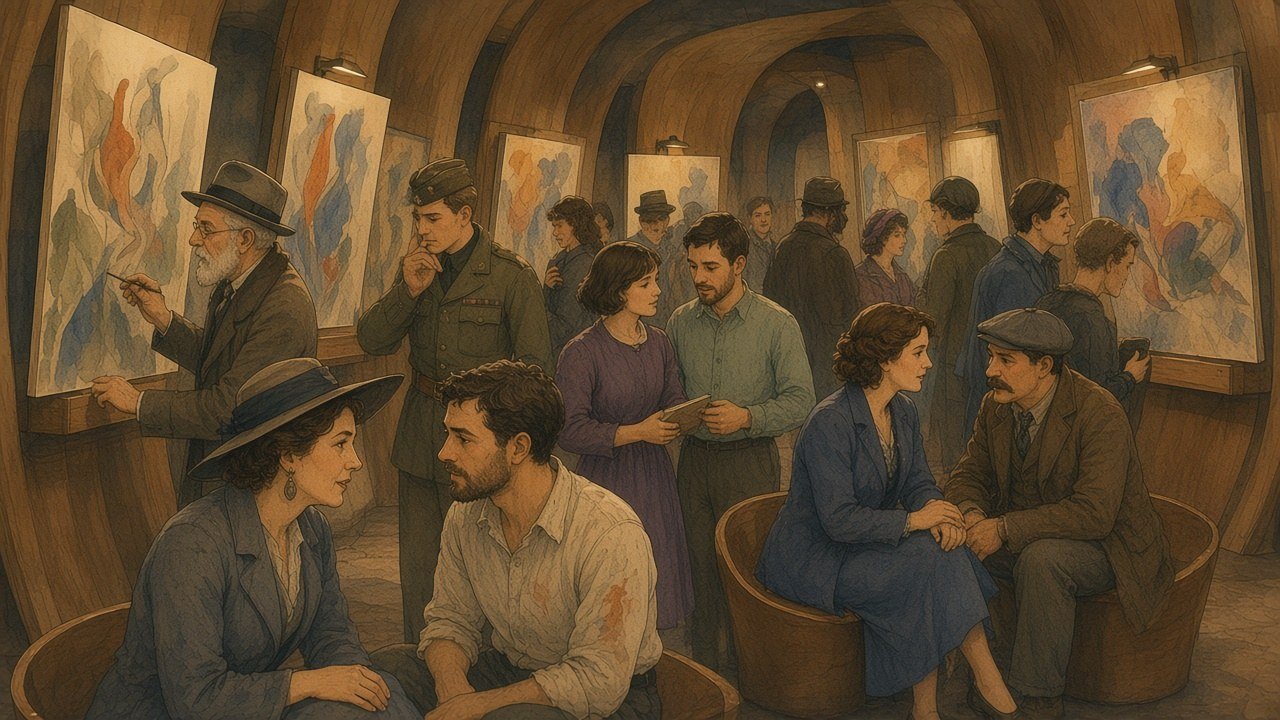
Art of This Century showed her collection of Cubist, abstract and Surrealist art, and temporary exhibitions of European artists, but its lasting importance lay in the young Americans it showed: William Baziotes, Robert Motherwell, Mark Rothko, Clyfford Still, Richard Pousette-Dart and, above all, Jackson Pollock.[1] In 1943 Peggy gave Pollock the first of four solo exhibitions and a monthly stipend, sold his paintings and commissioned his largest work, Mural, for her apartment; she later gave it to the University of Iowa.[1] She also organised two exhibitions of work by women artists and solo shows for Irene Rice Pereira and Janet Sobel.[1] The museum’s own account concludes that Peggy and her collection played a vital intermediary role in the birth of Abstract Expressionism, America’s first art movement of international importance.[1] Her marriage to Ernst ended in 1946, and in the same year she published her first memoir, Out of This Century.[2][3]
The collection she formed in these years reflected her friendships as much as any plan. It was strongest in Surrealism, the movement of her husband Max Ernst and of friends such as André Breton, Yves Tanguy and Salvador Dalí, and in the early abstraction of Kandinsky, Mondrian and the Constructivists that Duchamp and Herbert Read had taught her to value; and it included the young Americans whom she had been among the first to show.[1][3] Her private life remained turbulent. Her daughter Pegeen, a painter whose naive pictures of women and children Peggy exhibited and collected, struggled with depression for much of her adult life and died in 1967, a loss from which, her biographers agree, her mother never recovered.[3][5][4]
Art of This Century was also a place where women artists found a hearing that few galleries in New York then offered. In 1943 Peggy mounted an Exhibition by 31 Women, followed in 1945 by a second exhibition of women’s work, and among the artists she showed were Leonora Carrington, Frida Kahlo, Louise Nevelson, Dorothea Tanning and Leonor Fini.[1][4] The jury for the first exhibition included Duchamp, Ernst and Breton, and it was while choosing the works that Ernst met Tanning, whom he would later marry, an episode Peggy described with rueful humour in her memoirs.[2][3] Some reviewers of the day treated the very idea of an exhibition of women with condescension, but for several of them it was the first appearance in a New York gallery, and the catalogue of names reads today like a roll of the century’s most admired women artists.[4][3]
A palace on the Grand Canal
In 1947 Peggy closed the gallery and returned to Europe. “I loved Europe more than America,” she wrote, “and when the war ended I couldn’t wait to go back.”[1] In 1948 her collection was shown at the Venice Biennale, in the Greek pavilion, which was empty because Greece was in the middle of a civil war. It was the first time that works by Arshile Gorky, Pollock and Rothko had been seen in Europe.[1] That winter she bought the Palazzo Venier dei Leoni, an unfinished eighteenth-century palace on the Grand Canal of which only the ground floor had been built, and installed her collection there.[6][1]
She lived there for thirty years. In 1950 she organised the first European exhibition of Pollock’s work, and from 1951 she opened her house and collection to the public several afternoons a week.[1] She supported young Italian artists, among them Edmondo Bacci, Emilio Vedova and Tancredi, to whom she gave a stipend and a studio in the basement of the palazzo. In 1962 Venice made her an honorary citizen.[1] In 1969 the Solomon R. Guggenheim Museum in New York, founded by the uncle whose taste she had once mocked, exhibited her collection, and she agreed to leave it to his foundation. She gave the palazzo to the foundation in 1970 and the collection in 1976.[1] She died on 23 December 1979, at the age of eighty-one, and her ashes were placed in a corner of the garden, near the graves of her dogs.[1] “I am not an art collector,” she had said. “I am a museum.”[1]
References
OpenClose
- Peggy Guggenheim Collection, “About Peggy” *
- Peggy Guggenheim, Out of This Century. Confessions of an Art Addict (New York: Universe Books, 1979), print *
- Francine Prose, Peggy Guggenheim. The Shock of the Modern (New Haven: Yale University Press, 2015), print *
- Anton Gill, Art Lover. A Biography of Peggy Guggenheim (London: HarperCollins, 2001), print *
- Mary V. Dearborn, Mistress of Modernism. The Life of Peggy Guggenheim (Boston: Houghton Mifflin, 2004), print *
- Peggy Guggenheim Collection, “Peggy Guggenheim Collection celebrates founder in year of her centenary,” press release *
The family tree, timeline, places, glossary and select bibliography for the whole history are on the Guggenheim index page.