El Teniente and William Braden
The Guggenheims’ first great Chilean property was a copper mine high in the Andes south-east of Santiago, known as El Teniente. Copper had been dug there on a small scale for centuries. In 1904 an American mining engineer, William Braden, took an option on the property and began to develop it with tunnels, a rope tramway, a mill and a railway of about sixty-five kilometres.[1][2] He introduced techniques that made it possible to work the low-grade ore profitably, but the project proved too costly for him to complete with his own resources.[2][1]
In 1909 Braden sold a controlling share in his Braden Copper Company to the Guggenheim Exploration Company.[1] One study gives 1908 as the date of the purchase; the International Directory of Company Histories gives 1909, which is the date used here.[1] The Guggenheims completed the works, including a smelter, at a total cost of about $25 million. By 1915 El Teniente was producing fifty million pounds of copper a year at a cost of less than eight cents a pound.[1] When Guggenex was wound up that year, ninety-five per cent of Braden Copper passed to the newly founded Kennecott Copper Corporation, which the Guggenheims also controlled.[1][2]
El Teniente lay high in the Andes, and the men who worked it needed somewhere to live. Braden’s company built the town of Sewell in 1905, at about two thousand metres above sea level, on a mountainside too steep for wheeled vehicles; its streets were staircases climbing from the railway station, and its timber houses were painted green, yellow, red and blue.[3] At its peak Sewell had about fifteen thousand inhabitants. It was largely abandoned in the 1970s, when the miners and their families moved down to the valley, and in 2006 it was inscribed on UNESCO’s World Heritage List as an outstanding example of the company towns built in remote places by the fusion of local labour with the capital and technology of an industrial nation.[3] El Teniente itself became the largest underground copper mine in the world, and it is still worked today by the state company Codelco.[3][1]
Chuquicamata
Their second Chilean venture was larger still. Chuquicamata, in the Atacama Desert of northern Chile, was one of the largest copper deposits in the world. It had been mined by the Incas, and in the nineteenth century by small Chilean and British operators who took the richest veins. The International Directory says that the deposit was brought to the attention of M. Guggenheim’s Sons in 1900 by an employee who reported that it could be bought for less than $250,000, and that the Guggenheims passed on the opportunity.[1] A Boston mining engineer, Albert C. Burrage, bought the property and found that he lacked the resources to develop it.
In 1910 Burrage sold it to the Guggenheims for stock valued at $25 million in the Chile Exploration Company, the operating arm of the Chile Copper Company that the family formed to exploit it.[1] The Encyclopedia of Latin American History gives 1911 as the year of acquisition, and the difference probably reflects the interval between agreement and transfer.[2][1] The decision to buy was taken on the advice of the family’s engineers, who believed that the porphyry methods worked out in Utah could be applied to the immense low-grade deposit of the Atacama.[1][4]
Tocopilla and the aqueduct
Chuquicamata lay in one of the driest places on earth, at an altitude of nearly three thousand metres, far from fuel and water. To work it the Guggenheims built a modern port and an electric power plant at Tocopilla on the coast, about 145 kilometres to the west, with transmission lines to carry power to the mine, and an aqueduct over the mountains to bring water.[1] The mine opened in 1915 and used the porphyry reduction processes perfected by Guggenheim engineers in Utah, with a leaching process for the oxide ores worked out by the family’s metallurgist, Elias Anton Cappelen Smith.[1][5]
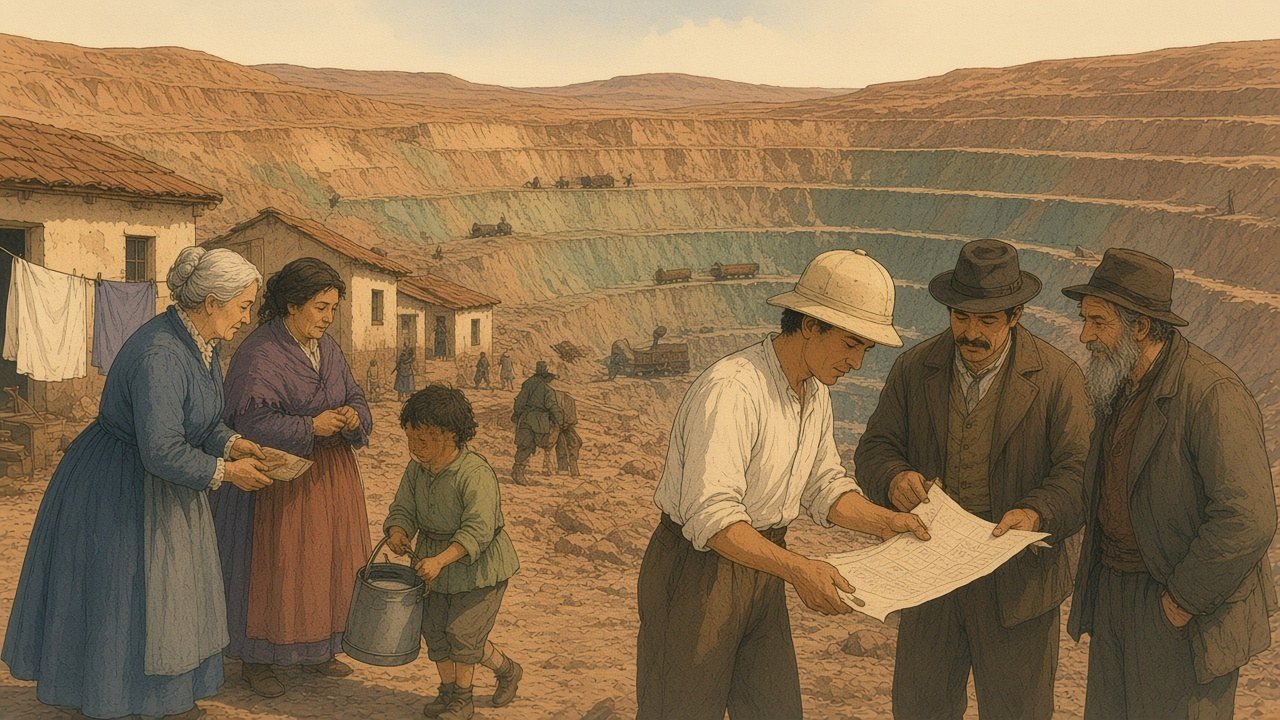
Chuquicamata became, the International Directory says, the world’s most productive and profitable copper mine; in 1923 it produced refined copper for less than six cents a pound, the lowest cost in the world.[1] It drew thousands of workers from the countryside of central and southern Chile and from Bolivia to a company town in the desert, with housing, schools and shops provided by the company and a sharp division between the foreign staff and the Chilean labourers. Thomas O’Brien’s study of American enterprise in Latin America describes the attempt of the copper companies to impose American managerial discipline on a Chilean workforce, and the resentment and labour conflict it provoked.[6]
The scale of the works matched the scale of the deposit. The ore at Chuquicamata was mostly oxidised, and Cappelen Smith devised a process in which it was crushed, leached in great vats with sulphuric acid, and the copper recovered from the solution by electrolysis, a method that had not been tried on such a scale before.[5][1] The company town that grew beside the mine housed the managers and engineers, most of them American, in one quarter and the Chilean workers in another. Thomas O’Brien describes the company’s efforts to create a disciplined, sober and stable workforce through welfare programmes, company stores and the suppression of union activity, and the long resistance of the miners, which made Chuquicamata a centre of the Chilean labour movement.[6]
The war years
The First World War transformed the market for copper. The armies of both sides consumed enormous quantities for shell cases, wire and munitions, and the price rose sharply. The Guggenheims’ mines in Alaska, Utah and Chile were among the largest suppliers to the Allies and, after 1917, to the United States government.[4][5] The family’s profits in these years were immense. When the United States entered the war the copper producers agreed to sell to the government at a fixed price below the market, an arrangement presented by the industry as patriotic restraint and attacked by its critics as still far too generous to the producers.[4][7]
The end of the war brought a slump in metal prices. Glaser-Schmidt notes that the holding company had invested heavily in Chuquicamata during the war, and that after the war falling prices for raw materials and rising inflation in Chile threatened to reduce its operating profits.[5] The International Directory adds that despite its low costs the mine was losing money in the commodities slump that followed the war.[1]
The sale of 1923
In 1923 the family decided to sell. Anaconda Copper, whose own mines in Montana were declining and which needed new sources of ore, bought a controlling interest in Chile Copper. The figures given in the sources differ. The International Directory says that Anaconda bought fifty-one per cent of Chile Copper in 1923 for $70 million and the remaining forty-nine per cent in 1929.[1] Glaser-Schmidt says that the family sold two million of Chile Copper’s 3.8 million shares.[5] A Chilean history of the country’s foreign relations gives $77 million as the price paid for the controlling interest.[8] By any measure it was one of the largest transactions in the history of mining up to that time.
The decision divided the family. Glaser-Schmidt records that it was taken narrowly, and that the sharp dissent within the family moved two of the four Guggenheim partners then active to resign: Edmond, Murry’s son, and Harry, Daniel’s son, who had been the leading spirit of the Chilean ventures after his father’s retirement.[5] The remaining brothers, Murry and Solomon, became the chief directors of the firm’s future strategy, assisted by Cappelen Smith and John K. McGowan, two long-serving employees.[5] The family had sold its greatest mine, and much of the money from the sale would go into an industry that was about to collapse.
The Chilean copper mines outlived the family’s interest in them by many decades. In 1966 Kennecott sold fifty-one per cent of its Chilean operations to the government of Chile; in 1971, under the government of Salvador Allende, the great mines, including Chuquicamata and El Teniente, were fully nationalised, and in 1976 the state company Codelco was formed to run them.[1] Chuquicamata had by then become the largest open-pit copper mine in the world.[1][2] For Chileans the history of the Gran Minería, the great mining, is a history of foreign ownership and national recovery, and the Guggenheims stand at its beginning.[2][6]
References
OpenClose
- “Corporación Nacional del Cobre de Chile,” International Directory of Company Histories, reprinted at Encyclopedia.com *
- “Gran Minería,” Encyclopedia of Latin American History and Culture, reprinted at Encyclopedia.com *
- UNESCO World Heritage Centre, “Sewell Mining Town” *
- Irwin Unger and Debi Unger, The Guggenheims. A Family History (New York: HarperCollins, 2005), print *
- Elisabeth Glaser-Schmidt, “The Guggenheims and the Coming of the Great Depression in Chile, 1923-1934,” Business and Economic History 24, no. 1 (1995), 176 to 185 *
- Thomas F. O’Brien, The Revolutionary Mission. American Enterprise in Latin America, 1900 to 1945 (Cambridge: Cambridge University Press, 1996), print *
- Harvey O’Connor, The Guggenheims. The Making of an American Dynasty (New York: Covici, Friede, 1937), print *
- Walter Sánchez G. and Teresa Pereira L. (eds), Cientocincuenta años de política exterior chilena (Santiago: Universidad de Chile, 1977) *
The family tree, timeline, places, glossary and select bibliography for the whole history are on the Guggenheim index page.