Birch and the Bonanza claim
In 1900 two prospectors in the Wrangell Mountains of south-central Alaska found a green outcrop of copper ore on a ridge above the Kennicott glacier. The ore was extraordinarily rich; the Historic American Engineering Record notes that high-grade surface ore assayed up to seventy per cent copper and astounded the mining world.[1] The claim was called the Bonanza. It was nearly three hundred kilometres from the sea, across mountains, rivers and moving glaciers, and for several years it was tied up in litigation over who owned it.[1][2]
The man who saw its possibilities was Stephen Birch, a young mining engineer from New York who had come to Alaska looking for investments for wealthy backers, among them the sugar magnate Henry O. Havemeyer. Birch bought up interests in the Bonanza and neighbouring claims from 1902, organised the company that became the Kennecott Mines Company, and set about finding the capital to build a railway from the coast.[2][1] The name of the company was a misspelling of the glacier’s, which had been named after the naturalist Robert Kennicott, and the misspelling stuck.
The Alaska Syndicate
Birch’s search for money brought him to the two most powerful financial groups in the country. In 1906 the house of J. P. Morgan and Company and the Guggenheims joined to form what became known as the Alaska Syndicate, with the purpose of buying out the rival claims, building a railway and a mill, and developing the mines.[1][2] The Historic American Engineering Record dates the agreement to November 1906; other accounts speak of negotiations through the summer of that year.[1] Daniel Guggenheim led the family’s side of the negotiations.[3]
The Syndicate’s ambitions reached far beyond a single mine. It bought the Alaska Steamship Company and other shipping interests, acquired salmon canneries, and planned a railway that would carry both copper and coal. Between 1905 and 1911, according to the engineering record, it spent $25 million to build the mine and mill works, a railway of 196 miles and a steamship line connecting the port of Cordova with the American Smelting and Refining smelter at Tacoma, on Puget Sound, all before the first shipment of copper.[1] The Syndicate owned the mine, the railway and the ships outright, and the Guggenheims owned the smelter, an arrangement that the National Park Service describes as a monopoly in Alaska that would spur many legal, press and political challenges with nationwide repercussions.[2]
The Copper River and Northwestern
The railway was the Syndicate’s greatest undertaking. After a false start on a route from Valdez, it bought a surveyed route along the Copper River from the contractor Michael J. Heney, who had built the White Pass and Yukon Railway during the Klondike gold rush, and hired him to build it.[2] The line ran north from Cordova, along the Copper River and across the face of two active glaciers, the Miles and the Childs, before turning east to Kennecott. Crews worked through winters in which the temperature fell to forty degrees below zero. A steel bridge known as the Million Dollar Bridge was built across the river between the two glaciers, its piers designed to withstand the pressure of icebergs breaking from the glacier faces.[2][3]
The Copper River and Northwestern Railway was completed in 1911, an engineering feat built, the National Park Service says, in just four years.[2] The first train of copper ore left Kennecott on 8 April 1911, carrying ore worth $250,000 in thirty-two railway cars, ten days after the line was completed.[1][2] The high-grade ore was shipped directly to Tacoma; the lower grades were concentrated in the mill below the mines, a tall timber building stepped down the hillside that still stands, painted red, in the national park. In 1915 the mill became the site of the first successful use of the ammonia leaching process for recovering copper from low-grade ore.[1]
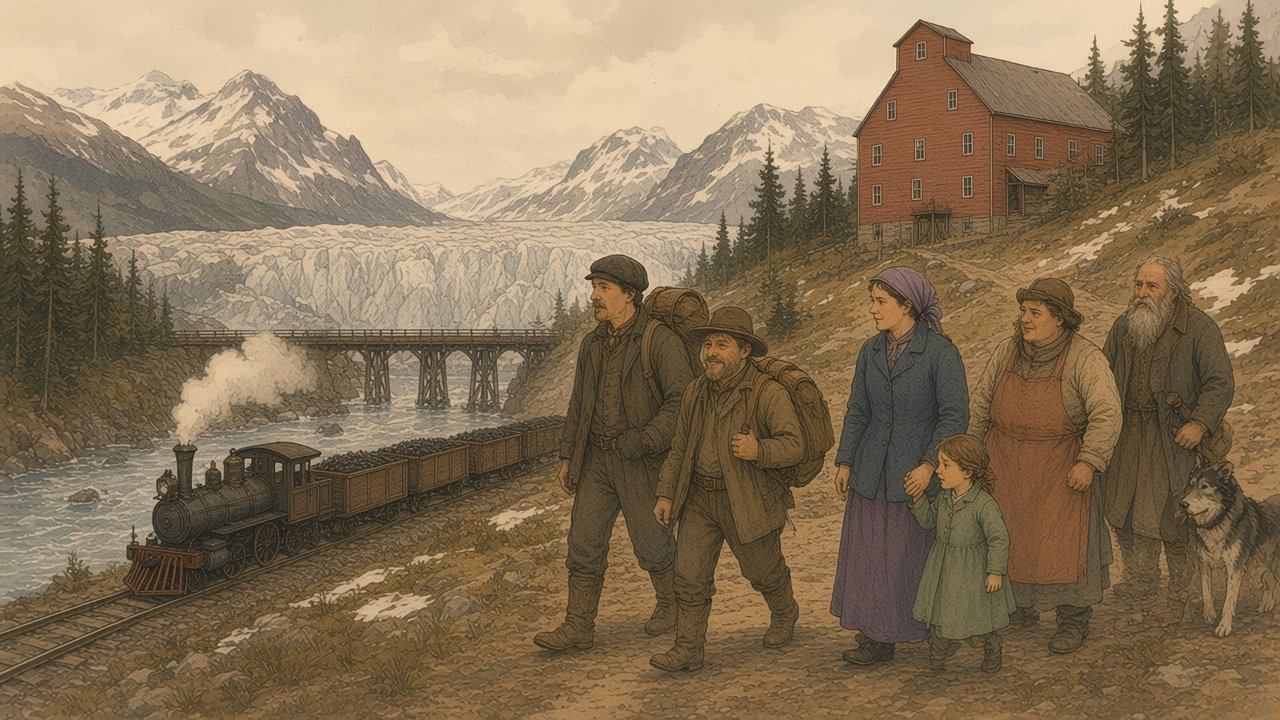
The mines repaid the investment many times over. By 1916, the engineering record says, production had reached more than 108 million pounds of copper, worth about $28 million, and Kennecott ranked among the nation’s largest copper mines with those of Butte, Bisbee and Bingham Canyon.[1] No single Alaskan gold district, the record adds, was as productive of mineral wealth as Kennecott.[1]
Gold dredges on the Klondike
The Alaska copper venture was only one of the family’s northern enterprises. In 1906 the Guggenheims also organised the Yukon Gold Company, which bought up claims in the Klondike district of the Canadian Yukon and worked them with large mechanical dredges and hydraulic plant. The individual miners of the 1898 rush had taken the richest gold from the creeks with pans and sluices; the dredges could work gravels that no individual could profitably touch, and Yukon Gold became one of the largest gold producers in the region for a time.[3][4] The Guggenheims sold its shares widely to the public, and their later decline, as the dredges reached the limits of the profitable ground, left many small investors disappointed.[3]
At the same time the family moved into the low-grade copper deposits of the American West. At Bingham Canyon in Utah the engineer Daniel Jackling had shown that ore containing only about two per cent copper, the so-called porphyry ores, could be mined profitably on an enormous scale with steam shovels and concentrated in large mills. The Guggenheims invested in his Utah Copper Company and in similar properties in Nevada, and the porphyry method became the basis of their later operations in Chile.[3][5] The profits from Alaska, the engineering record notes, funded Kennecott’s later purchase of the Bingham Canyon mine and other low-grade mines in Nevada, Arizona and New Mexico.[1]
The Syndicate’s power reached into every part of the territory’s economy. It controlled much of the shipping between Alaska and Seattle, and therefore the cost of goods and passage for everyone who lived there; it owned salmon canneries and coal claims as well as the mines and the railway; and its managers were influential in territorial politics.[2][3] For many Alaskans who campaigned for home rule and an elected legislature, the Syndicate stood for the remote corporate control from which they wanted to escape. Congress gave Alaska a territorial legislature in 1912, partly in response to that campaign.[3][1]
Coal, Ballinger and Pinchot
The Syndicate’s ambitions in Alaska brought it into national politics. To fuel its railway and its mill, it sought coal from the Bering River fields near the coast, where claims had been staked under federal land laws by a group of claimants who intended to sell them to the Syndicate. The claims were suspected of being fraudulent, since the law limited the size of individual claims and forbade their consolidation.[1][3]
The affair became a scandal in 1909, when a land office investigator named Louis Glavis accused the Secretary of the Interior, Richard Ballinger, of favouring the claimants. Gifford Pinchot, the head of the Forest Service and the leading figure of the conservation movement, took up Glavis’s cause, and President William Howard Taft dismissed Pinchot in January 1910.[1] The Historic American Engineering Record summarises the outcome: Taft declared the coal claims invalid over Ballinger’s protests, and the feud affected the presidential election that followed, in which Theodore Roosevelt broke with Taft and ran as a Progressive.[1] The Syndicate never got its coal, and became, in the words of the same record, to many people a monstrous grabber of Alaska’s resources.[1]
The name Guggenheim became a byword in the Progressive press for monopoly. Cartoons showed the brothers as octopuses with tentacles round the territory, and opponents of the Syndicate spoke of “the Guggs” as an emblem of the power of eastern capital over the West. Some of the attacks had an undertone of antisemitism, and the family histories note how the name was used in a way that the names of Morgan and Havemeyer, equally involved, were not.[3][4] To meet the changed political climate, on 12 April 1915 the Guggenheim and Morgan interests formed the Kennecott Copper Corporation, with Birch as its first president, and transferred to it the mine, the railway, the steamship company and the other Alaskan holdings.[1][2] Kennecott would become one of the great copper companies of the world, and its next great property was in Chile.
The mines at Kennecott produced copper for less than three decades. The richest ore was worked out in the 1920s and 1930s, and as the deposits were exhausted the mines were closed in 1938.[2] The railway was abandoned soon afterwards, and the mill town on the glacier, with its red-painted timber buildings climbing the hillside above the moraine, was left almost as its workers had abandoned it.[2][1] It slowly decayed until preservationists and the National Park Service began to stabilise the buildings, and in 1986 the site was designated Kennecott Mines National Historic Landmark.[2] In 1998 the National Park Service acquired much of the land, and the concentration mill and the workers’ bunkhouses now stand within Wrangell-St. Elias National Park and Preserve, the largest national park in the United States.[2] The company that took its name from the mines, Kennecott Copper, outlived them by many decades, using the profits of Alaska to buy copper mines in Utah, Nevada, Arizona and Chile.[2][1]
References
OpenClose
- Historic American Engineering Record, “Kennecott, Alaska” (National Park Service) *
- National Park Service, Wrangell-St. Elias National Park and Preserve, “Kennecott Mines” visitor brochure *
- Irwin Unger and Debi Unger, The Guggenheims. A Family History (New York: HarperCollins, 2005), print *
- Harvey O’Connor, The Guggenheims. The Making of an American Dynasty (New York: Covici, Friede, 1937), print *
- “Corporación Nacional del Cobre de Chile,” International Directory of Company Histories, reprinted at Encyclopedia.com *
The family tree, timeline, places, glossary and select bibliography for the whole history are on the Guggenheim index page.