A camp above the timber line
Leadville stands at more than three thousand metres in the Rocky Mountains of central Colorado, at the head of the Arkansas river valley. Gold had been washed from California Gulch, the ravine on which the town grew, in the early 1860s, but the placers were soon exhausted, and the miners complained of a heavy black sand that clogged their sluices. In the 1870s it was discovered that the sand was a carbonate of lead rich in silver. The Dictionary of American History credits a European-trained mining engineer, August R. Meyer, with correctly identifying the ores as silver-lead carbonates in 1877.[1] Within two years Leadville had grown from a handful of cabins into a city of tens of thousands, with smelters, banks, an opera house and some of the most famous mining fortunes of the century.
By the time Meyer Guggenheim heard of it, in about 1880, the first boom had passed its peak. Many of the shallow carbonate deposits had been worked out, and the deeper workings were troubled by water, which seeped into the shafts and had to be pumped out at great expense. The A.Y. and the Minnie, two adjoining claims in California Gulch, were in exactly this condition.[2][3]
A flooded mine called A.Y.
The family histories agree on the essentials of what happened next, if not on all the details. Meyer travelled to Leadville to inspect the property he had acquired and found the shafts full of water. He could either abandon his investment or spend more money on pumps in the hope that ore lay below. The Encyclopedia of World Biography says that he reluctantly invested $20,000 more to get the mines into operation.[4] Davis and the Ungers describe a series of further payments as the pumping went on and costs mounted, and a long period in which the mines seemed likely to swallow the profits of the embroidery business.[3][2]
The pumps eventually cleared the water, and the miners found what Meyer had hoped for. The best-known version of the story has a telegram arriving in Philadelphia announcing a rich strike. The biographical material reprinted by Encyclopedia.com, citing Davis, says that the mining operation hit a great silver lode in 1881, and that by 1887 the strike had produced nine million ounces of silver and 86,000 tons of lead, earning Meyer about $750,000 a year.[5] The same source gives a slightly different chronology elsewhere, describing the mines as producing about $750,000 a year by 1888.[5] The New York Times in 1905 described the A.Y. and Minnie as famous mines and Meyer as having acquired a substantial interest in them, after which he became almost instantly transformed into a great miner.[6] Whatever the precise figures, the property was one of the richest in the district and made the Guggenheims rich on a new scale.
Leadville in these years was one of the richest and most turbulent mining camps in the American West. Silver had been found in the lead carbonate ores of California Gulch in the late 1870s, and within a few years tens of thousands of people had crowded into the town at more than ten thousand feet above sea level.[1][2] Fortunes were made and lost with bewildering speed. Horace Tabor, a storekeeper who grubstaked two prospectors in return for a share of whatever they found, became one of the richest men in Colorado and a United States senator, and lost everything in the crash of silver in 1893.[2][7] Disputes over which claim owned a vein that crossed the boundary between two properties filled the courts, and a strike of miners in 1880 ended with the declaration of martial law.[1] It was in this world, where the outcome of an investment could turn on a lawsuit or a flood as easily as on the richness of the ore, that Meyer’s sons served their apprenticeship in mining.[2][8]
The education of a miner
Meyer knew nothing about mining when he bought his interest, and his first years in the business were an education. He had to learn about ores and their assay, about the cost of labour and machinery at high altitude, about the law of mining claims, which was a fertile source of litigation in the West, and above all about the economics of what happened to ore after it left the mine.[2][7]
The last lesson was the most important. Silver-lead ore was of little value until it had been smelted, and the smelters of Colorado charged heavily for the service. A mine owner sold his ore to a smelter, which paid him according to the metal content as determined by its own assay, minus a treatment charge, and the smelters, which were few in number, tended to act together on prices. A history of Colorado published in 1918 describes how Meyer’s relations with the custom smelters of Denver and Leadville were fraught with conflict, because the smelters formed combinations that fixed treatment charges and paid miners less than the full value of the lead and silver in their ore.[9][2][7] The Encyclopedia of World Biography puts it more simply: Guggenheim felt victimised by the smelting companies.[4]
He drew the conclusion that would shape the family’s future. Mining was a gamble; every mine was eventually exhausted; but the smelter took its share of every ton of ore, whichever mine it came from, and the smelting business was a far better hedge against the risks of mining than any single property.[4][1] The Dictionary of American History states the point directly: Meyer decided that he would make more profit if he smelted his own ores.[1]
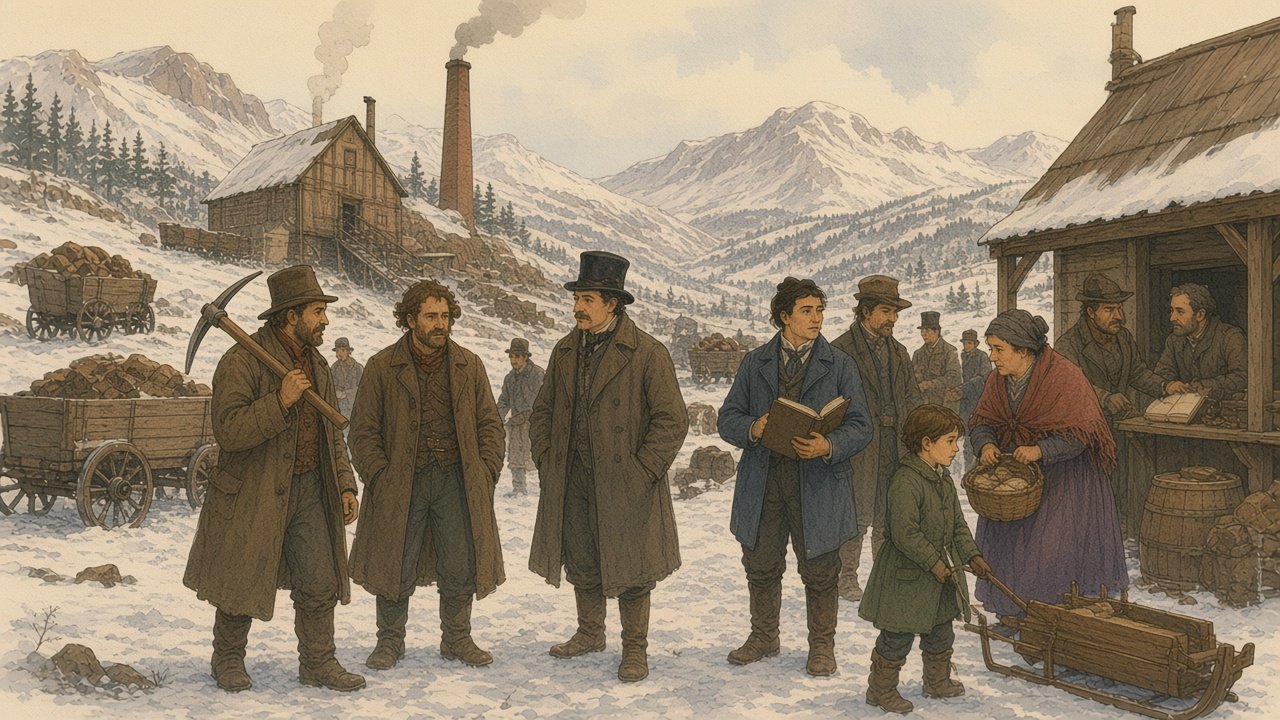
Leadville itself was an education in the risks of the business. Its population rose from a few hundred to tens of thousands in two or three years, and it acquired banks, theatres and an opera house alongside saloons and gambling halls. In 1880 its miners struck for higher wages and shorter hours, and the governor sent troops and declared martial law.[9][2] The most famous of its millionaires, Horace Tabor, who had made his fortune grubstaking two prospectors and then buying the Matchless mine, spent it on houses, theatres and politics and lost everything when the price of silver collapsed in 1893.[9] The lesson for the Guggenheims was clear: a mine was a wasting asset, and silver was a commodity whose price depended on decisions taken in Washington.[2][4]
Benjamin and William in Colorado
The family’s first representatives in the West were the younger sons. Benjamin, born in 1865, was sent to Leadville to learn the business at first hand, and he worked in the mine and at the smelter there, learning the trade in practice in a way that none of his elder brothers had done.[2][3] William, the youngest son, was sent to study metallurgy at the University of Pennsylvania and joined Benjamin in Colorado. These two would have the closest practical knowledge of smelting of any of the brothers, and they would also be the first to leave the partnership.[2]
The elder brothers were called home from Europe. In 1884 Meyer asked Daniel, who had spent eleven years in Switzerland, to return to the United States and help the family manage the mining enterprise.[5] In the same year Daniel married Florence Shloss, the daughter of a New York family; they would have three children, Robert, Harry and Gladys.[5] Murry and Solomon also turned their attention to metals, and Isaac took charge of the firm’s finances in New York. The lace and embroidery business was wound down and finally sold, and the capital released from it went into Colorado.[5][6][2]
A family in the metals business
By the second half of the 1880s M. Guggenheim’s Sons was no longer an importing house with a mining investment. It was a mining company with ambitions in smelting. The brothers had learned a new vocabulary of ores and assays, flux and matte, roasting and refining, and they were beginning to hire the engineers and metallurgists whose expertise would be essential to everything that followed.[2][7] Their father, now approaching sixty, had found in the mines a second career more remarkable than the first.
There were many fortunes made at Leadville, and most of them were spent or lost. Horace Tabor, the most famous of the Leadville millionaires, died poor in 1899 after the collapse of silver prices. The Guggenheims’ fortune survived, not because their mines were richer than others, but because they used the profits from the mines to buy into the stage of the industry that did not depend on the luck of any one deposit. That decision, taken in the late 1880s, is the subject of the next chapter.[2][1]
References
OpenClose
- “Smelters,” Dictionary of American History, reprinted at Encyclopedia.com *
- Irwin Unger and Debi Unger, The Guggenheims. A Family History (New York: HarperCollins, 2005), print *
- John H. Davis, The Guggenheims. An American Epic (New York: William Morrow, 1978), print *
- “Meyer Guggenheim,” Encyclopedia of World Biography, reprinted at Encyclopedia.com *
- “Daniel Guggenheim,” biographical entries reprinted at Encyclopedia.com *
- Obituary of Meyer Guggenheim, The New York Times, 17 March 1905 *
- Harvey O’Connor, The Guggenheims. The Making of an American Dynasty (New York: Covici, Friede, 1937), print *
- Thomas F. O’Brien, The Revolutionary Mission. American Enterprise in Latin America, 1900 to 1945 (Cambridge: Cambridge University Press, 1996), print *
- Wilbur Fiske Stone (ed.), History of Colorado, vol. 1 (Chicago: S. J. Clarke, 1918), print *
The family tree, timeline, places, glossary and select bibliography for the whole history are on the Guggenheim index page.