Money looking for work
By the late 1860s Meyer Guggenheim had more money than his household businesses could use. Like many merchants of his generation he looked for places to put it, and he found them first in the securities market and then in a trade that took him back, in a sense, to Switzerland.[1][2]
His first notable investment was in railway shares. Halfond records that he bought two thousand shares in a railway line which within a few years became essential to the construction plans of Jay Gould, the most feared speculator of the age, and that Guggenheim sold at a large profit.[1] The family histories identify the line as the Hannibal and St Joseph Railroad, which crossed Missouri from the Mississippi to the Missouri river and was one of the links in the chain of western routes over which Gould and his rivals were fighting.[3][2] The sums involved are given differently in different accounts, and the episode is best taken as the histories present it: an early sign that Meyer, the cautious maker of polish and lye, could also be a bold speculator when he judged the odds to be in his favour.[4][2]
The Mining Foundation of the Southwest, summing up his career for its hall of fame, lists the stages in order: stove polish, soap, lye and coffee, railroad stock investments, and eventually imported lace and embroidery.[5] It is a useful reminder that the mining fortune was the last chapter of a long commercial life, not its beginning. Meyer was over fifty when he first heard of Leadville.
Embroidery from St Gallen
The trade that made his first real fortune was the import of Swiss embroidery and lace. In the middle decades of the nineteenth century eastern Switzerland, and above all the region around St Gallen, became the centre of a new industry: machine embroidery. The hand embroidery machine, and later the Schiffli machine with its shuttle, allowed workshops to produce decorative trimming for dresses, underwear and household linen in quantities and at prices that hand work could not match. American demand was enormous, and much of the trade passed through the hands of importers in New York and Philadelphia.[2][6]
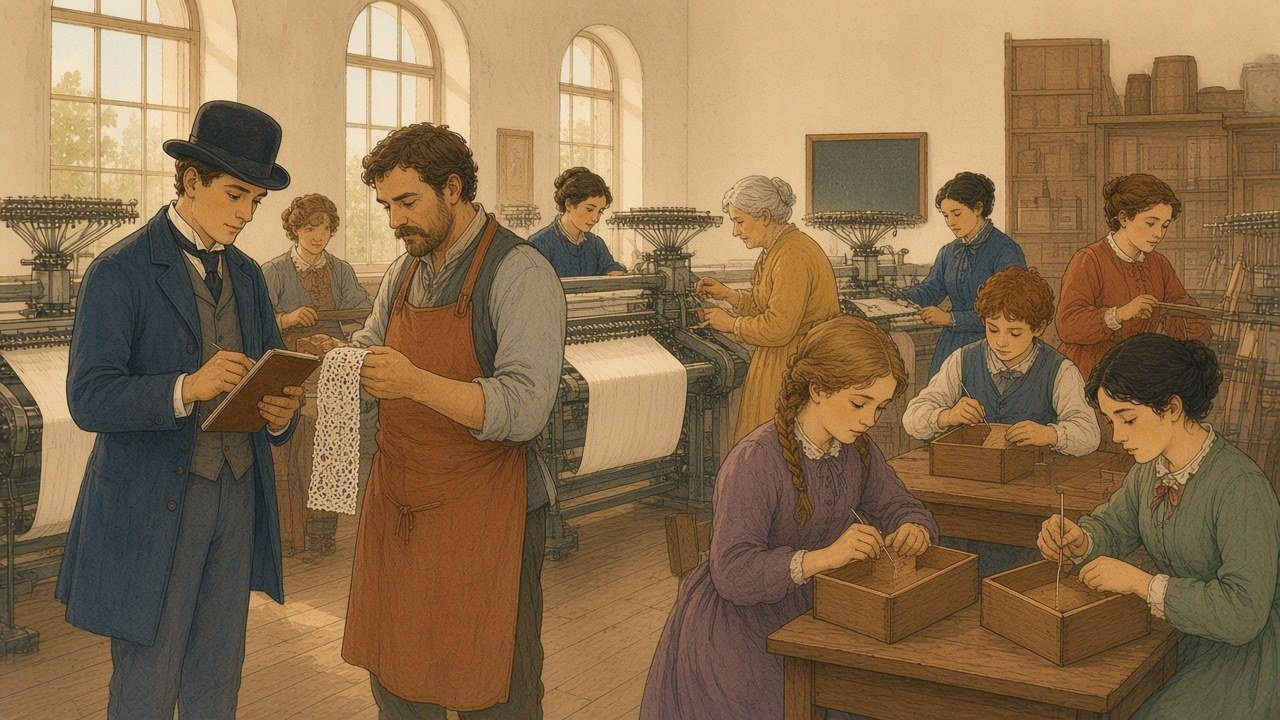
The Jewish Encyclopedia says simply that Meyer turned his attention next to embroideries, gaining a large fortune by importing the Swiss products.[7] He did so in partnership with a merchant named Morris Pulaski, under the name Guggenheim and Pulaski, and later on his own account.[2][3] The Encyclopedia of World Biography adds that when the first machine-made lace was woven in Switzerland, Guggenheim sent two sons there to establish factories, and made a modest fortune importing and selling the lace in the United States.[4] Other sources speak of the sons establishing machine-made lace factories in Switzerland under the family’s control, so that the firm both made and imported the goods.[8]
Isaac and Daniel abroad
The sons sent to Europe were the eldest, Isaac, and the second, Daniel. Isaac, born in 1854, was by every account the most conservative of the brothers, careful, methodical and happiest with accounts and contracts. Daniel, two years younger, was small, energetic, persuasive and quick to grasp the possibilities of a situation; he would become the leader of the family enterprise for a generation.[2][3] Daniel was sent to Switzerland as a teenager to learn the lace and embroidery business. The biographical sketches reprinted by Encyclopedia.com say that he remained in Europe for eleven years before he was called home, in 1884, to help manage the family’s mining interests.[8]
The years in Europe gave Daniel a cosmopolitan education. He learned the trade from the bottom, studied the machines and their operation, bought from manufacturers, managed the family’s factories and handled shipments to the United States. He became fluent in German and French, and familiar with the ways of European business.[8][2] The other sons were brought into the business in turn. Murry, the third son, was also trained in Switzerland and in the import trade. The younger boys, Solomon, Benjamin, Simon and William, were educated partly in Philadelphia and partly abroad; several spent time at schools in Switzerland, as their elder brothers had done.[2][3]
The embroidery trade also taught the family lessons that it would later apply to metals. It was an international business, in which goods made in one country were sold in another across a tariff wall, so that changes in American duties could make or break a season. It depended on fashion, which could turn suddenly, and on credit, since importers paid manufacturers months before they were paid by retailers. And it rewarded those who controlled several stages of the process, from the factory to the warehouse, rather than buying from one middleman and selling to another.[2][6] When the Guggenheims later built smelters to avoid paying other men’s treatment charges, and went to Mexico to get round a tariff, they were following a pattern first learned in the lace trade.[4][2]
Daniel spent about eleven years in Switzerland, and the experience shaped the man who would later lead the family’s mining empire. He learned the lace and embroidery trade from the bottom, studying how the machines of St Gallen worked and how the goods were priced, bought and shipped, and he learned German and French well enough to negotiate with the manufacturers on his own.[8][2] The family histories describe him as the most ambitious and the most restless of the brothers, small in stature, quick to anger and to decide, and at ease in a European business world that his father had known only as a poor emigrant.[2][3] Isaac, the eldest, was more cautious, and it was Daniel’s appetite for risk, rather than Isaac’s prudence, that would set the course of the firm once it turned to metals.[2][8] When Daniel came home in the early 1880s he brought with him not only a knowledge of lace but also a network of European contacts and a habit of thinking about trade on a continental scale.[8]
M. Guggenheim’s Sons
In 1881 Meyer reorganised the business and transferred it to New York under the name M. Guggenheim’s Sons.[7] The name, which would become famous in mining and finance, began as the name of an embroidery and lace importer. Its structure reflected Meyer’s convictions about family. Each of the sons who entered the firm became a partner with an equal share of the profits, whatever his age or contribution, an arrangement that the family histories see as both its strength and the source of later quarrels.[2][3] The partnership pooled the fortunes of the brothers and made them collectively responsible for its obligations. It also tied them to their father, who remained the head of the firm until his retirement and who decided, with his eldest sons, which ventures it would take on.
By the end of the 1870s Meyer had become a rich man. One account says that by 1879, at the age of fifty-one, he had amassed a fortune, and the family was living in a style appropriate to a prosperous merchant.[8] The figures quoted by the family histories for the value of the embroidery business vary, and none of them comes from audited accounts. What is clear is that the business was large enough to support eight sons and their families, and to finance a move into another industry altogether.[2][3]
The move to New York put the family at the centre of American commerce and finance, and among the German-Jewish families who were becoming its leading bankers. Meyer and Barbara settled on the Upper West Side, and in time their sons married into the families of that circle, the Seligmans, the Schlosses, the Myers and others.[2][9] It also placed them close to Wall Street at the moment when the opening of the West and the expansion of the railways were creating demand for metals of every kind.
A debt repaid in mining shares
The decision that changed the family’s history was taken almost casually. In 1881, the year of the move to New York, Meyer acquired an interest in two silver mines in Leadville, Colorado, called the A.Y. and the Minnie. The Encyclopedia of World Biography says that he accepted a half interest in the mines in payment of a debt, and then reluctantly invested a further $20,000 to get them into operation.[4] Other accounts say he bought a share from a Philadelphia acquaintance who was short of funds, and give different figures for the price and the size of the share.[2][3][8] The details vary from book to book, and some reference works even misdate the purchase to 1887.[10] The best-supported version is that the interest was acquired around 1880 or 1881, that the mines were flooded when Meyer acquired it, and that he had no idea when he did so that he had bought one of the richest silver properties in the American West.[4][8][11]
He also did not intend, at first, to leave the embroidery trade. For some years M. Guggenheim’s Sons continued to import lace and embroidery while Meyer and his sons learned about mining. The decision to sell the embroidery business and put everything into metals came later in the decade, once the mines had shown what they could produce. The New York Times, in its obituary of Meyer in 1905, summed up the turning point by saying that he disposed of his flourishing manufacturing business without hesitation and, with his sons as his associates, mastered the intricacies of mining and then of smelting.[11] The phrase “without hesitation” is an obituarist’s flourish. As the next chapter shows, the decision was preceded by several anxious years of pumping water from a mineshaft in the Rocky Mountains.
References
OpenClose
- Irwin Halfond, “Meyer Guggenheim,” EBSCO Research Starters, 2024 *
- Irwin Unger and Debi Unger, The Guggenheims. A Family History (New York: HarperCollins, 2005), print *
- John H. Davis, The Guggenheims. An American Epic (New York: William Morrow, 1978), print *
- “Meyer Guggenheim,” Encyclopedia of World Biography, reprinted at Encyclopedia.com *
- Mining Foundation of the Southwest, “Meyer Guggenheim,” American Mining Hall of Fame *
- Harvey O’Connor, The Guggenheims. The Making of an American Dynasty (New York: Covici, Friede, 1937), print *
- Isidore Singer et al., “Guggenheim, Meyer,” Jewish Encyclopedia (New York: Funk and Wagnalls, 1901 to 1906) *
- “Daniel Guggenheim,” biographical entries reprinted at Encyclopedia.com *
- Edwin P. Hoyt, The Guggenheims and the American Dream (New York: Funk and Wagnalls, 1967), print *
- “Smelters,” Dictionary of American History, reprinted at Encyclopedia.com *
- Obituary of Meyer Guggenheim, The New York Times, 17 March 1905 *
The family tree, timeline, places, glossary and select bibliography for the whole history are on the Guggenheim index page.