When Joseph Duveen died in May 1939, the firm that bore his family’s name passed out of the family’s hands. The firm’s own records and later accounts agree on the two men who took over, but not on exactly when or how. The archive’s history says that on Joseph’s death Armand Lowengard and Edward Fowles became joint owners of the firm.[1] Fowles’s obituary in the New York Times says that a year before Lord Duveen’s death, Fowles and two partners bought the company, and that by 1958 he had acquired their shares.[2]
Lowengard and Fowles
Armand Lowengard came from a Paris family of antique dealers; the Duveens had bought a Georges Jacob bed from the Lowengards as early as 1887.[3] His relationship to Joseph is described differently in different sources. The archive’s finding aid calls him Joseph’s nephew; Time magazine in 1930 called him Sir Joseph’s son-in-law and said that he managed the Paris branch; the National Gallery of Art’s chronology calls him Joseph’s brother-in-law.[1][4][5] The finding aid says that he died in 1943; the National Gallery of Art’s chronology gives 1944.[1][5]
Edward Fowles had directed the firm’s Paris branch from 1917 to 1938, and served as vice-president of the New York gallery from 1938 to 1945, when he became president.[2] He had been at Joseph’s side for twenty years, carrying the Allendale Nativity to I Tatti and sending the cable that ended the partnership with Berenson.[6] He knew the firm’s methods and its clients as well as anyone alive.
The war
The Second World War shattered the European side of the business. The German occupation of France forced Duveen Brothers to evacuate Paris, and the London office closed soon afterwards.[1] The great house in the Place Vendôme and the gallery in Old Bond Street, which had been the firm’s centres for buying in Europe, ceased to operate. The New York gallery at 720 Fifth Avenue was now the whole of the business.
The market that the firm had dominated had also changed. The American millionaires who had paid record prices in the 1920s were dead or had given their collections to museums. Schjeldahl observes that after Joseph’s death the business declined “for want of his interventions”, and that the prices of the English portraits he had promoted never fully recovered.[7]
Post-war clients
The firm still had important customers. The archive lists among them Henry Ford II and Robert Lehman, and Fowles’s obituary adds Charles Wrightsman.[1][2] The archive’s history adds that the business never regained its former vibrancy.[1] Fowles summed up the dealer’s craft in a sentence: “Two things are needed. You have to be an intelligent buyer and a good salesman. They’re rarely combined”.[2]
Too commercial
In 1951 Duveen Brothers announced that it would leave 720 Fifth Avenue for the former house of Mrs Stanley Grafton Mortimer at 18 East Seventy-Ninth Street, explaining that the old location had grown “too commercial”.[8] The limestone palace that Sergent and Trumbauer had built in 1912 to look like a private house had been overtaken by the shops of Fifth Avenue; now the firm moved into a real private house. The five-storey mansion would be its last home.[2]
Norton Simon
The end came through a single picture. Norton Simon, the industrialist whose businesses included Hunt-Wesson Foods, Canada Dry and later Avis, began collecting in the mid-1950s, buying mostly nineteenth-century paintings for his house.[9][10] In 1957 he became interested in a Bust Portrait of a Courtesan attributed to Giorgione, which the firm offered him for $190,000.[11] He thought the price too high for a single painting but kept coming back to it, taking the picture home, returning it and taking it again.[9][11]
In 1963 he asked what else the firm had. Fowles later recalled the conversation. Simon, he said, “told me he wanted to buy a lot of stuff.” “I told him that this would mean that much of my finest stock would be gone. He said, ‘Why don’t [I] buy the whole thing, lock stock and barrel, including the building?’ That’s how it started”.[2] Simon made two offers: about $1.57 million for a group of works including the Giorgione, or $4 million for everything in stock together with the building and library.[11]
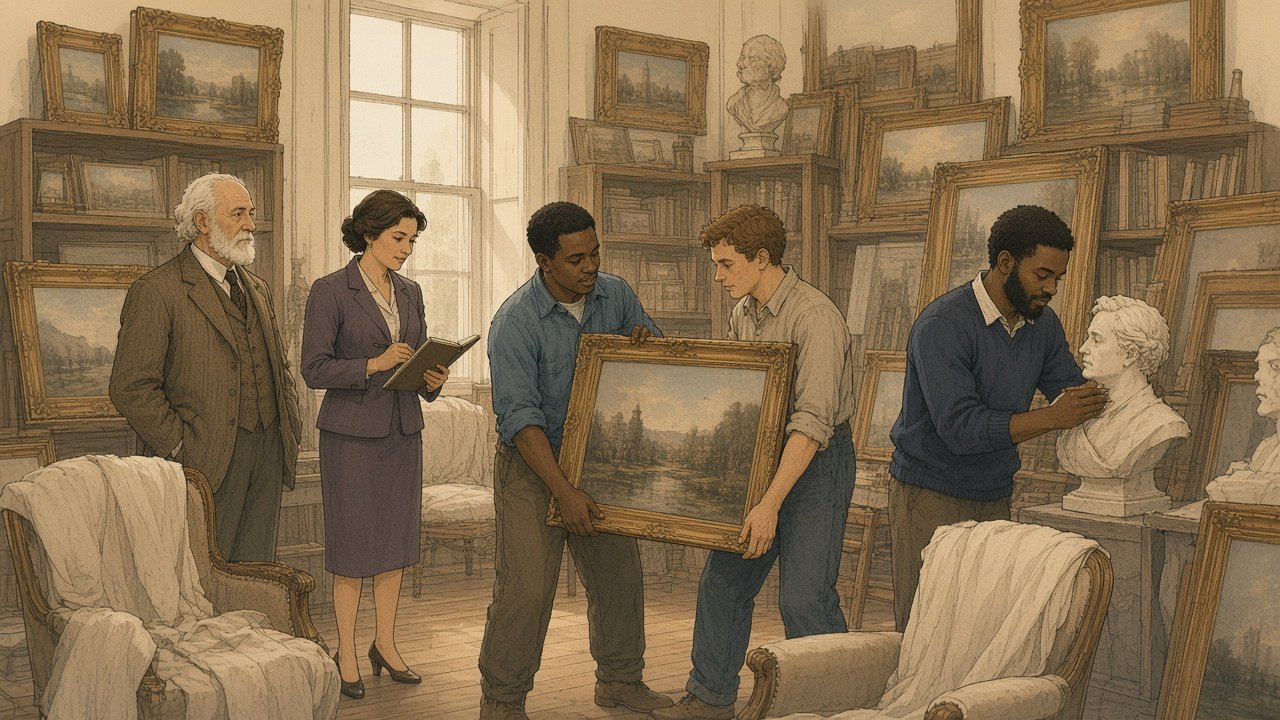
On 18 April 1964 the Norton Simon Foundation agreed to buy the entire inventory of Duveen Brothers, with its library and the five-storey building on East Seventy-Ninth Street, for $4 million.[10] The inventory included nearly three hundred European paintings, drawings and sculptures, a hundred pieces of French, Italian and English furniture, and four hundred decorative objects, among them tapestries, carpets and stained glass.[10] Fowles valued the collection at $15 million.[2] He was seventy-nine, and the sale, as the Los Angeles Times put it, gave him the chance to retire with enough money to provide for himself and his staff.[10] The firm’s last sale to the public, Fowles said, was made in March 1964: a portrait of a girl by Mainardi, bought by a collector from Dayton, Ohio.[2]
Simon got almost eight hundred objects. Over the years he sold most of them, and about 130 remain at the Norton Simon Museum in Pasadena.[9] Among the pictures that stayed are the Giorgione courtesan, Titian’s Salome with the Head of John the Baptist and a Madonna and Child in a Landscape by Giovanni Bellini.[10] His chief curator, Carol Togneri, said that the purchase became “a game almost for him”, driven by “this zeal to find the best for the cheapest amount of money”.[9] In 2014 and 2015 the museum marked the fiftieth anniversary with an exhibition, Lock, Stock and Barrel: Norton Simon and the House of Duveen.[10][12]
Fowles kept his eye to the end. In 1965, a year after the sale, he declared that a stucco bust which the Metropolitan Museum had bought at auction for $225 was a $500,000 bargain, since experts attributed it in whole or in part to Leonardo da Vinci or to his master Verrocchio.[2] It was the kind of pronouncement that Joseph Duveen would have enjoyed.
Fowles served as a consultant to the Norton Simon Foundation after the sale.[1][2] He died at his winter home in Barbados in March 1971, aged eighty-five.[2]
The archive
The firm had always guarded its records jealously. Brewer notes that no one outside the firm had access to its archives, and that this continued after Joseph’s death.[13] The 1964 sale excluded the business records.[1] In 1968 Fowles gave his papers and the Duveen Brothers business records to the Metropolitan Museum of Art, where they stayed until 1996.[1] In 1969, according to the finding aid, the Sterling and Francine Clark Art Institute bought the firm’s library of books, periodicals and sale catalogues, together with part of the business records interfiled with it; the National Gallery of Art’s chronology dates the Clark’s purchase to 1965 or 1966.[1][5]
In 1996 the Metropolitan Museum gave the archive to the Getty Research Institute in Los Angeles.[1] It runs to some 394 linear feet, in 585 boxes, with about two thousand negatives, and contains ledgers, sales books, stock reports, invoices, letters and cables, press cuttings, photographs and X-rays of paintings.[1] Its opening transformed the study of the firm. Cohen notes that many details of the Berenson partnership remained hidden until the archive was opened to researchers, and the scholarship of Charlotte Vignon, Meryle Secrest and the authors of the essay on 720 Fifth Avenue all rests on it.[6][3][8] Both parts of the archive were digitised with the support of the Samuel H. Kress Foundation.[14]
The finding aid gives a sense of what the records contain. Much of the correspondence between the London, Paris and New York houses survives in carbon copies, and the guide calls it “voluminous and revealing of the strategies employed in buying and selling art”.[1] Twelve boxes hold letters between Bernard Berenson and the firm’s staff, and others record exchanges with the scholars on whose opinions the firm relied, among them Wilhelm von Bode, Max Friedländer, Lionello Venturi and W. R. Valentiner. There are papers from the lawsuits, including Hahn against Duveen, about a hundred X-rays of paintings and some thousand photographs, a number of them annotated by Berenson and other experts.[1] The archive also includes six linear feet of Edward Fowles’s own papers, among them material for his memoir of the firm, and records of the dealers Kleinberger and Company.[1]
Not everything went to Los Angeles. The Metropolitan Museum kept the bound volume known as the X book, which records the paintings authenticated by Berenson and sold by Duveen between 1910 and 1927, together with ten client summary books covering 1894 to 1959.[1] The Clark Art Institute holds some 240 cubic feet of Duveen records alongside the firm’s library, many of whose catalogues are annotated. Between 1999 and 2002 the archive and the Metropolitan’s volumes were microfilmed, and copies of the 422 reels were placed in New York, in the Witt Library of the Courtauld Institute in London and in Paris; the original papers are restricted because they are brittle.[1] The secrecy that Joseph Duveen guarded so carefully has become one of the best documented histories of the art trade.
The National Gallery of Art in Washington holds some two thousand objects that came through the Duveens, and the Metropolitan Museum nearly as many; there are substantial holdings at Detroit, Philadelphia, the Frick and the Huntington.[3] The firm that began with a stock of Delftware in Hull ended as the source of a large part of the Old Masters in American public collections.
References
OpenClose
- Getty Research Institute, Finding aid for the Duveen Brothers records, 1876 to 1981 (accession no. 960015) *
- “Edward Fowles of Art Gallery, Ex-Duveen Owner, Dies at 85”, The New York Times, 20 March 1971 *
- Wendy Moonan, “The Family That Brought European Luxury to America’s Gilded Age Tycoons”, 1stDibs Introspective, 1 September 2019 *
- “Art. Sir Joseph and His Brethren”, Time, 21 July 1930 *
- National Gallery of Art, “Duveen Brothers, Inc.”, Archives biographies *
- Rachel Cohen, “Priceless. How Art Became Commerce”, The New Yorker, 8 October 2012 *
- Peter Schjeldahl, “Masterpieces for Sale”, The New Yorker, 8 November 2004 *
- Anne Helmreich, Jill Sterrett and Jacqueline van Ginhoven, “Purpose-Built. Duveen and the Commercial Art Gallery”, Nineteenth-Century Art Worldwide 20, no. 2 (Summer 2021) *
- Susan Stamberg, “Meet Joseph Duveen, the Savvy Art Dealer Who Sold European Masterpieces”, NPR, 9 March 2015 *
- Suzanne Muchnic, “Norton Simon. A look at the art purchase that transformed the collector”, Los Angeles Times, 17 October 2014 *
- “One painting led Norton Simon to buy a whole gallery, building included”, LAist, 10 November 2014 *
- Carol Togneri, “Norton Simon and the House of Duveen”, Incollect, 5 November 2014 *
- John Brewer, “The Art of the Deal”, The New York Review of Books, 7 October 2004 *
- Emmabeth Nanol, “The Man of La Belle Ferronière”, Getty News, 23 May 2013 *
The family tree, timeline, places, glossary and select bibliography for the whole history are on the Duveen index page.