Joseph Duveen’s father had turned himself into a benefactor of the British national collections in the last years of his life. The son did the same on a far larger scale. The archive’s history lists his gifts: new galleries at the Tate for modern foreign art, for the work of Sargent and for modern sculpture; a new building at the National Gallery; new galleries at the National Portrait Gallery; a gift to London University; and a new building at the British Museum for the Parthenon sculptures and the Nereid monument.[1] Brewer, following Secrest, sees these benefactions as part of his consolidation of himself as a public figure,[2] and the Ben Uri Research Unit, following Elizabeth Kehoe, describes his philanthropy as “a means of consolidating his position among the nation’s elite”.[3]
The Tate
The first great gift was to the Tate, where his father had paid for the Turner wing. Duveen contributed to the building of the Modern Foreign and Sargent Galleries, which King George V and Queen Mary opened on 8 June 1926.[4] He also paid for the gallery’s restaurant, decorated with a mural by Rex Whistler, The Expedition in Pursuit of Rare Meats, which has since become controversial for its racist caricatures.[5] Among the pictures he gave the Tate were Sargent’s study of Madame Gautreau and Augustus John’s study for his portrait of Madame Suggia.[3]
He took up the cause of living artists as well. In 1926, according to the New Yorker, he wrote an open letter to the Prime Minister, Stanley Baldwin, scolding the nation for failing to buy the work of living painters and declaring that the current English school was the finest since Reynolds and Gainsborough; he started a fund to help struggling young painters and bought works by living American artists to send to England.[6] He founded the British Artists Exhibitions organisation to encourage lesser-known British artists, and in 1930 published Thirty Years of British Art.[1]
Honours and trusteeships
The honours followed the gifts. Knighted in 1919, Duveen was made a baronet in the 1920s; the New Yorker, writing in April 1928, says the baronetcy came “last year”, the National Gallery of Art’s archive chronology gives 1926, and the Encyclopaedia Judaica gives 1929.[6][7][8] He became a trustee of the National Gallery in London, in 1929 according to Brewer and from 1930 to 1936 according to Challis, and also served as a trustee of the Wallace Collection and of the Imperial Gallery of Art.[2][5][1]
It was a remarkable position for a dealer. The Encyclopaedia Judaica notes that the apparent conflict of interest of an art dealer helping to decide which works the national museums should buy was widely debated, and that it led to his removal from these posts shortly before his death.[8] Brewer describes his “ignominious removal from the Trustees of the National Gallery”, and notes that the gallery’s young director, Kenneth Clark, distrusted him.[2] In 1932 he presented a gallery for early Italian paintings to the National Gallery, and he gave it pictures including Hogarth’s The Graham Children.[3]
At the National Portrait Gallery he gave £40,000 towards new galleries, which George V opened in 1933.[5] That year he was raised to the peerage as Baron Duveen of Millbank, taking his title from the site of the Tate.[9] The Encyclopaedia Judaica calls it the first peerage ever awarded to an art dealer.[8] Schjeldahl notes that his long cultivation of Ramsay MacDonald, the Labour Prime Minister, who was not a collector, helped, and that the honour came despite “sore feelings about Duveen’s systematic export of national treasures”.[10]
The sculpture halls at Millbank
The largest of his gifts to the Tate was a suite of sculpture galleries running through the heart of the building opposite the Millbank entrance. Designed by John Russell Pope with Romaine-Walker and Gilbert Jenkins, the neoclassical galleries are some three hundred feet long, and they were the first public galleries in England designed specifically for the display of sculpture.[11] King George VI opened them on 29 June 1937.[4] Today the Duveen Galleries house an annual commission by a British artist.[11]
A gallery for the Parthenon
The British Museum project began, according to Debbie Challis, following Kehoe, when Lord d’Abernon, chairman of the Royal Commission on National Museums and Art Galleries, suggested to his friend Duveen that he pay for a gallery as a means of getting a peerage.[5] In 1928 Duveen offered £40,000 to build a new gallery for the Parthenon sculptures, which had been displayed for a century in a cramped room built in the 1830s.[5] He insisted on his preferred architect, Pope, while the trustees asked three classical scholars, John Beazley, Donald Robertson and Bernard Ashmole, for proposals; in 1929 they recommended putting the original sculptures together in one gallery, as works of art rather than archaeological specimens.[5] The Ben Uri Research Unit says that the gallery eventually cost more than £100,000 and took ten years to complete.[3]
Duveen wanted the sculptures to look white. Challis, drawing on William St Clair, writes that he “harangued” the trustees over their colour, and on one account even talked of dipping them in acid.[5] The marble from Mount Pentelicon had weathered to a golden-brown patina that did not match the polished white of later classical taste.
Copper tools and carborundum
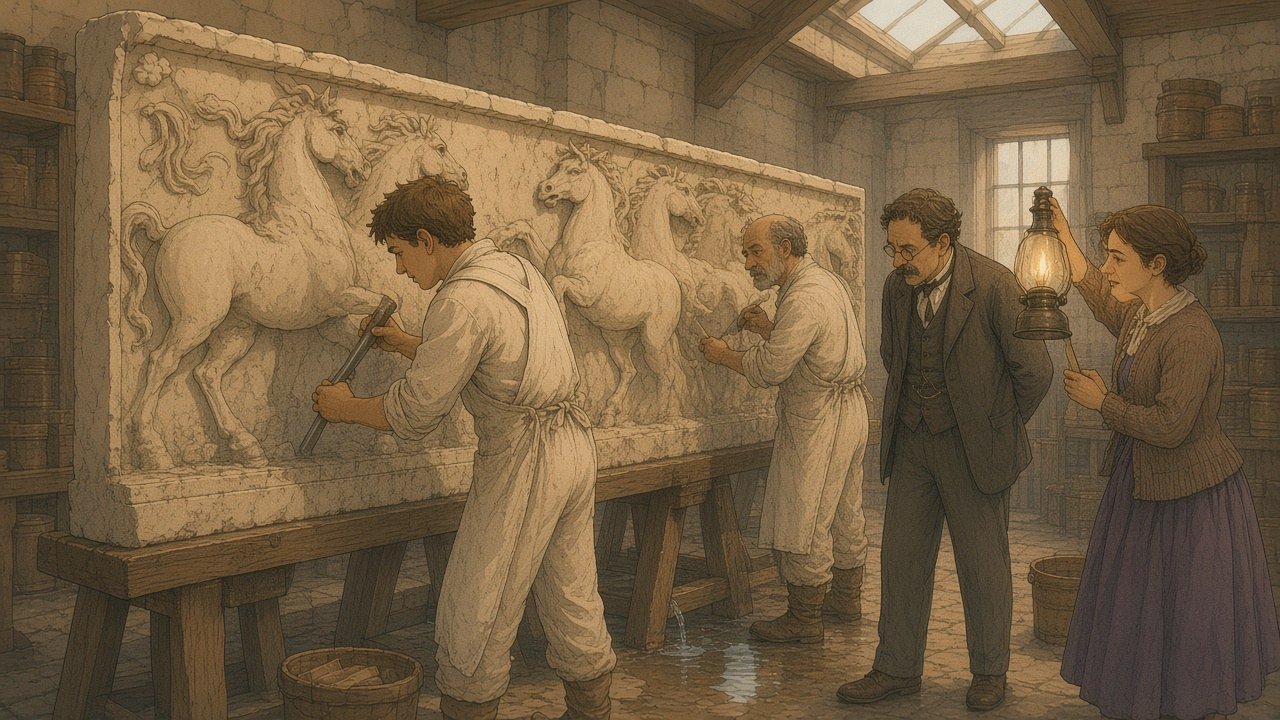
What followed became one of the great scandals in the museum’s history. The museum’s scientist, Harold Plenderleith, had devised a safe method of cleaning with soap and ammonia.[5] But Duveen brought in his own foreman, and the museum’s chief mason, Arthur Holcombe, was, in Challis’s account, bribed to look the other way or to use more robust methods.[5] Over some fifteen months, according to the British Museum’s own later memorandum to Parliament, copper chisels and carborundum were used on some of the sculptures in addition to the recommended soap and water.[12] St Clair later described labourers using “hammers, chisels, copper rods, scrapers, wire brushes”, and carborundum, an artificial abrasive that was then the hardest substance known after diamond.[13]
The work was finally noticed in September 1938 by John Forsdyke, the museum’s Director and Principal Librarian, who had been appointed in 1936 partly because the trustees thought he could handle Duveen.[5] An internal report admitted that “the damage is obvious and cannot be exaggerated”.[13] After an enquiry, the Keeper of Greek and Roman Antiquities, F. N. Pryce, took early retirement, a young Assistant Keeper, Roger Hinks, resigned, and all the craftsmen involved left the museum’s service. The museum issued a statement to the press on 18 May 1939, a week before Duveen’s death.[12]
The gallery was completed in 1938, but the outbreak of war prevented its opening. The sculptures were taken to safety, the frieze to an unused section of the Underground, and the gallery itself was seriously damaged by bombing in 1940. It finally opened in 1962.[12]
Sixty years later
The cleaning was largely forgotten until the publication of the third edition of St Clair’s Lord Elgin and the Marbles in 1998, which reproduced the museum’s internal papers.[13] The museum held an international conference on 30 November and 1 December 1999, attended by three hundred scholars; its director, Robert Anderson, called the cleaning “one of the most controversial episodes in the history of the BM”.[13] St Clair produced a piece of carborundum from his pocket; Ian Jenkins of the museum criticised the cleaning and the cover-up but argued that the damage was less serious than critics claimed.[13] Jenkins later gathered the documents in Cleaning and Controversy, published by the museum in 2001.[14]
The last years
Duveen kept his illness secret. Brewer says that he was dogged by cancer from the late 1920s, and Schjeldahl describes a five-year losing struggle that he hid from the world.[2][10] He remained, Brewer writes, doggedly optimistic to the end.[2] He had married Elsie Salomon, daughter of Gustav Salomon of New York, in 1899, and their only child was a daughter, Dorothy.[6]
He died on 25 May 1939.[7] Schjeldahl says that he left fifteen million dollars in the bank, an inventory worth ten million, and a business that “promptly declined for want of his interventions”.[10] Neither of the galleries that bear his name in London was yet open to the public with its intended contents: the British Museum’s was waiting for its sculptures, and within months the Tate’s would be emptied for the war.
The Tate’s sculpture halls had little time in use. Arrangements to evacuate the gallery’s collection were made after the Munich Agreement in 1938, the gallery closed on 24 August 1939, and in September 1940 and January 1941 bombs struck the building, shattering the roof of the Rotunda that adjoins Duveen’s galleries.[4]
Secrest’s judgement, quoted by Brewer, is that Duveen was “the creative spirit behind the great American collections that became the great American art museums”, and that because of him “American museums are filled with Old Masters rather than tenth-rate salon paintings”.[2] In London his memorial is in stone: the Duveen Galleries at Millbank and the Duveen Gallery in Bloomsbury.
References
OpenClose
- Getty Research Institute, Finding aid for the Duveen Brothers records, 1876 to 1981 (accession no. 960015) *
- John Brewer, “The Art of the Deal”, The New York Review of Books, 7 October 2004 *
- Ben Uri Research Unit, “Joseph Duveen”, contributor biography *
- Tate, “History of Tate Britain” *
- Debbie Challis, “Seeing White. Chromophobia for Chromophobia’s Sake”, 21 January 2022 *
- Alva Johnston, “Noble Merchandise”, The New Yorker, 21 April 1928 *
- National Gallery of Art, “Duveen Brothers, Inc.”, Archives biographies *
- W. D. Rubinstein, “Duveen”, and “Duveen, Joseph, Lord”, Encyclopaedia Judaica, 2nd edn, vol. 6 (Detroit: Macmillan Reference, 2007), p. 73 *
- Hull Jewish Archive Committee, Historical Walking Tour of Jewish Hull (Hull, 2008) *
- Peter Schjeldahl, “Masterpieces for Sale”, The New Yorker, 8 November 2004 *
- Tate, “Duveen Galleries at Tate Britain” *
- House of Commons Culture, Media and Sport Committee, Seventh Report 1999 to 2000, “Annex IV. The Parthenon Sculptures” (British Museum memorandum) *
- Martin Bailey, “Parthenon Marbles conference report”, The Art Newspaper, 1 January 2000 *
- Ian Jenkins, Cleaning and Controversy. The Parthenon Sculptures 1811 to 1939, British Museum Occasional Paper 146 (London: British Museum, 2001) *
The family tree, timeline, places, glossary and select bibliography for the whole history are on the Duveen index page.