November 1864
David Sassoon died in the first week of November 1864, at about seventy-two. Even the main reference works do not agree on the details. The Dictionary of National Biography says that he “died of fever at Poonah on 5 Nov. 1864.”[1] The Jewish Encyclopedia gives the place as Bombay and the date as 7 November.[2] His tomb is in the courtyard of Ohel David in Pune, which supports the Pune version of where he died. The Bombay memorial meeting of 13 December, called by the governor, shows how far the refugee merchant had come. He had become one of the public men of the city.[2][3]
He left behind a firm with branches across Asia and in England, eight sons by two wives, and a set of institutions that bore his name. Two of the sons had particular claims to succeed him. Abdallah, born in Baghdad in 1818 to David’s first wife, Hannah, was the eldest.[1] The Jewish Encyclopedia gives his year of birth as 1817.[2] He had been educated in India and had spent time developing the firm’s trade with China.[1] Elias, born in 1820, was the second son and had opened the firm’s China business in 1844. For two decades he had been the man on the spot in Canton, Hong Kong and Shanghai.[4]
The will and Elias’s refusal
David’s will named Abdallah as head of the firm. Joseph Sassoon, who has read the family papers, writes that Elias “refused to abide by the will. After three years of futile negotiations, the family split into two competing firms.”[5] Sotheby’s catalogue essay on the family describes the brothers as sharing control at first, but on unequal terms. “Because of these and other tensions,” Elias broke away in 1867 and founded E. D. Sassoon & Co., also based in Bombay.[4] The Encyclopaedia Judaica puts it more bluntly: Elias, “disliking his subordinate position, left the family business.”[3]
The new firm began modestly. According to Sotheby’s, it dealt at first in less profitable goods, such as tea, spices, camphor, fruit, nankeen cloth, silk and metals, before it entered the opium and cotton trades in competition with the parent house.[4] Dinyar Patel observes that from the 1860s onward the two firms “became bitter rivals in the opium trade,” and calls the rift “the first crack in the mighty Sassoon edifice.”[6] Commercially the quarrel did neither side much harm in the short run. The Encyclopaedia Judaica judges that the new company, with interests in the Orient, Africa, Europe and America, “prospered even more than the original one.”[3]
From this point the history of the Sassoons divides. The “old” house of David Sassoon & Co. was led by Abdallah, who became Sir Albert. It moved its centre of gravity to London and produced most of the English Sassoons: the baronets, the hostesses, Rachel Beer and, by marriage and descent, Philip and Siegfried. The “new” house of E. D. Sassoon & Co. stayed rooted in Bombay and Shanghai. It produced Sir Jacob and, in the twentieth century, Sir Victor. The chapters that follow take each line in turn.
Mills and the move to London
Under Albert, David Sassoon & Co. began to move from trade into industry. The Dictionary of National Biography records that after his father’s death “factories for the manufacture of silk and cotton goods were opened” in Bombay, giving work to large numbers of Indians. The Encyclopaedia Judaica credits him with establishing “one of the first large-scale textile mills in Bombay.”[1][3] The family also bought land. Patel notes that the Sassoons came to own large tracts of what is now central Mumbai, on which they built many of the mills that powered the city’s economy into the middle of the twentieth century.[6] Further afield, the Jewish Encyclopedia records that the Sassoons managed the Port Canning Company, which held estates at the mouth of the River Mullah, as it spells the name, in Bengal.[2]
Sotheby’s catalogue essay adds some detail to his career. Albert’s first posts for the firm were in Baghdad and then Shanghai, and he came back to Bombay in 1862 to help his ageing father. After he took over, he used the opening of the Suez Canal in 1869 to found new branches in the Middle East. In 1874 he set up a subsidiary, the Sassoon Spinning and Weaving Company, to manufacture textiles in Bombay’s mills.[7] In 1889, by the same account, he helped to found the Imperial Bank of Persia, and he served as president of the Jewish community of Manchester.[7]
Albert himself, however, wanted to be in London. Joseph Sassoon writes that he “felt that as chairman of a global firm, he should be close to the locus of British imperial power and decision-making.”[5] His knighthood in 1872 gave him the occasion. He took the English form of his name, as every Sassoon who moved to England did, and moved the firm’s headquarters from Bombay to 12 Leadenhall Street in the City. The site had once belonged to the East India Company. On the top floor, Joseph Sassoon records, “a staff of translators handled bills of lading and marine insurance written in Hebrew, Arabic, Persian, Chinese and Hindustani.”[5] His third brother, Sassoon David Sassoon, had already opened the family’s London business in 1858 and branches in Liverpool and Manchester, so Albert was not starting from nothing.[1][7] Albert visited England in 1873 and settled there permanently soon afterwards. The day-to-day running of the Bombay house fell to his younger brother Solomon.[1][6]
The first wet dock on the west coast
Before he left India, Albert gave Bombay its most practical Sassoon monument. The Dictionary of National Biography calls “the construction of the Sassoon dock at Colaba” his “main benefaction to Bombay”. It was “the first wet dock on the western coast of India” and covered 195,000 square feet. Work began in 1872 and was finished in 1875.[1] A wet dock holds water at a constant level behind gates, so that ships can load and unload whatever the tide. Bombay’s older docks had been dry docks for building and repair. The Jewish Encyclopedia adds that the success of the Sassoon Dock spurred the Bombay government to build the much larger Prince’s Dock, and the Encyclopaedia Judaica notes that it employed thousands of local workers.[2][3] The Gazetteer of Bombay City and Island says that the dock was opened by David Sassoon & Co. in 1875 and bought by the government on behalf of the Port Trustees in 1879. For several years after that it was used as a boat basin and a landing place for troops. The Gazetteer also suggests why the government bought it. From 1873, when the Port Trust was set up, until 1879, the Trust’s accounts were in deficit. The Gazetteer blames this chiefly on competition from the private wharf owners along the foreshore, “chief among whom were Messrs. D. Sassoon & Co., who had built a small dock at the Colaba end of the foreshore.”[8]
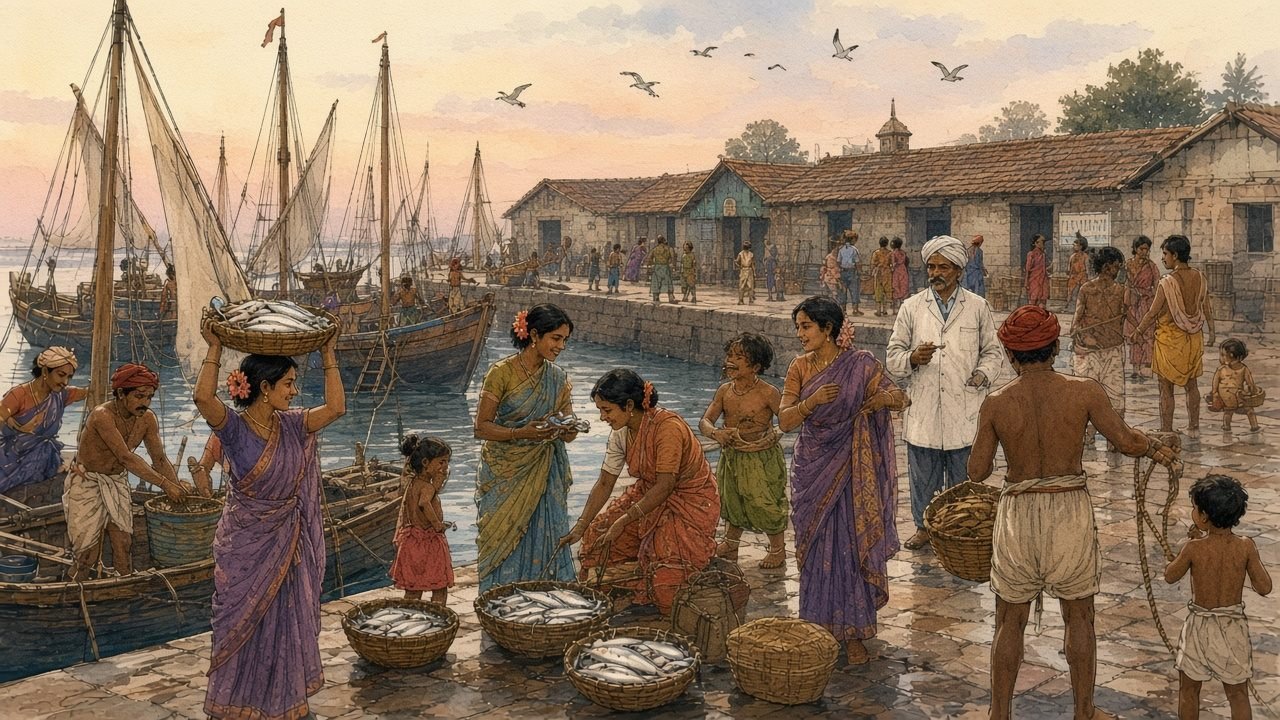
The dock survives, though its trade has changed entirely. Sassoon Dock is now Mumbai’s oldest fishing harbour and a cultural hub for the Koli fishing community. Every morning, long before the city wakes, Koli fisherwomen bargain over prawns, Bombay duck and pomfret, and the catch is auctioned and sent on to hotels, markets and exporters.[9] Few of the people who work there are likely to know who Albert Sassoon was. Their working day, however, still runs on a timetable his quay made possible.
Statues, schools and honours
Albert’s other gifts to Bombay followed his father’s mix of the useful and the ceremonial. In 1872 he gave a lakh of rupees, then reckoned at £10,000, towards rebuilding the Elphinstone High School. Later he added half a lakh more as a thank-offering for the recovery of the Prince of Wales, and the building was finished in 1881. He founded scholarships at the university and the art school, gave an organ to the Town Hall to mark the Duke of Edinburgh’s visit, and built a school in Baghdad for the Alliance Israélite Universelle.[2][1] When the Prince of Wales visited Bombay in 1876, Albert commemorated the visit with an equestrian statue by Joseph Edgar Boehm.[1] Patel notes that it gave a whole district its name: Kala Ghoda, the “black horse”, at the southern tip of the Fort, where the family’s library also stands.[6]
The honours came steadily. He was made a Companion of the Star of India in 1867, joined the Bombay legislative council in 1868 and was knighted in 1872. The Shah of Persia gave him the Order of the Lion and the Sun, in 1871 according to the Dictionary of National Biography.[2][1] In November 1873 the City of London gave him its freedom. The Jewish Encyclopedia says he was the first Anglo-Indian to receive it.[2] Joseph Sassoon quotes the commemorative brochure: “This is the first time an East Indian merchant has been admitted to the honour.”[5]
In England he lived as the head of a great family was expected to live. He had a mansion at Albert Gate in Knightsbridge and a house at Brighton, and the Prince of Wales was a frequent guest. When the Shah came to England in 1889, Albert entertained him.[1] He was created a baronet on 22 March 1890, taking his territorial designation, Sotheby’s records, from Kensington Gore.[1][7] Vanity Fair caricatured him in 1879 under the title “The Indian Rothschild.”[1] He died at 1 Eastern Terrace, Brighton, on 24 October 1896 and was buried in an elaborate private mausoleum he had built on adjoining land.[1] The refugee’s son who had been born in Baghdad thus ended his life on the Sussex coast as a baronet of the United Kingdom.
References
OpenClose
- E. I. C., “Sassoon, Sir Albert Abdullah David (1818–1896),” Dictionary of National Biography, vol. 50 (London: Smith, Elder, 1897), pp. 312–313 *
- Joseph Jacobs, Goodman Lipkind and J. Hyams, “Sassoon,” Jewish Encyclopedia, vol. 11 (New York: Funk and Wagnalls, 1906), pp. 66–68 *
- “Sassoon,” Encyclopaedia Judaica, 2nd ed. (Detroit: Macmillan Reference, 2007), reprinted at Encyclopedia.com *
- Sotheby’s, “The Sassoons in the Far East” *
- Joseph Sassoon, “How to lose an empire,” The Critic, April 2024 *
- Dinyar Patel, “The Rise and Fall of the Sassoons,” The India Forum, 6 October 2022 *
- Sotheby’s, “The Sassoons in England” *
- S. M. Edwardes (comp.), The Gazetteer of Bombay City and Island, vol. 3 (Bombay: Times Press, 1910) *
- Jinit Parmar, “Sassoon Dock: Mumbai’s Oldest Fishing Harbour Faces A Storm,” Outlook India, 19 September 2025 *
The family tree, timeline, places, glossary and select bibliography for the whole history are on the Sassoon index page.