Magen David at Byculla
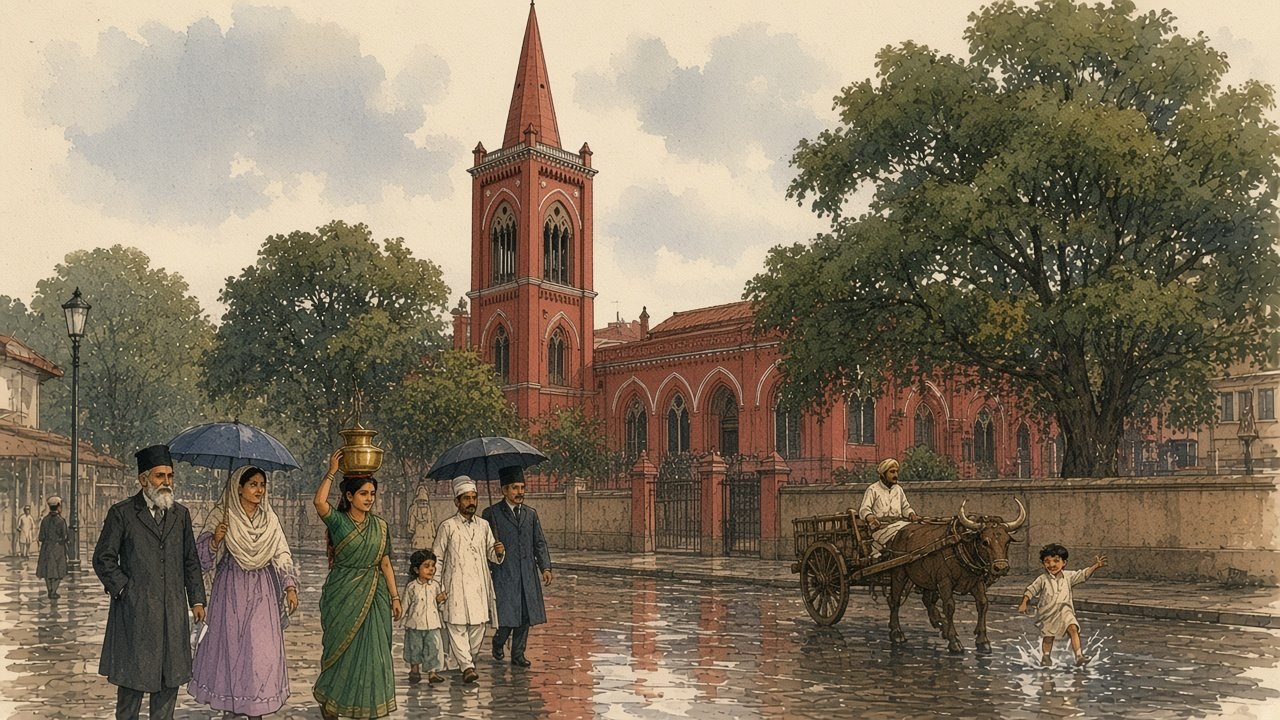
The first great Sassoon building in India was a synagogue. In 1861 David Sassoon built the Magen David Synagogue in Byculla, the district north of the Fort where the family first lived and where many of the Baghdadi Jews of Bombay settled around them.[1][2] An account published for the 125th anniversary of the family’s other great Bombay synagogue, Keneseth Eliyahoo, describes Magen David as a large synagogue “built in the spacious style of Victorian architecture” in extensive grounds, “fronted by pillars and a clock tower.” Inside it kept the arrangement of the synagogues of Baghdad, with a central tebah for the reader, a hekhal for the Torah scrolls and a spacious women’s gallery. Its prayers followed the Baghdadi rite.[3]
The synagogue was a statement about the community the Sassoons meant to lead. The Bene Israel, the older Marathi-speaking Jews of the Konkan coast, had their own prayer houses in Bombay. Magen David was built for the Arabic-speaking Baghdadis, many of them employees of the family firm. Beside it David built an elementary school in the same compound, “to provide an education for the community’s children in Torah and proper behavior.” His grandson Jacob later expanded it into a high school, which was renamed the Sir Jacob Sassoon Free High School.[3] According to the same account, the synagogue and school grounds became in effect a community centre for the Jews of Byculla, where young and old met in the evenings.[3] The synagogue is still in use. With Keneseth Eliyahoo in the Fort and Ohel David in Pune, it is one of the three synagogues managed by the Sir Jacob Sassoon Trust.[4]
A school and a reformatory
The Jewish Encyclopedia lists a remarkable range of institutions that David Sassoon founded or endowed in Bombay. For his own community he established a Talmud Torah school, and he supported an institution for teaching English, Arabic and Hebrew, which closed in 1901.[5] The Dictionary of National Biography names his principal Jewish school as the David Sassoon Benevolent Institution, “a school for Jewish children.” His son Albert later maintained it as “a school affording instruction to many hundreds of Jewish children.”[5][6]
His charity was not confined to Jews. Among his public institutions the Jewish Encyclopedia counts the Sassoon Reformatory and Industrial Institution for Juvenile Offenders, which it calls one of the most important. The Dictionary of National Biography describes the same foundation as “an industrial school and reformatory.”[5][6] The official Gazetteer of Bombay City and Island, published in 1909–10, gives the reformatory’s history. It began in 1843 as a school of industry that Dr Buist founded near his house at Sewri, meant both to reform juvenile offenders and to improve the industrial arts. In 1856 its committee applied to the government for aid. While the request was still being considered, the Sassoon family offered to deposit 30,000 rupees in the government treasury and to provide premises for a juvenile reformatory. In return the government was to pay a sum equal to the interest on the deposit and lend an engineer as superintendent. The arrangement was approved, and in 1857 the school moved to Chunam Kiln Road as the David Sassoon Industrial and Reformatory Institution.[7] Half a century later its boys were taught English and the Indian vernaculars and were drilled. They also learned carpentry, carriage-building, painting, brass-moulding and wood and iron turning. By then the city had grown up around the school, and the government had bought land at Matunga to move it further out.[7]
He gave to the Sailors’ Homes in Bombay and Hong Kong, to famine relief and to the relief of the Lancashire mill workers.[5] The Encyclopaedia Judaica sums up the range: hospitals, orphanages, libraries, museums, schools and charitable organisations in Bombay “owe their existence to Sassoon’s munificence and generosity.”[1]
The Mechanics’ Institution
The best known of David Sassoon’s Bombay foundations is now a library. In 1847 the foremen mechanics of the Mint and the Government Dockyard had founded the Bombay Mechanics’ Institution, to build up a library and a collection of mechanical models and to hold a yearly course of lectures on scientific and literary subjects.[7] Shortly before his death, the Jewish Encyclopedia records, David Sassoon set aside “a large sum for the erection of a Mechanics’ Institution at Bombay, which is called by his name.”[5] The Dictionary of National Biography adds that Albert joined his father in contributing more than £12,000 to the institute.[6] The Gazetteer fills in the arrangement. The government gave the society a plot of 1,485 square yards on the Esplanade at a nominal rent of one rupee a year and promised a grant towards the building. The fund was swelled by the 20,000 rupees left over from the subscription for a statue of David Sassoon, matched by a further government grant. Sir Bartle Frere, the governor, laid the foundation stone on 21 February 1867, and the society took possession on 24 March 1870. In 1870 Albert gave 4,500 rupees for bookshelves and furniture, and in 1873 he gave the clock that is still the chief feature of the front gable. In 1885 another member of the family, S. E. Sassoon, gave a further 5,000 rupees.[7]
The building, on what was then the Esplanade at the southern edge of the Fort, was put up between 1867 and 1870. The Gazetteer records that it was erected by the Public Works Department to the designs of Scott, McClelland & Co.[7] It now stands in the Kala Ghoda district as the David Sassoon Library and Reading Room, a Victorian Gothic building of arches, louvred windows and Minton tiles. A sixteen-month restoration led by the conservation architect Abha Narain Lambah began in February 2022, and the library reopened to the public in June 2023.[8] Inside it is David Sassoon himself. After his death a public meeting at the Bombay Town Hall on 13 December 1864, presided over by the governor, voted a memorial. The result was a statue by the sculptor Thomas Woolner, erected in the Mechanics’ Institute in 1870.[5][6]
The family’s gifts also reached the city’s museum. The Jewish Encyclopedia says that the citizens of Bombay placed a marble bust of David Sassoon in the Victoria and Albert Museum, to which he had presented an illuminated clock tower. It calls the erection of a statue of Albert, the Prince Consort, “his last public act.”[5] The Dictionary of National Biography gives the statue of the Prince Consort in the museum to Albert Sassoon instead.[6] The Gazetteer of 1910 supports the first version. It describes the marble statue of the Prince Consort by Noble in the museum as “presented by Mr. David Sassoon” and erected in 1864.[7] The museum stood in the Victoria Gardens at Byculla, and among the gardens’ features the Gazetteer lists another Sassoon gift, the David Sassoon clock tower and fountain. The tower is in the Palladian style and sixty-seven feet high. It cost 51,653 rupees, of which David Sassoon gave 30,000.[7]
Poona, its hospital and Ohel David
Poona, the modern Pune, was the hill station of the Bombay Presidency, where the government and wealthy families went to escape the heat and the monsoon of the coast. David Sassoon had his summer residence there, and it was there that he built his most personal monuments.[5][1]
The first was a hospital. The Jewish Encyclopedia records that the General Hospital at Poona was founded in 1863 “for all castes and creeds.” The Encyclopaedia Judaica calls the David Sassoon Hospital “noteworthy for its nonsectarian character.”[5][1] According to the Hindustan Times, its foundation stone was laid in 1863 and it opened in 1868. A century later, the President of India, Zakir Husain, visited Pune for the hospital’s centenary celebrations and laid a wreath on its founder’s tomb.[4] David also built and endowed an asylum for the infirm in the city, and the Encyclopaedia Judaica adds a leper asylum.[5][1]
The second was a synagogue. Ohel David, the “Tent of David,” stands in the Camp area of Pune. Its foundation stone was laid in 1862 and it was inaugurated in 1867, three years after its founder’s death.[4] The Encyclopaedia Judaica singles out its ninety-foot spire as a landmark of the city.[1] In Pune it is popularly known as Lal Deval, the Red Temple.[4] When Pune marked the synagogue’s 160th anniversary in December 2024, the building and David Sassoon’s tomb were added to Maharashtra’s Jewish heritage tourism circuit. The trust that announced the change, the Sir Jacob Sassoon Trust, still manages the synagogue.[4]
David Sassoon was buried there. The Encyclopaedia Judaica describes his mausoleum in the synagogue courtyard, with “a long Hebrew inscription in both prose and poetry.”[1] The Jewish Encyclopedia printed a photograph of it under the caption “Tomb of David Sassoon, Puna, India.”[5] For a man who had arrived in western India as a refugee three decades earlier, a Gothic synagogue and a hospital for every caste was a remarkable thing to leave behind.
The Pune institutions also show the pattern that the rest of this history follows. The Sassoons built for their own community first: synagogues, Hebrew schools and housing for poor Jews. They also built, on a larger scale, for the city around them. Their hospitals, libraries and docks were offered to everyone, and in time they became more familiar to the people of Bombay and Pune than the family that paid for them.
References
OpenClose
- “Sassoon,” Encyclopaedia Judaica, 2nd ed. (Detroit: Macmillan Reference, 2007), reprinted at Encyclopedia.com *
- Sir Jacob Sassoon Synagogues and Allied Trusts, “Synagogues” *
- “The Kenesseth Eliyahu Synagogue,” Midrash Ben Ish Hai, “Jews of India” pages *
- “Ohel David Synagogue and David Sassoon Tomb join Maharashtra’s Jewish Heritage Tourism Circuit,” Hindustan Times, December 2024 *
- Joseph Jacobs, Goodman Lipkind and J. Hyams, “Sassoon,” Jewish Encyclopedia, vol. 11 (New York: Funk and Wagnalls, 1906), pp. 66–68 *
- E. I. C., “Sassoon, Sir Albert Abdullah David (1818–1896),” Dictionary of National Biography, vol. 50 (London: Smith, Elder, 1897), pp. 312–313 *
- S. M. Edwardes (comp.), The Gazetteer of Bombay City and Island, vol. 3 (Bombay: Times Press, 1910) *
- Kala Ghoda Association, “Restoration Projects: David Sassoon Library” *
The family tree, timeline, places, glossary and select bibliography for the whole history are on the Sassoon index page.